Are you trying to decide whether the Instagram partnership program is a real B2B lead source, or just another influencer idea that looks useful until you try to apply it in an industrial market? That's the wrong question to start with. The better question is whether Instagram's branded-content tools can fit into a measurable lead-generation system for a manufacturer, machine shop, or technical service firm.
For industrial businesses, the confusion usually starts with the phrase itself. The term Instagram partnership program is used inconsistently, and that creates avoidable uncertainty for small businesses trying to figure out what setup they require, whether that's creator tagging, branded content workflows, or partnership ads managed through Meta tools (Trustt). If your team already uses systems for CRM, automation, or handoff between marketing and sales, it's worth comparing this channel the same way you'd evaluate marketing automation strategies for agencies, with process, tracking, and ownership in mind.
If you want a broader baseline on channel fit, we also cover the role of social media for lead generation in a more general B2B context. The point is simple, if a partnership can't be tied to audience fit, qualified traffic, and a sales outcome, it's not a system. It's a post.
Table of Contents
- Is the Instagram Partnership Program Right for Your Business
- What Is the Instagram Partnership Program Exactly
- How to Set Up and Run a Branded Content Partnership
- Practical Instagram Partnerships for Manufacturers
- How to Measure the Real ROI of Your Partnerships
- A Go-No-Go Checklist for Your First Campaign
Is the Instagram Partnership Program Right for Your Business
The first diagnostic question is not whether Instagram is trendy. It's whether your buyers can be reached through creators, educators, or niche industry voices who already have your audience's trust. If your product is highly visual, technical, or benefits from demonstration, this channel can fit into the top of a B2B funnel. If your offer is hard to explain without a long sales cycle and technical proof, partnerships only work when they're tightly targeted.
What this channel is actually good for
The strongest use case is not mass reach. It's controlled access to an audience that already pays attention to a trusted voice in a niche. That matters in industrial marketing, where a respected engineer, trade creator, or specialist publication can carry more weight than a larger but irrelevant creator.
Practical rule: if the audience match is weak, the partnership is usually weak, no matter how polished the content looks.
This is also where the operational side matters. If you're mapping creator campaigns into a repeatable process, it helps to think in systems, not one-off posts. The same mindset that drives CRM hygiene, lead routing, and reporting should drive partnership selection and follow-up.
When to say no
You should probably pause if you can't answer these questions clearly.
- Who is the buyer? Not “everyone in manufacturing,” but the specific role, plant type, or technical niche.
- What action matters? A demo request, spec sheet download, or contact form submission, not just likes.
- Can the product be shown quickly? If the value only appears after a long sales conversation, Instagram may not carry enough weight on its own.
- Do we have someone credible to feature? A real operator, engineer, or trade voice usually beats a broad lifestyle creator.
If those answers are fuzzy, the channel is probably premature. If they're clear, the next question is how the system works.
What Is the Instagram Partnership Program Exactly
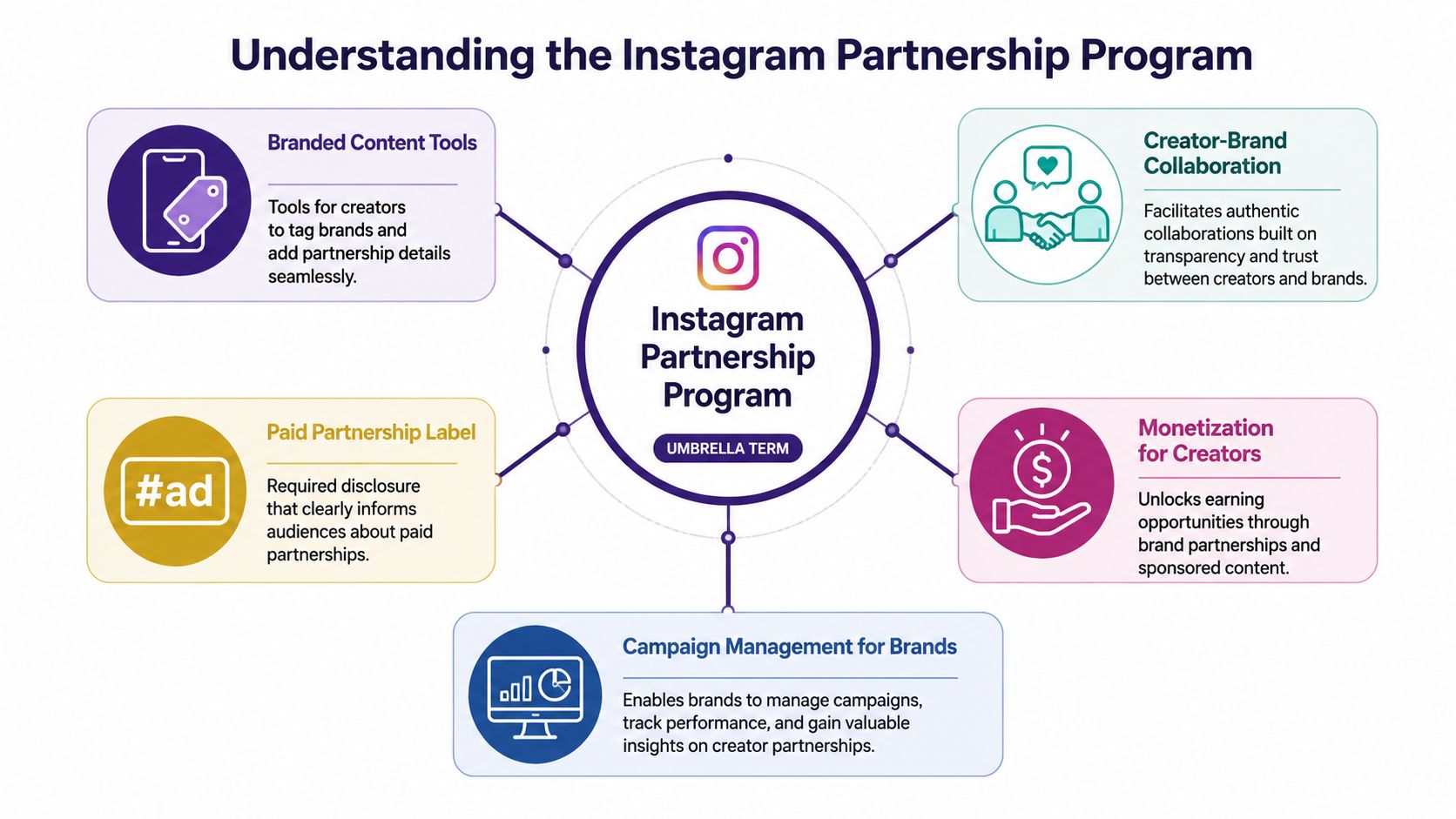
The clearest way to think about the Instagram partnership program is as an umbrella term, not a single club you join. It's a set of branded-content tools that let creators tag business partners so the collaboration is disclosed inside Instagram, which makes the content easier to identify and manage. The paid partnership feature was launched in 2017 to increase transparency around sponsored posts, and that move shifted sponsored content from informal promotion to a native disclosure system that can support measurable branded media buying (Sked Social).
The label, the tools, and the ad format
There are three pieces to separate in your head.
- Paid Partnership label: this is the disclosure that appears at the top of feed posts or Stories, so viewers can see the content is branded.
- Branded content tools: these are the workflow features creators use to tag a business partner and enable collaboration.
- Partnership ads: this is the paid media layer, where the brand can reuse creator content as a promoted ad asset through Meta's workflow.
That distinction matters because a tagged post and a scaled ad are not the same thing. A tagged post is useful for authenticity and native reach. A partnership ad turns that same asset into something you can target, measure, and expand like paid social.
Why the distinction matters for B2B
For a manufacturer, the value is not the label itself. The value is what happens after the label makes the content eligible for controlled media buying. When the creator content can be reused as a paid asset, the marketing team can connect it to a landing page, lead form, or product page instead of leaving it as a one-off post.
The other practical issue is account type. Partnership ads are only available for content shared from a professional Instagram account or professional Facebook page, and personal accounts are not eligible (StrikeSocial). To use branded content tools, the creator needs a creator or business account, branded content must be enabled in settings, and one setup guide says the status should show as Eligible after setup (Reshift Media).
If you want the shortest possible definition, this is it. The program is not a membership. It's a branded-content system that supports disclosure, approval, and paid amplification.
How to Set Up and Run a Branded Content Partnership
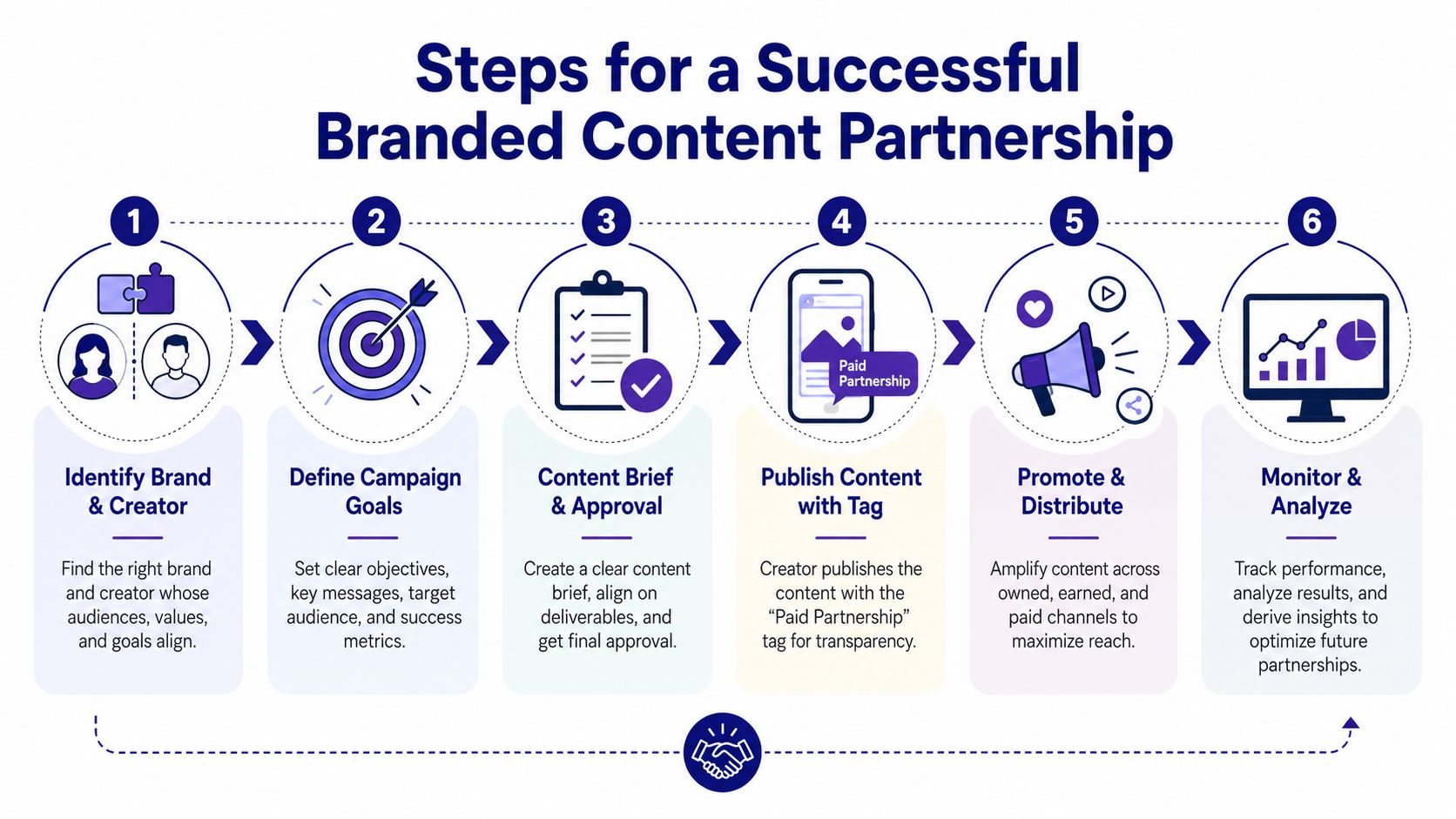
A clean partnership workflow starts before anyone posts. The creator has to use a professional account, enable the paid-partnership label, and grant promotion permission. Once that's done, the brand can launch the same asset as a paid ad inside Ads Manager using the partnership setup, which is how creator content becomes a controlled media object rather than a one-off organic post (CreatorlaneHQ).
The creator side comes first
The creator has to make the content eligible before the brand can do anything useful with it. If that step is skipped, you'll get delays, approval confusion, or a post that can't be promoted the way you intended.
The cleanest workflow is always creator setup first, brand approval second, promotion last.
That's why the handoff should be documented. We'd treat it like any other SOP, with a checklist that includes account type, branded-content status, content approval, and promotion permission. If your team already manages video assets or repurposing workflows, a practical guide like how to record videos for Instagram becomes particularly useful, because bad framing or poor lighting can make an otherwise strong industrial product look disposable.
The brand side happens in Ads Manager
Once the creator has enabled the right permissions, the brand uses the partner's ad code or post info in Meta Ads Manager to identify the exact post being boosted. That matters because it removes ambiguity about which asset is being promoted and keeps the workflow tied to a specific creator post rather than a vague collaboration.
A few setup habits help avoid friction:
- Confirm account eligibility early: only professional accounts qualify for partnership ads.
- Approve content before publishing: don't rely on last-minute edits after the creator goes live.
- Store the ad code in one place: your media buyer or campaign owner should be able to find it fast.
- Build the landing page first: if the post drives to a dead-end homepage, the campaign will underperform.
If you need outside support, one option is using a creator marketplace or relationship platform such as amplify social presence with creators, but the key factor is whether your workflow is documented and your asset tracking is clean. Without that, the partnership stays tactical instead of becoming repeatable.
Practical Instagram Partnerships for Manufacturers
For manufacturers, the best partnerships usually look nothing like mainstream influencer campaigns. Think less celebrity, more credibility. A machine shop might work with a respected engineer who reviews tooling, a parts manufacturer might sponsor an educator who shows machine setup, or a trade publication might publish a short series of technical explainers that later get boosted as partnership ads.
The reason this works is simple. Industrial buyers tend to trust people who already live close to the problem. A creator who speaks to machinists, maintenance teams, plant supervisors, or procurement-adjacent operators can do more for qualified attention than a broad creator with a larger but disconnected audience.
Vetting beats follower count
The strongest guidance here focuses on community quality, selective brand alignment, and whether the creator's audience matches the brand's audience, not raw size (Superfiliate). That's the right lens for B2B, because follower count alone doesn't tell you whether the audience includes buyers, specifiers, or people who influence purchasing decisions.
Look at the creator like you'd evaluate any sales channel partner.
- Posting cadence: are they active enough to maintain attention?
- Prior brand partnerships: do the collaborations make sense, or do they feel random?
- Audience fit: does the audience look like the people you sell to?
- Controversy history: is there anything that could create reputational risk?
- Content style: do they explain technical topics clearly, or just entertain?
That last point matters. An industrial audience usually responds better to clarity than hype. If a creator can show a tool in use, explain a workflow, or break down why a part matters, the content has a better chance of supporting lead quality.
What a good fit looks like
A good partner is often someone small enough to stay credible and specific. A local machining educator, a technical trade page, or a niche engineer with a focused audience can be more effective than a general industrial influencer with mixed interests. The goal isn't fame, it's relevant attention.
This is also where you should be careful with campaign design. If the content is purely awareness-driven, the sales team may not see meaningful leads. If the content is too technical without a clear next step, the audience may watch but never act.
The best practical setup is usually a narrow audience, a narrow offer, and a narrow landing page. For example, one post can point to a spec sheet, a demo request, or a short application form instead of a generic homepage. That keeps the campaign aligned with how industrial buyers move.
How to Measure the Real ROI of Your Partnerships
By 2026, partnership campaigns are being evaluated with performance metrics, not just follower count. Guidance in the provided source says an engagement rate above 3% is considered excellent, ROI is typically assessed over 4-12 weeks, and strong partnerships can generate 300-500%+ ROI (InfluenceFlow). Those figures matter less as promises and more as reminders that this channel should be judged over a real sales window, not a weekend.
What to measure for B2B
If you're selling industrial products or services, vanity metrics won't tell you enough. You need to know whether the campaign produced a qualified action.
Track these outcomes instead:
- Website clicks: especially clicks to a spec sheet, quote form, or product page.
- Lead form submissions: this is the clearest first-step conversion.
- Demo requests: strong signal if the product needs explanation.
- Qualified lead quality: did the prospect fit the target industry or role?
- Sales follow-up response: did the lead respond, or disappear after intake?
Practical rule: if your report ends with impressions and likes, you're measuring exposure, not demand.
Make tracking boring and consistent
Your reporting stack should be simple enough that the team uses it. Put UTM parameters on every partnership link, send traffic to a dedicated landing page, and make sure the form fields match your sales criteria. If you're reporting through a structured dashboard, a developer guide for social media APIs can help your team think about consistent attribution, especially when creator content gets reused in more than one placement.
Here's the trade-off. A partnership can look strong on engagement and still fail if the audience isn't buying. That's why the reporting window matters. Industrial buying cycles rarely finish in a few days, and the campaign should be judged against a lead quality timeline, not just early clicks.
A useful internal benchmark
If you want to stay disciplined, compare each partnership against the same questions every time.
- Did it drive the right kind of traffic?
- Did sales accept the leads?
- Did the campaign justify the creator cost and media spend?
- Did the asset hold up when reused in paid distribution?
That last question is often overlooked. A creator post that performs organically may still be the wrong asset for a paid campaign. The paid version has to earn attention, click-through, and downstream action, not just comments.
A Go-No-Go Checklist for Your First Campaign
Use this as a final filter before you spend time and money.
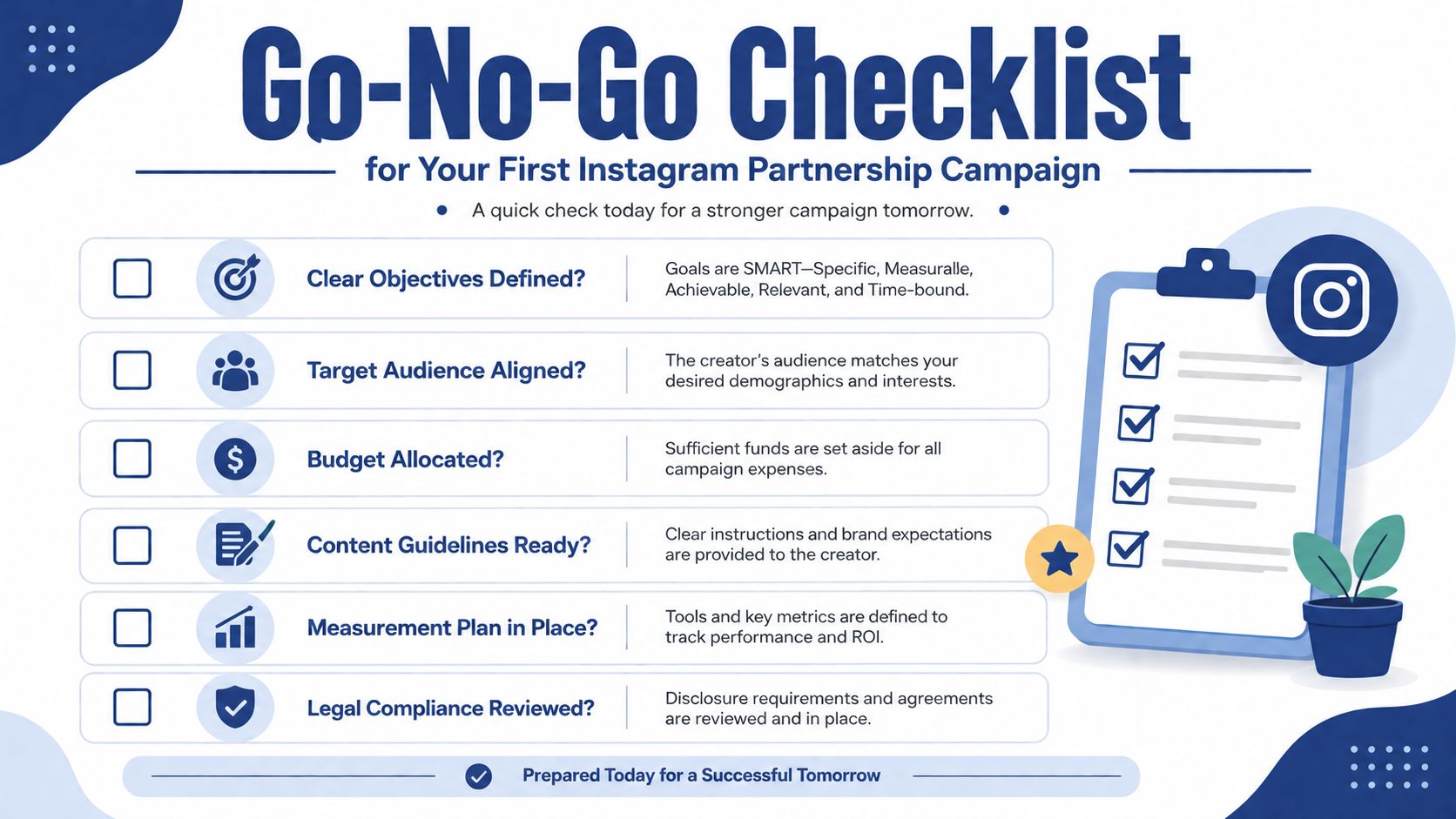
Ask these six questions
- Clear objectives defined? Your goal should be specific enough to review later against actual sales activity, not just engagement.
- Target audience aligned? The creator's audience should resemble the buyers you want to reach.
- Budget allocated? You need room for content creation, media spend, and testing.
- Content guidelines ready? The creator should know what to show, what to avoid, and what action to drive.
- Measurement plan in place? Tracking should be set before launch, not after.
- Legal compliance reviewed? Disclosure and approvals need to be handled cleanly.
If you can't answer those with confidence, the campaign is probably too early. If you can, you've got the bones of a testable system.
The key decision isn't whether Instagram is for consumer brands. It's whether you can turn creator trust into measurable B2B demand without losing control of the process. If that's the problem you're facing, Machine Marketing can help you diagnose the gap, map the workflow, and decide whether an Instagram partnership belongs in your lead-generation system.