Zero-party data is information a customer intentionally shares with a brand, and it gives you direct intent instead of guesses. For manufacturers, that matters because project-based sales depend on knowing who's serious, what they need, and when they're ready, not just who happened to click a page.
If you've ever had a rep start Monday with a pile of leads that looked promising on paper but went nowhere in the CRM, you already know the problem. A catalog download, a trade show badge scan, or a form filled out by the wrong person can waste time fast when your deals involve engineers, buyers, and specifiers making decisions over months, not minutes. Zero-party data gives you a cleaner signal from the start.
Table of Contents
- The Lead You Cannot Read and Why That Hurts
- What Zero Party Data Actually Means
- Zero Party Data vs First Second and Third Party Data
- Why Zero Party Data Fits Manufacturing Sales Cycles
- How to Collect Zero Party Data and Wire It Into Your CRM
- Measuring the Impact and Proving the ROI
- Common Pitfalls and How to Dodge Them
- Putting Zero Party Data to Work in Your Shop
The Lead You Cannot Read and Why That Hurts
Monday morning looks productive until you open the lead queue. You've got volume, but most of it doesn't match your sales motion, and your team spends the week sorting signal from noise instead of moving real opportunities forward.
Why behavioral clues fall short
Manufacturing buyers don't always raise their hand in a straight line. An engineer may browse a spec sheet, a procurement lead may compare vendors later, and a plant manager may never touch your site until a project is almost approved. Behavior tells you that someone looked, but not always why they looked or whether they matter.
That gap gets expensive when the buying group is large and the decision path is technical. A junior staffer can fill out a form, a consultant can request information on behalf of a client, or a visitor can leave before you learn the application, timeline, or role. Your CRM records activity, but activity alone doesn't tell you if the account is worth a rep's afternoon.
Practical rule: if your team can't answer “what project is this for?” or “who is the decision maker?” from the lead record, you don't have enough intent data yet.
That's the diagnosis. You're not short on contacts, you're short on declared context. Zero-party data is the missing input because it comes from the prospect directly, at the moment they choose to tell you something useful.
What Zero Party Data Actually Means
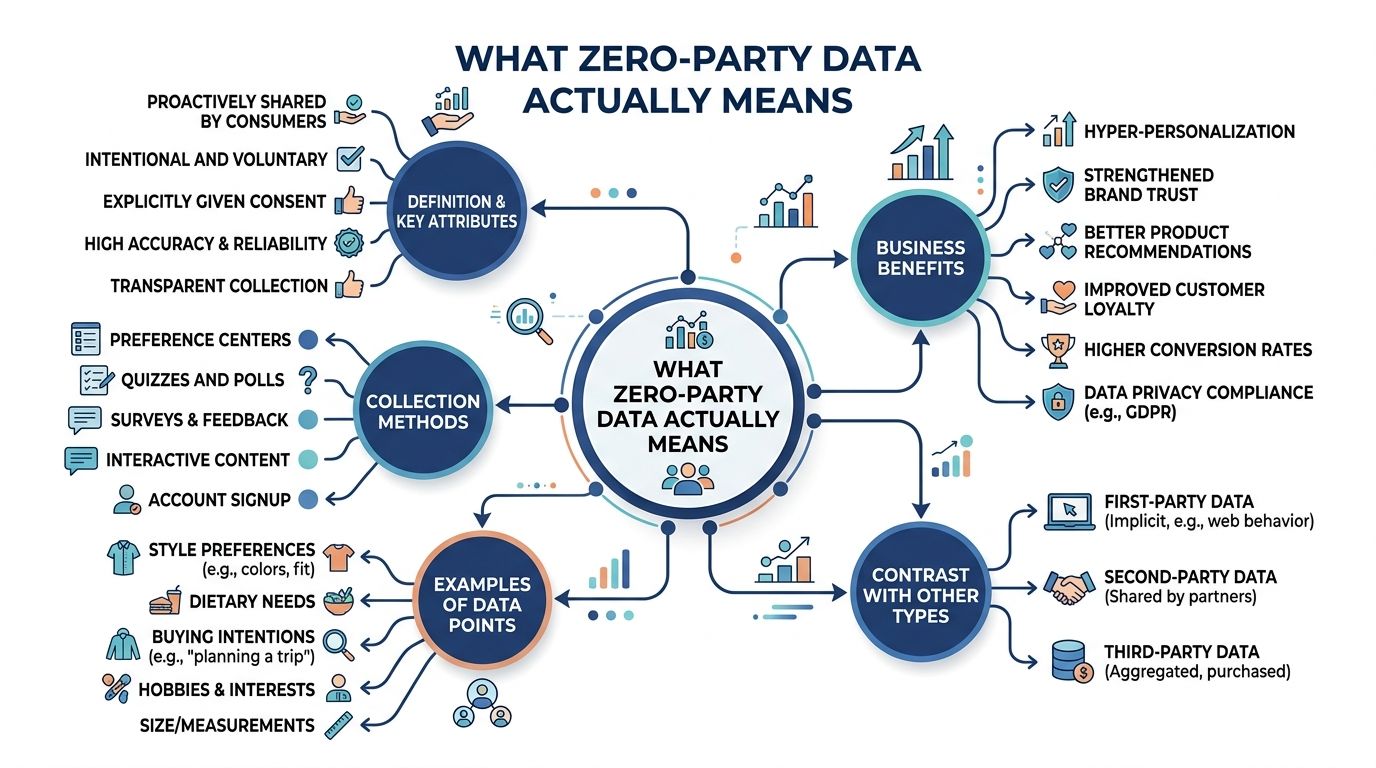
Zero-party data is information a customer intentionally and proactively shares with a brand. The term is credited to Forrester Research, which defined it as details such as preferences, purchase intentions, personal context, and how the person wants to be recognized. That definition matters because it draws a clean line between what you observe and what the customer tells you.
A project brief, not a guess
Think of it this way. A salesperson looking at page views is reading footprints in the hallway. A buyer filling out a project brief is handing over the map. In manufacturing, that might be an RFQ form, a product selector, a quote request with application details, or a trade show conversation captured through a short follow-up survey.
The difference is control. With zero-party data, the customer chooses what to share, and you know exactly where the signal came from. That's why it became important during the shift toward privacy-first marketing, as brands looked for alternatives to inferred behavior and cookie-dependent targeting.
Two examples that make it concrete
A buyer who selects “need a quotation for a line upgrade this quarter” has given you far more usable context than a visitor who downloaded a brochure. A maintenance manager who chooses a preferred contact method and states a downtime pain point has told you how to follow up without guessing.
The key is that zero-party data is volunteered, not inferred. You're not scraping browsing history or reverse-engineering clicks. You're collecting explicit answers through opt-in interactions, which makes the information cleaner for personalization and CRM use.
Zero Party Data vs First Second and Third Party Data
A lot of confusion clears up once you place zero-party data inside the full data stack. Each type has a different source, a different level of consent, and a different job in your marketing system.
| Data Type | Source | Consent | Accuracy | Manufacturing Use Case |
|---|---|---|---|---|
| Zero-party data | Customer states it directly | Explicitly given by the user | High for declared preferences and intent | RFQ qualifiers, project timing, spec intake, role selection |
| First-party data | Your owned channels and observed behavior | Typically collected through site use or transactions | Strong for behavior, weaker for intent | Page visits, repeat visits, quote history, CRM activity |
| Second-party data | Another brand's first-party data shared through a partnership | Depends on the partnership | Useful when the partner is trusted | Co-marketing lists, channel partner audiences, shared events |
| Third-party data | Aggregated from outside sources | Often least direct | Broad, but less specific | Audience expansion and enrichment, where allowed |
How the categories work in practice
First-party data is useful because it shows what people did on your site or in your CRM. Second-party data can broaden reach when a trusted partner shares their audience information. Third-party data can help with scale, but it's the least direct and is under more pressure as privacy rules tighten.
Zero-party data stands apart because the prospect says it themselves. If you want a deeper framework for using intent data effectively, it helps to treat zero-party data as the declared layer of your overall signal stack, not a replacement for everything else.
For manufacturers, the practical question is simple. Which data type tells you who is ready for a quote, who is still researching, and who needs technical follow-up now? That's where this category earns its place in your stack, alongside the rest of your CRM and marketing data, including the approach outlined in what is intent data.
Why Zero Party Data Fits Manufacturing Sales Cycles
Manufacturing sales don't behave like impulse purchases. Projects take time, buying groups are bigger, and the questions that matter are specific, technical, and tied to operational risk. That means the best data is the data a prospect gives you when the project is real enough to name.
The questions that actually move a deal
A consumer brand might ask about color or style. A manufacturer needs to know project timing, budget range, application requirements, equipment specs, downtime pain points, and who the decision maker is. Those answers help sales sort the account, route it correctly, and avoid wasting cycles on low-fit inquiries.
Behavioral data can degrade quickly in this environment. Engineers compare options, procurement reviews vendors later, and the buyer may stay invisible until the project is far enough along. Zero-party data captures intent at declaration, which is exactly when it's most useful.
That's why it works so well for B2B and industrial marketers. It can reveal product interests, buying timelines, role-based needs, and communication preferences directly from prospects, which makes segmentation and lead nurturing more precise than relying on behavioral inference alone. That same logic is why a five-question project qualifier often outperforms a long, generic contact form.
A simple example from the shop floor side
A custom machine shop doesn't need ten fields just to start the conversation. It needs enough information to know whether the inquiry is real, who owns the project, and what problem needs solving. A short qualifier can do that better than a sprawling form that scares off good prospects.
Here's the pattern we see most often. Replace a “tell us everything” form with a narrow intake that asks only what the rep needs to prioritize follow-up. Then let the rest of the conversation happen in sales, not in the form builder.
The point isn't to collect more data. The point is to collect the right data at the moment the buyer is willing to share it.
How to Collect Zero Party Data and Wire It Into Your CRM
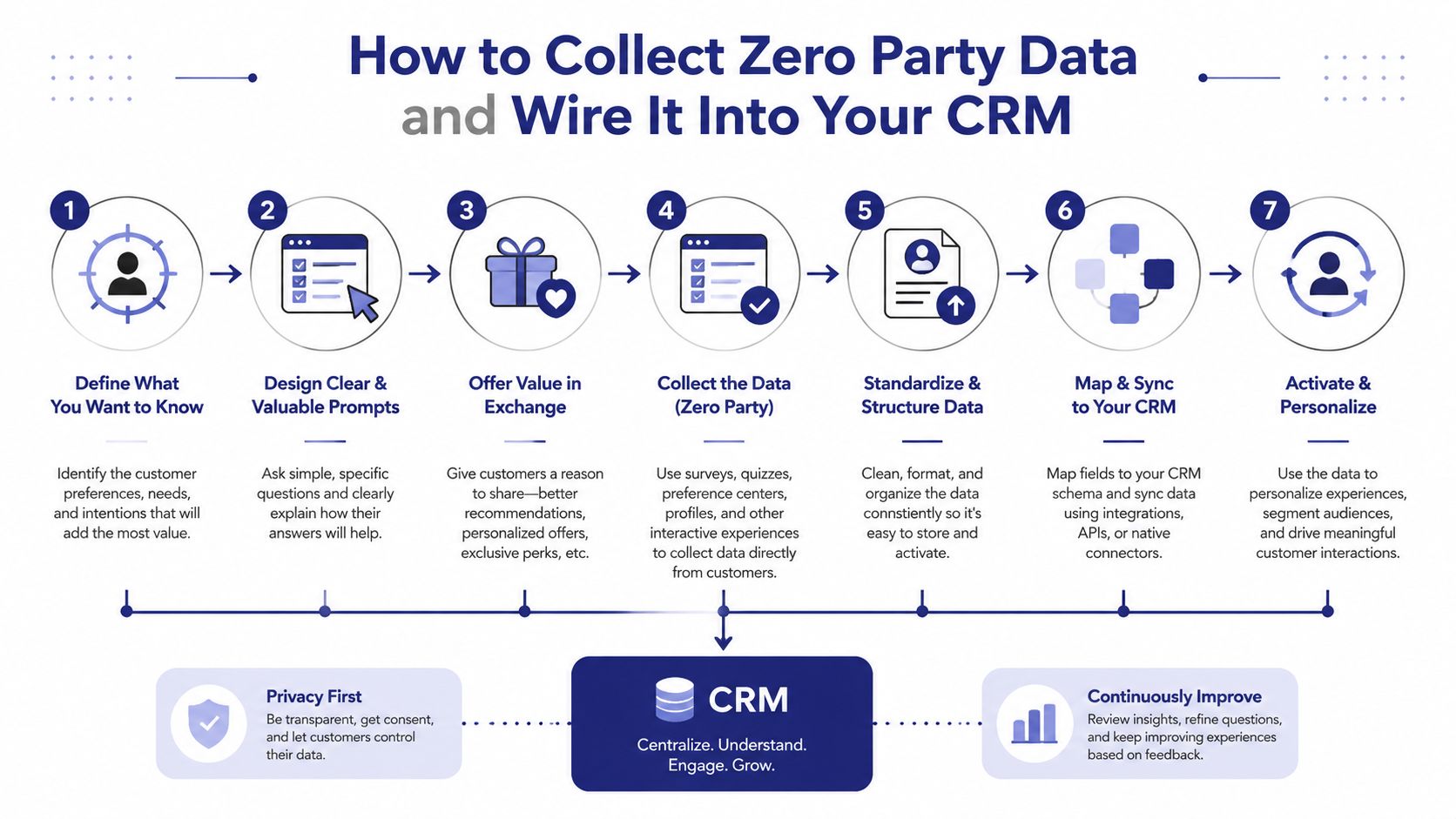
The collection method has to fit the sales motion, or people won't complete it. Manufacturers usually get the best results from short RFQ qualifiers, gated calculators, technical quizzes, preference centers, post-event surveys, and onboarding forms for new accounts. These work because they feel useful, not intrusive.
Keep the ask small
Many marketers recommend collecting only three to five initial data points in an interactive experience instead of building long forms. That's the right instinct for industrial sites too, because the prospect is more likely to finish when the exchange feels quick and relevant. Ask only what you need to route the lead and personalize the next step.
A practical set of fields might include project type, timeline, role, application, and preferred follow-up method. You don't need all of those on every form, but you do need a repeatable rule for what your team asks at each high-intent moment.
Wire it into the system, not just the form
Start by defining the fields you want inside the CRM. Then connect your form, quiz, or survey so the answers flow into contact records, list segments, and automation rules. If you're using a platform stack that includes HubSpot, GoHighLevel, or a similar CRM workflow, the goal is the same, get the declared data out of the form and into the system where sales can act on it.
A useful implementation sequence looks like this.
- Define the field list. Decide which answers matter for routing, prioritization, and follow-up.
- Build the short interaction. Keep the form, quiz, or survey narrow and relevant to the offer.
- Map the fields to CRM properties. Make sure every answer has a home.
- Trigger segmentation. Route high-intent leads to the right rep or nurture path.
- Confirm handoff. Sales should see the declared data before first contact.
- Review and refine. Tighten the questions if completion drops or the data is weak.
If your team needs a process layer to connect forms, tasks, and CRM updates, Wisely's monday.com services can be useful for building the operational handoff. The point is not the tool itself, it's making sure declared intent doesn't disappear between collection and sales follow-up.
Measuring the Impact and Proving the ROI
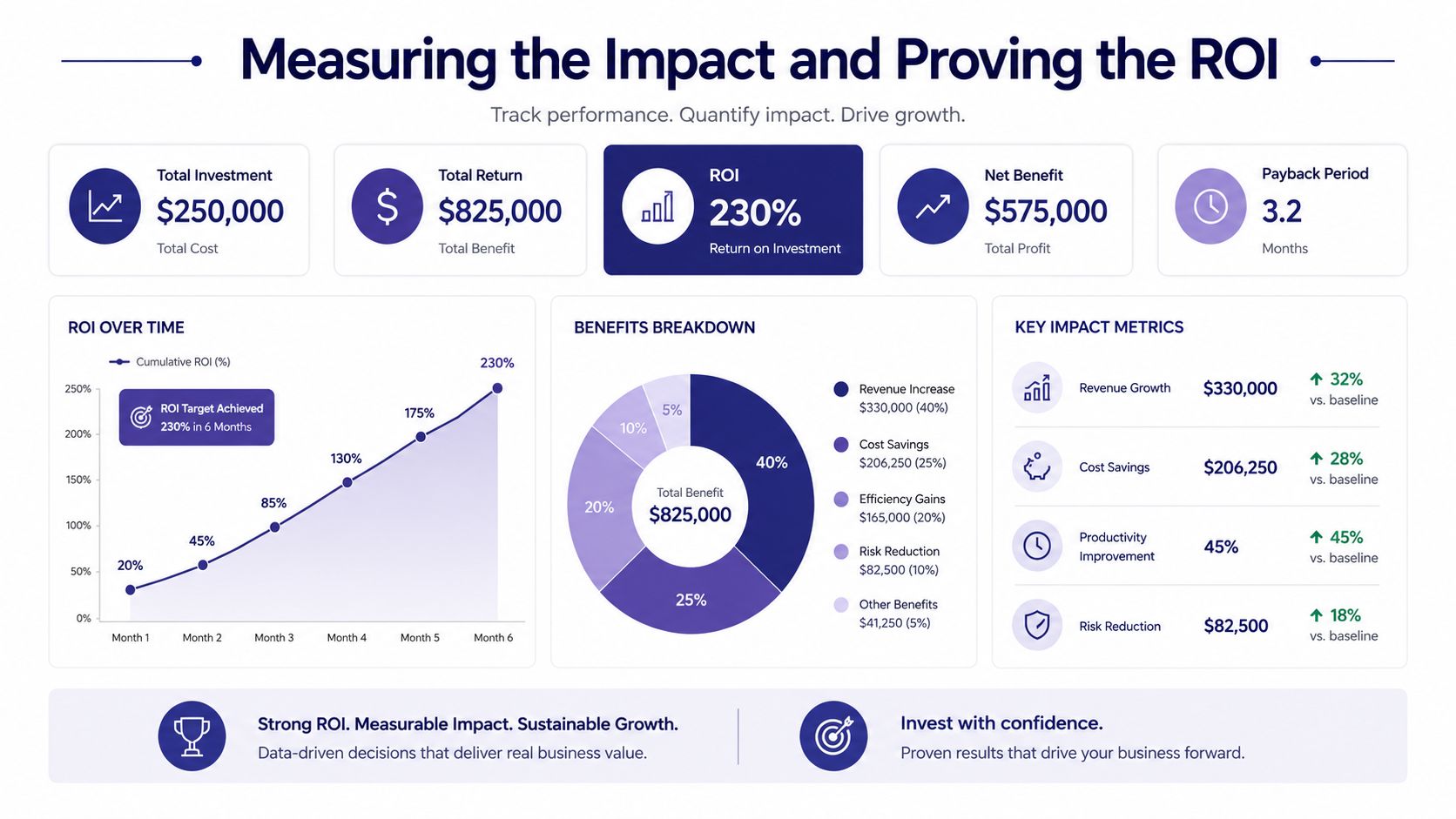
If zero-party data matters, it has to show up in business results. That means you measure it against lead quality, sales process speed, and revenue, not just form fills or quiz completions.
Start with the right KPIs
The best metrics are the ones that help a plant owner or sales director make a decision. Track lead-to-opportunity rate, sales cycle length, drop-off by form type, content engagement by declared preference, and revenue influenced by zero-party segments. Those numbers tell you whether the data is improving the pipeline or just creating activity.
Before rollout, baseline what your current forms and lead paths produce. Then check the same metrics after the system has had time to run, first at the 60-day mark, then again at 90 days, so you can compare like with like. You're looking for cleaner routing, better follow-up, and stronger fit, not just more submissions.
Tie declared data to closed-won revenue
The strongest proof comes from the CRM. When a deal is won, you should be able to trace the declared answers that shaped routing, nurture, or sales follow-up. That lets marketing claim contribution without leaning on vanity metrics.
A simple way to think about it is this. If the prospect told you they needed a line upgrade within the quarter, and the sales record shows that same project moved to proposal and closed, the declared data clearly helped move the opportunity forward. That's the kind of evidence leadership understands.
For a practical framework on this, use how to measure marketing ROI as your internal model and then add your zero-party fields to it. The combination shows not just that the campaign worked, but that the data you collected improved how the deal moved through the pipeline.
Common Pitfalls and How to Dodge Them
Most failed implementations don't fail because the idea is wrong. They fail because the system is sloppy, vague, or too ambitious for the buyer's patience.
The five mistakes we see most often
- Asking too many questions. Long forms scare off good prospects. Keep the first interaction short and only ask what you'll use immediately.
- Using vague consent language. If the prospect can't tell how you'll use the data, you create trust and compliance risk. Say plainly what happens next.
- Collecting data without routing it. If sales never sees the declared answers, the form becomes noise. Push the data into the CRM and trigger a workflow.
- Treating it like a one-time project. Zero-party data needs maintenance, not a launch date. Review fields, handoffs, and follow-up rules regularly.
- Ignoring the buyer behind the user. In B2B, the person filling out the form may not be the decision maker. Build your questions so they reveal the account context, not just the individual.
Use the right audit question
A broken setup usually shows itself fast. If your answer to any of these questions is weak, you've found the gap.
Can the sales team see the declared intent in the CRM before first contact?
If not, the system isn't wired correctly. If yes, check whether the questions you ask still match the information sales needs. The best setups stay short, clear, and directly tied to action.
Putting Zero Party Data to Work in Your Shop
Zero-party data gives you a cleaner way to understand serious buyers because the prospect tells you what matters, instead of leaving you to infer it. For manufacturers, that makes it especially useful in long sales cycles, technical evaluations, and buying groups where the person who fills out the form isn't always the final decision maker.
The playbook is straightforward. Use short, high-intent interactions, collect only the fields you'll use, push the answers into your CRM, and measure whether the data improves routing, follow-up, and revenue quality. If your current forms are doing all the talking and your sales team is still guessing, the system needs a better input.
Pick one high-intent moment this quarter, replace the long form with a five-question qualifier, and route the answers into your CRM. Then review the handoff with sales and tighten the workflow until the data is moving deals forward.
If you want help turning this into a working CRM system, Machine Marketing builds the strategy, form logic, and follow-up process that manufacturers need to make zero-party data useful. Visit Machine Marketing and use this topic as the starting point for a focused diagnosis of your current lead capture and CRM workflow.