Most manufacturers don't lose customers because the product suddenly got worse. They lose them because the business can't see the account clearly enough to protect it.
A service issue sits in one inbox, the renewal date lives in another, the salesperson knows the customer by heart, and operations has no clean record of the last quote. That's the problem customer relationship management in manufacturing industry has to solve. It's not a digital rolodex, it's the operating layer that keeps sales, service, and production pointed at the same customer.
Table of Contents
- Why Manufacturers Lose Accounts Without Realizing It
- CRM Adoption and Market Growth in Manufacturing
- Four Core Use Cases for Manufacturing CRM
- Connecting CRM to ERP and Shop-Floor Systems
- Rethinking CRM Success Metrics Beyond Lead Volume
- Vendor Selection and Implementation Roadmap
- Change Management and Team Adoption Strategies
- Your Next Steps for Building a Manufacturing CRM Strategy
Why Manufacturers Lose Accounts Without Realizing It
A mid-size machine shop can think it's doing fine right up until a long-time customer shifts repeat work to a competitor. The pricing wasn't wildly off. The quality wasn't the issue. The customer just got tired of repeating the same story to three different people while the renewal date, the last complaint, and the latest quote each sat in a different place.
That's the common failure mode. Sales thinks service is handling it, service thinks account management owns it, and operations assumes someone else has the customer context. By the time the loss shows up in revenue, the account already feels neglected.
Practical rule: if three teams can describe the same customer three different ways, the account is already at risk.
A useful way to think about this is through omnichannel coordination. Retailers learned long ago that customers don't care which department owns the interaction, they care whether the business remembers them. The BEDHEAD guide to omnichannel retail is a good reminder of that principle, even though manufacturing has a different buying cycle and a longer service tail.
Manufacturing CRM fixes the hidden leak by making the customer record visible across the business. When quoting, warranty history, service notes, and reorder timing all live in one place, the company can respond like one organization instead of a collection of disconnected functions.
What fragmentation looks like on the ground
The warning signs are usually boring, which is why they get ignored. A sales rep leaves and takes the customer context with them. A distributor asks for an update and gets a different answer from each department. A service tech closes a job without the issue ever reaching the account owner.
That kind of fragmentation doesn't just create annoyance. It creates churn risk, slower response times, and a steady erosion of trust. In manufacturing, trust compounds over time, and so does neglect.
CRM Adoption and Market Growth in Manufacturing
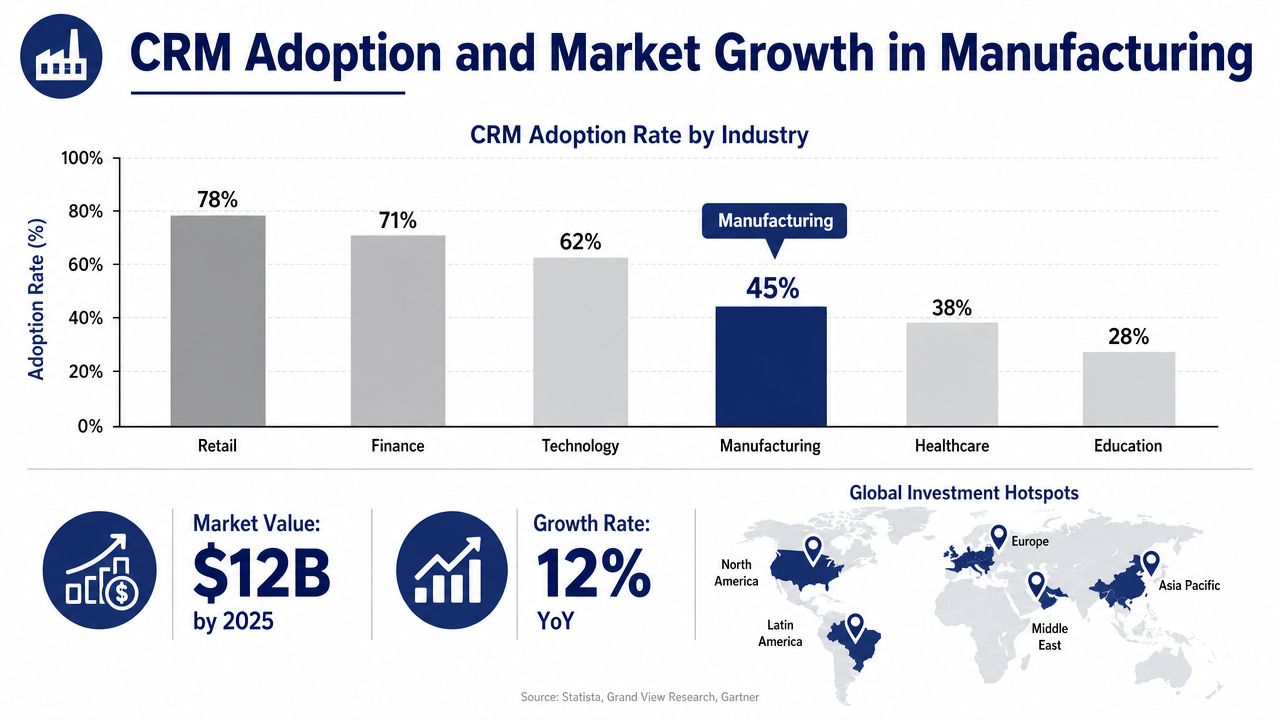
The market already tells us manufacturing isn't treating CRM as optional anymore. A manufacturing survey reported that 86% of manufacturing companies have adopted a CRM system, compared with 73% across all businesses. Another industry survey found 41.1% of respondents were either already using CRM or in the process of implementing it, and within that group, more than 70% of companies above $1 billion in revenue used CRM, versus 60% of companies in the $50 million to $1 billion range, according to the manufacturing CRM whitepaper from Manufacturing.net. That pattern matters because larger manufacturers tend to have longer sales cycles, more distributor touchpoints, and more post-sale service to coordinate.
The long view is just as clear. In 2009, CRM represented $116 billion of investment and employed 502,000 people in Canada across wholesale, manufacturing, finance and insurance, retail, and logistics/transportation sectors, a sign of how embedded relationship management already was in industrial commerce, according to the Canadian customer relationship management industry overview. More recently, the global CRM market was valued at $73.40 billion in 2024 and is projected to reach $163.16 billion by 2030, growing at a 14.6% CAGR from 2025 to 2030, also from that same Canadian industry source.
What the adoption data means for mid-market firms
The biggest manufacturers are not waiting around for perfect systems. They're building CRM into the operating model because they have to keep revenue, service, and planning aligned across more moving parts.
For mid-market firms, that creates a blunt choice. You can keep relying on spreadsheets and inboxes, or you can treat customer data as an operational asset. The firms that stay manual usually aren't smaller because they want to be. They're smaller because their systems can't support the next layer of complexity.
What the growth trend signals
The market growth isn't just software hype. It reflects a broader shift from scattered contact records to coordinated account management, service visibility, and retention work. In manufacturing, that shift matters because repeat orders and account expansion often carry more value than first-time lead capture.
Bottom line: the companies moving first are usually the ones with the most complexity, not the most patience.
Four Core Use Cases for Manufacturing CRM
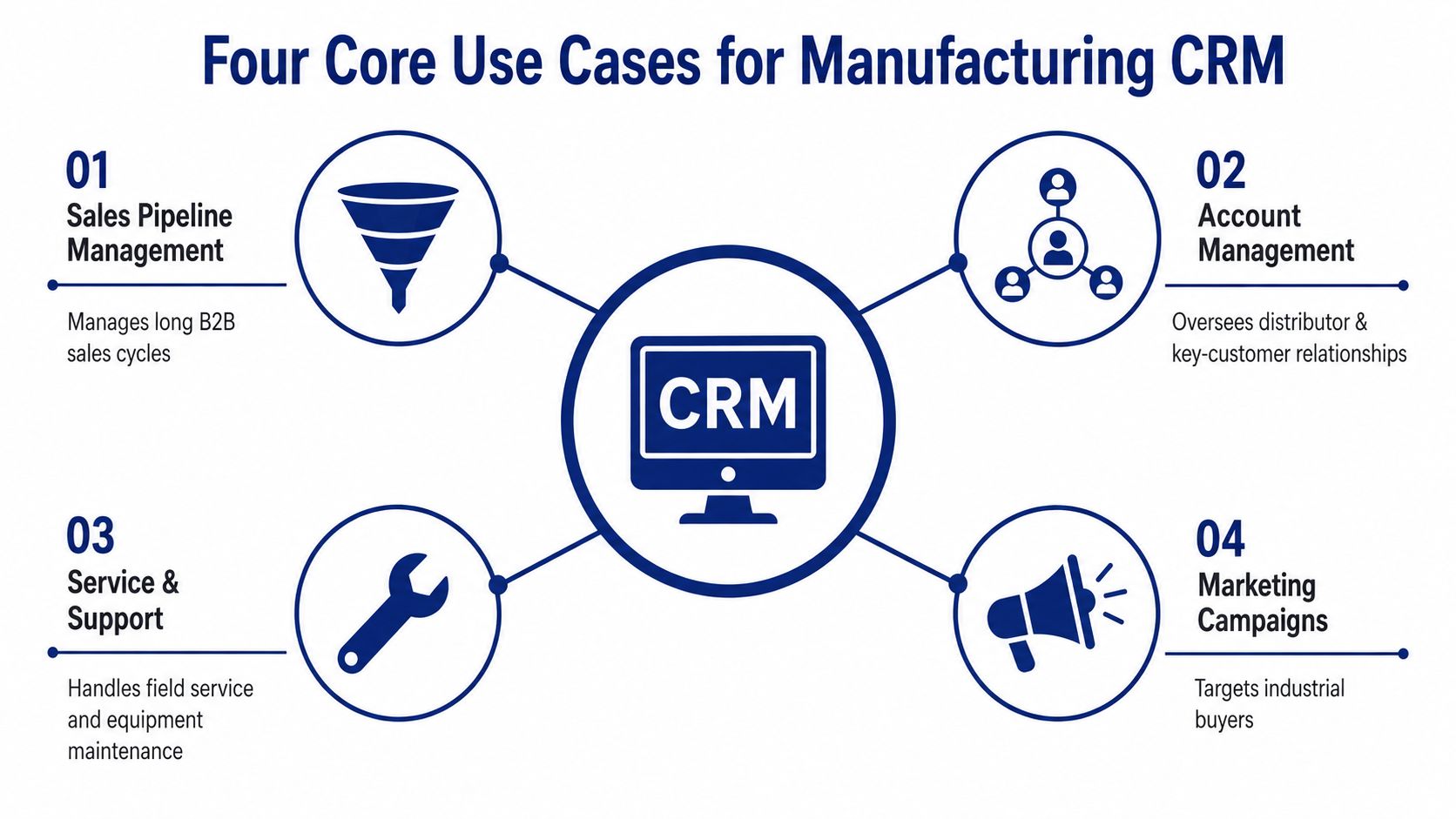
Manufacturing CRM works when it supports the work people already do, not when it adds another place to log notes. The four use cases that matter most are pipeline management, account management, after-sales service, and aftermarket parts or reorder management.
Sales pipeline management for long B2B cycles
Industrial buying doesn't move like ecommerce. One deal may involve engineering review, procurement, plant visits, and multiple revisions before a purchase order lands. CRM helps the sales team keep every stage visible so the next action isn't trapped in someone's memory.
This is also where a good cold email guide can help teams build cleaner prospecting habits, especially when they need to document outreach and follow-up discipline instead of relying on one-off messages.
Account management for distributors and key customers
A manufacturer's best accounts often depend on relationships that span years, not quarters. CRM gives account managers a place to track distributor communication, decision-maker changes, quote history, and service commitments without forcing them to search through email threads.
Service and support after the sale
Many systems fail at this point. A service ticket triggered by a machine fault should not start from scratch. The technician needs to see purchase history, warranty status, prior work, and the last few interactions before picking up the phone.
What works: one customer record that connects service, equipment, and account history.
What doesn't: forcing technicians to reconstruct the story from memory or separate apps.
Aftermarket parts and reorder management
For mature accounts, CRM should help spot repeat demand, parts replacement patterns, and renewal timing. That doesn't mean turning CRM into an ERP replacement. It means giving the commercial team a live view of account behavior so they can anticipate reorder opportunities instead of guessing.
For teams that want a practical primer on outbound follow-up structure, the Rite NRG article on SaaS customer retention strategies is useful because the logic of keeping accounts warm often translates well, even though the customer type is different.
Connecting CRM to ERP and Shop-Floor Systems
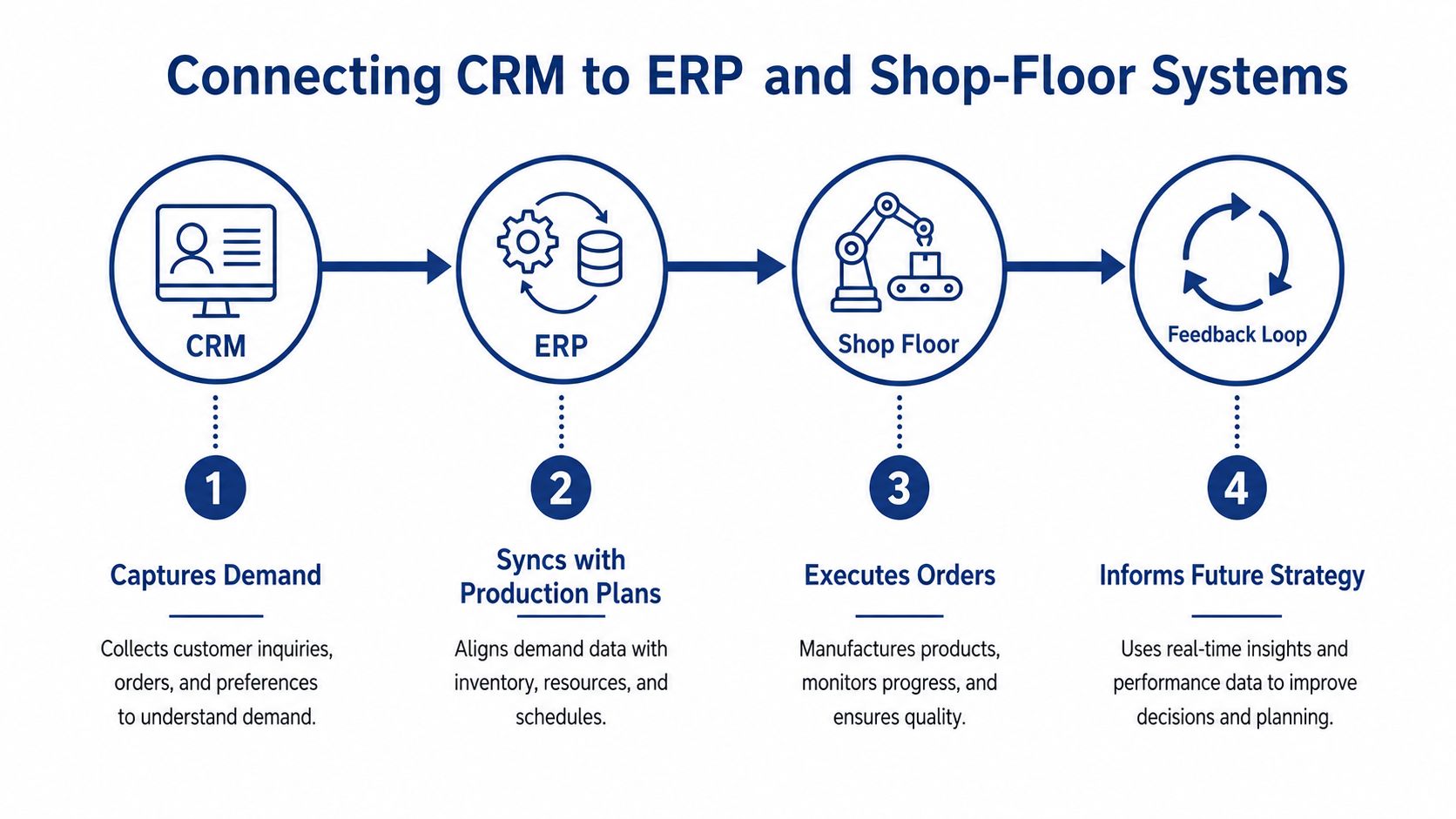
CRM becomes useful in manufacturing when it stops acting like a standalone database and starts acting like a demand-synchronization layer. That's the point where sales activity, inventory constraints, and service demand all connect to the same operational picture.
The data flow that actually matters
When a deal closes in CRM, ERP should receive the demand signal quickly enough to support planning. When service calls start clustering around a certain product line, that pattern should inform spare-parts positioning. When quoting needs cost or availability context, CRM should pull from the systems that know the numbers.
That architecture lines up with the manufacturing guidance that CRM should operate as an operational layer linked to quoting, fulfilment, service, and account growth, not just as a sales database. It also matches the broader need for a single source of truth across sales, marketing, service, distributors, and operations, so the customer record doesn't fracture by department.
Why ERP and shop-floor visibility change the math
Demand in manufacturing is constrained by capacity and inventory. That means better pipeline visibility doesn't just help sales, it affects production planning, stock positioning, and how confidently the business can commit to delivery dates.
If you want a broader systems view, the discussion on manufacturing digital transformation shows why CRM, ERP, and operational data work best when they're treated as one system instead of separate projects.
Where implementation gets messy
Integration is rarely blocked by software alone. The core problems are inconsistent item naming, duplicate account records, and unclear ownership of who updates what. If those issues aren't cleaned up early, the CRM just becomes a prettier version of the same confusion.
Rethinking CRM Success Metrics Beyond Lead Volume
Manufacturing teams get into trouble when they judge CRM by lead count alone. That metric may matter in some sectors, but in mature B2B accounts it can hide the revenue story. A plant manager doesn't care whether marketing filled the top of the funnel. They care whether the supplier shows up, communicates clearly, and solves problems fast.
Industrial buyer behavior backs that up. Independent research reports that 89% of industrial decision-makers say supplier experience is a critical purchasing factor, 68% say transparent communication during project execution is critical to satisfaction, and 65% of industrial customers are likely to switch vendors because of poor service, according to the industrial customer experience statistics source. Those numbers make retention a revenue issue, not a soft-service issue.
Metrics that fit manufacturing accounts
A better dashboard asks different questions. Is the account healthy? Are reorders happening on time? Is the service queue shrinking or growing? Are account owners spotting cross-sell triggers before a competitor does?
That's where the manufacturing CRM conversation gets sharper than most generic retention advice. The SaaS customer retention strategies framework is still useful as a starting point, but manufacturers need it adapted to service history, install base, and reorder cadence.
Manufacturing CRM Metrics That Matter
| Traditional CRM Metric | Manufacturing CRM Metric | Why It Matters |
|---|---|---|
| MQL volume | Account health score | Shows whether key accounts are expanding or slipping |
| Pipeline velocity | Reorder cycle adherence | Reveals whether repeat demand is arriving when expected |
| Lead conversion rate | Service ticket resolution time | Connects support quality to retention risk |
| Campaign response rate | Cross-sell conversion rate | Measures expansion inside existing accounts |
| New opportunities created | Customer defection rate | Tracks loss in the accounts that already matter |
A practical dashboard doesn't need to be fancy. It needs to tell account owners where the risk is and what to do next. If the system can't show that, it's reporting activity, not business health.
Vendor Selection and Implementation Roadmap
The wrong CRM choice usually starts with a vague buying process. A manufacturer sees a slick demo, likes the interface, and only later discovers the system can't handle quoting, warranty tracking, or the approval flow that runs the business.
What to evaluate before you buy
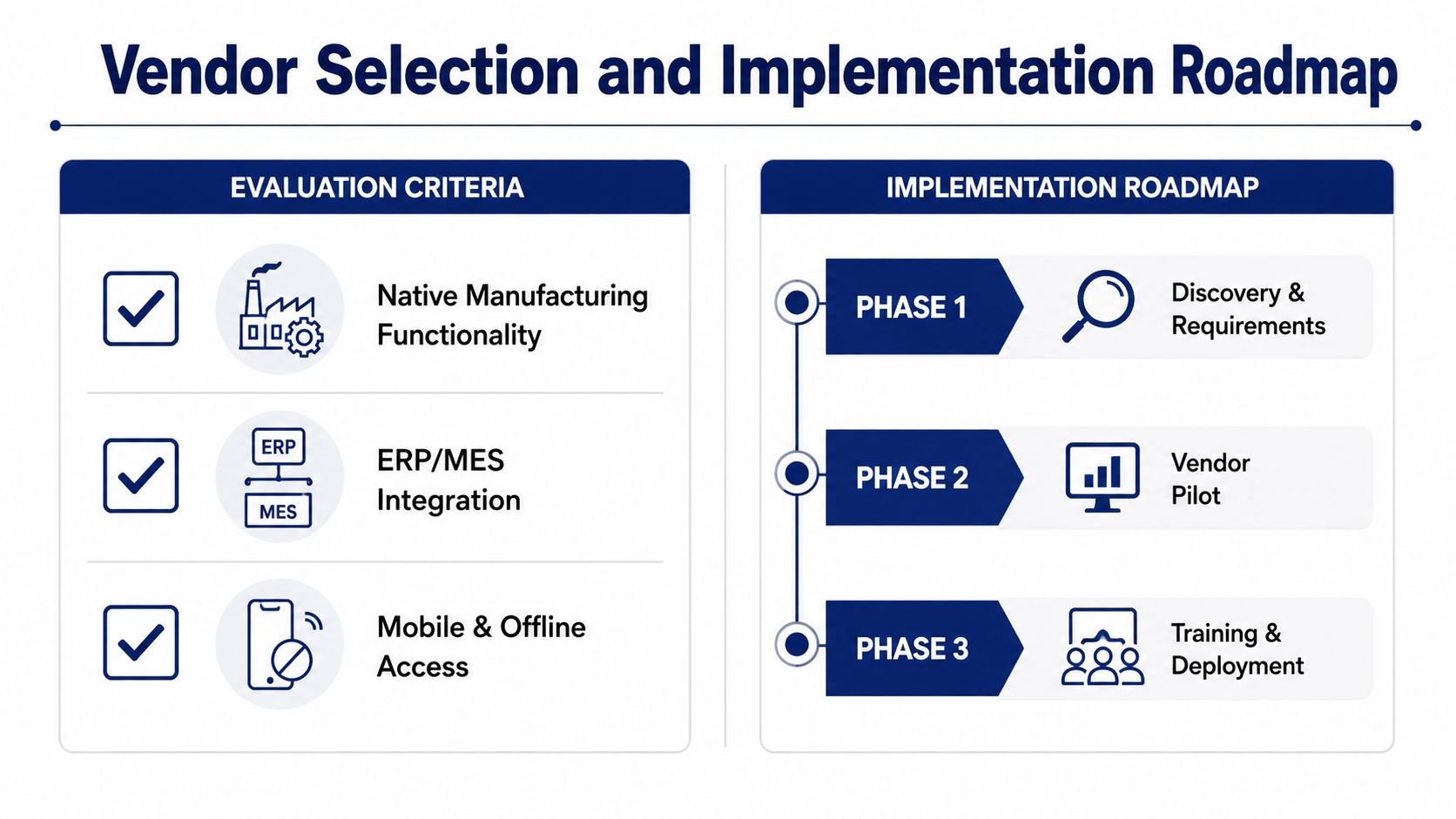
Look for native support for quoting, BOM integration, warranty tracking, ERP or PLM integration, distributor portal support, and mobile access for field service teams. If the vendor can't speak your process language, it will force your team to invent workarounds.
The questions below are the ones we use when a project is still salvageable:
- Does it handle manufacturing records cleanly? Check how it deals with customer, part, serial, warranty, and service data.
- Can it integrate without heavy custom code? Favor systems that connect cleanly to ERP and PLM.
- Will field teams use it? Mobile access matters when technicians are on site.
- Does it support partner or distributor workflows? If channel sales matters, this can't be an afterthought.
For a practical vendor comparison lens, the how to choose a CRM system guide is a useful companion piece when you're narrowing options.
A phased rollout that reduces risk
The cleanest path is usually discovery and data audit first, then a pilot with one product line or region, then integration build-out, training, and full rollout. That sequence keeps the team from drowning in migration work before anyone trusts the system.
Avoid the common trap: don't move every legacy record on day one. Clean the high-value data first, prove the workflow, then expand.
If you try to do everything at once, you usually end up with a slow launch, bad records, and user frustration. A pilot gives you a controlled way to learn where the process breaks before the whole company is affected.
Change Management and Team Adoption Strategies
The technical setup matters, but adoption decides whether the system pays off. I've seen cleanly configured CRMs fail because the sales team kept working in spreadsheets and the service team treated logging calls like extra admin work.
Who resists, and why
Sales reps often protect their customer relationships because they think CRM makes those relationships visible to everyone. Shop-floor managers may see it as office software that won't help them hit production goals. Service technicians may skip updates because they're trying to get to the next machine, not fill out a form.
The fix is different for each group. Power users should help shape the fields and workflows. Commission plans should reward clean pipeline hygiene, not just closed deals. Technicians should see how logged service data reduces repeat troubleshooting and missed history.
Adoption tactics that actually move behavior
- Involve field users early. Let them test the mobile workflow before rollout.
- Tie usage to accountability. If the CRM record isn't current, the forecast shouldn't pretend it is.
- Keep screens short. If a tech needs ten fields to close a call, the form is too heavy.
- Review adoption weekly. A simple scorecard keeps leaders honest about who's using the system and who's avoiding it.
For a structured rollout checklist, the CRM implementation steps guide is worth using alongside your internal plan.
The goal isn't compliance for its own sake. It's getting enough trusted data into the system that the business can rely on it when accounts get busy, service gets messy, and customer memory starts to fade.
Your Next Steps for Building a Manufacturing CRM Strategy
Start with a quick diagnosis. Check whether you have one record per customer, whether service history is visible to account owners, whether CRM is tied to ERP or still floating alone, whether your metrics focus on retention as much as new leads, and whether your team uses the system.
If you're starting from scratch, run a vendor evaluation sprint around the four use cases that matter most. If your CRM is already in place but underperforming, audit integration and reporting first. If your CRM is mature, shift the focus to account expansion and retention optimization.
The businesses that win here don't treat CRM as software. They treat it as the system that keeps customer promises, service history, and reorder timing in sync.
If you want a practical diagnosis of where your manufacturing CRM is helping, and where it's creating friction, Machine Marketing can help map the gaps across sales, service, and operations. Visit Machine Marketing to start a strategy conversation built for manufacturers who need a system, not another tool.