You're probably sitting on leads that looked good on paper and then went quiet. The trade show contact never replied. The quote request never turned into a conversation. The downloaded guide didn't lead anywhere. That's not usually a product problem, it's a nurture problem, and in industrial B2B, the gap between first interest and sales readiness is where revenue leaks out.
B2B lead nurturing strategies fix that gap by turning follow-up into a system. The point isn't to “stay in touch” for the sake of it. The point is to keep the right buyers engaged with the right message until they're ready to talk about specs, timing, and pricing.
Table of Contents
- Why Industrial Leads Disappear and What Nurturing Fixes
- Mapping the Industrial Buyer Journey Stage by Stage
- Segmenting Manufacturing Leads So Your Message Lands
- Building a Lead Scoring Model You Can Trust
- Choosing the Right CRM and Automation Stack
- A Sample Nurture Sequence for an Industrial Lead
- Handoff to Sales and the Metrics That Prove It Works
Why Industrial Leads Disappear and What Nurturing Fixes
A plant manager downloads your capability sheet on Tuesday. Procurement opens the follow-up email once, then nothing. The rep who met you at the expo says they'll circle back after budget review, and then the inbox goes cold. If you've seen that pattern, you already know that the problem isn't lead volume. It's the silence between initial interest and actual buying intent.
That's why I treat nurturing as a revenue-efficiency system, not a follow-up tactic. Companies that excel at nurturing generate 50% more sales-ready leads at 33% lower cost, nurtured leads make 47% larger purchases and convert 23% faster than non-nurtured prospects, and nurturing emails get response rates 4–10 times higher than generic broadcasts (B2B lead nurturing research). Those numbers matter because they explain the economics. If you're already paying to create demand, the smart move is to stop wasting that demand with one-and-done follow-up.
Practical rule: if a lead hasn't asked for a quote yet, your job isn't to push harder. Your job is to stay relevant long enough for the buyer to become ready.
For manufacturers and industrial suppliers, that usually means building a workflow that follows the buyer's timeline, not your sales team's convenience. A structured nurture program gives marketing a way to educate, sales a way to prioritize, and leadership a way to see which leads are warming up. If you want a plain-English walkthrough of lead follow-up systems, the guide on nurturing leads with MakeAutomation is worth a look.
The internal problem is usually messy data, weak segmentation, and no agreed handoff point. If you're dealing with the same symptom set on your side, our earlier breakdown of why manufacturers struggle with marketing is the right diagnostic companion.
This work doesn't compound overnight. Nurturing pays off when you run it consistently, with discipline, for months. If your team wants a quick win, start with one segment and one buying trigger, then build from there.
Mapping the Industrial Buyer Journey Stage by Stage
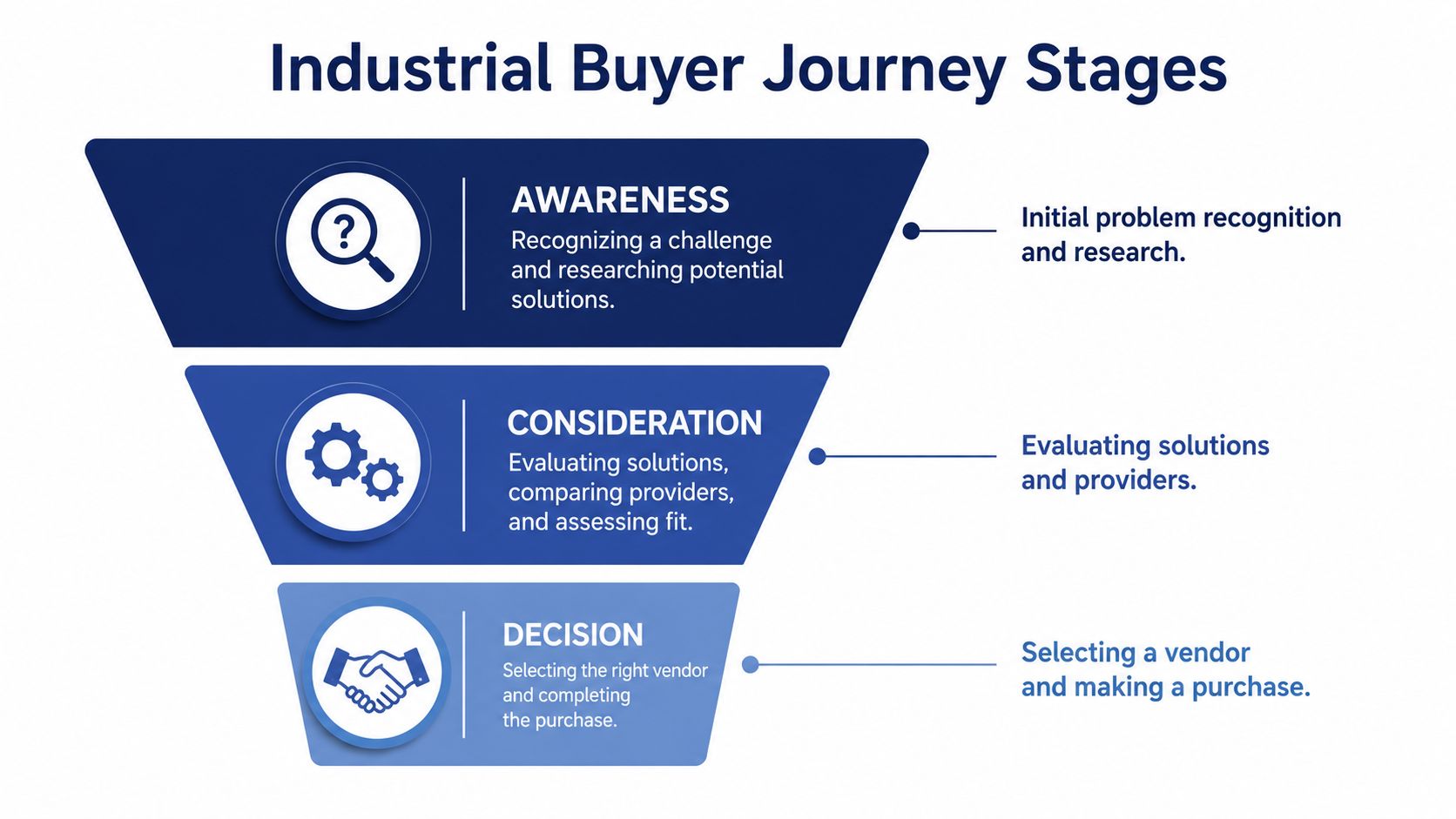
Industrial buying only looks linear from far away. In practice, a maintenance engineer may be comparing tolerances while procurement is already checking vendor risk, and operations is still deciding whether the problem is urgent enough to solve this quarter. If your nurture content doesn't match that reality, the buyer ignores it.
Awareness means problem recognition
At the awareness stage, the buyer knows something's wrong, but they haven't committed to a solution path yet. They're asking, “What's causing this?” or “Why does this keep happening?” That's where educational content earns attention. Use problem-focused articles, process explainers, and diagnostic checklists, not product pitches.
Consideration means comparing approaches
Once the buyer starts evaluating options, the questions get sharper. They want to know what methods exist, what trade-offs matter, and what standards they should use to compare vendors. At this stage, comparison guides, case studies, and implementation overviews are effective. If you skip straight to pricing, you'll lose the buyer before they've justified the project internally.
Decision means reducing risk
Decision-stage buyers are looking for proof, clarity, and next-step certainty. They need technical details, timelines, references, and a clean path to procurement. This stage is where your content should help a champion defend the choice inside the company. The right asset here is usually a spec sheet, an ROI summary, a vendor comparison, or a concise implementation roadmap.
What you should ask your sales team is simple:
- What questions show up first in real conversations?
- Which objections slow deals down most often?
- What content do buyers ask for before they'll book a meeting?
A practical framework helps, but your own customer conversations matter more than any generic funnel diagram. If you need a sharper starting point for personas, use the thinking in how to create buyer personas and then validate it against real sales notes.

Segmenting Manufacturing Leads So Your Message Lands
Sending the same email to a plant manager and a CFO is lazy marketing. It lowers engagement, and it tells both people you do not understand their job. In manufacturing, segmentation has to reflect role, buying context, and intent, or the nurture program turns into noise.
Start with firmographic basics
Start with the fields that are usually already in the CRM, even if they are incomplete. Industry, company size, and role are the baseline. Clean the record and enrich what is missing so sales is not guessing who is who. That cleanup step fits the practical five-step workflow described in the source guidance on B2B nurture process design (B2B lead nurturing guide).
Add behavioral and intent signals
Firmographics tell you who the lead is. Behavior tells you whether they are serious. A person reading a machine capability page is not the same as a person opening every message, clicking into comparison content, and coming back twice in a week. That is the difference between general interest and active evaluation.
What to look for: repeat visits to product pages, clicks on technical content, and responses from multiple people at the same company. Those are the signals that deserve tailored follow-up.
Keep segments small enough to use
I would rather see four clean segments than twelve shaky ones. Over-segmentation sounds smart until the marketing team cannot maintain the workflows. Write each segment in plain English so sales can push back on it if needed. That keeps the definitions honest and usable.
A workable manufacturing model usually looks like this:
- Technical evaluators: engineers, maintenance leads, quality managers.
- Economic buyers: owners, CFOs, operations directors.
- Procurement-led accounts: buyers focused on vendor comparisons and pricing.
- Re-engagement leads: contacts who went cold and need a different message.
The message changes with the segment. Technical buyers get specifications and process detail. Economic buyers get risk reduction and business case support. Procurement gets comparison assets and proof that your shop will not create surprises.
If you want a clean way to build those lists, the process in how to segment email lists is the right internal reference point. Use it to keep your segments usable, not theoretical.
Building a Lead Scoring Model You Can Trust
Lead scoring scares small teams because it sounds technical. It doesn't have to be. A useful scoring model is just a shared agreement about what buying behavior looks like and when marketing should stop holding the lead back.
Score fit first, then intent
Give points for demographic fit, meaning the contact matches the kind of company and role you want. Then add points for behavior, meaning the lead does something that suggests movement toward a purchase. A machine shop visitor from the right industry is more valuable than a random download from a student or vendor. That sounds obvious, but a lot of CRMs still reward form fills too heavily.
The core mistake is overvaluing easy signals. A form fill is weak by itself. A pricing page visit, a demo request, or repeated engagement with comparison content carries more weight because it reflects active evaluation.
Set the handoff threshold
Your score needs a clear line where marketing stops nurturing and sales starts calling. If sales doesn't know what the score means, the system falls apart fast. I like a threshold that is tied to actual behavior, not arbitrary volume, because the goal isn't to create more alerts. The goal is to create better ones.
A simple starter model can include:
- Fit points: industry match, decision-making role, company size.
- Intent points: pricing page views, demo requests, multiple email opens, repeat visits to technical content.
- Negative points: unqualified roles, no engagement over time, spammy or irrelevant behavior.
Review the score against real deals
Don't freeze the model. Revisit the weights as your sales team learns which behaviors show up before quotes, not after. If a lead with a high score never turns into a conversation, the model is lying. If a lower-scoring lead keeps converting, the scoring logic needs a rewrite.
Practical rule: if sales can't explain the score in one sentence, the score is too complicated.
The best scoring models are boring, visible, and tied to actual follow-up behavior. That's what makes them useful in an industrial CRM. Anything fancier usually creates more internal debate than revenue.
Choosing the Right CRM and Automation Stack
The platform matters, but not in the way vendors usually sell it. You don't need the flashiest demo. You need a system that can segment cleanly, score leads clearly, and route handoffs without creating a mess for sales.
For small and mid-size industrial teams, three tools come up often, GoHighLevel, HubSpot, and ActiveCampaign. Each can support nurture workflows. The question is how much complexity you can manage, how much automation depth you need, and whether the CRM side is strong enough for your sales motion.
| Criteria | GoHighLevel | HubSpot | ActiveCampaign |
|---|---|---|---|
| CRM foundation | Better for teams that want a broad, flexible system | Strong native CRM with deeper ecosystem support | Solid for contact and email management, lighter CRM posture |
| Automation depth | Strong for practical workflows and branching | Strong for more mature lifecycle orchestration | Strong email automation, good for lean teams |
| Fit for industrial sales | Useful when you want speed and simplicity | Best when marketing and sales need a more complete operating system | Good when email nurture is the priority and the sales cycle is narrower |
| Team complexity | Better for smaller teams that want to move fast | Better for teams that need structure and scale | Better for lean teams that want control without overhead |
| Main trade-off | Less polished for some reporting and ecosystem needs | Can become expensive and heavier than a small shop needs | May feel limited if you need deeper CRM coordination |
HubSpot is the safest bet if you need a more complete inbound and sales alignment platform. ActiveCampaign is often the sensible middle ground when email automation matters more than a giant system. GoHighLevel can work well if your team wants speed and flexibility, especially when you're managing a simpler stack.
Before you buy, ask the hard questions:
- Can sales see the same lead history marketing sees?
- Can we trigger workflows from behavior, not just form fills?
- Will this tool still feel manageable six months from now?
- Can we build handoff rules without a consultant every time?
The wrong stack slows the program before it starts. The right one fades into the workflow and lets the team focus on content, scoring, and sales follow-up instead of software babysitting.
A Sample Nurture Sequence for an Industrial Lead
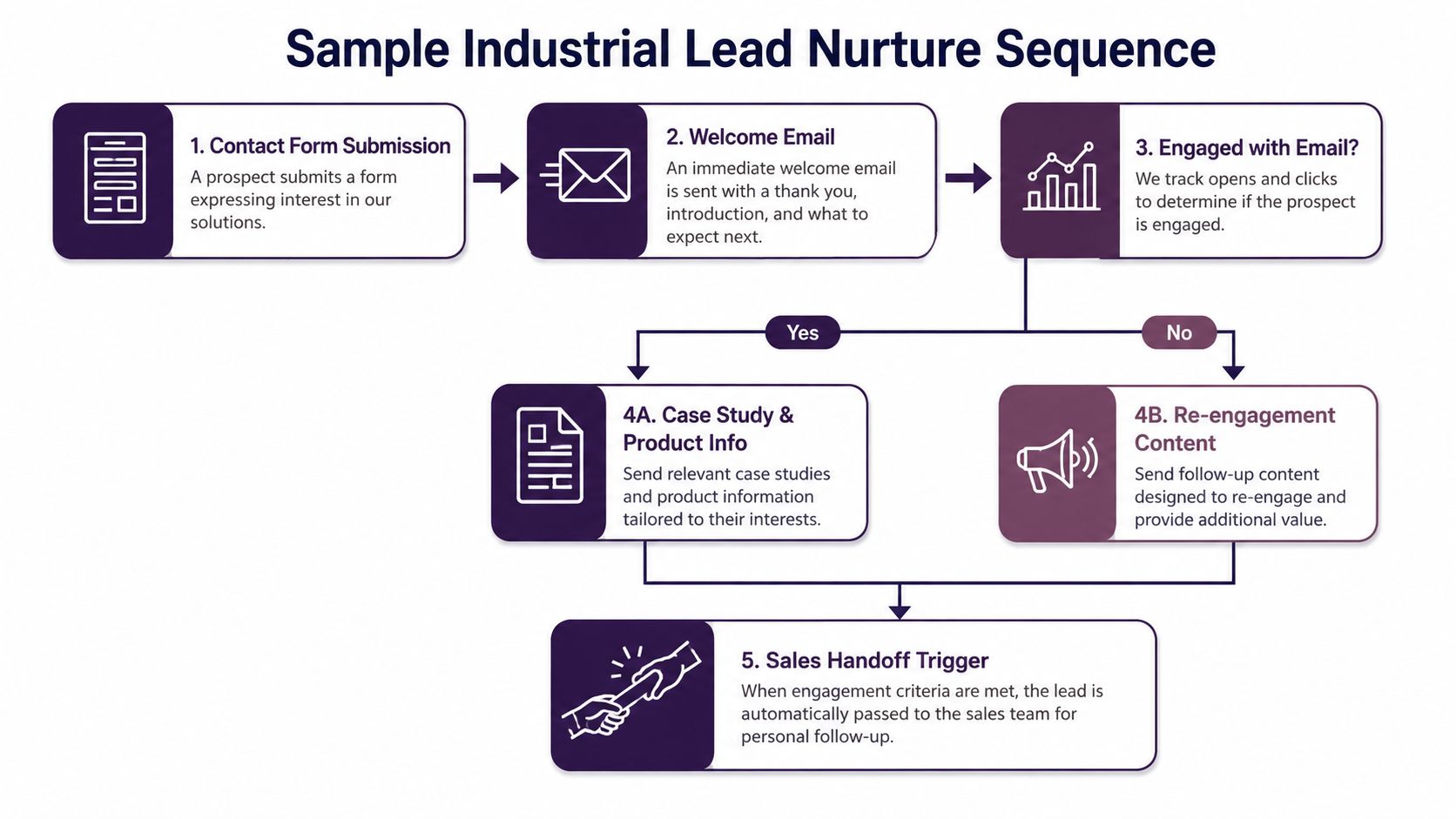
A real nurture sequence doesn't spam the inbox. It gives the buyer a reason to keep moving, then watches for intent. For manufacturing leads, I prefer a conservative cadence, generally one touch every one to two weeks, because industrial buyers don't need pressure. They need usefulness.
The sequence below starts with a contact who downloaded a CNC machining guide. That's a clean entry point because the topic signals technical curiosity without assuming purchase intent. If your emails are consistently underdelivering, a resource like Best email warmup tools can help you protect deliverability before you scale the sequence.
Example sequence
Week 0, welcome email.
Purpose, confirm the download and point to a related technical resource. Trigger, if they click through, move them into the next content track.Week 1, educational follow-up.
Purpose, answer the most likely question the buyer has after reading the guide. Hook, a subject line like “What usually slows CNC projects down.”Week 3, proof content.
Purpose: show how a similar issue gets solved in the world. If they engage, send case-study content or product details.Week 5, retargeting ad exposure.
Purpose, keep the brand visible while the buyer keeps researching. This works best when the ad reinforces the same message as the email.Week 7, human touch.
Purpose, a short Loom or a personal note from sales with one useful observation. At this point, many teams either sound helpful or sound desperate.Week 10, technical content.
Purpose, give deeper detail for buyers who are moving toward evaluation. This can be a spec sheet, comparison guide, or implementation checklist.Week 14, handoff check.
Purpose, if the lead has shown repeated engagement, route them to sales. If they haven't, recycle them into a lighter nurture track.
The logic matters more than the exact week count. If someone stops opening for thirty days, reduce pressure and switch the content angle. If someone starts opening everything, treat that as a buying signal and accelerate the handoff. Don't wait for them to ask twice.
Handoff to Sales and the Metrics That Prove It Works
The handoff is where most nurture programs break. Marketing calls the lead warm. Sales calls it junk. The buyer gets ignored, then disappears into a competitor's inbox. That is not a content problem, it is a rules problem.
Define handoff triggers in behavior, not in calendar time
Sales should get alerted when a lead shows high-intent behavior, not when an arbitrary sequence reaches its last email. Pricing page visits, demo-request page views, comparison-content consumption, and sudden re-engagement deserve immediate attention. Those are the moments when the buyer is signaling they are closer to a decision.
Practical rule: if the buyer is comparing vendors or asking for pricing, the clock should speed up immediately.
Lead response discipline still matters, and the broader nurturing literature supports that point, including MarketingSherpa's ROI reporting as summarized by Online Marketing Institute. Your internal handoff policy still matters more than any external benchmark, because sales has to know exactly what behavior earns a call, a task, or an SDR follow-up.
Measure the right things
Stop using vanity metrics as the headline. Opens and clicks matter as signals, but they do not prove revenue. Track the numbers that show whether nurture is feeding pipeline or just filling inboxes:
- Pipeline value from nurtured contacts
- Time from trigger to first sales touch
- Conversion from MQL to opportunity
- Sales feedback on lead quality
If those numbers do not improve, the system is broken. One weak email, a bad scoring rule, or a sloppy CRM handoff can drag the whole program down. In industrial selling, that usually shows up as slow follow-up on quote-ready accounts and sales reps complaining that marketing sent over noise instead of buying intent.
A stronger process ties the alert to a clear next step. If a lead hits your pricing threshold, sales gets the task, the CRM logs the activity, and the rep knows whether the contact has already consumed technical content, compared suppliers, or requested a demo. That is the difference between a lead that sits and a lead that moves.
Fix one thing at a time
Every quarter, rewrite the underperforming emails, retire dead segments, and adjust the scoring weights based on what sales sees. If a handoff trigger fires and nobody follows up fast enough, the nurture program is only half-built. If sales keeps rejecting the same leads, the scoring or segmentation is wrong. Fix the root cause before you add more automation.
For help with sales handoff, consider hiring professionals, see Hire Appointment Setters. If you need outside help diagnosing where your nurture system is leaking, Machine Marketing builds the strategy, CRM logic, and content structure that make industrial lead nurturing work. Visit Machine Marketing if you want a clearer handoff between marketing and sales and a system built for manufacturers, not generic B2B theory.