Industrial sales leads rarely come from one campaign. They come from a connected system that helps the right buyer discover your capability, verify technical fit, involve other stakeholders, and receive disciplined follow-up. That matters because industrial buying cycles are long, requirements are specific, and a single inquiry may involve engineering, procurement, operations, quality, and finance.
The diagnosis should start with quality, not volume. A 2026 benchmark summary reported that only 9.8% of MQLs became SQLs, down from 13.1% in 2024, while manufacturing's median cost per lead was $137, with a top-quartile level of $64 and a bottom-quartile level of $251. The figures show why more form fills won't fix weak qualification or inconsistent handoffs. (B2B lead generation ROI insights)
Below, the tactics are ranked by practical fit, implementation effort, time to signal, likely lead quality, and the follow-up capacity they require. The list moves from focused, high-quality approaches to broader demand capture. Track every source through five fields: source, qualified conversations, pipeline, closed revenue, and estimated ROI. Machine Marketing helps manufacturers, machine shops, and industrial business owners connect existing tools and teams through a clearer strategy, so marketing activity supports the sales process instead of creating another disconnected list.
Table of Contents
- 1. LinkedIn Sales Navigator
- 2. Content Marketing With SEO
- 3. Account-Based Marketing With Personalized Email and Direct Mail
- 4. Industry-Specific Trade Shows and In-Person Events
- 5. LinkedIn Organic Content and Community Engagement
- 6. Email Outreach and Cold Email Sequences
- 7. Referral and Strategic Partnership Programs
- 8. Google Local Services Ads
- 9. Reactivation Email and SMS Campaigns
- 10. PPC and Local Search Foundations
- Industrial Sales Lead Strategies: 10-Point Comparison
- Turn the Eight Tactics Into a 30-Day Plan
1. LinkedIn Sales Navigator
LinkedIn Sales Navigator works best as a research layer for targeted outbound prospecting, not as a complete sales system. It helps you identify accounts, map decision-makers, and notice useful timing signals. It won't write a relevant message, make the phone call, or manage the opportunity after someone responds.
Start by defining your industrial ideal customer profile around facts your sales team can verify:
- Account fit: Industry, geography, facility type, production process, and likely application.
- Contact fit: Engineers, plant managers, procurement directors, operations leaders, and other roles involved in supplier decisions.
- Timing signals: Job changes, promotions, facility expansion, equipment projects, hiring activity, or relevant posts.
- CRM discipline: Every qualified contact should move into one CRM-led follow-up workflow, not remain in a separate spreadsheet or browser list.
Create 3 to 5 saved searches for your strongest combinations of industry, role, territory, and company characteristics. Check them weekly, record which searches produce qualified conversations, and adjust filters based on actual opportunity quality.
Practical rule: Sales Navigator identifies and informs outreach. Your message, email, phone process, qualification criteria, and CRM create the conversion path.
Consider a pump manufacturer searching for plant engineering managers at food-processing facilities within its service area. A CNC shop might monitor job-title changes at regional aerospace contractors, then contact new procurement or engineering leaders with a relevant capability message. The trade-off is cost and research time. Sales Navigator plans commonly cost $99 to $165 per user per month, so indiscriminate messaging can turn a useful targeting tool into an expensive source of low-quality activity.
For a practical operating model, use this guide to using LinkedIn for sales. Measure saved-search matches, accepted connections, replies, qualified conversations, opportunities, and closed revenue by search.

2. Content Marketing With SEO
Technical content is the strongest compounding inbound tactic when your team has real engineering knowledge and can commit to consistent publishing. Industrial buyers research privately, compare suppliers, and look for evidence that a vendor understands their application before they agree to a sales conversation. Accenture's industrial research identified more than 1,600 customer pain points across the buying process, which supports a content strategy built around education, comparison, specifications, and proof rather than generic company news. (Accenture's industrial buyer experience research)
Begin with the top 10 to 15 questions your sales team hears repeatedly. Turn them into technical articles, application guides, case studies, videos, comparison pages, and downloadable resources. Keep useful educational content ungated, but use forms for valuable assets such as detailed guides, case studies, drawings, calculators, or specification packages.
Every asset needs a next step, such as:
- Technical fit: Link to the relevant capability or application page.
- Commercial fit: Offer an RFQ, consultation, or drawing review.
- Qualification: Ask for the application, material, volume, timeline, and certification requirements.
- Measurement: Track qualified leads and opportunities, not traffic alone.
A downtime guide for an industrial controls manufacturer generating 200 or more monthly visits and 15 to 20 qualified leads is a specific example, not a universal forecast. A precision machine shop documenting aerospace tolerances, medical-device complexity, and short lead times may find that case studies become a meaningful source of qualified inquiries. SEO typically needs a 3 to 6 month ramp and a 6 to 12 month commitment, so it isn't the right choice for an urgent sales gap.
Use this resource on technical content marketing to structure the work. Measure organic visits, assisted conversions, qualified conversations, RFQs, pipeline, and revenue by page.
3. Account-Based Marketing With Personalized Email and Direct Mail
ABM fits businesses that sell complex solutions to a small number of high-value accounts. It isn't efficient to build an elaborate account playbook for every inquiry, but it can make sense when one customer could justify sustained engineering, sales, and implementation effort.
Run a focused pilot with 10 to 20 accounts. Start with your best existing customers and identify shared characteristics, such as industry, facility profile, process requirements, geography, and buying trigger. Then map the people who influence the purchase:
- Engineering: Technical requirements, design constraints, validation.
- Procurement: Commercial terms, supplier approval, purchasing process.
- Plant leadership: Capacity, uptime, labor, and operational risk.
- Finance: Investment case, payback, and budget ownership.
Coordinate email, LinkedIn, phone, direct mail, and account-specific retargeting around one account hypothesis. The message to an engineer shouldn't be identical to the message to a plant manager. Build a simple playbook with persona, problem, proof, touch sequence, owner, and next action.
A precision equipment manufacturer could send a plant manager a case study tied to the facility's production challenge, followed by a LinkedIn message from the sales rep and a technical email. A controls company might use public expansion or equipment-purchase signals to prioritize accounts and coordinate outreach across channels. Treat any meeting or revenue result from such examples as context-dependent, not a promise.
ABM usually requires a 3 to 6 month or longer ROI window, and the resource burden is real. Measure accounts engaged, accounts with multiple stakeholders active, pipeline, quoted value, and closed revenue. Evaluate the method using this explanation of what ABM really means, not by email opens alone.
4. Industry-Specific Trade Shows and In-Person Events
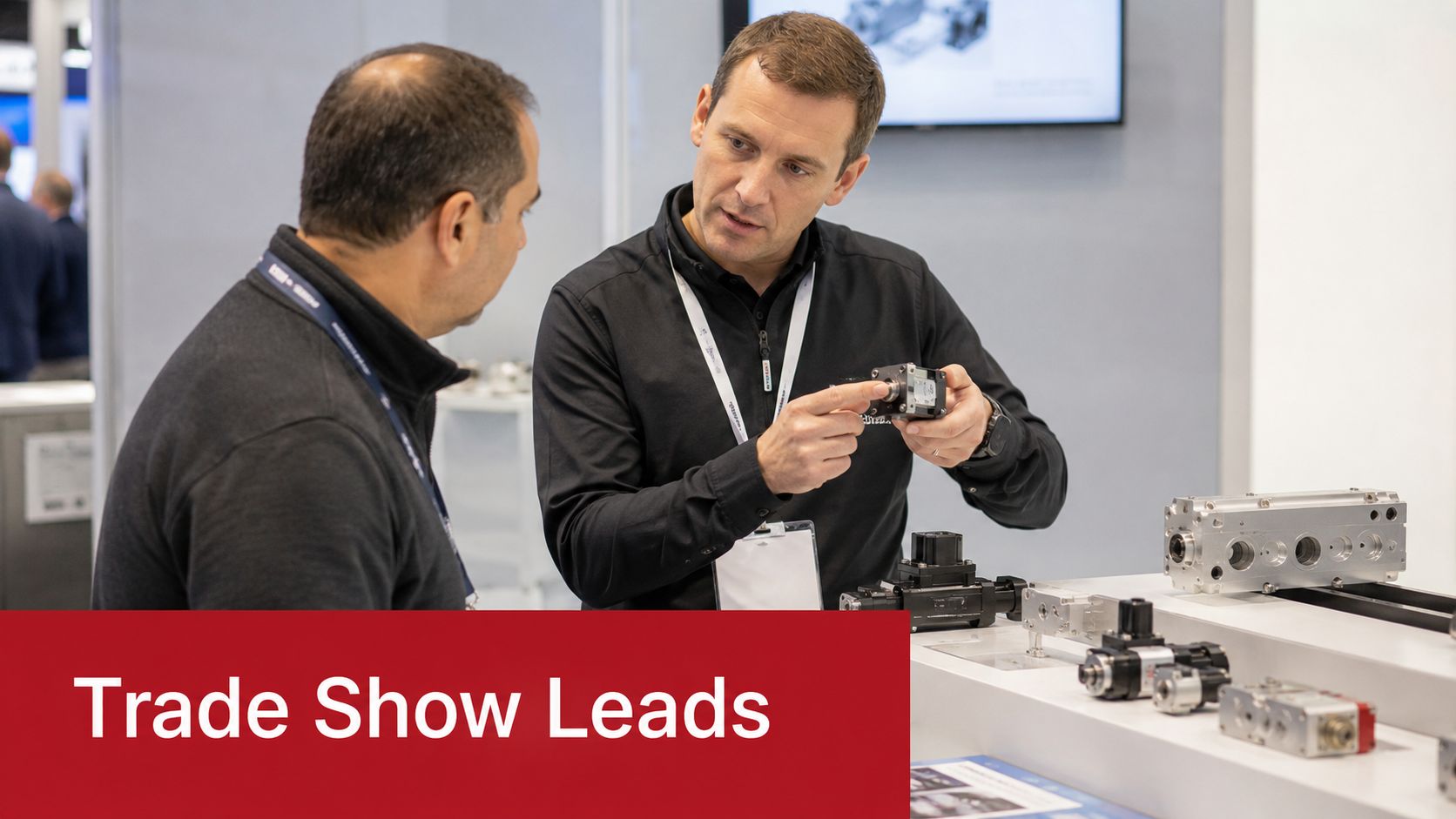
Trade shows can generate excellent industrial sales leads, but only when you treat the event as a full-funnel system. A booth without pre-show targeting, qualification, CRM capture, and fast follow-up is mostly a visibility expense.
Choose events based on customer concentration and sales history. Ask which shows produced serious conversations in the past, then examine whether the attendees match your ideal account profile. Booths and sponsorships can require $5,000 to $50,000 or more, concentrate activity into 2 to 3 days, and often need 3 to 6 months before opportunities convert. The event also consumes technical staff time, travel capacity, and follow-up hours.
Build the system before you arrive:
- Pre-show outreach: Invite target accounts to a demonstration, consultation, or scheduled conversation.
- Booth qualification: Train staff to explain the value proposition in 90 seconds and ask about application, timeline, authority, and fit.
- Data capture: Record industry, role, project need, timing, next action, and consent in the CRM.
- Follow-up: Send a relevant email the same day and make the first call within 48 hours.
- Revenue tracking: Tie every opportunity and closed order back to the event source.
A CNC machine manufacturer might use live demonstrations and an optimization consultation to distinguish serious prospects from casual visitors. A regional fabrication shop could gain more from speaking at a focused manufacturing roundtable than from paying for a large national booth. The right choice depends on account value, geography, and whether your team can work the leads after the show.
5. LinkedIn Organic Content and Community Engagement
Organic LinkedIn content builds visible expertise before a prospect replies to outbound outreach. Industrial buyers often want to assess how clearly your team understands real production problems, not just whether your company lists the right equipment.
Use both company pages and personal profiles. Engineers, sales leaders, owners, and operations specialists can publish different perspectives without repeating the same brochure language. Useful topics include:
- Technical lessons: Tolerance decisions, material selection, maintenance issues, design-for-manufacturing guidance.
- Project insight: The problem, constraint, decision, and result, with confidential details removed.
- Factory evidence: Equipment, inspection methods, certifications, team expertise, and process improvements.
- Community participation: Thoughtful comments on customer, supplier, association, and industry posts.
A machine-shop owner generating 8 qualified leads in 6 months from people who contacted her after seeing technical posts is a useful example of how trust can accumulate. An industrial manufacturer attributing 15% of monthly leads to LinkedIn inbound from a team of engineers and sales leaders shows another possible operating model. Neither result should be treated as a forecast for your company.
The trade-off is reach. Results can be inconsistent, and subject-matter experts need coaching, editing, and a manageable publishing rhythm. Measure profile views, qualified conversations, assisted opportunities, and revenue. Reactions matter only when they lead to recognizable account engagement or sales activity.

6. Email Outreach and Cold Email Sequences
Cold email is useful when you need controlled access to a precise group of industrial prospects, but list size isn't a substitute for relevance. A well-built sequence gives sales a repeatable way to test an account segment, application, or offer without committing to a large event or long SEO program.
Build and verify the list using tools such as LinkedIn, ZoomInfo, Apollo, Clearbit, Hunter, or RocketReach. Segment by facility, industry, role, process, geography, and likely need. The first email should stay short, usually 3 to 5 sentences, and ask for a specific 15 to 20 minute conversation rather than a broad presentation.
A workable sequence includes 3 to 7 touches over 2 to 3 weeks, coordinated with LinkedIn or phone outreach. Lead with a reason to care, such as capacity in a process the prospect outsources, a facility expansion, or an efficiency audit. Don't send generic product language to a purchased list and expect technical buyers to create the relevance for you.
A CNC shop targeting automotive suppliers might offer a focused conversation about overflow capacity. A hydraulics supplier could offer a system-efficiency audit to facilities managers. Response and conversion figures from individual campaigns are examples, not guarantees. Monitor deliverability closely. A 5% bounce rate or 0.1% complaint rate is a warning that your list, targeting, or sending process needs attention. (Guidance on checking email spam placement)
Use this resource on email campaign best practices to tighten execution. Calculate ROI from closed revenue minus list cost, tools, and staff time. Also verify applicable privacy, consent, and business-email requirements before scaling.
7. Referral and Strategic Partnership Programs
Referrals work because the prospect receives context before your sales team enters the conversation. The channel can include satisfied customers, systems integrators, tooling suppliers, distributors, maintenance providers, and other complementary businesses that serve the same industrial buyers without competing directly.
A referral program needs operating rules, not just goodwill:
- Select the right partners: Choose people who understand your capability and encounter your ideal customer.
- Define the handoff: Record the prospect, need, permission, owner, and next action in your CRM or a controlled spreadsheet.
- Create mutual value: Use a referral fee where appropriate, or exchange introductions, technical support, co-marketing, or project collaboration.
- Report outcomes: Tell the referrer whether the inquiry was accepted, qualified, quoted, won, or declined.
- Protect the relationship: Handle poor-fit inquiries quickly and explain why you can't pursue them.
A precision machine shop offering a $500 cash bonus for each converted customer generated 15 converted referrals, $18,000 in new business, and $7,500 in bonuses, producing a stated 2.4x ROI in that example. Those figures describe one program, not a normal outcome for every referral effort.
An industrial controls manufacturer could partner with 3 systems integrators that specify controls in projects. The agreement might define mutual introductions, response expectations, lead ownership, and rules for non-competing opportunities. Volume is unpredictable, customer satisfaction must support the request, and legal or tax requirements may apply to incentives. Measure accepted referrals, qualified conversations, opportunities, closed revenue, incentive cost, and repeat business.
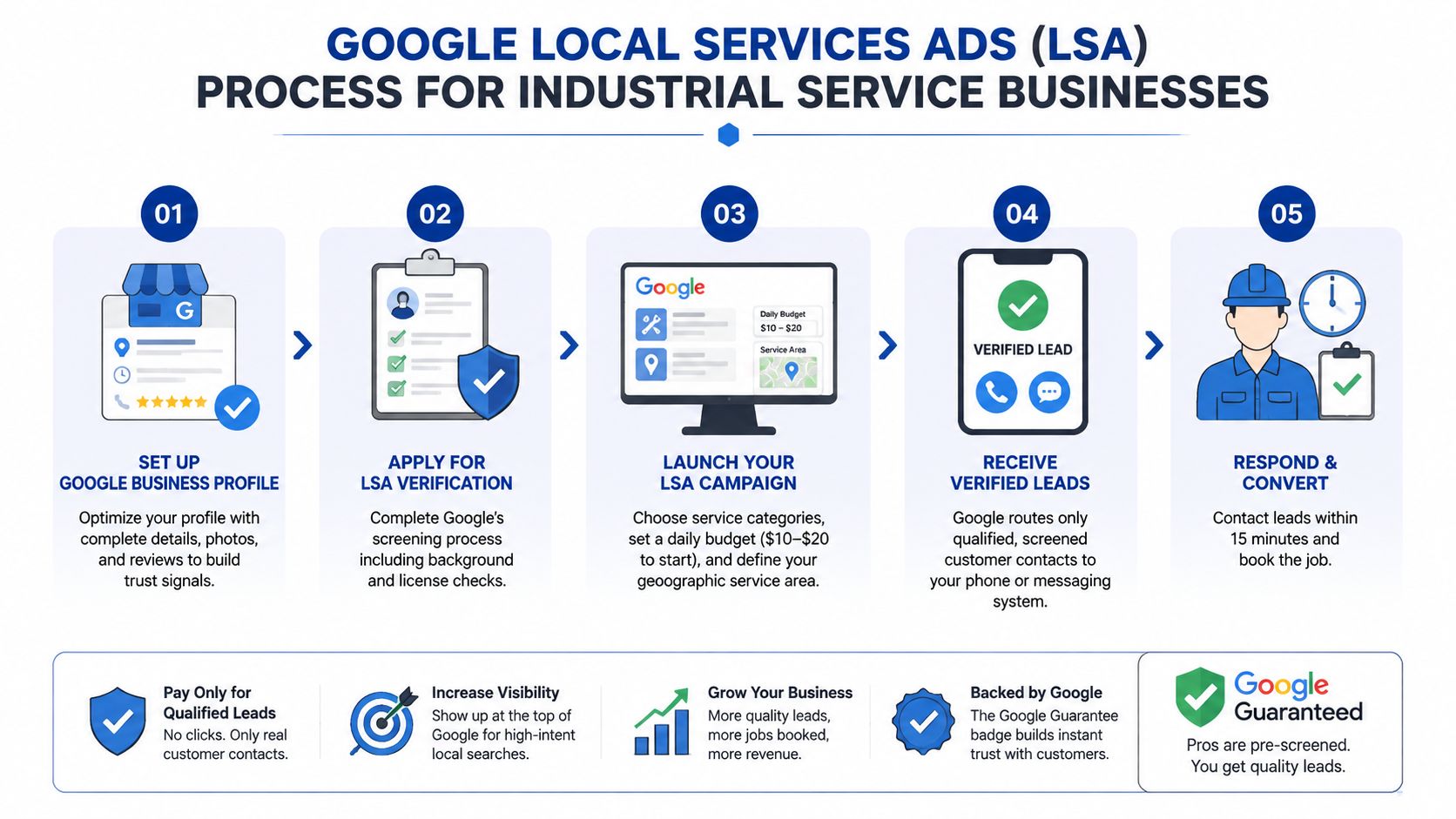
8. Google Local Services Ads
Google Local Services Ads can fit eligible industrial service businesses that capture urgent or geographically bounded demand, including machine repair, equipment maintenance, installation, and local fabrication. Unlike standard PPC, LSA generally uses a pay-per-lead model rather than charging for every click. Eligibility, categories, and coverage vary, so product manufacturers and businesses outside supported locations may find the channel unsuitable.
Start with a complete and accurate Google Business Profile. Show the facility, equipment, service area, certifications, and relevant work. Reviews help prospects evaluate credibility, but the profile must also route leads to someone who can respond quickly and qualify the request.
A practical setup includes:
- Lead routing: Send calls and messages to a monitored number or shared queue.
- Call tracking: Connect inquiries to the service category and booked job.
- Response ownership: Define who answers during business hours and what happens after hours.
- Budget control: Test a modest $10 to $20 starting daily budget, then compare lead cost with booked work.
- Qualification: Ask about equipment, location, urgency, failure mode, and access requirements.
Context-dependent examples include $5 to $50 or more per lead, 8 to 12 weekly inquiries, or a service company converting 40% of LSA leads to jobs. These outcomes depend on category, geography, competition, profile quality, response speed, and actual service capacity.
LSA is a poor fit when your sale requires a long specification process, national account development, or a product purchase that can't be handled through a local service inquiry. Track qualified calls, booked jobs, revenue, cost per booked job, and response time.
9. Reactivation Email and SMS Campaigns
Before you buy more attention, inspect the database you already own. Dormant quote requests, former customers, past service inquiries, and contacts who stopped responding may contain better-fit industrial sales leads than a new, unverified list. Reactivation requires less acquisition effort, but it depends on clean records and a relevant reason to reply.
Segment contacts by last purchase, quote status, service history, industry, known application, and previous conversation. Then create a short sequence that acknowledges context and offers a useful next step. Examples include a drawing review, a capacity update, a maintenance planning conversation, a replacement-part check, or an invitation to revisit a paused project.
Your CRM should capture:
- Last meaningful interaction
- Previous product, process, or service interest
- Quote stage and reason for inactivity
- Known timing, application, and decision role
- Opt-out, suppression, and permission status
Email should usually be the primary channel. Use SMS only where you have the appropriate permission and a clear operational purpose, such as confirming a scheduled service discussion or notifying a customer about an active request. Don't use text messaging as a shortcut around consent or relevance.
Measure replies, booked conversations, recovered opportunities, quoted work, closed revenue, and unsubscribes. Compare recovered revenue with staff time and platform cost. A campaign that produces fewer responses but reopens high-value accounts may be more useful than one that creates a larger number of low-intent replies.
10. PPC and Local Search Foundations
Paid search captures existing demand while technical SEO compounds over time. It works best when you separate high-intent queries by service, product, capability, application, and geography, then send each group to a closely matched landing page. A broad campaign that sends every visitor to a generic homepage usually creates noisy data and weak qualification.
Before spending, audit five points:
- Search demand: Are prospects searching for the specific process, application, service, or product you sell?
- Landing-page fit: Does the page state capability, materials, tolerances, certifications, service area, and commercial next step clearly?
- Traffic controls: Use negative keywords, geographic targeting, and device or schedule adjustments where they fit your market.
- Tracking: Connect calls, forms, drawing uploads, and quote requests to the CRM.
- Sales capacity: Confirm that someone can respond, qualify, and follow up while the campaign runs.
Local listings support machine shops, repair providers, fabricators, and service territories. A broader manufacturer may need capability pages, product campaigns, industry-specific landing pages, or account-based campaigns instead. Don't optimize for clicks. Define the conversion event first, such as a qualified RFQ, technical consultation, booked site visit, or accepted opportunity.
A sensible next step is a paid-search readiness review. Compare query intent, landing-page clarity, profile completeness, conversion tracking, response SLA, and available budget. Then run a narrow test and judge it by qualified pipeline and closed revenue, not by impressions.
Industrial Sales Lead Strategies: 10-Point Comparison
| Tactic | Implementation Complexity 🔄 | Resource Needs ⚡ | Expected Outcomes 📊 | Ideal Use Cases 💡 | Key Advantages ⭐ |
|---|---|---|---|---|---|
| LinkedIn Sales Navigator | Medium, set up 3–5 saved searches, CRM sync, ongoing discipline 🔄 | Moderate, $99–$165/user + research time and weekly maintenance ⚡ | Steady pipeline signals, higher-quality prospect IDs; informs outreach (not a channel) 📊 | Targeted outbound to engineers, plant managers, procurement in specific regions/industries 💡 | Rich profile data, job-change alerts, CRM integration; improves personalization ⭐ |
| Content Marketing (Technical SEO) | Medium–High, strategy, keyword research, technical writing, backlinking 🔄 | High upfront time/skill (writers, SEO, possible agencies); 6–12 month commitment ⚡ | Compounding organic traffic and qualified leads over 3–12 months; measurable lead quality (not instant) 📊 | Manufacturers with domain expertise aiming for long-term inbound lead flow 💡 | Low long-term CPL, authority building, repurposable assets ⭐ |
| Account-Based Marketing (ABM) | High, account research, playbooks, multi-channel coordination 🔄 | High, intent data, creative, direct mail, ad targeting, shared sales/marketing resources ⚡ | Higher close rates per account; measurable account-level pipeline but 3–6+ month ROI window 📊 | Selling to 10–50 high-value, long-cycle enterprise or mid-market accounts 💡 | Deep personalization, multi-stakeholder alignment, strong ROI per account ⭐ |
| Trade Shows & In-Person Events | Medium–High, event planning, staffing, pre/post programs 🔄 | High, $5K–$50K+ booth/sponsorship, travel, demos, staff time ⚡ | Concentrated qualified leads and relationships; conversion often takes 3–6 months 📊 | Equipment manufacturers and suppliers needing demos, face-to-face qualification 💡 | Face-to-face trust, live demos, high-intent audience and networking opportunities ⭐ |
| LinkedIn Organic Content & Community | Medium, content calendar, coaching, consistent posting 🔄 | Low–Moderate, staff time for posts, possible content support ⚡ | Brand-building and inbound leads over 2–3 months; reach can be inconsistent 📊 | Companies building personal/brand authority and recruiting, long-term inbound growth 💡 | Free platform, builds trust via personal brands, amplifies other channels ⭐ |
| Email Outreach & Cold Sequences | Medium, list building, deliverability management, sequence design 🔄 | Low–Moderate, data tools (ZoomInfo/Apollo), sending platform, staff time ⚡ | Measurable replies/meetings; low response rates require volume; scalable with testing 📊 | Targeted outreach by title/region; complements LinkedIn and phone follow-up 💡 | Precise targeting, measurable ROI, scalable once optimized ⭐ |
| Referral & Strategic Partnerships | Low–Medium, program design, partner onboarding, tracking 🔄 | Low–Moderate, incentives, admin, partner communication ⚡ | High-quality warm leads, faster closes, volume can be unpredictable 📊 | Businesses with satisfied customers or complementary systems integrators/tooling partners 💡 | Lowest CPL, high conversion and trust, scalable via partner network ⭐ |
| Google Local Services Ads (LSA) | Low, Google verification and profile setup, category fit check 🔄 | Moderate, per-lead costs ($5–$50+), GBP verification, quick-response capacity ⚡ | Immediate high-intent local leads; conversion depends on response time and reviews 📊 | Local industrial service providers (repair, maintenance, installation) within supported regions 💡 | Pay-per-lead, top placement, Google-verified trust signals ⭐ |
| Reactivation Email & SMS Campaigns | Low–Medium, segmentation, compliance (opt-outs), concise sequences 🔄 | Low, uses owned CRM data; requires clean lists and minimal creative ⚡ | Recover dormant opportunities & revenue quickly if data is clean; variable uplift 📊 | Past customers, dormant leads, unclosed quotes needing a nudge 💡 | Low acquisition effort, low cost, fast ROI potential from existing contacts ⭐ |
| PPC & Local Search Foundations | Medium, campaign setup, negative keywords, landing pages, tracking 🔄 | Moderate, ad spend, landing-page work, call/form tracking tools ⚡ | Immediate demand capture and measurable conversions; needs budget testing and optimization 📊 | High-intent service/product queries, local service territories, product-specific campaigns 💡 | Fast visibility, controllable spend, complements SEO for immediate leads ⭐ |
Turn the Eight Tactics Into a 30-Day Plan
Industrial sales leads improve when the business treats marketing and sales as one operating system. The strongest channel depends on your account value, geography, technical differentiation, existing content, database quality, budget, and ability to follow up. There isn't a universal winner, and a channel that fits a custom machine builder may be wasteful for a local repair business.
Use the first month to create a controlled test:
- Diagnose your ICP and service area: Define the industries, applications, facility types, locations, volumes, certifications, tolerances, timelines, and deal characteristics that represent a good fit.
- Audit the current system: Review the CRM, website, capability pages, technical content, local listings, forms, tracking, sales handoffs, and dormant contacts.
- Choose one compounding inbound tactic: Start with technical SEO when your team has distinctive expertise and can support a sustained publishing program. Choose reactivation when your existing database contains relevant customers, quotes, or unfinished conversations.
- Choose one controlled outbound tactic: Add LinkedIn Sales Navigator or targeted email when sales has the capacity to research accounts and follow up consistently. Use ABM when a small group of high-value accounts justifies coordinated attention.
- Match the channel to the business model: Consider trade shows when your buyers concentrate at specific events and your team can work the post-show pipeline. Consider referrals and partnerships when trusted complementary relationships already exist. Use PPC or LSA when search intent, geography, category eligibility, and response capacity support them.
- Assign ownership: Name the person responsible for weekly activity, CRM updates, response time, qualification, and reporting.
- Define the conversion event: Decide whether success means a qualified conversation, drawing review, accepted RFQ, booked service job, quoted opportunity, or another concrete sales milestone.
- Launch a small test: Limit the audience, offer, territory, or account list so you can diagnose performance without confusing scale with learning.
- Review the right measures: Track qualified leads, opportunities, closed revenue, cost, staff time, source, and time to signal.
A unified CRM matters as the program grows. A 2023 industrial sales and marketing survey reported unified CRM use among 68% of companies with more than 200 employees, compared with 28% of smaller firms, while 25% of respondents still managed leads in spreadsheets. (Industrial buyer behavior and CRM statistics) The operational lesson is simple. If your source data, qualification notes, routing, and follow-up live in separate places, every tactic will appear less reliable than it really is.
Digital discovery now deserves equal attention with traditional relationship-building. A summarized 2022 IndustrialSage survey reported that 98% of industrial manufacturers generated sales-qualified leads through digital marketing, while digital channels drove about 60% of new lead generation in the same reporting stream. (Manufacturing marketing statistics and channel benchmarks) That doesn't mean every manufacturer needs every digital channel. It means buyers need clear capability information, proof, and an easy path to a qualified conversation before your sales team invests time.
Start with the bottleneck, not the trend. If you have expertise but weak visibility, build technical content. If you have accounts but inconsistent prospecting, use LinkedIn or targeted email. If you have old opportunities, reactivate them. If you have urgent local demand, evaluate LSA or PPC. If you have event access and follow-up capacity, make trade shows part of a measured pipeline process.
Machine Marketing can diagnose the connected system, identify the most impactful gaps, and help you prioritize the next practical test across strategy, SEO, content, CRM, automation, email, and social channels.
Machine Marketing helps manufacturers, machine shops, and industrial business owners connect marketing strategy, technical content, CRM workflows, and follow-up into a clearer industrial sales lead system. Visit Machine Marketing to request a diagnosis and identify the next priority for your pipeline.