If you're a manufacturer publishing articles, product pages, and updates but still not getting qualified conversations from engineers or buyers, the problem usually isn't effort. It's that your content operation was built like a publishing task, not a demand system.
Technical content marketing works when it answers real implementation questions, earns trust with depth, and connects each asset to a sales outcome. That's why this channel keeps gaining ground. The global content marketing industry is projected to grow to over $107 billion by 2026, and 83% of marketers identify it as the most effective method for demand generation, ahead of organic SEO, according to Salesgenie's content marketing statistics.
For manufacturers, the gap is wider because generic B2B advice doesn't fit technical buying behavior. Engineers want specificity. Procurement wants proof. Sales wants assets they can use. You need a system that makes those things work together.
Table of Contents
- Why Your Current Content Fails to Generate Technical Leads
- Diagnosing Your Audience and Keyword Opportunities
- Building a Repeatable Technical Content Engine
- Optimizing Your Content for Technical Search Queries
- Activating Content for Sales Enablement and Distribution
- Measuring Content ROI and Driving Growth
Why Your Current Content Fails to Generate Technical Leads
Most weak technical content programs fail in predictable ways. The company publishes regularly, but the topics are too broad, the writing is too shallow, and nobody can tie the work to pipeline. The result feels busy internally and invisible externally.
The deeper issue is structural. Marketing often owns the calendar, engineering owns the knowledge, sales owns the objections, and nobody owns the full content system. That disconnect creates content that sounds polished but doesn't help a plant manager compare options, doesn't help an engineer solve an integration problem, and doesn't help a buyer justify a quote request.
Practical rule: If your content can't answer a real pre-sales question from engineering, procurement, or operations, it probably won't generate technical leads.
There's another common failure pattern. Teams create content around what they want to say instead of what buyers are trying to solve. That produces vague leadership pieces, recycled trend summaries, and product pages filled with claims but short on application detail.
What works looks different:
- Buyer-led topics: Start with field questions, RFQ friction points, technical objections, and implementation concerns.
- Depth over volume: One useful guide, spec comparison, or application note can outperform a pile of surface-level posts.
- Operational ownership: Someone needs to manage the workflow from topic selection to SME review to CRM tracking.
Technical content marketing isn't a writing exercise. It's a production system with inputs, constraints, and measurable outputs. Once you treat it that way, content stops disappearing into the void and starts acting like a sales asset.
Diagnosing Your Audience and Keyword Opportunities
Manufacturers often say they know their audience. Usually they mean they know job titles, industries, and account size. That's not enough for technical content marketing.
You need to know what the reader is trying to fix, compare, validate, or prevent. An engineer doesn't search like a marketer. A procurement lead doesn't search like a design engineer. A maintenance manager doesn't search like a plant owner. Good audience diagnosis starts with the work they're trying to complete.

Stop building personas from assumptions
Traditional personas often produce soft descriptions such as "values innovation" or "cares about efficiency." That language doesn't help you decide whether to write a guide on material compatibility, tolerance stack-up, system retrofit constraints, or maintenance intervals.
A better approach is to build functional audience profiles. For each role, document:
- What triggers research: A failed part, a capacity bottleneck, a compliance issue, an automation upgrade, a quality problem.
- What they must prove internally: Cost, reliability, compatibility, lead time, serviceability, risk reduction.
- What they won't tolerate: Fluff, vague claims, thin product detail, or content written below their level.
- What question moves them forward: "Will this integrate with our line?" is more valuable than "What is industrial automation?"
If your team needs a practical way to find your target audience on social media, use that process to observe the language buyers use in public. For technical markets, social listening isn't about chasing trends. It's about finding repeated problem statements and exact wording.
Where technical keyword opportunities actually come from
Keyword tools are useful, but they're not enough on their own. In manufacturing, many high-value topics come from internal and industry language that broad SEO databases flatten or miss.
Use this research stack:
Customer support and sales logs
Pull recurring questions from email threads, quote requests, onboarding calls, and support tickets. If buyers keep asking the same thing, that is a content opportunity.Competitor documentation and product pages
Review spec sheets, installation guides, FAQ pages, CAD resource hubs, and application pages. Don't copy them. Map the questions they answer poorly or leave unanswered.Technical forums and community threads
Reddit communities, industry forums, LinkedIn discussions, and niche association boards often reveal the actual phrasing engineers use when troubleshooting or evaluating options.Search behavior around parts and applications
Look for searches tied to specific use cases, materials, machine types, tolerances, environments, and failure modes. Those usually show stronger commercial intent than broad awareness phrases.
For a more structured process, this guide to keyword strategy for manufacturers is a useful complement to audience diagnosis. It helps turn raw questions into a content roadmap instead of a disconnected keyword list.
The best technical keywords usually sound boring to non-buyers. That's a good sign. Specificity is where qualified demand lives.
Questions to ask yourself
Use these prompts before you approve a topic:
- What job is the reader trying to complete? Are they selecting, troubleshooting, comparing, validating, or just learning?
- Who asks this question first? Engineering, operations, maintenance, procurement, or leadership?
- What proof does this reader need? Drawings, tolerances, test data, implementation detail, service implications, or cost framing?
- What happens if they choose wrong? Downtime, scrap, rework, compliance risk, integration delays, or purchasing regret?
- Can sales use this asset later? If not, the topic may be too top-heavy.
When you finish this step well, your content calendar changes fast. You stop publishing generic industry commentary and start building assets around real decision friction.
Building a Repeatable Technical Content Engine
A familiar scenario plays out in industrial marketing teams. Sales asks for a quick article on a product category. Marketing drafts something from old brochures. An engineer reviews it late, strips out the vague claims, adds caveats in comments, and the piece dies in revision. Two weeks later, the same team repeats the process with a different topic.
That is not a content strategy. It is a production failure.
A technical content engine needs three things working together. Clear content types. A defined SME workflow. A way to decide what gets produced first. If one breaks, the program slips back into ad hoc interviews and opinion-driven publishing.
Standardize the content types before you scale output
Technical programs get stronger when each format has a job in the buying process. Teams that skip this step usually publish whatever is easiest to draft, not what helps engineers evaluate risk, fit, and implementation.
Scube Marketing's guide for manufacturers points to the formats that consistently matter in industrial B2B. Technical documentation, whitepapers, case studies with measurable results, and educational content built for engineers and procurement teams. Growth Beaver's manufacturing B2B marketing guide makes the same point from a different angle. Technical buyers respond to application-specific content, detailed white papers, real product demonstrations, and case studies that tie product performance to business outcomes.
For most manufacturers, that turns into a working format stack:
- Application pages: Organized around a use case, operating condition, machine type, or failure risk.
- Technical guides: Used for selection, implementation, maintenance, validation, or compliance questions.
- Case studies: Strongest when they show the operating context, constraints, and measured outcome.
- Demo or walkthrough videos: Useful when the buyer needs to see setup, process flow, or performance under real conditions.
The point is not format variety for its own sake. The point is coverage. Engineers need different proof at different stages, and your library should reflect that. If your team also needs stronger search structure around these assets, this guide to SEO for manufacturing companies is a practical complement to the production system.
Build SME collaboration as an operating system
The usual advice is to "interview subject matter experts." That is too loose to scale. Interviews alone do not create a repeatable program. They create one-off assets that depend on who was available that week.
A better model is to treat SME input as a managed production input, with fixed checkpoints and clear expectations. Inbound Square's technical content marketing analysis cites a McKinsey summary showing that content involving direct SME authorship earns much higher engagement from engineering leads, while many B2B tech companies still lack a formal process for involving experts.
That gap is where quality breaks.
Use a simple workflow your team can repeat every month:
| Stage | Owner | What happens |
|---|---|---|
| Topic intake | Marketing + Sales | Collect recurring buyer questions, objections, implementation concerns, and deal-stage friction |
| SME assignment | Department lead | Match the topic to the engineer, product manager, or specialist closest to the problem |
| Brief creation | Marketing | Write a one-page brief with audience, search intent, core question, proof points, CTA, and due dates |
| Knowledge capture | Writer + SME | Run a structured interview or review an annotated outline |
| Drafting | Writer | Turn raw expertise into clear, accurate content built for the reader, not internal terminology |
| Technical review | SME | Check accuracy, nuance, assumptions, and unsupported claims |
| Commercial review | Sales or product | Confirm the asset helps with real evaluation and objection handling |
| Publish and activation | Marketing | Publish the asset, route it into sales use, and tag it for reporting |
This works because it respects both sides of the process. Engineers are not asked to become copywriters. Writers are not forced to guess at technical nuance.
A few operating rules make the system hold up under pressure:
- Use SMEs for judgment, not filler: Ask them to explain trade-offs, edge cases, and field failures.
- Capture source material once, reuse it many times: Save transcripts, diagrams, review notes, and approved explanations by topic.
- Keep prompts specific: "What causes premature wear in high-heat environments?" gets better material than "Can you talk about the product?"
- Separate accuracy review from style review: SMEs should check technical truth. Marketing should own readability and structure.
- Set review windows in advance: Undefined review timing is one of the fastest ways to stall production.
The highest-performing teams I have seen do one more thing. They build an internal knowledge bank from every SME session. Over time, that turns content production from repeated extraction into a reusable system. One engineer's explanation of material compatibility can support an application page, a sales one-pager, a webinar outline, and three follow-up articles without scheduling four new interviews.
That is how you build authority at scale. Not by asking experts to "hop on a quick call" forever, but by converting their expertise into structured, reusable inputs.
Prioritize topics with a scoring model, not internal noise
Without a scoring model, content calendars drift toward whatever is loudest. Product launches take over. Executive opinions crowd out buyer questions. Broad industry topics beat narrow, profitable ones because they feel bigger.
Use a simple prioritization matrix before production starts:
| Content Idea | Estimated Value (1-5) | Confidence (1-5) | Ease (1-5) | Priority Score (Value x Confidence x Ease) |
|---|---|---|---|---|
| Servo motor sizing guide | 5 | 4 | 3 | 60 |
| Retrofit checklist for legacy CNC lines | 4 | 4 | 4 | 64 |
| General trends in smart factories | 2 | 2 | 3 | 12 |
| Stainless material compatibility page | 5 | 5 | 4 | 100 |
Score each idea against three criteria:
- Estimated value: Will this topic influence pipeline, shorten evaluation, or support sales conversations?
- Confidence: Do you have the SME access, evidence, and point of view needed to produce something credible?
- Ease: Can the team ship it without long delays, missing inputs, or legal and technical approval drag?
This model forces good trade-offs. A broad trend article may be easy to approve but weak in commercial value. A highly technical comparison piece may have strong value but low confidence if no qualified reviewer is available. The right answer is not always the highest-value topic. It is often the topic with the best mix of impact, proof, and production feasibility.
That discipline is what turns technical content from a series of isolated assets into an engine. The system should produce reliable output, use SME time carefully, and create content sales can use.
Optimizing Your Content for Technical Search Queries
An engineer searches for a torque limit, ingress rating, or retrofit constraint. Your company has the answer, but it lives inside a PDF with no HTML page, vague file naming, and no internal links from product or application pages. That is how strong technical content fails to earn traffic or influence pipeline.
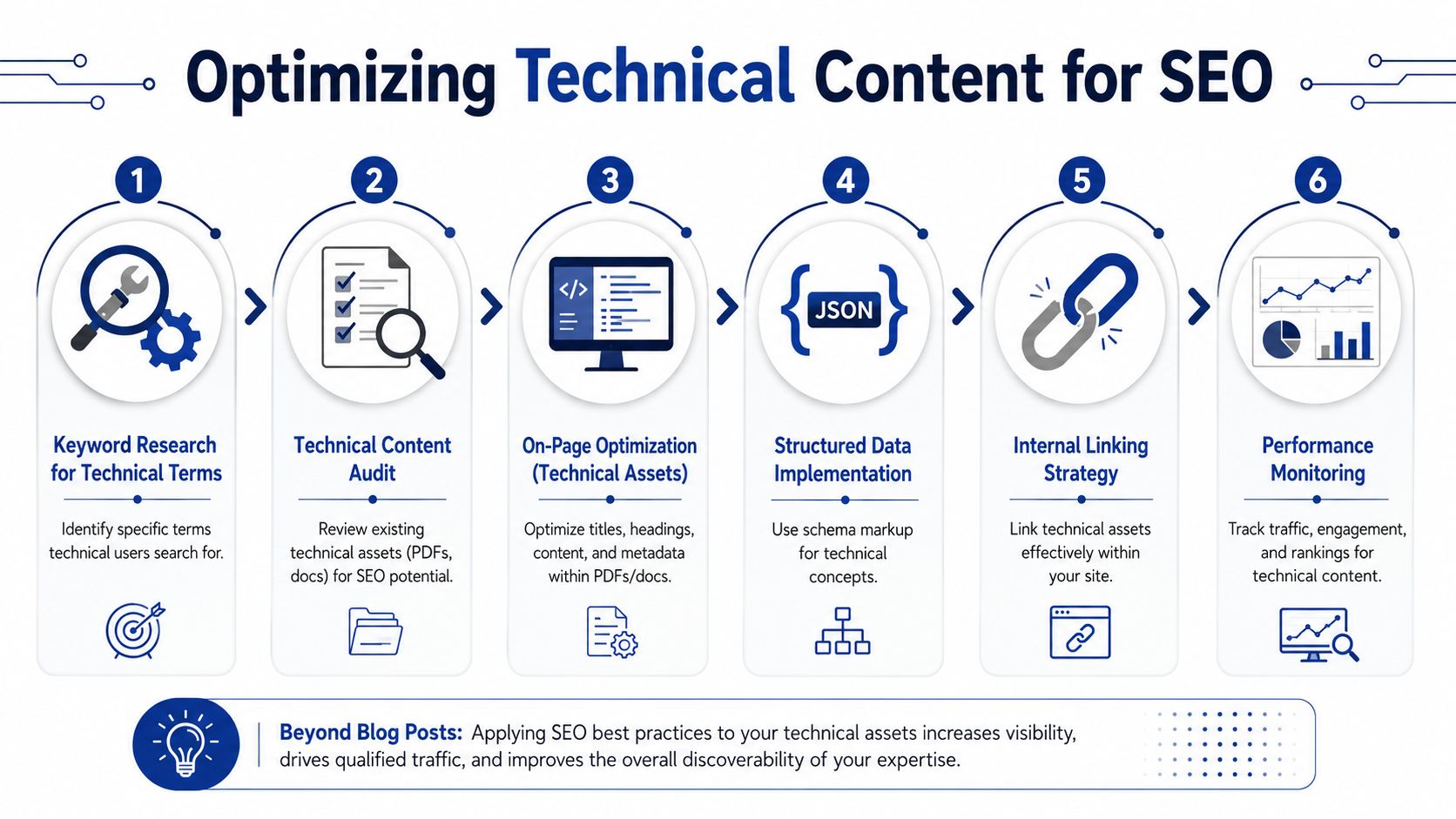
Search optimization for technical content starts with retrieval, not blogging. Buyers need to find the right asset, judge its relevance fast, and move to the next action without hunting through a resource center. That requires a system for turning expert knowledge into indexable pages, clear document structures, and links that mirror how engineers research.
Make technical assets searchable
Every high-value asset needs an HTML home page, even if the final deliverable is a PDF, calculator, CAD file, or gated guide. The page gives search engines context and gives buyers a quick way to confirm they are in the right place before they commit time or a form fill.
Build those pages with the same discipline you use for product documentation:
- Use a precise page title: Name the problem, component, spec, or use case directly.
- Write a short summary: State what the asset helps the reader evaluate, compare, size, fix, or implement.
- Break content into clear sections: Compatibility, operating limits, installation requirements, performance trade-offs, and maintenance implications are common patterns.
- Add a next action: Download the file, request a quote, contact engineering, or view related product pages.
The document itself also needs cleanup. File names, headings, image alt text, and on-page anchor links should describe the subject in plain technical language. "linear-actuator-side-load-guide.pdf" gets indexed and understood more easily than "final-v3-updated.pdf."
Optimize for query intent, not just keywords
Technical search queries are often narrow and high intent. "IP67 vs IP69K enclosure washdown," "servo motor sizing for vertical load," and "316 stainless compatibility with caustic cleaners" signal a buyer trying to solve a real selection problem. Those queries deserve dedicated pages or tightly matched sections within larger guides.
This is where a repeatable SME collaboration system matters. One interview rarely produces enough specificity for search. The better approach is to capture recurring field questions from sales engineers, application engineers, support, and product teams, then map each question to a page, section, or FAQ block. That gives your team a steady pipeline of search-driven topics grounded in actual buyer language.
A practical optimization checklist looks like this:
- Create parent-child topic structures: Link broad application pages to selection guides, troubleshooting content, FAQs, and product detail pages.
- Use schema where it fits the asset:
TechArticle,FAQPage, and product-related markup can improve how technical pages are interpreted. - Support gated assets with ungated context: Let readers assess relevance before asking for contact details.
- Link by engineering task: Connect overview pages to calculators, spec sheets, comparison content, and implementation resources.
- Reduce click depth: If a support document sits several layers deep, both crawlers and users have a harder time finding it.
For teams building this out, this guide to SEO for manufacturing companies is a useful reference for connecting technical pages, product architecture, and search intent.
Search traffic alone is not the goal. The goal is to attract the right technical visitor and help sales assess fit faster. Content that answers detailed evaluation questions can support both organic discovery and qualifying sales leads effectively, especially when the page makes the user's problem, constraints, and likely buying stage clear.
A spec sheet in a downloads folder rarely wins search visibility. A structured page that explains what the spec means, who it applies to, and what to read next has a far better chance.
Activating Content for Sales Enablement and Distribution
A rep is on a call with a plant engineer who asks a narrow question about compatibility, implementation risk, and maintenance load. If the only available asset is a broad top-of-funnel blog post, the deal stalls. Technical content earns pipeline when it helps sales answer real evaluation questions with speed and precision.
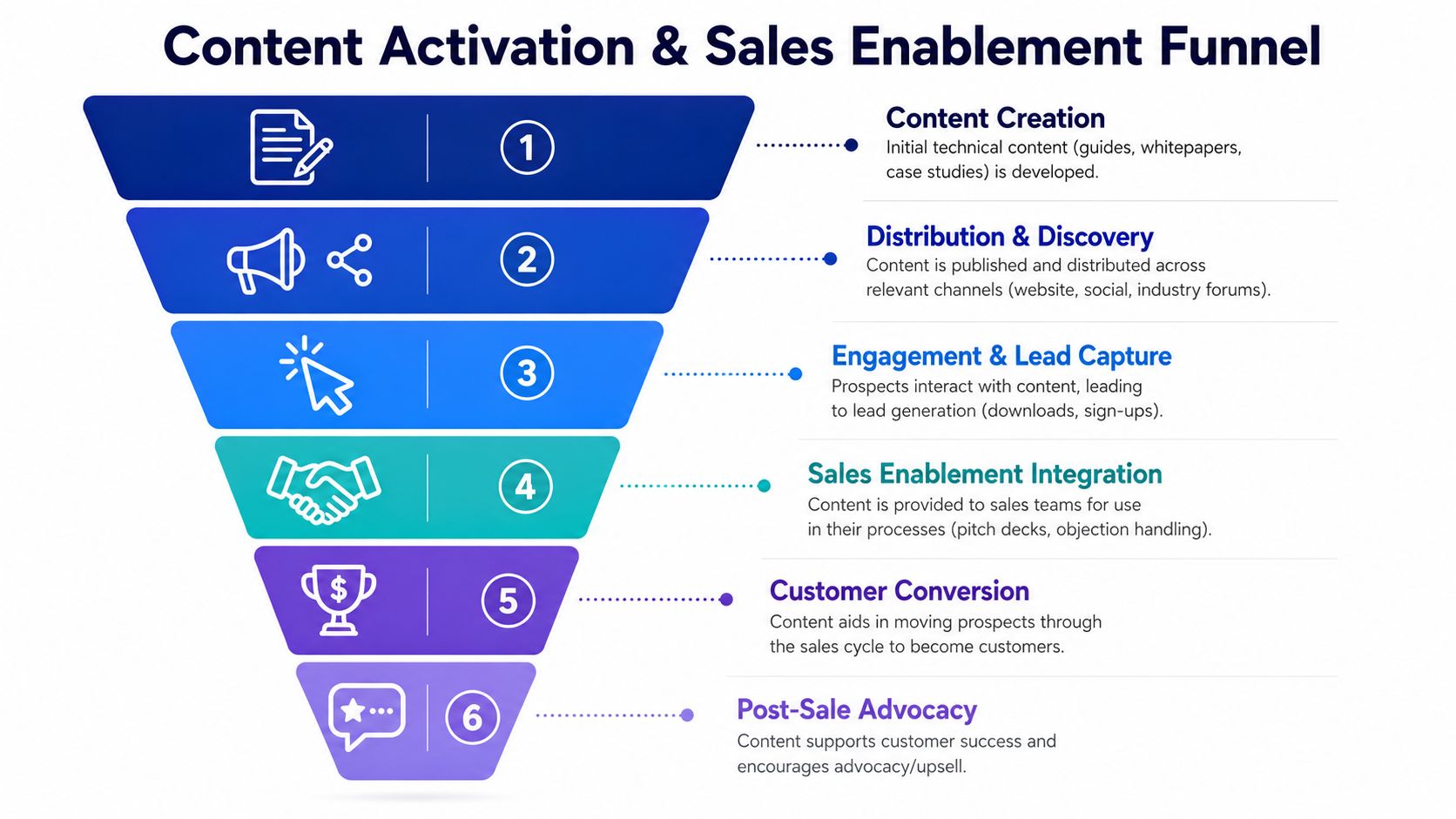
That requires an activation system, not a pile of published assets. Marketing needs a clear process for turning SME knowledge into material sales can trust, find, and use in the field. Buyers move between self-education, peer validation, and direct vendor conversations. Your content program has to support that motion.
Turn published assets into usable sales tools
Sales should not have to hunt through a CMS, Slack thread, or shared drive to find proof points. Build an internal content library around the questions reps hear late in the buying process: fit, risk, rollout, integration, cost justification, and internal approval.
A practical structure looks like this:
- Awareness assets: Problem guides, trend explainers, educational blog posts
- Evaluation assets: Application notes, comparison pages, whitepapers, technical FAQs
- Decision assets: Case studies, demo videos, implementation checklists, quote-support content
- Post-sale assets: Onboarding guides, maintenance resources, expansion use cases
The stronger approach is to attach each asset to a specific sales moment. That is where SME collaboration becomes repeatable. Instead of interviewing an engineer once for a whitepaper, capture reusable inputs: the common objection, the technical constraint behind it, the approved answer, the proof source, and the next recommended asset.
| Asset type | Best sales use |
|---|---|
| Application note | Answer fit and compatibility questions |
| Case study | Reduce perceived risk |
| Whitepaper | Support internal stakeholder buy-in |
| Demo video | Show practical operation before a call |
| Comparison page | Handle competitive evaluation |
A manufacturing funnel often benefits from both ungated and gated assets. Vital Design's manufacturing content marketing framework gives a useful model for splitting educational content, lead capture assets, and bottom-of-funnel demos by buying stage.
For teams refining handoff quality, this framework for qualifying sales leads effectively can help align content engagement signals with real sales readiness.
Distribute by channel, audience segment, and sales use case
Broad distribution is rarely the problem. Misdirected distribution is. A detailed implementation guide belongs in a follow-up email from sales, not the same social promotion plan as a thought-leadership post.
Use a simple activation workflow:
- Publish the core asset on your site
- Write a short version for email by segment, such as role, product interest, or application
- Give sales a one-page brief with the asset summary, approved talking points, and the best objection to pair it with
- Break the asset into smaller formats for LinkedIn, outbound follow-ups, partner sharing, or community responses
- Review which assets appear before meetings, quote requests, and opportunity creation
Technical content programs often break down. Marketing publishes, sales improvises, and SMEs are pulled back in to answer the same questions again. A repeatable system fixes that by packaging subject matter expertise once, then reusing it across campaigns, sequences, and sales conversations.
One rule matters here. Every distributed asset should have an intended sales action. Read this before the call. Send this after the objection. Use this when procurement asks for justification. If the next action is unclear, the asset is not ready for activation.
Teams that want tighter reporting between distribution and pipeline should set up campaign tracking early and connect content touches to CRM stages. This guide to measuring marketing ROI across channels and pipeline stages is a practical reference for that setup.
Good distribution is precise. It puts the right technical proof in front of the right buyer, and it gives sales a repeatable way to use SME-backed content without starting from scratch each time.
Measuring Content ROI and Driving Growth
A familiar pattern shows up six months into a technical content program. Traffic is up. A few articles rank. Sales still says the content is not helping enough in live deals, and leadership asks the same question again: what did this produce?
That question is fair. Technical content rarely drives value through a last-click conversion alone. It does its work earlier by reducing technical doubt, answering implementation questions, and helping buyers move through internal review. If measurement stops at sessions and form fills, the program will look weaker than it is. If measurement is too loose, every asset gets credit and none of the reporting is trusted.
Measure content at three levels
Use a simple model.
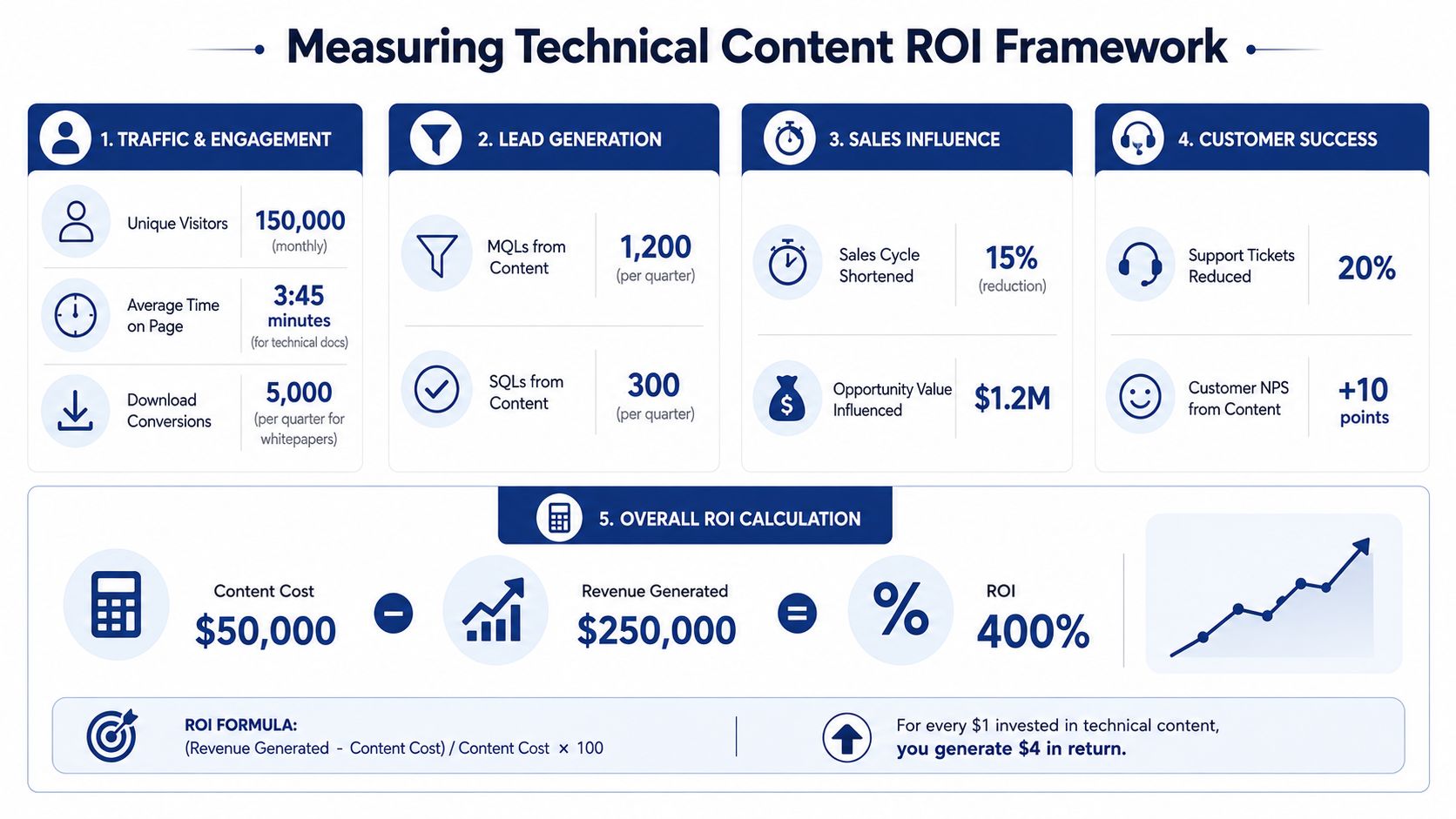
First, track consumption. This includes organic entrances, engaged visits, scroll depth on high-intent pages, and return visits to technical assets.
Second, track buying signals. Look for quote requests, demo requests, contact clicks, pricing-page visits after reading technical content, downloads of late-stage assets, and repeat views from known accounts.
Third, track pipeline influence. Check whether specific assets appear before sales meetings, opportunity creation, solution validation, or closed-won deals.
This structure matters because each layer answers a different question. Consumption tells you whether the topic is getting attention. Buying signals tell you whether the content is attracting the right audience. Pipeline influence tells you whether the asset deserves more investment, refreshes, and distribution support.
Connect SME-backed assets to revenue events
The strongest technical programs measure reuse, not just readership.
If an SME-heavy integration guide gets used by search visitors, outbound reps, and account executives in active deals, that asset is more valuable than a higher-traffic article nobody sends to prospects. The same logic applies to comparison pages, compliance explainers, migration guides, and application-specific case studies.
Track at least these signals:
- Sales-contact clicks from technical pages
- Quote or demo requests after viewing product-supporting content
- Asset usage by sales in active opportunities
- Repeat visits to technical pages from target accounts
- Opportunities influenced by specific articles, guides, or case studies
- Reuse rate of SME source material across multiple assets
That last metric gets missed. It should not. A repeatable SME collaboration system lowers production cost over time because one well-run expert session can feed a core article, a sales one-pager, objection handling copy, email follow-ups, and supporting posts. If the same experts are answering the same questions from scratch every month, the program is creating content but not building an operating system.
Build a dashboard your sales team will trust
A useful dashboard is plain and hard to argue with. It should show which assets attract qualified attention, which ones support deal progression, and which ones waste effort.
| Dashboard area | What to monitor |
|---|---|
| Audience fit | Organic entrances to technical pages, returning visitors, engagement on high-intent topics |
| Commercial intent | Contact actions, quote-page visits, demo requests, BOFU asset downloads |
| Revenue influence | Opportunities with content touches, meetings booked after asset views, closed-won deals with asset usage |
| Program efficiency | Production cost per asset, SME reuse rate, refresh cadence, sales adoption |
Keep attribution rules simple enough to maintain. Overbuilt reporting breaks fast, especially when marketing ops is trying to stitch together analytics, automation, CRM fields, and sales activity logs with limited support. Start with directional influence, then tighten the model once the team is using it.
If you need a practical framework for tying content touches to pipeline stages and revenue reporting, use this guide to measure marketing ROI across channels and pipeline stages.
Review the dashboard monthly. Cut topics that attract the wrong audience. Update assets that sales already uses but prospects keep challenging. Expand the themes that show up before qualified conversations and late-stage progression. That is how technical content turns from a publishing habit into a growth system.