A CNC shop owner can spend heavily on trade-show booths, send a quarterly email blast, and still wonder why inbound opportunities arrive in unpredictable bursts. The problem usually isn't effort. It's that the company has activities, not a connected system that helps technical buyers discover the right supplier, validate its capability, and justify a purchase before sales enters the conversation.
Industrial marketing solves that system problem. It connects search, technical content, email, sales enablement, events, paid media, and measurement around the way manufacturers are chosen. In this guide, we'll define what industrial marketing means, compare it with B2C, map the modern buyer journey, identify the channels that earn investment, and lay out a practical 90-day implementation plan.
Table of Contents
- What Industrial Marketing Actually Means
- How Industrial Marketing Differs From B2C
- The Modern Industrial Buyer Journey
- Channels That Move the Needle for Manufacturers
- KPIs and Measurement That Match Industrial Cycles
- Short Case Snapshots From Real Manufacturers
- Common Mistakes That Stall Industrial Marketing
- Your 90-Day Industrial Marketing Implementation Plan
What Industrial Marketing Actually Means
Industrial marketing is the system a manufacturer builds to be found, evaluated, and chosen by technical buyers. It serves manufacturers, machine shops, suppliers, distributors, and equipment companies whose buyers need more than a persuasive slogan. Engineers need specifications. Procurement needs commercial clarity. Operations leaders need confidence that the supplier can perform after the purchase.
The timing matters. One widely cited industry statistic says 57% of industrial buyers make purchase decisions before directly interacting with a manufacturing company, while websites with quote and contact forms average a 3% conversion rate, compared with 2.2% for the average online B2B conversion rate in manufacturing. Those figures are reported in industrial marketing facts and statistics from WebFX. Your website and content aren't supporting assets anymore. They're part of the sales process.
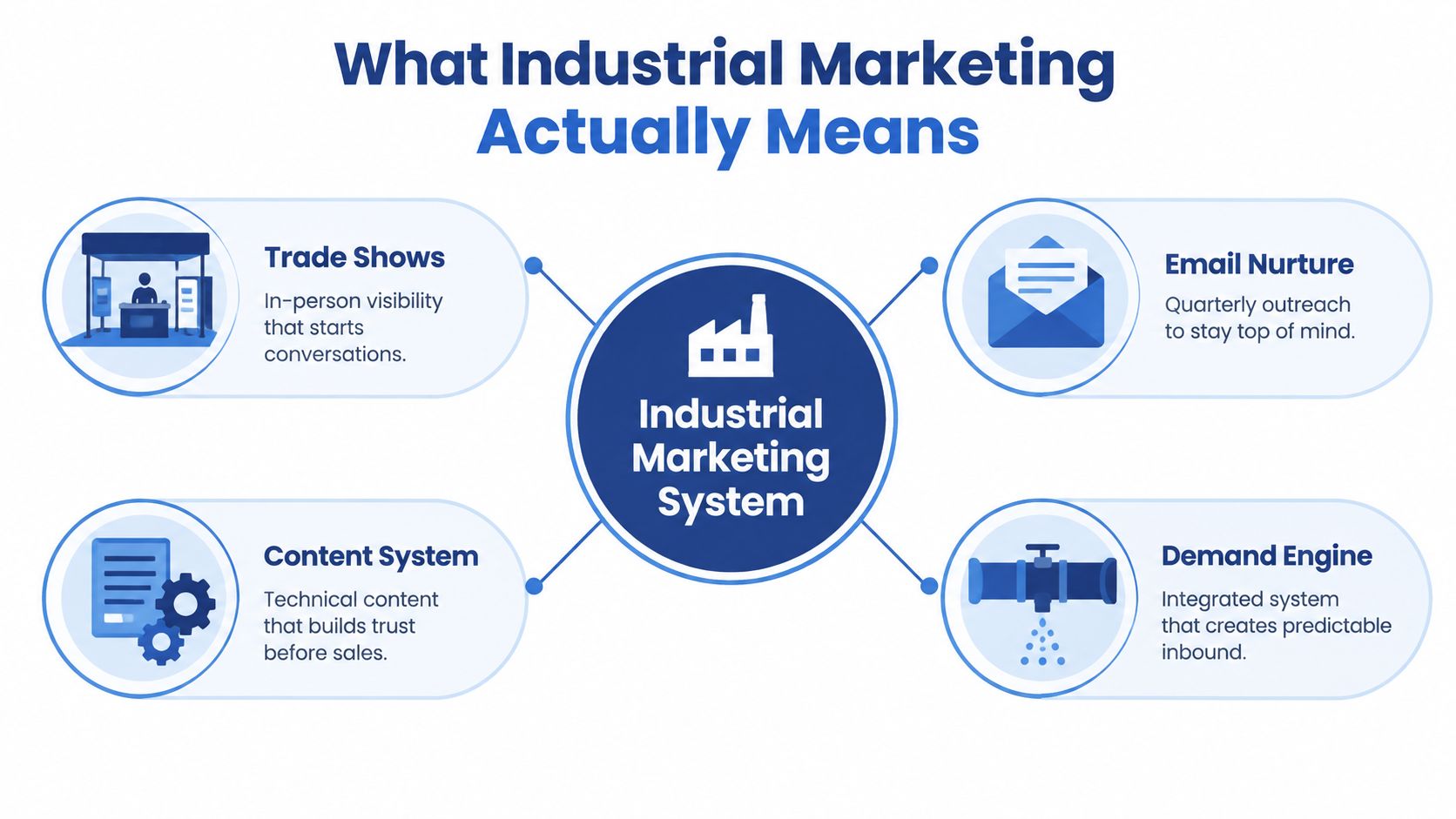
The three jobs of the system
A functioning industrial marketing program has three jobs:
- Generate qualified demand: Help the right accounts find you through industrial SEO, application content, events, referrals, and paid search.
- Equip sales with evidence: Give representatives case studies, comparison pages, compliance documentation, application notes, and answers to common objections.
- Shorten complex buying cycles: Remove avoidable friction before the first meeting, so sales spends time on fit, urgency, and commercial decisions rather than repeating basic explanations.
The mistake is treating these jobs as separate campaigns. A trade-show conversation should lead to a useful technical follow-up. A search visitor should find a clear application page and a credible next step. A quote request should enter a CRM workflow that gives sales context instead of another unqualified name.
Industrial marketing also has to account for the entire customer lifecycle. The industrial marketing strategy guidance from Machine Marketing is useful because it frames marketing as a connected growth system rather than a collection of isolated promotional tasks.
By the end of this article, you'll have a working definition, a channel decision framework, a measurement model, and a 90-day plan. The standard is simple: every marketing asset should help a buyer answer a technical, financial, or risk-related question.
How Industrial Marketing Differs From B2C
B2C marketing often aims to move one person from awareness to action quickly. Industrial marketing usually supports a group of stakeholders who must agree that a supplier is technically capable, commercially sensible, operationally reliable, and safe to approve.
That difference changes the creative brief. A consumer ad can win with recognition, emotion, convenience, or lifestyle appeal. A manufacturer needs evidence that survives an internal review, an engineering discussion, an RFP, and a procurement negotiation.
| Dimension | Industrial Marketing, B2B | Consumer Marketing, B2C |
|---|---|---|
| Buying group | Engineers, procurement, operations, finance, and executives may all influence the decision | Often one shopper or a small household decision |
| Sales cycle | Frequently extends across multiple research, validation, and approval stages | Often resolves in one session or a short consideration period |
| Technical depth | Tolerances, materials, certifications, integration, maintenance, and application fit matter | Benefits, features, convenience, identity, and experience usually lead |
| Price scrutiny | RFPs, negotiated pricing, delivery requirements, and total cost of ownership shape the decision | Listed price, promotions, financing, and perceived value dominate |
| Trust signals | Case studies, audit documentation, install references, test data, and engineering access | Reviews, ratings, creator content, guarantees, and brand familiarity |
The buying group is also wider than many teams assume. Forrester-referenced research reported by Optimum7's industrial B2B marketing guide identifies an average of 13 internal stakeholders and 9 external participants in complex purchases. That means one generic persona can't represent the whole account.
Evidence must travel internally
A plant manager may care about uptime and implementation risk. An engineer may need CAD files, dimensional data, and material compatibility. Procurement may focus on terms, delivery, and supplier qualification. Finance may ask whether the total cost is defensible.
Your content must give each person something they can forward. That could be a comparison matrix, a concise application note, a validation checklist, or a case study that explains the operating context rather than merely praising the supplier.
Practical rule: Create assets that help a champion defend your company when you're not in the room.
Industrial search also needs a modern interpretation. Buyers increasingly use search engines and AI-assisted research to summarize options, so teams should learn how to implement GEO and AEO for B2B, while keeping the underlying content specific, verifiable, and technically accurate. Industrial teams need evidence assets and long memory, not emotional creative alone.
The Modern Industrial Buyer Journey
A procurement engineer and plant manager may begin with a production problem, not a supplier name. They search for the failure mode, review technical discussions, examine product data, and ask colleagues for recommendations before any representative knows the account exists.
That journey has several distinct stages. Marketing has to place the right artifact at each one.
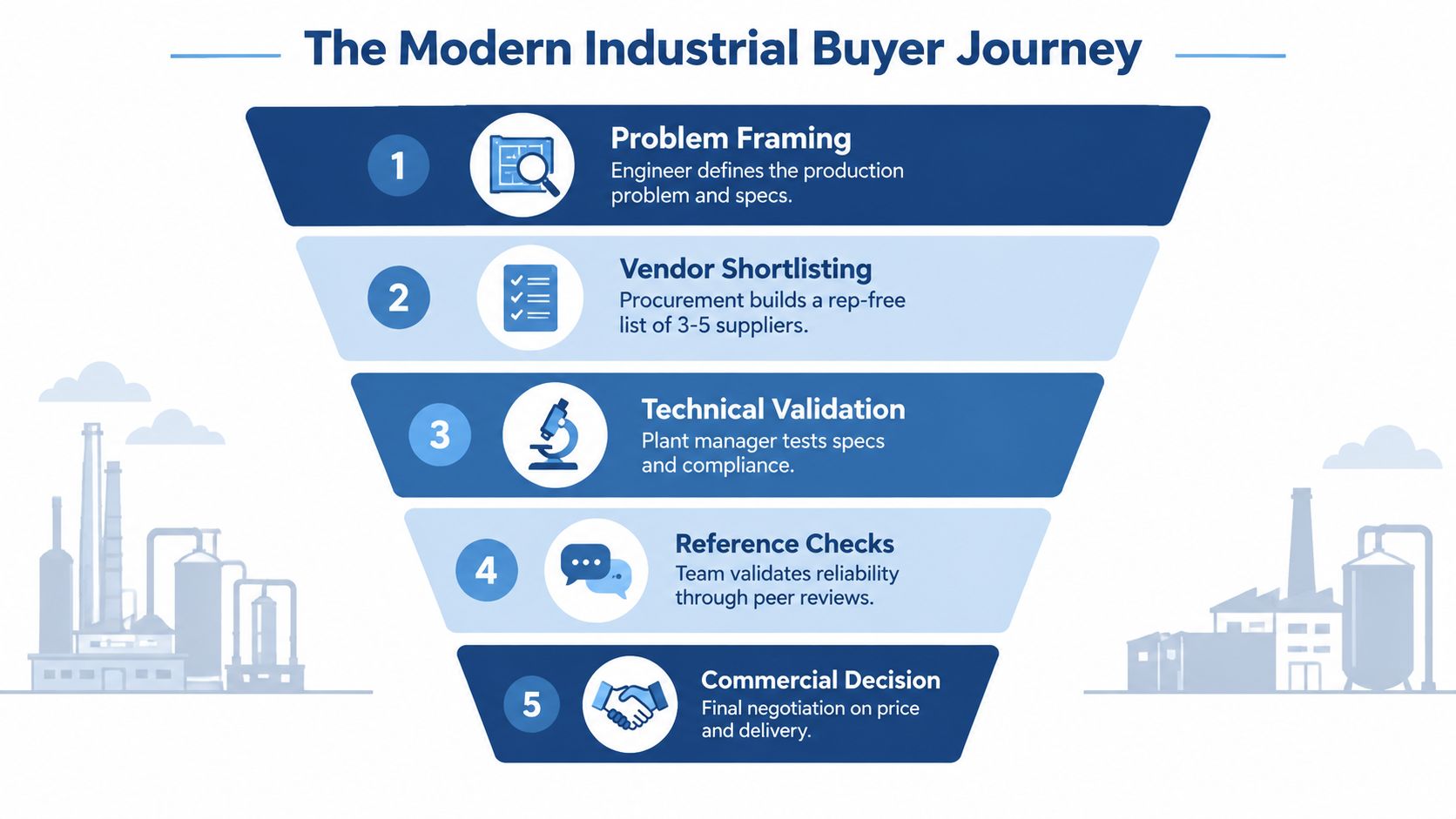
Five stages, five friction points
- Problem framing: The engineer defines the production problem and the required specifications. Marketing needs pages that use the buyer's language, such as surface-finish problems, thermal limits, automation integration, or repeatability concerns.
- Vendor shortlisting: Procurement builds an initial supplier list without necessarily speaking to representatives. Clear service pages, product coverage, industries served, geographic information, and qualification details reduce uncertainty.
- Technical validation: The plant manager and engineering team test specifications, compliance, compatibility, and implementation requirements. Downloadable data sheets, drawings, application notes, videos, and comparison content matter here.
- Reference checks: The team looks for evidence that the supplier has delivered in a similar environment. Case studies, install references, testimonials, and transparent descriptions of constraints carry more weight than broad claims.
- Commercial decision: The shortlist becomes a negotiation over price, delivery, service, and risk. A calculator, quote process, scope checklist, or total-cost explanation can help a champion build the internal business case.
Much of this research is private. Buyers may use search, peer conversations, industry communities, forwarded documents, and AI tools without filling out a form. That doesn't mean marketing is absent. It means the company must publish assets that answer questions before a form submission becomes visible.
A useful way to audit this journey is to ask, “What would a skeptical engineer need to forward internally?” The consumer decision-making journey framework from Machine Marketing offers a broader way to think about decision stages, but industrial teams should apply it through technical validation and account-level evidence.
The following video provides another visual explanation of the journey:
The objective isn't to force every buyer into a form. It's to make your company easy to understand, compare, validate, and contact whenever the buyer is ready.
Channels That Move the Needle for Manufacturers
Manufacturers don't need every channel. They need the right sequence for their market, sales capacity, product complexity, and account concentration. A machine shop selling into a narrow regional market shouldn't copy the channel mix of a global automation supplier.
| Channel | Typical Cost Shape | Time to Impact | Best For | Watch Out For |
|---|---|---|---|---|
| Industrial SEO | Compounds through research, content, and technical optimization | Gradual | Specification and application searches | Publishing generic pages without engineering input |
| Technical content | Internal expertise plus production and review time | Moderate | Evaluation, validation, and sales enablement | Treating data sheets as the entire content strategy |
| Email and CRM | Platform, setup, list quality, and workflow management | Moderate | Follow-up, reactivation, and account education | Sending the same blast to every contact |
| ABM | Research, sales alignment, content, and targeted outreach | Targeted | Strategic named accounts | Choosing accounts without a clear reason to win |
| Trade shows and events | Booth, travel, sponsorship, staffing, and follow-up | Immediate conversations, slower attribution | Discovery and relationship development | Measuring floor traffic instead of pipeline |
| Paid search and retargeting | Media spend plus landing-page and conversion work | Fast traffic, variable lead quality | Capturing active intent and staying visible | Paying for broad terms that don't signal fit |
Start with the buyer's question
Industrial SEO earns priority when buyers search for specific capabilities, materials, tolerances, replacement parts, or application solutions. Build pages around those questions, then connect them to proof and a clear inquiry path.
Technical content performs its best work in the middle of evaluation. Application notes, comparison guides, process videos, and selection tools help an engineer decide whether your company belongs on the shortlist.
Email tied to a CRM is more useful as a memory system than as a newsletter. Segment contacts by industry, application, account status, and known interest. A person who downloaded a machining capability guide shouldn't receive the same next email as a dormant trade-show contact.
ABM makes sense when a small number of accounts represent meaningful opportunity and sales can work a coordinated plan. Start with a reason for selecting each account, then align advertising, content, outreach, and executive involvement around that reason.
Trade shows still matter where buyers want to inspect equipment, discuss process constraints, or meet specialists. But the event is only one touchpoint. Without pre-event targeting and post-event follow-up, the booth becomes an expensive collection of conversations.
Paid search can capture urgency, especially for replacement, repair, and clearly specified needs. Use narrow intent terms, dedicated landing pages, negative keywords, and conversion tracking. The 2026 manufacturing benchmark compiled by Webtonic reports a $5.70 Google Ads industrial CPC and a 2.1% website visitor-to-lead conversion benchmark, useful as planning references rather than promises.
For a broader perspective on current priorities, B2B marketing for manufacturers in 2026 provides additional channel context. In the first 90 days, sequence channels this way: fix the conversion path, publish the highest-value technical pages, connect follow-up to the CRM, then add paid or ABM where sales can respond quickly.
KPIs and Measurement That Match Industrial Cycles
Lead volume is easy to report and easy to misunderstand. A form submission from a poor-fit company can inflate the dashboard while a quiet target account reads technical content for months before contacting sales.
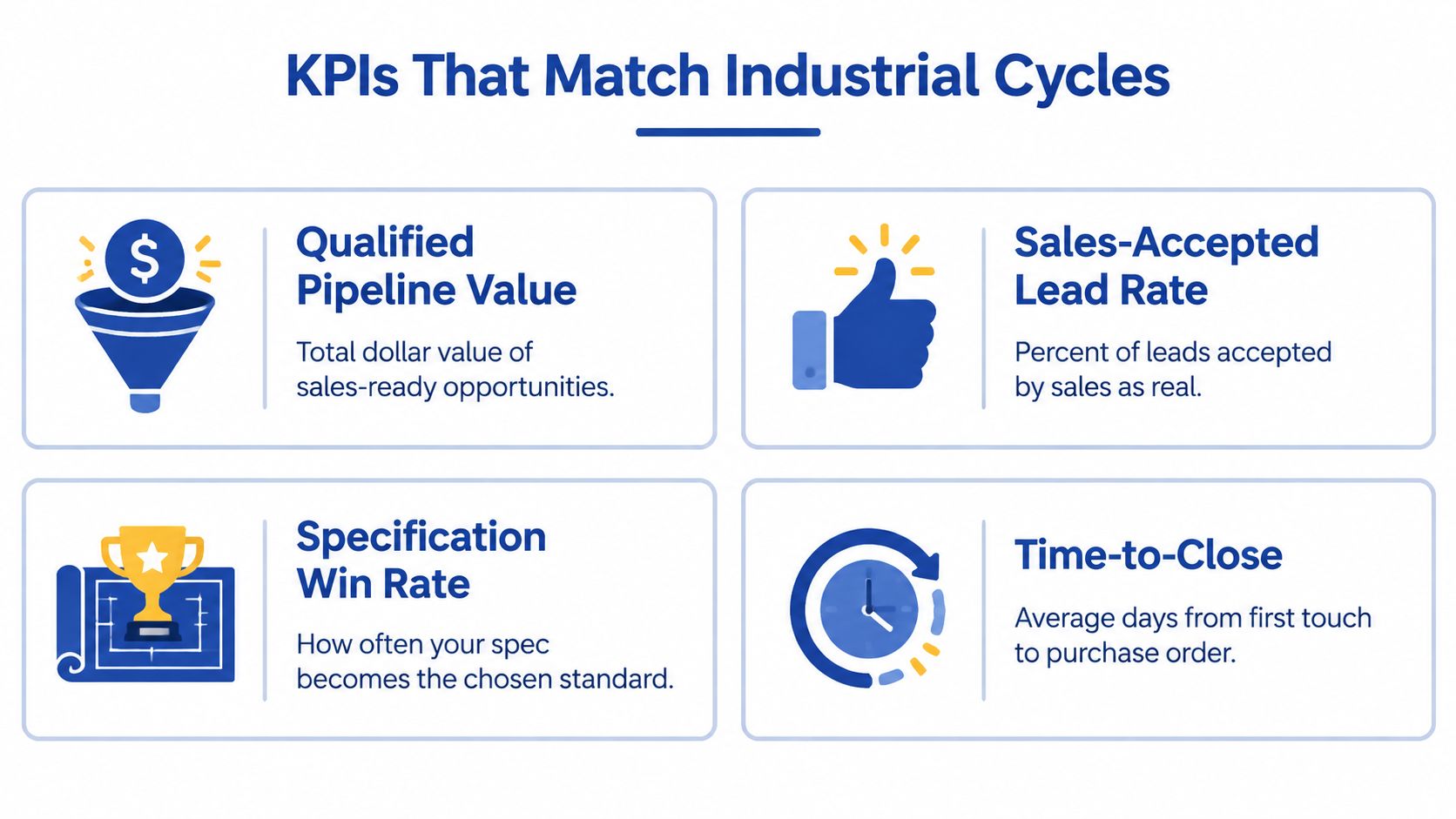
A better measurement system follows account movement and commercial progress. Track:
- Qualified pipeline value: The dollar value of opportunities that sales considers real and active.
- Sales-accepted lead rate: The share of marketing-sourced inquiries that sales accepts after reviewing fit and intent.
- Specification win rate: How often your product or process becomes the chosen specification on target opportunities.
- Content influence: Which assets appeared in the journey of opportunities that progressed or closed.
- Sales cycle length: Compare time from first known interaction to purchase order by segment, product, and source.
- Customer acquisition payback: Evaluate whether gross profit from new business repays acquisition investment within an acceptable period.
Use benchmarks as signals, not guarantees
A 2026 benchmark summary reports a 3.4% click-through rate for B2B engineering-focused content aimed at engineers and decision-makers, as documented by Digital Marketing's industrial benchmark. That can help you spot weak relevance, but it can't tell you whether the clicks come from valuable accounts.
Marketing spend has also become more central to manufacturing growth planning. Reported average marketing spend rose from 6.7% of revenue in 2024 to 9.5% in 2025, a 42% increase, according to the WebFX industrial marketing data. Use that context carefully. Budget growth should follow evidence of opportunity, not create activity for its own sake.
Attribution needs the same honesty. First-touch attribution shows how an account discovered you. Last-touch shows what created the visible conversion. Weighted multi-touch models distribute credit across interactions, but they depend on clean data and sensible assumptions.
For many manufacturers, a practical starting point is source-of-conversion tracking plus opportunity-stage influence. The manufacturing marketing KPI guidance from Machine Marketing can help structure that dashboard. Set thresholds from your own baseline, then review whether target accounts are advancing, sales accepts the opportunities, and content removes objections.
Short Case Snapshots From Real Manufacturers
The most useful examples show a decision, not a victory lap. They explain what changed, what moved, and what the team learned.
A precision machining supplier rebuilt its website around application pages. The old site organized information around internal service names, so buyers had to translate their production problem into the company's terminology. The team created pages for specific applications, materials, and manufacturing requirements, then connected each page to qualification questions and inquiry paths. Organic qualified requests increased fourfold over nine months. The lesson is that search visibility improves when the site reflects how engineers describe work, not how the shop organizes its departments.
An industrial automation integrator ran an ABM pilot against 20 named accounts. Sales and marketing agreed on account selection, mapped likely stakeholders, and built coordinated outreach around each company's operating context. The pilot won three new logos worth seven figures combined and became a repeatable playbook. The lesson is that ABM works when it is an account strategy with marketing support, not a list upload followed by generic advertising.
A components manufacturer reduced its trade-show footprint by half. It redirected budget toward technical webinars and SEO, then used event conversations as inputs for follow-up content instead of treating the booth as the whole campaign. The company reported shorter discovery-to-quote cycles. The lesson is that event reduction doesn't mean abandoning relationships. It means extending the useful life of event knowledge.
The fastest return usually comes from fixing an existing high-intent path, such as a quote process, a technical page, or follow-up sequence. New channels can help, but they can't compensate for a confusing conversion experience.
Common Mistakes That Stall Industrial Marketing
Mistake one is treating one persona as the committee
The symptom is a website written only for “the engineer” or only for procurement. The hidden cost is internal friction when a technical champion can't give finance, operations, or purchasing the evidence they need.
Map the committee instead. For each role, document the question, objection, proof requirement, and preferred format. One person may need a drawing. Another may need a delivery explanation. A third may need a cost justification.
Mistake two is worshipping MQL counts
A growing MQL total can conceal poor fit, duplicate contacts, or activity from accounts that will never buy. The better default is account movement: new target accounts engaged, qualified opportunities created, sales acceptance, stage progression, and specification wins.
Mistake three is publishing spec sheets alone
A data sheet answers “what is it?” It often doesn't answer “will it work in my process?” Add application stories, selection guidance, process explanations, videos, installation notes, and comparison assets. A technically correct document can still fail if it leaves the buyer to interpret everything alone.
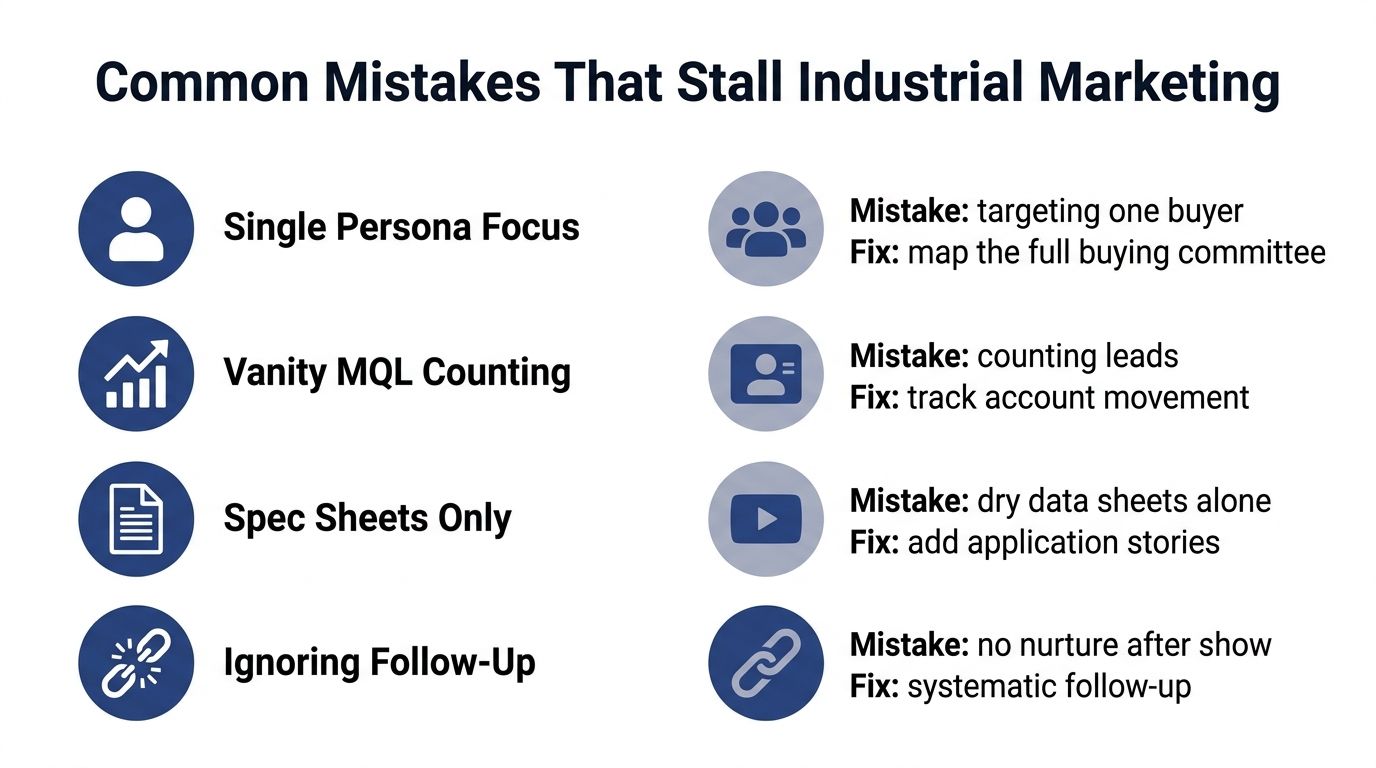
Mistake four is ignoring private research and follow-up
If a buyer doesn't complete a form, your team may never see the research that shaped the shortlist. You can't eliminate that blind spot, but you can publish citable evidence, monitor account-level engagement where possible, and give sales useful follow-up sequences.
Trade-show contacts need a documented next step. Website inquiries need routing rules. Downloaded technical content needs a relevant continuation, not an unrelated newsletter.
Weak evidence and vague targeting compound over time. Sales then gets blamed for poor conversion when the system never gave buyers enough confidence to move.
Your 90-Day Industrial Marketing Implementation Plan
A 90-day plan should produce decisions and usable assets, not a larger backlog. Assign one owner to each phase, involve sales and engineering early, and require the business owner to approve the few choices that can otherwise stall execution.
Days 1 to 30, diagnose and focus
Outcome: A defined ideal customer profile, buying committee map, baseline dashboard, and evidence inventory.
Complete these tasks:
- Review the last opportunities won, lost, and abandoned. Identify industries, applications, deal triggers, objections, and proof gaps.
- Define the target account profile by market, capability fit, geography, buying trigger, and commercial potential.
- Map the committee. List engineering, procurement, operations, finance, executive, distributor, and service concerns where relevant.
- Audit the website, CRM, sales files, case studies, drawings, certifications, testimonials, and application knowledge.
- Agree on qualified pipeline value, sales acceptance, specification wins, cycle length, and acquisition payback as core measures.
The owner signs off on the target market, priority offer, and definition of a qualified opportunity.
Days 31 to 60, build the evidence layer
Outcome: A conversion-ready website foundation and a repeatable content and account workflow.
Rebuild the most important service and application pages around buyer language. Publish two technical comparison assets, such as a material-selection guide, process comparison, integration checklist, or replacement decision guide.
Create an ABM target list only if sales can actively work it. Set up CRM stages, contact roles, source tracking, and follow-up sequences. Instrument forms, calls, downloads, quote requests, and opportunity influence so the team can see more than traffic.
The owner signs off on the two content priorities, the target-account criteria, and the response standard for new inquiries.
Days 61 to 90, activate and review
Outcome: Live campaigns connected to sales, with a documented pipeline review.
Align paid search and trade-show activity with the new pages and follow-up workflows. Run the first ABM plays with coordinated sales outreach. Turn completed projects into case studies that explain the original problem, technical solution, operating context, and measurable commercial outcome when the customer permits it.
Hold a pipeline review at the end of the phase. Examine account engagement, sales acceptance, opportunity quality, content influence, and stalled stages. Remove channels that create activity without useful account movement, then reinvest in the paths that produce evidence of fit.
Your marketing system doesn't need to be perfect after 90 days. It needs a clear diagnosis, a focused evidence layer, reliable handoffs, and enough measurement to make the next decision intelligently.
Machine Marketing helps manufacturers connect industrial SEO, technical content, CRM and email campaigns, website improvements, and lead-generation strategy into a practical demand system. Visit Machine Marketing to discuss a diagnosis of your current buyer journey and identify the next marketing assets your sales team and technical buyers need.