Most advice about demand generation vs lead generation starts with a tidy funnel and ends with “you need both.” That's directionally correct, but it doesn't solve the problem faced by a manufacturer with a finite market, technical buyers, long quoting cycles, and few monthly inquiries. More form fills can create more work for sales without creating more revenue.
The useful question is different: which accounts are becoming interested, which contacts are ready for a conversation, and how do you measure progress before a purchase request appears? We'll separate demand creation from demand capture, connect each motion to the right KPIs, and build a practical system for industrial businesses.
Table of Contents
- Rethinking the Funnel for Industrial Markets
- Comparing Goals and Buyer Journey Stages
- Measuring Success with the Right KPIs
- Choosing the Best Channels and Content Formats
- Applying Account-Based Strategies for Industrial Markets
- Aligning Sales and Marketing Handoffs
- Building Your Next-Step Implementation Checklist
Rethinking the Funnel for Industrial Markets
A form fill is an event, not a sales opportunity. Someone may download a technical document for research, apply for a job, compare suppliers, or request information that has nothing to do with an active project. If your team treats every contact as pipeline, sales spends time sorting noise instead of advancing qualified opportunities.
Demand generation creates awareness and interest before a buyer is ready to identify themselves. It helps a manufacturer explain an application problem, demonstrate technical competence, and become familiar to the people who influence a future purchase. Lead generation captures that interest into a contact record, usually through a form, consultation request, quote request, demo, or other conversion point. Demand generation precedes lead generation because it builds the audience that lead generation later identifies.
The distinction is especially important in industrial markets. A buyer may need to validate tolerances, materials, production capacity, quality systems, lead times, and application fit before contacting a supplier. Several people may participate, including engineering, purchasing, operations, and ownership. A lead-generation-only program asks for a name before the buying group has developed enough confidence to engage.
Demand creation and demand capture
A practical operating model separates demand creation from demand capture:
- Demand creation educates the 95% of the market that isn't actively seeking a solution, according to the demand creation and demand capture framework.
- Demand capture reaches the 5% actively looking to buy, using conversion paths that make it easy to request help, pricing, availability, or a technical discussion.
The exact split matters less than the principle. Your ungated machining guide may reach an engineer who won't submit a form today but will remember your company when a project enters sourcing. Your quote-request page serves a different visitor, one who already has a defined need and wants a response.
Practical rule: Don't force every visitor into the same conversion path. Give early researchers useful education, and give active buyers a fast route to a human.
A useful marketing funnel framework should therefore account for returning visitors, account engagement, sales conversations, and pipeline influence, not just contact volume. For manufacturers, the funnel isn't a conveyor belt. It's a set of repeated interactions across a buying committee.
Comparing Goals and Buyer Journey Stages
Demand generation and lead generation use overlapping channels, but they answer different buyer questions. Demand generation answers, “Why should this problem matter, and why should this company be considered?” Lead generation answers, “Who is interested enough to continue the conversation, and what should happen next?”
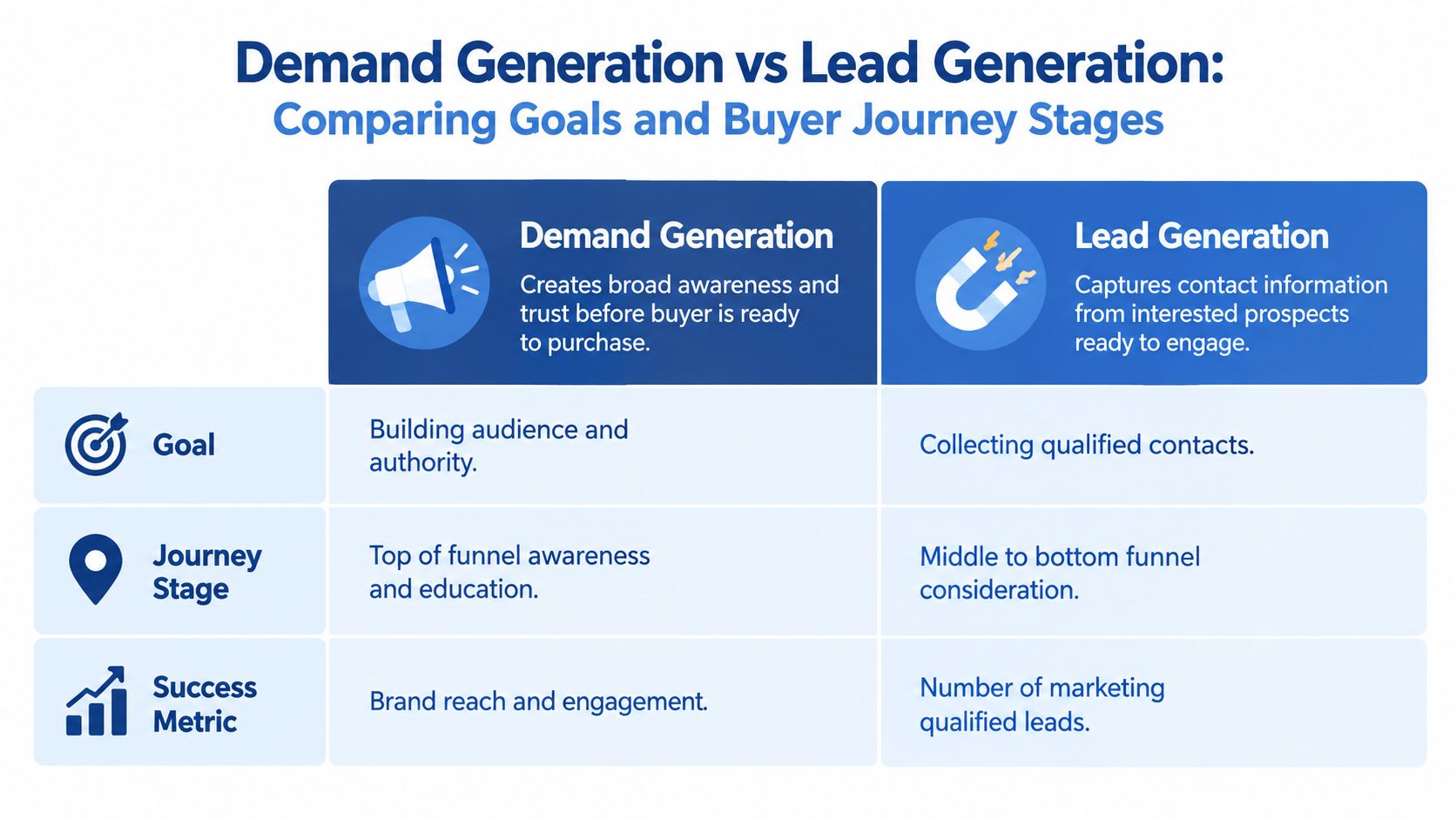
Where the motions diverge
| Dimension | Demand generation | Lead generation |
|---|---|---|
| Primary job | Build awareness, authority, and interest | Capture identifiable prospects |
| Buyer readiness | Early research or problem education | Active evaluation or request for assistance |
| Typical friction | “I don't know this supplier yet” | “I need enough value to exchange my contact details” |
| Useful content | Ungated technical education, articles, podcasts, videos | Forms, assessments, quote requests, demos, and gated resources |
| Main measurement lens | Account engagement and pipeline influence | Contact conversion and qualification |
| Sales involvement | Equip future conversations | Accept, qualify, route, and advance contacts |
Demand generation is broader than brand awareness. For an industrial company, it can clarify an application challenge, explain a material choice, compare manufacturing approaches, or show how to evaluate a supplier. That content earns attention from people who may not be ready to call.
Lead generation becomes appropriate when the visitor has a reason to exchange information. A request for a capacity review, design-for-manufacturing discussion, sample evaluation, or quote can justify a form because the next step offers direct commercial or technical value.
One asset can support both jobs
The mistake isn't using the same subject for both motions. The mistake is giving the asset only one job. A technical article can attract organic search visitors and answer early questions. Within that article, a relevant calculator, drawing review, or consultation can provide a voluntary next step for a higher-intent reader.
Content marketing often serves as the bridge. 74% of B2B marketers said content marketing helped generate demand or leads in the last 12 months, according to B2B lead-generation statistics compiled by Sopro. The same asset can support upstream education and downstream capture when the conversion offer matches the reader's readiness.
Ask three questions before publishing:
- Is the buyer trying to understand a problem, compare approaches, or select a supplier?
- Does the call to action fit that stage?
- Will the sales team know what the contact engaged with?
If an educational article is gated too early, reach suffers. If a quote form appears only after a long sequence of generic content, a ready buyer may leave. Precision comes from matching the ask to the buyer's current question.
Measuring Success with the Right KPIs
Industrial marketing can look productive while producing little pipeline. A dashboard built around form fills misses account-level interest. A dashboard built around reach gives marketing no responsibility for commercial outcomes. For long-cycle, low-volume sales, measurement must connect buyer engagement, sales acceptance, and opportunity progress.
The distinction is practical: demand generation is measured at the account and pipeline level, while lead generation is measured at the contact and conversion level. Salesforce's B2B demand-generation guidance includes brand search volume, share of voice, content engagement, intent lift, and inbound pipeline growth among demand metrics. Lead metrics include MQL volume, MQL-to-SQL conversion rate, cost per lead, speed-to-lead, and lead-to-opportunity rate.
Why form-fill reporting distorts reality
Across B2B websites, the average visitor-to-lead conversion rate is about 2.6%, while the median MQL-to-SQL conversion rate across B2B SaaS is 13%, according to B2B lead-generation benchmarks for 2026. These figures are not manufacturing-specific, but they show why captured contacts require qualification and nurturing before they become credible opportunities.
A form submission also says little about account value, project timing, or technical fit. In manufacturing, one engaged target account can matter more than a large volume of unrelated contacts. The operating lesson is direct: more traffic and forms will not repair weak qualification or an incomplete sales handoff.
Use a dashboard that separates leading indicators from revenue outcomes:
| Metric category | Demand generation KPIs | Lead generation KPIs |
|---|---|---|
| Awareness | Brand search volume, share of voice | Not a primary measure |
| Engagement | Account content engagement, returning visits, intent lift | Contact activity after conversion |
| Capture | Account entry into pipeline | MQL volume, cost per lead |
| Qualification | Engaged target accounts, influenced pipeline | MQL-to-SQL, lead-to-opportunity |
| Operations | Pipeline growth from inbound sources | Speed-to-lead, routing completion |
| Revenue | Account-level pipeline influence | Opportunity creation and progression |
Build a dashboard your sales team can use
Connect marketing activity to CRM records wherever possible. Track which target accounts return, which pages they study, whether known contacts request a conversation, and whether those accounts enter an opportunity. Attribution will remain incomplete when buying committees research privately or engage with several suppliers, so use the data as directional evidence rather than a claim of perfect causation.
For each contact, monitor the path from conversion to an accepted sales conversation. Review lead source, company fit, application, project timing, and why sales accepts or rejects the contact. A manufacturing marketing KPI framework can help the team diagnose leakage instead of rewarding activity alone.
The dashboard should answer two questions: Are the right accounts becoming more engaged, and are captured contacts becoming better opportunities?
Choosing the Best Channels and Content Formats
Channel selection should follow buyer readiness, not internal preference. A machine shop may publish a detailed capabilities page, but that page can serve two very different visitors: an engineer learning what processes are possible and a purchasing manager comparing suppliers for an active job.
Start by auditing every important asset. Label each item demand creation, nurture, or lead capture, then check whether its call to action matches the label.
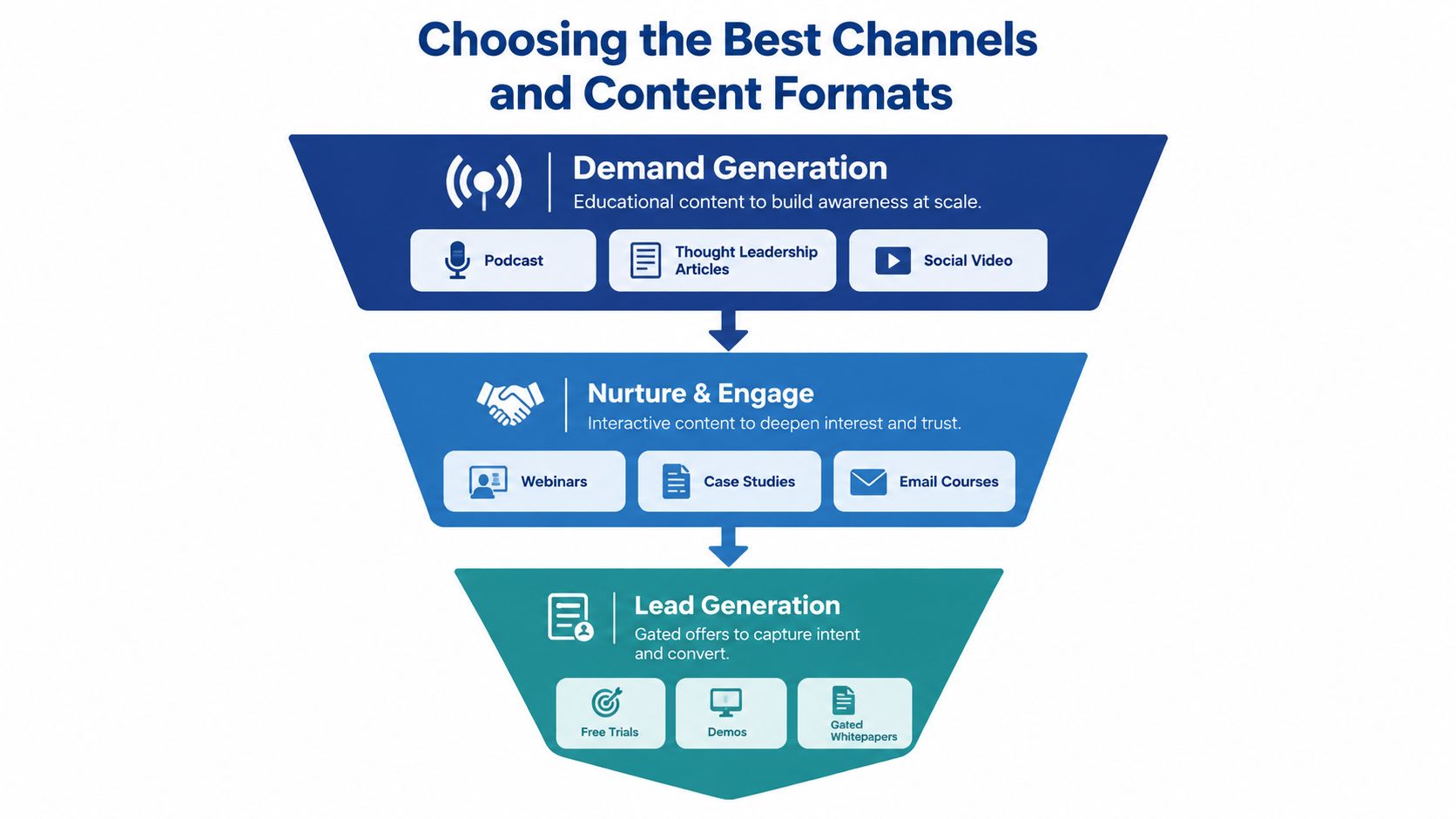
Match the format to the job
Demand creation formats should be easy to access and easy to share. Examples include:
- Technical articles: Explain application problems, material decisions, tolerances, process limits, and supplier-selection criteria.
- Industry podcasts: Give engineers, owners, and sales professionals a way to discuss recurring production challenges without turning every episode into a product pitch.
- Organic search pages: Answer specific questions buyers ask before they know which supplier they want.
- Short technical video: Show equipment, inspection methods, setup considerations, or process context that text alone may not communicate.
Lead capture formats should make a stronger exchange worthwhile:
- Quote and capacity requests: Use a concise form and ask only for information needed to route the inquiry.
- Design or application reviews: Offer a clear technical next step for a visitor with a defined problem.
- ROI assessments and calculators: Help buyers evaluate cost, downtime, scrap, or process alternatives when the inputs are meaningful.
- Targeted paid campaigns: Send active searchers to a focused landing page rather than a generic homepage.
Nurture content sits between the two. Case studies, webinars, email courses, comparison pages, and project checklists help a known contact build internal confidence. They also give sales useful context before a call.
Remove unnecessary gates
Don't put a form in front of every valuable resource. An ungated guide can earn search visibility and establish credibility, while a related assessment can capture the smaller group ready to discuss a project. If you gate the guide itself, you may reduce the number of engineers who discover and share it.
A single core asset can create multiple paths. Turn a technical guide into an article series, a sales enablement document, a short video, and a diagnostic worksheet. Keep the educational material open, then place the worksheet or consultation behind a clear, relevant invitation.
Educational content is not separate from pipeline work. It is often the bridge. The key is to connect it to a useful next step without interrupting the buyer before trust exists.
Applying Account-Based Strategies for Industrial Markets
A broad-audience funnel makes less sense when your company sells specialized equipment, precision parts, fabrication, or contract manufacturing to a defined set of accounts. You don't need every visitor. You need the right engineering, operations, purchasing, and executive stakeholders inside accounts that can buy.
That changes the operating model from volume acquisition to account-based orchestration. Recent guidance on ABM-style demand generation for industrial manufacturers recommends identifying target accounts first, then coordinating personalized education, targeting, and contact capture around those accounts.
Start with the account, not the form
Define an initial target-account list using the characteristics that affect commercial fit:
- Application fit: Does the account buy the type of process, equipment, or component you deliver?
- Operational fit: Can your capacity, quality requirements, materials, and lead times support the work?
- Commercial fit: Is the account large enough, accessible enough, and strategically valuable for your sales model?
- Relationship status: Is it a current customer, dormant customer, known prospect, or entirely new account?
Then map the buying group. A contact who downloads a process guide may be an engineer. The person who approves a supplier may sit in purchasing. The person who feels the operational pain may be in production. Your content and outreach should help these people build a shared case for change.
Coordinate creation and capture
Use ungated education to make the account familiar with your expertise. When engagement indicates a more active project, offer a targeted conversion path such as a technical review, application call, sample request, or quote discussion. The contact record matters, but the account context matters more.
A revenue operations approach can help connect marketing activity, sales ownership, CRM data, and account progression. The system should show which accounts are engaged, which stakeholders are known, what they consumed, and what action sales should take next.
For a finite market, relevance beats reach. A smaller program that reaches the right buying committee can be more useful than a larger program that produces disconnected contacts.
Document the play in your account-based marketing process for B2B. Assign account owners, define trigger events, specify the next offer, and decide when marketing pauses and sales takes control. Demand generation and lead generation then operate as coordinated actions aimed at the same account over time.
Aligning Sales and Marketing Handoffs
A marketing-qualified lead isn't automatically sales-qualified. For a manufacturer, qualification should reflect the realities of the work, including application, technical fit, project timing, authority, and the kind of help requested.
The handoff needs an agreement, not an assumption. Marketing must know what sales accepts, and sales must commit to reviewing qualified contacts and returning useful reasons when a lead isn't ready.
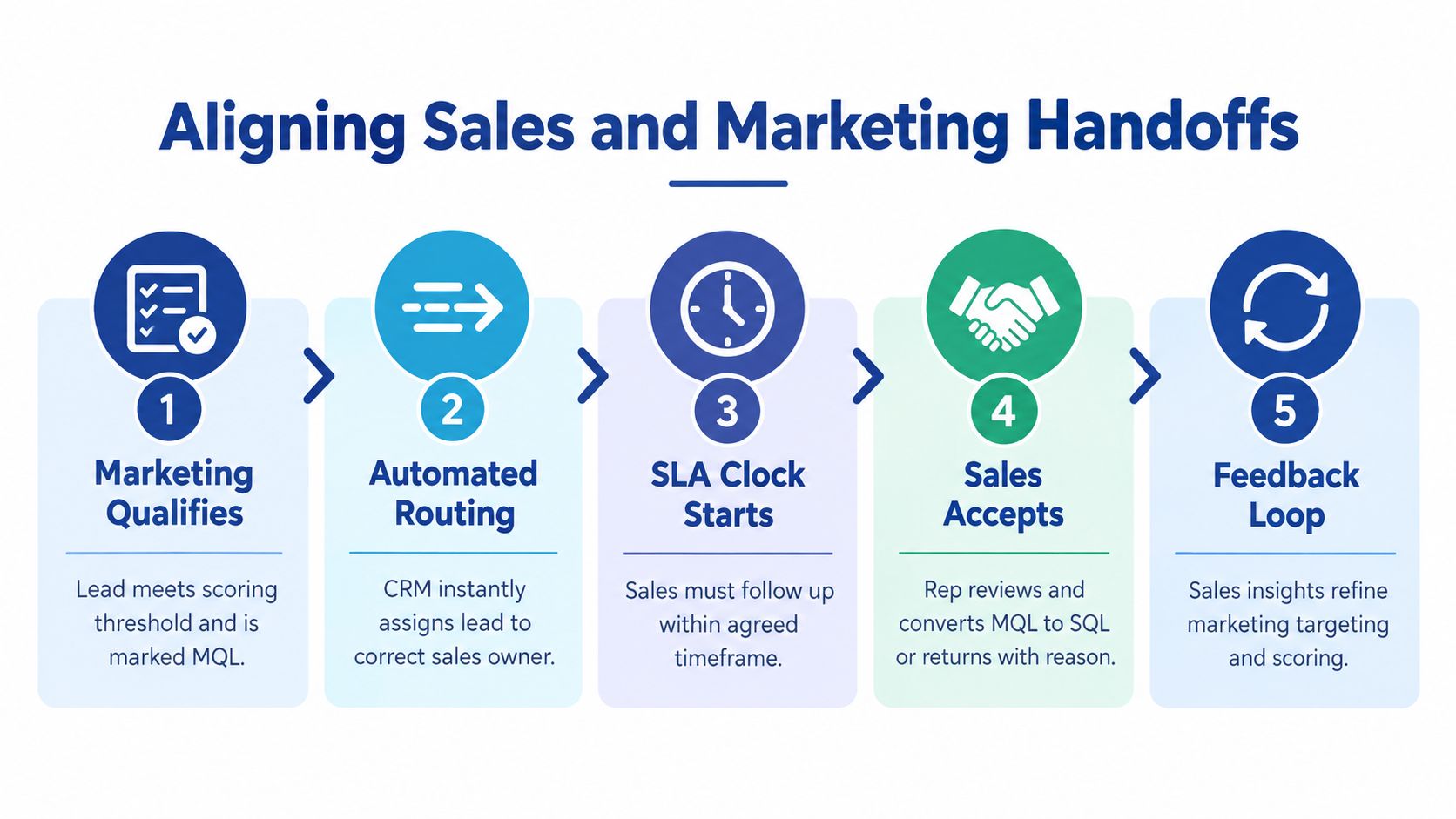
Define the acceptance rules
Write the qualification rule in plain language. A manufacturing MQL might have the right company profile and meaningful engagement. An SQL should meet your agreed threshold for fit and intent, with enough information for a sales representative to take a relevant next step.
Use a scoring model that combines:
- ICP fit: Industry, application, geography, company type, and operational requirements.
- Behavioral intent: Visits to capability, application, pricing, or contact pages; repeat engagement; and response to a relevant offer.
- Project evidence: A quote request, drawing review, sample request, stated timeline, or specific technical question.
- Exclusions: Students, job seekers, suppliers, competitors, and requests outside your capabilities.
The score shouldn't replace judgment. It should make judgment consistent and explainable.
Create a visible service-level agreement
Your CRM workflow should assign the contact to the correct owner, record the timestamp, and make the next action visible. The SLA should define what counts as an accepted lead, how quickly the owner reviews it, and what reason must be recorded if sales returns it to marketing.
The benchmark gap explains why this discipline matters. A 2026 benchmark summary reports a median MQL-to-SQL conversion rate of 13%, with top-quartile performance at 28%, according to B2B lead-generation benchmark data. The figures reinforce the need for qualification rules and ICP fit scoring, not a race to create more MQLs.
A BDR can support account research, qualification, and outbound follow-up when your sales representatives lack time for structured prospecting. Whether the work sits with a BDR, salesperson, or owner, document the same routing and feedback rules.
A returned lead isn't a failure if sales records why it was returned. That reason improves targeting, content, scoring, and future handoffs.
Building Your Next-Step Implementation Checklist
Don't rebuild the entire marketing system at once. Diagnose the largest source of leakage, then run a focused test that connects one demand motion to one lead motion. The purpose is to create a repeatable system your team can inspect and improve.
A useful audit starts with the buyer journey, not with the software. Inventory your pages, campaigns, forms, CRM fields, follow-up sequences, and sales responses. Then ask whether each component has a clear job.
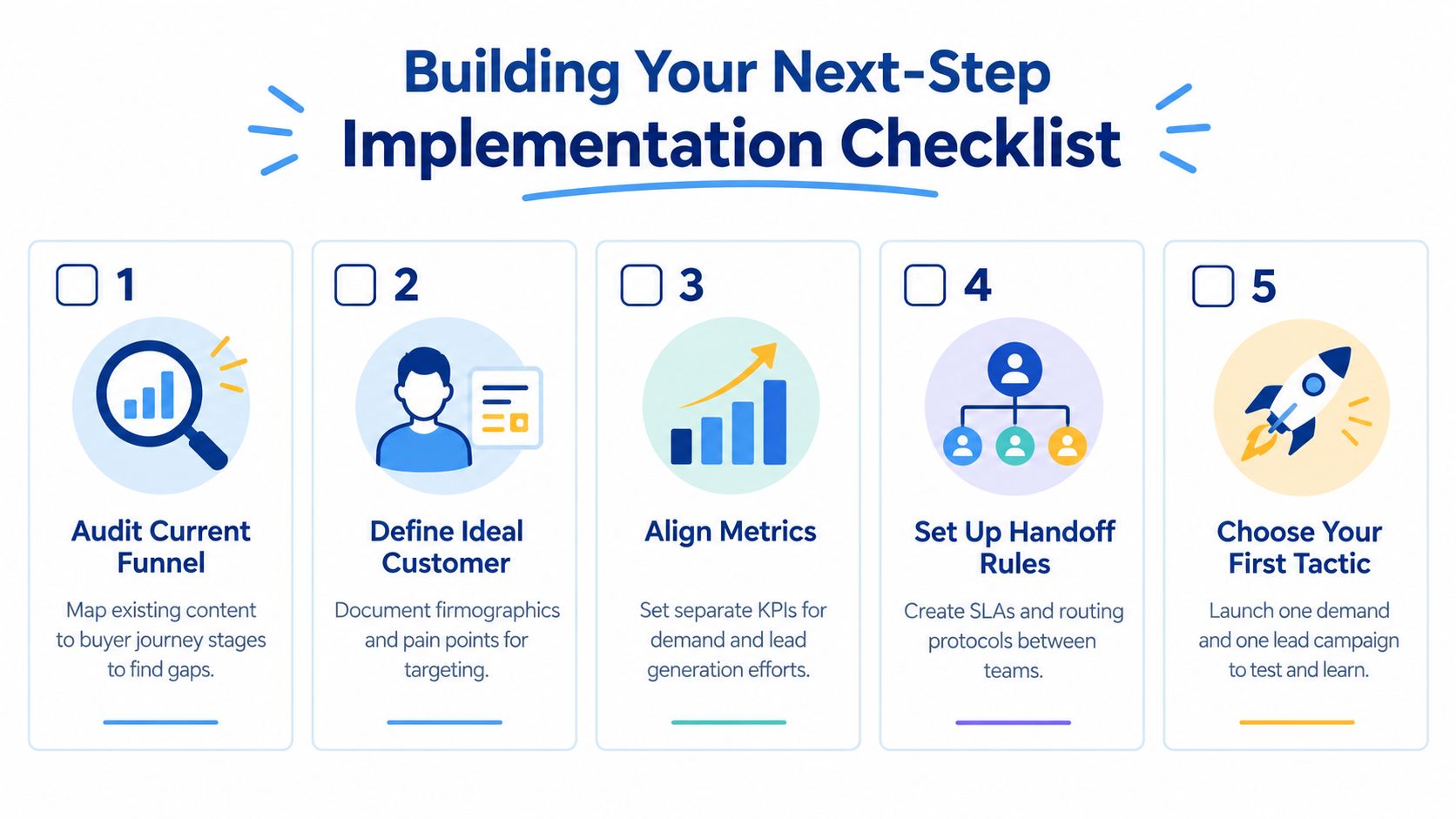
Run the diagnosis
1. Audit the current funnel. Map each important asset to awareness, education, evaluation, or conversion. Mark content that is gated without a strong reason, pages with no relevant next step, and forms that ask questions sales doesn't use.
2. Define the ideal customer. Write down the accounts you can serve well, the applications you want, the problems you solve, and the stakeholders involved. If your team can't agree on a good-fit account, lead scoring won't fix the targeting problem.
3. Separate the KPI views. Create one report for account engagement and pipeline influence, and another for contact conversion, qualification, routing, and opportunity progression. Lead-gen-only reporting is especially misleading when just 2.3% of B2B website visitors convert to leads, according to B2B inbound demand-generation benchmarks.
4. Set handoff rules. Define MQL and SQL in operational terms. Assign owners, document the response process, record rejection reasons, and review those reasons with marketing and sales together.
5. Choose one demand tactic and one capture tactic. For example, publish an ungated application guide and connect it to a technical review offer. Or improve an existing capability page and route quote requests through a documented qualification workflow.
Check the system after launch
Review account engagement, contact quality, sales acceptance, and opportunity movement together. Don't judge the demand tactic solely by immediate form volume, and don't judge the lead tactic solely by raw submissions. Look for evidence that the right people are learning, returning, identifying themselves, and entering useful sales conversations.
The transformation is operational, not cosmetic. Your team moves from chasing disconnected inquiries to managing a system with defined inputs, decision rules, handoffs, and feedback. That system can be managed internally, with a CRM and automation partner, or with a specialist such as Machine Marketing, which provides manufacturing-focused strategy, SEO, content, websites, campaigns, and lead-capture workflows.
Machine Marketing helps manufacturers diagnose gaps between demand creation, lead capture, CRM routing, and sales follow-up, then build a connected system around measurable pipeline outcomes. Visit Machine Marketing to discuss your current funnel and identify the next practical improvement.