Most advice about account based marketing for manufacturers starts in the wrong place. It tells you to choose a list of accounts, personalize an email, and launch a sequence. That may create activity, but it doesn't solve the core problem: industrial purchases involve long evaluations, multiple plants, technical scrutiny, procurement gates, and stakeholders who enter or leave the process without warning.
We recommend treating ABM as an operating system for revenue. You need a finite account universe, persistent committee coverage, trigger monitoring, coordinated channels, CRM workflows, and reporting that shows whether named accounts are progressing. The shift is simple to state and difficult to fake: stop optimizing for more leads and start managing more account coverage.
Table of Contents
- Why ABM for Manufacturers Is a System, Not a Campaign
- Mapping the Buying Committee Across Plants
- Building Messaging Engineers and Buyers Actually Read
- Running the Channel Mix as One Account Motion
- Setting Up CRM and GoHighLevel Workflows
- Measuring What Matters on Named Accounts
- A 90-Day Rollout and the Mistakes to Skip
Why ABM for Manufacturers Is a System, Not a Campaign
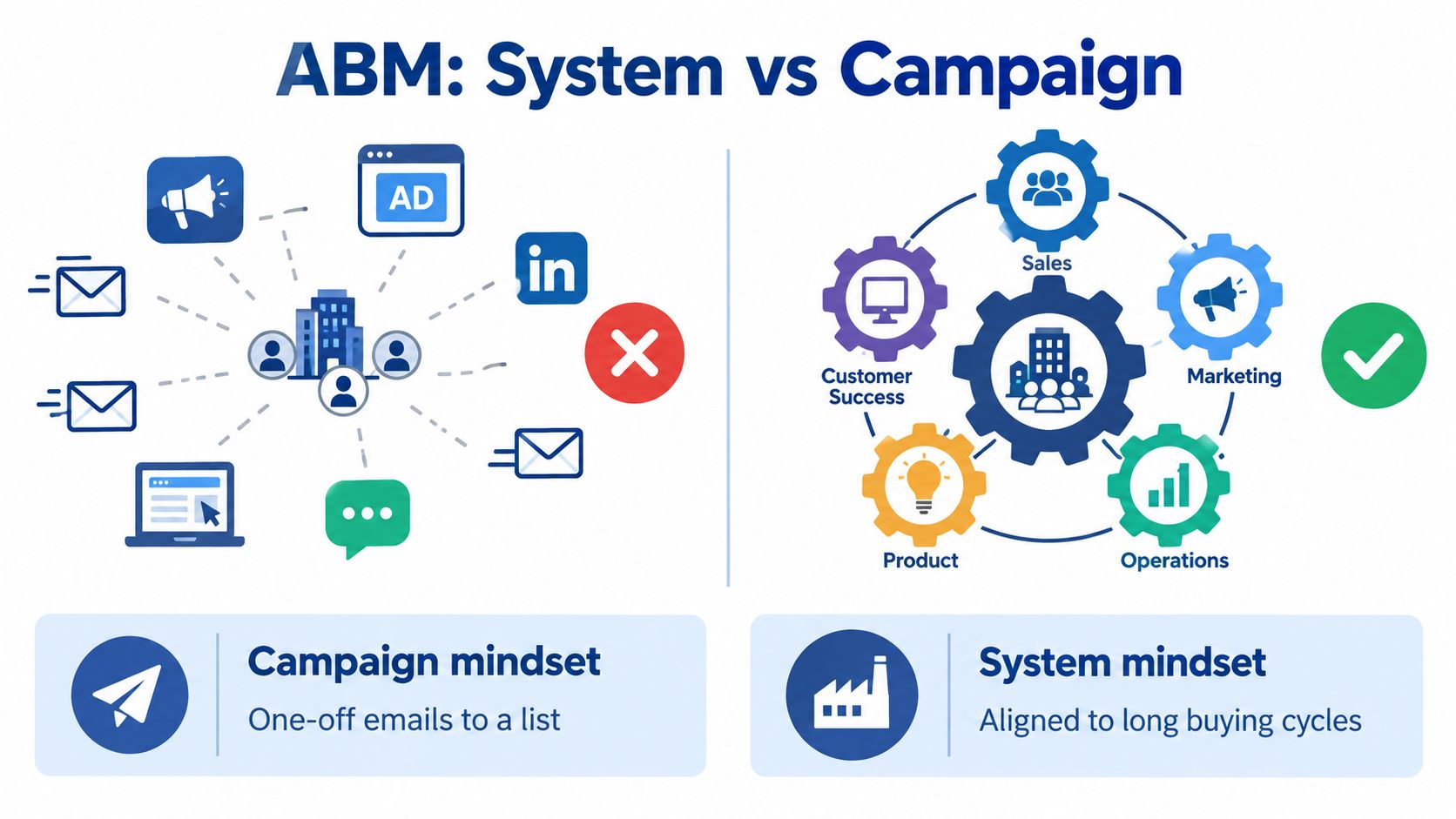
Personalized email is a tactic. It isn't an ABM strategy.
A campaign starts and stops. A system keeps an account visible while its buying process changes. That distinction matters when a capital equipment evaluation runs through engineering, operations, finance, and procurement, or when a plant expansion changes the original specification. If your CRM only records individual contacts and isolated form fills, your team won't see the account-level story.
The historical development of ABM reflects this need for coordination. Bev Burgess at ITSMA coined the term account-based marketing in 2003, formalizing a practice built around complex B2B buying behavior, as documented in the history of account-based marketing. More recent buyer research cited in that source indicates that an average B2B buying decision involves 13 people, while 89% of B2B purchases involve two or more departments. Those conditions describe industrial sales better than the typical one-contact nurture model.
A 2025 industry analysis reported that 76% of B2B companies had adopted some form of ABM, and a manufacturing-focused analysis found that 81% of B2B marketers believed ABM delivers stronger ROI than other marketing initiatives, according to manufacturing marketing statistics from Lead Forensics. The same analysis cited reported revenue increases of up to 208% versus less targeted campaigns and average ABM budget allocation of around 29%. These figures don't mean every manufacturer should copy an enterprise program. They do show that ABM has moved from specialist experiment to budgeted go-to-market system.
Start with an account universe you can operate
Your ideal customer profile should describe more than industry and company size. For a manufacturer, include the conditions at the buying site that predict a real opportunity:
- Plant-level fit: Record production environment, regulatory exposure, operational complexity, and the manufacturing sub-verticals where your solution has earned credible references.
- Technology context: Identify ERP or MES platforms, automation maturity, equipment age, and integration requirements. A technically incompatible account shouldn't receive the same priority as a ready-fit account.
- Commercial value: Separate accounts where a focused sales effort is justified from accounts better served through broader demand generation.
- Timing signals: Monitor plant announcements, expansion activity, executive appointments in operations, mergers and acquisitions, reshoring pressure, and other events that can change purchasing priority.
Score accounts on fit, intent, and timing. Then tier them into A, B, and C groups with explicit capacity limits. The exact limits should reflect your sales and marketing resources, but the principle is fixed: tiering protects focus and SDR time.
Build that list inside your CRM, not in a spreadsheet. A spreadsheet can hold names, but it won't reliably connect contacts, opportunities, tasks, trigger events, owners, and stage history. If you want help diagnosing the strategic layer before configuring the system, use a strategic marketing consultation.
Make the list refreshable
Most manufacturers define a target list once and let it decay. That creates stale contacts, outdated assumptions, and wasted spend.
Give every account a review date, an account owner, a fit rationale, a current trigger, and a next action. Revisit the list when a plant expands, a key executive changes role, a partner shares intelligence, or a technical requirement shifts. ABM works when the account record stays useful after the first campaign ends.
Practical rule: If your sales team can't explain why an account is on the list and what changed recently, the account isn't ready for active ABM.
Mapping the Buying Committee Across Plants
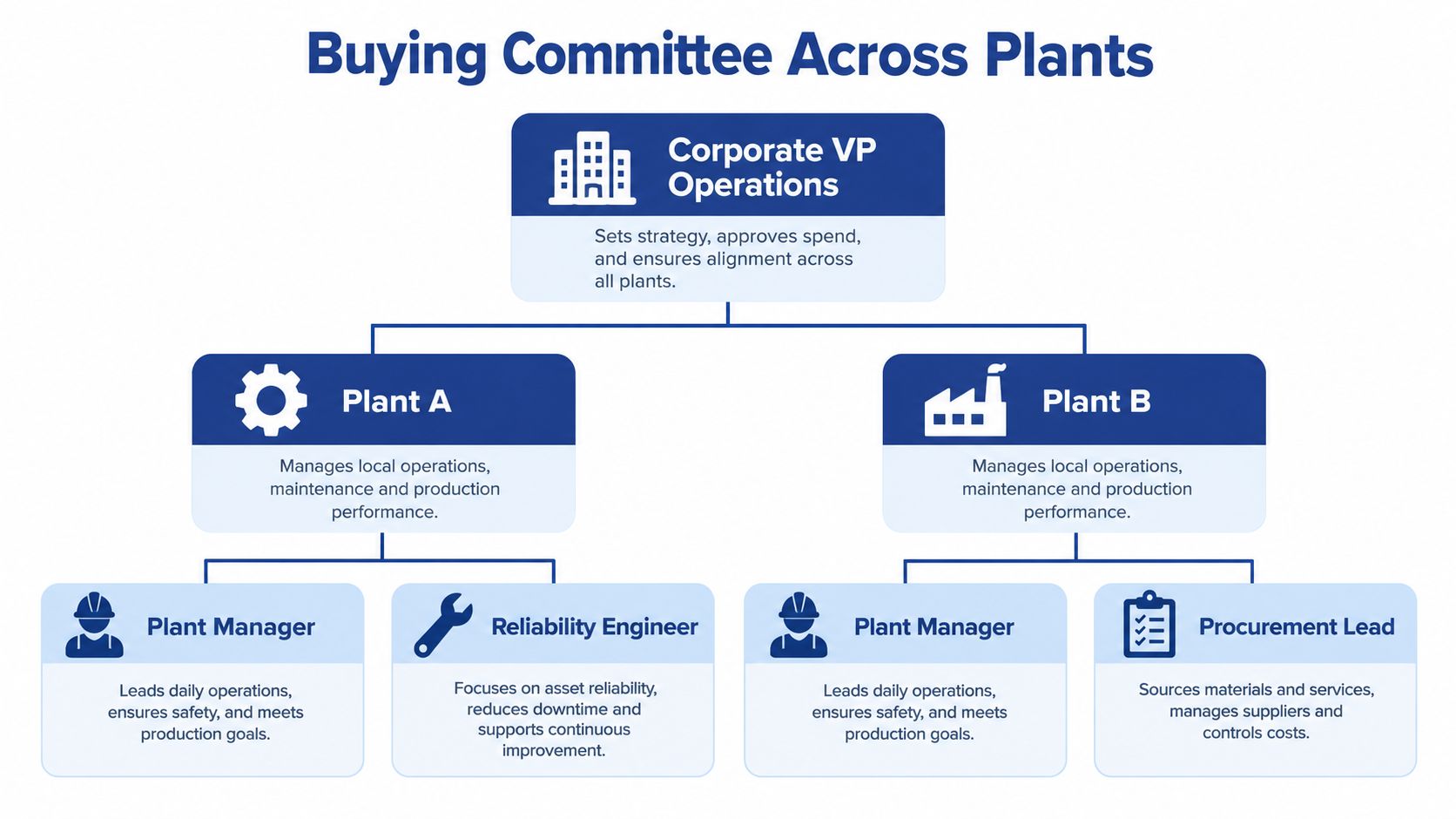
A manufacturing opportunity rarely belongs to one location or one job title. A corporate operations leader may approve the direction, while a plant manager defines the operating need, an engineer validates technical fit, procurement negotiates terms, and finance evaluates commercial risk. External systems integrators, distributors, and channel partners may influence the decision without appearing in your original lead list.
Research on manufacturing ABM describes industrial committees that can involve 10 to 20 stakeholders, while broader B2B references cite 6 to 10 people, as summarized by The S Marketers' manufacturing ABM guidance. The practical conclusion is more important than choosing one benchmark: one contact is not account coverage.
Build coverage by role and location
Start with a committee map on the account record. Include corporate and plant-level stakeholders, then assign each person a role in the decision:
- Operations: Defines throughput, uptime, rollout, and site-level priorities.
- Engineering: Tests specifications, integration, tolerances, certifications, and technical risk.
- Maintenance and reliability: Evaluates serviceability, failure exposure, and implementation practicality.
- Procurement: Compares suppliers, commercial terms, lead times, and purchasing requirements.
- Finance: Reviews capital justification, risk, and budget ownership.
- Channel or technical partners: Adds plant access, implementation expertise, or influence over specifications.
Set a coverage target by account tier. The appropriate target depends on deal complexity, but it must be explicit. A benchmark from Grou Global's manufacturing ABM research found stronger programs reached 85% of buying-committee members, compared with 61% for less mature programs.
Verify each contact with a business email, a current professional profile, and a recent account trigger such as a promotion, plant announcement, or published technical contribution. Store contacts against the account object, not as disconnected leads. Assign one owner to each relationship so your sales and marketing teams don't send parallel, contradictory outreach.
For a practical persona framework, review how to create buyer personas, then adapt it to plants, sites, and committee roles rather than treating the company as one audience.
Building Messaging Engineers and Buyers Actually Read
Industrial buyers ignore polished slogans when the message does not help them judge plant fit, process impact, or commercial risk. Build content around the decision each committee member must make, then connect every asset to the account stage and the next buying action.
Translate one capability into different proof. If a product reduces implementation friction, do not repeat the phrase across every channel. Show engineers the connection points, integration requirements, technical limits, and validation steps. Give procurement a structured view of supplier comparison, ordering, service, and lifecycle cost. Show operations the rollout sequence, training needs, maintenance implications, and controls for production risk.
| Buyer Role | Primary Pain | Proof Asset | Example Hook |
|---|---|---|---|
| Engineering | Integration risk, specifications, reliability | Technical one-pager, CAD drawing, certification details | “Review the integration points before your next line modification.” |
| Procurement | Lead time, supplier risk, total cost | Comparison sheet, commercial requirements checklist | “Compare supply, service, and total ownership factors in one view.” |
| Operations | Downtime, rollout complexity, production continuity | Plant-floor application guide, implementation plan, OEE-focused calculator | “See how the rollout can fit the operating constraints at this site.” |
Build proof from real sales friction
Sales conversations should supply the content backlog. Record the technical questions that appear before serious opportunities, the objections that stop a quote, and the documents buyers request after the first meeting. Turn those inputs into application guides, comparison sheets, technical FAQs, and assets tied to account stage.
Store each asset with clear tags for role, account stage, and committee seat. A generic nurture sequence cannot serve an engineer validating specifications and a procurement contact preparing an internal comparison. Engineers respond to specific technical evidence. Procurement needs structured information that can circulate without a salesperson explaining every point.
Test for account progression
An open is not a buying signal. Keep messaging that produces a technical evaluation request, introduces a second stakeholder, advances a plant discussion, or starts a reference conversation. Retire assets that attract attention without moving a named account.
Review performance in the CRM by role and account, not only by email engagement. When an engineer downloads an integration guide, route that signal to the account owner. When procurement returns to a comparison asset, trigger the appropriate follow-up. Messaging earns its place by improving committee coverage and pipeline progression, not by increasing MQL volume.
Running the Channel Mix as One Account Motion
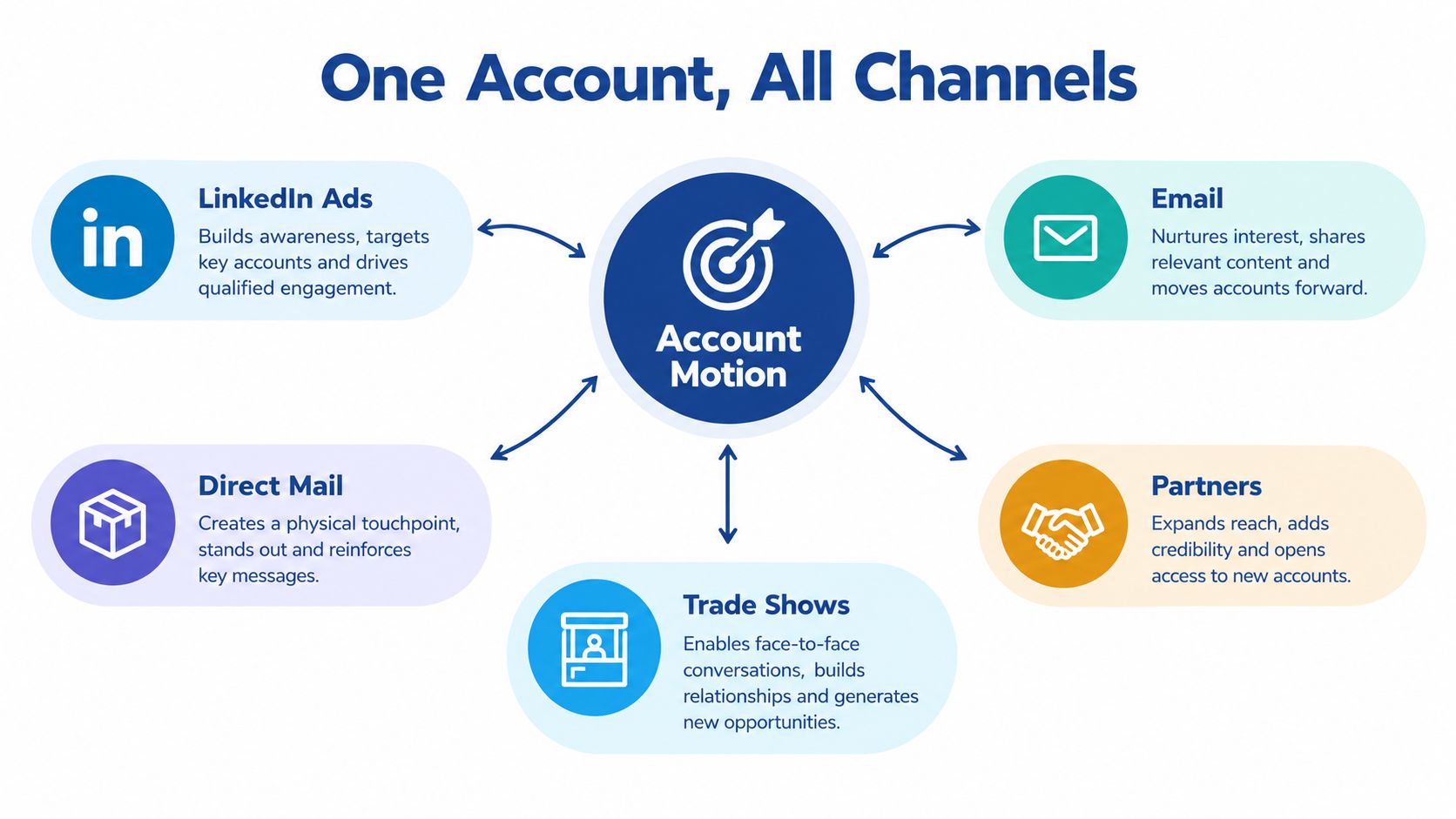
LinkedIn, email, direct mail, trade shows, and partners shouldn't operate as separate campaigns that each claim success. They should perform different jobs inside one account plan.
Use LinkedIn to establish credibility and identify relevant people. Use email to deliver sequenced education tied to a real account context. Use phone and field sales for technical depth and meeting conversion. Use trade shows to bring several stakeholders into contact quickly. Use distributors, integrators, and other partners to reach plants your internal team can't access efficiently.
Assign every channel a job
A useful account plan connects channel activity to buying progress:
- Early awareness: LinkedIn content, technical search content, and partner introductions establish relevance.
- Active evaluation: Email sequences, application guides, technical calls, and field outreach answer specific questions.
- Committee alignment: Executive meetings, trade shows, plant visits, and shared technical sessions bring roles together.
- Decision support: Comparison documents, reference conversations, implementation plans, and commercial follow-up reduce perceived risk.
A Tier A account might receive one coordinated weekly rhythm:
- Marketing shares a technical asset aligned with the known plant trigger.
- The account owner follows up with the engineer or operations contact.
- A field representative or specialist calls with a specific technical question.
- A partner or event invitation creates another route into the committee.
That sequence isn't a rigid automation. The account owner should change the next touch when a stakeholder responds, a new contact appears, or the buying stage changes.
Stop channel-level credit fights
Log every interaction against the account and contact. Review the account record weekly, not five separate campaign dashboards. LinkedIn may create recognition, email may reveal a second stakeholder, and a field call may create the actual meeting. Treating one channel as the winner misrepresents how industrial buying works.
Trade shows deserve the same discipline. Don't measure the event only by badge scans. Before the show, identify target accounts and committee gaps. During the show, schedule conversations. Afterward, assign account-specific follow-up with context from the meeting.
Setting Up CRM and GoHighLevel Workflows
ABM fails quickly when the CRM is built for inbound lead capture alone. Contact records and form submissions don't show whether an account has engineering coverage, whether procurement has entered the process, or whether a plant-level trigger changed the opportunity.
Create an Account object in GoHighLevel or your existing CRM. Link every relevant contact and opportunity to that object. If your platform doesn't provide a native account structure, use a controlled custom field and workflow convention, but don't allow account identity to depend on free-text entry.

Use stages that describe buying progress
Replace MQL labels with stages your sales team can recognize:
- Engaged: The account shows relevant activity from a known contact.
- Committee Formed: Multiple required roles are identified and at least one relationship is active.
- Spec In: Your solution is included in a technical discussion, requirement, or specification.
- Pilot: The account is testing, validating, or reviewing an implementation path.
- Decision: Commercial and operational stakeholders are evaluating the final path.
These stages aren't a substitute for opportunity management. They give marketing and sales a shared view of account development before a formal opportunity exists.
Automate signals and ownership
Create separate account scoring from contact scoring. Weight committee coverage, meaningful engagement, trigger strength, and stage progression. A contact downloading a document shouldn't automatically make the entire account sales-ready. A second stakeholder requesting technical information may matter more than another anonymous page visit.
Useful workflow alerts include:
- A known account returns to a pricing or specification page.
- A second contact from the same account engages with an asset.
- A new engineering, operations, or procurement contact is added.
- A target account shows a plant expansion or other relevant trigger.
- An opportunity remains unchanged and needs a review decision.
Hold a weekly account standup. Review 10 to 15 named accounts, update stage notes, identify coverage gaps, and assign one next action per account. The CRM should answer three questions without manual spreadsheet work: what changed, who owns the next move, and what evidence supports the current stage.
For implementation guidance specific to the platform, see GoHighLevel for manufacturers. Machine Marketing also offers marketing automation for manufacturers, including sales handoff rules and notifications that can support this type of workflow.
Measuring What Matters on Named Accounts
MQL volume is a poor primary measure for industrial ABM. It rewards form fills and list growth even when the right account has no committee coverage and no movement toward a decision.
Use an account dashboard that shows the story of each named account across recent review periods. The dashboard should help a salesperson decide what to do next, not merely help marketing defend activity.
Track coverage before conversion
Coverage rate measures how much of the planned buying committee you've identified and engaged. Track it by role and site. An account with strong engineering engagement but no procurement or operations relationship has a visible risk, even if its lead count looks healthy.
Engagement depth measures meaningful actions rather than passive activity. Examples include:
- A second meeting is booked.
- A technical evaluation is requested.
- An internal stakeholder is introduced.
- A plant visit or reference call is requested.
- A specification conversation begins.
These events indicate that the account is becoming more operationally real. They also tell the account owner where the committee is still thin.
Read the account as a progression story
Stage progression should mirror the CRM stages. Record why the account moved from Engaged to Committee Formed, what evidence supports Spec In, and what blocked movement toward Pilot or Decision. If the stage hasn't changed, document the reason rather than allowing the account to appear active indefinitely.
Pipeline measurement should also stay account-based. A benchmark reported a 171% average qualified-pipeline lift versus matched non-ABM controls, according to The Starr Conspiracy's 2025 ABM benchmarks. The same benchmark source reported that 77% of organizations saw increased pipeline, 55% reported higher win rates, and 49% saw larger average deal sizes. Those figures are benchmarks, not promises. Your job is to establish a baseline and track whether your own named accounts progress.
Measure the account's next decision, not the contact's last click.
Industrial programs can run alongside or in preparation for formal qualification processes over 12 to 36 months, according to industrial ABM strategy guidance from The S Marketers. That makes stage notes, coverage, and pipeline progression more useful than short-cycle funnel reporting.
A 90-Day Rollout and the Mistakes to Skip
Start small enough to operate well. ABM becomes expensive when your team promises account-level attention to more accounts than it can research, contact, and review.
Days 1 through 30 establish the operating layer
Lock the ICP and document the plant-level fit criteria. Build a controlled named-account list, create account objects and buying stages in the CRM, set coverage requirements by tier, and write one useful message for engineering, operations, and procurement.
Don't wait for perfect technology. The minimum viable system is a clean account record, linked contacts, named owners, stage definitions, trigger fields, and a weekly review agenda.
Days 31 through 60 test the motion
Launch the coordinated channel mix against the highest-priority accounts. Run the weekly review, log account signals, test subject lines and content hooks, and ask sales to record objections in a structured field rather than burying them in notes.
Look for evidence of account progression:
- New roles identified: The committee map is becoming more complete.
- Technical questions received: Messaging is reaching an active evaluation.
- Meetings involving multiple functions: The account is moving beyond one-person interest.
- Commercial or implementation questions: The conversation is approaching a decision path.
Days 61 through 90 expand selectively
Use observed signals to decide which accounts deserve more attention. Expand the next tier only when the first motion is documented and repeatable. Formalize partner co-selling where channel intelligence opens access to plants or sites your team can't reach alone. Tune the dashboard so leadership sees named-account pipeline, stage movement, coverage gaps, and stalled opportunities.
The most common failure modes are predictable:
- Too many accounts: Reduce the list until owners can research and review every active account.
- Email-only execution: Add field, technical, event, and partner touches where the buying process requires them.
- Missing operations or procurement: Map the roles that influence rollout and commercial approval, not only the technical champion.
- Stale account lists: Refresh triggers and contact records on a defined cadence.
- MQL reporting: Replace lead-volume celebrations with account movement and committee coverage.
- Unclear ownership: Give every account, contact, and next action a named owner.
ABM is an operating discipline, not a campaign wrapper. If your team can't see the account, its committee, its trigger, its stage, and its next action in the CRM, the program isn't running yet.
Machine Marketing can help you diagnose gaps in your named-account strategy, build the CRM and GoHighLevel workflows, and connect content, sales handoffs, automation, and trade show activity into one manufacturing ABM motion. Visit Machine Marketing to discuss an account-coverage system built around your industrial sales cycle.