Your sales team is busy quoting existing relationships, trade shows produce a stack of cards, and your website still describes capabilities in language that only someone inside the plant understands. Meanwhile, technical buyers are searching exact materials, tolerances, certifications, processes, and lead-time questions before they ever call. By the time a salesperson enters the conversation, the buyer may already have a shortlist.
A manufacturing marketing agency can fix that, but only if you hire it to design and operate a connected pipeline system. SEO, technical content, CRM, email, paid search, and trade show follow-up shouldn't become separate projects owned by separate vendors. They should move the same buyer toward a qualified opportunity, with sales able to see what happened and what to do next.
Table of Contents
- Why Manufacturers Are Turning to Outside Marketing Help
- What a Manufacturing Marketing Agency Actually Does
- The Core Service Stack Manufacturers Should Expect
- How to Evaluate and Shortlist the Right Agency
- What Realistic ROI Looks Like After You Hire
- Red Flags and Common Regrets to Avoid
- Your Next Step and a Practical Hiring Checklist
Why Manufacturers Are Turning to Outside Marketing Help
Manufacturers usually don't contact an agency because they need more activity. They contact one because their expertise isn't reaching enough qualified buyers, or because inquiries arrive without enough information for sales to act on them.
A machine shop may rank for its company name but not for the machining problem it solves. A fabricator may have impressive equipment but no page explaining which applications it supports. An industrial OEM may depend on one salesperson to remember every follow-up across a sales cycle that lasts 6 to 18 months, with complex capital equipment purchases often taking longer, as reported by The Digital Bloom's manufacturing marketing report.
The buyer's behavior has changed, too. Technical buyers complete 62% of the buying process online before engaging sales, rising to 66% among buyers age 35 and under, according to Atomic Design's manufacturing buyer journey research. They search vendor websites, technical content, industry sources, and generative AI tools while forming an early shortlist.
Diagnose the actual business problem
Before you compare agencies, write down the problem in operational terms:
- Demand visibility: Are the right buyers unable to find your capabilities?
- Lead quality: Are form fills missing application, volume, timing, or purchasing information?
- Sales follow-up: Does someone own every inquiry after a trade show, download, or quote request?
- Proof of value: Can you connect marketing activity to qualified opportunities and revenue influence?
- Internal capacity: Does anyone have time to interview engineers, build content, configure automation, and maintain reporting?
Industry coverage identifies lead quality, sales alignment, and revenue attribution as persistent manufacturing marketing gaps. One report says 47% of manufacturing marketers find content insufficiently tied to the customer journey, while 66% say content doesn't prompt a desired action. Another reports that 49% struggle to create enough high-quality content that converts, with 32% citing limited budget, as summarized by Winbound's coverage of manufacturing content marketing.
Practical rule: Don't hire an agency to “do marketing.” Hire it to repair a named constraint in your revenue system.
Outside help makes sense when the gap involves several disciplines at once, or when internal staff know the products but can't consistently execute the system. Our guide to outsourced marketing for manufacturing lays out that decision in more detail.
The right partner should understand quoting behavior, engineered-to-order lead times, technical approval processes, and the difference between an interesting visitor and an account sales can pursue. That's why this isn't a simple vendor swap. It's a system-design decision.
What a Manufacturing Marketing Agency Actually Does
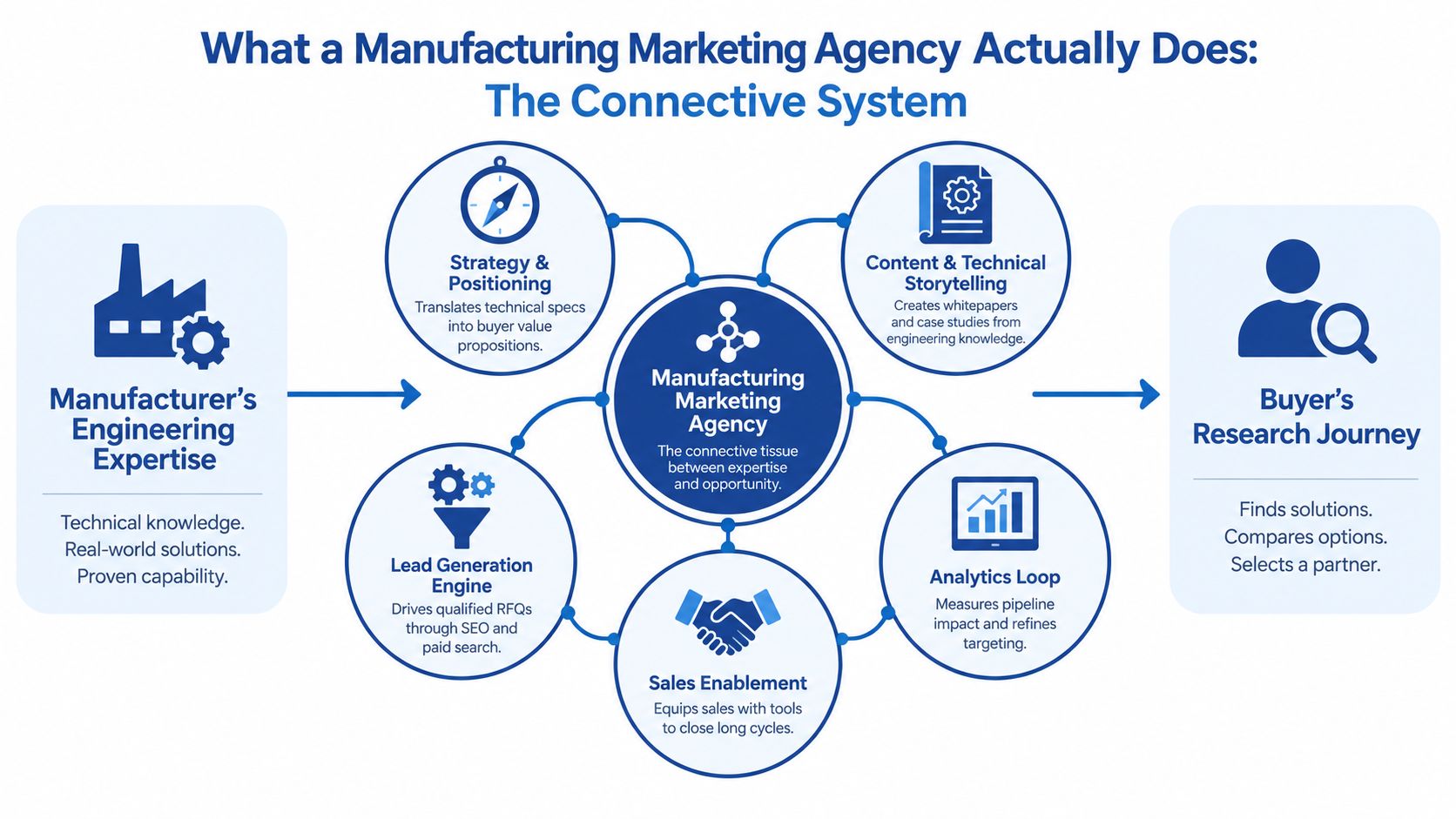
Think of the agency as connective tissue between your plant and the buyer's research process. Your engineers know the tolerances, materials, certifications, failure modes, and production constraints. Your buyers need that knowledge translated into pages, resources, campaigns, and follow-up that help them decide whether you're a credible fit.
The work happens across the full journey
A serious engagement may include a technical SEO audit of capability and product pages, interviews with engineers, content briefs based on actual buyer questions, and landing pages for high-intent searches. It may also include paid search around specific industrial terms, CRM cleanup, lead scoring, and automated nurture for inquiries that aren't ready for a quote.
Trade shows belong in the same system. Before an event, marketing can help sales identify target accounts and arrange conversations. Afterward, scanned contacts should enter a defined sequence, receive relevant technical material, and route to the right salesperson based on fit and engagement.
Reporting closes the loop. The agency should show which pages, campaigns, forms, and event activities influenced qualified RFQs, sales-qualified opportunities, or movement within existing accounts. Traffic and impressions can diagnose reach, but they aren't the business result.
Translation is the agency's highest-value skill
Good technical marketing doesn't simplify your product until it becomes vague. It preserves the details that establish credibility, then explains why those details matter to an engineer, procurement manager, plant leader, or executive.
For example, “five-axis machining” is a capability. A useful page explains the types of parts it supports, the materials your team handles, the inspection process, the constraints that affect quoting, and the next step for a buyer with a real application.
For a practical overview of how digital channels can support industrial growth, review Come Together Media LLC's manufacturing tips. Use it as a comparison point, then ask any agency to show how its recommendations connect to your CRM and sales process.
A connected system looks like this:
- Engineering supplies evidence.
- Marketing turns evidence into searchable resources.
- SEO and paid media put those resources in front of the right buyers.
- CRM and automation preserve context and manage follow-up.
- Sales feedback improves targeting, content, and qualification.
This is the standard an agency should meet.
The Core Service Stack Manufacturers Should Expect
A proposal can contain every fashionable channel and still fail to produce a usable pipeline. Evaluate the stack by asking one question: Does each service help the next person in the buying process do better work?
Industrial B2B marketing is a substantial market. One industry summary values it at $47.6 billion in 2023 and projects $72.4 billion by 2030, a 6.1% compound annual growth rate. The same summary reports $18.9 billion in global industrial digital marketing expenditure in 2023, up 12.4% year over year, in GITNUX's industrial marketing overview. The numbers matter less than the direction: manufacturers are putting more emphasis on measurable digital channels.
| Service Pillar | Typical Deliverables | Why It Matters for Manufacturers |
|---|---|---|
| Industrial SEO and technical content | Capability pages, product pages, specification articles, comparison guides, case studies, technical audits | Captures buyers searching specific applications, materials, processes, and standards |
| CRM, email, and automation | Lifecycle stages, lead fields, scoring rules, nurture sequences, routing, reactivation campaigns | Maintains context through long sales cycles and keeps raw inquiries from disappearing |
| Trade show and event support | Pre-show account lists, invitations, booth messaging, scan imports, follow-up sequences, sales alerts | Turns temporary event attention into trackable conversations and opportunities |
| Paid media and retargeting | Search campaigns, high-intent landing pages, account targeting, remarketing, conversion reporting | Creates targeted reach when organic visibility is still developing |
Industrial SEO and technical content
The deliverable isn't a calendar full of generic blog posts. It should include pages that answer the questions buyers use to screen suppliers, such as whether you support a material, tolerance, volume, certification, geography, or application.
Ask for a content process that includes engineer interviews, source review, technical approval, internal linking, conversion paths, and updates. The best page may be a detailed capability page, not a broad article.
CRM and nurture
Your CRM should distinguish an unqualified inquiry from an active RFQ, an existing customer expansion opportunity, and a long-term prospect. Email should reflect those differences.
Manufacturing email performance also requires realistic expectations. A 2026 benchmark summary reports a 37.36% average open rate for manufacturing, compared with a cited 43.46% average across industries, in KLIQ Interactive's benchmark report. Segmentation, deliverability, useful subject lines, and relevant technical content matter more than sending more frequently.
Events and paid media
Trade show support should cover the entire loop, not just booth graphics. Paid media should focus on high-intent searches and defined audiences, not broad reach for its own sake.
Review how an agency configures the technology behind that work in Machine Marketing's marketing technology stack guide. You should leave a proposal review knowing what gets built, who owns it, how sales receives alerts, and which pipeline fields make attribution possible.
How to Evaluate and Shortlist the Right Agency
Start with a written brief, not a search for attractive agency websites. Describe your best customers, sales cycle, average buying committee, quoting process, capacity constraints, revenue goals, current CRM, trade show calendar, and the marketing work your team can realistically support.
Industrial buying involves multiple stakeholders. One manufacturing buying-journey report says 83% of purchases involve five or more evaluators, 81% of buyers already had a shortlist before contacting a vendor, and 48% used AI to research suppliers in the prior 90 days, according to RH Blake's manufacturing buying journey report. Your agency must therefore create material that helps more than one person inside the account.
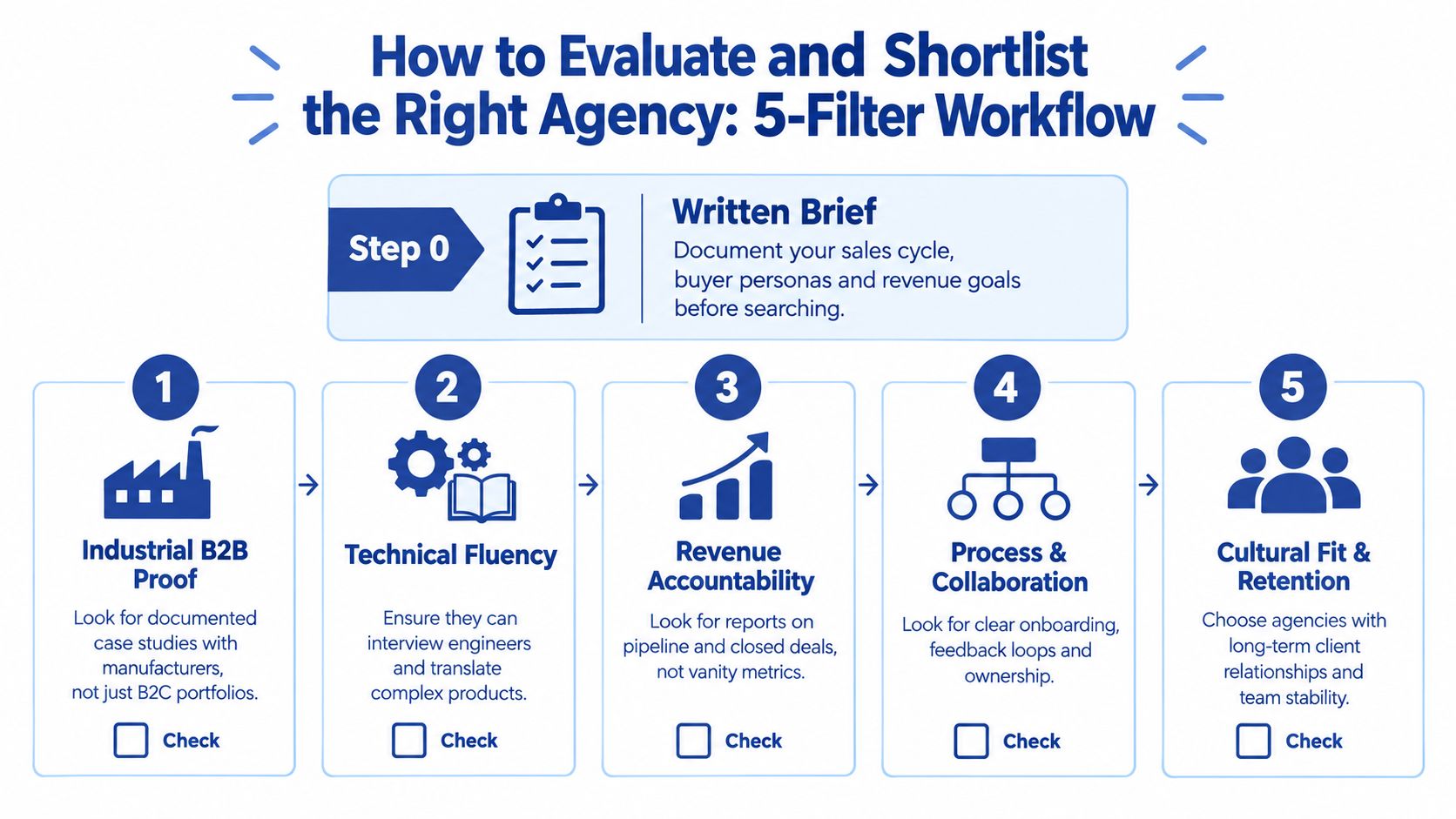
Use five filters
- Industrial proof: Look for documented work with manufacturers, machine shops, industrial suppliers, or technical B2B companies.
- Technical fluency: Ask who interviews engineers, checks claims, and turns specifications into useful buyer content.
- Revenue accountability: Require reporting on qualified leads, opportunities, meetings, and pipeline influence.
- Process ownership: Confirm who configures the CRM, writes the SOPs, manages approvals, and handles handoffs.
- Cultural fit: Speak with the people who will do the work, not only the salesperson who presents it.
Give three finalists the same brief and request a short diagnosis. A capable partner will identify missing data, weak conversion points, content gaps, and sales-process risks. A generalist will return a channel menu.
Ask questions that expose operating depth
Use discovery calls to ask:
- How do you define a qualified lead for a high-value capital equipment decision?
- Which CRM platforms do you configure most often?
- How do you document a buyer's technical questions before writing content?
- Who reviews engineering claims?
- How do you separate an RFQ from a low-fit contact?
- How do you route trade show leads?
- What does your first 90 days include?
- Which reporting dashboard will our sales team use?
- How do you handle a campaign that produces activity but poor lead quality?
- What happens to our accounts, content, data, and automation if we end the engagement?
A useful lead-generation framework should also help you compare demand capture, outbound, and account-based approaches. Eludic's guide to finding the right lead generation model can serve as one reference during that comparison.
Score each finalist against the same criteria. Weight industrial experience, technical production, CRM ownership, sales alignment, reporting, and contract flexibility. Don't let polished creative compensate for a weak operating model.
What Realistic ROI Looks Like After You Hire
Consider a representative 120-person contract manufacturer selling precision components. The company has capable salespeople, a dated website, a CRM full of incomplete records, and trade show leads that receive inconsistent follow-up. It hires an agency to connect search, content, automation, and sales reporting.
The first checkpoint is diagnostic, not dramatic. At 90 days, the team should have a technical baseline, cleaner CRM fields, initial content, clearer conversion paths, and early movement in organic impressions. A reasonable planning range is 5 to 15 marketing-qualified leads from existing channels, but that range is not a guarantee. It depends on the starting audience, site condition, sales capacity, and whether internal experts make time for content review.
At six months, the system should begin compounding. The manufacturer may see stronger visibility for engineer-focused searches, a working nurture sequence, and a measurable trade show to pipeline process. A planning range of 20 to 40 net new qualified opportunities can help leadership model capacity, but the agency shouldn't present it as promised output.
At 12 months, the company should be able to defend an inbound channel, reduce manual nurture work for sales, and evaluate whether media has returned 3 to 5 times its spend in attributed pipeline. That is pipeline attribution, not closed revenue. Sales follow-through, quote speed, production fit, pricing, and customer timing still determine what becomes won business.
| Timeline | Marketing Outputs | Pipeline Contribution | Internal Effort Required |
|---|---|---|---|
| 90 days | Technical baseline, CRM cleanup, initial content, conversion fixes | Approximately 5 to 15 marketing-qualified leads from existing channels, as a planning range | Engineer interviews, CRM access, sales definitions, fast approvals |
| Six months | Search visibility gains, nurture sequence, trade show follow-up loop | Approximately 20 to 40 net new qualified opportunities, as a planning range | Regular content review, lead feedback, sales adoption |
| 12 months | Defensible inbound channel, mature reporting, reactivation and nurture systems | Target of 3 to 5 times media spend in attributed pipeline, not a guarantee | Ongoing sales follow-up, attribution review, quarterly prioritization |
Use Machine Marketing's guide to measuring marketing ROI to establish definitions before campaigns launch. If your CRM can't show source, stage, owner, next action, and opportunity value, your ROI report will be an opinion dressed as a dashboard.
Red Flags and Common Regrets to Avoid
The most expensive agency mistake usually happens before the contract is signed. Leadership chooses a partner based on presentation quality, then discovers that the team can't write credible technical content, qualify inquiries, or work inside the sales process.
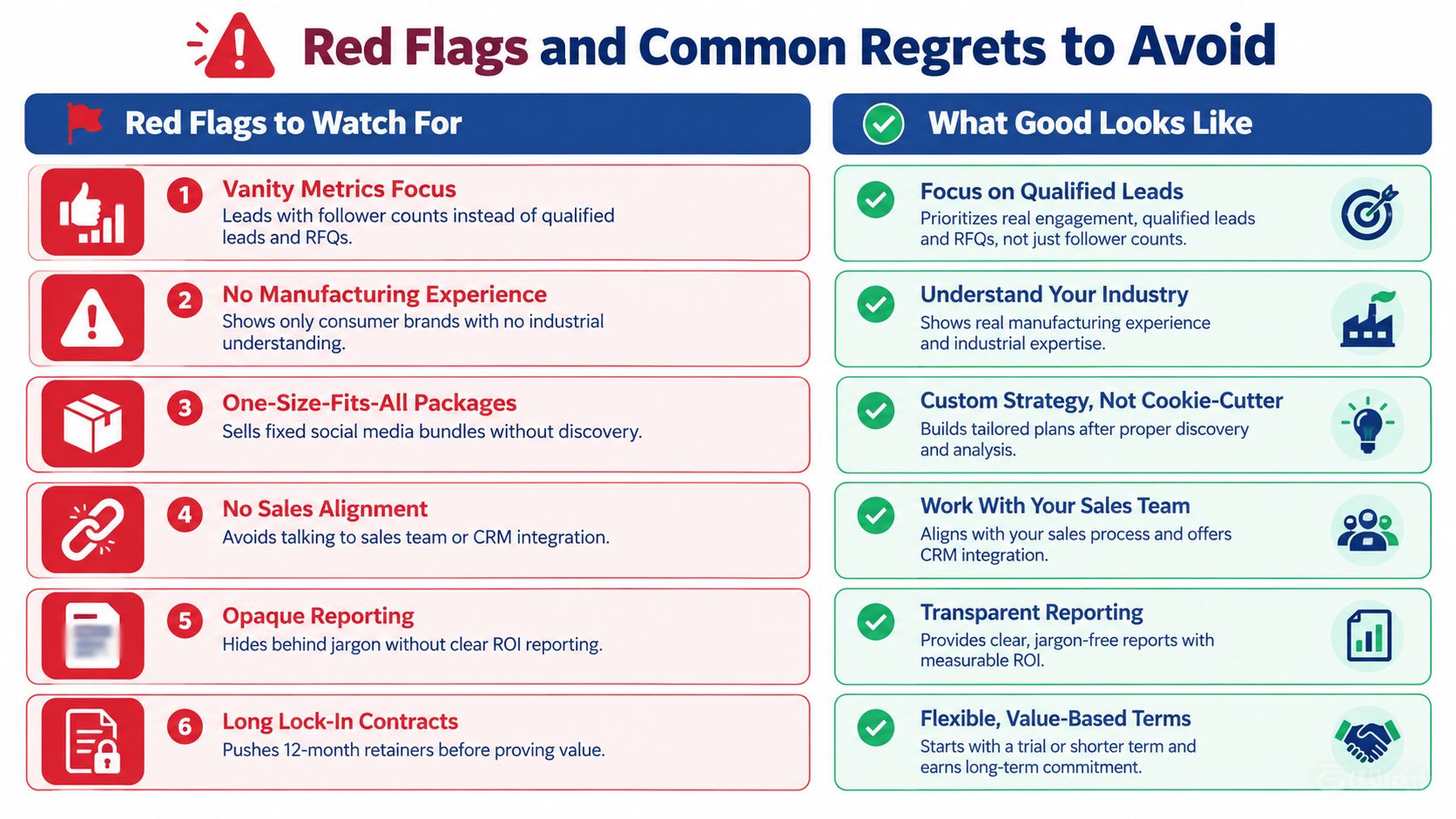
Watch for these signals:
- Vanity metrics first: If the agency leads with followers, impressions, or engagement, ask where qualified leads and RFQs appear in the report. The regret is paying for attention sales can't use.
- Vague pricing: A retainer without defined deliverables, review cycles, and ownership makes comparison difficult. The regret is discovering that every useful request becomes an extra project.
- No industrial proof: Consumer portfolios don't demonstrate knowledge of drawings, specifications, quoting friction, or technical approval. The regret is spending months teaching the agency your market.
- Marketing language over engineering credibility: Copy packed with adjectives but light on evidence won't persuade technical buyers. The regret is publishing content your engineers refuse to share.
- No pipeline commitment: An agency can't control closed revenue, but it should commit to measurement, qualification definitions, reporting cadence, and optimization. The regret is receiving reports that never reach the sales forecast.
- Proprietary lock-in: If the agency won't return your content, CRM data, workflows, or accounts in usable form, your exit cost is part of the contract. The regret is losing operational control when the relationship ends.
Ask for references from companies with similar sales complexity. Then ask those clients whether the agency accepted technical corrections, met deadlines, improved lead quality, and made sales follow-up easier.
A low monthly fee can become expensive when your team must manage every missing piece.
The selection process protects the engagement. If the agency is wrong for your buyers, your technology, or your sales behavior, better project management won't solve the underlying mismatch.
Your Next Step and a Practical Hiring Checklist
You don't need to sign a retainer this week. You do need a clear diagnosis of the gap you want to fix. Use this checklist before inviting agencies to pitch:
- Define the revenue problem: Decide whether you need visibility, qualified inquiries, nurture, sales enablement, or attribution. Ask, “Which pipeline constraint will this engagement address first?”
- Verify industrial experience: Review relevant work and call references. Ask, “Have you marketed products with technical specifications, long lead times, or engineered-to-order quoting?”
- Test technical SEO fluency: Request an audit of capability pages, product pages, search intent, internal links, and conversion paths. Ask, “Which pages would you improve first, and why?”
- Check CRM integration: Confirm the agency can work with your CRM, fields, stages, routing, scoring, and reporting. Ask, “How will a salesperson know what happened before an inquiry reached them?”
- Review trade show support: Look for pre-event targeting, booth follow-up, lead routing, and nurture. Ask, “Show us the workflow from scanned badge to assigned next action.”
- Confirm attribution: Require definitions for MQL, sales-qualified lead, opportunity, sourced pipeline, and influenced pipeline. Ask, “Which numbers will appear in our monthly leadership review?”
- Clarify contract terms: Document deliverables, approval responsibilities, access, ownership, cancellation, and exit support. Ask, “What do we retain if the engagement ends?”
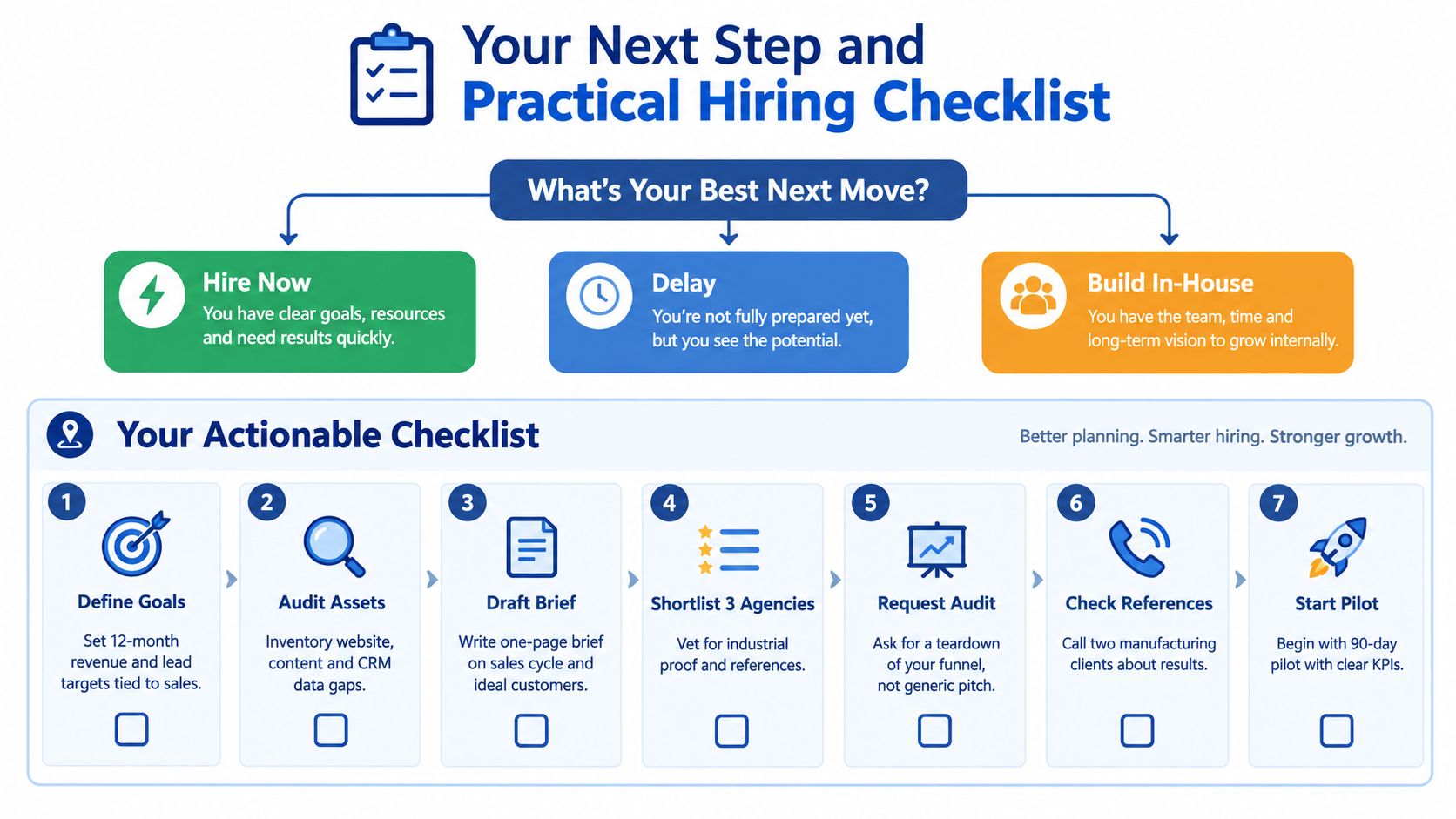
Choose one of three paths. Hire now if you have a clear lead-generation gap, internal sales capacity, and budget for consistent execution. Pilot first if you want proof before making a larger commitment. Define the scope, baseline, responsibilities, and success measures for the pilot. Build in-house if your volume and cycle length justify a dedicated marketing owner who can coordinate content, systems, sales, and events every day.
Machine Marketing helps manufacturers connect industrial SEO, technical content, CRM and automation, email, lead generation, and sales pipeline optimization into one operating system. Visit Machine Marketing to request a practical diagnosis of your current marketing and decide whether you need an agency, a focused pilot, or stronger internal ownership.