If your shop delivers excellent work but growth still feels uneven, the problem usually isn't capability. It's system design. We see manufacturers with strong production teams, solid reputations, and years of customer trust, yet their pipeline still depends on referrals, trade shows, and whoever on the sales side has time to follow up.
That's where outsourced marketing for manufacturing becomes useful. Not as a way to dump random tasks on an outside vendor, but as a way to install a working growth system that connects strategy, lead generation, CRM, sales handoff, and reporting. When it's done right, your marketing stops acting like a collection of disconnected activities and starts acting like an operation.
Table of Contents
- Your Manufacturing Firm Is Succeeding But Not Scaling
- Diagnosing Your Current Marketing Gaps
- Four Common Outsourcing Engagement Models
- Key Marketing Systems You Can Outsource
- How to Evaluate and Select the Right Partner
- The First 90 Days A Proof-of-Concept Roadmap
- FAQs About Outsourced Manufacturing Marketing
Your Manufacturing Firm Is Succeeding But Not Scaling
A common pattern looks like this. Your team builds quality parts, keeps customers happy, and solves hard production problems. But new business arrives in bursts. One month looks strong, the next goes quiet, and nobody can clearly explain which marketing activities are producing qualified opportunities.
That gap matters because growth doesn't come from operational excellence alone. It comes from pairing operational excellence with a repeatable demand system. If quoting, prospecting, follow-up, and CRM discipline all depend on spare time, growth will stay inconsistent no matter how good the shop floor is.

Manufacturers are already moving in this direction. The manufacturing outsourcing market projection from Market.us says the global market is projected to grow from USD 248.30 billion in 2024 to USD 497.65 billion by 2034. The important point isn't just market size. It's the reason behind the shift. Manufacturers are using outside partners for strategic capabilities such as digital strategy, lead generation, and data-driven direction.
Why this shift is happening
Most internal teams don't fail because they're careless. They fail because they're overloaded.
A plant manager, owner, or sales lead is often trying to do all of this at once:
- Protect delivery performance: Production problems always take priority over campaign management.
- Handle customer communication: Existing revenue pulls attention away from new pipeline creation.
- Manage scattered tools: The website, CRM, inboxes, forms, and sales notes often live in separate systems.
- Make marketing decisions without feedback loops: Teams launch activity, but they don't get clean reporting back.
Practical rule: If your marketing lives in separate tools, separate owners, and separate conversations, it isn't a system yet.
Outsourcing works when it solves that systems problem. It doesn't work when it becomes another disconnected vendor relationship. The firms that get value are the ones that treat marketing like an engineered process with inputs, handoffs, measurement, and maintenance.
Diagnosing Your Current Marketing Gaps
Before hiring anyone, you need a clean diagnosis. Not “we need more leads.” A real diagnosis. Where is demand breaking down, where are handoffs failing, and where is your team spending time that a better system should remove?
For many manufacturers, lead quality is the first visible symptom. That's one reason outsourced teams can help. According to Callbox's guide to outsourcing marketing, outsourced marketing agencies for B2B manufacturers can deliver up to 43% higher lead quality and conversion rates than in-house efforts because their tools and processes are built to filter out poor-fit prospects earlier.
Audit the flow before you audit the tactics
Don't start by asking whether you need SEO, email, content, or ads. Start with flow.
Look at the path from first touch to sales conversation:
How do prospects first find you?
Search, referrals, trade shows, outbound, distributor introductions, old accounts, or direct list outreach.What happens when they raise a hand?
Do they fill out a form, call the office, reply to an email, or message someone on LinkedIn?Where does that information land?
In GoHighLevel, HubSpot, a spreadsheet, someone's inbox, or nowhere consistent.Who qualifies it?
Sales, the owner, customer service, or nobody.What happens if the timing is wrong?
Is there a nurture sequence, a reminder task, or a reactivation workflow?
If you can't answer those five questions clearly, you don't have a lead generation problem yet. You have a process control problem.
Questions worth asking internally
Use this checklist with your sales and leadership team. Keep it blunt.
- Lead source clarity: Can you name which channels produced your last few good-fit opportunities?
- Sales acceptance: Does your sales team trust incoming leads, or do they treat them as noise?
- CRM discipline: Is every inquiry captured in one system with notes, status, and next action?
- Speed to follow-up: Does someone own first response every time?
- Reactivation process: Do you have a way to re-engage old quotes, dormant contacts, or stalled accounts?
- Content fit: Does your website answer technical buyer questions, or is it mostly generic company language?
- Offer structure: Do you give prospects a clear next step, such as a capabilities review, quote request, consultation, or spec discussion?
- Reporting visibility: Can leadership see pipeline movement without asking three different people for updates?
Most manufacturers don't need more random activity. They need fewer leaks between inquiry, qualification, follow-up, and sales handoff.
A useful diagnosis usually reveals one of three realities:
| Gap Type | What it looks like | What it usually means |
|---|---|---|
| Traffic gap | Few qualified people visit or inquire | Visibility and targeting are weak |
| Conversion gap | Traffic exists but few good leads emerge | Messaging, offer, or form flow is weak |
| Handoff gap | Leads come in but sales doesn't act on them consistently | CRM, ownership, and follow-up are weak |
Once you know which one you have, outsourced marketing becomes easier to scope. You stop buying “marketing help” and start buying a fix for a defined constraint.
Four Common Outsourcing Engagement Models
Not every manufacturer needs the same kind of partner. Some need strategic direction. Some need execution. Some need a deep integration partner that can plug into sales, CRM, and reporting. If you choose the wrong model, the relationship feels expensive even when the people are competent.
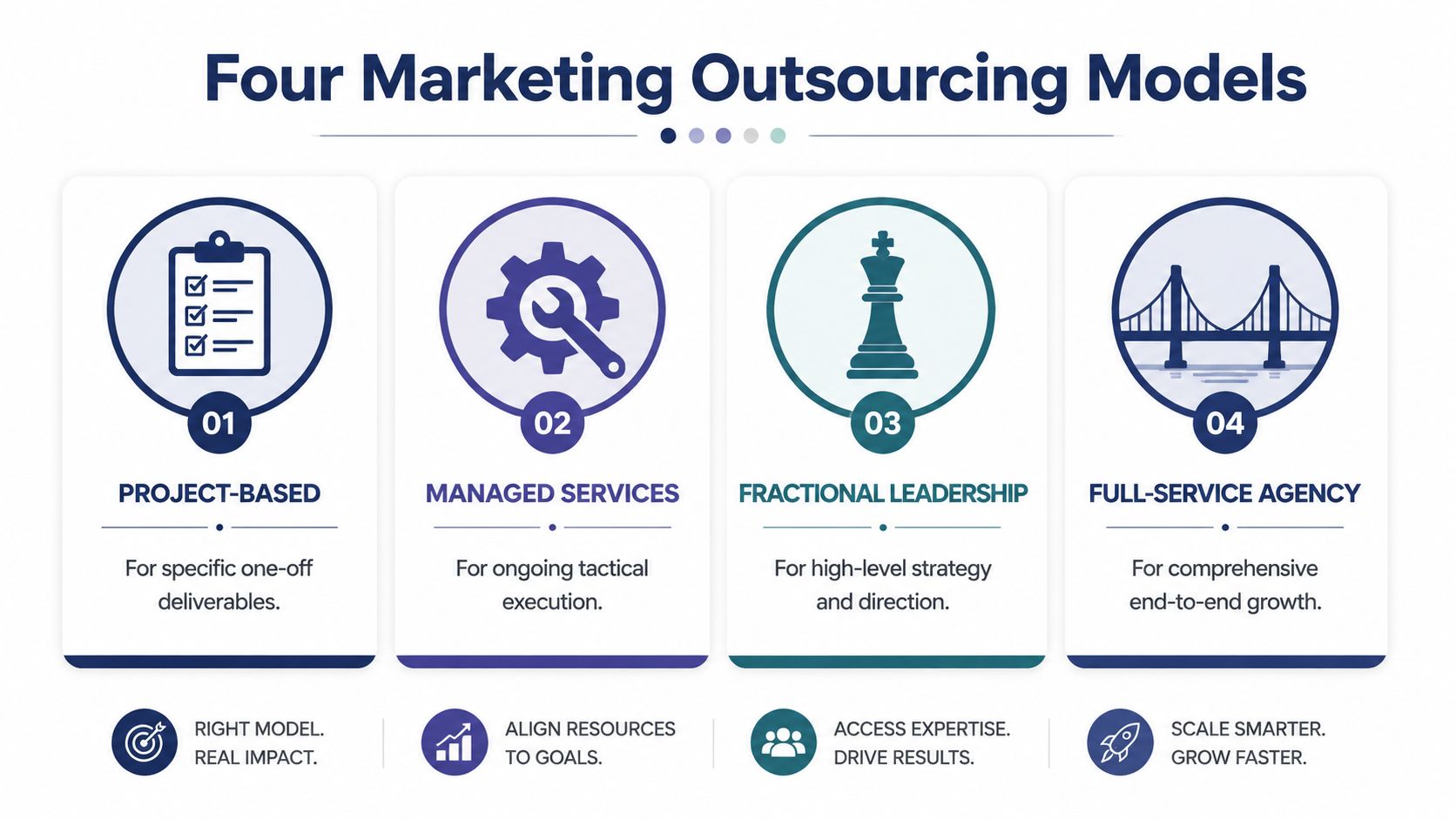
How the four models actually differ
Think of these models as different machine configurations. Same purpose. Different throughput, control, and setup time.
1. Project-based work
This is the right fit when you have a clearly defined deliverable. Examples include a website rebuild, CRM cleanup, an SEO audit, a trade show follow-up sequence, or a capabilities deck refresh.
This model works well when your internal team can operate the finished asset after delivery. It fails when you expect a one-time project to fix an ongoing pipeline problem.
2. Managed services
This is ongoing tactical execution. An outside team handles recurring work such as email campaigns, content publishing, paid search management, CRM maintenance, reporting, or outbound coordination.
Good fit for firms that already know what they need done but don't have the bandwidth or specialist staff to do it consistently.
3. Fractional leadership
A fractional CMO or senior strategist provides direction, prioritization, and oversight without acting as a full-time hire. This model is useful when your team has people and tools, but no one is driving alignment between sales, CRM, website, campaigns, and budget.
It's often the missing layer when work is happening but results stay mixed.
4. Full-service agency or embedded team
This is the deepest model. Strategy, execution, technology integration, reporting, and sales coordination all sit under one partner relationship. For manufacturers with multiple moving parts, this is often the most practical route because fewer handoffs means fewer failures.
A vendor can complete tasks. A partner should improve system performance.
Choosing the model that fits your operating reality
Here's a straightforward comparison.
| Model | Best For | Typical Cost (USD/Month) | Key Outcome |
|---|---|---|---|
| Project-Based | One-off builds, audits, migrations, redesigns | Varies by scope | Completed deliverable |
| Managed Services | Ongoing execution without adding internal headcount | Varies by scope | Consistent marketing output |
| Fractional Leadership | Companies needing senior direction and accountability | Varies by scope | Clear strategy and prioritization |
| Full-Service Agency | Firms needing strategy, execution, and integration together | Varies by scope | Unified growth system |
Cost varies too much by scope, channel mix, integration complexity, and internal readiness to give a useful fixed number without guessing. What matters more is matching the model to the problem.
A few selection rules help:
- Choose project-based if the issue is isolated and your team can run the result.
- Choose managed services if you need recurring output and already have reasonable strategic clarity.
- Choose fractional leadership if teams are active but misaligned.
- Choose full-service support if your bottleneck sits between departments, tools, and follow-up.
Poor choices usually manifest in specific ways. A manufacturer hires an execution agency when the actual issue is sales process and CRM design. Or they hire a strategist when nobody internally can execute the plan. That mismatch is why many outsourced relationships underperform.
Key Marketing Systems You Can Outsource
The best outsourced marketing for manufacturing doesn't start with channels. It starts with systems. Each system has a job, and each job needs to connect to the next one. If those connections are weak, you get activity without usable pipeline.

The CRM system is the control panel
For many manufacturers, the CRM is the first system to fix. Whether you use GoHighLevel, HubSpot, Salesforce, or a hybrid setup, the CRM should store contact history, lead status, next steps, campaign attribution, and handoff notes in one place.
If it doesn't, your outsourced team will struggle to do useful work.
A strong outsourced partner can handle:
- Pipeline architecture: Stages for inquiries, qualified opportunities, quoted work, stalled deals, and closed business.
- Automation setup: Lead routing, reminder sequences, task creation, reactivation workflows, and internal notifications.
- Data cleanup: Merging duplicates, standardizing fields, and separating customers, distributors, prospects, and inactive accounts.
- Sales handoff rules: Defining when marketing owns a contact and when sales takes over.
If you're using GoHighLevel or planning a broader automation layer, this guide to marketing automation for manufacturing shows how those workflows should support actual sales operations instead of adding complexity.
Demand generation needs multiple connected parts
Manufacturers rarely grow through one channel alone. Good outsourced teams connect discoverability, outreach, content, and follow-up.
The 2025 trend worth watching is the combination of AI-supported outreach and outsourced SDR execution. According to Martal's manufacturing sales overview, this approach lets manufacturers scale outreach to hundreds of niche prospects weekly, boosting lead volume by over 50% while reducing costs compared with building the same function in-house.
That matters most when your sales team is strong at quoting and closing but weakly staffed for prospecting.
What good outsourced execution looks like
A capable partner should be able to build or manage several connected systems, including:
| System | What it does | What good looks like |
|---|---|---|
| SEO and website | Helps engineers and buyers find you | Service pages match real capabilities and buyer intent |
| Content marketing | Answers technical questions and builds trust | Articles, spec-focused pages, and follow-up assets support sales conversations |
| Outbound SDR support | Opens conversations with targeted accounts | Messaging is specific to industry, part type, process, or use case |
| Email reactivation | Re-engages old leads and quoted accounts | Dormant contacts get sequenced follow-up with clear next actions |
| Reporting dashboards | Shows what is creating pipeline | Leadership can see lead status, source, and sales outcomes in one view |
A quick walkthrough helps clarify what these systems should support in practice:
The failure mode is easy to spot. You outsource SEO to one firm, email to another, CRM setup to a freelancer, and paid media to whoever your web developer knows. Everyone produces deliverables. Nobody owns the full path from inquiry to opportunity.
That's why system ownership matters more than service breadth.
How to Evaluate and Select the Right Partner
A polished pitch deck won't tell you whether a partner can function inside your operation. The most important question is simpler. Can this team integrate with your sales process, your CRM, your data structure, and your definition of a qualified opportunity?
That's the filter that matters most because disconnected outsourcing fails in predictable ways. According to Datamatics on outsourced marketing skill gaps, a 2025 Gartner report on B2B manufacturing notes that 68% of outsourced marketing initiatives fail to achieve significant lead conversion uplift due to CRM misalignment, and manufacturers report 40% higher ROI when outsourcing includes CRM strategy consulting from the start.
Integration skill matters more than a long service menu
A partner can offer SEO, ads, email, content, social, and automation and still be the wrong fit.
What you're really buying is the ability to answer questions like these:
- How will new inquiries get into the CRM?
- Who changes lifecycle stages?
- How will sales disposition bad-fit leads?
- What happens to dormant quotes?
- How are distributor leads separated from direct opportunities?
- How will campaign reporting tie back to pipeline, not just clicks?
If a partner can't answer those clearly, they're not ready to work in a manufacturing environment with longer cycles, multiple stakeholders, and technical qualification steps.
One option in this category is a firm that focuses specifically on manufacturing digital marketing services, where CRM alignment, industrial SEO, content, and lead systems are built around manufacturing sales workflows rather than generic lead generation.
If the agency talks mostly about impressions, reach, and posting frequency, keep asking questions until they explain handoffs, qualification, and CRM ownership.
Questions to ask before you sign anything
Use this shortlist in partner interviews.
- CRM compatibility: Have you worked inside GoHighLevel, HubSpot, Salesforce, or ERP-connected setups similar to ours?
- Lead definition: How do you define MQL, SQL, and sales acceptance for a manufacturing business?
- Handoff process: What exact event moves a lead from marketing to sales?
- Data access: Who owns the data, dashboards, automations, and campaign assets?
- Reporting cadence: What will we review weekly and monthly?
- Feedback loop: How do you capture sales feedback and apply it to messaging or targeting?
- Implementation discipline: Who is responsible for setup, testing, and documentation?
- Exit readiness: If we stop working together, can our internal team run the system?
A good partner won't dodge those questions. They'll welcome them.
A weak partner usually reveals itself by speaking in generalities. They'll say they “drive awareness,” “boost the brand,” or “optimize engagement,” but they won't map those claims to actual operational steps. In manufacturing, that's not enough. Your partner needs to work like an extension of production planning. Clear inputs. Clear outputs. Clear ownership.
The First 90 Days A Proof-of-Concept Roadmap
The first three months should prove whether the relationship can work. Not by chasing vanity metrics, but by building one controlled system, launching one focused campaign, and creating one reporting loop that sales and leadership both trust.
Days 1 to 30 build the foundation
Month one is for diagnosis and setup. During this stage, a serious partner earns trust.
Core milestones should include:
- System audit: Review CRM stages, forms, website conversions, lead sources, email tools, and sales handoff steps.
- Data cleanup: Normalize contact records, tags, pipeline fields, and ownership rules.
- Tracking setup: Build dashboards that tie inquiries to opportunities and outcomes.
- Priority selection: Pick one audience, one offer, and one campaign to test first.
The technical layer often breaks internal efforts. Datamatics on outsourced martech services notes that expert agencies handle complex integrations such as HubSpot to ERP connections, addressing the 70% failure rate of in-house setups. It also says this integration can cut sales-marketing friction by 40% and lower customer acquisition costs by 25% through automated workflows and shared data.
Days 31 to 60 launch a controlled quick win
Month two should produce visible movement. Not full transformation. A controlled test.
Common quick-win campaigns include:
- Dormant lead reactivation: Old quotes, inactive accounts, or past inquiries.
- Targeted outbound: A narrow list of ideal-fit accounts in one vertical or geography.
- Lead capture asset: A capabilities guide, process checklist, or engineering-focused content offer tied to a landing page.
- High-intent page improvement: Upgrading RFQ, contact, or service pages so inquiries are easier to submit and route.
Start with the shortest path to revenue, not the most glamorous campaign.
For many firms, that means reactivation before acquisition. You already have contacts, quotes, conversations, and partial opportunities sitting in the system. An outsourced team should be able to organize and activate that base quickly.
Days 61 to 90 optimize and decide what scales
Month three is where you decide whether the proof of concept deserves expansion.
By this point, you should have:
| Deliverable | What you should see |
|---|---|
| CRM visibility | Clear stage definitions and ownership |
| Dashboard reporting | Source, status, and sales feedback in one place |
| Campaign learning | Which message, list, or offer is generating better-fit conversations |
| Process discipline | Faster follow-up and fewer dropped inquiries |
If you want a practical planning tool for that rollout, this marketing roadmap template is a useful starting point for assigning owners, milestones, and review points.
What you shouldn't do at day 90 is add five more channels because one campaign showed signs of life. Scale only what the team can measure and maintain. If the handoffs still aren't clean, more volume will just create more waste.
FAQs About Outsourced Manufacturing Marketing
A few questions come up in nearly every manufacturer conversation. Here are direct answers.
| Question | Answer |
|---|---|
| Will outsourcing replace our sales team? | No. In most manufacturing firms, outsourced marketing supports the front end. It improves visibility, qualification, follow-up, and handoff. Your internal team still handles quoting, technical review, relationship management, and closing. |
| Do we need to switch CRMs first? | Not always. Many firms can improve results inside their current setup if the data structure, stages, and automation are cleaned up. The real issue is usually process discipline, not software alone. |
| Is this only for larger manufacturers? | No. Smaller shops often benefit because they don't have room for a full internal marketing department. The key is scoping the work around a specific bottleneck instead of outsourcing everything at once. |
| What usually goes wrong? | Weak integration, unclear ownership, and poor sales feedback. If leads enter the system but nobody qualifies, routes, or follows up consistently, the outsourcing partner can't fix the revenue problem alone. |
| How do we know it's working? | You should see cleaner data, faster follow-up, better sales trust in leads, and clearer reporting on which activities are contributing to pipeline. |
If you want a practical diagnosis of your current growth system, Machine Marketing helps manufacturers connect strategy, CRM, lead generation, and reporting into one operating model. If your tools and team are already in place but results still feel fragmented, that's usually the right place to start.