Most advice on personalized content marketing starts with a name field. Add “John” to the subject line, change a headline by industry, and call the campaign personalized. That approach may make a message look more relevant, but it won't solve the harder problem for industrial B2B companies: helping an entire buying group agree that your solution fits its application, risk profile, and operating reality.
The stronger approach treats personalization as a connected marketing system. You need useful account context, role-specific content, stage-aware journeys, consistent data, and measurement tied to pipeline. The sections below show how to build that system without turning your content operation into an unmanageable collection of bespoke assets.
Table of Contents
- Why First-Name Personalization Is Failing Industrial B2B
- The Core Principles of Personalized Content Marketing
- Segmenting Engineers and Industrial Buying Groups
- Mapping Content to Segments and Buying Stages
- Data, CRM, and Automation Workflows That Actually Connect
- Measuring What Matters and Iterating Without Guesswork
- Real Examples and a 30-60-90 Day Implementation Plan
Why First-Name Personalization Is Failing Industrial B2B
First-name personalization is easy to deploy because it changes a visible field without changing the substance of the message. An engineer still receives the same generic article, a procurement manager still sees the same product pitch, and a plant manager still has to translate technical detail into an operating case. The email may feel customized, but the buying problem remains untouched.
That distinction matters. The Demand Metric Content Personalization Benchmark Study found that 61% of participants were personalizing content at some level, while 80% said personalized content was more effective than unpersonalized content. The study also found that teams personalizing 21% to 40% of their content reported the highest rate of meeting content objectives. That points to a practical lesson, partial personalization can outperform an attempt to customize everything.
Industrial buying makes surface tactics even weaker. A plant upgrade, automation project, or precision component decision involves people with different responsibilities. The design engineer cares about fit, tolerances, and technical proof. The reliability lead cares about failure prevention and maintainability. Procurement cares about commercial terms and supply risk. A CEO may care about capacity, margin, and operational resilience.
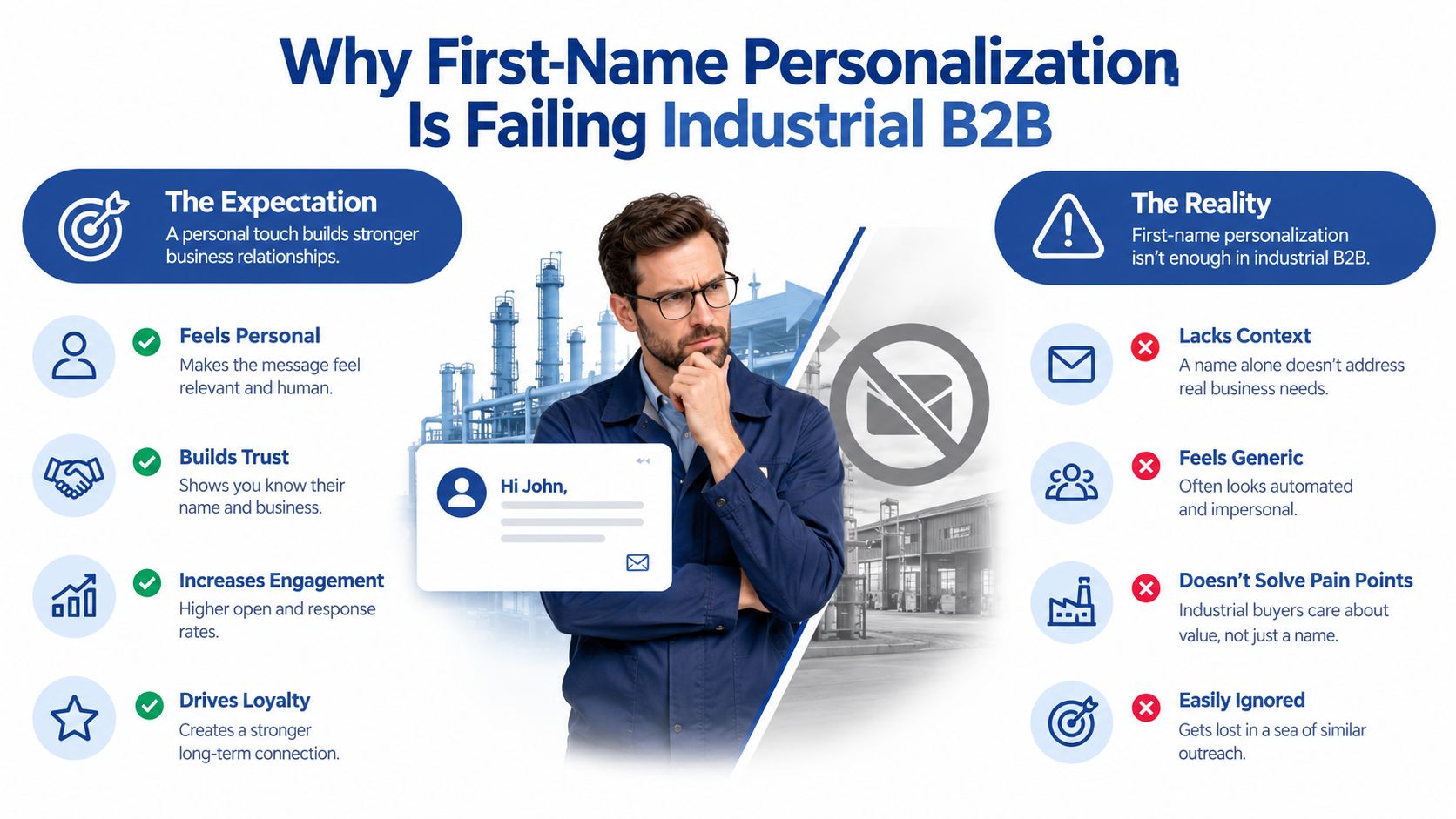
Practical rule: Personalize the decision being made, not merely the person receiving the email.
Move from fields to context
The useful question isn't “What name should appear in the subject line?” It's “What does this account need to prove before it can move forward?” That answer may involve retrofit urgency, installed equipment, regulatory exposure, production constraints, or a specific application.
First-party information can help, especially when buyers voluntarily provide it through forms, preference centers, or technical requests. We explain the role of this permission-based approach in zero-party data, but the principle is simple: ask for information that improves the buying experience, then use it to make the next interaction more useful.
The four shifts are straightforward:
- From fields to context: Use role, application, account, and stage.
- From personas to committees: Build messaging that supports shared evaluation.
- From standalone plays to journeys: Coordinate email, website, sales content, and advertising.
- From engagement vanity to pipeline attribution: Measure movement toward an opportunity.
Personalization isn't an email template choice. It's a system question. If sales can't see what marketing learned, if the website doesn't reflect the same account context, or if every stakeholder receives disconnected messages, the system is producing activity rather than alignment.
The Core Principles of Personalized Content Marketing
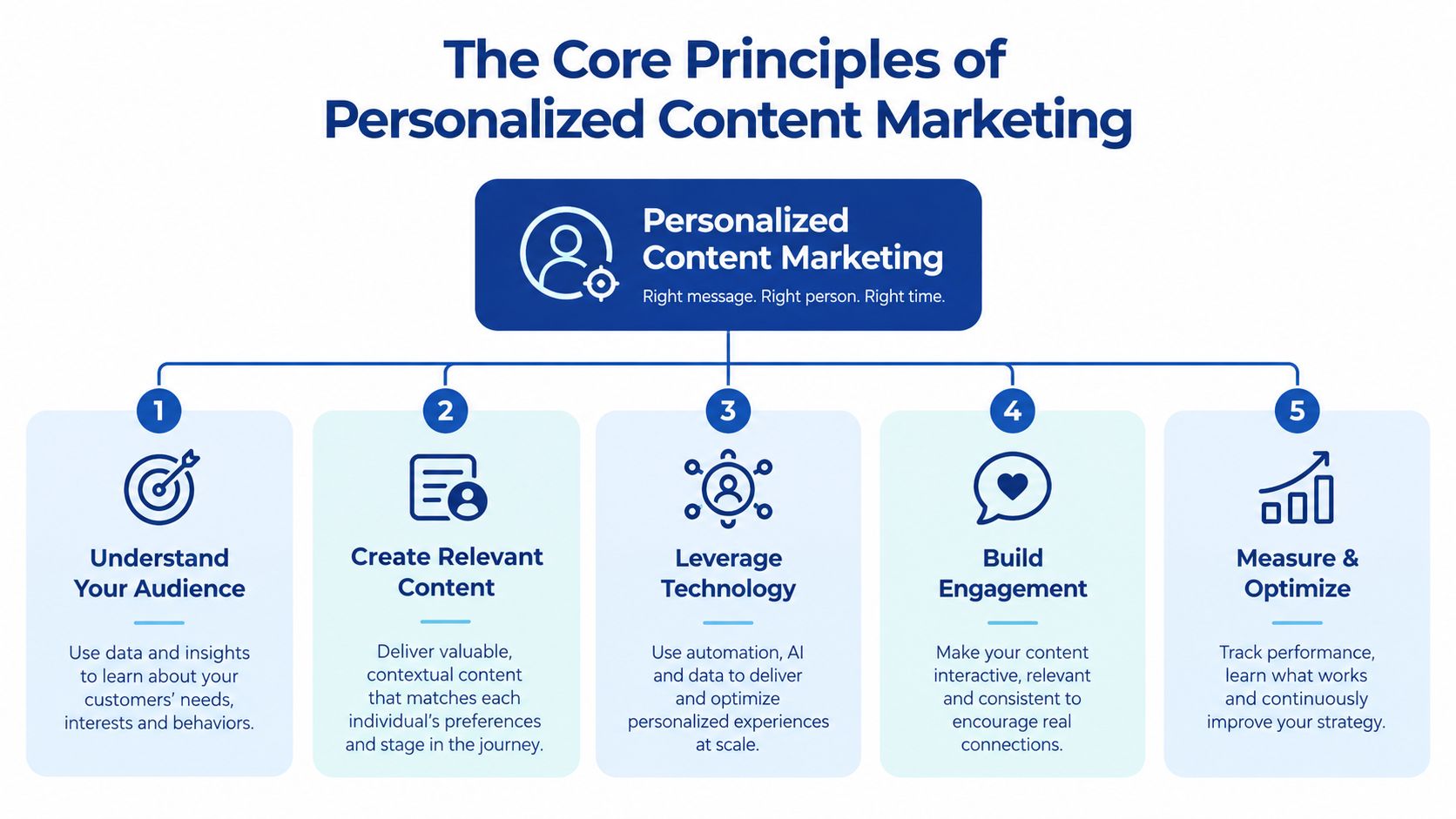
Treat personalized content marketing as a layered operating model. Each layer depends on the one below it. If your team skips the foundation and starts with automation, you'll deliver irrelevant content faster.
Define relevance before selecting technology
Personalization should reflect role, buying stage, sector, application, and account context. A controls engineer evaluating an upgrade needs different evidence from a procurement manager comparing suppliers. A retrofit opportunity also needs a different message from a greenfield installation.
Diagnostic: Can you describe what changes in the message for each priority role and stage?
Next, document the buyer problem behind every asset. A product feature isn't a problem statement. “Advanced sensor platform” says little. “Detect intermittent vibration before it causes an unplanned line stoppage” gives the content team a useful job to perform.
A strong brief should identify:
- Operational problem: What is failing, slowing production, or creating risk?
- Evaluation question: What must the buyer verify?
- Proof requirement: Which specification, test, reference, or process detail reduces uncertainty?
- Next action: What should the reader do after consuming the asset?
Diagnostic: Does each asset answer a documented buyer question, or does it merely describe your offering?
Build reusable content modules
Don't create a separate whitepaper from scratch for every segment. Build modular assets that can be recombined. A technical proof section, application example, implementation note, and commercial summary can serve several journeys when each module has a clear purpose.
Diagnostic: Can your team create a role-specific version by assembling approved modules rather than commissioning a new project?
Use behavior to inform the next interaction
A visit to a torque-specification page carries a different signal from a visit to a company-history page. A download, repeat visit, comparison-tool interaction, or request for a technical drawing should change what happens next.
Keep the logic visible. If someone requests a specification sheet, send related application guidance or a technical review option. Don't place that contact into a generic newsletter and expect the system to infer intent later.
Diagnostic: Does each meaningful behavior trigger a relevant next step?
Make every channel read the same record
Email, website personalization, sales sequences, advertising, and account-based marketing should use compatible definitions. A contact shouldn't receive a late-stage commercial email while the account website still presents introductory education.
Teams exploring audience targeting with AI personalization should start with clean segmentation and explicit rules. AI can help generate and select variants, but it can't repair contradictory data or an undefined buying process.
Diagnostic: Would marketing and sales describe the same account, role, stage, and next action?
Segmenting Engineers and Industrial Buying Groups
Most segmentation projects fail because they create labels without changing decisions. “Manufacturing,” “North America,” and “operations” may help organize a database, but they don't tell a writer what to say or a salesperson what to do.
Use three axes together: role, buying stage, and account context. Keep the taxonomy deliberately small. A manageable system with a handful of useful segments will outperform an elaborate structure that nobody maintains.
Start with the buying role
A design engineer evaluates technical fit, integration, tolerances, and documentation. A controls engineer may focus on compatibility, programming, diagnostics, and commissioning. A plant manager looks for throughput, downtime reduction, staffing implications, and operational risk. A reliability lead wants evidence about failure modes, maintenance, and serviceability. Procurement needs clarity on supply, commercial terms, and vendor risk.
These aren't personality types. They're different responsibilities inside the same decision.
Add the stage of the decision
Use a practical progression:
- Problem framing: The account recognizes a performance, quality, capacity, or reliability issue.
- Solution exploration: The group investigates possible approaches.
- Vendor evaluation: Stakeholders compare technical and commercial options.
- Shortlist and approval: The group validates risk, implementation, and business value.
- Commissioning and expansion: The customer deploys, reviews performance, and considers additional work.
The same asset shouldn't serve all five stages. Early content should clarify the problem. Later content should reduce implementation and commercial uncertainty.
Layer in account context
Account context can include industry, installed base, retrofit urgency, production environment, regulatory exposure, and current relationship. These factors make the message materially more relevant than a regional or demographic label.
A useful matrix might look like this:
| Role | Early Stage Focus | Mid Stage Focus | Late Stage Focus |
|---|---|---|---|
| Design engineer | Application problem and design constraints | Drawings, specifications, compatibility | Validation package and technical review |
| Controls engineer | System architecture and integration risk | Interface details and diagnostics | Commissioning plan and support |
| Plant manager | Capacity, uptime, and operational impact | Business case and implementation disruption | Rollout plan and accountability |
| Reliability lead | Failure modes and maintenance exposure | Service model and test evidence | Maintenance handoff and performance review |
| Procurement | Supply risk and vendor qualification | Commercial comparison | Terms, availability, and contractual requirements |
The B2B personalization evidence reinforces this group-level approach. A 2024 Gartner survey of 632 buyers found that individual-level content had a 59% negative impact on group consensus, while buying-group framing improved consensus by 20% and organizational framing improved it by 18%. Groups that reached consensus were 2.5 times more likely to report a high-quality deal, according to the B2B personalization research summary.
The right segment is the smallest group that shares a decision, a problem, and a measurable next step.
Use one segment, one message, and one measurable outcome. If a segment needs several unrelated messages, your taxonomy is probably mixing stages or roles.
Mapping Content to Segments and Buying Stages
A content calendar answers when you publish. A content-to-segment map answers why a specific person should receive a specific asset at a specific point in a decision.
Start with the decision matrix below, then fill the gaps with existing material before commissioning new work.
| Role | Buying Stage | Asset Type | Distribution Channel |
|---|---|---|---|
| Design engineer | Problem framing | Application guide and failure-mode overview | Organic search and technical website hub |
| Design engineer | Vendor evaluation | CAD-ready specifications and comparison sheet | Spec portal, email, and sales follow-up |
| Plant manager | Solution exploration | ROI calculator and implementation brief | Website, email, and sales presentation |
| Reliability lead | Vendor evaluation | Maintenance benchmark and service plan | Technical nurture and account review |
| Procurement | Shortlist and approval | Supply, terms, and qualification package | Sales sequence and secure document area |
| Buying group | Decision | Pilot-program brief and reference call | Account-based campaign and sales coordination |
Design engineers need content they can use in an engineering process. That may mean dimensional drawings, compatibility notes, test conditions, and failure-mode data. Plant managers need a credible operating case, including disruption, maintenance implications, and expected workflow changes. Executive content can matter, but it usually earns attention after the technical and operational questions have been addressed.
Sequence channels by intent
Use ungated technical material for awareness when the buyer is still defining the problem. Move to configurators, comparison tools, and detailed specifications during consideration. Offer pilot-program briefs, implementation plans, and reference calls when the group is deciding.
The common mistake is publishing one whitepaper and calling it personalization. A single asset can support several audiences, but the surrounding experience should change. The landing page, follow-up message, sales enablement, and next offer should reflect the segment and stage.
Worked example for a precision components supplier
Suppose a supplier targets automotive Tier 1 manufacturers. The early campaign could publish an ungated guide about dimensional consistency and production risk. A design engineer who downloads it might receive a specification package and material-compatibility content. A plant manager from the same account could receive an implementation brief focused on line disruption and quality control.
Sales should see the account-level activity, not just a lead score attached to one contact. If several stakeholders consume related content, marketing should treat that pattern as a buying-group signal and coordinate the next action around a technical review or application workshop.
The transformation is practical. Each asset earns a defined job, every channel supports the same decision, and content production follows gaps in the buying process rather than the urge to publish.
Data, CRM, and Automation Workflows That Actually Connect
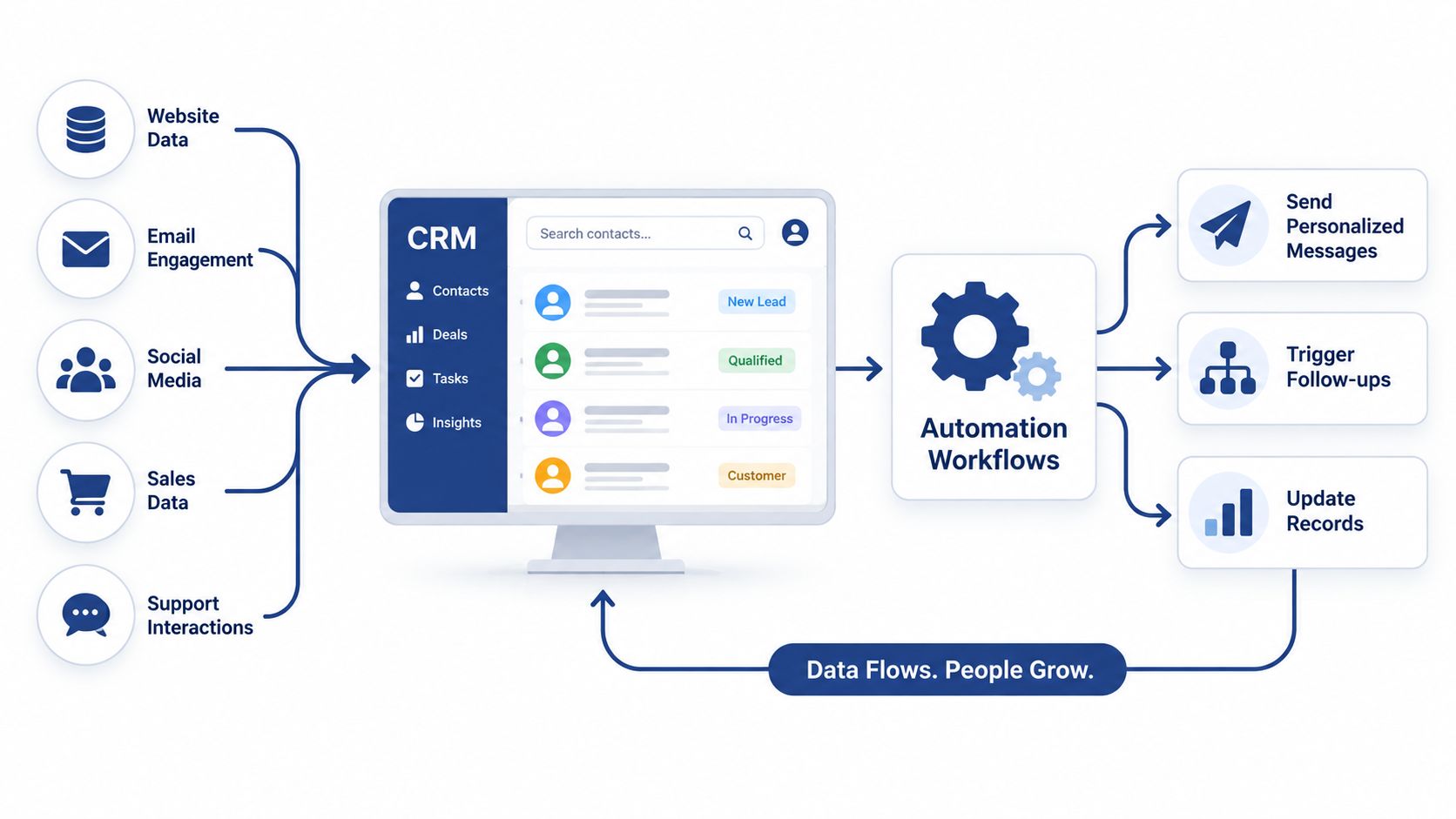
Your martech stack isn't a strategy. HubSpot, Salesforce, a marketing automation platform, and enrichment tools can create a powerful system, but only when they share definitions and trigger useful actions.
Industrial marketers usually control four important data sources:
- First-party behavior: Visits to specification portals, technical pages, calculators, and gated downloads.
- Firmographic and technographic enrichment: Account size, industry, systems, and technology signals from providers such as Bombora and ZoomInfo.
- CRM account context: Sales conversations, active projects, installed equipment, objections, and buying roles.
- Intent signals: Relevant activity from trade publications and other industry content environments.
The quality of the workflow depends on how these sources combine. A design engineer downloading a torque-specification PDF should enter a technical nurture related to that application. The contact shouldn't receive a generic drip designed for an unknown audience.
Build the trigger chain
A practical workflow looks like this:
- Form submission: Capture role, application, company, and declared interest.
- Record enrichment: Match the contact to an account and add relevant firmographic or technographic context.
- CRM update: Write the activity to the account record and associate the buying role.
- Segment assignment: Apply stage and content-interest rules.
- Nurture selection: Deliver the next relevant technical or operational asset.
- Buying-group evaluation: Increase account attention when related stakeholders engage.
- SDR alert: Notify sales when behavior and account context meet the agreed threshold.
- Sales sequence: Give the salesperson a role-specific reason to follow up.
Keep the logic auditable. Marketing and sales should know why an alert fired, which asset caused it, and what response is expected.
Fix speed and ownership
CRM and marketing automation records need to stay synchronized quickly enough for the next interaction to remain relevant. A five-minute synchronization target is a useful operational standard for teams that need sales alerts to follow meaningful behavior, but the exact timing should match your systems and staffing.
Document ownership for every field. Sales should maintain account status and project context. Marketing should maintain content interest, campaign membership, and journey logic. Nobody should own a field that they can't keep accurate.
For teams that need to turn existing landing-page material into short campaign assets, generate videos from landing pages can help extend a core asset into another format. Use the output as a distribution aid, not as a replacement for technical review.
See our guidance on turning your CRM into a growth engine with campaigns for the operating discipline behind these workflows.
Measuring What Matters and Iterating Without Guesswork
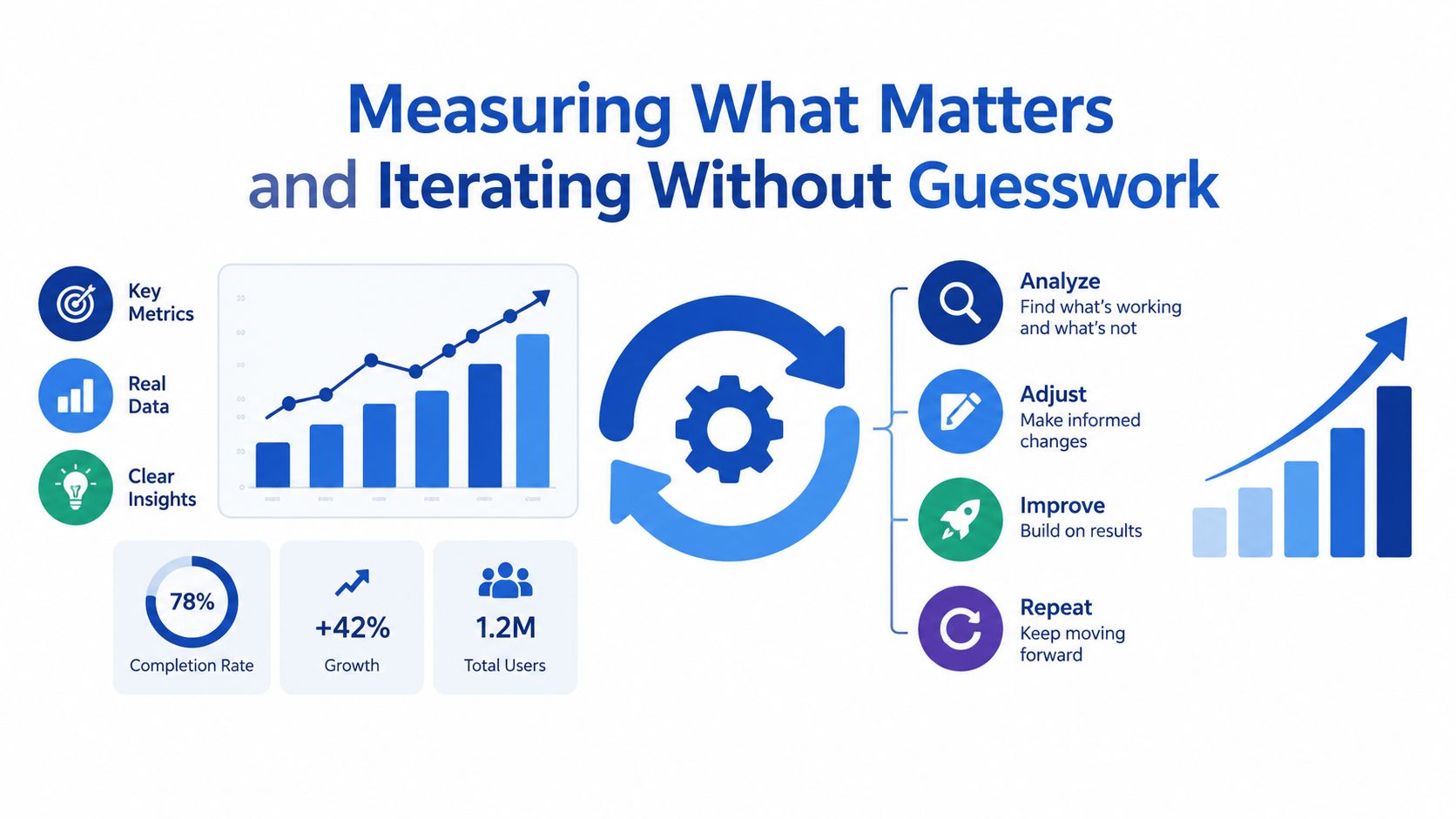
Open rates and form fills can help diagnose delivery and interest, but they don't prove that personalized content marketing is helping an industrial business win work. Long sales cycles require a measurement stack that connects content behavior to account progress and commercial outcomes.
Track four primary measures:
- Pipeline acceleration by segment: Compare how quickly opportunities move when the relevant segment journey is active.
- Content-to-SQL conversion by asset: Identify which assets create qualified sales conversations, not just downloads.
- Account engagement across the buying group: Look for meaningful activity from multiple roles at one account.
- Influenced revenue attribution: Record where content contributed to an opportunity, while recognizing that influence isn't the same as sole causation.
Use a 90-day operating loop
Review content performance weekly. Look for consumption quality, repeat activity, segment fit, and sales feedback. Don't rewrite an asset because one email underperformed. First check delivery, audience definition, timing, and whether the offer matched the stage.
Recalibrate segment scoring monthly. If procurement engagement never changes a buying-group score, your model may be overvaluing individual activity. If several stakeholders from one account engage with related technical assets, your system should make that visible to sales.
Retire or rebuild assets quarterly. Remove content that no longer reflects your products, applications, or customer questions. Improve high-value assets with stronger proof, clearer next actions, and better distribution.
A simple dashboard can use three layers:
- Engagement: Asset views, repeat visits, downloads, tool interactions, and email response.
- Intent: Account-level research signals, known project context, and role coverage.
- Opportunity: Stage movement, sales acceptance, pipeline progression, and revenue influence.
Don't use a generic benchmark to excuse weak diagnosis. The useful comparison is between your own segments, assets, and journeys. The Marq content marketing statistics summary reports that 87% of businesses say at least some customers expect personalized content, while 43% say most customers expect it. Yet only 32% of brands say the majority of their content is personalized, and only 21% personalize more than 75% of their content. The execution gap is where your measurement system should focus.
Privacy belongs in the dashboard too. A Contentful summary based on Segment and Twilio reports that 69% of customers appreciate personalization when it uses data they explicitly shared, while only 37% trust companies with their personal data. The same source says 50% of companies report that recent privacy regulations have made personalization more difficult. Use declared preferences and useful interactions first, explain the value of data collection, and give buyers control.
Real Examples and a 30-60-90 Day Implementation Plan
Personalization becomes easier to judge when the use case is concrete. Consider three operating examples, not as promises of guaranteed results, but as patterns you can adapt.
A sensor supplier can target plant engineers with diagnostic content tied to a known equipment problem. The first interaction might explain failure indicators, the next might provide installation constraints, and the sales handoff might offer an application review. The relevant segment is the plant engineering group, and the measurable outcome is progression from technical interest to a qualified project conversation.
A hydraulics manufacturer can run an account-based program for engineering, procurement, and operations contacts inside EPC firms. Each role receives material suited to its evaluation responsibility, while the account record shows shared engagement. The campaign succeeds when the group advances toward a coordinated technical and commercial discussion, not when one contact accumulates the highest score.
A precision components vendor can retarget design engineers with specification-sheet content after they engage with an application page. The next asset can address material compatibility, quality documentation, or production constraints. The point is to remove the next technical objection, not to repeat the original product message.
Use a staged rollout
| Phase | Days | Key Deliverables | Success Signal |
|---|---|---|---|
| Diagnosis | 1 to 30 | Audit data, repair CRM hygiene, define the top three buying-group segments | Sales and marketing agree on account, role, stage, and ownership fields |
| Build | 31 to 60 | Create the content map, launch one automated nurture, instrument tracking | Each priority segment has a relevant asset and next action |
| Expand | 61 to 90 | Add multi-touch campaigns, complete the first attribution review, lock the next-quarter iteration | The team can identify account engagement, sales response, and content gaps |
Start with manufacturing lead generation as the commercial frame. Personalization should support a defined growth objective, such as creating qualified conversations in a target application, not become an isolated marketing project.
Avoid these rollout traps:
- Starting with software: Don't buy another platform before defining the decision, data, and workflow.
- Scoring individuals alone: Give buying-group activity a clear place in account evaluation.
- Creating too many variants: Reuse approved modules and reserve bespoke work for high-value opportunities.
- Ignoring privacy signals: Use data buyers understand and have chosen to share.
- Measuring downloads as revenue: Connect assets to account progress and sales outcomes.
- Leaving sales out: A journey fails when the salesperson can't interpret the signal or act on it.
The first move is small but consequential. Select one application, one buying group, and one journey. Map the technical, operational, and commercial questions in sequence, then connect each question to an asset and a measurable next action.
Machine Marketing helps manufacturers connect content strategy, SEO, segmentation, CRM, and marketing automation into a practical growth system. Visit Machine Marketing to discuss a diagnosis of your current personalized content marketing workflow and identify the next implementation step.