If you're a manufacturer and lead generation feels inconsistent, the problem usually isn't effort. It's system design. You might be spending money on trade shows, paying for lists, posting on LinkedIn when someone remembers, and waiting for the website to somehow produce RFQs. That isn't a system. It's a collection of disconnected activities.
Modern manufacturing lead generation works when you treat it like an engineered process. You define the right accounts, build content that answers technical questions, activate the right channels, route every response through a CRM, and measure quality all the way to revenue. That's how you stop chasing random inquiries and start creating qualified opportunities your sales team can close.
Table of Contents
- Your Old Lead Generation Playbook Is Broken
- Define Your High-Value Customer and Core Message
- Build Your Digital Hub for Industrial Buyers
- Activate Demand with Targeted Paid and Organic Channels
- Engineer Your Outbound and ABM Engine
- Automate Your System with CRM and GoHighLevel
- Measure What Matters and Your 90-Day Rollout Plan
Your Old Lead Generation Playbook Is Broken
A lot of manufacturers are still running a playbook built for a different buying environment. They show up at events, collect business cards, send a few follow-up emails, buy a contact list, and hope the sales team can force momentum from there. That worked better when buyers depended on reps to get basic information.
They don't anymore. Around 57% of B2B buyers have already made up their minds before speaking with a sales representative, according to SmartBug Media's manufacturing lead generation analysis. In industrial markets, that's even more important because engineers, plant managers, and procurement teams usually do a lot of silent research before anyone fills out a form.
So the old model fails in two ways. First, it shows up too late in the buying process. Second, it treats every inquiry like progress, even when the lead is a bad fit, has no timeline, or just wants a price check.
Practical rule: If your process depends on a salesperson being the first meaningful touchpoint, you're losing deals before your team even knows the account exists.
There's another reason to stop defending outdated tactics. A content-led strategy costs 62% less than traditional marketing while generating three times as many leads, also cited by SmartBug Media. That doesn't mean trade shows are useless. It means trade shows can't carry the whole load anymore.
What manufacturers need now is a lead generation machine. Not a campaign. Not a quarterly scramble. A machine.
That machine does four things well:
- Captures demand early: It shows up while buyers are researching.
- Filters for fit: It keeps your team away from low-value opportunities.
- Creates continuity: Website, ads, email, LinkedIn, and sales all work from the same targeting logic.
- Measures outcomes: You can see which channels produce qualified pipeline, not just clicks.
If you're still asking, "How do we get more leads?" you're asking a weak question. Ask, "How do we build a system that consistently creates qualified manufacturing opportunities?"
Define Your High-Value Customer and Core Message
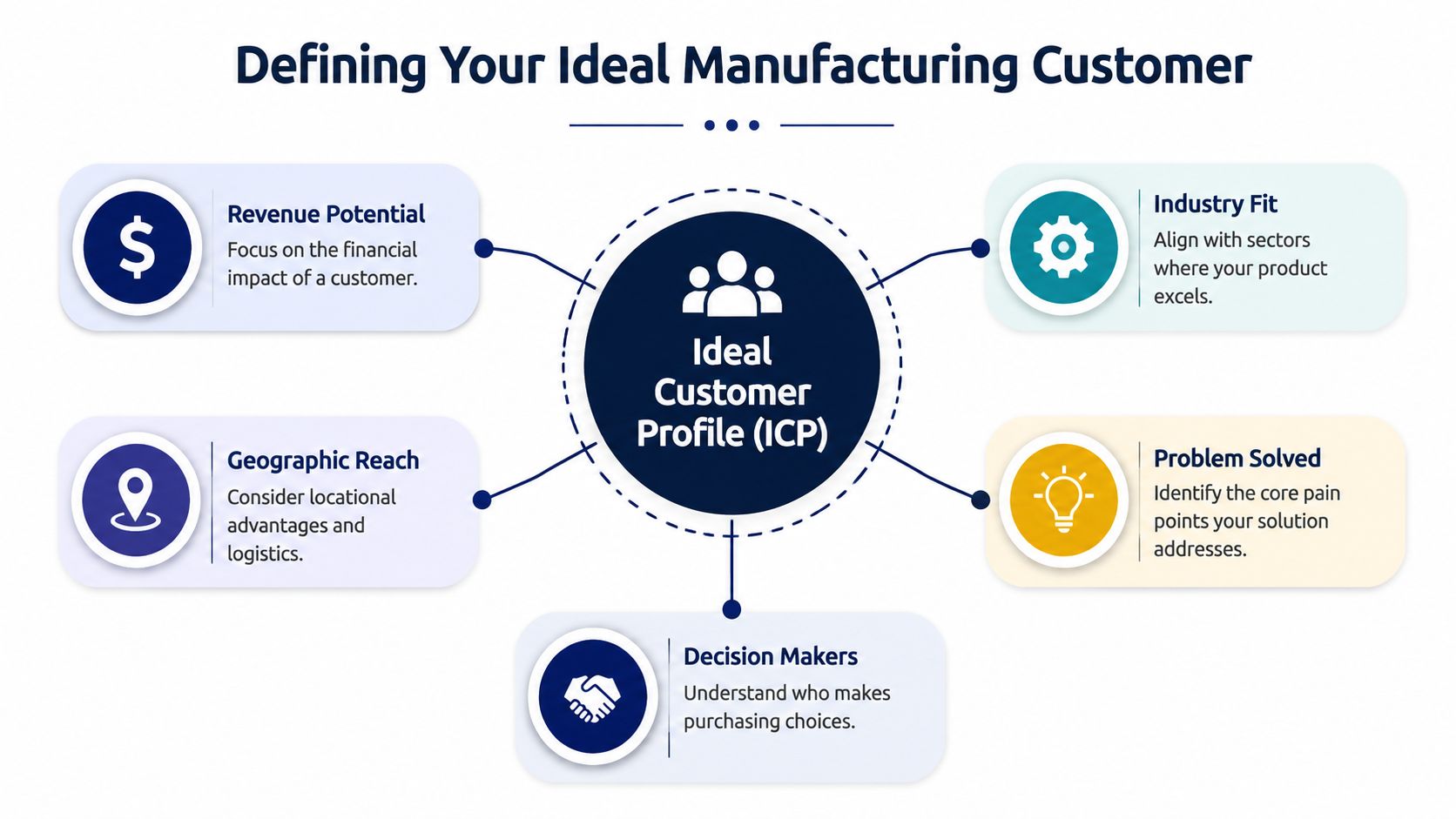
Most manufacturers go wrong at the foundation. They define the target too broadly, write generic copy, and then wonder why lead quality is poor. If your ICP includes "any company that might need our service," you don't have an ICP. You have wishful thinking.
Industrial sales cycles commonly run 6-18 months, and buyers often do much of their research in the dark funnel before they ever contact sales, as noted by Act-On's manufacturing lead generation guide. That makes front-end targeting critical. A bad-fit lead can consume months of engineering reviews, quoting time, and follow-up with almost no chance of closing.
Start with revenue fit, not demographics
Don't begin with company size and industry code alone. Start by looking at your best customers and reverse-engineering why they're worth serving.
Ask these questions:
- Which customers generate strong margins: Not just top-line revenue, but profitable work with manageable support burden.
- Which applications fit your process well: Where do you have clear production, quality, or speed advantages?
- Which accounts reorder or expand: One-off custom jobs may keep the shop busy but still weaken long-term growth.
- Which prospects move cleanly through quoting and approval: Some accounts create friction at every step.
- Which geographies make logistical sense: Freight, service coverage, and response time still matter.
A useful ICP for manufacturing lead generation usually includes:
- target industries
- common applications
- production or compliance requirements
- order profile
- buying environment
- expected revenue potential
If you need a starting framework for documenting those segments, this guide on how to create buyer personas is a practical companion to the ICP work.
Map the buying committee before you write copy
A single manufacturing purchase often has multiple agendas attached to it. If your messaging only speaks to one person, the deal stalls when it reaches the next reviewer.
Here's the simplest way to map the committee:
| Role | What they care about | What you need to show |
|---|---|---|
| Engineer or technical evaluator | Specs, tolerances, materials, compatibility | Detailed technical proof, drawings, capabilities, process clarity |
| Plant manager or operations leader | Uptime, throughput, implementation risk | Reliability, delivery consistency, support responsiveness |
| Procurement | Pricing structure, terms, supplier risk | Commercial clarity, lead times, documentation, vendor stability |
| Executive sponsor | Business impact | Strategic fit, risk reduction, confidence in execution |
This is why vague value propositions fall flat. "High quality solutions" doesn't help an engineer. "Trusted partner" doesn't help procurement. Buyers need evidence that fits their role.
The message has to survive internal forwarding. If your contact sends your page to engineering, operations, and purchasing, each person should find a reason to keep the conversation alive.
Build one core message with role-specific proof
You don't need five different brands. You need one clear positioning statement supported by proof that changes by audience.
A strong core message usually answers:
- What do you make or do?
- Who is it for?
- What problem do you solve well?
- Why are you a safer or smarter choice?
For example, a custom component supplier might anchor on responsiveness and precision for regulated production environments. Then the proof shifts by role:
- engineers get tolerances, materials, and QA process
- operations gets lead time reliability and issue resolution
- procurement gets documentation and ordering consistency
Avoid soft marketing language. Use the language your buyers already use internally. Specifications. Certifications. Application fit. Risk reduction. Delivery confidence. Total project friction.
If the message sounds like it could belong to any industrial company, rewrite it.
Build Your Digital Hub for Industrial Buyers
Your website shouldn't act like an online brochure. It should function like a trained technical salesperson who never sleeps, never forgets a follow-up, and always has the right documentation ready.
Too many manufacturing sites still force buyers to hunt for basic answers. Product pages are thin. Capability pages are vague. Contact forms ask for nothing useful. Engineers can't find the specs they need, and procurement can't tell whether you're credible enough to shortlist.
Your website needs to answer technical questions fast
Industrial buyers don't browse the way consumer buyers do. They arrive with a specific question. Can you machine this material? Do you work to this tolerance? Have you built for this application? Can you meet compliance requirements? If your site can't answer those questions quickly, the buyer leaves and keeps researching.
Your core page types should include:
- Capability pages: Explain what you do, who it's for, and where you fit best.
- Industry pages: Show how your offer applies differently in aerospace, medical, food processing, energy, or other target sectors.
- Application pages: Focus on the problem being solved, not just the product itself.
- Resource pages: House spec sheets, PDFs, FAQs, certifications, and technical guides.
- RFQ and contact pages: Make it easy to submit the right information without friction.
A strong manufacturing website doesn't hide technical depth. It organizes it. If you want a useful benchmark, review this breakdown of a manufacturing website that generates leads.
Create content that matches how industrial buyers evaluate vendors
Most industrial content is too shallow. It talks about excellence, innovation, and customer service. Buyers don't need more of that. They need content that helps them evaluate whether you fit the job.
Create assets like these:
- Detailed case studies: Show the problem, the process, and the outcome. Keep them grounded in real applications.
- Spec sheets and capability summaries: Give engineers something they can share internally.
- Material and process comparison guides: Help buyers decide between options.
- FAQ articles: Answer the technical and commercial questions your sales team hears every week.
- Compliance and certification pages: Put qualifications where people can verify them.
- Part-number or spec-focused pages: Capture high-intent searches from technical users.
A good content map follows the buyer journey:
| Buying stage | What the buyer needs | Best content type |
|---|---|---|
| Early research | Understanding options and constraints | Educational articles, application guides, comparison pages |
| Vendor evaluation | Proof that you can do the work | Capability pages, certifications, case studies |
| Purchase preparation | Confidence and speed | RFQ forms, contact pages, downloadable specs, process overview |
Design conversion paths for engineers and buyers
Not every visitor is ready to request a quote. That's fine. Your site should offer more than one next step.
Useful conversion paths include:
- downloading a spec sheet
- requesting a capability review
- asking a technical question
- booking a discovery call
- submitting an RFQ
Those actions should route into different follow-up paths inside your CRM. An engineer downloading a technical PDF needs a different nurture sequence than a buyer submitting a project timeline.
A manufacturing site converts better when it respects buyer intent. Don't force every visitor into the same generic "Contact Us" path.
Also fix the basics:
- clear calls to action on every key page
- forms that gather relevant project details
- visible proof points like certifications and industries served
- mobile usability for buyers checking vendors between meetings
- page structure that supports SEO around technical terms
When the website is built correctly, manufacturing lead generation stops depending on chance. The site becomes the center of your system. Every campaign, outreach effort, and follow-up sequence should send people back to pages designed to answer questions and move them forward.
Activate Demand with Targeted Paid and Organic Channels
Once the foundation is in place, you need to create consistent traffic from the right people. Not random traffic. Qualified attention from the accounts and roles you want.
The channel mix matters because industrial buying rarely happens in one touch. Pepper Insight reports that 89% of B2B marketers use LinkedIn, 87% use email, and 70% of B2B companies say more than half of their revenue pipeline comes from structured lead-generation programs, according to its 2025 B2B lead generation guide. That tells you where serious teams are investing and why disconnected outreach underperforms.
LinkedIn is a targeting tool, not a brand diary
Most manufacturers use LinkedIn badly. They post company anniversaries, booth photos, and hiring updates, then conclude the platform doesn't generate leads. That's not a channel problem. That's weak execution.
LinkedIn works best when you use it for three things:
Audience intelligence
Build lists by role, industry, and target account. Follow the companies you want to win.Content distribution
Share technical insights, short case-study takeaways, process lessons, and buying guidance. Keep it useful. Skip the corporate fluff.Paid targeting
Run campaigns aimed at specific job functions, seniority levels, industries, and account lists. Promote content that helps buyers evaluate fit, not just product slogans.
Content that usually performs well on LinkedIn for manufacturing lead generation:
- technical explainers
- before-and-after application stories
- short videos from engineers or leadership
- compliance, quality, or process education
- event follow-up content for attendees and non-attendees
Paid search works when you filter aggressively
Google Ads can work well for industrial companies, but only if you protect the budget. Broad targeting creates junk traffic fast.
Use paid search for:
- high-intent product or service terms
- application-specific searches
- urgent problem-solving searches
- branded competitor comparison queries, if appropriate
Then tighten the campaign structure:
- group keywords by application or service line
- match landing pages tightly to query intent
- use ad copy with technical qualifiers
- include negative keywords to block consumer, hobbyist, student, and DIY traffic
If you need a reference point for structuring industrial campaigns, Upward Engine's PPC solutions offer a useful look at how a dedicated PPC program can be organized around targeting, landing pages, and optimization.
Trade show follow-up needs a digital workflow
Trade shows still matter in manufacturing. What fails is the follow-up. Most companies gather contacts, wait too long, and send one generic email to everyone. By then, the conversation is cold and your team has lost context.
Run trade show follow-up like this instead:
- Digitize immediately: Enter every contact into the CRM the same day.
- Tag by conversation quality: Separate serious project discussions from casual booth traffic.
- Assign next action: RFQ follow-up, nurture sequence, sales call, or future target account.
- Send fast recap emails: Reference the actual conversation, not the event in general.
- Retarget engaged contacts: Use email and LinkedIn to stay visible after the event.
A simple segmentation model works well:
- hot leads with active projects
- warm leads with known fit but unclear timing
- long-term prospects worth nurturing
- low-fit contacts who shouldn't get sales time yet
The trade show isn't the lead-generation event. The follow-up system is.
Organic and paid channels should reinforce each other. A prospect might see a LinkedIn ad, visit your resource page, meet you at a trade show, and then respond to an email weeks later. If your messaging and CRM tracking stay consistent, that sequence produces opportunity. If each touchpoint is disconnected, it produces confusion.
Engineer Your Outbound and ABM Engine
Inbound captures existing demand. Outbound and ABM create opportunities with the accounts you want most. For manufacturers, that's usually the smarter path for high-value growth because not every dream client is actively searching today.
The best manufacturing workflows start with ICP definition, account research, multi-channel outreach, qualification, and sales handoff. They also require strict qualification discipline because the typical B2B manufacturing lead service costs about $30 to $200 per qualified lead, according to OneShot.ai's manufacturing lead generation overview. Cheap lead volume is not a win if your team burns time on the wrong accounts.
Build a named account list
ABM starts with a list, not a campaign theme. Pick the companies you want to win and rank them.
Use practical criteria such as:
- fit with your best applications
- revenue potential
- technical alignment
- geographic practicality
- existing relationships or entry points
- likelihood of supplier change
Split the list into tiers. Your top tier gets custom attention. Lower tiers get lighter personalization.
A named account list forces focus. It also makes sales and marketing alignment easier because everyone knows which accounts matter.
Run coordinated outreach across channels
Manufacturing buyers don't respond well to generic prospecting. They respond when the outreach shows relevance, timing, and competence.
A solid sequence often combines:
- personalized email
- LinkedIn profile views and connection requests
- direct outreach from sales
- targeted ads to the account list
- follow-up based on engagement signals
Keep the first message simple. Don't introduce the full company history. Don't attach a deck. Don't ask for a meeting because "we'd love to learn more." Respect the buyer's time.
A better opening sounds like this in principle:
- you work with a specific application or production challenge
- you've seen a common issue in that environment
- you have a useful resource, observation, or question
- you're open to a brief conversation if relevant
Qualify before you hand off to sales
Not every positive response is sales-ready. Someone may be curious but not aligned. Someone may like the content but have no active initiative. Someone may be junior and unable to move the project.
Use qualification filters tied to:
- application fit
- project value
- role in the buying process
- timing
- urgency
- current supplier status
Here's a practical handoff model:
| Lead state | What it means | Next action |
|---|---|---|
| Engaged | Interacting with content or outreach | Keep nurturing |
| Marketing qualified | Fits ICP and shows meaningful interest | Add deeper follow-up |
| Sales qualified | Real need, plausible timing, right stakeholders | Route to sales |
| Disqualified | Poor fit or weak upside | Remove from active pursuit |
Outbound fails when teams confuse activity with progress. ABM works when every touchpoint is tied to a narrow account list, relevant messaging, and qualification rules that protect sales capacity.
Automate Your System with CRM and GoHighLevel
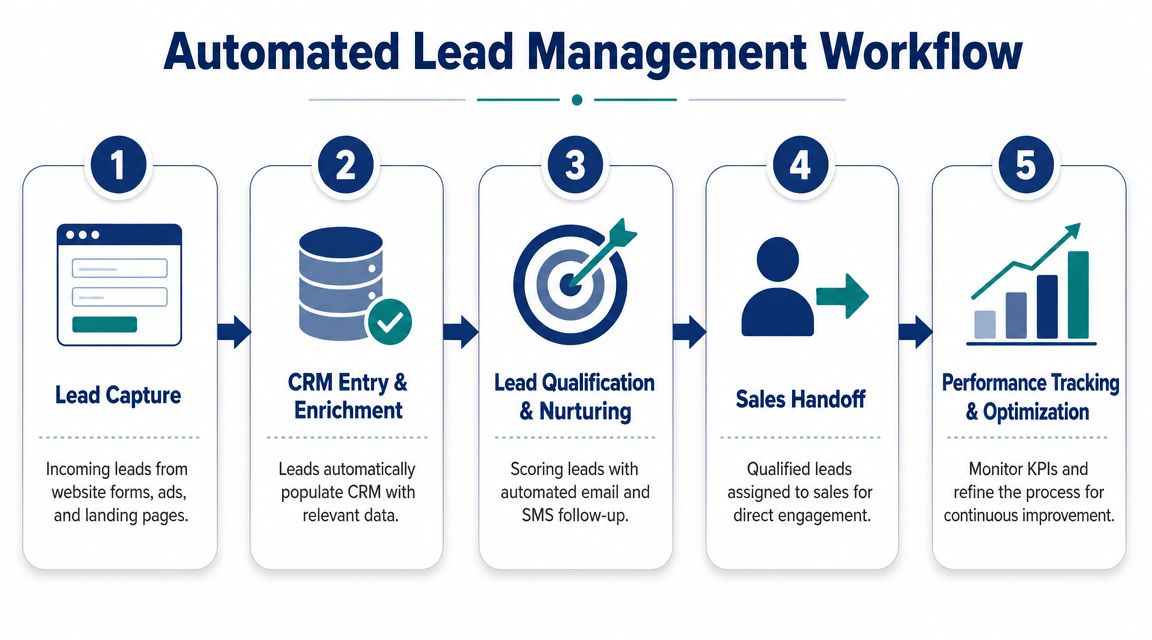
Without a CRM-centered workflow, manufacturing lead generation becomes memory-based management. Contacts sit in inboxes. Trade show notes stay on phones. Quotes go out without reminders. Warm leads go cold because nobody owns the next action.
You need one operating system for the process. GoHighLevel is one option that works well when you want CRM, pipeline visibility, automation, and messaging under one roof.
To see what that looks like in a manufacturing context, this overview of GoHighLevel for manufacturers is worth reviewing before you start building workflows.
Build the pipeline around actual buying stages
Don't copy a generic sales pipeline. Build stages that reflect how your buyers move.
A typical manufacturing pipeline might include:
- new inquiry
- contacted
- discovery completed
- quoted
- technical review
- commercial review
- closed won
- closed lost
That structure matters because it tells you where deals stall. If opportunities pile up in technical review, you may have a documentation issue. If they die after quoting, pricing or qualification may be off.
Use required fields on entry. Source, industry, application, product interest, estimated value, and buying stage should not be optional if you want clean reporting later.
A short walk-through helps:
Use tags and triggers to control follow-up
Tags make the system usable. Without them, every contact becomes a generic record.
Useful tags include:
- lead source
- trade show name
- target industry
- product or service interest
- plant location
- buying stage
- hot, warm, nurture
- quote sent
- no response
- reactivation candidate
Then build triggers. If a form submission comes from a high-value service page, alert sales. If someone downloads a spec sheet but doesn't request contact, start a nurture sequence. If a quote goes out and no one follows up, create a task automatically.
Automation should remove delays and dropped handoffs. It should not turn your communication into robotic spam.
Automation recipes that manufacturers should actually use
The best automations are simple and operational. Start there.
Recipe one: New web lead response
If a prospect submits a form, create the contact, tag the source, assign an owner, send an immediate confirmation, and create a follow-up task for sales.
Recipe two: Quote follow-up
When a quote is sent, trigger timed reminders for the rep and send a short check-in email sequence based on response status.
Recipe three: Long-cycle nurture
If a lead fits the ICP but isn't ready, enroll them in a sequence with case studies, technical content, and periodic check-ins.
Recipe four: Reactivation
If a previously engaged contact goes quiet, send a re-engagement message tied to a relevant capability, new content asset, or operational update.
Recipe five: Trade show routing
When event leads are imported, tag by booth conversation category and drop each segment into a different follow-up path.
Don't automate everything at once. Build the few workflows that stop revenue leakage first.
Measure What Matters and Your 90-Day Rollout Plan
If you can't see how leads move from source to quote to revenue, you don't have a lead-generation system. You have activity with weak feedback.
Manufacturing teams should track a short list of metrics that connect to opportunity quality and sales efficiency. Operational guidance for this space emphasizes metrics such as pipeline coverage ratio, engagement rates, opportunity-to-win ratio, and sales cycle time, as noted earlier in the process guidance from OneShot.ai. Those are useful because they reflect buying reality in long, multi-stakeholder deals.
A structured front-end strategy can materially affect results. One manufacturing case study reported more than $2.7 million in quoted business and over $1.5 million in added revenue from a disciplined multi-channel approach, according to Athena SWC's manufacturing lead generation case study.
Track business metrics, not vanity metrics
Use a simple dashboard. It doesn't need to be fancy. It needs to answer these questions:
- Where did the lead come from
- Was it qualified
- Did it become an opportunity
- What pipeline value did it create
- How long did it take to move
- Did it close or stall
Your core KPI set should include:
- cost per qualified lead
- lead-to-opportunity conversion
- pipeline value by source
- opportunity-to-win ratio
- sales cycle length
- win and loss reasons
Traffic matters only when it helps explain one of those outcomes.
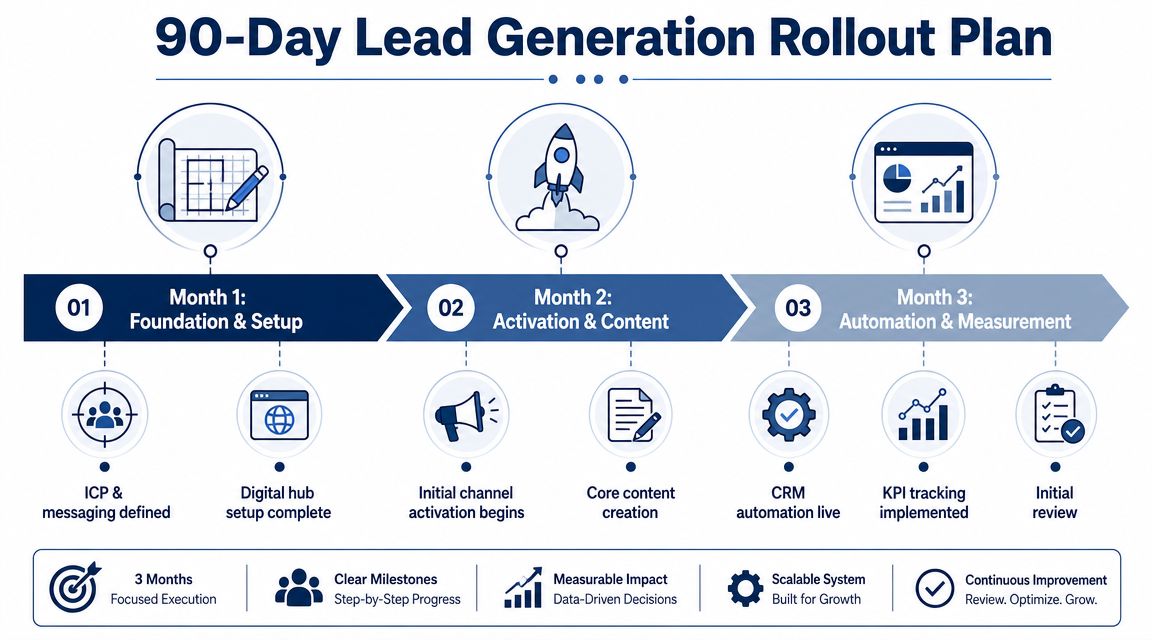
A practical 90-day rollout
Don't try to launch the full machine in one week. Roll it out in phases.
Month 1: Foundation and setup
- define ICP and disqualifiers
- map buying committee roles
- refine core messaging
- clean up website conversion paths
- set up CRM stages, fields, and tags
Month 2: Activation and content
- publish key capability and application pages
- build one or two lead magnets such as spec sheets or guides
- launch LinkedIn and search campaigns
- create outbound account lists
- implement trade show follow-up workflow if relevant
Month 3: Automation and measurement
- turn on lead routing and follow-up automations
- launch nurture and reactivation sequences
- review source quality weekly
- tighten qualification thresholds
- align sales and marketing around handoff rules
The point of the first 90 days isn't perfection. It's control. You want a system that captures leads, classifies them correctly, follows up consistently, and shows you where to improve.
Manufacturing lead generation gets easier once the machine exists. Until then, every month feels like starting over.
If you want help diagnosing your current system and building a lead-generation machine that fits how industrial buyers buy, talk with Machine Marketing. We help manufacturers connect strategy, content, CRM, and automation so your marketing stops producing noise and starts producing qualified opportunities.