Your website is live, your CRM is configured, your sales team knows the industry, and your LinkedIn page gets occasional attention. Yet the RFQs still arrive in bursts, follow-up depends on individual memory, and nobody can explain which marketing activity helped create the last good opportunity.
That's the central problem in B2B industrial marketing. Most manufacturers don't need another disconnected tactic. They need a system that connects technical content, search visibility, lead capture, CRM follow-through, and sales conversations around the way industrial buyers make decisions.
Table of Contents
- Why Industrial Marketing Feels Stuck
- What B2B Industrial Marketing Actually Means
- The Channels That Matter in 2026
- A Four-Part Strategy Framework That Works
- Metrics That Tell You the Truth
- What This Looks Like in a Real Machine Shop
- Your 30-60-90 Day Plan and the Pitfalls to Avoid
Why Industrial Marketing Feels Stuck
Industrial marketing often stalls because companies have accumulated tools without deciding how those tools should work together. A website publishes company information, LinkedIn shares occasional updates, email sends announcements, and the CRM stores contacts. Each activity may be reasonable on its own, but none of it gives the buyer a clear path from technical question to qualified conversation.
We see this most often in machine shops, OEMs, fabricators, and component manufacturers with strong operational expertise. The sales team understands applications and tolerances. The engineers can explain the product. The owner knows which customers are profitable. But that knowledge stays inside conversations instead of becoming searchable, reusable marketing infrastructure.
A useful diagnosis of why manufacturers struggle with marketing starts with one question: Where does buyer knowledge disappear? If an engineer asks about a material, a procurement manager needs compliance documentation, and an operations director wants evidence of reliability, can each person find a relevant answer without waiting for a salesperson?
Practical rule: If your best technical knowledge exists only in sales calls, you don't have a content problem. You have a knowledge distribution problem.
The gap between activity and system
A trade show can create attention, but it won't replace a technical page that answers the buyer's next question. An email can reactivate an old contact, but it won't fix a website that hides capabilities behind vague language. A CRM can record every inquiry, but it won't create a consistent handoff unless sales and marketing agree on what happens next.
The answer isn't to abandon these channels. It's to assign each one a job:
- SEO and technical content help buyers discover and evaluate your capabilities.
- LinkedIn and industry publishing reinforce credibility with people who may influence the purchase.
- Email and CRM nurture keep your company relevant while the buying group evaluates options.
- Sales conversations clarify fit, scope requirements, timing, and commercial terms.
- Measurement shows which activities create qualified opportunities rather than just attention.
The rest of this playbook gives you one operating framework. We'll start with the industrial buying committee, then map the channels, build the strategy, define honest metrics, apply the system to realistic machine-shop scenarios, and finish with a 30-60-90 day implementation plan.

What B2B Industrial Marketing Actually Means
B2B industrial marketing is the process of making your capabilities discoverable, credible, and easy to buy from across a complex buying committee. That definition matters because industrial marketing isn't just lead generation. It must help several people understand whether your company can solve a specific operational problem, meet technical requirements, and perform reliably after the purchase.
The buyer might be an engineer checking tolerances late in the evening. It might be a procurement manager comparing suppliers, a quality specialist reviewing certifications, or an operations director replacing equipment. Each person asks a different question, and each person can influence whether your company reaches the shortlist.
The committee structure makes generic messaging especially weak. In a 2026 manufacturing buying-journey study, 83% of purchases involved 5 or more evaluators, including 40% involving 5 to 8 people and 12% involving 9 to 12 people. Your website and sales enablement therefore need to persuade a group, not just capture one contact form submission.
One purchase, several information needs
An engineer wants dimensional details, materials, process limits, drawings, and evidence that your team understands the application. Procurement wants clear documentation, dependable communication, commercial clarity, and a supplier that can fit internal purchasing requirements. Operations wants confidence that the solution will reduce disruption and support production goals.
A single “Why choose us?” page can't do all of that work. It can establish positioning, but it shouldn't carry the entire buying journey.
| Buyer role | Question they're trying to answer | Useful marketing asset |
|---|---|---|
| Engineering | Can this supplier meet the application requirements? | Technical pages, drawings, specifications, application notes |
| Procurement | Can we evaluate and purchase from this supplier with confidence? | Certifications, supplier information, clear RFQ process |
| Operations | Will this improve production or reduce operational risk? | Use-case content, implementation guidance, performance evidence |
| Finance or ownership | Does the business case justify the investment? | ROI logic, lifecycle considerations, commercial FAQs |
This is why industrial marketing behaves more like a publishing and trust operation than a media-buying exercise. Your company has to publish useful answers, organize them logically, and make proof easy to verify. Paid promotion can accelerate visibility, but it can't compensate for thin technical information or an unclear buying path.
What generic lead generation gets wrong
Generic campaigns often optimize for form fills without asking whether the visitor is researching a real application. That creates noise. A visitor who downloads a broad brochure isn't automatically ready for a sales call, and aggressive follow-up can make your company look disconnected from the buyer's intent.
A stronger approach treats every asset as part of a progression:
- Discovery: Answer a specific technical or operational question.
- Evaluation: Show capabilities, process discipline, and relevant proof.
- Validation: Provide documentation, references, certifications, or a clear explanation of fit.
- Action: Make it simple to request a quote, upload drawings, book a technical conversation, or ask a precise question.
The goal isn't to force every visitor into a sales conversation immediately. The goal is to help the right people move forward while giving the rest of the committee enough evidence to support the decision.
The Channels That Matter in 2026
Industrial channels work best as a connected map, not a popularity contest. SEO may create the first discovery, LinkedIn may reinforce credibility, a trade show may create trust, and a CRM sequence may keep the conversation alive after the event. Direct sales then turns accumulated confidence into a defined commercial opportunity.
The data supports a digital-first foundation. One industrial marketing facts roundup reports that 98% of manufacturers generate sales-qualified leads through digital marketing, while 57% of industrial buyers make purchase decisions before speaking directly with a manufacturing company. The same source cites an average online B2B conversion rate of 2.2% for manufacturers, which is a useful reminder that industrial websites need strong qualification and follow-through, not just more visitors.
Give every channel a specific job
SEO and technical content should capture high-intent searches involving materials, part numbers, tolerances, certifications, processes, industries, and applications. A page targeting “custom machining” is broad. A page addressing a particular material, tolerance range, finishing requirement, and end use gives an engineer a reason to stay and a sales team a clearer context for follow-up.
LinkedIn is useful for distributing expertise and showing the people behind the work. Publish inspection insights, application lessons, production constraints, equipment decisions, and short explanations from engineers or owners. Don't use it as a stream of generic company announcements.
Email and SMS belong in the nurture layer, but only when the list is clean and the message matches the contact's context. A contact who downloaded a drawing may need technical follow-up. A dormant customer may need a capability update. A broad promotional message sent to both groups is lazy segmentation.
Trade shows and industry events can accelerate trust because buyers can meet your people, inspect examples, and ask questions in real time. They're expensive and slow, though. Capture the conversation in the CRM, record the application discussed, and send a relevant resource afterward. Otherwise, the event becomes a stack of business cards.
Direct sales closes the loop. Sales should know which pages a prospect viewed, which resource they requested, what application they described, and what qualifies the inquiry for active pursuit. Marketing should know which questions sales hears repeatedly and turn those questions into better content.
For public-sector and government-facing manufacturers, a government RFP database can add an opportunity-monitoring layer to the channel map. It's useful when your team needs to identify relevant solicitations and connect them to the capabilities, documentation, and response process already managed by sales and operations.
Search is also changing how buyers discover technical answers. Review how to optimize for AI search as part of your content planning, but don't chase AI visibility with vague summaries. Publish clear, structured, accurate material that helps both human buyers and search systems understand your expertise.
A Four-Part Strategy Framework That Works
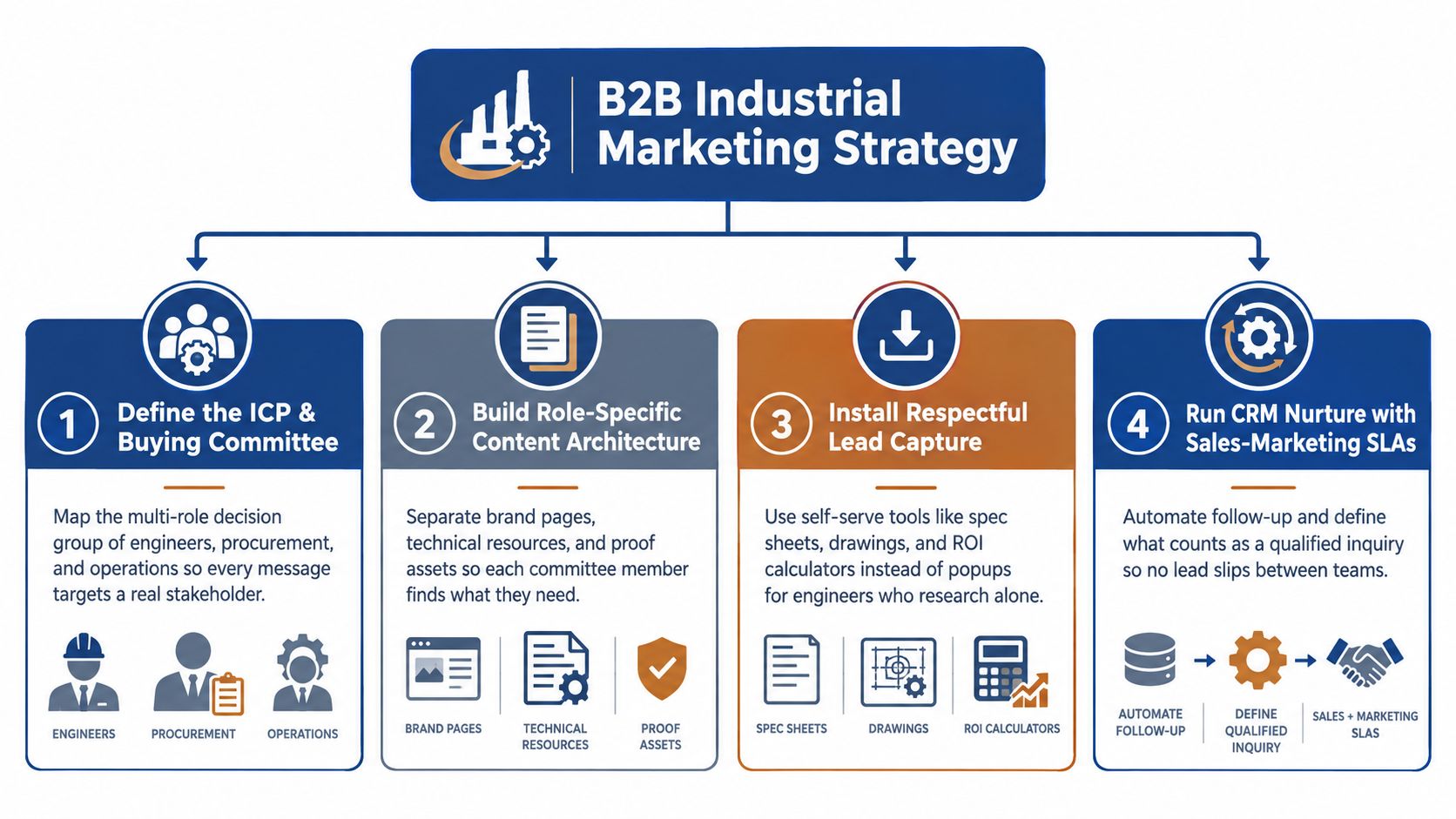
A practical strategy needs an operating sequence. Start with the buyer, build the information system, make self-service easy, and then create disciplined follow-up. Reversing that order usually produces campaigns that generate contacts without creating useful opportunities.
1. Define the ICP and buying committee
Your ideal customer profile, or ICP, should describe more than industry and company size. Define the applications you serve well, the problems that make those applications urgent, the requirements you can meet profitably, and the buying roles involved.
Run a working session with sales, engineering, operations, and leadership. Document:
- Target applications: What is being made, processed, replaced, repaired, or automated?
- Technical requirements: Which materials, specifications, certifications, tolerances, or operating conditions matter?
- Commercial triggers: What creates urgency, such as capacity pressure, equipment replacement, quality issues, or supplier failure?
- Buying roles: Who researches, approves, operates, specifies, purchases, and influences the decision?
- Disqualifiers: Which projects consume time without fitting your capabilities or margins?
If you can't name the application and buying group, your content plan will drift toward generic awareness.
2. Build role-specific content architecture
Organize content into three layers.
Brand pages explain who you serve, where you operate, what you make, and why your process is dependable. They give unfamiliar visitors orientation.
Technical resources answer application questions. Include specification pages, process explanations, material guides, drawings, FAQs, maintenance guidance, and comparisons. Write for the engineer who needs a useful answer before contacting anyone.
Proof assets reduce perceived risk. Use certifications, inspection processes, quality documentation, project constraints, production photographs, and clearly described examples. Don't publish unsupported claims. Explain what happened, what the requirement was, and how your team addressed it.
3. Install respectful lead capture
Recent research reports that 67% of B2B buyers prefer a rep-free buying experience, 84% consider self-service tools critical, and 66% of technical buyers value independent product reviews most. The same research says 73% avoid suppliers that send irrelevant messaging. These findings are summarized in research on industrial marketing trends.
Give visitors useful ways to continue without forcing a call:
- Download a relevant specification sheet.
- Upload drawings for an initial feasibility review.
- Request a sample, quote, or technical consultation.
- Use a clear comparison or application checklist.
- Submit a focused question to an engineer.
The form should ask only for information your team will use. A long form doesn't prove qualification. It often proves that you don't respect the buyer's time.
4. Run CRM nurture with sales-marketing SLAs
Create stages that describe buyer progress, not internal activity. A useful sequence might move from inquiry, to qualified application, to technical review, to commercial opportunity, to closed or disqualified.
Set a sales-marketing service-level agreement, or SLA, for response ownership. Decide who reviews new inquiries, what information triggers an alert, when sales accepts or rejects a lead, and how the reason gets recorded.
Then build nurture around intent. Someone who requests technical documentation should receive related guidance, not a generic newsletter. Someone who isn't ready should remain in a useful education sequence until their behavior or reply shows stronger intent.
Metrics That Tell You the Truth
Industrial marketing measurement fails when the dashboard rewards activity instead of commercial progress. A pageview can be useful, but it doesn't tell you whether the visitor represents a profitable application. A social reaction may show interest, but it doesn't tell you whether the buying committee can approve the purchase.
Use a compact scorecard that leadership can understand without a marketing glossary.
The metrics worth reviewing
Qualified inquiries by source tells you whether search, referrals, events, email, paid campaigns, or sales outreach produce conversations that fit your ICP. Define “qualified” using application, capability, timing, and commercial fit.
Content-to-RFQ conversion shows whether technical pages and resources help visitors take a meaningful next step. Track the page or asset associated with the inquiry, then review the quality of those RFQs with sales.
Pipeline by channel connects marketing activity to commercial value. Don't stop at the first conversion. Record whether an inquiry became an opportunity, whether the opportunity moved forward, and whether the source appears repeatedly across the journey.
Sales cycle length by channel helps you understand how different channels influence readiness. A trade show contact and a high-intent technical search may require different follow-up, even if both become opportunities.
Opportunity win rate gives the leadership team a stronger view of quality than lead volume. Review losses by reason, such as capability mismatch, price, timing, incumbent supplier, or insufficient proof.
Use manufacturing marketing KPIs as a reference when building the dashboard, but keep the final version small enough to review consistently.
What to stop optimizing
Stop treating raw traffic as the primary outcome. Stop celebrating social likes without knowing whether the audience includes target accounts. Stop judging email performance by open rates alone, especially when the message doesn't produce replies, resource engagement, or qualified conversations.
A manufacturing marketing report estimates that only around 5% of buyers are in the market in any given quarter, as reported by manufacturing marketing effectiveness research. That means your dashboard must track the trust-building work that happens before an active inquiry, while still separating useful engagement from empty activity.
Attribution also needs honesty. In a committee purchase, several people may visit different pages, attend an event, speak with sales, and return through a branded search. Last-click reporting will over-credit the final action. Start with source capture, CRM notes, contact self-reporting, and multi-touch review, then improve the system as your data becomes more complete.
What This Looks Like in a Real Machine Shop
Consider a hypothetical 30-person CNC shop that relies heavily on repeat customers and wants to win aerospace work. Its existing website lists equipment, but it doesn't help an engineer determine whether the shop can handle a particular material, tolerance, finishing requirement, or certification need.
The first move isn't a broad blog campaign. The shop should create focused capability and application pages, each tied to a real engineering question. A technical visitor might arrive through a page about a material or process, review inspection information, and download a drawing or capability document.
The owner can then use LinkedIn to explain how the shop approaches quality, fixturing, inspection, and difficult production constraints. A CRM sequence can follow the document request with a relevant technical resource and a clear invitation to submit drawings. Sales receives the application context instead of a notification that says only “new lead.”

A different system for an equipment OEM
Now take a hypothetical mid-size OEM selling capital equipment with a 9-month sales cycle. The committee may include an engineer evaluating specifications, an operations leader assessing production impact, procurement reviewing suppliers, and finance examining the investment case.
The OEM shouldn't send every contact the same brochure. It needs an information path that reflects each role:
- Engineers get technical specifications, integration requirements, drawings, and maintenance information.
- Operations leaders get implementation guidance, workflow implications, and an ROI calculator.
- Procurement teams get compliance documentation, supplier information, and a clear purchasing process.
- Executives and finance get business-case material focused on operational priorities and investment logic.
The CRM should record the role, content consumed, application, stage, and next action. Sales can then tailor the conversation instead of repeating information the buyer already found.
Recent buyer-journey research found that the website was the number one research destination for 85% of respondents, while technical and industry-specific expertise ranked above brand recognition. The same research reports that nearly six in ten industrial buyers expect to increase investment in automation and robotics. Those findings are detailed in the manufacturing buyer-journey study.
The two scenarios differ in product, sales cycle, and content depth. The principle stays the same: design the path around the committee, not around the departments that happen to own your marketing channels.
Your 30-60-90 Day Plan and the Pitfalls to Avoid
You don't need a complete rebrand to start. You need a focused diagnosis, a short list of high-value fixes, and agreement between sales and marketing about what happens after an inquiry.
Days 1 through 30
- Define the ICP: Document priority applications, profitable requirements, buying roles, and disqualifiers.
- Audit the website: Identify missing technical pages, unclear capabilities, weak proof, outdated documents, and difficult RFQ paths.
- Fix conversion leaks: Improve contact paths, clarify calls to action, and make technical resources easy to find.
- Align sales: Agree on the definition of a qualified inquiry, response ownership, and CRM fields.
Days 31 through 60
- Publish role-specific resources: Create technical pages for engineers, proof assets for procurement, and business-case content for operations or ownership.
- Start focused SEO: Target specific technical queries tied to materials, applications, tolerances, processes, and certifications.
- Clean the database: Remove unusable contacts, separate customers from prospects, and organize contacts by role and intent.
- Create a channel rhythm: Repurpose each useful technical insight across the website, LinkedIn, email, and sales enablement.
Days 61 through 90
- Implement CRM stages: Make each stage represent a meaningful buyer or sales milestone.
- Build one nurture sequence: Start with the highest-value download, inquiry type, or dormant customer segment.
- Create the dashboard: Review qualified inquiries, RFQs, pipeline, sales cycle, win rate, and source quality.
- Run a monthly diagnosis: Ask which content helped sales, where buyers stalled, and which questions remain unanswered.
Avoid four predictable mistakes. Don't chase every channel. Don't write for a fictional single buyer. Don't treat the website as a brochure. Don't measure only traffic.
Use this video as a practical prompt for your planning discussion:
This week, create a one-page strategy map with your ICP, buying roles, priority applications, technical content gaps, lead-capture offers, CRM stages, and five metrics. If you want a second pair of eyes, Machine Marketing helps manufacturers connect SEO, content, CRM, email, and sales processes into a practical B2B growth system. Bring your existing tools and team, and start with a diagnosis of where the handoffs are breaking down.