
Most customer acquisition funnel advice starts with the wrong question: How do we generate more traffic? For a manufacturer, the more useful question is, what prevents a technically suitable account from becoming a qualified opportunity? More visitors won't fix slow lead routing, missing specifications, an unprepared buying committee, or a quote process that leaves prospects guessing.
An industrial funnel is an operating system shared by marketing, sales, engineering, and customer service. It must help buyers educate themselves, build internal agreement, receive a timely response, and move from technical inquiry to commercial decision. This guide shows how to diagnose that system and connect content, CRM workflows, self-service, and revenue reporting.
Table of Contents
- Rethinking the Customer Acquisition Funnel for Manufacturers
- Mapping Content and Tactics to Each Funnel Stage
- Designing for the Industrial Buying Committee
- Accelerating Conversions with Speed and Self-Service
- Tracking the KPIs That Actually Drive Revenue
- Diagnosing and Fixing Leaks in Your Sales Pipeline
- Building Your Automated Funnel in the CRM
Rethinking the Customer Acquisition Funnel for Manufacturers
The traditional funnel assumes one person moves neatly from awareness to interest, consideration, and purchase. That picture may be convenient for a presentation, but it doesn't reflect how a machine shop, equipment manufacturer, or industrial supplier really wins business. A buyer may discover you through search, validate your capabilities through technical documents, speak with an engineer by video, visit your facility, and involve procurement before anyone requests a quote.
McKinsey's 2024 B2B Pulse Survey found that buyers use an average of 10 interaction channels during the purchasing journey, compared with five in 2016. Buyers also want interactions divided roughly equally among in-person, remote, and digital self-service channels. McKinsey's B2B research makes the operational implication clear. Your funnel can't live only in Google Analytics, a landing-page builder, or a salesperson's memory.
Practical rule: Treat every meaningful buyer interaction as part of one account journey, not as an isolated lead event.
Replace the linear model with a connected system
A practical customer acquisition funnel for manufacturing should connect:
- Search and website behavior, including application-page visits, technical-document downloads, and specification requests.
- Marketing automation, including nurture emails, event follow-up, and behavior-based routing.
- Sales activity, including calls, engineering reviews, site visits, and video meetings.
- Commercial progression, including sample requests, quote creation, revisions, approvals, and closed-won revenue.
- Post-sale signals, including reorders, referrals, and expansion opportunities.
The handoff from marketing to sales deserves special attention. A form submission isn't a qualified opportunity. It becomes a useful funnel stage only when someone owns it, responds, records the interaction, and determines whether the project fits your capabilities and timing.
Before changing campaigns, document the journey in a format your team can operate. Sensoriium's operating guide for scaling teams is useful context for connecting customer-journey design with internal processes. You can also use this practical explanation of what a marketing funnel is to align terminology across marketing and sales.
Ask your team:
- Can we identify the account behind every serious inquiry?
- Do we know which stage follows a technical form submission?
- Does sales receive enough context to respond intelligently?
- Can we see online research alongside offline meetings?
- Are we measuring qualified revenue, or only lead volume?
If the answers are unclear, buying more traffic will amplify the confusion. The first improvement is usually not another campaign. It's a defined system with shared stages, ownership, and evidence.
Mapping Content and Tactics to Each Funnel Stage
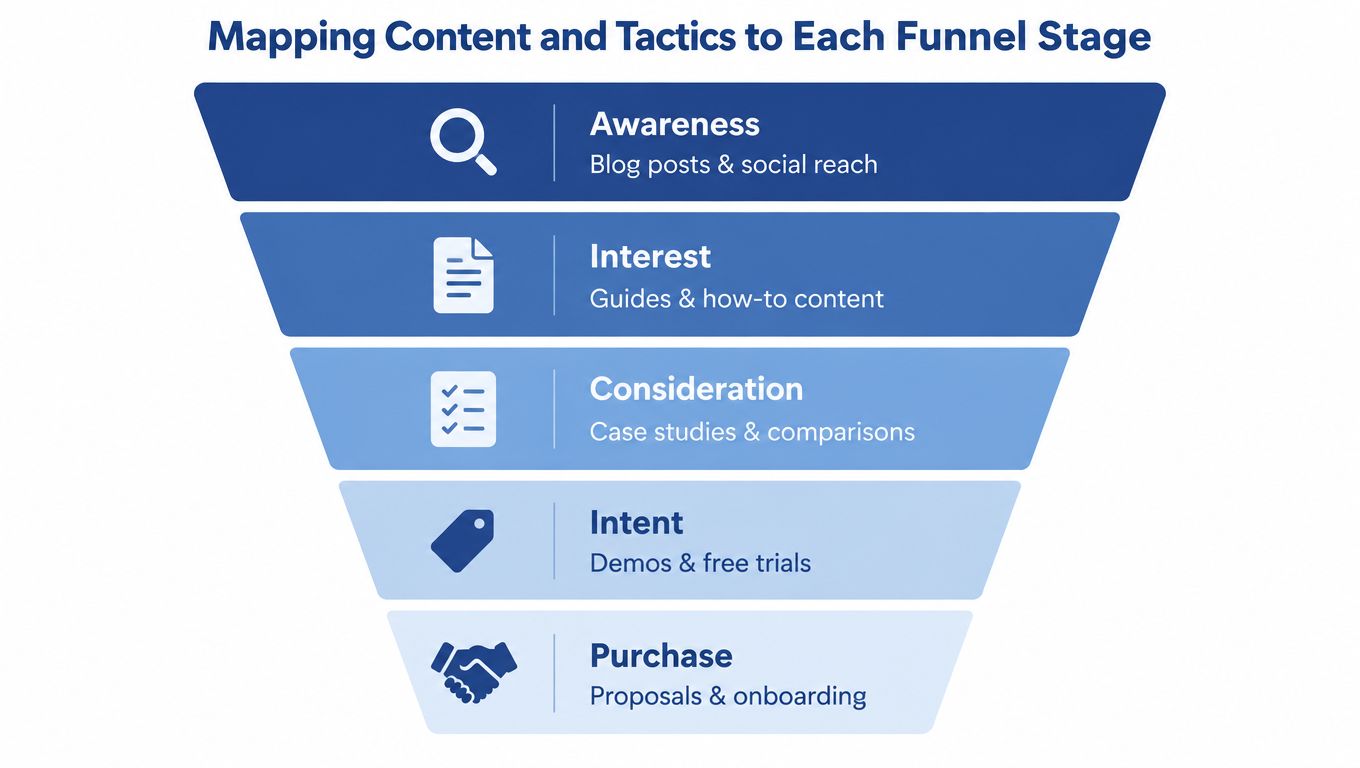
Industrial buyers don't need the same content at every stage. An engineer researching a tolerance problem needs a different asset from a procurement manager comparing suppliers, while an executive needs a concise commercial case. Map each stage to the question the buyer is trying to answer and to the next observable action.
Awareness and interest
At awareness, the buyer is defining a problem or learning the category. Publish practical material around manufacturing constraints, material selection, integration risks, maintenance questions, and application requirements. Search-focused articles can attract the right audience, but they shouldn't force a quote request before the buyer understands the problem.
At interest, give the visitor a reason to identify themselves. Useful offers include:
- Technical guides, with clear application boundaries and decision criteria.
- How-to resources, written for engineers and operations leaders.
- Webinars or video demonstrations, showing a process rather than reciting product features.
- Diagnostic checklists, helping a prospect assess fit before contacting sales.
Track downloads, repeat visits, and return engagement. These aren't automatically opportunities, but they reveal which accounts are investing attention.
Consideration and intent
At consideration, buyers compare approaches and suppliers. Here, generic claims lose ground to evidence. Provide drawings, material options, tolerance ranges, cycle-time information, certifications, integration requirements, application examples, and comparisons that explain trade-offs candidly.
A B2B buying-journey study reports that 91% of buyers arrive at a sales meeting already familiar with the vendor, while 78% narrow the shortlist to three vendors through early research and content validation. The B2B buying-journey study shows why your website often performs part of the sales job before a representative speaks with the buyer.
Use a B2B content strategy for engineers to organize assets around technical questions, not publishing frequency. At the intent stage, add application reviews, sample requests, consultations, configurators, and quote pathways. Require enough context to help sales act, but don't demand information the buyer can't reasonably provide yet.
Purchase and retention
At purchase, remove uncertainty. Give the buyer a clear proposal, implementation sequence, lead-time explanation, documentation list, and named owner. For repeat business, make reordering, support requests, and document access simple.
Every asset should produce a useful signal:
- A specification download can indicate technical evaluation.
- Multiple contacts from one account can indicate committee activity.
- A sample request can indicate project intent.
- A quote acceptance can indicate commercial progression.
Your CRM should store those events against the account and opportunity, not scatter them across disconnected contact records.
Designing for the Industrial Buying Committee
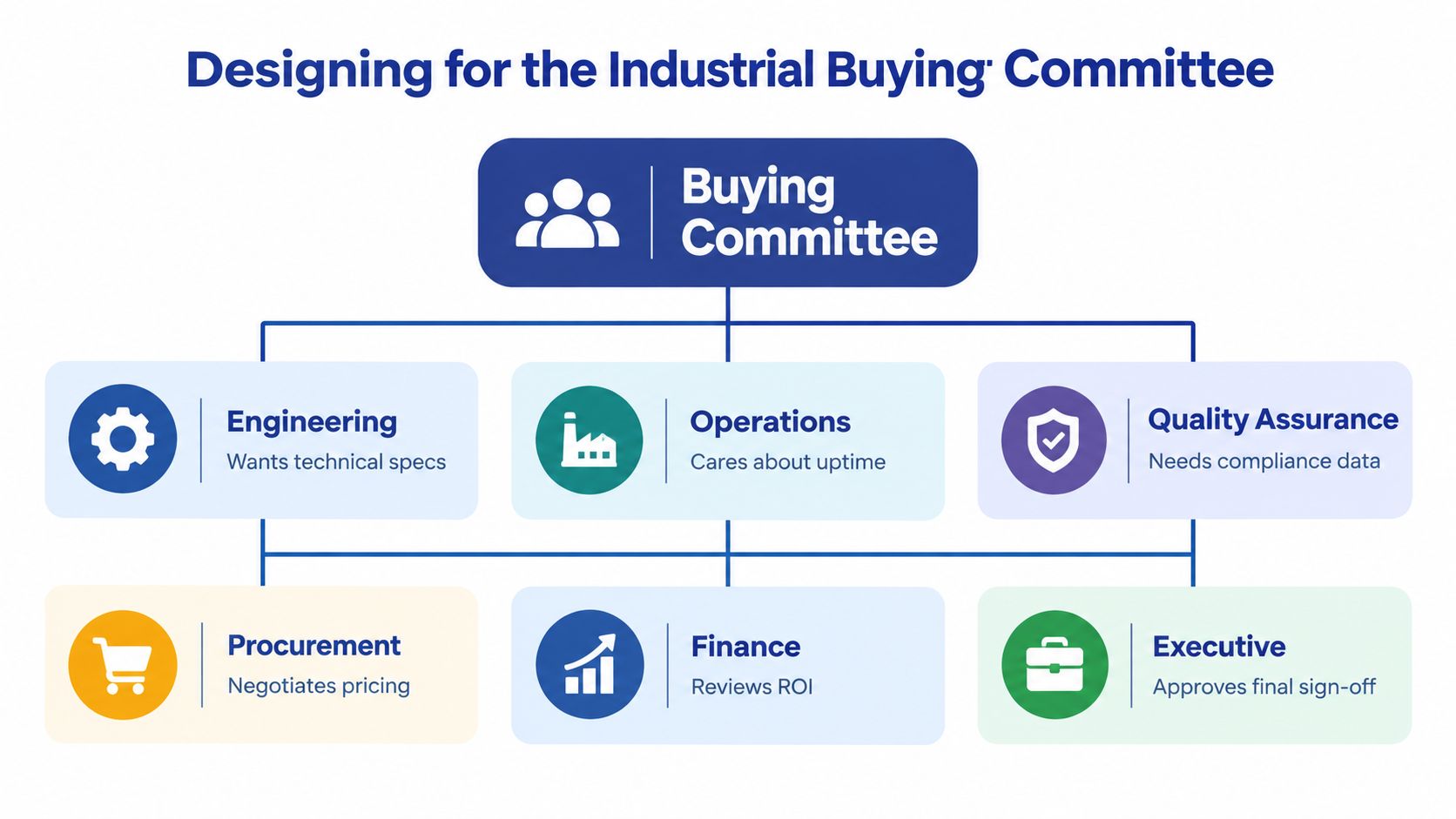
A promising contact isn't the same as an aligned buying group. Manufacturing purchases commonly involve engineering, operations, quality assurance, procurement, finance, IT, and executive leadership. Recent manufacturing-buyer coverage reports that an average industrial purchase involves 13 stakeholders across those functions. The manufacturing buyer-journey coverage reinforces a point many funnels miss: the person who fills out the form may be only one participant in the decision.
Give every role a reason to support the purchase
Each stakeholder evaluates risk differently. If your content serves only the technical champion, the opportunity may stall when the proposal reaches another department.
| Stakeholder | Question they need answered | Useful proof |
|---|---|---|
| Engineering | Will it meet the application requirements? | Drawings, materials, tolerances, integration details |
| Operations | Can we run it reliably? | Uptime evidence, maintenance process, throughput implications |
| Quality assurance | Can we document compliance? | Certifications, inspection process, quality-system information |
| Procurement | Can we manage supplier and commercial risk? | Terms, lead-time clarity, supplier information |
| Finance | Does the investment make commercial sense? | Total-cost assumptions, payback logic, operating-cost considerations |
| Executive leadership | Why should we approve this direction? | Concise business case, strategic fit, implementation risk |
Don't wait for a deal to stall before looking for missing influencers. Add committee coverage to opportunity reviews. Record which roles are known, which have engaged, and which still need evidence. A strong champion should be able to forward a technical document to engineering, a risk summary to procurement, and a concise business case to leadership.
Measure consensus, not just lead score
A single lead score can disguise weak organizational support. One highly engaged contact may download several assets while the rest of the account remains unaware, unconvinced, or opposed.
Use account-level fields such as:
- Known roles, with contact names and responsibilities.
- Evidence consumed, including specifications, compliance documents, and commercial material.
- Open objections, recorded in plain language.
- Next internal decision, such as engineering approval or budget review.
- Consensus status, distinguishing individual interest from committee readiness.
This changes the sales conversation. Instead of asking, “Is this lead hot?” ask, “Which decision-maker can still block the project, and what evidence would help them?” That question leads to better enablement, more realistic forecasting, and fewer late-stage surprises.
The trade-off is effort. Mapping a committee takes more discipline than assigning a score to one contact. It also produces a more accurate picture of whether an opportunity is technically qualified, commercially viable, and internally approved.
Accelerating Conversions with Speed and Self-Service
A lead loses value when your team leaves it untouched. The response process should begin before a salesperson opens the CRM record. Route submissions immediately, assign an owner, capture the inquiry source and requested application, and define a response-time service level.
Research associated with the Harvard Business Review lead-response study found that contacting an inbound prospect within five minutes made the company approximately 21 times more likely to qualify the lead than waiting 30 minutes. The lead-response analysis also supports a broader conclusion. Response speed is not merely a customer-service preference. It's a measurable conversion lever.
Build a response protocol
Your service level should answer practical questions:
- Who owns the inquiry? Assign a person or queue, not a department.
- What happens outside business hours? Send a useful acknowledgement and create a follow-up task.
- What information is required? Capture application, material, volume, timing, and technical constraints where appropriate.
- What counts as contact? Define whether an automated email, personal call, or engineering response satisfies the stage.
- What happens after no response? Use a short, relevant nurture sequence rather than letting the record disappear.
Speed without relevance doesn't help. A fast generic reply can frustrate an engineer who provided detailed technical context. Automate acknowledgement and routing, but reserve the substantive response for someone who can interpret the requirement.
Make self-service part of acquisition
Buyer-controlled research is now a core expectation. A 2025 benchmark of senior decision-makers found that 84% considered self-service tools critical when selecting a vendor, with insufficient pricing transparency and slow vendor response among the leading frustrations. The 2025 B2B buyer benchmark supports investing in tools that reduce effort before a sales conversation.
For a manufacturer, self-service might include:
- Configurators that clarify available options.
- Technical-document libraries with sensible filters.
- Application guidance and compatibility information.
- Quote-status visibility.
- Lead-time or availability information where reliable.
- Sample requirements and reorder paths.
- Clear next steps after a form submission.
Self-service doesn't mean removing sales. It lets buyers answer routine questions independently and gives sales more time for design, risk, pricing, and implementation discussions. The danger is publishing unreliable estimates or disconnected information. Tie website content, CRM records, quoting workflows, and customer portals to the same definitions, and label information clearly when it requires confirmation.
Tracking the KPIs That Actually Drive Revenue
Traffic is an input, not a pipeline outcome. A manufacturer can attract the right audience and still lose opportunities through slow contact, weak qualification, poor committee coverage, or an unclear quote process. Your dashboard should separate each transition so the team can locate the operational constraint.
Research associated with the Harvard Business Review lead-response study found that contacting an inbound prospect within five minutes made the company approximately 21 times more likely to qualify the lead than waiting 30 minutes. The number matters because it gives response time a place on the revenue dashboard, rather than leaving it as an informal sales habit.
Build a stage-based dashboard
| Funnel stage | Primary KPI | What it diagnoses |
|---|---|---|
| Inquiry | Inquiry-to-contact time | Whether routing and ownership work |
| Contact | Contact rate | Whether sales can reach the requester |
| Qualification | Qualification rate | Whether targeting and form context produce viable demand |
| Opportunity | Opportunity rate | Whether qualified inquiries become real projects |
| Commercial | Closed-won revenue | Whether the system creates revenue, not activity |
Add account, channel combination, and sales-cycle views. A prospect may first arrive through organic search, return after an email, attend a video meeting, and request a quote after a plant visit. If those interactions create separate records, your reporting will understate the value of the combined journey.
Separate intent from interest
Not every visitor is ready for sales. Baymard found that 42% of U.S. online shoppers had abandoned a cart in the previous three months because they were just browsing or weren't ready to buy. Baymard's cart-abandonment research concerns online shopping, but the diagnostic principle applies to B2B. A researcher downloading a guide shouldn't receive the same treatment as an account requesting an application review.
Track intent signals separately:
- Repeat visits to product or application pages.
- Technical-document downloads.
- Specification requests.
- Sample or consultation requests.
- Engagement from multiple contacts at one account.
- Quote activity and commercial replies.
For broader visibility reporting, how MyMentions tracks visibility offers a useful reference point for organizing visibility data alongside other marketing indicators. Don't let that top-level view replace CRM progression. Use it to understand reach, then judge performance by qualified opportunities and revenue.
Diagnosing and Fixing Leaks in Your Sales Pipeline
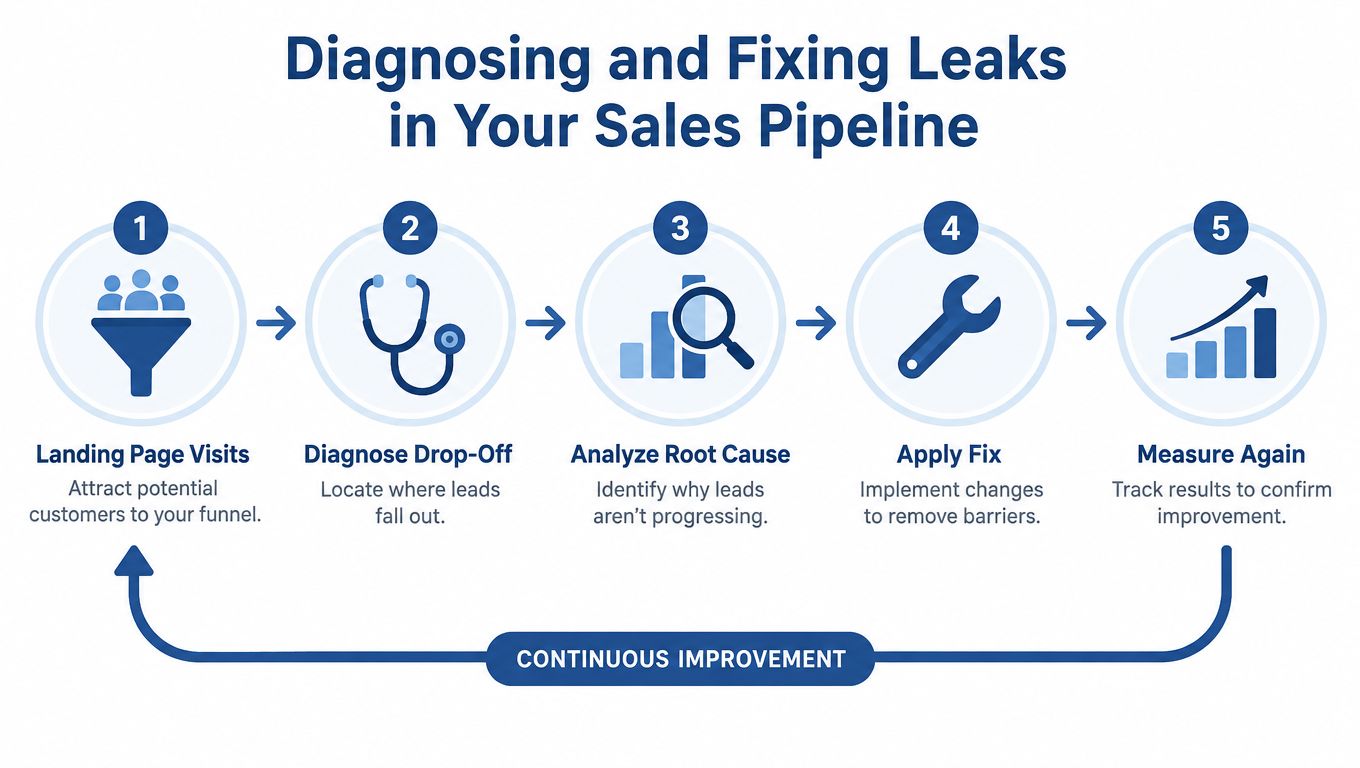
A leak is real only when it appears at a named transition. Agree on the four transitions below, then pull the numbers for each before changing the page. A decline in inquiries alone cannot show whether the problem is poor targeting, weak explanation, form friction, or delayed sales action. Treat the funnel like an engineering system and isolate the failing handoff.
Locate the measurable loss
Use these transitions:
- Traffic to engagement, which shows whether visitors interact with the page and its content.
- Engagement to form start, which tests whether the offer and call to action match buyer intent.
- Form start to completion, which exposes unclear requirements, technical faults, or unnecessary effort.
- Completed inquiry to qualified opportunity, which tests targeting, response quality, and sales follow-up.
Baymard's checkout research reports a global average cart-abandonment rate of 70.19%. The finding illustrates how process friction and user intent can create high drop-off even when initial interest exists. Baymard's checkout usability research offers a useful model for separating abandonment caused by the user from abandonment caused by the experience.
Use a controlled troubleshooting loop
Record evidence before changing the page. Review analytics events, form-start and completion behavior, abandonment recordings, device performance, and the quality of submitted inquiries. Ask sales whether the form captures enough technical context to assess fit without forcing a buyer to complete an engineering questionnaire.
Diagnosis before redesign: If you cannot identify the failing transition, a new page is an expensive guess.
Test one hypothesis at a time:
- If mobile users abandon a long form, shorten the first step and measure completion.
- If visitors engage with technical content but do not request help, add a clear application-review path.
- If inquiries arrive but qualification remains weak, refine targeting and state the form's fit criteria.
- If qualified inquiries stall after contact, inspect response time, ownership, and the quality of the first conversation.
Apply one material change, measure the same transition, and document the result. A manufacturing funnel improves through repeatable diagnosis, not a redesign that changes every variable at once.
Building Your Automated Funnel in the CRM
Automation should remove manual delay, not replace judgment. Start with the records your team needs to manage. Use an account record for the company, contact records for individual stakeholders, and opportunity records for active projects. Attach source, stage, application, timing, committee roles, and next action to the opportunity.
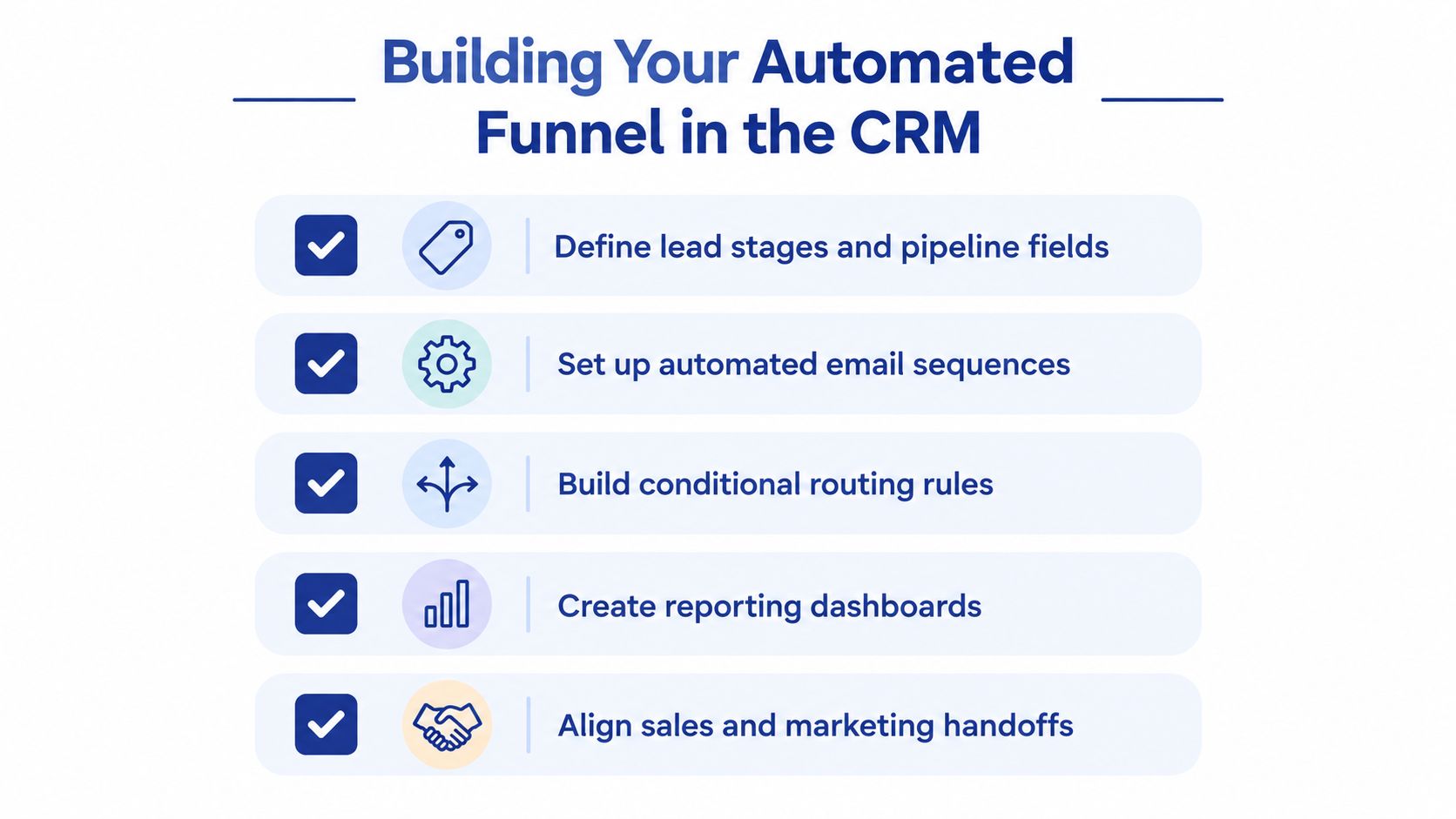
A practical rollout can follow this sequence:
- Define stage rules. Write the entry and exit criteria for inquiry, contacted, qualified, opportunity, quote, and closed-won. If salespeople interpret stages differently, the dashboard won't be trustworthy.
- Route by fit and context. Send an equipment inquiry to the relevant salesperson or engineer based on product, region, application, and urgency. Create ownership automatically, then make escalation visible.
- Nurture unresolved demand. If a visitor isn't ready for a conversation, send relevant technical resources and create a future task. Stop the sequence when the contact engages or an opportunity opens.
- Connect activity to reporting. Pass campaign source, landing page, document engagement, meeting activity, quote events, and revenue into one account view.
- Review exceptions. Automation should flag duplicate records, missing company data, overdue follow-up, and opportunities with no next action.
Audit the handoff before adding complexity
A successful CRM rollout depends less on the number of workflows than on shared definitions, clean ownership, and adoption. This successful CRM rollout provides useful implementation context, particularly for teams that need to connect process design with system use.
Use marketing automation in a CRM to document the workflows your team needs. Depending on your stack, that may include landing pages, forms, calendars, inbound calls, email, SMS, voicemail, or other follow-up channels. Machine Marketing offers these lead-capture and nurturing functions as part of its platform, alongside website and funnel-building tools.
Before launch, check:
- Data ownership: Every active opportunity has one accountable owner.
- Stage discipline: Each stage has a clear qualification rule.
- Response monitoring: Overdue inquiries generate visible tasks or alerts.
- Account matching: Multiple contacts can be connected to one company.
- Sales feedback: Rejected or stalled inquiries include a reason.
- Revenue linkage: Closed-won records retain the source and journey context.
Start with one funnel path, such as an application review or quote request. Run it through the CRM, inspect every handoff, correct the exceptions, and only then expand automation to other products or regions.
Machine Marketing helps manufacturers connect strategy, industrial SEO, content, lead capture, CRM workflows, and automated follow-up into a measurable customer acquisition system. Visit Machine Marketing to request a practical diagnosis of your funnel, identify the largest pipeline leak, and define the next operational fix.
