
You've bought a capable machine, hired people who can sell its work, and put money into your website. The inbox is still quiet. Before you buy more traffic, you need to know whether buyers can find you, qualify you, get a usable quote, and place an order without unnecessary friction. Market systems development helps us diagnose which connection is failing before we fund another channel.
Table of Contents
- What Market Systems Development Means for Manufacturers
- The Five Components of a Cohesive Marketing System
- Where Market Systems Thinking Breaks Down
- Build the System in Four Phases, Starting With One Constraint
- Test Whether a Change Is Systemic
- Scorecard for Tracking Systemic Change
- Summary and Your Next Step
What Market Systems Development Means for Manufacturers
Say your shop has production capacity and a strong sales team, but inquiries rarely become orders. Sales wants more leads. Production wants better-fit jobs. Buyers want proof that you can meet their application, documentation, and delivery requirements.
Those are connected problems, not necessarily separate departmental failures.
Market systems development (MSD) comes from international development, where practitioners use it to improve how markets work for small producers and underserved businesses. The HEKS-EPER Market Systems Development Guideline describes a market through interconnected transactions, supporting functions, and rules, with interventions aimed at underlying constraints rather than permanent outside support.
Think like a production engineer
A faster spindle doesn't improve throughput when material arrives late. Likewise, more advertising won't solve a quotation process that leaves buyers waiting.
For a manufacturer, the diagnostic separates:
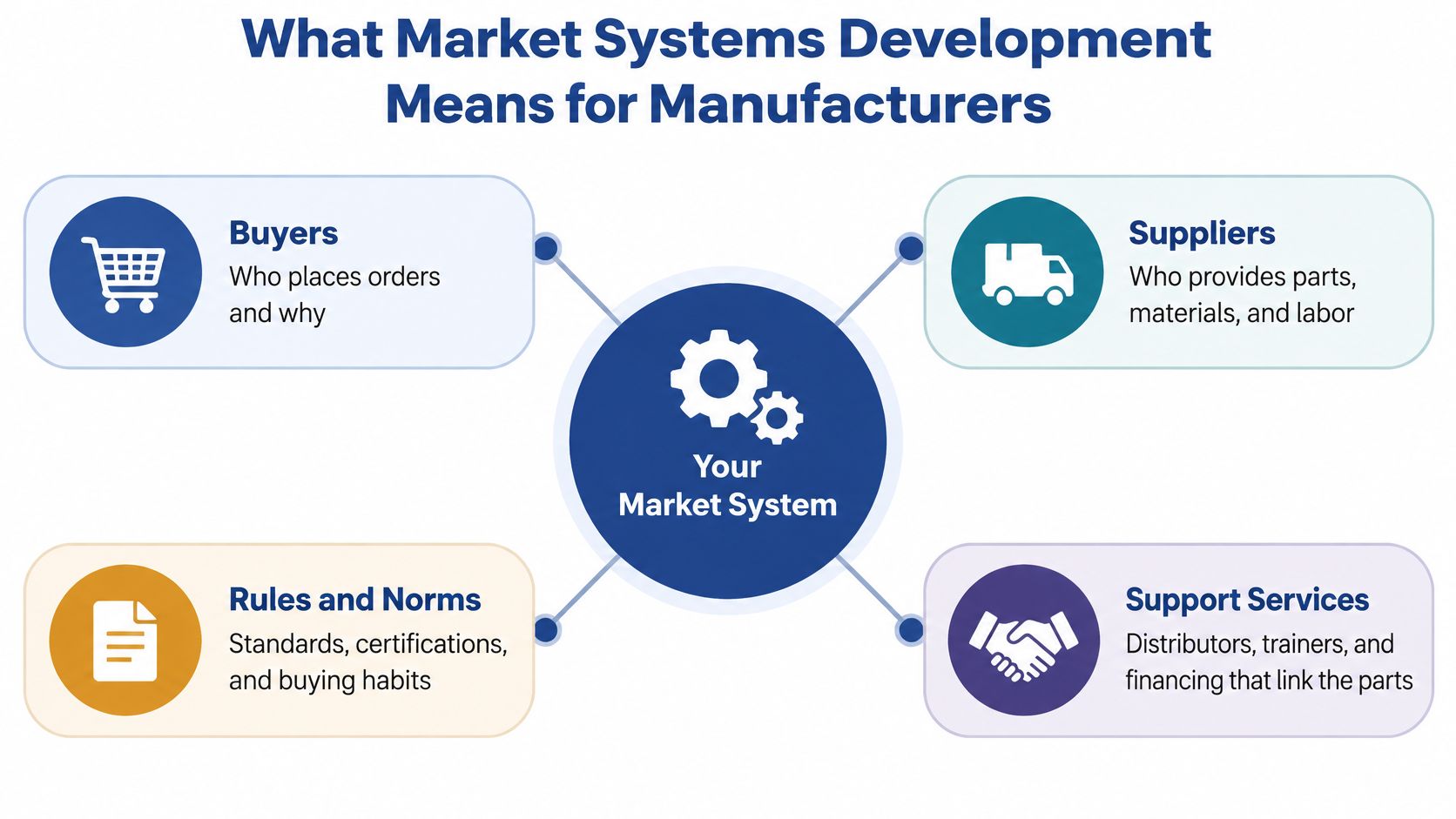
- The core market: RFQs, quotes, negotiations, and orders between you and buyers.
- Supporting functions: Financing, technical information, distribution, after-sales service, and workforce skills.
- Rules: Certification requirements, procurement practices, industry standards, and informal expectations about acceptable suppliers.
The distinction matters because the person experiencing the problem may not control its cause. A sales representative can chase an RFQ, but can't independently change a buyer's approved-vendor requirements or a distributor's service coverage.
This map shows the actors and connections worth examining.
Find the incentive behind the behavior
Ask why each participant would change. A distributor needs a commercial reason to stock parts; a buyer needs a defensible reason to qualify an unfamiliar shop.
Use market research and focus groups to investigate buying criteria, missing information, and the handoffs that cause hesitation. Ask about the last purchase decision, not whether someone likes your proposed solution.
A useful distinction is buy-in versus imitation. Buy-in means an actor commits its own resources; imitation means others copy or adapt the practice. Neither is established by attendance at training.
This is a diagnostic lens, not a certified manufacturing method. Where does your constraint sit: in the exchange, in the services supporting it, or in the requirements surrounding it?
The Five Components of a Cohesive Marketing System
A buyer downloads an application guide, submits an RFQ, and receives an acknowledgement. That sequence only helps if someone owns the opportunity, the representative has current technical material, and you can connect the eventual order to its source.
For our manufacturing application, the working system has five components: CRM, automation, content, sales enablement, and measurement. These are implementation categories, not a replacement for the wider market diagnosis.
Give each component a defined job
Your CRM records the opportunity, its owner, and its status. Without a follow-up process, it merely stores neglected quotes.
Automation handles predictable acknowledgements, reminders, and routing. It shouldn't pretend that an automated receipt is a technical answer.
Content helps buyers evaluate applications, limitations, and suitability before speaking with sales. Sales enablement gives representatives approved information they can use during a live decision.
Measurement connects activity to commercial results. It also helps you distinguish poor lead quality from weak qualification or slow quotation.
Marketing system components, failures and minimum versions
| Component | Question It Answers | Typical Manufacturer Failure | Minimum Viable Version |
|---|---|---|---|
| CRM | Who is in our pipeline, and where are they? | Quotes tracked in spreadsheets or inboxes, so follow-up depends on memory | One shared pipeline with four stages: RFQ, quoted, won, lost |
| Automation | What happens next without someone remembering? | Leads wait days for a first reply | Acknowledgement within one hour and a three-touch follow-up sequence |
| Content | What do buyers need to know before they call? | Spec sheets exist, but no application guides or case studies | Application pages for your top three machine uses and two case studies |
| Sales enablement | What does the rep need to close the deal? | Reps send PDFs with outdated pricing and capacity figures | One current battle card and a short library of quote-ready examples |
| Measurement | Is the system producing revenue? | Only website visits are counted | Pipeline value by source, quote-to-order rate and sales cycle length |
These minimum versions are proposed starting specifications, not industry benchmarks. A small firm can begin with two or three components rather than purchasing a full software stack.
For example, consider a machine builder whose quotations sit in individual inboxes. A shared pipeline with the four stages above and a proposed 24-hour human-response rule would make ownership and delays visible, without requiring a complex implementation.
Practical rule: Automate the handoff only after you've named the person responsible for the next action.
For an application where motion matters, a demonstration video can explain loading, changeover, or inspection more clearly than another PDF. Moonb's product video services are one resource to consider when outsourcing that asset; provide the operating sequence, buyer question, and technical-review requirements before commissioning production.
Score each component 0 for absent, 1 for inconsistent, or 2 for dependable. Treat the lowest score as a diagnostic lead, not automatic permission to buy software.
Where Market Systems Thinking Breaks Down
The strongest objection to systems thinking is straightforward: you can spend longer mapping a problem than fixing it. A single-product shop with a short buying cycle may need a clearer quote form, not a stakeholder workshop.
For a simple form failure, a proposed two-week repair sprint may be more sensible than a 90-day diagnosis. Scope the investigation to the uncertainty, not to the size of the framework.
A quote-form problem deserves a direct usability check before a larger programme.

Formal channels aren't the whole market
When you enter an unfamiliar territory, don't assume registered distributors explain how products reach users. Local brokers, repair networks, informal workshops, and personal referrals may determine access.
A South African marketplace study highlights gaps in the documentation of formal and informal marketplaces, limiting planning and support. An official directory therefore shouldn't be treated as a complete operating map.
Formalisation can improve protection, contracting, and access to larger customers. It can also impose compliance costs that exclude small intermediaries. Before requiring it, ask what commercial or safety problem the requirement solves, who pays, and whether a simpler qualification route is possible.
Know what the framework can't repair
A connected marketing operation won't rescue an offer buyers don't value. If prospects understand the product, can afford it, and still prefer alternatives, investigate product-market fit rather than adding nurture emails.
Attribution is another limit. When you change content, pricing, and sales coverage together, a later increase in orders doesn't reveal which change mattered.
Use these questions to decide whether a wider diagnosis is justified:
- Interdependence: Are three or more parts of the market involved in the buying blockage?
- Repeated disappointment: Have two attempts to fix an individual channel failed to move the commercial outcome?
- Outside influence: Do partners, procurement teams, certifiers, or regulators materially shape the decision?
These are recommended screening rules, not validated cutoffs. When the answers point to a narrow, controllable fault, fix it directly; when they point across organizational boundaries, map the connections before spending further.
Build the System in Four Phases, Starting With One Constraint
Start with a commercial outcome, not a software shortlist. Qualified RFQs per month can work, provided you define qualified: an application you can serve, sufficient technical information, a plausible purchasing organization, and an identifiable next step.
The BEAM Exchange market-system resource distinguishes the core market, supporting functions, and rules. Use that separation to investigate whether the blockage concerns demand, missing support, or the conditions under which buyers can purchase.
The sequence below is a proposed implementation schedule. Adjust the timings to your sales cycle, available staff, and approval requirements.
Use the timeline to keep the work ordered, rather than treating every component as an immediate priority.
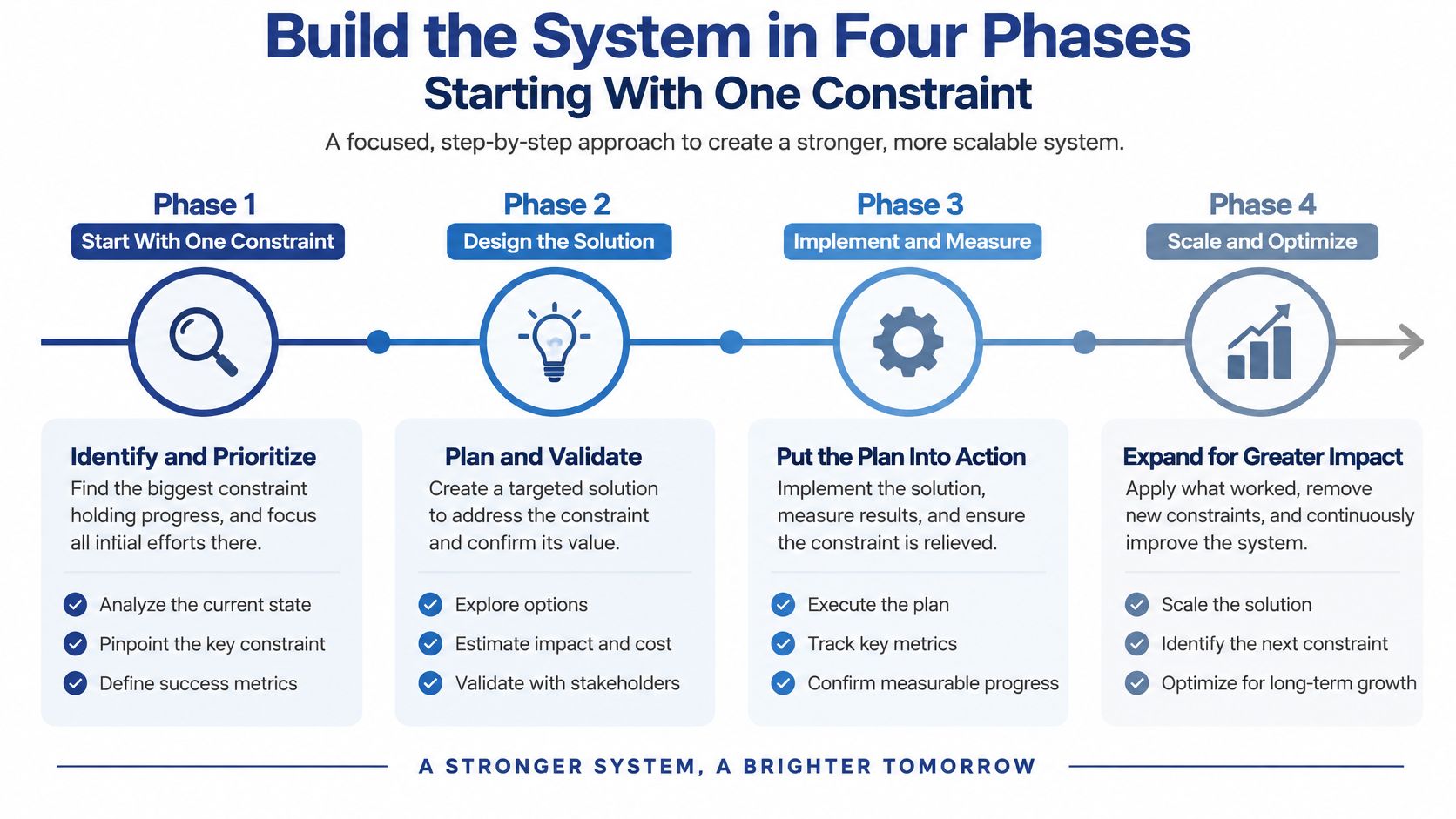
Phase 1 Diagnose
- Write the outcome and baseline. Record the current qualified-RFQ count and the rules used to classify it, so later comparisons use the same definition.
- Draw the market map. Put buyers and suppliers in the core, then add supporting services and relevant formal or informal rules on a single page.
- Name a falsifiable constraint. For example, if quotes receive a substantive response within 24 hours but conversion remains flat across comparable opportunities, response speed becomes a weaker explanation.
- Check the diagnosis in conversations. As a practical starting sample, hold ten buyer or sales conversations, including recent buyers and two lost-deal reviews.
During weeks 1-4, separate observations from explanations. A lost buyer saying your price was high is an observation; concluding that your market needs a discount is still a hypothesis.
The exit test below requires a disprovable statement, not agreement around a vague problem such as poor marketing.
Phase 2 Connect
- Put opportunities in a shared CRM. During weeks 5-10, assign RFQ, quoted, won, or lost status, with an owner and next-action date.
- Configure the follow-up. Set an acknowledgement within one hour and a three-touch sequence, stopping it when a buyer replies, declines, or places an order.
Keep automated receipts distinct from engineering responses. Where technical review takes longer, tell the buyer who owns it and when to expect an update.
Don't automate missing information into repeated requests. Check whether your RFQ form collects the drawing revision, material, quantity, and delivery requirement needed for an initial assessment.
Phase 3 Equip
- Build application content. During weeks 11-18, prepare pages for your top three applications, including operating conditions, limitations, and the information needed for quotation.
- Issue current sales tools. Give representatives an approved battle card and quote-ready examples, with a named technical reviewer and revision date.
A battle card is a concise reference for fit, differentiation, objections, and disqualifying conditions. It should help a representative say when your equipment is unsuitable, not just repeat selling points.
Use the supplied video as a discussion prompt alongside your own map and responsibilities.
Phase 4 Optimize
- Review the scorecard monthly. During months 5-12, compare the commercial outcome with the behavior changes you expected to cause it.
- Redesign or retire disproven work. If the evidence contradicts your explanation, change the intervention rather than extending it automatically.
Set a 90-day review even if your sales cycle is longer. At that checkpoint, test ownership, adoption, response handling, and buyer feedback rather than demanding completed revenue too early.
Reserve a budget line that can move. A BEAM Exchange study of adaptive management found that inflexible budgets and results-measurement arrangements can discourage learning and adjustment.
A pre-approved channel doesn't deserve continued funding merely because changing it creates paperwork.
Build phases, timing and exit tests
| Phase | Timeframe | Build Focus | Exit Test |
|---|---|---|---|
| 1. Diagnose | Weeks 1-4 | Constraint map for one commercial outcome | A named constraint with a written signal that would disprove it |
| 2. Connect | Weeks 5-10 | Shared pipeline and automated follow-up | Every inbound lead sits in one pipeline stage with a first reply logged within one hour for two weeks |
| 3. Equip | Weeks 11-18 | Application content and sales tools | Reps use current materials on quotes, and content gets read or shared |
| 4. Optimize | Months 5-12 | Scorecard reviews and redesign | The outcome metric moves in the expected direction for two consecutive reviews |
These are proposed operating gates. The connection-phase reply can be an acknowledgement, but substantive response time needs separate tracking.
Moving faster isn't always progress. Building the pipeline before naming the constraint can leave you efficiently automating the wrong process.
Test Whether a Change Is Systemic
Say a machine builder adds a supplier-qualification step and wins three accounts in a quarter. That's a useful commercial result, but it doesn't establish that other buyers will accept the process or that partners will maintain it.
The DCED systemic-change implementation guidelines use sustainability, scalability, and resilience to distinguish enduring change from an isolated intervention. Apply those tests to the mechanism behind the result, not merely the sales total.
Inspection records can support the mechanism, but completed paperwork alone doesn't establish systemic change.

Look for a pass and a failure
Sustainability asks whether the change keeps running without the initiating team. A pass would be a distributor funding and delivering qualification support through its normal operations. A failure would be every application waiting for your consultant to intervene.
For scalability, consider a second territory. If another partner can use the qualification package with affordable local adaptation, you have evidence of transferability; if expansion requires the owner to negotiate every exception personally, you don't.
Resilience concerns changed conditions. A supplier-qualification process that accommodates an alternate material through controlled engineering review may survive a supply disruption. A process tied to an unavailable input, with no substitution route, may stop working.
These tests also expose business model innovation questions. Who pays for qualification, who benefits from it, and does the supporting service remain commercially worthwhile?
Check whether expectations changed
A deeper signal is whether buyers now regard the new practice as normal. The BEAM Exchange paper on social norms treats informal expectations as part of market functioning and their change as an indicator of systemic change.
One customer signing an exception isn't the same as several procurement teams accepting a qualification route without renegotiating it.
Ask these questions before calling an initiative systemic:
- Ownership: Who will run and fund it when the launch team steps away?
- Transfer: Can another partner adopt it without recreating the entire intervention?
- Stress: What happens when demand drops, input costs rise, or trade conditions change?
- Expectation: Have several actors changed what they consider acceptable practice?
A one-off campaign isn't failing because it doesn't meet these tests. Not every useful initiative needs to be systemic, but its description should match what you can demonstrate.
Scorecard for Tracking Systemic Change
Revenue can increase while your new process remains dependent on constant intervention. Website visits and lead counts reveal even less about whether partners have changed their behavior.
A useful scorecard follows the chain from action to capability, behavior, market function, and commercial outcome. The BEAM Exchange measurement resource supports pairing outcome measures with indicators of autonomy, scale, resilience, and sustainability, using both quantitative and qualitative evidence.
Track behavior before claiming transformation
Treat the following as a proposed dashboard. Your CRM supplies opportunity records, partner logs establish independent activity, and short buyer interviews help explain acceptance or resistance.
Systemic scorecard indicators and review cadence
| Dimension | Indicator | Leading or Lagging | Review Cadence |
|---|---|---|---|
| Scale | Share of target accounts using the new process | Leading | Monthly |
| Autonomy | Share of quotes or orders where your partner runs the process without your staff | Leading | Monthly |
| Resilience | Days to restore normal pipeline activity after a supply or demand shock | Lagging | After each shock |
| Sustainability | Months the process runs with no outside support | Lagging | Quarterly |
| Replication | Number of partners or territories running the process on their own | Leading | Quarterly |
| Outcome | Quote-to-order conversion rate and average order value | Lagging | Monthly |
| Norm shift | Buyers accepting a new vendor qualification step without renegotiation | Leading | Quarterly |
Scale needs a stable denominator: define the eligible target accounts before calculating uptake. Autonomy requires more than a partner pressing submit while your staff perform the work behind the scenes.
For resilience, define normal pipeline activity before a disruption. For sustainability, distinguish temporary implementation support from ordinary commercial payments, since a viable service still needs revenue.
Replication should exclude partners who merely received materials. Outcome measures need consistent quote cohorts, while norm-shift records should distinguish routine acceptance from individually negotiated exceptions.
Use manufacturing marketing KPIs to connect this dashboard to your existing commercial reporting rather than creating a separate reporting burden.
Make the review change a decision
The general cadence is monthly for actionable leading signals and quarterly for slower durability evidence. The table deliberately checks commercial outcomes monthly and replication or norm shifts quarterly; shock recovery needs an event-based review.
- Record the baseline: Preserve definitions, eligibility rules, and the starting position before implementation.
- Keep a decision log: Record disappointing results, competing explanations, the adjustment chosen, and the next check.
- Set a persistence check: Schedule proposed follow-ups at 12 and 36 months for changes you intend to call durable.
The 2024 BEAM Evidence Review identifies limited ex-post evaluation, publication bias, and a shortage of non-MSD comparators. Durability and additional impact therefore need testing, not assumption.
Where feasible, compare similar accounts that didn't receive the change and examine their starting differences. Where that isn't possible, report the observed improvement and the remaining uncertainty plainly.
Evidence boundary: A result occurring after your intervention isn't, by itself, proof that your intervention caused it.
Summary and Your Next Step
Market systems development gives manufacturers a disciplined way to investigate growth problems beyond an individual marketing channel. The core exchange, supporting services, and surrounding rules belong in the diagnosis because buyers experience them together.
The practical work should stay narrow. Name the commercial constraint, connect the necessary tools and people, and judge the intervention against evidence that could prove your explanation wrong.
Start with a page, not a platform
This week, prepare a short working document:
- Commercial outcome: Name the result you need and record its current value.
- Market map: Show the buyer exchange, supporting functions, and relevant requirements.
- Constraint hypothesis: State what you think is preventing progress and what evidence would contradict it.
- Review decision: Assign an owner, a checkpoint, and the conditions for continuing, changing, or stopping the work.
A cohesive system isn't the largest software stack you can afford. It's an operating arrangement in which responsibilities are clear, buyers can progress, and partners have reasons to keep participating.
Don't confuse early adoption with durability, or a revenue improvement with proven attribution. Use the scorecard to make better decisions, and keep the solution proportional to the problem. Sometimes the right transformation begins with a better handoff rather than a broader programme.
Machine Marketing helps manufacturers connect strategy, CRM, lead generation, and follow-up around a diagnosed growth constraint. Visit Machine Marketing to discuss a market-system diagnosis, test the first constraint, and set a 90-day review, including a candid assessment of whether a single-channel fix is enough.
