If you're a manufacturer, this probably feels familiar. Your team goes to trade shows, posts on LinkedIn when there's time, sends a few email blasts, updates the website once in a while, and still can't predict where the next qualified opportunity will come from. Sales says the leads aren't right. Marketing says sales waits too long to follow up. Leadership sees activity, but not a reliable system.
That's the problem. Most B2B marketing for manufacturers doesn't fail because people aren't working hard enough. It fails because the process was never engineered. Industrial buyers don't respond to disconnected tactics. They respond to clear technical proof, relevant information, and consistent follow-up across a long buying cycle.
Table of Contents
- Diagnosing Your Growth Problem
- Build Your Foundation With a Technical ICP
- Turn Your Website Into a Digital Sales Engineer
- Build Your Marketing Engine with CRM and Automation
- Execute High-Value LinkedIn and Email Workflows
- Align Sales and Integrate Trade Show ROI
- Your 90-Day Launch Plan and KPIs
Diagnosing Your Growth Problem
In manufacturing, inconsistent lead flow usually isn't a lead problem. It's a system problem. You don't need more random activity. You need a machine that turns market demand, technical expertise, and sales follow-up into qualified opportunities.
That matters even more now because the buying environment has shifted. The global B2B eCommerce market is valued at $36.16 trillion as of 2026, with heavy industries driving the majority of sales, and nearly 75% of B2B buyers conduct extensive online research before any purchase according to B2B marketing statistics for digital commerce. If your digital presence is thin, buyers can screen you out before anyone on your team gets a call.
What a broken system looks like
Most underperforming manufacturers show the same symptoms:
- Website as brochure: It lists capabilities, but doesn't answer technical buying questions.
- Disconnected tools: Your CRM, forms, inboxes, trade show lists, and sales notes don't talk to each other.
- Weak follow-up: Engineers download a resource, then hear nothing useful for weeks.
- No shared diagnosis: Marketing tracks clicks. Sales tracks quotes. Leadership can't see where deals stall.
When that happens, teams default to blaming the channel. They say SEO doesn't work, LinkedIn is a waste, email is dead, or trade shows are too expensive. Usually the channel isn't the issue. The lack of process is.
Practical rule: Treat marketing like you'd treat production. Define the inputs, standardize the process, inspect the outputs, and fix the bottleneck instead of guessing.
The better frame
Strong B2B marketing for manufacturers works like an engineered system. You identify the right accounts, build content that proves competence, create workflows that route people correctly, and give sales the context to continue the conversation without starting from zero.
That also means accepting trade-offs. Not every manufacturer needs heavy paid media. Not every company should gate every spec sheet. Not every product line deserves its own campaign. The right answer depends on margin, complexity, buying committee structure, and internal sales capacity.
If you want a useful external perspective on proven digital strategies for manufacturers, that resource gives a good high-level view of how digital channels fit together. The key is turning that thinking into a working operating system inside your business.
Build Your Foundation With a Technical ICP
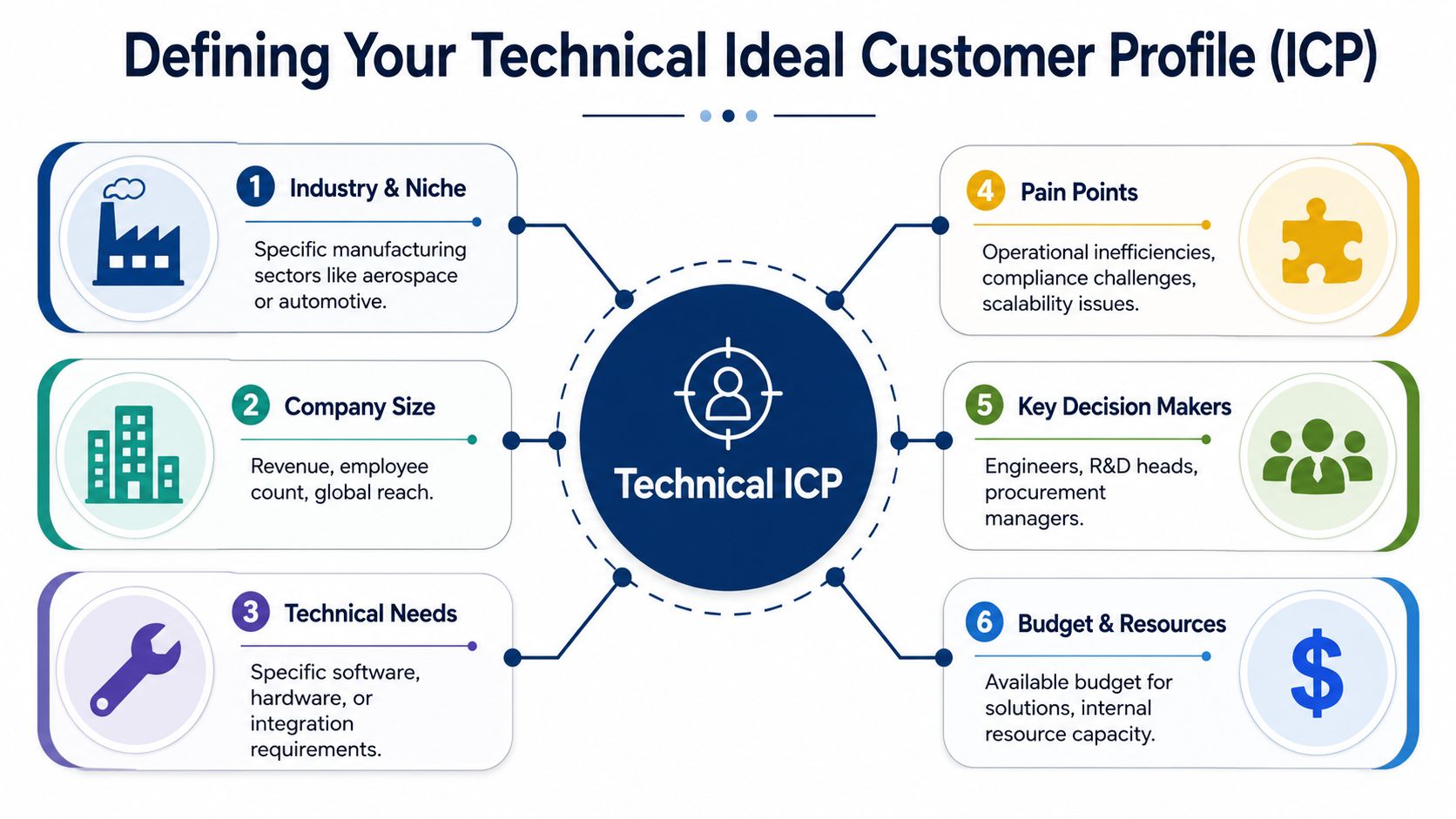
A lot of manufacturers say they know their customer. Then you look at the messaging and find a generic profile like “operations manager at a mid-sized industrial company.” That isn't enough to drive a serious campaign. It doesn't tell you what problem triggered the search, what proof the buyer needs, or which technical objections will kill the deal.
Why the generic persona breaks down
Most B2B content fails because it ignores the Engineering-Focused Buyer Journey. Engineers drive up to 70% of initial research and want technical materials such as application engineering notes and process capability studies. That kind of content builds credibility 3x more effectively than generic marketing copy.
If your current persona focuses only on budget, title, and industry, ask harder questions:
- What process failure starts the search
- What spec or compliance issue creates urgency
- What information does an engineer need before they'll even involve procurement
- What internal risk makes the buyer hesitate
A useful persona has to survive real-world scrutiny. If your sales engineer read it, would they say, “yes, that's the account we win,” or would they roll their eyes?
For a more structured way to document these profiles, this guide on how to create buyer personas is a practical starting point. If your product data is scattered across spreadsheets, PDFs, and old catalogs, it also helps to understand centralized product information workflows. This overview can help you discover PDM for manufacturing and retail.
What belongs in a technical ICP
A technical ICP goes deeper than a sales persona. It should include commercial fit, but it also needs operational and engineering context.
| ICP element | What to define | Why it matters |
|---|---|---|
| Industry fit | The exact vertical and use case | Aerospace buyers don't evaluate like food processing buyers |
| Process environment | Line type, throughput, material, tolerances | Technical relevance starts here |
| Trigger problem | Downtime, yield loss, compliance risk, labor constraint | This shapes search behavior and content needs |
| Buyer committee | Engineering, operations, procurement, leadership | You're selling into a group, not a single contact |
| Credibility threshold | Test data, certifications, implementation detail | Buyers need proof, not slogans |
| Buying friction | Integration risk, capex review, supplier switching cost | These objections determine what content you create |
Good manufacturing messaging doesn't start with “why choose us.” It starts with “what failure mode is the buyer trying to eliminate?”
Questions to ask yourselves
Use these in a working session with sales, engineering, and customer service:
- Which customers ask the best technical questions before buying?
- What documents do serious buyers request early?
- Where do deals stall because our website or content didn't answer something clearly?
- Which job title champions the project internally, and which one slows approval down?
- What proof points do we rely on in live sales calls that never appear online?
If you can answer those questions, your ICP starts becoming operational. That's when content stops sounding generic and starts sounding credible.
Turn Your Website Into a Digital Sales Engineer
A manufacturing website shouldn't act like a static brochure. It should behave like a sales engineer who's available all day, answers technical questions clearly, and routes the right people into the next conversation.
SEO is the most efficient channel for manufacturers, with a close rate of nearly 15%, compared with 2% from traditional cold-calling, and buyers perform an average of 12 online searches before ever interacting with a brand's website according to B2B marketing statistics on search and buyer behavior. That gap explains why weak industrial websites underperform. Buyers don't just visit once. They compare, research, and revisit.
Build for the questions engineers actually ask
Most industrial sites lead with broad claims like quality, innovation, and customer service. Those aren't useless, but they aren't enough to move a technical buyer. Engineers search around applications, failure points, materials, tolerances, maintenance demands, and compatibility.
A better website structure includes pages built around real decision paths:
- Application pages: Show where the product fits, where it doesn't, and what constraints matter.
- Process pages: Explain how your solution affects throughput, consistency, maintenance, or scrap.
- Industry pages: Translate your capabilities into sector-specific language and standards.
- Problem pages: Address issues such as contamination, downtime, repeatability, or handling difficulty.
If your team is planning a rebuild, this article on a manufacturing website that generates leads is worth reviewing before you touch navigation, content structure, or conversion paths.
The website elements that carry technical credibility
Here's where many teams fall short. They write a few service pages and call it content strategy. Technical buyers need a resource stack.
Include assets like these:
- Spec sheets: Clear dimensions, material options, performance parameters, and limitations.
- CAD files and drawings: Especially important when engineers need to assess fit early.
- Maintenance guides: Buyers want to know what ownership looks like after installation.
- Compliance references: Show which standards, documentation, or quality controls apply.
- Use-case articles: Explain why a solution works in a specific production environment.
- Video demonstrations: Show operation, setup, and process outcomes without forcing a sales call.
If a buyer can't verify capability on your site, they'll assume a competitor can answer faster.
A common mistake is hiding everything behind a contact form. Some gated content makes sense. Not everything should be locked. Early-stage researchers often want enough technical detail to decide whether you belong on the shortlist at all.
A practical test is simple. Pull your last five qualified deals. Review what buyers asked for before the first serious call. If those answers aren't available on your website in some form, your sales team is still doing work your digital system should already be handling.
Build Your Marketing Engine with CRM and Automation
Most manufacturers already have pieces of the stack. A website form, a CRM, Outlook inboxes, trade show spreadsheets, LinkedIn activity, maybe a few email campaigns. The problem isn't usually missing tools. The problem is that the tools don't behave like one system.
What the system must do
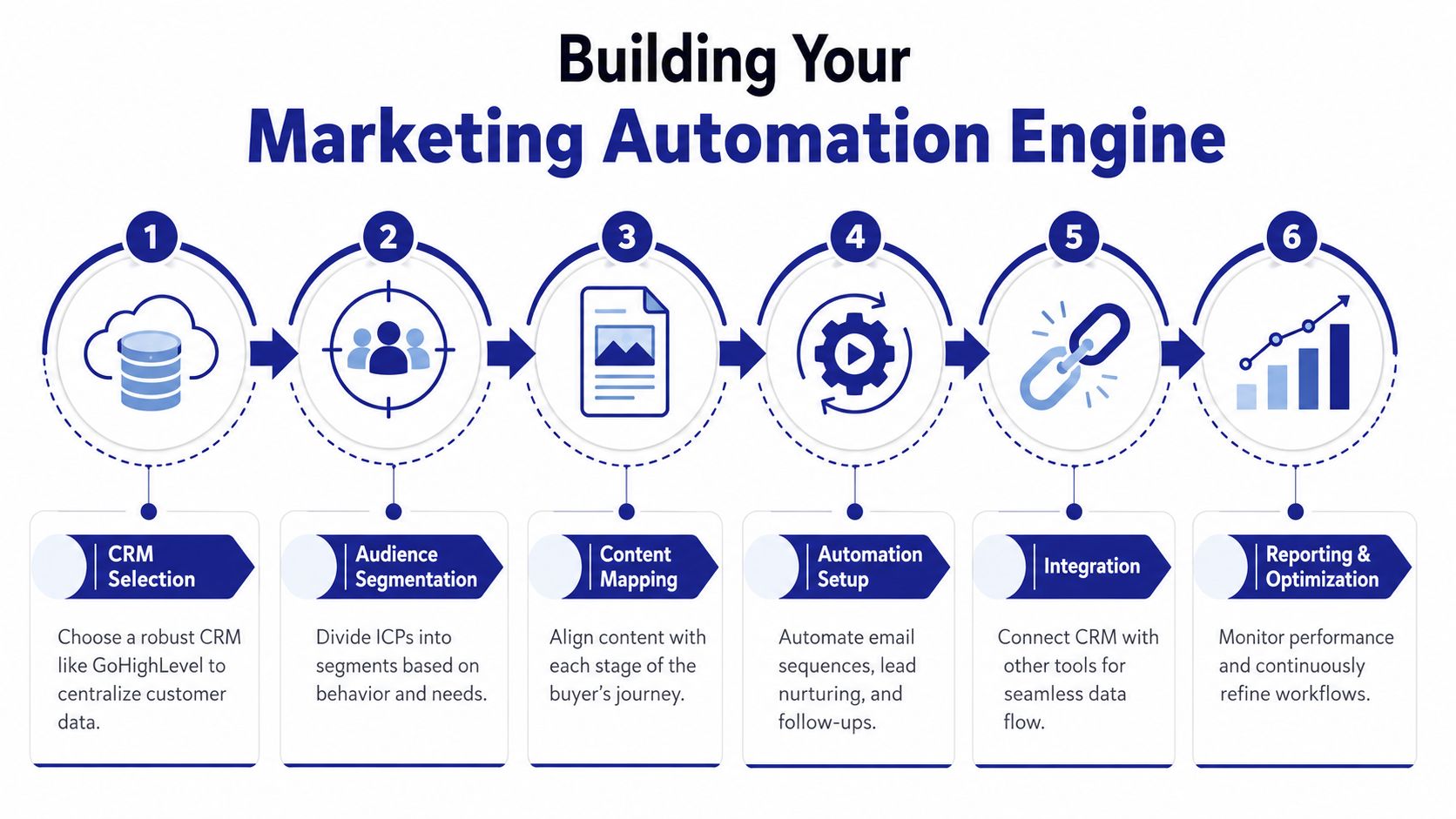
Before picking platforms, define required behavior. Whether you use GoHighLevel, HubSpot, Salesforce, Zoho, or another stack, the system should handle five jobs well.
Capture intent
Forms, quote requests, webinar registrations, content downloads, and trade show scans need to land in one place with source context attached.
Segment contacts
A plant engineer researching a line issue should not receive the same follow-up as a procurement contact requesting pricing. Segment by role, interest, product line, and stage.
Route leads
Some contacts need immediate sales follow-up. Others need education first. Routing rules should reflect deal complexity, not just form fills.
Automate nurture
Long-cycle manufacturing deals require relevant follow-up over time. Automation keeps that moving without depending on someone's memory.
Report by pipeline impact
You need visibility into what content, campaign, or source helped create movement, not just what generated activity.
A clean implementation starts with process, then software. If your team needs a practical reference, this guide to a CRM for manufacturing companies is useful because it focuses on operational fit rather than feature overload.
A practical workflow architecture
Start simple. Don't build a giant automation maze on day one.
Use a model like this:
- Inquiry workflows: RFQ form submitted, quote request sent to sales, reminder task created, follow-up email triggered.
- Technical education workflows: Whitepaper download, related content delivered, product specialist notified if engagement continues.
- Event workflows: Trade show scan tagged by event, rep assigned, post-show sequence triggered by topic of interest.
- Reactivation workflows: Older contacts receive updated application content, product launches, or maintenance resources.
Here's a useful benchmark for why this matters. B2B companies that maintain 10 or more landing pages generate 55% more leads, and 91% of B2B marketers use content marketing, with 74% reporting it is effective for lead generation, according to B2B marketing stats on landing pages and content. More importantly, the system behind those pages determines whether lead flow turns into real conversations.
This short walkthrough is useful if you want to see automation concepts visually before configuring the workflows in your own environment.
What to watch for
Teams usually make the same mistakes:
- Too many status labels: If nobody can explain the difference between lead stages, reporting will fail.
- No owner for data hygiene: Bad fields, duplicates, and missing notes break automation quickly.
- Over-automation: You don't need twenty emails. You need the next right message.
- No sales feedback loop: Marketing can't score lead quality alone.
Field note: The best automation feels boring. It sends the right thing, alerts the right person, and leaves a clean record.
That's what lets you manage long sales cycles without dropping opportunities between channels or between team members.
Execute High-Value LinkedIn and Email Workflows
Once the foundation is in place, execution gets easier because every move has context. For industrial manufacturers, LinkedIn is the premier channel, delivering the highest click-through rates and lowest cost per lead, and the strongest methodology combines personalized drip campaigns with targeted ads and retargeting according to B2B strategies for manufacturers on LinkedIn and email.

A realistic outreach sequence
Here's what an effective workflow often looks like in practice.
Your applications engineer posts a short LinkedIn update about a common production issue. Not a brand post full of slogans. A technical observation. Something like a comparison between two material handling approaches, or a note on why a process becomes unstable under certain conditions.
A target account engages with the post. One person clicks through to a problem-focused landing page. They read a maintenance guide and leave.
That's where most companies stop. A better system does this instead:
- Retarget the visitor with a related technical asset.
- Route form submissions by interest area, not just source.
- Send a short email sequence tied to the exact problem they engaged with.
- Notify sales only after intent becomes clearer through repeat engagement or direct inquiry.
- Add human follow-up from the right technical or commercial contact.
This works because the sequence respects how industrial buyers behave. They don't want generic nurture. They want relevance.
What good execution looks like
A strong LinkedIn and email motion usually includes a mix of people and content:
- Subject matter experts on LinkedIn: Engineers, technical sales reps, product managers.
- Short-form technical posts: Process notes, application considerations, teardown insights.
- Email sequences with utility: Spec summary, implementation guide, checklist, FAQ.
- Low-friction replies: “Want the worksheet?” performs better than pushing a call too early.
- Retargeting by topic: Show related proof, not unrelated brand ads.
Here's a simple comparison.
| Weak workflow | Strong workflow |
|---|---|
| One generic company post | Topic-specific posts from technical staff |
| One newsletter to all contacts | Segmented email follow-up by role and interest |
| Immediate sales pitch | Educational sequence followed by contextual outreach |
| Broad ad targeting | Retargeting tied to actual page or content engagement |
Don't ask for a meeting before you've earned technical trust.
The biggest mistake in this stage is volume obsession. More sends don't fix weak relevance. If your email copy could apply equally to a contract manufacturer, an OEM, and a precision machine shop, it's probably too broad.
A second mistake is hiding the people behind the business. In manufacturing, credibility often comes from the engineer, estimator, product specialist, or founder who understands the work. Let them speak. Buyers can tell the difference between polished corporate messaging and real expertise.
Align Sales and Integrate Trade Show ROI
Marketing and sales often operate like adjacent departments instead of one commercial system. In manufacturing, that split is expensive. The handoff matters more because deals involve multiple conversations, technical reviews, and long quiet periods where momentum can disappear.
Lead source dramatically impacts success. Referrals have the highest close rate for B2B sales, and social sellers create 45% more opportunities according to B2B sales statistics on referrals and social selling. That tells you something important. Relationship-based marketing isn't separate from digital execution. It's the point of it.
Why digital and field activity must share one system
Sales needs more than a name and company. They need context.
When a rep opens a record, they should see things like:
- What content the contact consumed
- Which product line or problem they engaged with
- Whether they came from search, LinkedIn, referral, or event activity
- Which stakeholders from the same account have appeared
- What happened in previous conversations
That intelligence changes the call. Instead of asking broad discovery questions the buyer already answered online, sales can continue the conversation at the right altitude.
If sales has to reconstruct buyer intent from scratch, marketing didn't finish its job.
How to run trade shows as part of revenue operations
Trade shows still matter. They just don't work well as isolated events. Treat them as a coordinated campaign with pre-show, at-show, and post-show workflows.
Before the event:
- Identify target accounts: Build a list of customers, open opportunities, and strategic prospects who are likely to attend.
- Warm the audience: Use email and LinkedIn outreach to schedule conversations before the show floor gets noisy.
- Support the booth experience: If you're reworking the physical presence itself, this guide on designing an exhibition booth is a useful reference for thinking through layout and engagement.
At the event:
- Tag scans by topic: Don't collect contacts without noting interest area, urgency, and next step.
- Capture account data: If several stakeholders visit, link them properly.
- Use simple qualification rules: Sales doesn't need more leads. It needs better context.
After the event:
- Send follow-up based on discussion topic, not a generic thank-you
- Route hot accounts to sales immediately
- Place longer-cycle contacts into nurture tracks tied to the exact solution discussed
- Review pipeline creation by account, not just badge count
Alignment becomes operational. Marketing supports awareness and follow-up. Sales brings account knowledge and live conversation skill. Trade shows then stop being expensive field activity and start acting like one touchpoint inside a larger buying journey.
Your 90-Day Launch Plan and KPIs
Most manufacturers don't need a grand reinvention. They need a controlled launch. Ninety days is enough time to diagnose the system, build the core infrastructure, and start generating cleaner signals.
The buying process is crowded and prolonged. Manufacturing purchases typically involve six to 10 decision-makers, and 73% of millennials are actively involved in these decisions, according to B2B marketing statistics for manufacturers and industrials. That means your launch plan has to support multiple stakeholders, not just one lead form.
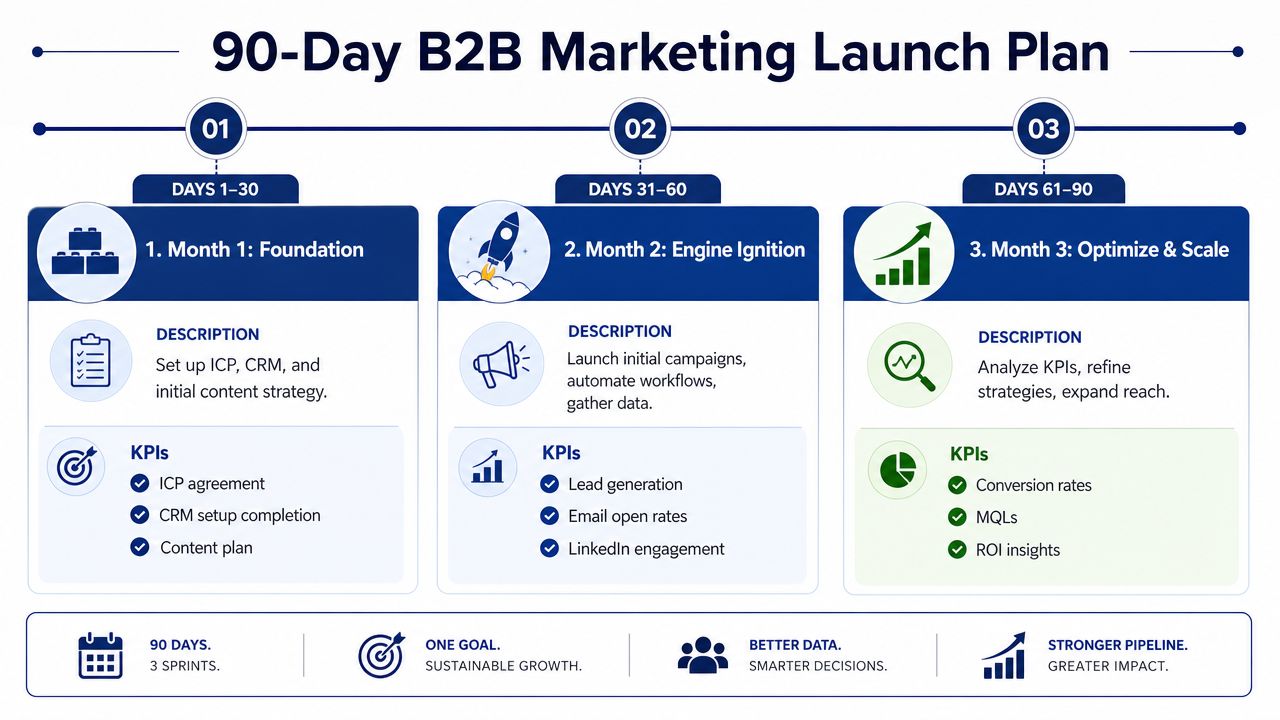
Month 1 foundation
Focus on diagnosis and agreement. Don't launch campaigns before your team agrees on who you want, what proof matters, and how leads should move.
Core actions
- Define the technical ICP: Include triggers, roles, objections, and required proof.
- Audit current assets: Website pages, PDFs, CRM fields, forms, trade show processes, and email history.
- Map the buyer journey: Problem recognition, solution exploration, business case building, vendor evaluation, final validation.
- Clean your CRM basics: Standardize lead sources, lifecycle stages, ownership, and required fields.
- Build a content priority list: Start with the assets sales uses most often.
KPIs to track
- ICP agreement: Sales, marketing, and leadership all approve one version.
- CRM setup completion: Required fields, pipelines, and routing rules are in place.
- Content plan readiness: Priority topics assigned to owners and dates.
Month 2 engine ignition
Deploy the minimum viable system. Don't try to publish everything. Build the pieces that support high-intent movement first.
What to launch
- One core landing page cluster tied to a real problem or product line.
- One technical email nurture sequence for educational follow-up.
- One inquiry workflow for quote requests or demo requests.
- LinkedIn publishing rhythm from a technical expert and the company page.
- Retargeting for key site visitors if budget and traffic support it.
KPIs to track
- Lead generation by source
- Email open and click behavior
- LinkedIn engagement from target accounts
- Sales response time
- Meetings created from qualified intent
Launch the smallest system that can produce feedback. Then improve it with evidence instead of opinion.
Month 3 optimize and scale
By this stage, you should have enough data to see friction points. Maybe the landing page gets visits but poor form completion. Maybe email engagement is fine but sales follow-up lags. Maybe LinkedIn content attracts the wrong audience. Good. Now you can tune the machine.
Use month three to:
- Refine segmentation: Separate engineers, plant leaders, procurement, and distributors where relevant.
- Improve conversion paths: Adjust forms, CTAs, page structure, and follow-up timing.
- Expand content around winning topics: Build out adjacent application pages, guides, and FAQs.
- Review pipeline influence: Which channels create real account movement.
- Tighten sales-marketing SOPs: Especially for handoff, follow-up expectations, and closed-loop feedback.
KPIs to track
- Conversion rates on key pages
- Marketing-qualified leads
- Sales-accepted leads
- Opportunity creation by source
- ROI insight by campaign or channel
- Sales cycle movement across active accounts
A useful dashboard for B2B marketing for manufacturers doesn't just show traffic. It shows whether the system is attracting the right accounts, moving them forward, and helping sales close with less friction.
If you want one simple operating principle for the whole ninety days, use this. Build for clarity first. Then for speed. Then for scale.
If you want a practical diagnosis of your current marketing system, Machine Marketing helps manufacturers connect strategy, website content, CRM workflows, and lead generation into a process that supports consistent growth. If your tools are in place but the results still feel chaotic, that's the right time to get an outside diagnosis.