
Popular B2B email advice puts too much weight on subject lines and open rates. For manufacturers, the bigger question is whether your email system helps engineers, buyers, and decision-makers move a complex purchase forward, even when they're not ready to talk to sales. We'll show you how to build that system around useful content, reliable delivery, stakeholder needs, and pipeline outcomes.
Email has a strong track record as a measurable channel, but an industry benchmark isn't a promise of what your campaigns will earn. The practical opportunity is to make every message serve a real buying or customer need, then connect its performance to commercial results.
Table of Contents
- Why Most Manufacturers Misuse Email Marketing
- What a B2B Email Marketing Strategy Actually Is
- Segmentation That Matches How Industrial Buyers Buy
- Mapping Email Journeys to the Industrial Buying Cycle
- Setting Up CRM and Automation So the System Actually Runs
- Deliverability, Compliance, and the Metrics That Actually Matter
- Your 30-Day B2B Email Strategy Starter Plan
Why Most Manufacturers Misuse Email Marketing
The common mistake is treating email as a broadcast channel: collect addresses, write one announcement, and send it to everyone. That approach assumes an engineer assessing a process and a purchasing manager comparing suppliers need the same information. They don't.
Industrial purchases involve technical evaluation, multiple stakeholders, and follow-up over time. A generic promotion may generate a click, but it rarely answers the questions that determine whether a supplier makes the shortlist. Sending more often won't fix a message that misses the recipient's job, project stage, or concern.
Email deserves a more deliberate role. The Direct Marketing Association's 2019 UK tracker reported average returns of just over £42 for every £1 spent across surveyed marketers, while B2B organizations reported just under £36 per £1. The same report found that approximately two-thirds of surveyed marketers measured email ROI, the highest result in the tracker's history at that point. Those figures are historical industry benchmarks, not a forecast for your business, but they reinforce the value of treating email as an accountable channel, not an occasional blast (DMA's 2019 Marketer Email Tracker).
Diagnose the system, not just the copy
A useful industrial email program supports several parts of the customer relationship. It can educate prospects, follow up on quotes, reconnect with dormant leads, retain customers, and share relevant post-purchase information. Each message should have a defined audience and a business purpose.
That doesn't mean every email needs to push for an RFQ. An engineer may need technical details before a supplier conversation makes sense. A purchaser may need lead-time or certification information to build an internal case. Helping each person answer the next practical question is often more useful than sending a broad “contact us” appeal.
Buyer research also points to email as a preferred vendor communication channel, with roughly 73–77% of B2B buyers preferring it. Treat that as a reason to communicate well, not as permission to fill inboxes (B2B email marketing statistics and trends).
Ask yourself: Does your current email program help a buying committee make progress, or does it send the same promotion to whoever happens to be on your list?
What a B2B Email Marketing Strategy Actually Is
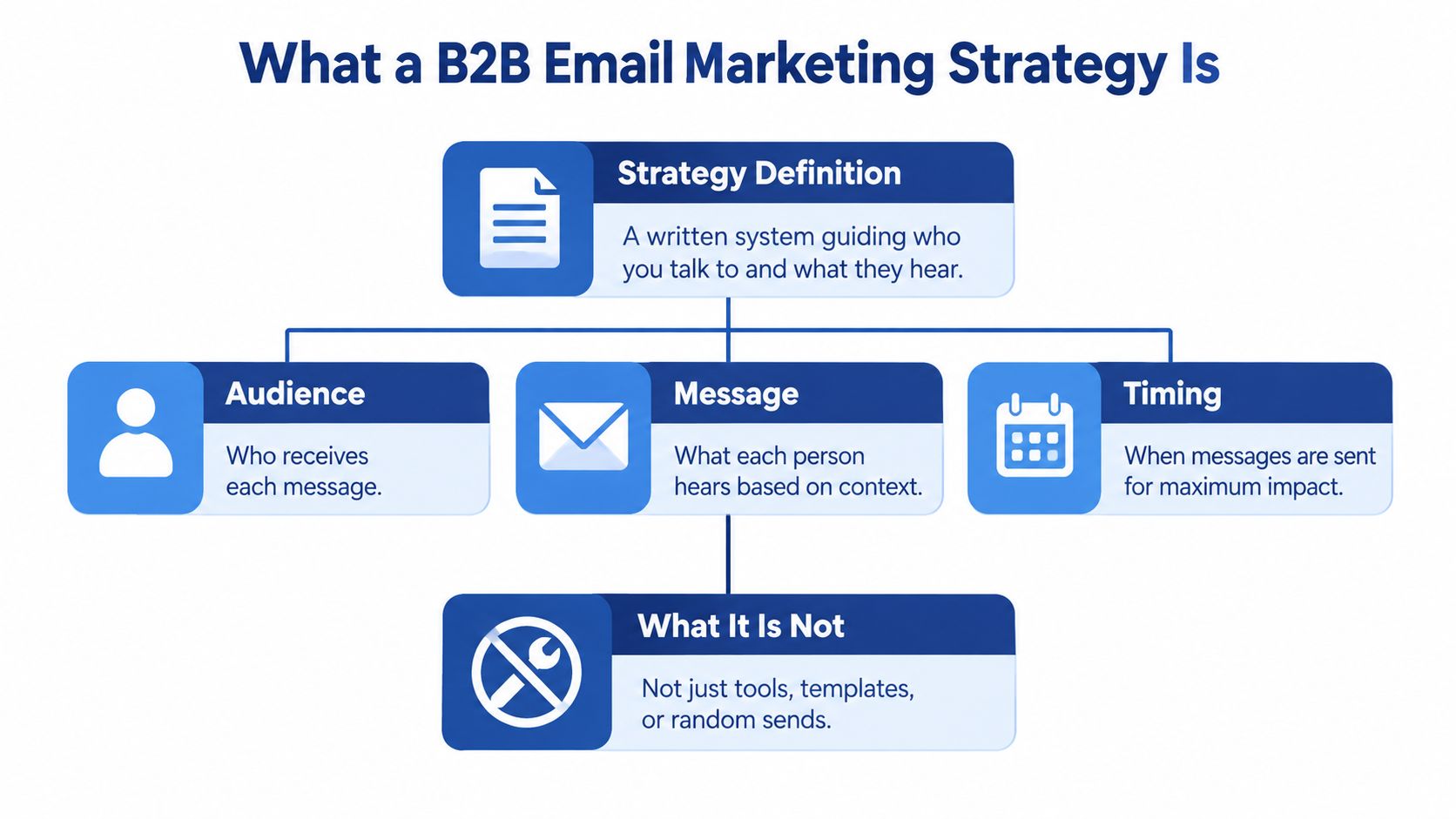
A B2B email marketing strategy is the written system that determines who receives each message, what they hear, when they hear it, and how you judge the business result. It connects marketing activity to the lead-to-quote process, so email isn't operating as an isolated calendar of sends.
Consider a CNC shop whose contacts include engineering evaluators, maintenance leaders, purchasing staff, and owners. A single message about general machining capabilities may be relevant to some, but it won't answer every role's questions. The engineer may need process and material details. The maintenance lead may care about reliability and service. Purchasing needs information that supports supplier comparison, while the owner may focus on the commercial case.
Four decisions make up the operating system
- Audience: Decide which contact or account segment needs the message. Use role and account context, not just a broad list.
- Message: Match the content to the recipient's task. A capability sheet and a quote follow-up serve different purposes.
- Journey: Plan how emails support a buying or customer stage, including what should trigger a follow-up and what should stop one.
- Measurement: Define how you'll connect activity to replies, meetings, quote requests, pipeline, or revenue.
A campaign calendar answers, “What are we sending this month?” The operating system answers, “Who needs what information to move a decision forward, and how will we know it helped?” A calendar can support a strategy, but it can't replace one.
Put email inside the CRM process
Your CRM should give the sales and marketing teams a shared view of the account, contact role, relevant activity, and next action. Email can then support the wider process: a form submission triggers a useful response, a quote request is routed appropriately, and sales can see which content a contact engaged with.
Don't optimize a message because it produced opens or clicks. Those actions matter only if they help you understand interest or lead to a useful next step. Does your team have a written rule for who gets each email and what sales should do when someone responds?
Segmentation That Matches How Industrial Buyers Buy
Segment by the buyer's needs and situation, not by the easiest fields in your database. Industry, role, machine or capability interest, and lifecycle stage can all help, but they answer different questions. Industry tells you what environment a company operates in. Role shows what a person is responsible for. Capability interest narrows the technical topic. Lifecycle stage indicates what the account is doing now.
For small and midsize manufacturers, role plus lifecycle stage is often the most useful starting point. It links the person's responsibilities to the current buying context. If you want a broader framework for choosing useful market segments, this guide to segment B2B markets effectively provides additional context.

Build segments around real buying differences
An engineering evaluator at a Tier 1 supplier may want tolerance and material data. A purchasing agent at that same company may need lead time, minimum order quantity, and certifications. Sending both contacts the same email doesn't create efficiency if neither message answers the recipient's question.
Start with CRM fields your team can maintain reliably:
- Role and account: Capture job function, company, and plant location.
- Technical fit: Record machine type, material capability, industry served, or relevant certification requirements.
- Buying context: Note quote activity, known project timing, and lifecycle stage where that information is available.
- Source and permission: Track where the contact came from and the basis for sending marketing email.
If records are thin, enrich them through sales conversations, website forms, and the information contacts choose to share. Don't turn a form into an interrogation. Ask only for details that will change what you send or how your team responds. For a practical walkthrough, see our guide to segmenting email lists.
Personalization should reflect this account context, not just insert a first name. One synthesis of B2B datasets reported higher open and reply rates for personalized subject lines, while a replication study found first-name treatment could perform worse. Use your own segment baselines and judge results by qualified replies, meetings, quote requests, and pipeline, not opens alone (B2B subject-line variation and personalization).
Make a segment specific enough to be useful and broad enough to evaluate. If you're considering a segment of fewer than 50 contacts, don't treat that cutoff as a universal benchmark. Decide whether a personalized sales sequence will serve those contacts better than an automated campaign.
Mapping Email Journeys to the Industrial Buying Cycle
An industrial buying journey is better mapped to the questions a buying committee needs to resolve than to a string of scheduled promotions. A buyer may begin by defining a production problem, then develop a specification, compare suppliers, reduce risk, and build internal agreement. Your emails should help with those tasks without pretending that every reader is at the same stage.
| Stage | Buyer Question | Email Format | Asset to Send |
|---|---|---|---|
| Problem definition | What process or capacity issue are we trying to solve? | Educational note | Tolerance-and-process guide |
| Specification development | What technical requirements should we document? | Practical checklist | Material, capability, or specification worksheet |
| Supplier comparison | Which supplier can meet our needs? | Clear comparison | Side-by-side capability overview |
| Risk reduction | How can we validate fit and reduce supplier risk? | Evidence-led follow-up | Relevant customer story and certifications |
| Internal approval | What does our team need to approve the decision? | Concise decision support | Quote details and a summary for internal review |
Match content to the buying question
Use a short technical guide when a buyer is defining the problem. When the team is developing a specification, provide a checklist that makes requirements easier to discuss internally. During supplier comparison, explain relevant capabilities plainly rather than sending a general company brochure.
When risk is the concern, offer evidence that helps the buyer evaluate fit. That could include certifications or a customer example, provided the material is accurate and appropriate to share. For approval, make quote details and next steps easy to find. The point is not to manufacture urgency. It's to remove avoidable uncertainty.
A useful content map should also account for silence. A contact who doesn't click immediately isn't necessarily uninterested. Watch for other meaningful signals, such as a later reply, a return visit to a technical page, or activity from another stakeholder at the account. Use those signals as context for a sales conversation, not as automatic proof of purchase intent.
For a fuller view of how email can connect to other sales and marketing touchpoints, use our guide to B2B customer journey mapping. Keep cadence restrained and usefulness high. A technically valuable email sent at the right moment beats a routine promotion that gives the buyer no reason to act.
Setting Up CRM and Automation So the System Actually Runs
Automation won't rescue an unhealthy list or unclear process. Build the operating foundation first, then automate the interactions your team already knows how to handle. A useful setup needs a CRM that tracks account activity, an email platform with segmentation and sequence controls, and a routine for keeping records and permissions current.
The right tools depend on your team's capacity and complexity. A small shop may need a CRM and email platform that cover contact management, simple workflows, and reporting. A larger manufacturer may need stronger account-level visibility and connections among marketing, sales, and quoting systems. Don't buy tools because a feature list looks impressive. Buy what your process can support.
Build in an order that protects the system
- Review list permission and suppression. Separate contacts you can appropriately email from those who must not receive marketing messages. Keep suppression records accessible to the people managing campaigns.
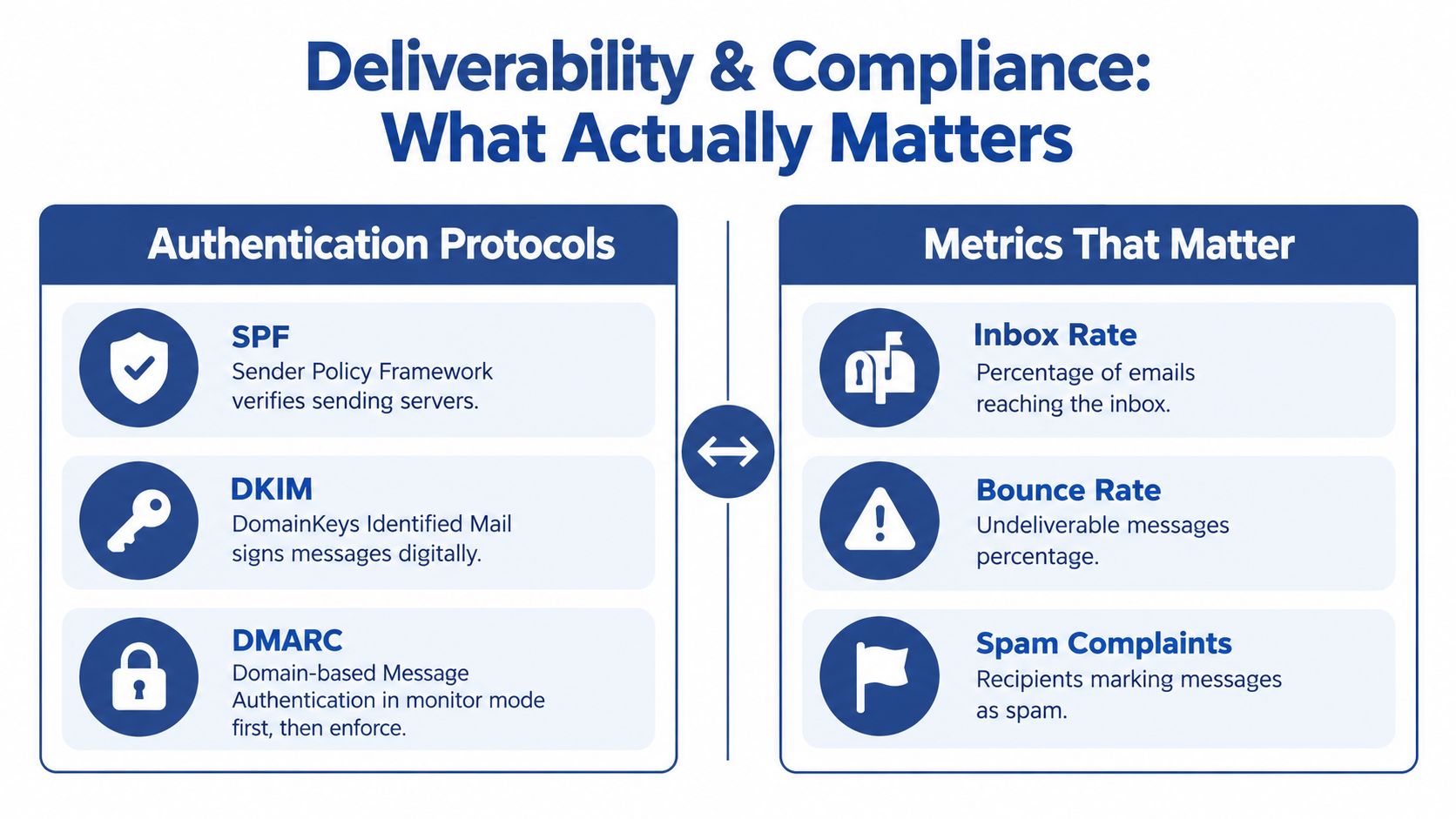
- Authenticate your sending domain. Configure SPF and DKIM, then publish DMARC in monitoring mode while you confirm legitimate platforms are represented. Move toward enforcement after you've reviewed the results.
- Clean up CRM records. Keep useful fields such as role, plant location, material interest, machine type, and quote activity current. Avoid collecting data nobody uses.
- Automate entry points. Start with clear events, such as a form submission, quote request, or trade-show import. Make sure the next message matches the contact's request and permission status.
- Add behavior-based triggers last. First confirm that your tracking, segments, and stop rules work. Then create follow-ups for meaningful actions, such as requesting a technical document or returning to a relevant capability page.
Google's sender guidance requires authentication for messages sent to Gmail accounts and sets additional requirements for bulk senders, including SPF, DKIM, and DMARC. For direct email, the From domain must align with the authenticated domain, and marketing messages need one-click unsubscribe plus a visible unsubscribe link (Google's email sender guidelines).
A CRM vendor should be able to answer this plainly: Can we see account-level activity and make an unsubscribe or suppression update stop every relevant automated email? If the answer is vague, the setup may be built for contact storage, not industrial sales.
Deliverability, Compliance, and the Metrics That Actually Matter
A campaign can't produce a business result if it doesn't reach the inbox. Treat deliverability as a system to diagnose before judging copy or increasing send volume. Validity's 2025 benchmark found that about 83.5% of legitimate marketing emails reached the inbox overall, while inbox placement at Microsoft was 75.6%. That means delivery figures can hide a material inbox-visibility problem, so track performance by mailbox provider rather than relying on an aggregate rate (Validity's 2025 Email Deliverability Benchmark Report).
Protect delivery and comply by design
Authenticate your sending domain with SPF and DKIM, and deploy DMARC in monitoring mode before moving to enforcement. Review bounce categories and complaint patterns, keep suppression rules current, and separate marketing traffic from transactional or sales-rep mail where your infrastructure allows. For practical operating guidance, see our overview of email deliverability best practices.
Compliance also shapes how campaigns should work. The FTC's CAN-SPAM guide requires accurate sender and routing information, non-deceptive subject lines, clear identification of advertising, a valid physical postal address, and a working opt-out mechanism. Senders must honor unsubscribe requests within 10 business days, and the mechanism must remain capable of processing requests for at least 30 days after the message is sent. The FTC states that each separate violating email may incur a civil penalty of up to $53,088 (FTC's CAN-SPAM compliance guide). In practice, maintain permission and suppression records centrally, stop sequences after an unsubscribe, and don't disguise promotional email as a personal reply.
Replace open-rate targets with business signals
Open rates are a weak foundation for decisions because privacy features can register opens without a person actively reading. Use them as a limited diagnostic, not as proof that a campaign worked. Mailchimp reports an overall optimal email click-through rate of 2.66%, while noting that results vary by industry from roughly 1% to 5%. Treat those figures as directional, then compare your campaigns against a consistent internal baseline and connect clicks to landing-page conversions or inquiries (Mailchimp's email marketing benchmarks).
| Weak KPI | Stronger operational question |
|---|---|
| Opens alone | Are messages reaching the inbox by provider? |
| Total clicks | Did a relevant contact take a meaningful next step? |
| List size | Is the addressable audience permissioned and engaged? |
| Campaign activity | Did qualified replies, meetings, or quote requests follow? |
| Click-through rate alone | Did the segment create pipeline or revenue? |
Calculate ROI with a formula your team can explain: (sales growth attributable to email minus email program cost) divided by email program cost. Litmus also reported that 36% of marketers weren't measuring email ROI, despite 87% of marketing leaders considering email critical to success. Track links, connect forms and opportunities to their originating email or sequence, and include software, production, and management costs in the calculation (Litmus's 2023 State of Email Workflows Report). For long sales cycles, report pipeline as well as closed revenue, and distinguish early signals from commercial outcomes.
Your 30-Day B2B Email Strategy Starter Plan
Use the first month to repair the system before you scale activity. Don't rent lists or launch a broad re-engagement campaign without checking permission and sender health. A high click-through rate isn't a win if it produces no qualified inquiries.
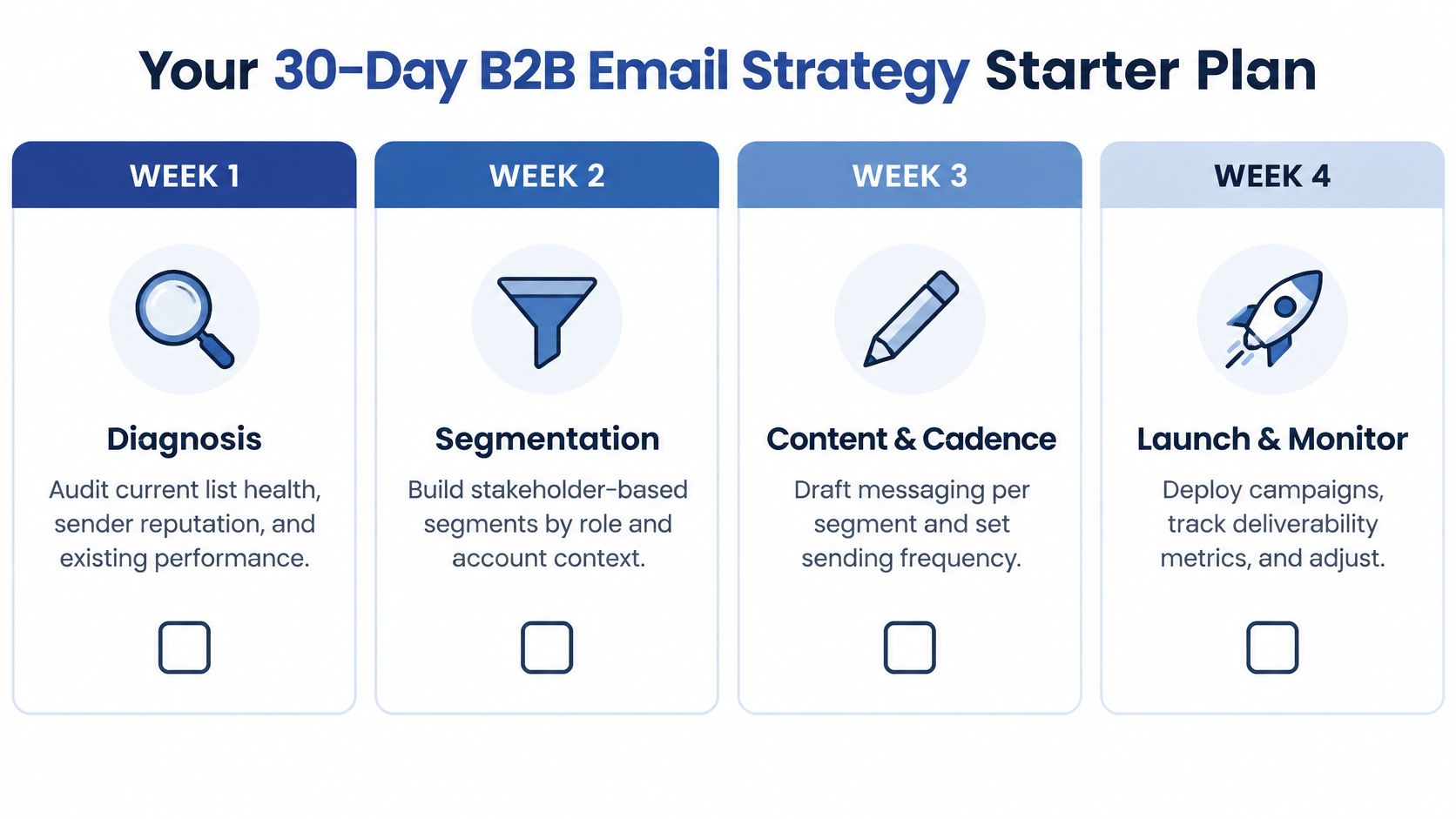
- Week one, diagnosis: Audit the list, permission records, suppression rules, sender reputation, and current reporting. Identify which contacts and campaigns have a clear business purpose.
- Week two, foundations: Configure authentication, confirm unsubscribe handling, and clean up CRM fields. Ensure the relevant teams can see and respect suppression updates.
- Week three, segmentation and journey: Define stakeholder groups and map a concise nurture path to buying questions. Draft messages that support useful technical or commercial decisions.
- Week four, measurement: Launch carefully and report delivery, qualified replies, meetings, quote requests, pipeline, and revenue by segment. Use opens as context, not the result.
The most effective move for a small manufacturer may be to pause broad sends to unengaged contacts and rebuild a healthy, permissioned audience before increasing volume. That decision can feel like giving up reach, but protecting access to the contacts who want to hear from you is more valuable than inflating list size.
Book a 30-minute diagnosis call with our team to map your current program against this operating model. We'll identify the gaps in permission, deliverability, segmentation, and attribution, then help you choose a practical next step.
Machine Marketing helps manufacturers connect email campaigns, automation, CRM, and reporting into a strategy built around industrial buying cycles. Visit Machine Marketing to discuss a diagnosis of your current program and a clear plan for improving it.
