Are you stuck in a zero-sum game, fighting for every customer? If your days are filled with price wars and feature-matching just to stay afloat, you're swimming in a "red ocean"—a crowded, bloody space where everyone fights over a shrinking profit pool.
We see this all the time. It’s the classic symptom of a strategy focused on beating the competition instead of creating new value. In this guide, we'll diagnose this problem and show you how to apply Blue Ocean Strategy to find new markets and drive real growth.
Stop Fighting Over Scraps and Start Creating Markets

So, how do you escape? Blue Ocean Strategy offers a clear path. The goal isn't to outperform your rivals; it's to make them irrelevant by carving out new market space where no competitors exist.
The foundation of this approach is value innovation—the simultaneous pursuit of differentiation and low cost. This isn't about compromise; it's about breaking the trade-off that traps most businesses.
The Power Of Creating New Demand
Instead of battling for a bigger slice of the existing pie, this framework shows you how to bake an entirely new one. By shifting your focus from competitors to "non-customers," you can unlock massive, untouched demand.
The data speaks for itself. A landmark study of business launches across 108 companies found that while 86% of new ventures were just line extensions in red oceans, they only generated 39% of the profits.
Meanwhile, the bold 14% that created blue oceans captured a staggering 61% of total profits. The diagnosis is clear: incremental improvements yield incremental returns. Market creation is the engine of sustainable growth.
Red Ocean vs. Blue Ocean: A Diagnostic Chart
Is your business currently fighting for survival or creating new territory? This table helps you diagnose which 'ocean' you're navigating.
| Attribute | Red Ocean Strategy | Blue Ocean Strategy |
|---|---|---|
| Industry Focus | Compete in existing market space. | Create uncontested market space. |
| Competitive Stance | Beat the competition. | Make the competition irrelevant. |
| Demand | Exploit existing demand. | Create and capture new demand. |
| Value/Cost Trade-off | Make the value-cost trade-off. | Break the value-cost trade-off. |
| Core Goal | Align the whole system with differentiation or low cost. | Align the whole system with differentiation and low cost. |
Seeing the strategies side-by-side reveals the core difference: one is about fighting for territory, the other is about discovering new worlds.
Why Red Oceans Are So Draining
The daily grind of red ocean competition forces you to benchmark against rivals, a process that’s both exhausting and creatively limiting. You’re constantly reacting. To survive, you need clear Brand Positioning, but even the best positioning can feel defensive in a saturated market.
Blue Ocean Strategy breaks this cycle by forcing you to ask better questions:
- Instead of, "How can we beat our competitors?" you ask, "How can we make them irrelevant?"
- Instead of, "How do we capture more of the existing market?" you ask, "How can we create new demand?"
This mental shift is the first step toward escaping the commoditization trap. A great first diagnostic step is to run a thorough competitive analysis for marketing. It will show you exactly how red your ocean is.
Using the Four Actions Framework for Value Innovation
Blue Ocean Strategy isn't just theory; it's a set of practical tools for action. The most powerful of these is the Four Actions Framework. Think of it as a diagnostic system for deconstructing your industry's accepted rules and rebuilding them around what customers actually value.
This is where you stop tweaking your current offerings and start asking the tough questions. It forces you to move from competing to creating. You'll often see this framework called the ERRC Grid, which stands for Eliminate, Reduce, Raise, and Create.
This framework is your engineering-style diagnostic tool. It helps you systematically take apart the competitive factors your industry has been fighting over for years and reassemble them into something new and valuable.
The Four Actions Framework is about breaking the value-cost trade-off. It’s not just about what you add to your offering, but what you have the courage to take away.
By working through the four questions of the ERRC grid, you get to the core of value innovation: pursuing both differentiation and lower costs at the same time.
Eliminate and Reduce Factors: The Key to Lowering Costs
The first two actions are about trimming the fat to drive cost savings and simplicity. This is your chance to challenge the status quo and get rid of the "features" that customers tolerate, not love.
Eliminate: What factors has your industry competed on for years that should be completely scrapped? These are often legacy features or services that add cost and complexity but little real value to the buyer. For a B2B software company, this might mean eliminating the bloated, one-size-fits-all user interface every competitor has.
Reduce: What factors should be scaled back well below the industry standard? These are areas where companies over-deliver in an arms race with competitors, driving up costs for minimal customer benefit. A manufacturing consultant, for instance, could reduce their reliance on dense, 100-page reports and instead deliver sharp, actionable dashboards.
These first two actions are critical for freeing up resources. Every dollar saved by eliminating and reducing is a dollar you can reinvest in creating real value.
Raise and Create Value: The Key to Differentiation
Now, you reinvest those savings to deliver a massive leap in value. This is where you identify what truly matters to buyers and invent new solutions to their problems.
Raise: What factors should be cranked up far beyond the industry standard? Look for the biggest pain points and desires your market is currently ignoring. A B2B logistics company might raise the bar on real-time tracking, offering a level of minute-by-minute transparency no competitor can touch.
Create: What brand-new factors can you introduce that the industry has never offered? This is where true invention happens. You're looking for unmet needs that can attract a whole new segment of customers. For example, a custom machine builder could create a "machine-as-a-service" subscription model, turning a huge capital purchase into a predictable operating cost.
By methodically working through the Four Actions Framework, you create a new and compelling value proposition. You stop playing by the industry's rules and start writing your own.
Ready to redefine your unique buyer benefits? Our guide on how to write a value proposition provides a systematic process that aligns perfectly with creating your blue ocean strategy summary.
Mapping Your New Strategy with the Strategy Canvas
How can you see opportunities that your competitors miss? Use the Strategy Canvas. Think of it as a diagnostic map of your competitive landscape. While the Four Actions Framework helps you decide what to change, the canvas shows you where the opportunities are hiding.
On this map, the horizontal axis lists the key factors your industry competes on—like price, service, quality, or specific features. The vertical axis ranks the offering level for each factor, from low to high.
When you plot your competitors on this graph, you’ll see their "value curves." What you'll almost certainly find is a tangled mess of lines all chasing the same basic shape. That’s a red ocean in picture form—everyone is fighting the same fight. Your job is to draw a new line, a new value curve, that looks completely different.
Visualizing Your Path to a Blue Ocean
The Strategy Canvas turns abstract market data into a clear, actionable picture. It forces you and your team to answer the most important question: "Where can we zig while everyone else zags?" By looking at the cluster of existing value curves, you can immediately see which factors are over-served and which are completely ignored.
This is where you put the Four Actions—eliminate, reduce, raise, and create—to work to achieve Value Innovation.
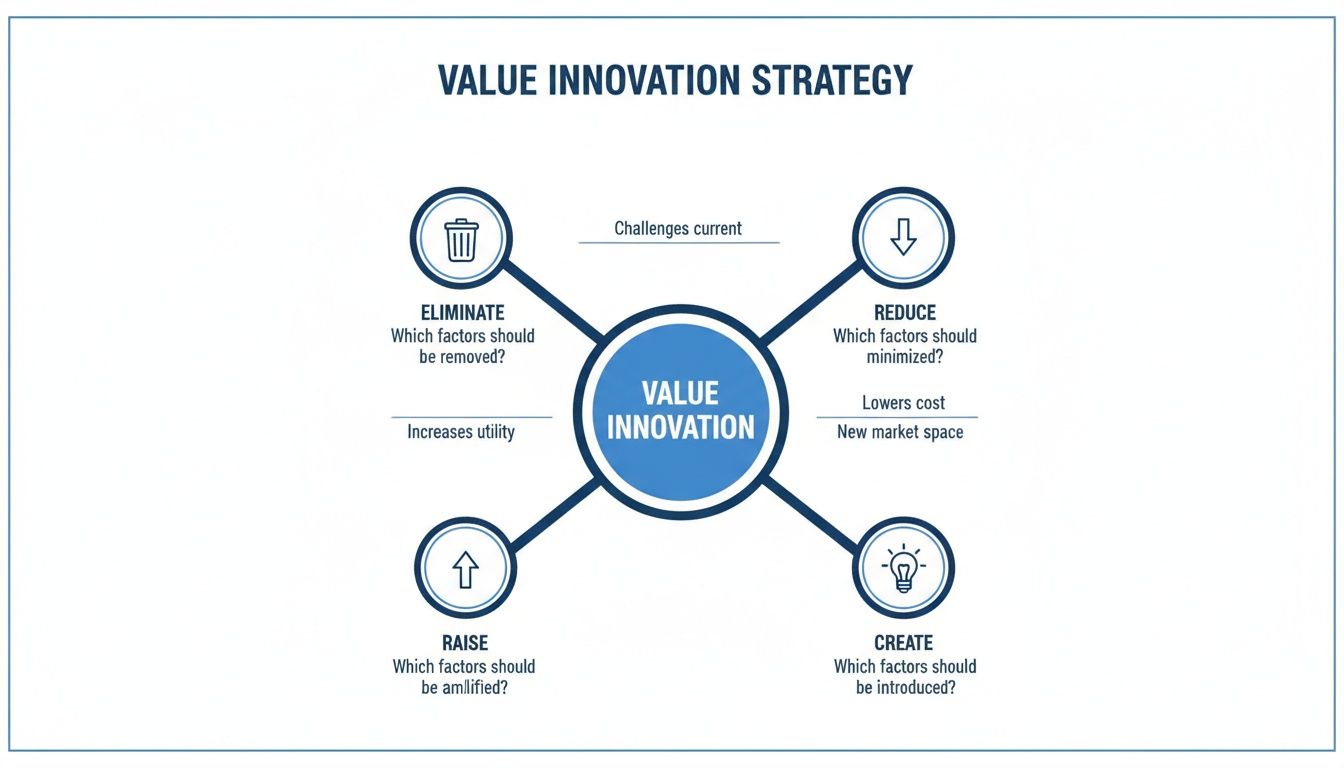
As the diagram shows, Value Innovation isn't a stroke of luck. It's the direct outcome of systematically challenging industry norms to create a new value curve.
Real-World Example: How Southwest Redrew the Map
Let’s diagnose the airline industry—a notoriously brutal red ocean. For decades, airlines were locked in a costly battle over the same factors: more lounges, fancier meals, and complex seating tiers. The result was a race to the bottom that drove up costs and frustrated travelers.
Then came Southwest Airlines. They didn't just try to compete better; they redrew the entire map. Their Strategy Canvas looks nothing like that of their rivals.
Southwest Airlines carved a blue ocean in the fiercely competitive airline industry by offering high-speed, frequent flights at prices and flexibility that competed with car travel. This masterfully broke the low-cost vs. speed trade-off and reshaped U.S. travel. You can find more details in Kim and Mauborgne's analysis from their research on uncontested market space.
Apply the Southwest Model: Questions to Ask Yourself
Here’s a breakdown of Southwest’s choices using the ERRC grid, giving you a clear model for your own blue ocean strategy summary:
- Eliminated: Assigned seating and in-flight meals. These were industry standards that added cost but didn't matter to their target customer. What accepted "standards" in your industry could you eliminate?
- Reduced: Reliance on congested, expensive airport hubs. By flying into secondary airports, they cut fees and improved turnaround times. What "premium" features are you over-delivering that you could reduce?
- Raised: Flight frequency and employee friendliness. Southwest focused on getting people where they needed to go often and with a positive attitude. What are the top frustrations of your customers that you could raise performance on?
- Created: A new category of travel: "fun, frequent, and low-cost." They stopped competing with other airlines and started competing with car travel. What new value or service could you create that would make the competition irrelevant?
The outcome? A value curve that was flat on things like lounges but shot through the roof on speed, frequency, and friendly service—at a price traditional airlines couldn't touch. This is the diagnostic process you can use for your own business.
From Theory to Action: Real-World Case Studies
Theory is one thing, but seeing a strategy make money is what counts. Let’s move past the textbook examples and get our hands dirty. We’ll dissect how two very different companies—one in B2B hardware, the other in SaaS—used Blue Ocean principles to sidestep the competition entirely.
This isn't just an academic exercise; it’s a playbook you can learn from.
By breaking down these successes, you'll see how the Four Actions Framework becomes a powerful tool for building a completely new value curve.
The B2B Hardware Revolution: Canon's Personal Copier
In the 1970s and '80s, the copier market was a warzone. Giants like Xerox owned the field, battling over massive, complex machines sold to corporate purchasing departments. It was a classic red ocean.
Canon took a step back and asked a brilliant question: Who isn't buying a copier?
Instead of trying to steal enterprise clients, they looked at the enormous, untapped market of small businesses and individual office workers. These users didn’t need a machine that could print a thousand pages a minute. They needed something small, affordable, and simple to use.
Canon's pivot to small desktop photocopiers was a masterstroke. They stopped talking to procurement managers and started selling directly to end-users. This strategic shift detailed in these case studies paid off spectacularly, making the large, centralized machines irrelevant to this new segment.
Here’s a look at how Canon applied the Four Actions Framework to pull it off.
Case Study Breakdown: Canon's Personal Copier
This table diagnoses how Canon systematically re-engineered the copier market by eliminating industry norms and creating new value.
| Action | Factor | Impact |
|---|---|---|
| Eliminate | Service contracts and complex maintenance | This was a game-changer. By using an all-in-one, user-replaceable cartridge, they slashed ongoing costs and removed a major customer pain point. |
| Reduce | Copying speed, paper tray size, and complex features | They correctly identified that their new target market didn't need these expensive features, allowing them to shrink the cost, size, and complexity of the machine. |
| Raise | Convenience and ease of use | The goal was to make it as simple as a toaster. The machine was "plug and play," making it accessible to anyone without a training manual. |
| Create | The personal desktop copier category | They didn't just build a better product; they invented an entirely new market for small-scale, personal copying. |
Canon cut costs by simplifying the tech while creating a massive leap in value for a new audience that valued convenience far more than raw performance.
The SaaS Simplification: Slack's Market Creation
Let's jump forward a few decades to B2B software. Before Slack arrived, team communication was a chaotic mess of email threads, clunky instant messengers, and different file-sharing services. The competition was stuck in a red ocean of adding more features, making their platforms bloated and confusing.
Slack didn't set out to build a "better email." Instead, they diagnosed the real problem: disorganized team communication. From there, they applied the Four Actions Framework to carve out a new category—the channel-based collaboration hub.
- Eliminate: The reliance on siloed, formal email chains for everyday team conversations.
- Reduce: The complexity of the user interface. Slack focused on a clean, intuitive design.
- Raise: The ability to integrate with hundreds of other business tools, transforming Slack from a messenger into a central operations hub.
- Create: Persistent, searchable, topic-based "channels." This simple idea brought conversations, files, and app notifications into one transparent, organized place.
By executing on these four actions, Slack created a brand-new market for team collaboration. They won by focusing on a simple, powerful user experience that solved a widely felt pain. This approach is a core lesson for any tech company looking for a modern blue ocean strategy summary.
Common Blue Ocean Pitfalls and How to Steer Clear
The call of the Blue Ocean is exciting, but thinking the waters are perfectly calm is a mistake. Fortunately, most of these traps are predictable. By facing them head-on, you can build a much stronger, more realistic strategy.
A common mistake we see is mistaking tech novelty for value innovation. Companies get excited about new technology but forget to ask the most important question: does this actually solve a real customer problem in a way that’s both new and more affordable? A true blue ocean isn’t about building the most advanced gadget; it’s about delivering a massive leap in value.
The goal is to build a sustainable system for market creation, not just to launch a single idea. True Blue Ocean thinking is a repeatable process, not a lottery ticket.
Pitfall #1: Creating a Blue Ocean Nobody Wants
One of the costliest mistakes is pouring resources into a new market only to discover it’s empty for a reason. This happens when your strategy is built on what you think people want, not what they actually need. Just because an idea is new doesn't make it valuable.
How to avoid it:
- Diagnose Before You Build: Use tools like the Buyer Utility Map to find where your idea creates undeniable value across the entire customer journey.
- Talk to Non-Customers: Forget surveying your existing customers. You need to focus on the three tiers of non-customers: the "soon-to-be" who are looking for an exit, the "refusing" who consciously avoid your market, and the "unexplored" who are in distant markets.
- Test Early and Often: Create simple, low-cost prototypes or pilots. Get them in front of actual non-customers and see if your assumptions hold up.
Pitfall #2: Failing to Get Your Team on Board
A perfect strategy is worthless if your team won't execute it. Blue Ocean moves often mean big changes to operations, marketing, and sales. Without clear alignment, internal friction will sink your project.
How to get everyone rowing in the same direction:
- Show, Don't Just Tell: Use the Strategy Canvas as a visual aid. A simple chart showing the crowded red ocean next to your wide-open blue ocean is far more convincing than a 100-page report.
- Break Down Silos: Don’t create your strategy in an executive-only meeting. Pull in people from sales, engineering, marketing, and customer service during brainstorming. Ownership is key.
- Address Fears Head-On: Be transparent about the challenges. Acknowledge what’s going to change and give your team the training and resources they need to adapt.
By knowing these common pitfalls, you can navigate your Blue Ocean journey with more confidence and a much higher chance of success.
Putting Blue Ocean Strategy Into Action: Your First Steps

This is where the rubber meets the road. A powerful blue ocean strategy summary is useless without a clear plan to execute it. Before you can chart a new course, you have to know exactly where you are right now.
Think of this as a small, focused project, not a complete company overhaul. The goal is to test your assumptions and build momentum with real-world feedback.
Your First Move: Diagnosis
The first step is to pull together a small, cross-functional team. You need people from sales, engineering, marketing, and customer service. Without these diverse perspectives, you’ll struggle to break free from the “this is how we’ve always done it” thinking that keeps companies stuck in red oceans.
With your team in place, it’s time to start the diagnostic work using the Strategy Canvas and the ERRC Grid. These aren’t academic exercises; they are tools for visualizing your competitive reality and questioning every assumption your industry operates on. To see how this fits into your overall market presence, check out our guide on strategic brand positioning.
The best Blue Ocean journeys start with an honest look in the mirror. By beginning with a small team and a sharp focus on diagnosis, you build the foundation for making bigger, bolder moves down the line.
A Checklist for Your First Session
Use this checklist to guide your first few meetings and start uncovering hidden opportunities.
Current State Analysis (The Strategy Canvas):
- What are the handful of factors our industry competes on right now? (List them: price, features, service, etc.)
- Where are our competitors—and where are we—investing time and money?
- If we mapped our value curve against the industry, would we look like just another "me-too" player? Be honest.
Deconstruction and Reconstruction (The ERRC Grid):
- Eliminate: Which industry standards are we clinging to that customers honestly don't care about anymore?
- Reduce: Where are we over-delivering in ways that add cost but no real value to the buyer?
- Raise: What are the biggest compromises our customers are forced to make? Where can we dramatically raise the bar?
- Create: What completely new value could we offer that no one has even thought of?
Use this checklist to get started today. If you find you want an experienced partner to guide you through the process, our team is here to help you build a practical roadmap for real growth.
Frequently Asked Questions About Blue Ocean Strategy
When we talk to business owners about Blue Ocean Strategy, the same questions always pop up. Let's cut through the jargon and give you the direct answers you need.
How is this different from traditional competitive strategy?
Think of traditional strategy as a Red Ocean. It's a crowded, bloody fight where everyone battles for the same customers in the same market. This inevitably leads to price wars and a race to the bottom on features. You're just trying to get a bigger slice of a fixed pie.
Blue Ocean Strategy is different. It's not about fighting harder; it's about making the fight irrelevant. The whole point is to create a new market—a Blue Ocean—where there are no competitors. You stop fighting over the old pie and bake a completely new one.
Can a small business or manufacturer really use this?
Yes. In fact, small and mid-sized businesses often have an advantage. A huge corporation is like an oil tanker—it takes forever to change course. A smaller business is a speedboat; you can pivot fast and explore new opportunities before anyone else sees them.
For example, a small machine shop could stop competing on one-off project quotes. Instead, they could launch a "machine-as-a-service" subscription. Suddenly, their service becomes a predictable operating expense for clients, not a massive capital cost. This opens up a whole new market of customers who were priced out before.
The trick is to stop obsessing over what your competitors are doing. Shift your focus to your non-customers—the people you aren't reaching—and figure out what they truly need.
How long does a blue ocean last?
This is a great question because it gets at the reality of competition. No advantage lasts forever. A true blue ocean can give you an incredible head start, often 10 to 15 years of profitable growth before imitators show up and the water turns red again.
But here’s the real goal: it isn't just about finding one blue ocean and stopping. The ultimate win is when creating blue oceans becomes a repeatable process—a core part of your company's DNA. When value innovation becomes a system, you build a business that can navigate to new, uncontested waters again and again.
Ready to stop fighting in a red ocean and start creating your own market? Machine Marketing specializes in helping businesses diagnose their current market position and build actionable roadmaps for growth. Book a discovery call with us to see how we can apply these principles to your business. Find out more at https://machine-marketing.com.