If your B2B sales pipeline feels broken—deals stalling, leads going cold—you’re not just seeing things. The problem isn’t your product or your sales team. It's a fundamental mismatch between how you sell and how modern business buyers actually navigate the consumer decision making journey today.
In this guide, we'll diagnose the common failure points in the traditional sales funnel. More importantly, we'll give you a practical, step-by-step framework to map the journey your customers are really on, so you can build a marketing and sales system that meets them exactly where they are.
Why Your B2B Sales Funnel Feels Broken

Are you watching promising deals grind to a halt for no apparent reason? You're not alone. Today’s B2B buyers are careful, overwhelmed with options, and armed with more information than ever before. This isn't just a feeling; it’s a proven shift in behavior.
According to Forrester's 2023 Global Buyers' Journey Survey, nearly 90% of business buyers saw their purchasing process stall out last year, with price sensitivity becoming a major roadblock. This new reality means the traditional sales funnel—that neat, linear path from awareness to purchase—is officially broken. It fails to account for the chaotic journey your prospects are on.
The Problem With an Outdated Model
When you rely on an old-school funnel, you create massive blind spots in your entire marketing and sales system. What does misunderstanding your customer’s journey actually cost you?
- Wasting money on marketing that completely misses the mark for your buyer's current mindset.
- Losing trust by pushing for a sale when a prospect is still just trying to understand their problem.
- Creating friction as deals get stuck because your process doesn't align with their internal approval steps.
The core issue we see is that businesses are still selling, but their customers have stopped listening. The modern consumer decision making journey requires you to act as a guide, not a salesperson.
A New Diagnostic Framework
Instead of trying to force prospects down a rigid funnel, you need to diagnose and map the journey they are already on. This calls for an "engineering mindset"—viewing your marketing and sales as an interconnected system that must align with your customer's natural progression.
This guide gives you a clear diagnostic framework to do just that. We'll ditch the old model to map the five critical stages your prospects truly navigate. You’ll walk away with an actionable roadmap to build trust, reduce friction, and get those stalled deals moving again.
Becoming the Answer in Early Stage Research
This is the quiet start of the consumer decision making journey. Your ideal customer has a problem they can no longer ignore. They don't have a name for the solution yet, and they definitely aren't searching for your brand. They’re just looking for answers.
They’re typing real-world questions into Google like, "how to reduce CNC machine downtime" or "best industrial coating for corrosive environments." Pushing a sales pitch now is like proposing on a first date—it’s too soon, and it just pushes them away.
Diagnosing the Information Gap
The modern buyer is overwhelmed. Recent data shows a staggering 74% of consumers abandoned a purchase simply because they felt overwhelmed by the decision-making process. Don't think this is just a B2C issue; the B2B landscape is just as noisy, making clarity your most powerful asset. You can explore the full Accenture report on empowered consumers for a deeper dive.
So, how do you fix this? The game changes when you stop selling and start teaching. Your goal is to become their most trusted educational resource, the indispensable guide they find on their own.
Shifting from Seller to Educator
To win this stage, you have to answer your customer’s foundational questions with genuine empathy and expertise. This means creating content that directly addresses their pain points without asking for anything in return.
Your strategy should focus on three core areas:
- Problem-Focused SEO: Build your content strategy around the questions your customers ask, not just the keywords for your products. This is how you show up when they need help the most.
- Educational Content: Create high-value resources that offer genuine solutions. Your content should be the best, most thorough answer they can find.
- Teach, Don't Sell: Use your blog, social media, and video channels to share what you know generously. The goal is building authority and trust long before a sales conversation ever happens.
The objective isn't to generate a lead immediately. It's to earn the right to be considered later. By providing value upfront, you become the benchmark against which all other options are measured.
Questions to Ask Yourself:
- What are the top 5 questions our customers ask before they even know our product exists?
- Are we creating content that answers those questions directly and honestly?
- Is our content focused on solving their problem or just promoting our solution?
To get this right, you need to know exactly who you're talking to. You can check out our guide on creating detailed buyer personas to nail this first step.
Winning the Mid-Funnel Comparison Battle

Once your prospect has a name for their problem, they step into the most critical part of the consumer decision making journey: the evaluation stage. They are now actively comparing, scrutinizing, and stacking you up against every competitor they can find.
This is where many businesses lose perfect-fit customers. Why? They failed to clearly show their unique value. When all solutions look the same on the surface, buyers will naturally drift toward the cheapest or what feels like the safest choice.
Your job is to make their decision obvious. You need to arm them with high-impact, high-trust content that goes beyond claims and offers undeniable proof.
Building Your Case with Proof, Not Promises
At this point, your prospects are skeptical. They've seen all the marketing slogans. Now, they're looking for validation. Your content needs to switch gears—from educating them on the problem to demonstrating why you are the definitive solution. It's time to present your evidence.
Here are the essential assets you need to win the comparison battle:
- Compelling Case Studies: Don’t just list features. Tell a story of transformation. A great case study follows a clear "before-and-after" narrative, detailing the client's problem, your solution, and the measurable results.
- Authentic Customer Testimonials: Social proof is incredibly powerful. Today, nearly 98% of consumers read online reviews before making a final decision. Video testimonials are especially convincing.
- Transparent Spec Sheets & Comparison Guides: Don't be afraid to get technical. Details matter. Create easy-to-read spec sheets or side-by-side comparison guides that clearly highlight your advantages over the competition.
The goal in the mid-funnel isn't just to be in the consideration set; it's to reframe the entire decision-making criteria around your strengths. You want your prospect to think, "I didn't even realize that was important, but now I can't imagine choosing a solution without it."
What to Look For in Your Mid-Funnel:
- Real-World Example (Durability Test): Film a side-by-side comparison showing your material's durability versus a competitor's under real-world stress conditions. Visual proof is far more powerful than a claim.
- Practical Tool (ROI Calculator): Create a simple, interactive tool on your website. Allow a prospect to plug in their own data—like current downtime or production volume—and instantly see the potential financial impact of switching to your solution.
- On-Demand Education (Webinar): Host a webinar that demonstrates your equipment's superior efficiency in a practical application. Make that recording available on-demand so prospects can watch it whenever it works for them.
When you're dealing with complex buying committees, these assets become indispensable tools for your internal champion. For a deeper dive into targeting these key players, check out our article on account-based marketing strategies for B2B companies. By arming prospects with clear, compelling proof, you earn their confidence.
Engineering a Frictionless Purchase Process
Getting a prospect to say "yes" is a huge win. But here’s a painful truth: a shocking number of deals fall apart right at the finish line. When we diagnose why, the culprit is almost always friction—a confusing, slow, or clunky buying process that creates last-minute doubt.
Your prospect has chosen you. Now your only job is to make it incredibly easy for them to give you their money. This is a crucial moment in the consumer decision making journey where momentum is everything.
This is especially true as more business buyers expect a consumer-like experience. Direct-to-consumer purchasing is a dominant preference. In fact, 63% of consumers have already bought products directly from a brand's website. For manufacturers, this is a clear signal to build simple, direct sales channels. You can discover more insights about this trend from PwC.
Diagnosing and Removing Friction Points
Friction at the purchase stage usually looks like unanswered questions and unnecessary waiting. Your goal is to engineer a process so smooth that buying from you feels like the easiest, smartest thing they’ve done all day.
This visual breaks down the three core pillars of a frictionless buying experience, moving a prospect smoothly from interest to commitment.
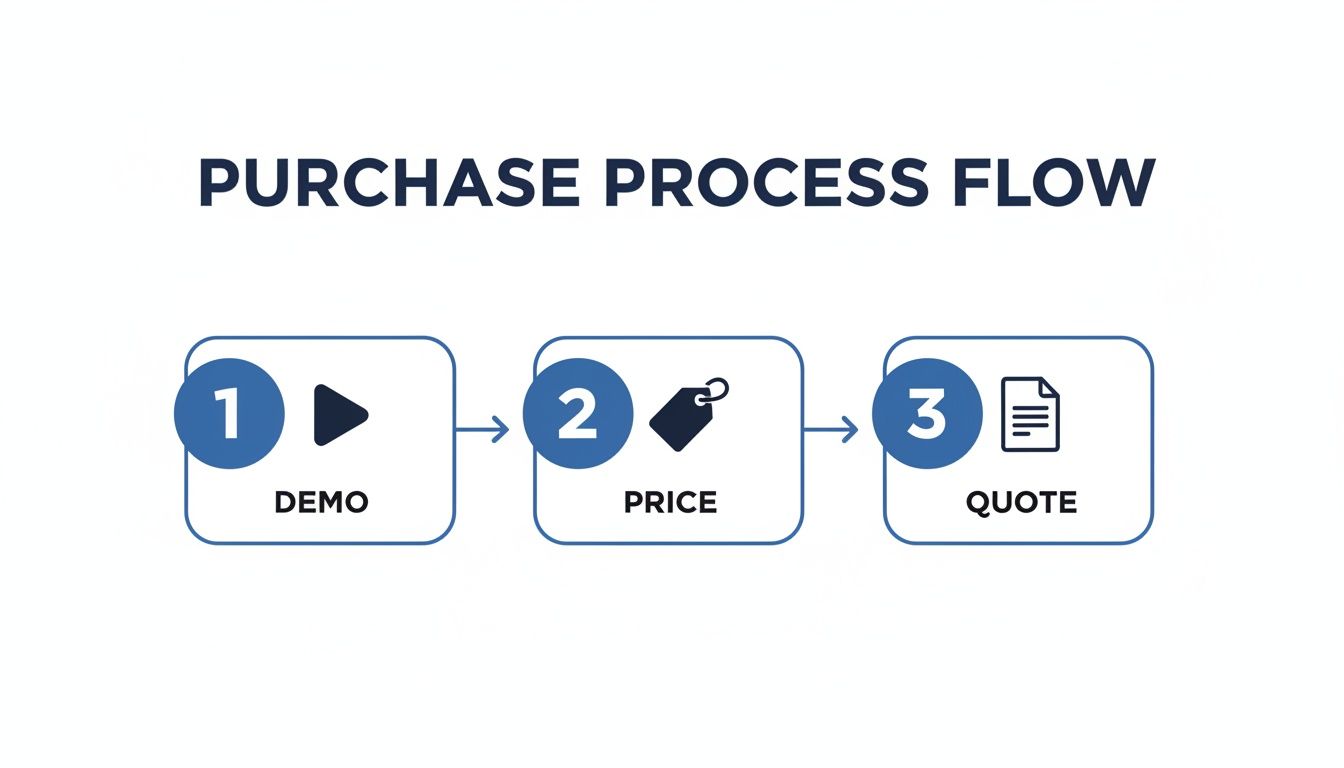
Each step—Demo, Price, and Quote—should be designed for speed and clarity, removing any guesswork that could stall a deal.
Three Steps to a Seamless Purchase Path
To overhaul your buying process, zero in on these three high-impact solutions. They tackle the most common friction points and build confidence at the exact moment a buyer is ready to commit.
- Offer Instant, On-Demand Demos: Waiting for a salesperson to schedule a demo is an old-school bottleneck. Use automated booking tools so prospects can instantly grab a time that works for them. Even better, offer a pre-recorded video demo they can watch immediately.
- Provide Transparent Pricing Calculators: Pricing ambiguity is a notorious deal-killer. An interactive calculator on your website lets prospects configure a solution and see an estimated price right away. This transparency builds trust and helps them make their internal business case without delay.
- Make Getting a Quote Effortless: Your "Request a Quote" form should be simple and direct. As soon as it's submitted, an automated system should confirm it was received and set clear expectations for when they'll hear back.
The final step of the sale isn't about persuasion; it's about facilitation. You've already won their trust. Now, prove they made the right choice by providing an effortless, professional, and respectful purchasing experience.
Automating the Final Mile with GoHighLevel
Implementing these fixes doesn't require a massive team. A powerful platform like GoHighLevel can automate nearly the entire process. We use it to build systems for our clients that ensure no qualified lead ever goes cold.
Here’s how we engineer it:
- Automated Appointment Booking: We embed a GHL calendar right on the site, allowing leads to book a demo or sales call 24/7.
- Intelligent Follow-Up Sequences: The second a quote is requested, an automated workflow fires off. This system sends confirmation emails, reminders, and follow-up messages.
- Task Creation for Sales: The system can automatically create a task for a sales rep in the CRM, ensuring a human follows up at the perfect time.
This approach transforms a potential point of failure into a final confirmation that choosing you is the right move. You remove the friction and make saying "yes" the easiest step in their entire journey.
Turning New Customers Into Lifelong Partners
The customer's journey doesn't end when the payment clears. Far from it. What happens after the sale is where you secure future revenue and create the vocal advocates who will drive your next wave of growth. It’s also the stage most businesses neglect.
The problem is simple but costly: companies pour massive resources into winning a new customer but leave retention to chance. Let's fix that. The solution is to build a solid, repeatable post-sale system that delivers immediate value and turns a one-time transaction into a genuine long-term partnership.
Building a System for Retention
An effective post-purchase system is about proactive, consistent, and helpful communication that shows you're invested in their success. This system should be designed to deliver value, gather feedback, and create opportunities for future business.
The core components are straightforward:
- An Effective Onboarding Sequence: The first few days are critical. A structured onboarding process makes sure your new customer gets the full value from your product right out of the gate.
- Proactive Support Check-ins: Don't wait for them to call with a problem. Scheduling regular, brief check-ins shows you care and lets you solve small issues before they blow up.
- Automated Feedback Collection: Systematically ask for feedback. This gives you priceless insights to improve and makes your customers feel heard and valued.
The goal here is to shift from being just another vendor to becoming an essential partner. A vendor is replaceable; a partner is indispensable. This is how you maximize customer lifetime value and build an army of advocates.
Automating the Partnership with GoHighLevel
Trying to manage this manually is impossible as you scale. This is where automation becomes your secret weapon. Using a platform like GoHighLevel, you can build a sophisticated post-purchase experience that runs on autopilot.
Here’s a practical look at how you can engineer this system:
- Automated Welcome & Onboarding Campaigns: The moment a deal is marked "won" in your CRM, trigger an automated email sequence. This workflow can deliver welcome messages and links to training resources.
- Scheduled Follow-Up Tasks: Create workflows that automatically schedule tasks for your account management team. For example, the system can create a task to call a new client 14 days after purchase.
- Re-engagement and Upsell Opportunities: Use automation to re-engage customers with timely, relevant offers, like a reminder about scheduled maintenance or an email showcasing a new complementary product.
To truly turn new customers into partners, consider ways to enhance customer support with live chat for immediate assistance and ongoing engagement. By systematizing your follow-up, you guarantee no customer ever feels forgotten.
Your 90-Day Journey Mapping Playbook
Alright, let's move from concepts to action. This is a practical, 90-day playbook designed to get you started immediately by breaking down the complex consumer decision making journey into a clear roadmap.
The goal isn’t to boil the ocean. It’s about making one significant, measurable improvement that builds momentum. Think of this as installing the first critical piece of a more powerful machine.
Month 1: Diagnosis And Foundation (Days 1-30)
Your first 30 days are about finding the single biggest leak in your current process and setting up the tools to measure it. Focus is your superpower here.
- Identify Your Biggest Gap (Weeks 1-2): Where are your deals stalling? Is it a lack of early-stage leads? Poor follow-up after a demo request? Get your sales team in a room and dig into your data. Find the one problem you're going to solve first.
- Set Up Your CRM Foundation (Weeks 3-4): You can't fix a leak you can't see. We recommend setting up a foundational CRM, like GoHighLevel. Your goal is simple: create a pipeline to visually track every new lead from the first touchpoint to the "quote requested" stage. This gives you a clear baseline.
To really get a handle on mapping these paths, diving into a practical guide on customer journey analytics can offer some incredibly valuable frameworks.
Month 2: Content And Automation (Days 31-60)
Now that you have a clear target and a way to measure it, month two is for building the solution. You'll create the asset that plugs your identified gap and build the automated system to deliver it.
- Create One Key Piece of Content (Weeks 5-6): Based on your diagnosis, build one high-value asset. If your gap is in the mid-funnel, a powerful case study is your best bet. If you're struggling with early-stage awareness, a definitive buyer's guide will do the trick.
- Build Your First Automated Workflow (Weeks 7-8): Time to build the machine that delivers your new content. Using GHL, create your first automated follow-up sequence. For a deeper look at building these systems, explore our guide to creating a marketing automation strategy.
Month 3: Launch And Measurement (Days 61-90)
The final 30 days are all about deployment and analysis. You'll push your new asset and workflow live, then watch the data to see the impact.
- Deploy Your New Asset (Week 9): Promote your new content everywhere—on your website, social media, and in your team's email signatures. Drive traffic to its landing page and let the automation do its job.
- Track and Review (Weeks 10-12): Now, watch the metrics you set up in month one. Are you seeing more demo requests? Is the engagement rate climbing? This data tells you what's working and what to tweak for your next 90-day sprint.
The Playbook's Purpose: This 90-day cycle isn't a one-and-done fix. It’s a repeatable system for continuous improvement. Diagnose, build, launch, measure, and then do it all over again on your next biggest gap.
Your Top Questions, Answered
Even with a detailed plan, it's natural to have questions. Let's tackle some of the most common ones we hear from business owners.
Is the B2B Journey Really That Different from B2C?
Absolutely. While the stage names look the same, the mechanics are worlds apart. The B2B journey is longer and rarely involves a single decision-maker. You're selling to a "buying committee" where multiple people have a say.
This means your approach must change. Logic, ROI, and efficiency trump emotion. B2B buyers need detailed technical specs, hard numbers in case studies, and a rock-solid business case. The relationship also doesn't end at the sale—the post-purchase phase is critical, focusing on long-term partnerships and reliable support.
What Are the Most Important Metrics to Watch at Each Stage?
You can't fix what you can't measure. Here are the key performance indicators (KPIs) to obsess over for each phase:
- Awareness: Keep an eye on your organic traffic, rankings for problem-focused keywords, and social media impressions. Are people finding you when they first realize they have a problem?
- Evaluation: This is all about engagement. Track your lead magnet downloads (guides, checklists), the number of demo requests, and time on page for key comparison content.
- Purchase: Monitor your average sales cycle length and, most importantly, your quote-to-close conversion rate.
- Post-Purchase: To measure loyalty, track your customer lifetime value (CLV), churn rate, and Net Promoter Score (NPS).
We're a Small Business. How Do We Even Start Mapping This?
Don't let perfect be the enemy of good. Start small and build momentum.
First, just talk to people. Grab your top salesperson and a couple of your best customers. Ask them what triggered their search, what questions they had, what competitors they looked at, and what finally convinced them to choose you.
Next, sketch it out. Create a simple flowchart of the main touchpoints—that first website visit, a demo call, the follow-up email.
Finally, find one or two obvious bottlenecks and fix them. Is there a long delay after you send a quote? Use a simple automation tool to trigger a follow-up. Just make one meaningful improvement, and you're already ahead of the game.
At Machine Marketing, we diagnose the cracks in your marketing and sales process and build automated systems that deliver qualified leads like clockwork. If you're tired of guessing and ready for a clear roadmap to growth, book a discovery call with us today.