Experiential marketing is a strategy that turns passive observers into active participants through immersive, hands-on brand interactions. Worldwide spending reached an estimated $128.35 billion in 2024, including about $38.03 billion in B2B spending, so the practical question for manufacturers isn't whether the category is real, but whether your next experience will create qualified pipeline.
The popular advice focuses on memorable moments, large events, and brand awareness. That advice is incomplete for an industrial business. A busy booth, impressive machine demo, or facility tour only becomes marketing performance when it captures useful buyer context, changes what the prospect understands, and gives sales a reason to follow up.
For manufacturers, the working definition is simpler and more demanding: experiential marketing is a measurable system for helping the right buyers experience your technical value, reveal their needs, and move toward a commercial conversation. The experience can happen on a shop floor, at a trade show, in a distributor training room, or through a hybrid digital format. The setting matters less than the participation and the follow-through.
Table of Contents
- Redefining Experiential Marketing for B2B
- The Five Mechanics of Buyer Participation
- Experiential Tactics Versus Traditional Outreach
- Manufacturing and Industrial Applications
- Designing Experiences That Capture Pipeline Data
- Measuring ROI Beyond Attendance Metrics
- Building Your Industrial Experience Strategy
Redefining Experiential Marketing for B2B
Experiential marketing isn't just consumer brand theater with better lighting. It isn't every event where a logo appears, either. A passive presentation, static display, or branded backdrop may support an experience, but it doesn't qualify on its own.
The defining feature is active participation. The audience interacts with the product, environment, people, or challenge instead of merely receiving an advertising message. That distinction aligns with the definition of experiential marketing as an immersive, interactive strategy that requires participation rather than passive ad exposure. Participation creates the conditions for stronger emotional connection and shifts in brand perception because buyers gather evidence through direct involvement.
For an industrial company, that evidence can be highly practical. A prospect might run a sample through a machine, inspect a finished part, compare process options with an applications engineer, or discuss a production constraint with peers. The brand isn't claiming capability. It's allowing the buyer to test, question, and interpret that capability.
A useful plain-English resource on the broader concept is experiential marketing explained, particularly for distinguishing an interactive experience from a conventional promotional event. For B2B teams, the important extension is connecting that interaction to a revenue process.
The pipeline test
Ask one question before approving an activation:
What will this experience help us learn, prove, or qualify that a passive message couldn't?
If the answer is only “more awareness,” the idea may still have value, but it doesn't yet have a pipeline design. You need a defined audience, a meaningful interaction, a data capture point, and a follow-up path.
That path might include:
- A technical signal: The buyer selects a material, tolerance, application, or production problem.
- A commercial signal: The buyer requests pricing, a feasibility review, a sample evaluation, or a meeting.
- A qualification record: The interaction is stored with the contact, account, role, needs, and agreed next action.
- A sales handoff: An account owner receives context, not just a scanned badge.
This is why modern experience programs are moving toward first-party data capture, real-time personalization, and measurement beyond attendance, according to recent industry coverage from Seeker. The shift is especially relevant to manufacturers because an engineer's question or operator's product preference can be more valuable than a large audience with no identifiable intent.
The result isn't “brand theater.” It's a controlled buyer interaction that produces technical trust and usable commercial information.
The Five Mechanics of Buyer Participation
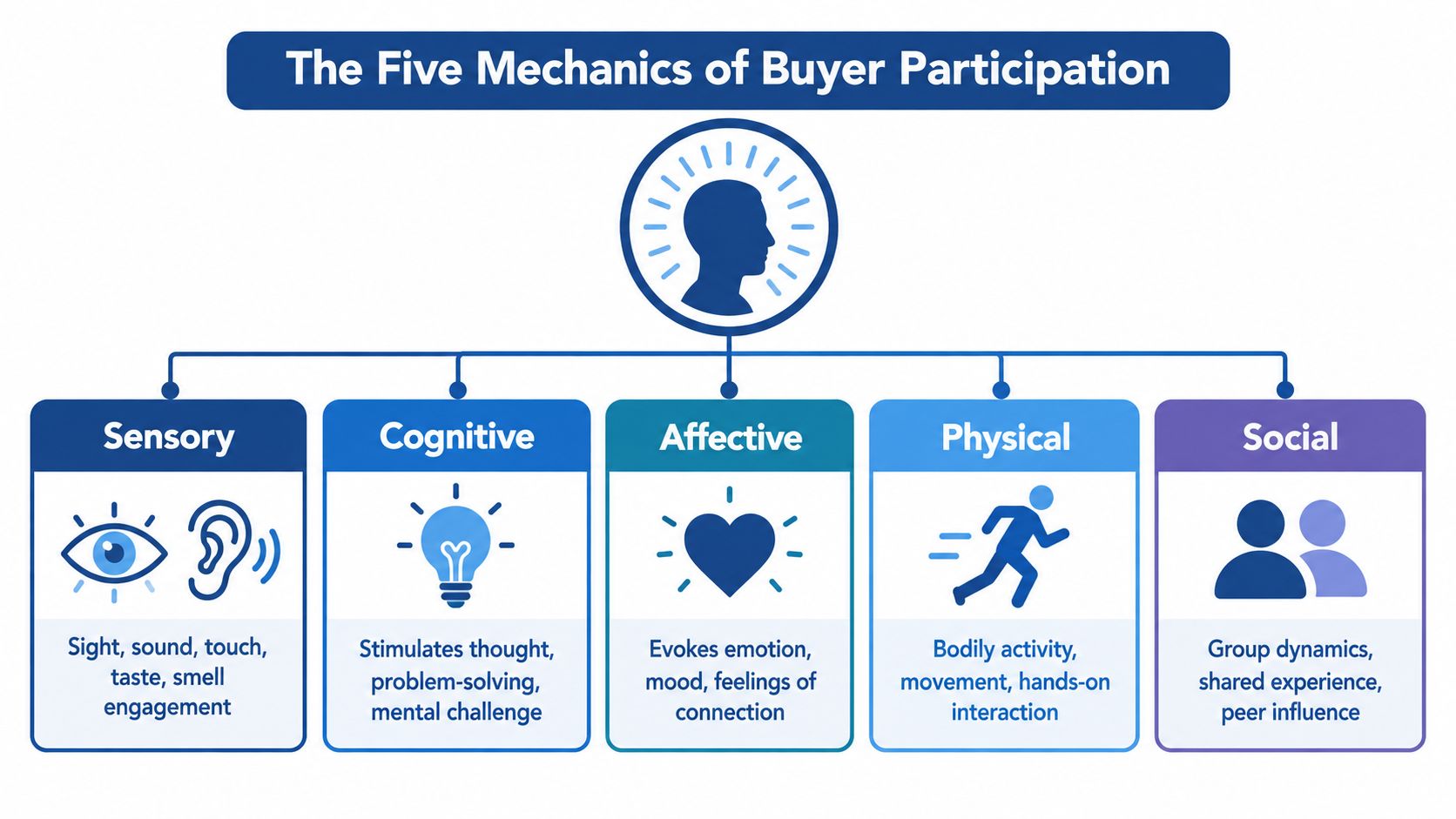
The definition becomes easier to apply when you separate participation into five experience types: sensory, cognitive, affective, physical, and social identity. This framework, described by EBSCO's overview of experiential marketing, helps you diagnose why an activation feels engaging, or why it produces little movement after the event.
Sensory and physical proof
Sensory participation uses sight, sound, touch, taste, or smell. In manufacturing, sight and sound may come from watching a machine operate, while touch may come from handling a finished component or comparing surface finishes. Sensory evidence can make an abstract promise concrete, but it must support a buyer question. Noise and motion alone don't create qualification.
Physical participation requires the buyer to do something. They might load a sample, adjust a setting, inspect a part, or test a user interface. A machine tool demo becomes stronger when the participant controls a meaningful step rather than watching a salesperson perform a rehearsed sequence.
Cognitive and affective response
Cognitive participation engages thought, problem-solving, and technical judgment. An engineer roundtable, process simulation, or design review can work well because the buyer has to evaluate trade-offs. Give participants a real decision to make, such as choosing between process routes or identifying the cause of a quality issue.
Affective participation concerns emotion, mood, and connection. Industrial marketing doesn't need to become theatrical. Confidence, relief, curiosity, and respect are all relevant emotions when a buyer is assessing production risk. A well-run technical workshop can make a prospect feel understood, rather than pressured.
Social identity and peer context
Social-identity participation uses group dynamics and peer influence. A distributor training day, plant tour, or engineer roundtable allows buyers to see how others approach similar problems. The social setting can establish credibility, but it can also expose weak claims quickly, so your technical staff must be prepared for candid questions.
Use the five mechanics as a design audit:
- Observe: What does the buyer see, hear, and touch?
- Challenge: What problem must the buyer think through?
- Connect: What feeling should the interaction create?
- Act: What does the buyer physically do?
- Share: Which peers, colleagues, or decision-makers enter the conversation?
A strong industrial experience doesn't need all five in equal measure. It needs the right combination for the buyer journey stage. Early curiosity may require sensory demonstration and social proof. Technical validation may depend more heavily on cognitive and physical participation.
Experiential Tactics Versus Traditional Outreach
Traditional outreach and experiential tactics solve different problems. A digital campaign can distribute a message broadly and support ongoing discovery. Cold outreach can create a direct invitation. Technical content can answer questions before a buyer speaks with sales. Experiential marketing adds a different mechanism, the buyer participates in evidence gathering.
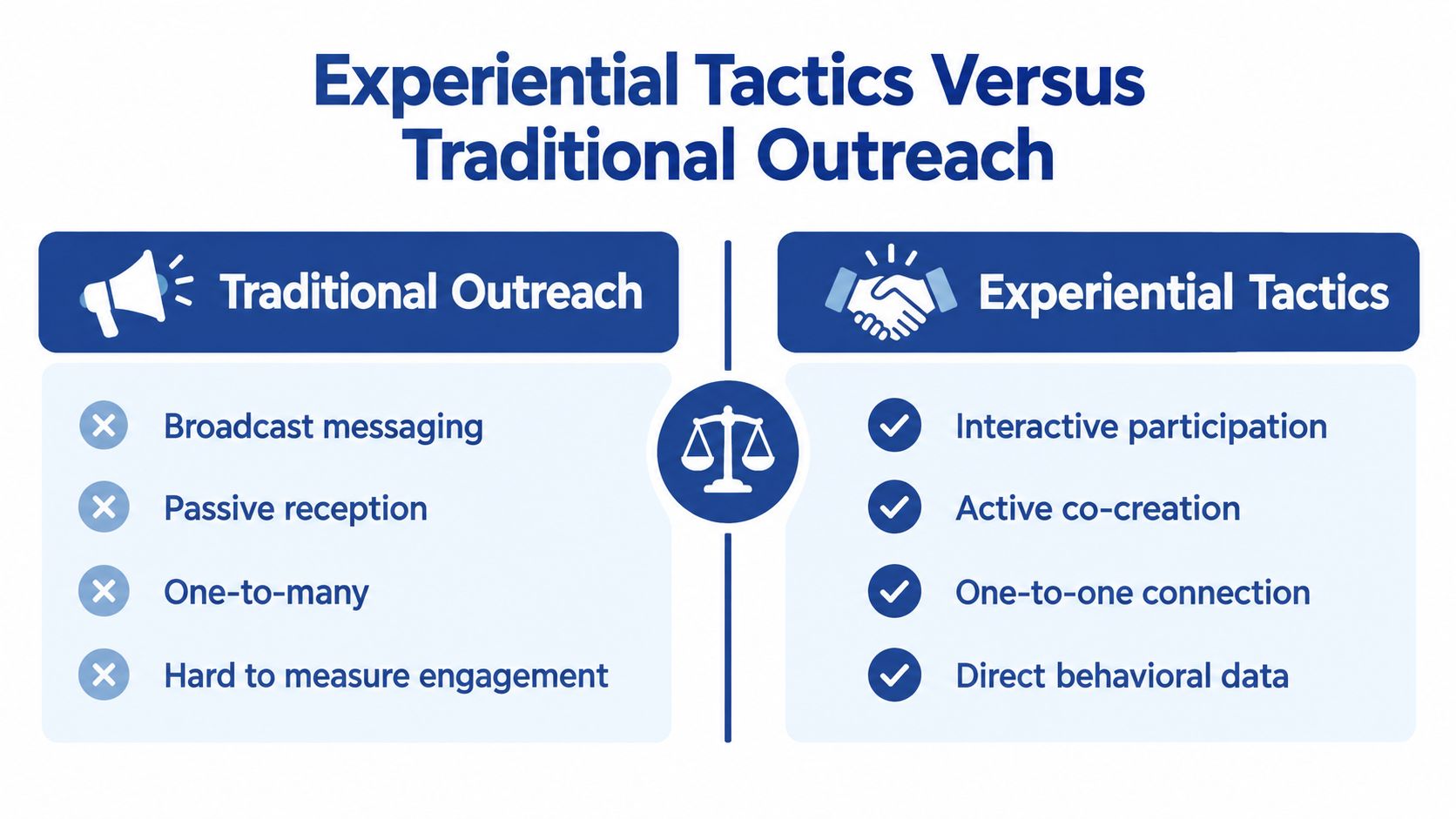
The term is also commonly called engagement marketing, live marketing, or participation marketing, as explained in Amazon Ads' description of experiential marketing. Those aliases highlight the central contrast. Traditional outreach broadcasts. Experiential tactics invite a response.
| Decision criterion | Traditional outreach | Experiential tactic |
|---|---|---|
| Primary strength | Reach and message distribution | Depth of interaction and technical proof |
| Buyer role | Reader, viewer, or recipient | Participant, tester, or co-creator |
| Best use | Create awareness and support research | Validate capability and surface needs |
| Main constraint | Limited behavioral context | Higher planning, staffing, and delivery demands |
| Typical data | Clicks, replies, content engagement | Questions, choices, actions, and requested next steps |
Where each approach works
Use digital advertising when you need to reach a defined market repeatedly or support a larger campaign. Use search-focused content when buyers need answers about materials, tolerances, equipment, lead times, or process capability. Use outbound when a specific account fits your market and deserves a direct conversation.
Use experiential tactics when the product or service is easier to understand through demonstration than explanation. A machine builder can let a buyer observe a cycle and examine output. A contract manufacturer can host a process review around actual parts. A component supplier can create a technical workshop where participants evaluate application alternatives.
The trade-off is real. A live interaction demands coordination, trained staff, suitable equipment, and a follow-up process. It won't provide the same broad exposure as an online campaign. It can, however, create richer context and address objections in the moment.
Avoiding channel confusion
A trade show presence isn't automatically experiential. A booth with brochures and a looping video is still mostly passive. Add a structured challenge, live test, guided inspection, or technical consultation, then record what each participant did and asked.
The best system uses channels together. Content earns attention before the event. The experience creates proof. CRM automation and sales follow-up convert the interaction into a next step. Treating experiential marketing as a replacement for every other channel creates unnecessary cost. Treating it as a connected component of the go-to-market system makes the investment easier to evaluate.
Manufacturing and Industrial Applications
A manufacturer doesn't need a consumer-style spectacle to create a compelling experience. The product already contains something valuable to demonstrate, performance under real conditions, process knowledge, engineering judgment, or operational reliability.
Consider a shop-floor tour for qualified prospects. The tour shouldn't be a walk past machines while an employee recites company history. Build the route around a buyer problem. Show incoming material controls, explain a setup decision, let the visitor inspect a relevant part, and finish with a discussion of how the process would apply to the buyer's requirements.
A live machine demonstration follows the same principle. Don't present every feature. Select a use case that matters to the target account, invite the buyer to define the condition being tested, and document the questions that emerge. The experience becomes stronger when the prospect helps shape the demonstration.
Four practical formats
- Facility tours: Use a defined operational narrative, such as quality control, repeatability, or high-mix production. Capture the visitor's priorities before arrival so the tour answers relevant questions.
- Demo days: Group demonstrations around a specific application rather than a general product showcase. Give participants a meaningful choice or test to complete.
- Engineer roundtables: Put technical peers in a room with an applications specialist. Use a real process challenge as the agenda, not a product brochure.
- Distributor training: Let channel partners operate, configure, troubleshoot, and explain the product. Their questions reveal where enablement content or sales support is weak.
This is also where industrial marketing strategy becomes useful context. Industrial buyers often need technical confidence, internal justification, and evidence that a supplier understands the operating environment. A targeted experience can address those needs more directly than a broad brand campaign.
Smaller can be more useful
Recent coverage points toward micro-experiences, community-building, and hybrid formats, with 2026 trend reporting describing micro-experiences as a faster-growing segment and hybrid physical-digital execution as a default approach rather than a novelty. The value isn't that smaller is always better. The value is that a focused group can support a more relevant conversation.
A hybrid format might combine an in-person demo with remote engineers, digital documentation, recorded test results, or a follow-up workshop. That extends access without forcing every stakeholder into the same room.
The wrong format is the one that attracts attention without creating a useful next action. A smaller technical session with clear qualification criteria may outperform a larger event for a complex B2B sale because the participants have more time to test assumptions and involve the right specialists.
Designing Experiences That Capture Pipeline Data
An experience that doesn't connect to your CRM is an expensive interruption. You may collect impressions, photos, and business cards, but you won't know which accounts have a problem you can solve or what sales should do next.
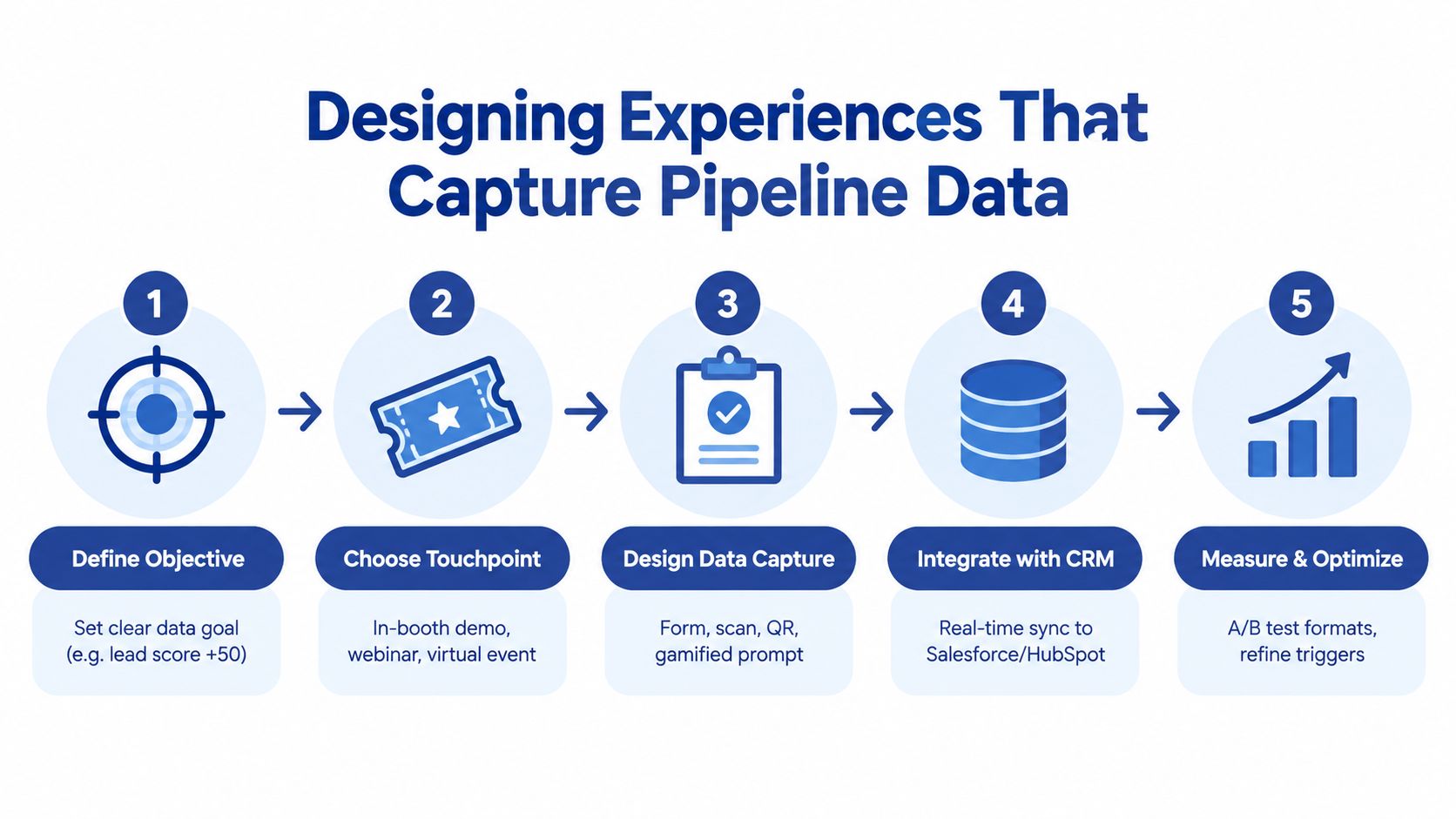
Recent industry coverage describes a shift toward first-party data capture, real-time personalization, and measurement beyond attendance, with experiences increasingly treated as a way to collect data and prove business value. The operational question is how to make that data capture useful without turning the interaction into a form-filling exercise.
Start with the commercial outcome
Define the decision you want the experience to support. That might be a feasibility review, sample request, design consultation, plant visit, or qualified sales meeting. The experience should make that next step natural.
Then identify the data required to route the lead:
- Account information: Company, location, industry, and existing relationship.
- Role information: Engineering, procurement, operations, ownership, or distribution.
- Technical context: Application, material, equipment, production constraint, or target outcome.
- Buying status: Current project, future evaluation, active supplier search, or educational interest.
- Permission and preference: What follow-up the participant has agreed to receive.
Don't ask for information you won't use. Every field should improve personalization, qualification, routing, or measurement.
Build capture into the interaction
A QR code, tablet form, badge scan, or short diagnostic can work when it follows a valuable exchange. For example, a participant might receive a customized process summary after selecting an application and answering a few technical questions. The data capture becomes part of the experience instead of a gate placed in front of it.
Use intent signals carefully. A resource download shows interest, but a request for a sample or a conversation about a production constraint carries different weight. A practical guide to intent data can help your team separate general engagement from behavior that indicates a possible buying motion.
Connect the handoff
Create CRM fields for the interaction type, topic, action completed, and agreed follow-up. Use automation to notify the correct owner, enroll the contact in a relevant sequence, and attach notes or recorded responses. Sales should see why the person engaged, not just that they attended.
Before the event, test the entire path with a dummy record. Confirm that the form submits, the CRM updates, the owner receives the notification, and the follow-up message reflects the experience. If any step fails, the creative concept isn't ready for launch.
Measuring ROI Beyond Attendance Metrics
Attendance is a logistics metric, not a complete return-on-investment argument. It tells you how many people arrived or were recorded, but not whether the right accounts participated, what they learned, or whether a commercial opportunity developed afterward.
The scale of the category makes measurement discipline more important. Worldwide experiential marketing spend was estimated at $128.35 billion in 2024, compared with $116.14 billion in 2023 and $121.87 billion in 2019, while the same estimate placed B2C spending at about $90.32 billion and B2B spending at about $38.03 billion. Those figures are reported in the global experiential marketing spending estimate, and they show why B2B teams need a clear measurement model rather than relying on enthusiasm after an event.
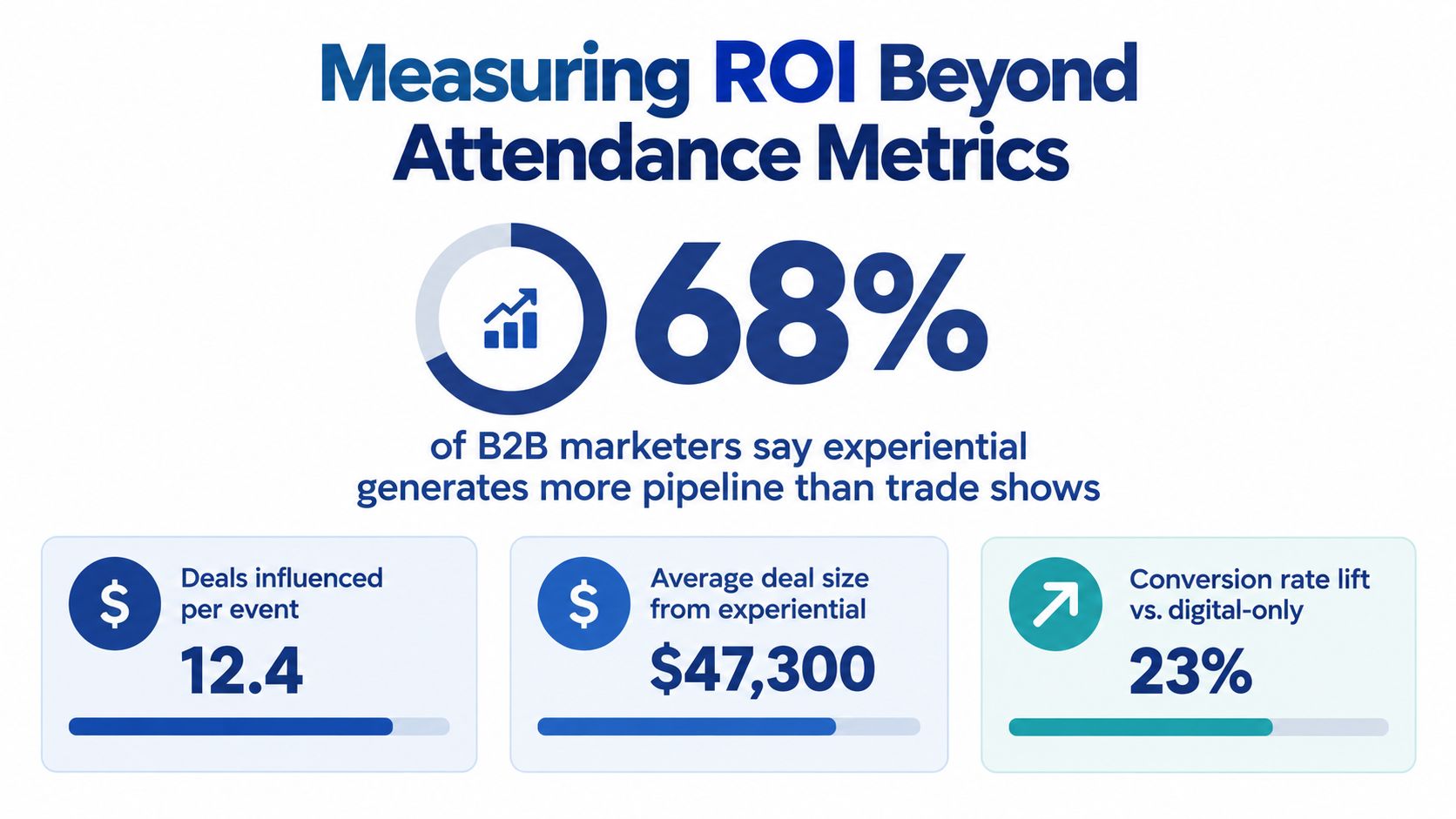
The infographic includes figures that aren't part of the verified evidence available for this article, so they shouldn't be used as business benchmarks. Build your own measurement system from the data your CRM and sales process can validate.
Use a measurement ladder
Start with operational data, then move toward buyer behavior and commercial influence:
- Participation quality: Record which target accounts attended, which roles engaged, and which technical activities they completed.
- Data quality: Review whether the records contain usable account, application, and follow-up information.
- Immediate response: Track requested samples, meetings, consultations, documentation, or demonstrations.
- Pipeline influence: Connect the interaction to opportunities created, advanced, or reactivated in the CRM.
- Commercial outcome: Evaluate sourced or influenced revenue when your sales cycle and attribution model support that conclusion.
You can also assess Experience Marketing Value, brand lift, and content performance when the activation produces shareable or hybrid assets. These measures are useful, but they shouldn't replace account-level pipeline analysis. A large amount of content engagement may indicate reach, while a smaller number of technically qualified conversations may carry greater commercial value.
For a broader discussion of how to connect activity to business outcomes, review The ROI of Play as a complementary resource. Then document your own assumptions in a campaign measurement plan, including what counts as sourced pipeline, influenced pipeline, and a sales-qualified next step. Our guide to measuring marketing ROI can help you build that process into your wider reporting system.
Account for the real costs
Include staffing, travel, equipment preparation, venue costs, technology, content production, follow-up, and the time required from engineers or salespeople. Sustainability also belongs in the evaluation. Recent coverage reports that 76% of experiential marketers had no sustainability policy, while 81% of attendees noticed sustainability, a combination that makes environmental planning a practical expectation rather than a cosmetic detail. These figures come from Farias' 2026 experiential marketing trends coverage, already referenced for format trends.
The best ROI model doesn't pretend every benefit is immediately attributable. It records what happened, identifies uncertainty, and improves the next activation.
Building Your Industrial Experience Strategy
A strong industrial experience strategy begins with diagnosis. Review your last trade show, open house, product demonstration, or technical event and ask whether buyers actively participated or stood near a branded display.
In-person and hybrid formats can include live events, trade-show activations, product trials, virtual events, and other interactive touchpoints. Digital components can extend reach beyond the physical audience and support amplification, as outlined in Salesforce's experiential marketing guidance. The format should follow the buyer problem, not the other way around.
Audit the current system
Use this checklist with marketing, sales, and technical staff:
- Buyer fit: Did the experience attract accounts that match our market and application priorities?
- Participation: Did attendees test, inspect, compare, solve, or configure something meaningful?
- Technical proof: Could a buyer verify our capability through direct evidence?
- Staff readiness: Could the team answer difficult questions without falling back on generic claims?
- Data capture: Did we record the application, role, need, action, and consent?
- CRM connection: Did each meaningful interaction create a usable record and owner assignment?
- Follow-up quality: Did the next message reflect what the participant discussed?
- Pipeline definition: Did we agree beforehand how the experience could influence an opportunity?
- Content reuse: Did the physical interaction produce useful technical content for people who weren't present?
- Resource trade-off: Did the format justify the time, staffing, travel, equipment, and environmental costs?
A “no” answer doesn't mean you should abandon experiential marketing. It identifies a system constraint. If participation is weak, redesign the interaction. If data capture is poor, simplify the form and clarify the value exchange. If follow-up fails, fix CRM ownership and automation before staging another event.
Choose the right experience
Match the format to the decision stage:
- Early awareness: Use a concise demonstration, educational session, or hybrid introduction.
- Technical evaluation: Use samples, controlled tests, engineering workshops, and detailed Q&A.
- Commercial consideration: Use account-specific feasibility reviews, facility visits, and defined next-step meetings.
- Channel enablement: Use distributor training and repeatable demonstration materials.
The strategy works when every physical touchpoint has a job. You aren't trying to make every event spectacular. You're building a connected system that lets buyers experience your value, gives your team better information, and creates a defensible path from interaction to pipeline.
Before planning the next activation, write the target account profile, the participation mechanic, the data fields, the sales handoff, and the success definition on one page. If those elements don't fit together, the experience needs more diagnosis before it needs more budget.
Machine Marketing helps manufacturers, machine shops, and industrial businesses connect strategy, CRM, automation, SEO, content, and lead generation into a measurable growth system. Visit Machine Marketing to request a practical diagnosis of how your next trade show, demo day, or facility experience can generate better-qualified pipeline.