Your sales team gives a solid presentation. The specs are accurate. The ROI math is clean. Procurement likes the pricing structure. Then the deal stalls, and nobody gives you a satisfying reason.
We see this pattern constantly in B2B. Especially in manufacturing, industrial services, and technical sales. Teams assume the pitch failed because they need better proof, more detail, or another comparison sheet. Often the opposite is true. The buyer already has enough information. What they still need is the feeling that choosing you is safe, smart, and professionally defensible.
That’s where emotions in marketing stop sounding soft and start becoming practical. Used well, emotional marketing doesn’t replace facts. It helps your facts land with the people making high-stakes decisions under pressure.
Why Your Rational B2B Pitch Is Failing
A manufacturer can have the better product and still lose to the vendor that feels easier to trust.
That’s the missed opportunity. Most B2B teams present information as if buyers are decision calculators. They lead with tolerances, lead times, throughput, certifications, and pricing logic. All of that matters. But it doesn’t answer the internal questions buyers are wrestling with.
They’re thinking things like:
- Will this choice create risk for my team
- Will I look careless if implementation gets messy
- Can I defend this recommendation to leadership
- Will this vendor stay responsive when something goes wrong
A technical pitch often falls flat because it addresses the product but ignores the person buying the product.
Research summarized by Spiralytics on emotional marketing performance shows that emotions drive approximately 70% of consumer decisions, ads with strong emotional response can generate a 23% sales increase, and fully emotionally connected customers are 52% more valuable than merely satisfied ones. That matters even more in long sales cycles where trust compounds over time.
What the buyer hears when your message is too rational
When your messaging is overloaded with logic, buyers don’t hear “professional and credible.” They often hear:
| Your message | What the buyer may feel |
|---|---|
| Dense spec sheet | Unclear on business impact |
| Generic ROI claim | Skeptical |
| Long feature list | More complexity |
| Hard close | Pressure |
| No social proof or implementation clarity | Risk |
Practical rule: If your message only proves capability, you’re still missing the part that creates confidence.
In B2B, the emotional failure usually isn’t lack of excitement. It’s lack of reassurance.
That’s why promising leads go cold after a good meeting. They didn’t reject the numbers. They couldn’t comfortably justify the decision.
The Engine Behind the Purchase Core Emotional Principles
The easiest way to understand emotions in marketing is to stop treating emotion and logic as opposites.
Buyers use both. Emotion helps them decide what matters. Logic helps them defend the choice.
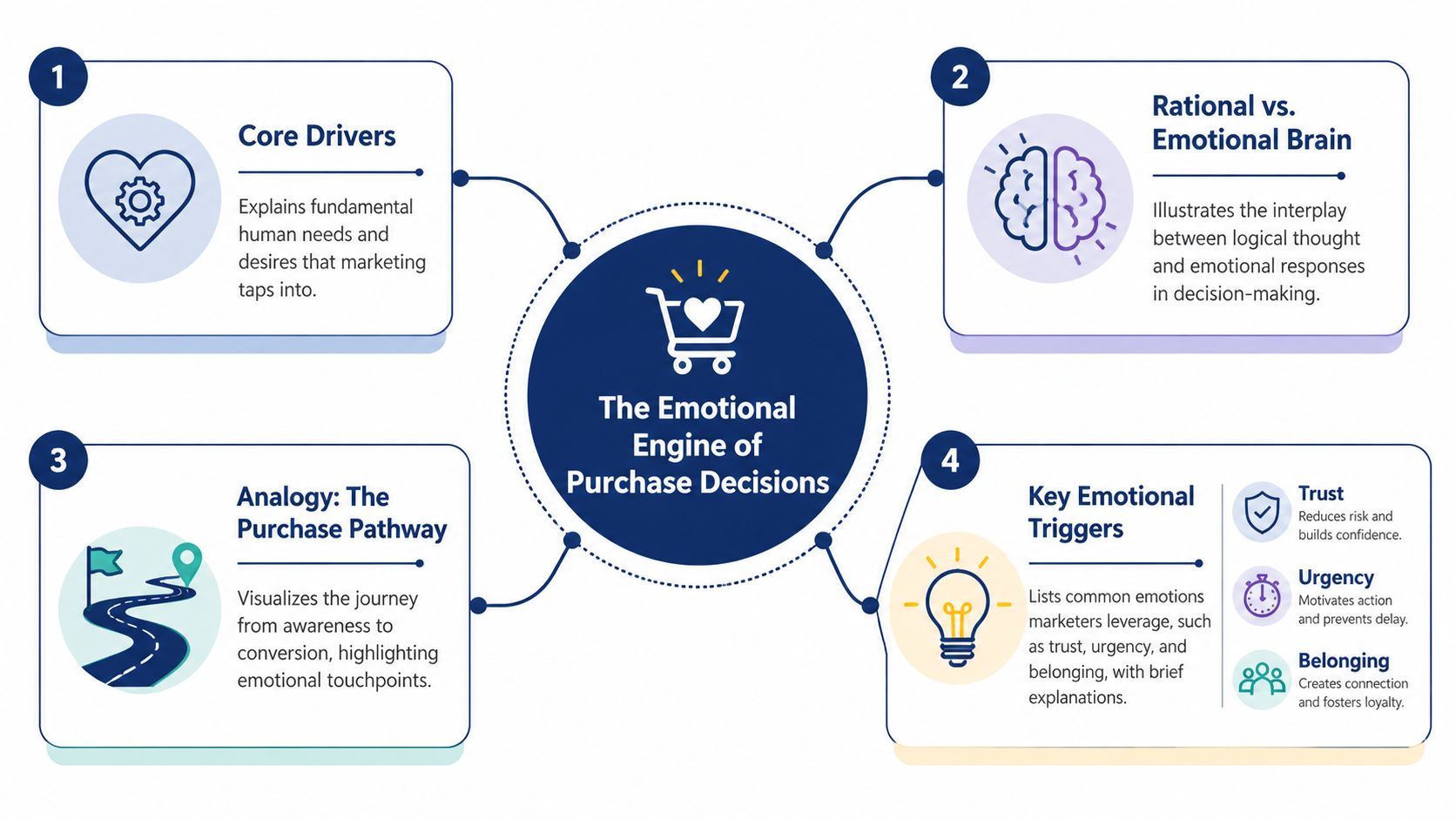
Emotion is the switchboard, not the shortcut
In practical terms, emotion works like a switchboard in the brain. A message comes in, and the buyer’s mind asks fast questions before it gives much attention to the details.
- Does this feel relevant
- Does this reduce risk
- Does this align with what I want to achieve
- Does this create tension or relief
If the answer is no, even strong evidence gets filtered out.
That’s why emotionally aware messaging performs better than rational-only messaging. Berger’s explanation of emotional analysis in marketing describes emotional analysis as extracting measurable emotional data across the customer journey, including sentiment, specific emotions, intensity, and their triggers. The same source notes that emotional advertising is twice as effective as rational-only content.
That doesn’t mean you should write melodramatic copy. It means you should identify what the buyer needs to feel at each stage.
The emotional spectrum buyers move through
A useful way to think about this is an emotional spectrum. Not every buyer needs joy. In many B2B environments, the stronger levers are trust, anticipation, relief, certainty, pride, and belonging.
Here’s a practical map:
Trust
Used when a buyer is comparing vendors. Trust grows through clarity, consistency, and proof that you understand their constraints.Anticipation
Helpful when a buyer sees upside but hasn’t acted yet. Good messaging makes the future feel concrete, not vague.Relief
Powerful when the buyer is carrying operational stress. This works well in messaging around support, onboarding, and reliability.Confidence
Essential in complex sales. The buyer wants to feel they are making a sound decision they can defend internally.Pride
Often overlooked. Engineers, operators, and leaders want to make strong calls and improve performance without creating chaos.Belonging
Useful in retention and community-based marketing. Buyers want to feel understood by people who work in their world.
Match emotion to stage, not just brand voice
A common mistake is using one brand tone for every touchpoint. The buyer doesn’t need the same emotional cue on a homepage, in a reactivation email, and during onboarding.
Use stage-based alignment instead:
| Buyer stage | Emotional goal | Message focus |
|---|---|---|
| Early research | Curiosity with safety | Show you understand the problem |
| Vendor comparison | Confidence | Make trade-offs visible and easy to evaluate |
| Decision | Reassurance | Reduce uncertainty and implementation fear |
| Onboarding | Relief | Show control, process, and responsiveness |
| Expansion or renewal | Pride and belonging | Reinforce progress and partnership |
Buyers don’t remember every feature. They remember whether your process made the decision feel easier or harder.
That’s the engine. Emotion opens the door. Logic walks through it. Proof closes the loop.
Decoding Your B2B Buyer's Emotional Triggers
B2C marketers often talk about joy, nostalgia, or urgency. In manufacturing, distribution, industrial service, and technical sales, the emotional triggers are different.
Your buyer may be a plant manager, sales engineer, operations lead, procurement director, or owner. They’re not buying a feeling in the consumer sense. They’re buying reduced exposure, smoother operations, and professional confidence.

Confidence is the underrated B2B emotion
In technical markets, fear-based messaging usually gets overused and underperforms. Buyers already know the downside of making a bad choice. You don’t need to dramatize it. You need to show them a path to certainty.
Buffer’s discussion of emotional dynamics in marketing highlights an important B2B angle: confidence often outperforms fear-based tactics, and 70% of emotionally engaged B2B buyers will spend up to 2x more when messaging builds trust and belonging rather than just listing product specs.
That should change how you write almost everything.
Instead of “Don’t risk downtime,” try a message that helps the buyer feel prepared, supported, and credible. Instead of “Act now before you fall behind,” show how your process helps them make a controlled upgrade without disruption.
The emotions that actually drive industrial buying
When we diagnose a weak B2B message, these are the emotional drivers we usually look for first:
Professional security
The buyer wants to avoid looking irresponsible. Your message should make implementation, support, and accountability feel clear.Control
This matters when operations feel fragile. Buyers respond well when they can see the process, timeline, and decision criteria.Ambition
Many buyers aren’t just preventing failure. They want to improve output, simplify workflow, or lead change inside the business.Relief from complexity
If your product is hard to understand, the buyer assumes ownership will be hard too. Clear communication itself becomes a competitive advantage.Pride in competence
Good buyers want to choose vendors who make them look thorough, forward-thinking, and capable.
A useful way to deepen this work is to study customer psychographic insights instead of relying only on firmographics like company size or industry. Titles and revenue bands tell you who the buyer is. Psychographics help explain why they move.
Questions to ask when building the real buyer profile
A weak persona says, “Operations manager at a mid-sized manufacturer.”
A useful persona answers harder questions. If you need a starting point, build that profile alongside your existing process for buyer personas.
Ask:
What failure is this person trying to avoid
Delays, rework, missed targets, difficult implementation, vendor silence?What internal pressure do they face
Leadership scrutiny, budget tension, staffing constraints, customer demands?What outcome would make them look good professionally
Faster response, smoother onboarding, fewer surprises, stronger reporting?What language signals safety to them
Predictable process, transparent pricing, technical support, documentation?What kind of proof do they trust most
Comparative tables, implementation steps, technical validation, peer examples?
This short video is a useful prompt for listening to buyer language more carefully before you write your next campaign.
If your copy sounds polished but your buyer still hesitates, you probably named the product benefit and missed the professional emotion underneath it.
The best B2B emotional messaging doesn’t sound sentimental. It sounds clear, controlled, and trustworthy.
A Practical Framework for Emotional Messaging
Many organizations don’t need more creativity. They need a repeatable system.
A simple framework works well across websites, sales emails, landing pages, ad copy, and outbound sequences. Use Emotion, Logic, Proof in that order.
Emotion first
Lead with the feeling the buyer wants, not the feature you want to promote.
If your first line starts with product specs, model numbers, or generic capability claims, you’re forcing the buyer to do too much interpretation. Start with the business tension they feel and the outcome they want.
Bad example:
Our CNC system offers advanced automation, modular tooling, and a flexible control interface.
Better example:
Keep production moving with a system your team can run confidently, even under pressure.
The second version creates emotional orientation first. It makes the feature set easier to absorb later.
Logic second
Once the buyer feels understood, give them the structure they need.
Specs, pricing logic, implementation details, compatibility notes, and process documentation belong here. Logic still matters. It just works better after the buyer has a reason to care.
A practical website or email structure looks like this:
| Step | What to say | What it does |
|---|---|---|
| Emotion | Name the risk, pressure, or desired outcome | Creates relevance |
| Logic | Explain how the offer works | Builds understanding |
| Proof | Show evidence and decision support | Reduces hesitation |
Proof closes the gap
Proof is what turns a strong message into a credible one.
That proof can be:
- Decision support tools such as comparison tables or implementation checklists
- Specific process clarity like what happens in week one, who owns setup, and how support works
- Trust-building assets such as testimonials, certifications, or documented workflows
Here’s the before-and-after difference for a manufacturing email.
Before
Subject: New Conveyor System Capabilities
Body:
Our conveyor system includes configurable controls, durable construction, and scalable design options. Contact us to learn how our system can improve your facility.
After
Subject: Reduce handoff delays without creating a difficult install
When throughput is slipping, businesses don’t need more equipment complexity. They need a system that fits the floor, gets adopted quickly, and helps operators stay in control. Our conveyor platform supports configurable controls and scalable layouts, so you can improve flow without forcing a disruptive overhaul. If you’d like, we can send a side-by-side planning sheet your team can use to evaluate fit.
If you’re refining outreach, this roundup of effective email subjects for sales is useful because it forces a good discipline. Subject lines should create relevance, not just announce that you exist.
For a more complete version of this SOP, map your copy to a marketing messaging framework so the same structure carries across your site, your emails, and your sales materials.
Putting Emotion into Action with Campaigns and Workflows
Emotional messaging gets more valuable when you operationalize it.
Most companies leave it at copywriting. They update a few headlines, rewrite a brochure, maybe refresh a landing page, and stop there. The better move is to build emotional cues into your CRM, your follow-up logic, and your reactivation workflows.

Build emotional tags inside your CRM
If you use GoHighLevel or a similar platform, start by tagging contacts based on the emotional context behind the opportunity.
Not every lead should go into the same nurture sequence. A buyer worried about disruption needs different messaging than a buyer focused on growth.
Useful tag examples:
- Concerned_About_Downtime
- Needs_Clear_Onboarding
- Price_Sensitive_But_Interested
- Ambitious_For_Growth
- Comparing_Vendors
- Seeking_Confidence_For_Internal_BuyIn
- Past_Customer_Needs_Reassurance
These are not personality labels. They’re message-routing tools.
You assign them from discovery calls, form responses, sales notes, email replies, and behavior signals. If a lead repeatedly asks about implementation or support response, tag for confidence and reassurance. If they ask about capacity or expansion, tag for ambition and upside.
Two simple workflow models that work
Here are two practical examples.
Workflow for a worried lead
This sequence fits a buyer who is interested but hesitant because they fear disruption, complexity, or post-sale silence.
Trigger
Lead requests pricing, views implementation content, or asks support-heavy questions.
Sequence
Email one
Subject focused on control and clarity. Body explains the process in simple steps and reduces fear of a messy handoff.SMS follow-up
Short note offering a useful asset, such as a planning checklist or comparison sheet.Email two
Address common implementation objections. Use plain language. Avoid hype.Task for sales rep
Call with a specific goal. Confirm constraints and identify what would make the decision easier internally.Email three
Share proof that your process is organized and responsive. Emphasize support, not pressure.
A message in this sequence might sound like this:
You don’t need a dramatic changeover. You need a rollout your team can manage without losing control of production.
Workflow for an ambitious lead
This sequence fits a buyer trying to improve output, modernize operations, or strengthen their position inside the business.
Trigger
Lead engages with productivity content, asks growth-oriented questions, or returns to product pages tied to scale.
Sequence
- Start with opportunity rather than pain. Show what gets easier or stronger after adoption.
- Send a follow-up email that frames the decision as a practical upgrade, not a risky leap.
- Use SMS carefully to keep momentum without sounding pushy.
- Prompt a rep task to discuss roadmap, expansion, or competitive positioning.
- Close the sequence with a proof-oriented message that helps the buyer justify forward movement.
What to write in the actual messages
A lot of teams understand segmentation and still send flat emails. The wording is where this succeeds or fails.
Use this pattern:
| Emotional trigger | Opening angle | CTA style |
|---|---|---|
| Concern about downtime | Reassure on stability and process | Review the rollout plan |
| Need for confidence | Clarify evaluation criteria | Compare options side by side |
| Ambition for growth | Show operational upside | Explore fit for next-stage goals |
| Re-engagement after silence | Acknowledge timing and reduce friction | Restart the conversation simply |
Don’t write every CTA as “Book a demo.”
Try alternatives such as:
- See the implementation checklist
- Review the comparison guide
- Reply with your biggest rollout concern
- Ask for the planning sheet
These calls to action feel lower pressure, which often makes them easier to accept.
Why this compounds over time
The payoff from emotional marketing doesn’t come only from the first conversion. It builds as your messaging creates loyalty, repeat engagement, and referrals.
Britopian’s research summary on emotional insights reports that emotional campaigns show compounding impact, with profit contribution rising from 13% in year one to 43% by year three. The same source notes that customers with an emotional bond show 306% higher lifetime value and recommend brands at a 71% rate.
That’s why this belongs inside the system, not just the copy deck.
If your follow-up still treats every contact the same, your automation is organized but not intelligent. A better setup turns your CRM into a relationship engine. If you’re planning that transition, study practical approaches to marketing automation for manufacturing and then map your own emotional tags into the workflow logic you already have.
Measuring Impact and Navigating Ethical Lines
If you can’t measure emotional impact, you’ll eventually drift into guesswork. If you don’t set ethical limits, you’ll drift into manipulation.
Those two issues belong together.

What to measure without overcomplicating it
You don’t need a neuroscience lab to improve emotions in marketing. Start with signals you can already observe.
Use A/B testing to compare emotional framing in:
- Headlines that emphasize confidence versus capability
- Email subject lines that reduce friction versus push urgency
- CTAs that offer clarity versus commitment
- Landing page sections that lead with reassurance versus features
Then add qualitative review.
Look through sales call notes, form responses, email replies, and customer feedback for recurring emotional language. Watch for words like unsure, worried, easier, clear, confident, overwhelmed, supported, and smooth. That language tells you where the core friction is.
A simple scorecard helps:
| Touchpoint | What to review | What it may reveal |
|---|---|---|
| Homepage | Scroll depth and click path | Whether the message earns attention |
| Sales emails | Reply quality and objections | What emotional resistance remains |
| Demo calls | Repeated concerns | What buyers need to feel before deciding |
| Onboarding feedback | Frustration or relief language | Whether promises match the experience |
The ethical test is simple
Ask one question before launching any message.
Does this help the buyer make a better decision, or does it only try to force action?
That standard filters out most bad emotional marketing.
Fear is the easiest example. Used carelessly, it creates pressure, not trust. Confusion is another. Teams often think complexity makes them sound impressive. Usually it just makes the buyer more hesitant.
The risk is real. This analysis referencing a January 2026 Gartner report says 40% of B2B campaigns fail to achieve emotional resonance. The same source notes that mismanaging emotions like confusion can lead to a 30% drop in attention.
Guardrail: If your emotional message creates anxiety without offering clarity, it’s not persuasive. It’s counterproductive.
A practical ethics checklist
Use this before you publish or automate anything:
Check for truthfulness
Does the message accurately represent the offer, process, and likely experience?Check for clarity
Will a busy buyer understand what happens next without needing extra interpretation?Check for pressure
Are you helping the buyer move, or are you manufacturing panic?Check for fit
Does the emotional cue match the stage of the relationship?Check post-sale reality
Can operations, sales, and service deliver the experience your message implies?
Ethical emotional marketing is usually more effective because it stays aligned with reality. The cleaner your measurement, the easier it becomes to spot the difference between resonance and manipulation.
Your First Step Toward More Human Marketing
The shift is simple to describe and harder to execute.
Stop writing as if your buyer is only evaluating a product. Start writing for the person carrying the decision.
That means your messaging should do three things well:
- Identify the core pressure behind the purchase
- Reduce uncertainty with structured logic
- Support the decision with proof and process clarity
When teams do this consistently, emotions in marketing stop being a creative add-on. They become part of the operating system. That’s the point. Berger’s overview of emotional analysis frames the end goal as a systematic process: extract emotional data from the customer journey, map triggers to touchpoints, and A/B test messaging to reduce friction. Done well, emotional advertising proves twice as effective as rational-only content.
One more practical note. If you use AI to draft messaging, don’t let it flatten your tone into generic marketing language. Tools like Humanize AI Text can help you review whether the copy sounds natural, but the harder job is still yours. You need to know what your buyer is worried about, what they want to achieve, and what kind of message makes them trust the next step.
Start small.
Audit one landing page, one sales email, and one follow-up workflow. Identify the emotional job each one should do. If the message only explains the offer, revise it until it also creates confidence.
If you want a second set of eyes on that diagnosis, Machine Marketing can help. A discovery call is a practical place to start. We’ll look at your current messaging, customer journey, and follow-up system through the lens of a structured marketing diagnosis, then identify where rational communication is doing its job and where the human side of the decision is getting missed.