If you want to create case studies that close deals, you have to stop thinking of them as simple testimonials. It's time to start treating them like strategic sales assets, engineered to prove your value.
So, how do you do it? The system is straightforward: find a customer with measurable results, interview them to pull out the "before-and-after" story, and frame it all around the problem, your solution, and the hard-number ROI. This guide will walk you through building that system, step-by-step.
Why Do You Need a System for Case Studies?
If you're in B2B, you know trust is everything. Your prospects are smart and skeptical—they want proof, not just promises. So, where’s the gap?
We see this all the time: a business gets a great result for a customer, grabs a quick quote, and calls it a day. That's a huge missed opportunity. The problem isn’t the lack of success; it’s the lack of a system to turn that success into a predictable engine for new business.
The fundamental diagnosis is this: a simple testimonial offers praise, but a strategic case study provides proof. One feels nice, the other closes deals by showing a clear, repeatable path to success that your next customer can trust.
From Simple Quote to Strategic Asset
Let's put on our engineering hats. To solve this, we need to diagnose why a basic testimonial falls flat while a full-blown case study delivers real impact. Your goal is to move from ad-hoc praise to a structured, persuasive asset that does the heavy lifting for your sales team.
A well-crafted case study works because it:
- Defines the Problem: It shows you understand the client's world by defining their initial challenge in their own words. This builds immediate empathy.
- Details the Solution: It walks through the specific steps you took, showcasing your process and expertise. This builds confidence in your method.
- Quantifies the Results: It delivers the knockout punch with undeniable, data-backed proof of the transformation—more revenue, time saved, or higher efficiency. This builds irrefutable proof.
This table breaks down the transformation you're aiming for:
From Ad-Hoc Testimonial to Strategic Case Study
| Element | Basic Testimonial (Low Impact) | Strategic Case Study (High Impact) |
|---|---|---|
| Focus | General praise ("They're great!") | Specific problem and quantifiable outcome |
| Structure | A short, isolated quote | A narrative: Challenge > Solution > Results |
| Data | Vague or non-existent | Hard numbers, percentages, and ROI |
| Credibility | Moderate; feels subjective | High; feels objective and data-driven |
| Sales Utility | A nice-to-have social proof point | A core asset for proposals and lead nurturing |
| Repurposing | Limited (website snippet) | High (blog posts, social, ads, one-pagers) |
Moving from the left column to the right is the system that turns customer satisfaction into a lead-generation machine.
Each step in the process builds on the last, turning a small win into a major sales tool.
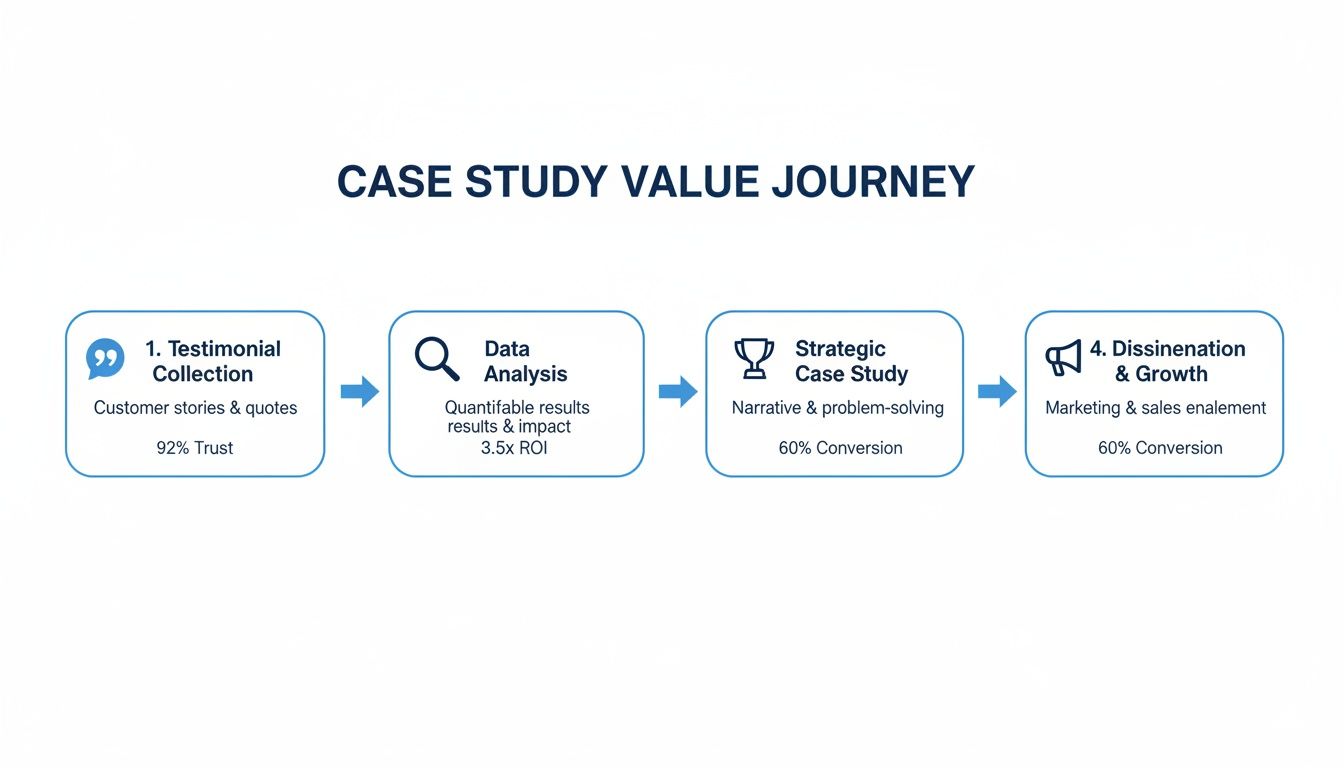
This visual makes it clear: a testimonial is a good start, but the strategic case study is the real trophy that validates your process. It's a cornerstone for anyone learning how to build a sales pipeline that runs on proof, not promises.
And while you're building these deep-dive stories, you can still use quick-hit social proof. Using some of the best WordPress testimonial plugins to boost trust and credibility on your site is a great way to complement your more detailed case studies.
How to Find and Recruit Your Best Case Study Partners
A powerful case study starts with the right customer. But which one? The key is to think strategically. You're looking for partners whose stories perfectly mirror the challenges and aspirations of your next ideal customer.
Your best candidates are usually hiding in plain sight. They’re the ones who not only appreciate your work but can also point to real, measurable proof of the transformation you delivered.
Identify Your Ideal Storytellers
First, look at your customer list. Don't just scan for compliments; hunt for impact. The goal is to find clients who match your ideal customer profile and have achieved results that will make your prospects pay attention.
Questions to Ask Yourself When Vetting Candidates:
- Did they see a quantifiable ROI? Look for clients who can share hard numbers—increased revenue, lower costs, hours saved, or a jump in lead generation. This is your proof.
- Does their story align with your ideal buyer persona? A story only lands if the reader sees themselves in the hero. For a deep dive on this, check out our guide on how to create buyer personas.
- Are they articulate and willing to be a champion? The best partners are genuinely excited about their success and happy to talk about it.
- Did they solve a widespread industry problem? A case study that tackles a common pain point is instantly more relatable and valuable to a wider audience.
Think of it this way: you're showing a specific type of customer that you've already solved their exact problem. Fast-growing companies generate 40% more of their revenue from this kind of personalization than their slower-moving competitors. You can find more insights on AI marketing case studies over at Visme.co.
Frame the Request as a Win-Win
Once you have a shortlist, it's time to reach out. The secret is to frame your request not as a favor, but as a mutually beneficial partnership. You're offering them a co-marketing opportunity and a platform for valuable brand exposure.
When you reach out, be direct and clear. Explain what you want to create, why you chose them, and what’s in it for their business.
Pro Tip: Position the case study as a co-promotional piece. Tell them you'll be sharing their success story across your website, social channels, and email list. This gives their brand valuable exposure and turns a simple request into a compelling business proposition.
Here's a simple structure for your outreach email:
- Subject: A quick question about your success with [Your Company]
- Opening: Start with a genuine compliment about their business or the specific results they’ve achieved with you.
- The Ask: Clearly state that you'd love to feature their success story in a case study. Be direct.
- The "What's In It For Them":
- Explain that you'll promote the story (and their company) on your website, social media, and to your email list.
- Offer to include a backlink to their website, driving traffic and SEO value.
- Give them final approval on all content before it goes live. This builds trust.
- The Commitment: Keep the initial ask small. Suggest a brief 20-30 minute call to hear more about their story.
This approach shows you respect their time and highlights the value for them, making a "yes" much more likely. You're showing that you see them as a partner, not just a past sale.
How to Conduct Interviews That Uncover the Real Story
The interview is where you find the gold. But are you asking the right questions? This isn't just about gathering facts; it's about finding the story of transformation. A great interview digs deep into the "before, during, and after" of your customer's journey.
Forget a rigid list of questions. Think of yourself as a journalist and a problem-solver. Your job is to get to the core of their business challenge, their decision-making process, and the concrete results they saw.
Structuring the Interview for a Compelling Narrative
To walk away with a story that has a clear beginning, middle, and end, you need to guide the conversation. We use a simple three-part framework that maps directly to the final case study, ensuring you get every piece of the puzzle.
The "Before" State (The Pain): What specific problems were they facing? What was the business impact—in terms of money, time, or morale? This is what builds empathy with your reader.
The "During" Phase (The Decision): Why did they choose you over a competitor? What was their "aha!" moment? How did they find the implementation process? This is where you highlight your unique value.
The "After" Transformation (The Proof): What are the specific, measurable outcomes they achieved? How has their business improved in a way they can quantify? This delivers the proof.
By guiding the conversation through these stages, you naturally build a narrative arc that moves from a relatable problem to a clear solution and wraps up with a powerful, data-backed conclusion.
A successful case study interview feels more like a collaborative diagnostic session than a Q&A. Your goal is to understand the system, identify the friction points they experienced, and document how your solution engineered a better outcome.
Questions That Uncover Metrics and Motivation
Open-ended questions are your best tool for getting detailed, quote-worthy answers. Ditch "yes" or "no" questions. Instead, use prompts that encourage storytelling and get your customer to be specific.
Questions for "The Before" (Diagnosing the Problem):
- "Can you walk me through what was happening in the business that made you realize a change was needed?"
- "Before working with us, what was the single biggest challenge you were trying to solve?"
- "What were the hidden costs or time-sucks associated with that problem?"
Questions for "The During" (Exploring the Solution):
- "When you were evaluating solutions, what were your key decision criteria?"
- "Was there an 'aha!' moment that made you confident we were the right partner?"
- "Can you describe what the implementation process felt like for your team?"
Questions for "The After" (Quantifying the Transformation):
- "Now that this is in place, what are the top 2-3 measurable improvements you’ve seen?"
- "Could you share any specific numbers on time savings, revenue growth, or lead increases?"
- "How has this change impacted your team's day-to-day workflow or morale?"
Practical Tips for a Flawless Interview
A few simple habits can be the difference between a frustrating call and a smooth one that gives you incredible content.
First, always ask for permission to record the call. Explain it’s for accuracy and to ensure you capture their quotes perfectly. For us, this is a non-negotiable step. To document and analyze your interviews accurately, checking out a modern guide to translate audio to text can be a game-changer. It saves hours of manual transcription and lets you search the conversation for key phrases later.
Second, practice active listening. Don’t just wait for your turn to talk. When you hear a powerful statement, jump on it with a follow-up: "That's a great point. Could you elaborate on that?" This is how you unearth the golden quotes that will make your case study connect with your next customer.
How to Write and Structure Your Case Study for High Impact
You've got the interview transcript. Now what? The next step is to engineer that raw material into a powerful sales asset.
A great case study needs to be scannable for a busy CEO but detailed enough for the manager who needs to see the "how." The goal is to guide a prospect from their problem to your solution, making your approach feel like the only logical choice.

Building the Narrative Framework
Think of your case study like a classic story: a hook, a journey, and a powerful payoff. We rely on a proven "Challenge, Solution, Results" structure—the same one you used to guide the interview.
Each section is designed to build trust and answer the reader's next question.
The core components are:
- The Magnetic Headline: Your one shot to grab a prospect’s attention and promise a solution.
- The Executive Summary: A quick overview for the decision-maker who only has 30 seconds. It must include the client, their core problem, and the headline ROI.
- The Challenge: Dive into the customer's world before you showed up to build empathy.
- The Solution: Walk through your process to prove your expertise and show how you partner with clients.
- The Results: The climax of the story, loaded with hard data and undeniable proof.
Following this logical flow ensures anyone can instantly find the information that matters to them. Mastering this narrative is a cornerstone of our wider content marketing best practices.
Crafting a Magnetic Headline
A weak headline guarantees your case study will be ignored. It’s that simple. The best headlines are specific, benefit-focused, and feature a compelling number.
Look at the difference:
- Weak Headline: Company X Improves Processes
- Strong Headline: How [Client Name] Slashed Machine Downtime by 32% With a New Predictive Maintenance System
The second headline tells a whole story. It names the client (credibility), states the problem (downtime), and quantifies the outcome (32%). It works.
A great headline doesn't just describe what’s inside; it sells the outcome. It makes a promise of valuable insight that compels your ideal prospect to click and learn how they can get similar results.
Detailing the Challenge and Solution
The Challenge section is your chance to connect with the reader’s pain. Use direct quotes from the interview to paint a vivid picture of their frustration. Don't just say "they had inefficient processes"—describe the costly overtime, missed deadlines, or customer complaints that resulted from it.
Once the problem feels real, the Solution section is your time to shine as the expert. This isn't a sales pitch. It's a walkthrough of the steps you took to fix the problem.
What to include in the Solution section:
- A quick overview of the strategy you developed for them.
- The specific services or products you implemented.
- Why you chose that particular approach for this specific client.
- A customer quote about the partnership or how easy the process was.
This section demonstrates that you have a repeatable, effective system for solving problems and positions you as a strategic partner.
Showcasing the All-Important Results
This is the payoff. The Results section is where you deliver the proof. Always lead with your most impressive metric.
Use a mix of hard numbers and qualitative benefits to tell the complete story.
- Quantifiable Metrics: Lead with the data. Use bullet points or callout boxes to make key performance indicators (KPIs) impossible to miss. Think revenue growth, cost savings, lead increases, and efficiency gains.
- Direct Quotes: Back up your data with a powerful quote from the client that expresses their satisfaction and the real-world business impact.
- Operational Benefits: Don't forget the "softer" wins. Did your solution reduce team stress? Improve morale? Free up the founder's time? These benefits often resonate just as strongly as the hard numbers.
This is especially true when new technology creates a clear advantage. We know that machine learning-powered marketing campaigns deliver an average of 14% higher conversion rates. When you can put a tangible lift like that in a case study, you’re not just telling a story—you’re building an airtight business case.
How to Design and Publish Your Case Study for Maximum Visibility
You've written a killer narrative. So, what now? Don't let your hard work die in a boring wall of text. Even the most powerful success story will get ignored if it’s not designed to be seen and shared.
Let’s be blunt: poor design kills content. A busy executive won't sift through dense paragraphs to find the ROI. Your job is to create two distinct assets: a polished PDF for your sales team and a scannable, SEO-optimized landing page that works for you 24/7.

Design for Scannability
Think like a magazine editor. Break up the text and pull the reader’s eye directly to the most valuable information. You have to make the results and key takeaways impossible to miss.
Here are the design elements we use in every case study:
- Pull Quotes: Lift the most impactful quotes from your customer interview and make them visually distinct. This immediately adds a human voice and social proof.
- Results Callout Box: This is non-negotiable. Create a visually separate section—a shaded box or a sidebar—that highlights the top 3-4 results. Use big, bold numbers to make the data pop.
- High-Quality Imagery: Use the client’s logo, a professional headshot of your contact, and any photos of your product or service in action. This isn’t decoration; it’s about credibility.
These pieces transform a simple article into a high-impact sales tool that respects your reader's time.
We see it all the time: a business spends weeks creating a case study, only to dump it onto their blog as plain text. It's like building a race car engine and then refusing to open the hood. Visual design is how you put that engine on full display.
Create a PDF for Your Sales Team
Your sales reps need a slick, downloadable asset they can attach to emails. This version has to look and feel like a premium document.
Use a tool like Canva or a designer to build a branded template. Make sure your logo, brand colors, and contact info are on every page. The PDF provides a controlled, polished presentation that is a reliable workhorse for your sales process.
Build an SEO-Optimized Landing Page
While the PDF is for direct sales, the web version is your silent salesperson, pulling in leads while you sleep. That means it must be built for search engines so prospects can find your wins on their own.
You’ll use the same powerful content and design elements, but you’ll build it as a dedicated landing page on your website.
Here’s your checklist for setting up the web page for success:
- Optimize the Title & URL: Put the customer's name and the single biggest result in the page title and URL. For example:
/case-studies/how-client-name-grew-leads-by-45-percent. - Write a Compelling Meta Description: This is your ad on Google. Summarize the challenge and the result to earn the click.
- Put All Text on the Page: Never just embed the PDF. Google can't read the text inside an embedded file, which means you get zero SEO value. The full story needs to be there as crawlable text.
This two-pronged approach gives you a sharp-looking PDF for your sales team and a hard-working webpage that generates inbound interest.
How to Promote and Repurpose Your Case Study Content
Publishing your case study isn't the finish line; it’s the starting gun. A single customer story can fuel your marketing for months if you have a system to get it in front of the right people. Treat it as a major campaign launch, not just another blog post.
A smart, multi-channel promotion strategy ensures your story finds prospects wherever they are, building credibility at every touchpoint.
Launch Your Multi-Channel Promotion Strategy
With your case study live, it's time to make some noise. Integrate it into your ongoing marketing to maximize the return on the effort you’ve already invested.
A solid promotion plan should include these actions:
- Arm Your Sales Team: Give your sales team the PDF and the direct link. More importantly, show them how to use it in proposals and follow-up emails to overcome specific objections with real-world proof.
- Social Media Amplification: Post the story on LinkedIn, targeting your specific industry. With their permission, tag your customer’s company and any key people involved to tap into their network. Pull a powerful quote or a standout metric to grab attention.
- Targeted Email Marketing: Announce the new case study with a dedicated email to your subscriber list. For maximum impact, segment that list to send the most relevant stories to the right contacts.
- Strategic Website Integration: Don't just bury your case study in a "Case Studies" section. Feature it on your homepage, link to it from relevant service pages, and sprinkle it throughout related blog posts.
Repurpose Your Case Study Into Micro-Content
The secret to extracting maximum value is to stop thinking of your case study as a single asset. Instead, treat it as a "pillar" and break it down into dozens of smaller "micro-assets." This approach gives you a constant stream of fresh, high-impact content.
A single case study is not one asset; it's an entire campaign waiting to be unpacked. Repurposing is the system that turns your one-time effort into a long-term lead generation engine.
For instance, a compelling, specific metric is the heart of any great story. We’ve seen how Ticketek's use of machine learning-powered recommendations drove a 250% lift in conversion rates. That one number can be repurposed endlessly to prove ROI. You can discover more about the impact of machine learning in marketing on Braze.com.
Here are a few repurposing tactics to try next:
- Infographics: Convert the key stats and results into a sharp-looking infographic for social media or other blog posts.
- Quote Graphics: Take the most powerful customer quotes and create branded graphics for LinkedIn and other social platforms.
- Short-Form Video: Use powerful clips from the recorded interview to create a short video testimonial. Add captions for an authentic piece of content that resonates.
- Blog Post Summary: Write a new, shorter blog post that recaps the case study’s story from a different angle, then link back to the full version.
By following a systematic approach to promotion and repurposing, you ensure your best success stories are always out there working for you.
Frequently Asked Questions About Creating Case Studies
Even with a clear playbook, you’ll run into a few common roadblocks. These are the questions we hear all the time from business owners like you.
Here’s our direct advice on how to handle them.
What if my client is hesitant to share hard numbers?
This happens, and it's a valid concern. The solution is transparency and flexibility.
First, always reassure them that they get final approval. Make it clear that nothing goes public without their sign-off. This single promise often eases their worries.
If they're still not comfortable sharing exact revenue numbers, get creative. You can tell a powerful story using percentages, multipliers, or operational wins.
- Instead of: "Increased revenue by $500,000."
- Try: "Achieved a 2.5x return on their initial investment in the first year."
- Or: "Reduced manual data entry by 40 hours per week."
The goal isn’t always a shocking dollar amount. It's about providing tangible proof of transformation. A compelling percentage or a massive time-saving metric can be just as effective at building trust. This strategy isn't right for everyone, but it's a great alternative when financial data is sensitive.
How long should a case study be?
There's no magic number, but for busy decision-makers, the sweet spot is around 500-1000 words. This provides enough room to detail the challenge, solution, and results without becoming a dense white paper they'll never read.
But remember, word count is only half the battle. Your design must work just as hard as your words.
Use pull quotes, bullet points, and a bold results section right at the top. This creates a document that serves both the skimmer who has 60 seconds and the deep-diver who wants every detail.
At Machine Marketing, we don't just write content; we build marketing systems that deliver measurable results. If you're ready to turn your customer successes into a predictable engine for growth, your next step is to diagnose where you can apply this system.
Ready to start? Book a discovery call with us today and we'll help you build the plan.