If you're a business owner struggling to get consistent, qualified leads, you're not alone. We see this all the time—and the root cause is often a breakdown in your sales process, not a lack of effort. Before you spend a dime on new landing pages or ads, you need to diagnose exactly where your current system is failing.
This guide will show you how to audit your existing process first. This diagnosis ensures the new sales funnel you create is built on a solid, data-driven foundation, not just guesswork.
Diagnosing Your Funnel Before You Build Anything New
Has your lead flow dried up? The problem isn't always a lack of trying. More often, there’s a specific breakdown somewhere in the customer's journey—from their first click to the final sales call.
Jumping straight into building a new funnel without a proper diagnosis is just a recipe for repeating the same mistakes. You might create a slick new website, but if your core offer is weak or your message is confusing, it’s not going to convert. You’ll just end up with a prettier version of a broken system.

Think of your entire sales process as an assembly line. A prospect comes in one end, moves through several stations, and—if all goes well—comes out the other end as a customer. A failure at any single point gums up the whole works. Our approach is to put on an engineer’s hat and methodically inspect each component to find the root cause of the failure.
Key Diagnostic Questions to Ask Yourself
We start every client engagement with a deep-dive diagnostic. It’s not about assumptions; it’s about following the data. You can do the same for your business by asking some brutally honest questions.
Here are the exact questions we use to start our audit process:
- Audience & Targeting: Are we actually talking to the right people? Look at your site visitors and social followers. Do they match your ideal client profile, or are you just casting a wide, ineffective net? A funnel full of unqualified leads is just as useless as an empty one.
- Messaging & Offer: Does our message hit on a real, painful problem for our target audience? Is our offer compelling enough to make someone stop scrolling and actually do something? If the answer is "maybe," it's "no."
- Conversion Points: Where are we losing people? Is the bounce rate on your key landing page through the roof? Are visitors starting a contact form but never finishing it? This data is a treasure map pointing directly to the friction points in your system.
- Follow-Up & Nurturing: What really happens after someone fills out a form? Is there an instant, automated response, or does the lead just sit in an inbox? Leads go cold fast. A delay of just a few hours can destroy your conversion rates.
Our Pro Tip: The most common failure point we see is the chasm between marketing and sales. Marketing promises a solution, but the sales team talks about something completely different. This creates a jarring experience that kills trust and stops deals in their tracks.
Identifying the Root Cause of Stalled Growth
Answering these questions forces you to see your process as a complete system. For instance, if your website isn't turning visitors into leads, the problem might not be the website itself. The root cause could be that your LinkedIn ads are targeting the wrong job titles, sending irrelevant traffic to a page that was never meant for them.
Likewise, if your sales team complains that leads are going cold, the issue might not be their follow-up. It could be a total lack of an automated nurture sequence to keep your brand top-of-mind while your prospect is still doing their research. Without a system to bridge that gap, valuable opportunities are guaranteed to fall through the cracks.
This systematic review is the heart of a proper marketing audit.
By getting this diagnosis right first, you stop throwing money at solutions that don't fix the real problem. You get crystal clear on exactly where to focus your time and energy. This ensures that when you do create your sales funnel, every single piece is engineered for maximum impact.
Defining Your Ideal Client and Crafting an Irresistible Offer
A sales funnel built on flashy tools or guesswork is doomed from the start. The most effective, high-converting funnels are built on two things: knowing exactly who you're selling to and having an offer they can't refuse.
If you get these wrong, nothing else matters. The most sophisticated automation in the world can't save a message aimed at the wrong person.
Our goal is to get surgically precise. We're moving beyond the generic "buyer persona" and engineering a data-backed Ideal Client Profile (ICP). This is the difference between casting a wide, expensive net and using a high-powered magnet that pulls in only your perfect customers.
From Vague Persona to Precise Ideal Client Profile
Let's be honest: "small business owners" isn't an audience—it's a guess. A true ICP is a detailed definition of the exact company that gets the most value from what you do and, just as importantly, is the most profitable for you to work with.
So, where do you find this information? You already have it. Look at your best customers.
- Analyze Your Winners: Pull a list of your top 5-10 clients. Who are they, really? Go beyond the company name and dig into their firmographics. What's their industry, employee count, and annual revenue?
- Find the Common Threads: What patterns jump out? Maybe you notice your best manufacturing clients all have between 50-200 employees and are stuck using outdated, clunky software. That's a specific, actionable insight you can build on.
- Uncover the Real Pain: Why did they actually hire you? It’s never just "they needed marketing." The real reason is always tied to a tangible business threat or a missed opportunity. Did they lose a major contract? Were competitors suddenly eating their lunch online?
Your ICP sits at the intersection of where you deliver the most value and which clients are the most profitable and enjoyable to work with. Aim for the center of that target.
For a deeper dive into this process, our complete guide on how to create effective buyer personas is a great resource to supplement your ICP work. This isn't just a thought exercise; it's the blueprint for your entire funnel. Every ad, landing page, and email should speak directly to this profile.
Architecting Your Core Offer and Value Proposition
Once you know exactly who you're talking to, crafting an offer that resonates becomes ten times easier. Your core offer isn't a list of services; it's the transformation you provide.
Think about it: people don't buy SEO services; they buy the confidence of seeing their business on the first page of Google. Manufacturers don't buy a CRM; they buy a system that stops valuable leads from ever falling through the cracks again.
Your offer needs to be a direct solution to the urgent pain you identified in your ICP research. It should present your service as the clearest, most logical path to relief. This is all summed up in your value proposition.
Example: A Value Proposition That Actually Sells
- Before (Weak & Vague): "We offer custom CRM implementation for manufacturers."
- After (Strong & Specific): "We help manufacturers with 50-200 employees implement a streamlined CRM in 90 days that stops lead leakage and increases sales-qualified opportunities by at least 25%."
The second version works because it's specific. It speaks directly to the ICP, promises a clear outcome, and gives a time-bound, measurable result. It immediately answers the prospect's unspoken question: "What's in it for me?"
Creating a Powerful Lead Magnet
Finally, you need a hook—something to pull your ideal clients into your world. That’s the job of the lead magnet. This isn't a thinly veiled sales pitch. It’s a genuinely valuable resource you give away for free in exchange for an email address.
The best lead magnets solve a small, specific, and urgent problem for your ICP.
Here are a few B2B lead magnet ideas that consistently work:
- A Diagnostic Checklist: "The 10-Point Plant Floor Inefficiency Audit for Mid-Sized Manufacturers."
- A Simple Calculator: "ROI Calculator: See How Much You Could Save by Automating Your Quoting Process."
- A Short Video Training: "A 5-Minute Guide to Fixing the 3 Most Common Google Business Profile Mistakes."
See the pattern? They're all hyper-specific and promise a quick win. This first interaction builds trust and earns you the right to talk to them again, pulling them naturally into the next stage of your funnel.
Building Your Funnel Stages and Core Marketing Assets
With your strategy locked in—a clear picture of your ideal client and an offer they can't refuse—it's time to move from planning to building. This is where you actually construct the marketing assets that will guide prospects on their journey from stranger to client.
Think of it as laying the track for your sales engine. Each piece has a specific job, designed to move people smoothly to the next stop.
We split this into three classic phases: Top of Funnel (TOFU), Middle of Funnel (MOFU), and Bottom of Funnel (BOFU). Each stage has its own mission and needs its own set of tools to get the job done.
Top of Funnel (TOFU): Capturing Attention
The goal here is simple: get on your ideal client's radar. At this point, they know they have a problem, but they probably don't know you have the solution. Your job is to offer value and introduce your brand as a credible voice, not to go for a hard sell.
The core assets you’ll be building for this stage are:
- The Lead Magnet Landing Page: This is the front door of your entire funnel. It needs to be brutally simple and focused on a single action: getting the visitor to download your lead magnet. It requires a strong, benefit-focused headline, a few bullets explaining what they get, and a dead-simple form for their name and email.
- Ad Creative and Copy: Whether you’re on LinkedIn, Facebook, or running Google Ads, your creative has to stop the scroll. For B2B, this usually means professional, direct imagery—skip the cheesy stock photos—paired with copy that hits on the exact pain points you uncovered in your research.
- Blog Posts and SEO Content: Think of these as your long-term attention magnets. By creating genuinely helpful articles that answer the questions your ideal clients are typing into Google, you attract high-quality traffic for free. Every post should then point naturally toward your lead magnet.
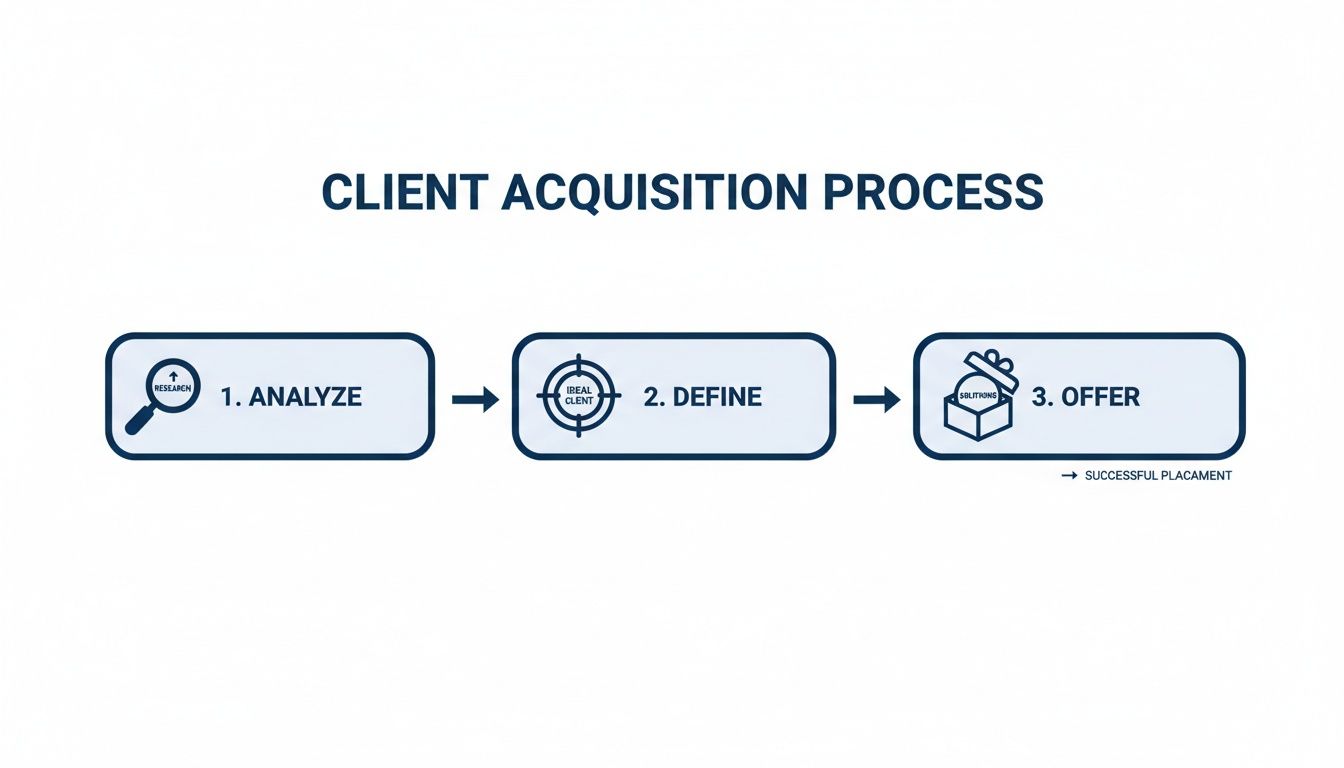
This foundational analysis ensures every asset you build has a clear purpose: attracting the right people.
Middle of Funnel (MOFU): Nurturing Trust
Once someone downloads your lead magnet, they’ve entered the MOFU. They’ve raised their hand and shown interest. Now, the mission is to build trust and position your company as the only logical solution to their problem.
This is where most funnels fall apart. Businesses grab a lead and then either immediately hit them with a hard sales pitch or just forget they exist. Consistent, valuable follow-up is non-negotiable.
Your workhorse here is an automated email nurture sequence. This is not a spammy blast of sales pitches. It’s a short series of 3-5 emails, dripped out over a week or two, designed to educate, build rapport, and demonstrate expertise.
A solid sequence often looks something like this:
- Email 1 (Instant Delivery): Deliver the lead magnet they asked for. Use this chance to briefly restate your core value proposition.
- Email 2 (2 Days Later): Share a related tip or a quick case study that proves you know what you’re talking about.
- Email 3 (4 Days Later): Tackle a common misconception or objection head-on. Show them you understand their world.
- Email 4 (7 Days Later): Introduce your core offer as the logical next step. Include a clear call to action, like booking a discovery call.
Each email should be short, helpful, and written in a personal, direct tone. You're guiding them, not nagging them.
Bottom of Funnel (BOFU): Driving Conversion
Down at the BOFU stage, your prospect is on the verge of making a decision. They trust you and believe you can help. The assets here are all about removing any last-minute friction and making it incredibly easy to take action.
Essential BOFU assets include:
- A Clear Sales or Case Study Page: This is where you go deep on your core offer. It should be packed with client testimonials, specific results, and a clear breakdown of your process.
- A Simple "Book a Call" Page: Don't make them work for it. Use a tool like Calendly to let prospects pick a time that works for them, which cuts out all the frustrating back-and-forth emails.
For our manufacturing clients, a well-built funnel like this makes a massive difference. Industry benchmarks show a 26% conversion from a lead to a Marketing Qualified Lead (MQL). From there, the funnel gets even tighter, with 41% of MQLs becoming Sales Qualified Leads (SQLs) and an impressive 51% of those SQLs converting into closed deals. These numbers, highlighted in sales funnel statistics on PassiveSecrets.com, show how building the right assets for each stage translates directly into revenue.
Automating Your Funnel with GoHighLevel
Building out your landing pages and emails is a solid start. But what if they could work for you 24/7, without you lifting a finger? That’s where automation becomes the engine driving your entire sales funnel, turning repetitive, manual tasks into a hands-off, efficient system.
This is precisely what platforms like GoHighLevel were built for. They bring all your marketing, sales, and communication tools under one roof. Forget trying to duct-tape different services for your CRM, emails, and landing pages. Here, you get a single, cohesive system where everything just works together. This isn't just about convenience—it's a massive strategic advantage.
At its core, automation is your safety net. Its main job is to make sure not a single opportunity falls through the cracks.
Setting Up Smart Follow-Up Sequences
The moment a prospect downloads your lead magnet, the clock starts ticking. A lead’s interest has a very short shelf life. An automated welcome sequence ensures you connect with them instantly, right when their problem is top of mind.
Inside GoHighLevel's workflow builder, you can craft powerful sequences that mix both email and SMS for maximum impact. Here’s how that might look for a B2B service company:
- Trigger: A contact fills out the form on your "10-Point Inefficiency Audit" landing page.
- Immediate Action: The system instantly fires off an email containing the link to their PDF audit.
- 10 Minutes Later: An SMS hits their phone: "Hi [First Name], just confirming you got the audit we sent over. Let us know if you have any questions. – Karl @ Machine Marketing"
- 2 Days Later: An email follows up, sharing a quick case study about a client who solved one of the issues mentioned in the audit.
- 4 Days Later: Another email asks a pointed question: "Was point #7 on the audit something you're seeing in your facility?"
This multi-channel approach feels incredibly personal and responsive, yet it's 100% automated. You're building a relationship without doing any of the manual work. To get the most from tools like GoHighLevel, it helps to understand the foundational ideas behind them. For a great deep dive, check out this guide on What Is Marketing Automation?.
Using Behavioral Tagging and CRM Automation
True automation is much more than just timed messages. It's about reacting to what your prospects actually do. What a person clicks on tells you everything you need to know about what they care about.
With a tool like GoHighLevel, you can set up rules that automatically "tag" contacts based on their behavior.
- Clicked a link about "Service X"? Tag them with
Interest-ServiceX. - Visited your pricing page twice? Tag them as a
Hot-Leadand send a notification straight to a sales rep. - Opened 4 of 5 emails in your nurture sequence? Tag them as
Engaged.
This isn't just about collecting data; it's about generating real business intelligence. These tags let you slice and dice your audience to send them hyper-relevant messages. Instead of a one-size-fits-all blast, you can send a special offer for "Service X" only to the people who've shown they're interested in it.
This is exactly how you build a smarter, more responsive sales system.
Even better, a connected CRM lets you automate the handoff from marketing to sales. When a lead earns that Hot-Lead tag, a workflow can automatically:
- Create an "opportunity" in your sales pipeline.
- Assign that lead to a specific sales rep.
- Create a task for that rep to "Call within 24 hours."
This completely closes the gap between marketing and sales, ensuring your hottest leads get immediate attention. Your sales team is freed from tedious data entry and can focus on what they do best: talking to qualified prospects and closing deals. This systematic approach is how you turn a simple funnel into a true revenue-generating machine.
Measuring and Optimizing Your Funnel for Growth
Getting your funnel live is a huge milestone, but it's just the beginning. A sales funnel isn't a "set it and forget it" project; it’s a living system that needs constant attention. To get real results, you have to think like an engineer—always measuring, diagnosing, and tweaking the system to squeeze more performance out of it.
This is where you stop guessing and start making decisions based on cold, hard data. Your job is to hunt down the bottlenecks, friction points, and hidden opportunities for small wins. Over time, these tiny adjustments compound into massive improvements in your ROI.
Identifying Your Core Funnel Metrics
You can’t fix what you can’t see. But tracking every metric under the sun is a recipe for analysis paralysis. Instead, we focus on a handful of Key Performance Indicators (KPIs) that give a crystal-clear health report on your funnel.
Start by zeroing in on these essentials:
- Landing Page Conversion Rate: Of all the people who hit your lead magnet page, what percentage actually signs up? If this number is low (below 20% for cold traffic is common but a red flag), it usually points to a mismatch between your ad and your headline, or an offer that just isn't compelling enough.
- Cost Per Lead (CPL): How many ad dollars does it take to get one new person onto your email list? This number is your compass for managing ad spend and understanding your upfront acquisition costs.
- Email Open/Click-Through Rates (CTR): Are your nurture emails even being opened? Are people clicking the links inside? Bad open rates mean your subject lines are falling flat. Bad CTRs tell you the email copy or call-to-action needs work.
- Cost Per Acquisition (CPA): This is the bottom-line metric. How much does it cost, in total, to land one paying customer? For your funnel to be profitable, your CPA has to be sustainably lower than your Customer Lifetime Value (LTV). No exceptions.
To get these numbers right, you need the right tools. Familiarizing yourself with platforms like Google Tag Manager is a game-changer for serious funnel optimization. It lets you add tracking codes (or "tags") across your site to watch conversions, clicks, and other key actions without having to constantly bother your developer to edit the code.
The Power of Systematic A/B Testing
Once you have your baseline numbers, it’s time to start improving them. The most powerful method we use for this is A/B testing, also known as split testing. The idea is simple: you create two versions of one thing—a landing page, an email, an ad—and change only a single variable.
You show version A to 50% of your audience and version B to the other 50%. The one that performs better against your target KPI is your winner. It becomes the new "control," and you test another variable against it.
A common mistake we see is testing too many things at once. If you change the headline, the image, and the button color all at the same time, you have no idea which change actually caused the improvement. The key is to be scientific—test one variable at a time.
A Simple A/B Testing Framework:
- Form a Hypothesis: Start with an educated guess. For instance: "Changing the headline from 'Download Our Guide' to 'Stop Losing Leads With This 10-Point Audit' will boost conversions because it speaks directly to a pain point."
- Create Your Variation: Clone your original landing page and change only the headline.
- Run the Test: Use your ad platform or landing page builder to split traffic evenly between the two pages.
- Analyze the Results: Wait for a statistically significant amount of data (we aim for at least 100 conversions per variation). The page with the higher conversion rate wins.
- Implement and Repeat: Make the winning page your new default and find your next variable to test. Maybe it's the button text, the form fields, or the main image.
This disciplined cycle of testing and measuring is how you engineer a funnel that gets smarter and more profitable every single month. It’s what turns marketing from a guessing game into a predictable growth engine for your business.
Common Questions About Creating a Sales Funnel
Even the most detailed guide can leave you with practical questions. Building a sales funnel is a serious project, and it’s smart to understand the timeline, common pitfalls, and tools you’ll need before you start.
We hear the same questions from business owners again and again. Here are our direct answers, based on years of building these systems for B2B companies.
How Long Does It Take to Build a Functional Sales Funnel?
This is always the first question, and the honest answer is: it depends on how complex your system needs to be. For most B2B companies, a solid, functional sales funnel can be planned, built, and launched within 30 to 90 days. Trying to rush it is a huge mistake, but so is getting stuck in "analysis paralysis."
Here's a realistic timeline of what to look for:
- Weeks 1-2: Strategy and Diagnosis. This is where the real work happens. You’ll be doing a deep dive into your Ideal Client Profile (ICP), nailing down your core offer, and mapping out every step of the customer journey. Do not skip this part.
- Weeks 3-5: Asset Creation. Now it's time to build. This means creating the lead magnet, writing all the copy for your pages and ads, and building out the landing pages themselves.
- Weeks 6-8: Automation and System Setup. This is the technical lift. You'll be configuring email and SMS sequences, setting up behavioral tags in your CRM, and building the automated workflows that handle all your follow-up.
- Week 9: Launch and Initial Traffic. Time to flip the switch. You’ll turn on your ads or start your organic promotions to get the first wave of prospects into the top of your funnel.
The goal here isn't perfection; it's to launch a Minimum Viable Funnel (MVF). You want to get a functional system live so you can start gathering real-world data and see what’s actually working.
What Is the Biggest Mistake Businesses Make?
Without a doubt, the most common—and most expensive—mistake we see is businesses skipping the upfront strategy work. People get excited about building landing pages and running ads, so they jump right in without a crystal-clear picture of who they’re trying to attract.
When this happens, you end up with a generic funnel aimed at a generic audience. It's a proven recipe for failure.
A sales funnel is a system, plain and simple. If the inputs are flawed—a fuzzy audience definition and a weak offer—the output will always be disappointing. You'll burn through your ad budget attracting the wrong people and wonder why no one is converting.
Taking the time to precisely define your ICP and craft an irresistible offer isn’t a "nice-to-have"; it’s the entire foundation of a system that works.
Do I Need an Expensive Tool like GoHighLevel to Start?
We are huge advocates for an all-in-one platform like GoHighLevel because it's built for scale. That said, if your budget is the primary concern right now, you don’t absolutely need it on day one. You can get started by piecing together a few more affordable, single-purpose tools.
Starting with Separate Tools:
- Landing Pages: You could use a tool like Carrd or Leadpages.
- Email Marketing: A service like Mailchimp or ConvertKit can handle your email sequences.
- CRM: A free version of HubSpot CRM can track your deals.
The big trade-off here is the complete lack of integration. These systems don't talk to each other, which means you're stuck with manual data entry, a disjointed customer experience, and gaps where leads inevitably fall through. For instance, a contact’s behavior on your landing page won't automatically trigger a specific workflow in your email tool. This isn't an ideal system, but it's better than nothing.
If at all possible, we strongly recommend starting with a centralized system. It builds a scalable foundation that grows with you and saves you from the massive headache of migrating all your data, automations, and assets down the road.
At Machine Marketing, we specialize in building these systematic, data-driven funnels that deliver predictable growth. We handle everything from the initial diagnosis and strategy to the hands-on implementation in GoHighLevel.
If you're ready to stop guessing and start building a marketing system that works, book a discovery call with Karl today. We'll help you diagnose the gaps and create a plan for results.