The most popular advice about featured snippets is already incomplete: write a concise answer, add a question heading, and wait for position zero. That playbook ignores how quickly Google's search results have changed. In 2026, a manufacturing marketer has to decide whether a query still deserves a classic snippet campaign, whether it's better suited to an AI Overview and entity strategy, or whether the search is too broad to justify either.
The practical answer is selective optimization. Specification lookups, tolerance clarifications, standards questions, comparisons, and procedural guidance can still bring qualified visitors to an industrial site. Broad definitions and exploratory questions often deserve less attention. We'll show you how to diagnose that difference, format answer blocks Google can extract, reinforce them with sound page structure and markup, and measure whether the work is earning its place in your content system.
Table of Contents
- The Real Featured Snippet Landscape in 2026
- Matching Snippet Formats to Query Intent
- Formatting Answer Blocks That Google Can Extract
- Structuring the Page Around the Snippet Candidate
- Schema and Markup That Reinforce Snippet Eligibility
- Testing and Measuring Snippet Performance Over Time
- Your 90-Day Featured Snippet Action Plan
The Real Featured Snippet Landscape in 2026
Featured snippets remain important, but they're no longer the default destination for every answer-focused query. Google introduced them in January 2014, and by 2026 one large summary reported that they appeared on about 12.3% of search results pages, with the featured-snippet position averaging 35.1% CTR, compared with 31.7% for the standard organic result in position one (Search Engine Land's search marketing history).
That doesn't mean every manufacturer should optimize every “what is” question. A separate 2025 analysis cited in 2026 reporting found featured snippets falling from 15.41% of SERPs in January to 5.53% in June as AI Overviews expanded (Ahrefs' analysis of SERP changes in the AI era). The old answer-first playbook still matters, but it now operates inside a two-track search environment.
Where industrial snippets still earn attention
For manufacturing sites, the strongest opportunities are specific and operational:
- Specification lookups: Buyers want dimensions, materials, pressure ratings, temperature ranges, and compatibility details.
- Tolerance clarifications: Searchers need a precise explanation of terms such as unilateral tolerance, bilateral tolerance, or geometric tolerance.
- Standards questions: Engineers and purchasing teams may search for the practical meaning or application of a named standard.
- How-to queries: Installation, inspection, maintenance, measurement, and setup questions often need ordered instructions.
- Comparison queries: Buyers may compare materials, processes, finishes, machine types, or component options.
Broad educational terms are different. A generic definition may be answered completely in an AI Overview, leaving little reason to click. That doesn't make the page useless, but it changes the business case. You may be better off building entity depth, supporting evidence, and a technically authoritative content cluster than spending hours polishing a single short definition.
| Query Category | 2026 SERP Behavior | Industrial Site Take |
|---|---|---|
| Definitional | Often absorbed or supplemented by AI Overviews | Pursue only when the definition is highly specific, commercial, or standards-related |
| How-to | Classic list and step formats remain viable | Prioritize procedures tied to installation, inspection, maintenance, or equipment use |
| Comparison | Mixed SERP, with snippets and AI-generated summaries | Strong opportunity when the comparison helps a buyer choose a process or product |
| Specification | Structured answers can remain highly useful | High priority, especially for dimensions, tolerances, materials, and operating limits |
| Exploratory | AI systems can satisfy broad research intent | Build entity and topical authority instead of chasing every broad question |
Strategic rule: Treat featured snippets as an amplification layer on top of page-one SEO, not as a shortcut around relevance, authority, or rankings.
Google's own documentation says there's no exact minimum length for a featured snippet. Selection depends on the content, language, and platform, among other factors (Google's featured snippet documentation). The page still needs a clear answer, a useful context, and enough authority to compete. Our answer engine optimization guide is useful when you're deciding how snippet structure should fit into a broader visibility system.
Matching Snippet Formats to Query Intent
Don't edit a page until you know which container Google already prefers. The query itself gives you a starting signal, but the live SERP is the final judge. Search the phrase in the target market, record the visible feature, and compare your page's available content with the format Google is already extracting.
Four intent signals to use
A definitional question usually needs a compact paragraph. A procedural query needs an ordered list or step sequence. A comparison or matrix query needs a real table, while a demonstration query may be better served by video supported by text on the page.
| Query Intent Signal | Target Snippet Format | Confirm via SERP Inlive |
|---|---|---|
| “What is,” “what does,” “meaning of” | Paragraph | Check whether Google displays a concise explanatory block |
| “How to,” “how do I,” “installation steps” | Numbered list | Look for ordered steps, video results, or both |
| “X vs Y,” “difference,” “comparison,” “chart” | Table | Check whether the SERP favors rows, columns, or prose |
| “How to demonstrate,” “how to use,” visual task | Video | Confirm that video results appear prominently for the query |
The table is intentionally practical. If Google shows a video for a machining setup query, forcing a numbered list won't address the visual intent. If the SERP presents a paragraph for a tolerance definition, don't turn the answer into a decorative comparison table because tables look more authoritative.
A fast live-SERP decision
- Search the exact query and close variants. Record the featured-snippet type, AI Overview presence, People Also Ask results, and video visibility.
- Identify the dominant answer shape. Look for a paragraph, list, table, or video rather than guessing from the wording alone.
- Check your page's evidence. Don't target a table if you don't have reliable values. Don't target a how-to list if the page lacks a complete procedure.
- Choose one primary container. Supporting formats can appear later, but the candidate answer should have one clear job.
- Recheck intent after editing. Google may change the result layout, especially for broad informational queries.
Use related concepts to improve topical coverage, but don't stuff every variation into one block. A practical explanation of latent semantic indexing and SEO can help your team think about related terminology without turning the page into a list of forced synonyms.
Formatting Answer Blocks That Google Can Extract
Google needs a clean unit of meaning. Write the answer so a reader can understand it without the surrounding paragraph, then add depth below it for visitors who need specifications, caveats, examples, or implementation guidance.
Paragraph snippets
Use a heading that matches the question, followed immediately by one declarative answer. A useful drafting range is 40 to 60 words, based on independent SEO guidance summarized by Advanced Web Ranking, although Google itself doesn't publish a formal word-count rule (Advanced Web Ranking's featured snippet guidance).
A practical pattern looks like this:
What is unilateral tolerance? Unilateral tolerance allows a manufactured dimension to vary in only one direction from its stated target. A drawing may permit material to remain above or below a nominal value, but not both. Engineers use this convention when fit, assembly clearance, or process control requires variation on one side of the reference dimension.
Place the block directly under the matching H2. Don't open with history, a sales message, or a large image. The explanation, examples, and technical exceptions belong after the extractable answer.
Numbered lists
Use 4 to 8 steps when the process has a sequence. Each item should use parallel grammar, start with a verb, and express one action. Native ordered-list markup is preferable to styled text that only looks like a list.
- Confirm the drawing: Verify the stated material, dimensions, tolerance, and revision.
- Prepare the equipment: Set the machine, tooling, inspection device, and workholding for the operation.
- Run the process: Produce the part using the approved settings and documented procedure.
- Inspect the result: Measure the required features and record the results against the acceptance criteria.
- Release or correct: Approve the part or document the corrective action before continuing production.
Avoid nested sub-steps inside the candidate block. Put detailed explanations below the list so Google and the reader can distinguish the primary sequence from supporting notes.
Tables
Use a clear header row, consistent units in the column names, and concise cells. Keep each cell under 25 words when possible so a row remains coherent if Google extracts it.
| Process | Best suited material | Primary advantage |
|---|---|---|
| CNC machining | Metals and engineering plastics | Tight control over complex dimensions |
| Laser cutting | Sheet metal and thin plate | Fast profile cutting with limited tooling |
| Waterjet cutting | Heat-sensitive materials | Minimal heat-affected zone |
Don't split the table into visual cards on mobile if the data loses its row and column relationships. A real HTML table with clear headers is easier to interpret than a graphic that contains the same information.
Video snippets
For a demonstration query, publish a YouTube or self-hosted video with a title phrased as the question, timestamped chapters, and a matching H2 plus explanatory paragraph on the page. The video shouldn't replace the text answer. It should show the operation while the page supplies the searchable context, safety notes, specifications, and written procedure.
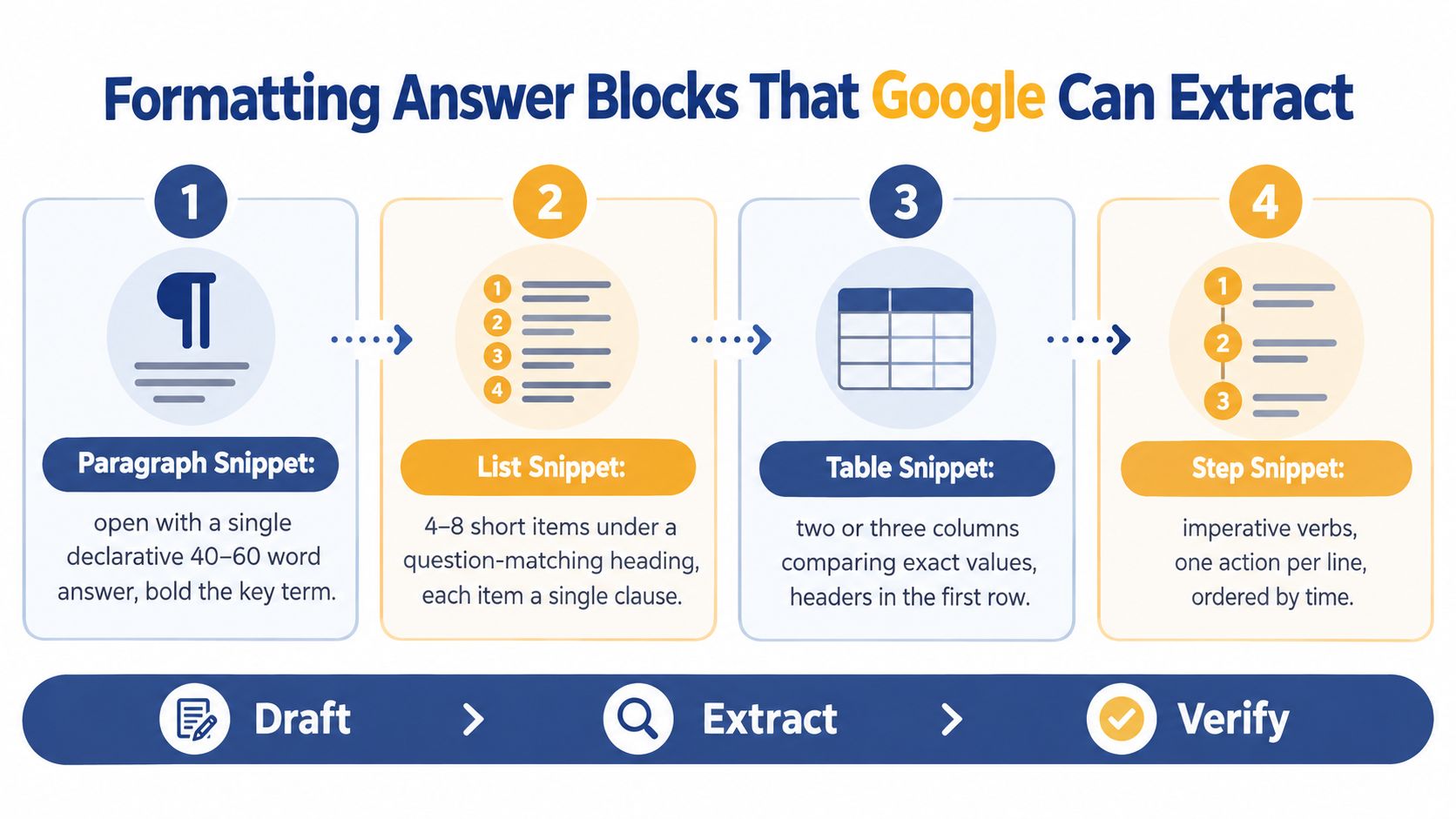
The common failures are predictable:
- Buried answers: Images, product widgets, and introductory copy appear before the candidate block.
- Broken lists: Ads, calls to action, or unrelated notes interrupt the sequence.
- Unstable tables: Responsive layouts split headers from values or turn rows into unrelated cards.
- Overloaded paragraphs: Several questions share one answer, so no single extractable unit is clear.
If your team needs a broader writing system for finding and shaping useful content opportunities, these content optimization techniques to enhance novel discoverability provide helpful supporting ideas. Keep the snippet candidate focused, then let the rest of the page do the selling and technical explaining.
Structuring the Page Around the Snippet Candidate
A strong answer block can still fail if the page makes Google work to find it. Treat the candidate like a component in an engineered system. The heading identifies the question, the first block answers it, and the surrounding content confirms that the page has genuine expertise on the subject.
Use a predictable hierarchy
Use an H2 that matches the target query or a close natural variant. Add H3 headings for supporting topics such as materials, tolerances, applications, limitations, inspection methods, or maintenance requirements.
The candidate should be the first 40 to 60 words under the matching H2, before an image, table, download widget, or product selector interrupts the flow. Supporting paragraphs should add entity-rich context above and below the candidate, ideally within roughly 150 to 200 words on either side when the page structure allows it. This keeps the answer close to terms that establish the subject without turning the opening into a keyword block.
For a manufacturer, the most common structural failure is commercial content arriving too soon. A CAD download component, product carousel, or specification widget may be valuable to a buyer, but it can interrupt the answer Google needs to interpret. Move those elements below the snippet zone, not out of the page entirely.
Run this page check before publishing
- Heading match: Does the H2 state the question naturally?
- First child element: Is the answer paragraph or list the first meaningful content under that heading?
- Mobile access: Can Googlebot see the block without interaction or delayed loading?
- Semantic markup: Does the HTML use real headings, lists, and tables?
- Entity support: Do nearby paragraphs mention the relevant materials, standards, processes, equipment, and applications?
- Internal context: Do related cluster pages link to this page with descriptive anchor text?
- Clean destination: Does the internal link point directly to the page or relevant snippet H2 without distracting parameters?
A cluster page about CNC machining, for example, might link to a tolerance guide with anchor text such as “CNC machining tolerance requirements.” That anchor helps users and search systems understand the relationship. Keep the link useful, not repetitive.
Schema and Markup That Reinforce Snippet Eligibility
Schema doesn't guarantee a featured snippet. It helps search systems interpret visible content, but it can't rescue a page with the wrong format, weak information, or an answer hidden behind a widget.
Use FAQPage schema when the page visibly presents user-facing questions and answers. Use HowTo schema when the page contains a genuine sequential procedure. Use ItemList or appropriate table-oriented structured data when the visible content presents a list or comparison. For industrial pages, Product and Specification schema can clarify products and measurable attributes, while BreadcrumbList helps Google understand how the content fits into the site hierarchy.
Align markup with what visitors can see
| Snippet Format | Recommended Schema | Confirmed Influence on Snippets | Industrial Use Case |
|---|---|---|---|
| Paragraph | No special schema required | Neutral by itself | Tolerance definition or standards explanation |
| Numbered list | HowTo | Supports interpretation of visible steps, not a guarantee | Installation, inspection, or maintenance procedure |
| FAQ | FAQPage | Doesn't force a featured snippet | Public product and engineering questions |
| Table or item list | ItemList or relevant structured data | Reinforces content relationships, not selection alone | Material, process, or component comparison |
| Product specification | Product and Specification | Clarifies product attributes | Dimensions, materials, ratings, and compatibility |
Google's guidance focuses on how well a snippet answers the query and how helpful it is, rather than on a magic markup switch (Google Search help on featured snippets). Google also emphasizes freshness when a query depends on current information (Google's guidance on fresh featured snippet information). For manufacturers, that means schema should reflect current, visible specifications, not stale catalog data.
Don't mass-deploy FAQPage markup on pages where the questions are not presented to users. That creates maintenance work and weakens trust in your implementation. Add schema only when the visible page already matches the format. If you need a starting point, this guide to the best schema markup generators can help your team compare tools, but validate every generated output manually.
Before publishing, test the page with Google's Rich Results Test and the Schema Markup Validator. Then complete a broader technical SEO audit checklist so crawlability, rendering, canonicals, and internal linking don't undermine the content structure.
Testing and Measuring Snippet Performance Over Time
A snippet campaign needs a baseline, a defined cohort, and a review cadence. Individual wins are useful, but they can create a misleading story when the SERP changes the following week. Track ownership across the target query set, then segment the results by intent and AI Overview presence.
Build the baseline
Use Ahrefs, Semrush, or STAT to record the current snippet owner, your organic position, the visible snippet format, and whether an AI Overview appears. Add the same fields to a shared sheet with the query, URL, target format, page owner, last update, and next action.
Your primary KPI should be snippet ownership rate across the target set, not the existence of one isolated win. Separate clean SERPs from queries where AI Overviews occupy the answer space. A page can be well optimized and still have a poor business opportunity if Google no longer displays the classic feature for that query.
Run weekly SERP checks for 90 days. Log changes rather than relying on memory:
- Ownership: Did your URL win, lose, or remain absent?
- Organic position: Did the page stay within the first ten results?
- Format: Did Google switch from paragraph to list, table, or video?
- AI Overview status: Is the query now showing an AI-generated result?
- Click behavior: Did impressions, clicks, and CTR change in Search Console?
- Competitor movement: Did another page improve its answer structure or supporting evidence?
Diagnose a page-one miss
A page that ranks in the top ten but doesn't win needs a targeted diagnosis, not a full rewrite. Check the answer block, heading match, schema validity, competing format, and semantic context around the candidate.
A large-scale study of 1.4 million featured snippets found list snippets were about 43%, paragraph snippets about 41%, and table snippets about 16% (the featured snippet study on arXiv). Those figures support format matching, but they don't mean every page should use a list. Your live SERP remains more important than a general distribution.
Google's mobile research also emphasizes close alignment between the query and on-page wording, especially when a compact answer appears near the top (featured snippet statistics and mobile guidance). If the page answers “What is bilateral tolerance?” under a vague heading such as “Important engineering concepts,” the fix is obvious. If the SERP favors video, rewriting the paragraph may not solve the underlying mismatch.
Connect visibility to business value
Use Search Console impressions and average position to identify whether the target query had enough exposure before and after the change. Compare CTR for the page across the same query group, but don't claim a causal lift unless the comparison controls for ranking changes, seasonality, competitor movement, and SERP layout.
A 2025 CTR analysis cited in 2026 reporting found an average featured-snippet CTR of 35.1%, falling to 23.4% when the snippet fully answered the query. It also reported that list snippets generated 41% more clicks than paragraph snippets in that analysis (the Ahrefs-based CTR reporting). Use those findings as directional context, not as a promise for your site.
After 60 days without movement, abandon or downgrade the target if the page has stable page-one visibility, the format matches the SERP, and the candidate is technically accessible. Redirect the effort to a higher-intent specification, comparison, or standards query.
Your 90-Day Featured Snippet Action Plan
Snippet work pays back for industrial sites when the query sits close to a buying, specification, evaluation, or implementation decision. It's a weaker investment when the searcher wants a broad definition that an AI Overview can answer without a click. Your team should prioritize opportunities where a precise answer leads naturally to a drawing, product page, engineering consultation, quote request, or process comparison.
Days 1 to 30 for diagnosis and quick wins
Start with a query inventory. Group terms into specifications, tolerances, standards, procedures, comparisons, definitions, and exploratory questions. Record the current SERP format, ranking position, AI Overview presence, page URL, and commercial relevance.
Then fix the pages already close to eligibility:
- Rewrite the opening block: Put one direct answer immediately under a query-matching heading.
- Match the container: Use a paragraph, ordered list, table, or video based on the live SERP.
- Remove interruptions: Move images, CAD widgets, downloads, and calls to action below the candidate.
- Strengthen internal paths: Link relevant cluster pages to the target with clear anchor text.
Days 31 to 60 for depth and markup
Add supporting content that proves the page understands the technical subject. Cover materials, standards, applications, limitations, measurement methods, and related terminology without bloating the answer block.
Deploy schema where it reflects visible content. Use HowTo for actual procedures, FAQPage for genuine user-facing Q&A, Product and Specification markup for product attributes, and BreadcrumbList for content grouping. Don't mass-publish FAQ markup just because a plugin makes it easy.
This is also the right time to create comparison content that helps buyers choose between manufacturing processes or materials. For teams serving construction and field-service audiences alongside industrial buyers, practical marketing articles for contractors can provide useful ideas for translating technical expertise into decision-focused content.
Days 61 to 90 for measurement and iteration
Review weekly SERP records, Search Console data, snippet ownership, organic position, and AI Overview changes. Refresh answer blocks that have lost visibility, test a different format when the SERP has changed, and stop investing in targets that have no movement after the defined review period.
Use this one-page handoff for your writers and developers:
- Select the query: Confirm page-one relevance and commercial or operational value.
- Scan the SERP: Record the current feature, format, competitors, and AI Overview presence.
- Choose the block: Draft one paragraph, list, table, or video-supported answer.
- Place it correctly: Put the candidate first under the matching heading.
- Support the topic: Add nearby technical context and relevant internal links.
- Validate the markup: Test visible schema and correct any errors.
- Track the cohort: Log ownership, position, format, impressions, clicks, and CTR weekly.
- Make the call: Improve, redirect, or abandon after the review window.
The verdict is simple. Don't stop doing snippet optimization, but stop treating it as a universal content tactic. Skip broad definitional battles already absorbed by AI Overviews, skip mass FAQPage deployment, and invest more time in buyer comparisons, specifications, tolerances, standards, and procedures. For the broad queries you still need to own, build entity depth and evidence so the same page can qualify for AI Overview visibility as well as classic snippets.
Machine Marketing helps manufacturers diagnose content gaps, prioritize industrial SEO opportunities, and build the technical content system behind qualified B2B leads. If you want a clear assessment of which queries deserve snippet work and which need a broader entity or AI Overview strategy, visit Machine Marketing and request a focused marketing diagnosis.