You've probably seen this product page before. An engineer arrives through search, finds accurate dimensions and a long specification list, then still has to email sales to ask whether the component fits the existing system, works in the intended environment, or stays within the required operating limits. The page documents the product, but it doesn't help the buyer make a decision.
That's the practical problem behind how to write product descriptions for industrial products. Strong copy isn't decorative text placed beside a photograph. It's a technical evaluation system that connects buyer intent, use case, specifications, compatibility, proof, objections, and the next action. We'll build that system in a way your marketing, engineering, and sales teams can reuse.
Table of Contents
- Why Industrial Product Descriptions Fail
- Diagnose the Buyer and Use Case
- Turn Technical Features Into Buyer Benefits
- Structure Copy for Search and AI Answers
- Build the Description in Your CMS
- Improve Examples and Test Meaningful Changes
- Audit, Approve, and Publish
Why Industrial Product Descriptions Fail
More specifications don't automatically create more qualified inquiries. A page can contain every approved measurement and still leave the reader uncertain because the information isn't organized around the decision they need to make.
Copied manufacturer text creates one common failure. It describes what the product is, often in language written for a catalog or internal engineering document, but it doesn't explain who should use it, where it fits, or what the buyer should verify before requesting a quote. Unsupported superlatives such as “best-in-class,” “advanced,” and “high performance” add little when the page doesn't show the evidence behind them.
A dense feature list creates a related problem. “Stainless steel housing, digital output, automatic calibration, IP-rated enclosure” may be accurate, but the reader still has to translate each item into an operational consequence. Does the enclosure suit washdown conditions? Which interface does it connect to? Does automatic calibration reduce setup work, or does it depend on a particular configuration?
Documentation is not evaluation
A useful description answers the questions a qualified visitor is already asking:
- Fit: Is this product suitable for my application?
- Compatibility: What does it connect to, replace, or require?
- Operating conditions: Where can it work reliably, and where can't it?
- Evidence: Which claims are supported by drawings, tests, ratings, or documented results?
- Next action: What information should I provide to confirm suitability?
A 2019 empirical study of more than 90,000 Rakuten product descriptions found that wording influenced sales, with authority signals, polite language, and informative or seasonal cues performing better. The wider lesson is especially useful for industrial teams: product copy is a commercial lever, and specific, context-rich language is more useful than generic wording when buyers compare alternatives. You can review the study summary in this analysis of product-description optimization.
Practical rule: If a qualified buyer must contact sales to discover basic fit information, the page is incomplete, regardless of how technically accurate it looks.
That doesn't mean copy solves every commercial problem. It can't repair an unsuitable offer, missing test evidence, incorrect specifications, poor imagery, or a slow quotation process. It can reduce uncertainty, expose a safe next step, and disqualify poor-fit applications before they consume engineering time.
For teams improving product presentation more broadly, the guide from Bruce and Eddy is a useful reminder that visual and written product information need to work together. A photograph can show construction, but the description still needs to explain application, limits, and verification.
Diagnose the Buyer and Use Case
Before writing a sentence, define the decision that the page needs to support. One product may have several audiences, but a useful page starts with a specific buying situation, not an abstract target market.
Identify four roles:
- The problem owner feels the operational pain, such as downtime, inconsistent output, difficult maintenance, or integration delays.
- The technical evaluator checks dimensions, materials, interfaces, tolerances, ratings, and compliance.
- The user or installer needs to know how the product is handled, configured, maintained, and operated.
- The purchasing contact needs commercial details, lead-time information, documentation, and a clear route to a quote.
These roles may belong to one person in a small manufacturer or several people in a larger organization. Don't force one generic voice across all of them. Give each reader the information needed to move the evaluation forward.
Mine the language buyers already use
Build your brief from evidence already inside the business. Review RFQs, sales-call notes, support tickets, search queries, drawings, installation manuals, and customer reviews. Look for repeated phrases, not just repeated topics. A buyer may search for “sensor for abrasive slurry,” while your internal team calls the same requirement “wear-resistant measurement equipment.”
Ask:
- What application is the buyer trying to complete?
- Which material, process, or environment affects suitability?
- What must the product connect to?
- Which dimensions or tolerances could stop installation?
- What operating limits create a safety or performance boundary?
- What question causes sales to send a drawing or manual?
- What would make a qualified buyer reject the product quickly?
A buyer persona can organize these observations, provided it stays connected to real evidence. This buyer-persona creation framework can help your team document role, priorities, objections, and decision context without turning the exercise into fictional demographic detail.
Create a shared research brief
Use a simple table before drafting:
| Input | Questions to Answer | Page Value |
|---|---|---|
| Application | What process, machine, or task is the product intended for? | Gives the opening a concrete use case |
| Environment | What temperature, moisture, dust, chemicals, vibration, or exposure matters? | Defines suitability and limits |
| Interface | What does it connect to, replace, or require? | Reduces compatibility uncertainty |
| Performance | Which capacity, tolerance, speed, or accuracy affects the decision? | Prioritizes commercially relevant specifications |
| Compliance | Which standards, certifications, or documents apply? | Provides verification points |
| Objections | What do buyers ask before approving the product? | Turns sales friction into FAQs |
| Procurement | What information is needed for a quote or technical review? | Makes the CTA useful |
Separate essential evaluation criteria from accurate but low-value detail. A finish description may matter for corrosion resistance, but not as a standalone selling point. A connector type may be more commercially important than a long list of general materials because it determines whether the product can enter the buyer's system.
Turn Technical Features Into Buyer Benefits
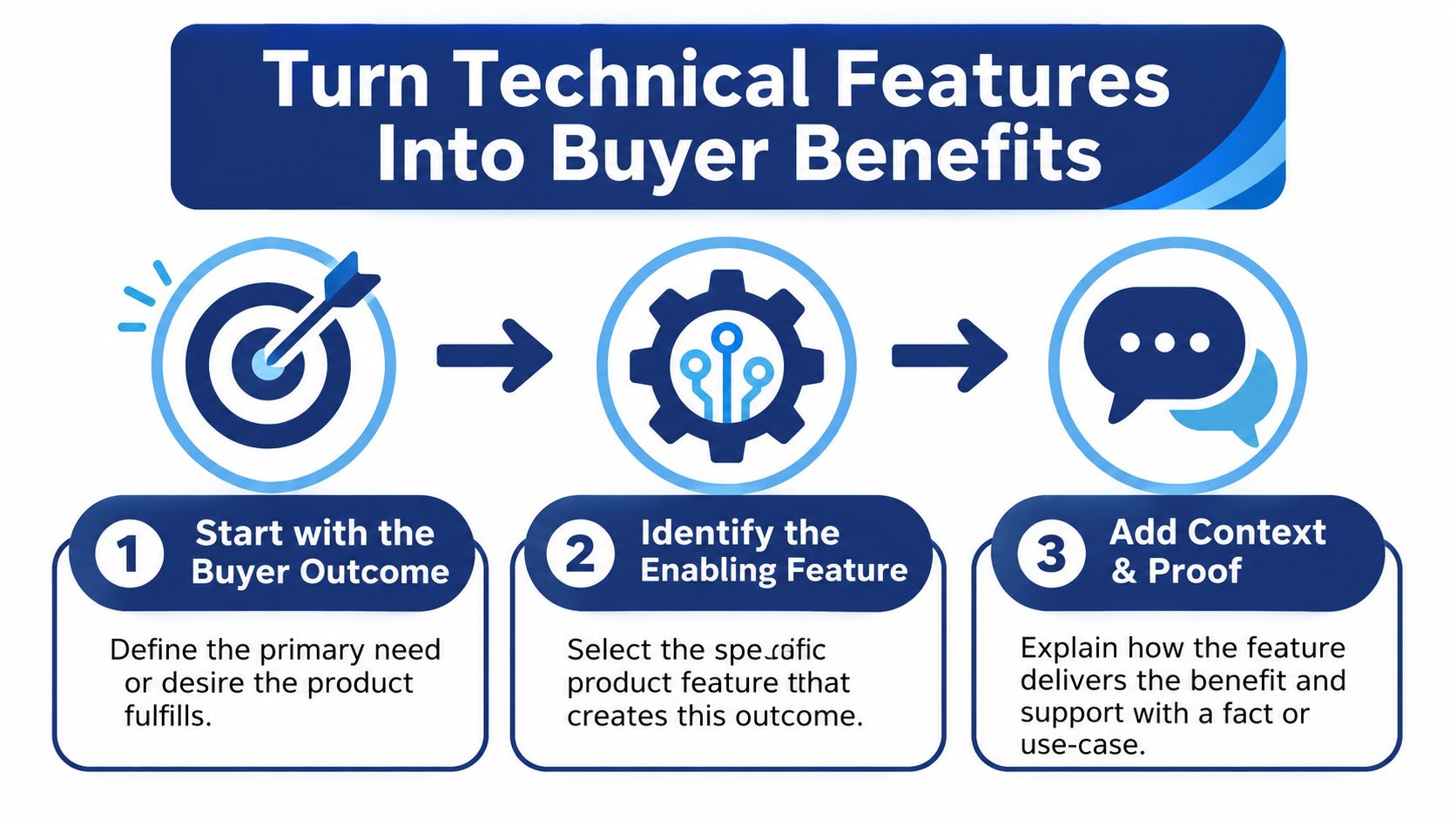
A feature earns space on the page when the buyer can understand its operational consequence. The safest drafting pattern has three linked layers:
Outcome, mechanism, proof.
Start with the outcome the buyer needs. Name the feature that enables it. Then provide the evidence, condition, or use-case context that makes the statement credible.
Consider an industrial sensor with a sealed enclosure. A weak description says:
“The sensor features a sealed enclosure for reliable operation.”
That sentence repeats a feature and attaches a vague adjective. A stronger version would be written only after the technical team confirms the relevant rating and conditions:
“Designed for measurement points exposed to dust and moisture, the sealed enclosure helps protect the internal electronics during the stated operating conditions. Confirm the enclosure rating, mounting orientation, and chemical exposure requirements against the application before ordering.”
The second version is more useful because it gives the reader an application, a mechanism, and a boundary. It doesn't imply that “sealed” means suitable for every environment.
Build the claim without overreaching
Use this worksheet for each priority feature:
- Buyer outcome: What does the buyer need to achieve?
- Enabling feature: Which product characteristic creates that possibility?
- Mechanism: How does the feature contribute?
- Proof: Which drawing, test, rating, manual, or documented result supports the claim?
- Limit: What configuration, installation, maintenance, or environmental condition affects it?
- Next action: What should the buyer confirm or submit?
For example, “standardized interface” may support easier integration, but only when the buyer's existing controller or machine uses the compatible interface. “Automated calibration” may reduce setup effort, but the page should state whether calibration requires a particular software package, reference, or maintenance procedure.
A practical guide to writing a value proposition can help your team sharpen the outcome statement, but industrial copy must keep the technical conditions intact. A concise benefit isn't permission to remove important qualifications.
Put proof close to the claim
Don't hide the evidence in an unrelated downloads area if the claim depends on it. Place the relevant rating, test reference, drawing link, or configuration note beside the benefit. If the proof isn't available, soften the language rather than filling the gap with confidence.
This video provides another visual explanation of benefit-led messaging:
The page should help a buyer understand both why the feature matters and when it may not be enough. That balance builds more confidence than universal claims.
Structure Copy for Search and AI Answers
Treat the product description as a technical evaluation system. A buyer should be able to identify the product, test its fit, find the evidence, and resolve common objections without reconstructing the page from scattered phrases.
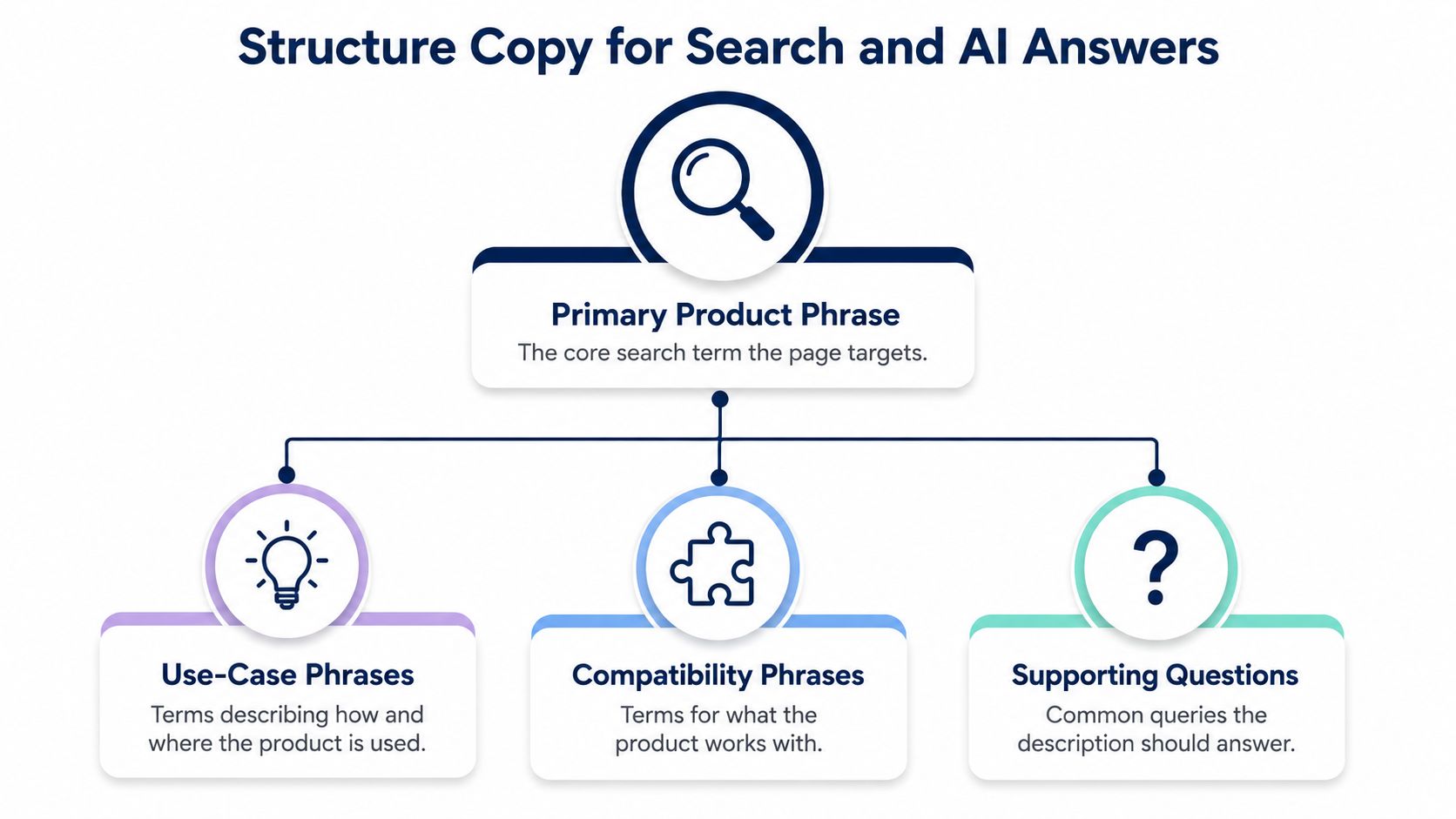
Choose one primary product phrase that accurately names the item. Add terms for application, compatibility, configuration, and buyer questions only when they reflect how engineers and purchasers evaluate the product. A page for a “stainless steel pressure sensor” might need language about process monitoring, threaded connections, output type, temperature range, and compatible control systems. Each term should answer part of the fit decision.
Give each page element a job
Use a deliberate page architecture:
- Product title and main heading: Identify the product plainly and include the primary phrase where it fits naturally.
- Opening summary: State the intended use and main buyer outcome early.
- Subheadings: Separate application, benefits, specifications, compatibility, documentation, and FAQs.
- Specification blocks: Present measurements and ratings in a controlled, readable format.
- FAQs: Answer fit, installation, maintenance, shipping, warranty, and configuration questions directly.
- Meta description: Summarize the actual page and give searchers a reason to inspect it, consistent with Google's guidance on search snippets and meta descriptions.
One product-page SEO guide recommends 300+ words, unique copy across the site, the primary keyword within the first 100 words, specifications, and answers to customer questions. Apply that guidance to the product's evaluation needs. Complex equipment may require substantial detail, while a simple item should not gain padding merely to reach a target. Use the relevant product-page SEO recommendations as a quality check, not a script for repetition.
Title tags are separate from the authored description. Independent SEO guidance commonly recommends keeping title tags under about 60 characters and meta descriptions around 150–160 characters, as explained in this product-description SEO guide. These constraints apply to search-result copy, not the product-page content.
For AI-generated answers, write plain declarative sentences and organize recurring questions into structured FAQs. The guide to product descriptions for search and AI explains this approach. Review how to optimize for AI search alongside the page's technical requirements, then verify every answer against approved specifications. Clear structure improves extraction, but it cannot make inaccurate data trustworthy.
Build the Description in Your CMS
An approved draft still has to survive the CMS. Industrial product pages often fail during implementation because specifications appear in multiple fields, editors shorten away important limits, or mobile users encounter a large block before reaching the information they need.
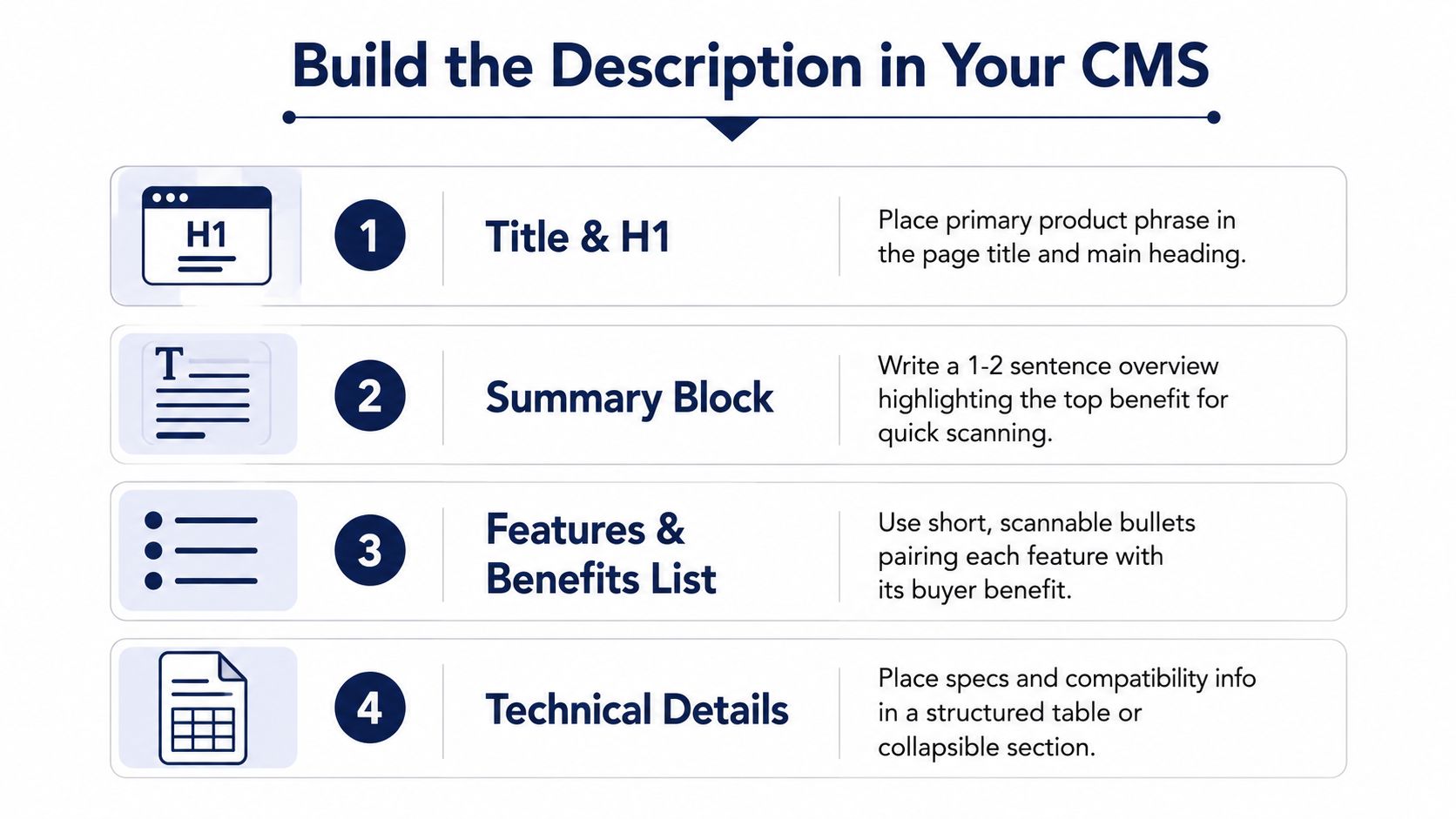
Use a stable hierarchy:
- Outcome-led introduction: Identify the product, intended application, and primary operational value.
- Core benefits: Pair the most important features with their buyer consequences.
- Application context: Describe suitable environments, materials, interfaces, and typical installation conditions.
- Technical specifications: Put verified dimensions, ratings, capacities, materials, and options in a structured table.
- Compatibility and limits: State what the product works with and where configuration or engineering confirmation is required.
- Proof and documentation: Link relevant drawings, manuals, certifications, test documents, and revision information.
- FAQs: Resolve the questions that otherwise reach sales or support.
- Inquiry action: Ask for the information needed to assess fit, such as application, operating conditions, drawings, or required quantity.
Separate fields from authored content
Keep fixed CMS fields consistent:
- Product name
- Part number
- Manufacturer or product family
- Primary category
- Title tag
- Meta description
- Revision date
- Document links
- Availability or quote status
Put interpretation and application guidance in the authored content. Don't maintain the same specification manually in the introduction, bullet list, table, and FAQ. Store one approved value, then reference it consistently where the CMS permits.
Format for scanning and review
Use short paragraphs, descriptive headings, bold lead-ins, and grouped bullets. A technical table should contain only information that helps evaluation. If the table becomes too wide on mobile, use a responsive layout or a collapsible details block, but keep critical fit information visible.
Images should show the product clearly and include useful captions. A caption such as “Rear connector view showing the standard interface” supports evaluation better than “Product image.” Make sure accessibility text describes the image's purpose rather than repeating the product name.
Finally, preserve traceability. Each consequential claim should map to a drawing, manual, test document, certification, or approved engineering source with a revision date. Marketing can improve the wording, but engineering or compliance must approve technical claims before publication.
Improve Examples and Test Meaningful Changes
A weak industrial description often looks like this:
“High-quality modular control unit with advanced technology and robust construction. Features include aluminum housing, digital display, multiple inputs, automatic setup, compact dimensions, and flexible mounting. Suitable for many industrial applications.”
The specification list might be accurate, but the buyer still doesn't know which application the unit serves, what it connects to, or whether “automatic setup” applies to the configuration they're considering.
A clearer version would use verified product information and make boundaries visible:
“The modular control unit is designed for operators who need to monitor and configure [specific process or equipment]. Its digital display presents [verified information], while the [verified interface or input type] supports connection to [compatible system]. The aluminum housing suits [confirmed environment or installation condition]. Automatic setup is available when [stated configuration or requirement applies]. Review the mounting drawing and input specifications before requesting a quote, and include your equipment interface, operating environment, and required inputs so we can confirm fit.”
The brackets aren't publishable copy. They show where the writer must obtain evidence rather than inventing a benefit. The revision is stronger because it connects the product to a use case, translates selected features into operating value, states a condition, and gives the buyer a useful next step.
Test the meaning, not just the wording
Create an experiment log with five fields:
- Hypothesis: Buyers can identify the intended application more quickly when the opening leads with the use case.
- Change: Replace the generic introduction with an outcome-led summary.
- Decision metric: Track qualified inquiries, fit-related questions, quote requests, or sales feedback.
- Review period: Choose a period that matches the product's buying cycle.
- Result and decision: Record what changed, what didn't, and whether the revision stays.
Test one meaningful variable at a time. Candidates include the opening benefit, specification order, proof placement, FAQ coverage, or CTA language. Traffic alone isn't enough. A page may attract more visitors while producing inquiries from poor-fit applications.
Traditional A/B testing has limitations for B2B products. A long buying cycle can separate the page visit from the eventual inquiry, product configurations can make comparisons uneven, and a product may not generate enough page activity for a clean statistical conclusion. Use qualitative signals as well, including sales notes, support questions, RFQ quality, and repeated requests for the same missing document.
Visual merchandising teams face a similar challenge when they use tools such as AI model outfit e-commerce. The presentation changes how people interpret a product, but the useful test still asks whether the new presentation helps the right buyer understand and act. Industrial teams should apply the same discipline to technical copy.
Audit, Approve, and Publish
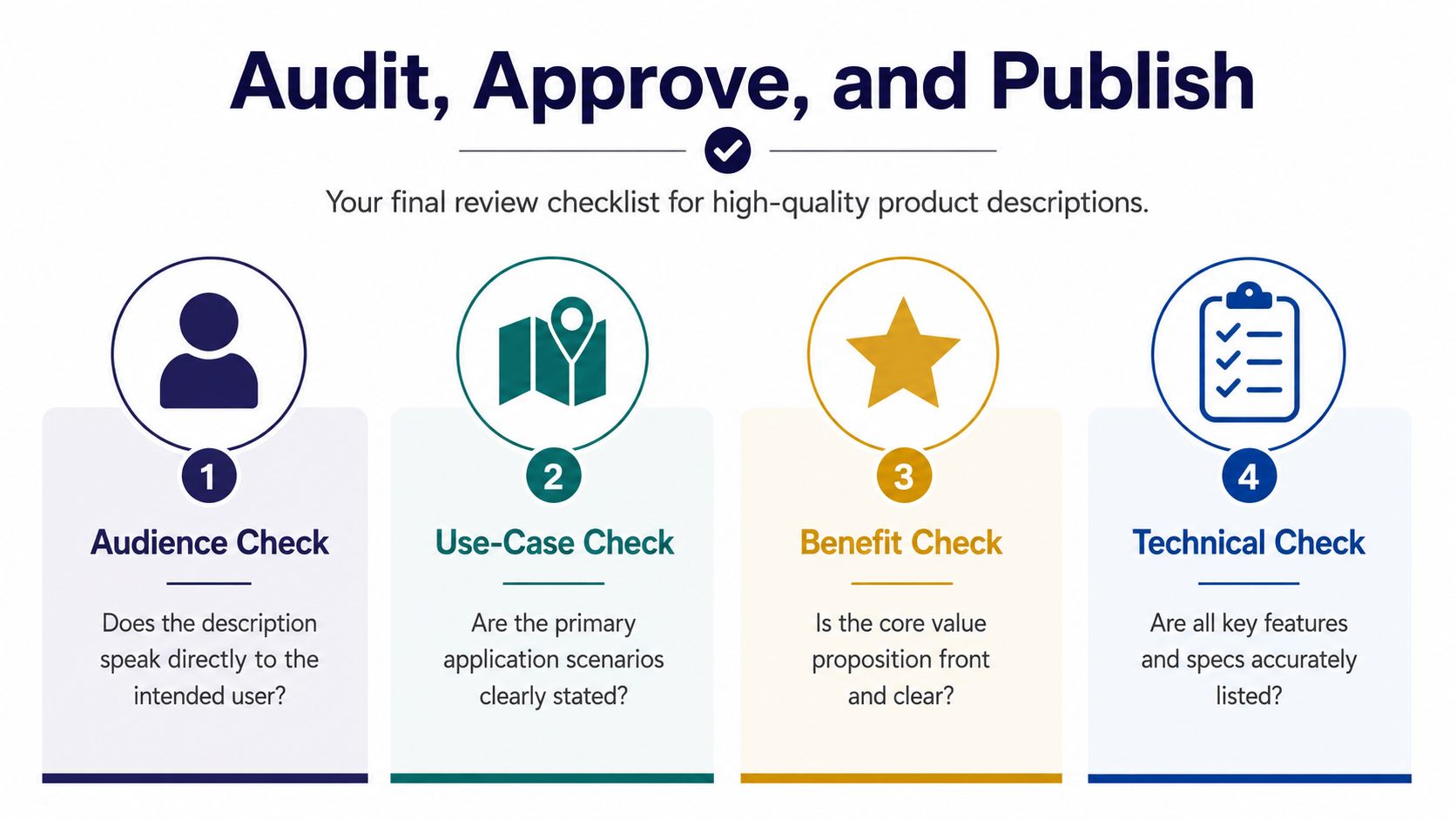
Turn the page review into an SOP rather than a last-minute proofreading task. Use this final audit:
- Audience check: Does the page address the decision-maker, technical evaluator, user, and purchasing needs?
- Use-case check: Is the intended application clear enough to judge relevance?
- Benefit check: Does each major feature connect to an operational outcome?
- Technical check: Are specifications, ratings, interfaces, and limits accurate?
- Proof check: Can important claims be traced to approved evidence?
- Search check: Does the page use one accurate primary product phrase and relevant supporting language?
- Format check: Can a mobile reader scan the opening, benefits, specifications, and CTA?
- FAQ check: Does the page answer recurring fit, installation, care, warranty, and configuration questions?
- CMS check: Are duplicated fields and conflicting specifications removed?
- Measurement check: Is there a documented hypothesis and a meaningful review metric?
Use a clear approval order. Engineering validates claims and boundaries. Sales checks objections, terminology, and inquiry quality. Marketing checks search intent, structure, and readability. The page owner controls revision dates and document traceability.
Ask one final question: Can a qualified buyer decide what to do next from this page? The right outcome may be a quote request, a technical consultation, a document download, or a safe decision that the product isn't suitable.
Select one high-value product today. Audit its opening, use case, compatibility information, proof, and next action, then document one evidence-backed improvement and publish it through the controlled review process.
Machine Marketing helps manufacturers and industrial teams connect product-page content with B2B lead generation, industrial SEO, and a practical marketing system. Visit Machine Marketing to discuss a diagnosis of one product page or build a repeatable content process for your product range.