You're probably in one of two situations right now. Your company builds solid equipment, solves real production problems, and has customers who stick with you for years. But outside your existing network, too few buyers know who you are, what you do, or why they should put you on the shortlist.
That visibility gap hurts more in industrial markets than is commonly understood. Sales cycles are long. Buying groups are cautious. Engineers, operations leaders, procurement, and executives all enter the process with different concerns. If your name doesn't show up early, your sales team spends too much time fighting from behind.
A strong industrial brand awareness strategy fixes that. Not with fluff, and not with vanity metrics. It fixes it by diagnosing where your brand is missing, defining what you should be known for, choosing the channels that fit industrial buying behavior, and measuring whether awareness moves buyers toward consideration.
Table of Contents
- Why Your Best-in-Class Product Is Still Invisible
- The Diagnostic Phase Audience and Market Research
- Defining Your Position and Core Message
- Choosing Your Channels The Omnichannel Playbook
- Building and Measuring Your Awareness Engine
- Your 30/60/90 Day Rollout and Optimization Loop
Why Your Best-in-Class Product Is Still Invisible
A plant engineer has a failure to solve, opens a few tabs, asks a colleague for supplier names, and starts narrowing the list. Your product may outperform every option on the page. If your company does not appear early, clearly, and repeatedly in that process, product quality never gets a fair shot.
That is the visibility problem industrial firms run into. Existing customers know the team is capable. The market outside that customer base often does not. In low-volume, high-value categories, that gap is expensive because each missed shortlist can represent months of sales effort and a meaningful share of annual pipeline.
The causes are usually operational, not mysterious. The website reads like an internal spec archive instead of a buyer-facing decision tool. Sales and applications teams hold the sharpest market insight, but it stays in conversations and inboxes. Marketing activity happens in bursts, with weak ties to real buying triggers. Trade show questions, distributor feedback, and win-loss patterns never get converted into content buyers can locate.
The result is predictable. Awareness stays trapped inside your installed base, referrals, and existing channel relationships. Then leadership asks for more leads, the team launches campaigns, and acquisition costs rise because the market still does not know what your company should be known for.
Practical rule: In industrial markets, awareness shapes consideration long before a quote request shows up in the CRM.
That is why this guide treats awareness as a measurable growth input. The standard B2C playbook is too loose for manufacturers with small buying committees, long sales cycles, and six or seven figure deals. The better approach is to track whether the right accounts are encountering your brand, whether they associate you with a specific technical strength, and whether those signals increase qualified conversation volume over time.
A strong awareness strategy does four jobs. It gives buyers a reason to remember you. It makes your expertise easy to verify. It puts your message in channels buyers already use to reduce risk. It creates measurement points that show whether visibility is improving among the accounts that matter, not just across total traffic.
Quality alone rarely carries that load. Buyers need repeated exposure, clear positioning, and evidence they can trust. The companies that win more often are usually the ones that make discovery easier, recognition faster, and evaluation less risky.
That can be built systematically. The rest of this guide shows how to diagnose the visibility gap, define a position the market can recall, measure awareness in a way that fits industrial buying behavior, and roll it out in a 30/60/90 day plan your team can execute.
The Diagnostic Phase Audience and Market Research
Most industrial companies start too broad. They say they target engineers, plant managers, or OEMs. That's not enough. A useful diagnosis tells you which job titles matter most, what triggers a search for a solution, which objections stall movement, and where buyers go to reduce risk before they talk to sales.
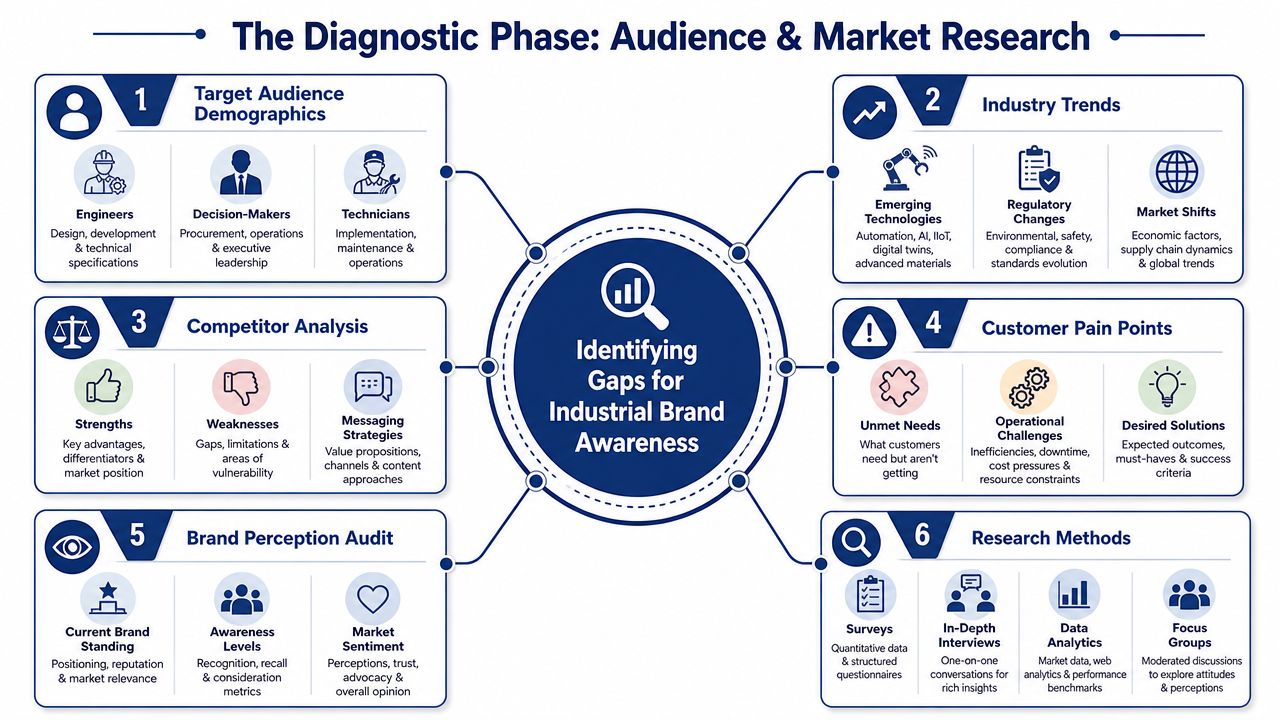
Start with internal evidence
Your sales team usually has the clearest view of the market. They hear the same comparisons, the same misconceptions, and the same buying triggers every week. Treat those conversations as raw diagnostic data.
Use a structured interview format with sales, applications engineering, customer service, and leadership. Ask questions like:
- What starts the buying process: Is the trigger downtime, expansion, compliance pressure, cost reduction, or supplier failure?
- Who shapes the decision: Who asks technical questions, who worries about implementation, and who pushes on price?
- Which competitors appear most often: Not the companies you admire. The names that show up in live deals.
- What buyers misunderstand about us: If the market keeps misclassifying your offer, your awareness problem is also a messaging problem.
- Where trust comes from: Do buyers respond to plant visits, third-party mentions, technical content, referrals, or trade event presence?
Then move into your CRM. If you use GoHighLevel or another CRM, don't just sort by closed revenue. Look for patterns in deal source, sales cycle notes, common pages visited before inquiry, repeated objection themes, and the industries or applications that produce the healthiest customer relationships.
Then validate with market signals
Internal opinions help, but they can also be biased. Validate them with direct customer research and external benchmarks.
A practical research stack includes:
- Customer interviews: Ask recent customers what problem made them start looking, what sources they trusted first, and which brands they considered credible early.
- Quantitative brand surveys: Measure aided recognition, category association, and recall across priority segments.
- Branded-query analysis: Track whether your market searches for your company by name and which related phrases appear alongside branded interest.
- Competitive benchmarking: Compare your visibility, message clarity, and channel presence against the vendors buyers already know.
That last point is important. In industrial categories, the audience can be small and the sales cycle can be slow. If you expect awareness work to show up immediately as closed revenue, you'll kill useful programs too early.
The first signals are usually directional, not dramatic. Better recall, more direct visits, more branded search, more familiarity in sales conversations.
A good diagnostic should leave you with a working map of the market. It should tell you which segments matter most, where your visibility is weak, what your buyers need to hear, and which channels deserve priority. If you can't answer those points clearly, you're not ready to scale awareness. You're still guessing.
Defining Your Position and Core Message
If research tells you where the problem is, positioning tells the market how to remember you. Many industrial firms often become vague here. They describe themselves as high quality, customer focused, or full service. None of that creates a clear memory in a buyer's mind because every competitor says some version of the same thing.
A strong position does one job
It gives buyers a simple reason to associate your company with a specific outcome, capability, or category strength.
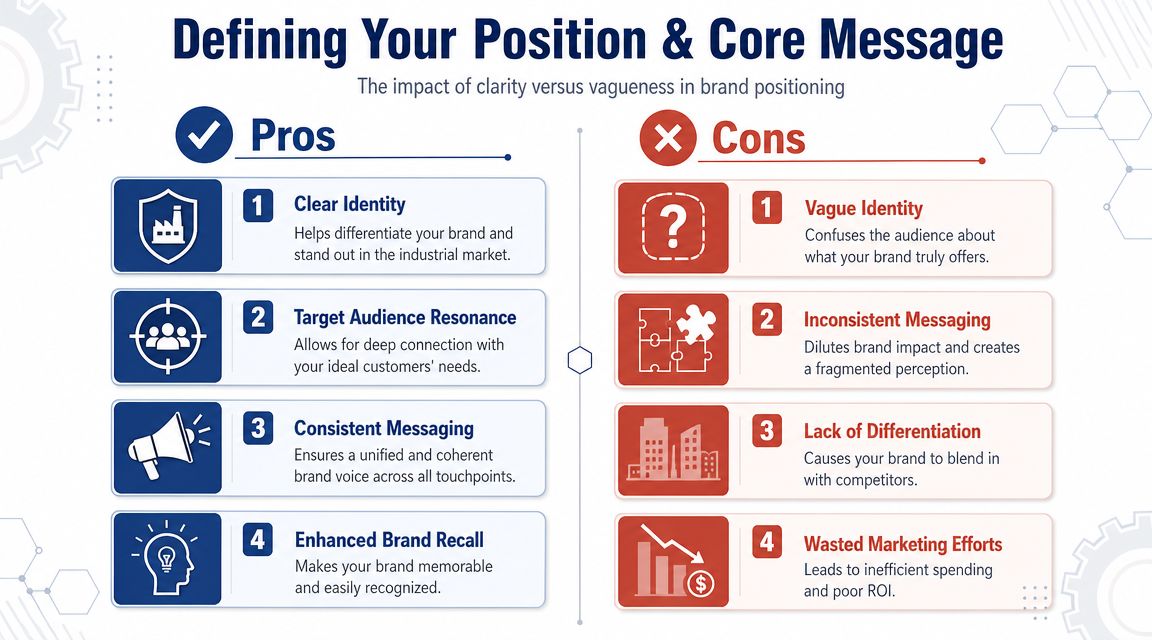
A weak position sounds like this:
- We build quality industrial equipment
- We serve many industries
- We provide custom solutions
A stronger position sounds more like this:
- We help high-mix manufacturers reduce setup friction
- We build automation systems for plants that can't afford long commissioning delays
- We support regulated production environments that need process consistency and documentation confidence
Notice the difference. The stronger version creates category fit, buyer fit, and business relevance. It gives sales, content, SEO, social, trade media, and website messaging the same center of gravity.
Buyers don't remember everything you do. They remember the one thing you consistently attach to your name.
There's a revenue reason to care about message discipline. Research cited by Qualtrics reports that consistent brand presentation can raise revenue by as much as 33%, and that 46% of consumers would pay more to buy from brands they trust. Even in industrial settings, consistency affects trust, and trust affects commercial outcomes.
If you need a deeper framework for this work, strategic brand positioning for B2B companies is where message clarity usually starts.
Build a messaging matrix
Once the core position is clear, adapt it for the people involved in the decision. Don't change the position itself. Change the framing.
A simple messaging matrix can look like this:
| Stakeholder | What they care about | Message angle |
|---|---|---|
| Engineer | Integration, performance, technical fit | Show application depth, constraints handled, technical confidence |
| Operations leader | Downtime, throughput, implementation risk | Show reliability, rollout practicality, support model |
| Procurement | Supplier confidence, total cost, comparability | Show consistency, vendor reliability, buying clarity |
| Executive | Strategic fit, business case, risk reduction | Show long-term value, resilience, and confidence in the choice |
This keeps the brand coherent while making the message usable.
A few rules help here:
- Lead with buyer outcomes: Don't open with your machine list. Open with the production or operational problem you solve.
- Translate technical depth: Keep the detail. But connect it to application value so non-engineering stakeholders can follow it.
- Use repeatable language: If every brochure, page, post, and sales deck describes you differently, the market won't retain anything.
- Cut claims you can't defend: If a phrase can apply to anyone, it isn't positioning.
Positioning isn't a copywriting exercise. It's a strategic filter. Once it's set, channel choices get easier, content gets sharper, and awareness becomes easier to build because people know what to attach to your name.
Choosing Your Channels The Omnichannel Playbook
A common industrial visibility problem looks like this. The company invests in a major trade show, sales follows up for two weeks, LinkedIn goes quiet, the website still reads like a product catalog, and none of the questions buyers asked at the booth turn into content. Activity happened. Market memory did not.
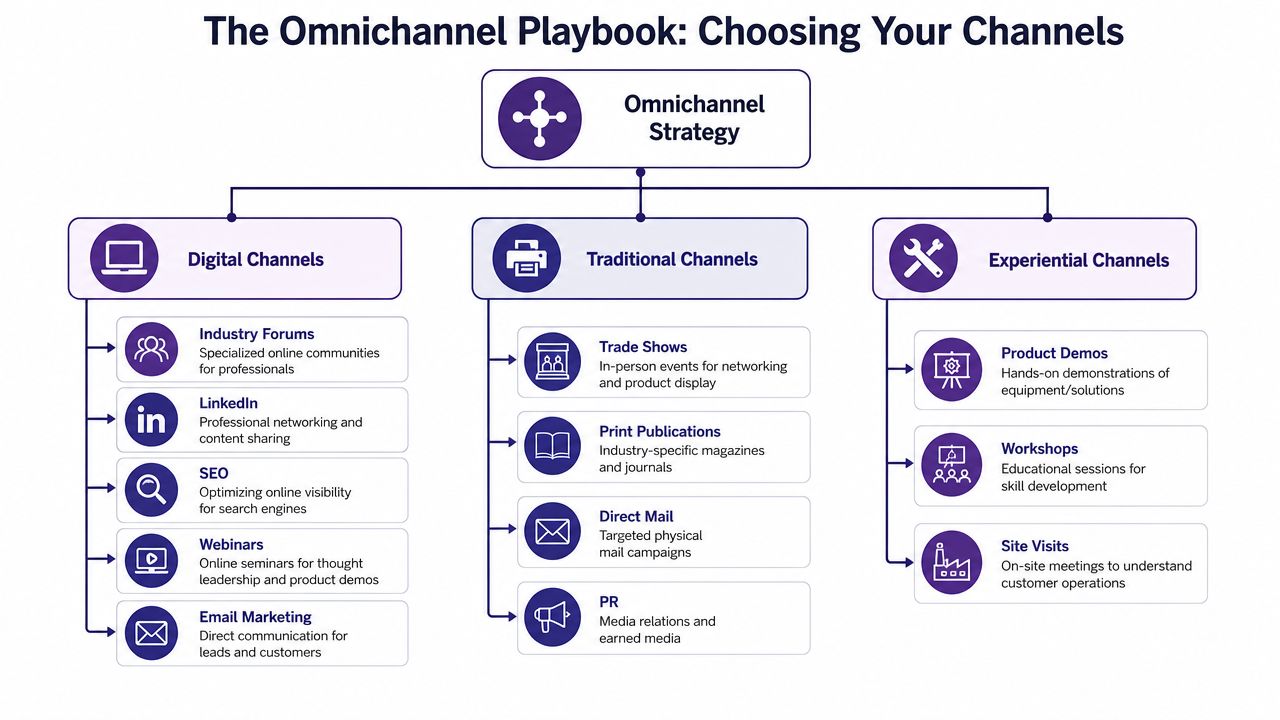
Channel strategy fixes that problem only when each channel has a job and supports the others. In industrial markets, buyers often move slowly, involve multiple stakeholders, and return to the same supplier shortlist over months. That means brand awareness grows through repeated exposure tied to a clear market position, not through isolated campaigns.
How to choose the right mix
Choose channels based on buyer behavior, deal economics, and your team's ability to maintain them. A low-volume, high-value manufacturer does not need the same mix as a broad-market distributor. If a typical opportunity is worth six or seven figures, one well-placed trade publication article and three strong technical pages may outperform a high-volume social calendar.
Use this table to assign roles, then cut channels that do not support the buying process.
| Channel | Best use | Weak use case |
|---|---|---|
| Website | Core hub for positioning, proof, and conversion paths | Treating it like a static brochure |
| SEO | Capturing active problem research and building discoverability | Chasing broad traffic with generic blog content |
| Executive visibility, thought leadership, industry engagement | Posting company updates no one asked for | |
| Trade shows and trade media | Credibility, conversations, market presence | Showing up once and failing to repurpose what you learn |
| Nurture, follow-up, segment-specific education | Blasting the same message to every contact | |
| Webinars and demos | Technical education and trust building | Product pitches with no clear buyer problem |
A few channel decisions usually sort themselves out once the buying motion is clear:
- Prioritize SEO if buyers search for process issues, compliance requirements, application fit, retrofit questions, or specification details before speaking to sales.
- Prioritize LinkedIn if technical leaders, commercial leaders, channel partners, and recruits all influence how credible the company appears.
- Prioritize events and trade media if shortlist formation happens through industry familiarity, face-to-face trust, and repeated presence in a narrow sector.
- Prioritize the website first if every campaign drives traffic there and the site still fails to explain who you help, where you fit, and why the buyer should believe you.
The trade-off is simple. Every added channel creates execution overhead. If the team cannot publish consistently, follow up quickly, and reuse what it learns, spreading wider usually weakens results.
This section is worth watching in action:
How channels reinforce each other
The strongest industrial programs run on transfer. One buyer question feeds multiple assets, and each asset supports a different stage of awareness.
A trade show conversation surfaces concern about implementation risk. That question becomes a technical article on the site. The article turns into a LinkedIn post from an engineer or executive. Sales uses it in follow-up emails. The same theme becomes a webinar topic. Questions from that webinar shape the next FAQ page, sales deck update, or trade media pitch.
That system does two things. It improves efficiency, and it increases message retention.
For manufacturers in low-volume, high-value markets, measurement has to follow the same logic. Channel performance should be judged by signals that indicate growing familiarity in the right accounts and buying committees. Direct traffic from target regions, return visits to technical pages, branded search growth, webinar attendance from named accounts, sales conversations influenced by content, and mentions during discovery calls matter more than raw impressions. A solid marketing analytics framework for B2B teams helps connect those touchpoints to real pipeline movement.
Coherence is the standard. Buyers should encounter the same company, with the same position and proof, across search, social, events, email, and sales follow-up often enough to remember it and trust it.
Building and Measuring Your Awareness Engine
Awareness only becomes an operating system when publishing and measurement are tied together. Organizations tend to be weaker on one side than the other. Some create content with no reporting discipline. Others build dashboards around metrics that don't tell them whether the market knows them better.
What to publish
Your content plan should follow your position and the questions buyers ask before contact.
Useful industrial content usually falls into a few categories:
- Problem-solving articles: Pages and posts built around application questions, process issues, compliance concerns, maintenance realities, or selection criteria.
- Decision support assets: Comparison guides, implementation checklists, spec explainers, and stakeholder-oriented buying content.
- Proof content: Case-story formats, customer outcomes described qualitatively, plant process examples, and technical walkthroughs.
- Authority content: Executive commentary, engineer-led explainers, webinars, podcast appearances, and trade publication contributions.
A workable cadence is less about publishing volume and more about coverage. If your market repeatedly asks the same five hard questions and your brand answers none of them publicly, awareness won't grow in a useful way.
If you're building reporting around this work, marketing analytics for B2B teams should connect content touchpoints to movement through the buying journey rather than just channel activity.
What to measure instead of vanity metrics
Likes, impressions, and follower counts can be directional, but they're not enough. Industrial awareness should be measured closer to recall, recognition, and movement into consideration.
A practical framework includes:
Baseline awareness measures
Start with aided recognition, brand-attribute association, and segment-level awareness gaps.Behavioral signals
Watch branded search, direct traffic, brand mentions, and share of voice trends.Consideration movement
Track whether the people who know you are also more likely to engage, return, inquire, or enter sales conversations with clearer intent.Controlled validation
Use lift studies or geo-based comparisons where possible to test whether campaigns caused movement rather than merely coinciding with it.
That last measure is the one many teams miss. Reach can grow while commercial usefulness stays flat. If awareness rises but buyers still don't connect your name to a relevant reason to choose you, the program isn't working yet.
A few reporting questions keep teams honest:
- Are more buyers finding us by name?
- Do they associate us with the position we want to own?
- Are priority segments moving from familiarity to active evaluation?
- Which channels are improving consideration, not just activity?
One practical option in this stage is to use a system that combines CRM, campaign tracking, and follow-up workflows. Machine Marketing supports this kind of diagnostic and execution work for manufacturers that already have tools in place but need a tighter strategy layer.
Your 30/60/90 Day Rollout and Optimization Loop
A common industrial marketing failure looks like this: the team finishes strategy, leadership wants visible activity, and ten initiatives go live in two weeks. Content starts shipping, sales hears three versions of the message, reporting breaks because nothing was staged properly, and by the end of the quarter nobody can say which work improved market visibility.
A 30/60/90 day rollout prevents that. It gives you sequencing, cleaner attribution, and enough time to see whether awareness is improving in the segments that matter. In low-volume, high-value markets, that matters more than raw activity. You are not trying to flood the market. You are trying to make the right buyers recognize your company, connect it to a specific capability, and enter sales conversations with more context.
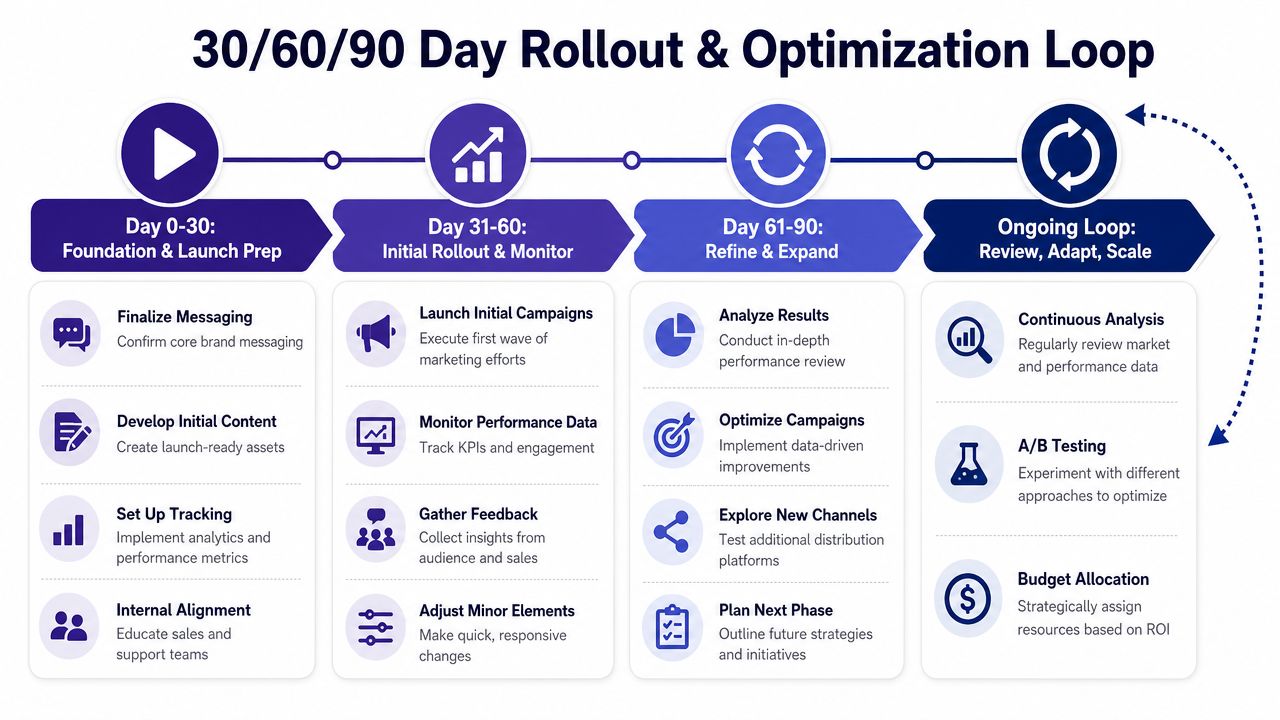
The operating principle is simple. Roll out in controlled stages, measure signal quality at each stage, then adjust before scaling. That is how awareness work becomes a repeatable growth system instead of a one-quarter campaign.
Days 1 to 30 foundation
The first 30 days are for setup, not volume.
Lock the message, fix the obvious visibility gaps, and establish a baseline your team can trust. If the baseline is weak, the next 60 days will produce noise instead of insight. I usually want manufacturers to leave this phase with one approved position, one reporting view, and one agreed definition of what an early awareness win looks like.
Focus on four outputs:
- Research completed: Interview internal teams, review CRM history, speak with customers, and document market assumptions that need validation.
- Position defined: Finalize the core message, proof points, and stakeholder-specific versions for engineers, operations leaders, procurement, and channel partners.
- Measurement baseline set: Record current branded search, direct traffic, key page engagement, share of voice in priority channels, aided recognition if available, and sales-reported familiarity in target accounts.
- Internal alignment finished: Train sales and leadership so the same language shows up on the website, in outreach, at events, and in discovery calls.
The checklist should stay operational:
- Homepage message updated
- LinkedIn company description aligned
- Sales deck revised
- Top website pages rewritten
- Reporting dashboard created
- Customer interview notes centralized
This phase often feels slow to impatient teams. It saves time later because it reduces rework.
Days 31 to 60 activation
Now publish and promote, but stay selective.
Use the channels that can reach technical buyers and buying committees repeatedly enough to build recognition. For many manufacturers, that means a tighter mix than they expected. One strong content theme distributed through LinkedIn, search, email follow-up, and sales usage usually outperforms a scattered presence across six channels with no consistency.
Good activation moves often include:
- Publishing cornerstone content tied to the position you want to own
- Launching a LinkedIn cadence through the company page and subject-matter experts
- Updating event follow-up with stronger nurture content and clearer proof
- Starting SEO improvements on high-intent product, solution, and industry pages
- Using sales feedback loops to capture which claims prospects respond to or question
Do not score this phase by lead volume alone. In industrial markets, early proof often shows up first in branded traffic, repeat site visits from target accounts, stronger engagement with core pages, more direct inquiries, and sales feedback that prospects already understand what you do.
If your team needs a working structure for owners, timing, and review checkpoints, use this marketing roadmap template for quarterly execution planning.
Days 61 to 90 optimization
By this point, you should have enough signal to make decisions instead of guesses.
Review performance in three layers:
| Layer | What to review | What to change |
|---|---|---|
| Message | Which themes buyers remembered, repeated, or engaged with | Sharpen weak claims, strengthen proof, remove generic phrasing |
| Channel | Which touchpoints drove branded engagement or return visits from priority segments | Shift budget and effort toward channels that improve consideration |
| Sales feedback | What prospects referenced in calls, forms, or follow-up emails | Promote language buyers already understand and trust |
Then run the next loop with discipline:
- Keep what created recognition in the right audience
- Cut content that pulled in low-fit traffic
- Expand only after message consistency is visible across channels
- Retest assumptions every quarter against account quality and pipeline movement
Formal awareness benchmarking does not need to happen every month. Directional checks should. Review monthly indicators such as branded search, direct traffic, target-account engagement, return visitor rate, and sales-reported familiarity. Then run scheduled awareness benchmarks on a cadence your market size and budget can support, often twice a year for slower-moving industrial categories.
That distinction matters. Monthly checks help you catch execution problems early. Scheduled benchmark studies tell you whether the market position is strengthening over time.
A good 90-day cycle produces more than output. It gives manufacturers a measurement framework for low-volume, high-value buying environments, where the actual question is not "did traffic go up?" but "did more qualified buyers recognize us, remember our claim, and move closer to consideration?" That is the standard worth holding.