Is your marketing producing a steady flow of qualified opportunities, or is it running on memory, habit, and luck?
That is the problem in a lot of industrial companies. Production has a process. Quality has a process. Quoting has a process. Marketing gets handled whenever someone has time, which usually means inconsistent outreach, weak follow-up, and a website that explains the company without helping buyers take the next step.
We see the same failure pattern over and over. Good technical teams publish nothing useful for engineers. Lead forms collect names but not buying context. Sales gets inquiries with no qualification. Existing customers are happy but never asked for referrals. None of that is a talent problem. It is a system design problem.
Digital marketing is no longer optional for industrial firms that want predictable growth. Competitors are already using it to bring in sales conversations, and the gap widens when they measure what works and remove what does not.
So this is not a random list of industrial business owner marketing tips. It is a prioritized plan. We will treat marketing like an engineering problem. Diagnose the weak point, apply a defined fix, and measure the result. If your team needs a stronger foundation for technical messaging, start with a B2B content strategy built for engineers and then connect the rest of the system around it.
The goal is simple. Give you a practical way to stop improvising and start building a marketing operation that produces repeatable results.
Table of Contents
- 1. Build a Content System That Speaks to Engineers Not Just Salespeople
- 2. Implement a Systematic Lead Capture and Qualification Process
- 3. Develop a Referral System and Activate Your Customer Base as Sales Amplifiers
- 4. Master Google Business Profile and Local SEO for Physical Visibility
- 5. Use Email and SMS Marketing as a Retention and Reactivation Engine
- 6. Create a Case Study and Social Proof Strategy That Converts
- 7. Build an Integrated Marketing Technology Stack That Talks to Itself
- 8. Establish a Consistent LinkedIn Strategy for Thought Leadership and Lead Generation
- Industrial Marketing: 8-Point Strategy Comparison
- Your Next Step Implement One System This Quarter
1. Build a Content System That Speaks to Engineers Not Just Salespeople
Industrial buyers don't buy because your headline says “unique solutions.” They buy when they can verify that you understand tolerances, failure modes, lead times, maintenance reality, and implementation risk. Engineers want specifics. Procurement wants confidence. Leadership wants proof that you won't create a new headache.
That's why content has to do more than fill a blog. According to WebFX industrial marketing data on manufacturer content usage, 85% of manufacturers use content marketing to generate leads and nurture relationships. That tracks with what we see in practice. The companies that publish useful technical material earn trust before the first call.

Start with the questions engineers already ask
A hydraulic equipment manufacturer usually has enough material for a quarter of content sitting in service emails, quoting notes, and application calls. Questions about pressure calculations, seal choices, contamination risk, and duty cycles are content topics already validated by the market.
If you want a strong example of how to structure this, study a B2B content strategy for engineers and build around technical clarity, not promotional fluff.
Practical rule: If your best salesperson says, “We explain this on every call,” that topic should already exist on your website.
Turn one technical topic into four assets
Don't create from scratch every time. Document once, then repurpose. A machine shop software provider can take one piece on CNC programming optimization and turn it into a search-focused article, a one-page PDF brief, a short walkthrough video, and a sales leave-behind.
Use this pattern:
- Interview real users: Ask your best customers' engineers what they needed to know before buying.
- Check search intent: Use Google Search Console to find product and process questions already bringing impressions.
- Match format to buyer need: Long article for research, PDF for forwarding, video for clarity, comparison page for evaluation.
- Measure useful behavior: Watch click-through to product pages, downloads, and sales conversations influenced by the asset.
What doesn't work is generic blogging with no technical depth. If a competitor's application engineer could read your article and learn nothing new, your buyer probably won't stay either.
2. Implement a Systematic Lead Capture and Qualification Process
A lot of industrial companies don't have a lead problem. They have a sorting problem. Inquiries arrive from website forms, referrals, trade shows, LinkedIn messages, and direct calls. Then they land in inboxes, spreadsheets, notebooks, or nowhere useful.
That waste gets expensive fast, especially if sales spends time chasing poor-fit accounts while strong opportunities wait too long for follow-up. For a practical baseline, tighten your lead qualification process for sales inquiries before you buy another tool. Then review outside ideas like Divimode's lead generation guide and adapt only what fits industrial buying behavior.
Define qualified before you automate anything
Start with your top three qualification criteria. Industry fit, application fit, and buying readiness usually beat fancy scoring formulas. A controls integrator, for example, might prioritize industries where the team already has implementation experience and filter out work that falls outside proven delivery capability.
Industrial buying is rarely a one-person decision. A 2025 Gartner-based overview of B2B purchasing complexity notes that 74% of industrial buyers require 3 or more engagements before converting, and 45% of purchase decisions are made by committees. That means one form fill doesn't tell the whole story. You need a process that tracks the account, not just the individual contact.
A practical routing model
Keep this simple enough that your team will use it.
- Capture every source: Website forms, phone inquiries, referral intros, and trade show leads should enter one CRM.
- Score for fit first: Separate “can we help them?” from “are they ready now?”
- Create a disqualification list: Wrong industry, unrealistic budget, unsupported geography, or poor application fit.
- Route by urgency: Hot opportunities go to sales now. Early-stage contacts go into nurture.
- Review closed deals monthly: Compare your criteria against actual wins and losses.
Bad qualification creates two failures at once. Sales wastes time, and good prospects get treated like noise.
What doesn't work is making every inquiry look urgent. That usually leads to slow response on the deals that matter most.
3. Develop a Referral System and Activate Your Customer Base as Sales Amplifiers
Most industrial firms say referrals matter. Very few run referrals like a system. They wait for a happy customer to make an introduction by accident, then call that strategy.
That's leaving qualified demand on the table. Referred prospects often arrive with context, trust, and a shorter explanation path because someone already vouched for you. In industrial markets, that matters more than clever ad copy.
Referrals need a process
Pick a small group first. Start with your best customers, former customers who still respect the work, channel partners, and industry peers who regularly see the kind of problems you solve. Don't blast a generic referral announcement to everyone. Build it intentionally.
A machine shop software provider might offer a service credit when another shop signs. An equipment manufacturer might invite a group of strong advocates into quarterly customer roundtables where application ideas and peer introductions happen naturally. A controls engineering firm might tie closed referrals to charitable donations chosen by the referrer.
What to say to customers
Most companies overcomplicate the ask. Keep it direct and easy to forward.
- Thank them first: Reach out after a successful project or a positive service interaction.
- Name the fit clearly: Tell them what kind of company or problem you help best.
- Make sharing easy: Provide a short email they can forward or a direct introduction line.
- Track every referral: Log source, date, account status, and outcome in the CRM.
- Close the loop: Tell the referrer what happened, even if the deal didn't close.
A good referral system isn't pushy. It's respectful. You're helping customers connect someone they know with a vendor they trust.
What doesn't work is vague language like “send anyone our way.” People refer better when they know exactly who to think of.
4. Master Google Business Profile and Local SEO for Physical Visibility
If you have a real facility, service area, or regional market, your visibility in local search can't be an afterthought. Buyers still search for suppliers, repair partners, fabricators, and service providers by category and location. If your profile is weak, incomplete, or inconsistent, you lose before anyone reaches your website.
Your map listing is often your first impression
Google Business Profile is basic, but basic doesn't mean unimportant. For many industrial businesses, it's the first thing a local buyer sees. Photos, business category, service details, reviews, and response behavior all shape that impression.
A practical starting point is this guide on how to optimize Google Business Profile for leads, plus a detailed walkthrough on Google Business Profile optimization for industrial companies.
What to fix this week
A precision machine shop should show its facility, machines, front office, finished work, and team. An industrial controls company should have a process for requesting reviews right after project completion. A hydraulic repair company should make service details clear, especially if it offers emergency or on-site support.
Use this short audit:
- Complete every field: Category, service area, phone, hours, website, and business description.
- Upload real photos: Exterior, interior, equipment, team, and completed work.
- Standardize NAP: Your name, address, and phone should match everywhere online.
- Request reviews consistently: Send the ask while the successful project is still fresh.
- Respond professionally: Thank positive reviewers and move problem resolution offline when needed.
- Post updates regularly: New capabilities, certifications, equipment, and local hiring news.
Local SEO isn't glamorous, but it's one of the cleaner fixes for industrial business owners who need nearby buyers to find them without friction.
5. Use Email and SMS Marketing as a Retention and Reactivation Engine
A lot of industrial companies keep chasing net-new business while ignoring customers who already know the team, trust the work, and may need another product, service interval, reorder, or upgrade. That's a preventable mistake.
Email and SMS work best when you use them like service channels, not digital junk mail. Send reminders, maintenance prompts, technical updates, reorder nudges, and useful education. Stay relevant and stay remembered.
Most companies ignore the list they already own
Forrester's 2024 B2B budget benchmarks for marketing investment found that the average firm invests 8% of total revenue into marketing. If you're spending real money to acquire attention, it makes no sense to neglect the customer database you already own.
An industrial HVAC company can send seasonal maintenance guidance. A CNC machine manufacturer can trigger service reminders based on the original purchase date. A fastener distributor can segment active customers, inactive accounts, and prospects so each group receives different messaging.
Keep the rhythm simple
You don't need a giant automation maze. You need consistency and segmentation.
- Segment by relationship: Active customers, lapsed customers, prospects, and referral partners.
- Build one core sequence: Welcome, value email, product update, then re-engagement.
- Mix useful content: Technical tips, process guidance, industry updates, then occasional offers.
- Use SMS sparingly: Good for reminders, scheduling, and urgent service communication.
- Watch response quality: Replies, service requests, and sales conversations matter more than vanity metrics.
Send the message your customer would want if they were already busy. Short, useful, and easy to act on.
What doesn't work is sending the same promotion to everyone. That usually creates unsubscribes, ignored messages, and internal doubt about whether email “works.”
6. Create a Case Study and Social Proof Strategy That Converts
Industrial buyers are cautious for good reason. A bad vendor choice can interrupt production, create safety risk, damage schedules, or force expensive rework. That's why generic praise doesn't move the needle. “Great team” is nice. It's not enough.
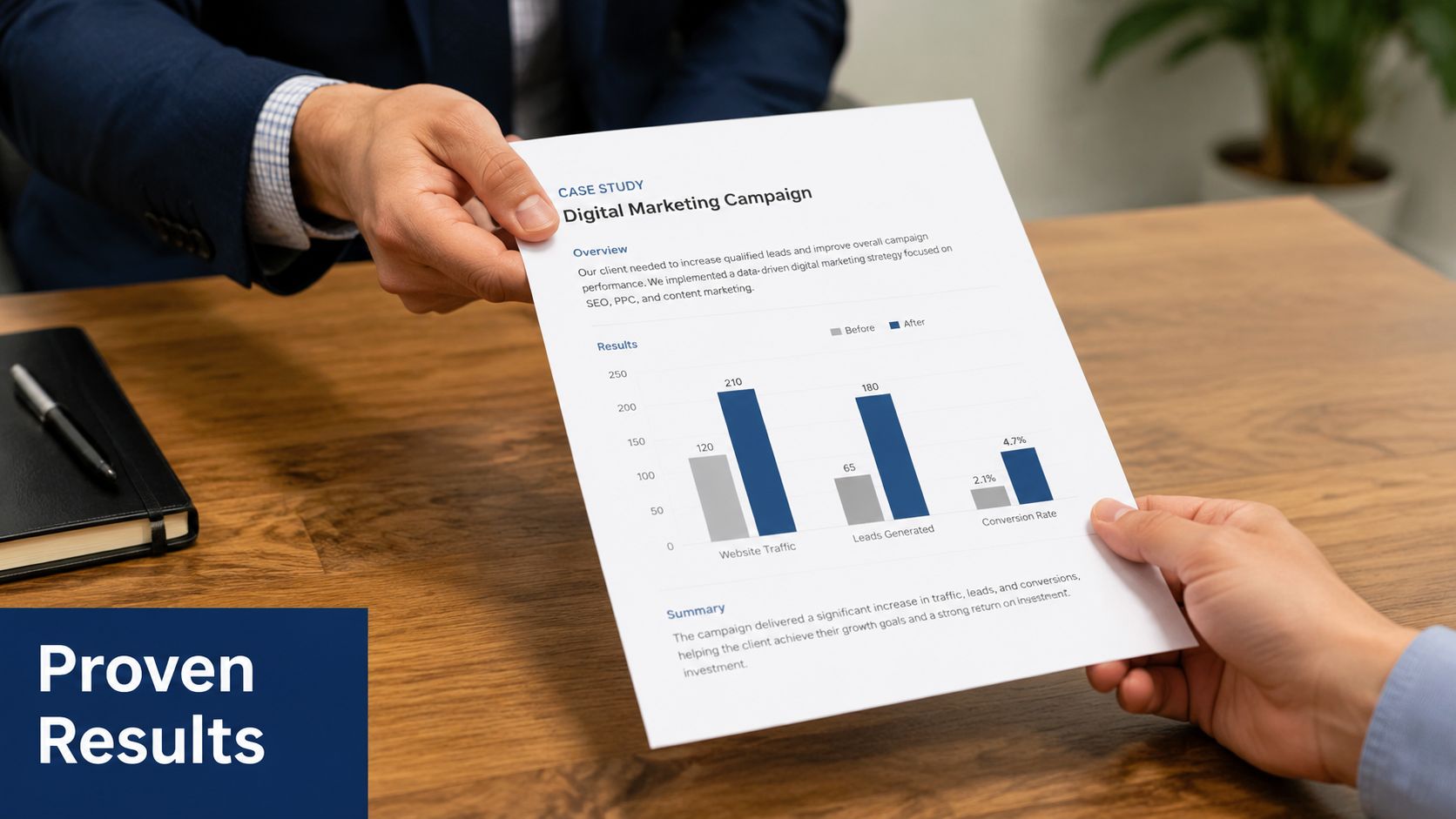
Case studies work because they reduce uncertainty. They show the problem, the constraints, the fix, and the result in a format buyers can evaluate.
Proof beats claims
An industrial software firm shouldn't just say its platform improves quoting. It should document how one customer handled the process before, what changed during implementation, where resistance showed up, and what improved after adoption. A controls integrator should collect short video testimonials where the customer explains the original issue in plain language.
The strongest social proof isn't always flashy. Certifications, recognizable client logos, review patterns, and detailed project documentation often carry more weight than polished slogans.
A usable case study structure
Keep the format repeatable so your team can produce these without reinventing the process every time.
- Start with the customer situation: Industry, application, and operational challenge.
- Show the constraint: Downtime risk, staffing limits, compliance concerns, or process inconsistency.
- Explain the solution clearly: What you implemented, how long it took, and what changed.
- Include concrete outcomes when available: Use customer-approved specifics only.
- Distribute the asset: Website page, PDF, proposal support, email follow-up, LinkedIn post.
Case studies fail when they read like self-congratulation. Let the customer's problem carry the narrative. That's what future buyers relate to.
7. Build an Integrated Marketing Technology Stack That Talks to Itself
Disconnected tools create invisible failure. A form gets submitted, but sales never sees it. A lead downloads a technical guide, but nothing updates in the CRM. A customer replies to an email, but the account owner doesn't know. That's not a software issue alone. It's a systems issue.

A lot of firms have already invested in tools. According to Market Veep's industrial marketing technology benchmark summary, 85% of successful industrial manufacturers use a tech stack that integrates CRM, automation, and analytics software. The lesson isn't “buy more software.” It's “connect what you already rely on.”
Fewer tools better connected
A manufacturer using GoHighLevel, HubSpot, Zapier, Calendly, Google Analytics, and website forms can build a clean workflow if each handoff is defined. A machine shop doesn't need seven platforms doing overlapping work. It needs one reliable chain from inquiry to follow-up to pipeline visibility.
Systems beat tool piles. If nobody can trace a lead from first touch to sales action, the stack isn't integrated.
What to look for in your stack
The technology should support the process, not dictate it. Start with the minimum working system and expand only when the core flow is stable.
- Map the data path: Form fill, CRM entry, owner assignment, nurture action, sales follow-up.
- Prefer native integrations: They usually break less and are easier to maintain.
- Assign ownership: One person should monitor sync issues and data cleanliness.
- Document trigger logic: Who gets notified, when, and based on what behavior.
- Configure for segmentation: Engineers and procurement contacts shouldn't receive the same content.
For teams that want to make technical content easier to retrieve, Market Veep's benchmark summary also notes that firms using CRM systems with automated lead scoring and RAG capabilities for technical content retrieval report a higher lead-to-opportunity conversion rate than firms using disconnected tools. That fits what we see. Retrieval matters when your sales team needs the right manual, spec, or proof asset fast.
Here's a useful example of how connected systems support response speed and follow-up in practice.
What doesn't work is adding platforms faster than your team can govern them. Complexity without ownership turns into data noise.
8. Establish a Consistent LinkedIn Strategy for Thought Leadership and Lead Generation
What does a buyer see when they check your company on LinkedIn before returning your call?
For many industrial firms, the answer is a weak signal. The company page is outdated. Leadership profiles read like resumes from three jobs ago. Posts, if they exist, are generic and disconnected from the problems customers are trying to solve. That hurts trust early, especially in long-cycle B2B sales where buyers screen vendors before they book a meeting.
As noted earlier, industrial companies already put budget into social channels. LinkedIn usually earns the highest practical value because engineers, operations leaders, plant managers, procurement teams, and technical sales contacts already use it for work. The opportunity is not to post more. It is to build a repeatable system that shows competence in public and supports real conversations.
Treat LinkedIn like a credibility system
A consistent LinkedIn strategy has three jobs. It should confirm that your company is active and credible. It should help target accounts recognize your expertise before a sales conversation. It should give your team a library of proof points they can use in outreach, follow-up, and recruiting.
That means random posting is not enough.
A manufacturing owner can publish short observations on lead times, quoting friction, quality control lessons, or maintenance planning. An engineering leader can explain a design trade-off customers often misunderstand. A service manager can share field lessons without exposing customer details. These posts work because they answer real questions buyers already have.
Leadership posts also tend to carry more weight than company-page updates alone. People trust named experts faster than branded graphics.
A practical posting system for busy owners
If you do not want LinkedIn to become another half-finished marketing project, keep the process tight and operational.
- Standardize the profiles: Update the company page and key leadership profiles with current positioning, markets served, certifications, and a clear description of what you do.
- Build a 3-topic content plan: Pick three subjects tied to buying decisions, such as production reliability, technical problem-solving, and project execution.
- Use existing inputs: Turn sales call questions, service tickets, plant visit notes, proposal objections, and customer onboarding lessons into posts.
- Set a fixed cadence: Start with one leadership post per week, one company update every two weeks, and fifteen minutes of manual engagement three times a week.
- Write for technical buyers: Use specifics, constraints, lessons learned, and trade-offs. Cut buzzwords and generic inspiration.
- Support account targeting: If your team is pursuing a defined list of accounts, publish around the issues those accounts are dealing with now.
What good industrial LinkedIn content actually looks like
Good content on LinkedIn does not try to entertain everyone. It helps the right buyer conclude that your team knows the work.
One post might explain why a cheaper material option increased maintenance costs six months later. Another might show how quoting delays happen when specs arrive incomplete, then give a checklist customers can use before requesting pricing. A third might describe a hiring or training problem affecting plant output and how your team addressed it. Posts like these create authority because they reflect experience, not theory.
According to the Elliance article on marketing manufacturers and industrial companies, account-based marketing performs well for many industrial marketers. LinkedIn works better when you use it inside that structure. Profile activity, content themes, and direct outreach should all support the same target accounts, buying roles, and operational problems.
LinkedIn execution checklist
Use this simple review every month:
- Are leadership profiles current and credible?
- Are we posting from real customer questions and field experience?
- Do our posts speak to engineers, operations, and procurement in plain language?
- Are sales reps using relevant posts in follow-up messages?
- Are target accounts engaging, connecting, or mentioning our content in calls?
- Can we point to inquiries, conversations, or referrals that started with LinkedIn activity?
If the answer is no on most of these, the fix is usually simple. Reduce volume, raise relevance, and make one person own the calendar. Consistency beats bursts of activity every time.
Industrial Marketing: 8-Point Strategy Comparison
| Approach | 🔄 Implementation complexity | Resource requirements | ⚡ Speed / efficiency | 📊 Expected outcomes | ⭐ Key advantages & 💡 Tip |
|---|---|---|---|---|---|
| Build a Content System That Speaks to Engineers (Not Just Salespeople) | High, requires SME interviews, editorial workflow, and cross-team review | High, technical writers, engineers, video & tool production, SEO resources | Slow to produce; long-term compounding gains | Deep credibility, organic traffic growth, fewer sales friction points | ⭐⭐⭐⭐ Builds trust with technical buyers; 💡 interview engineers and create cornerstone pieces |
| Implement a Systematic Lead Capture and Qualification Process | Medium‑High, CRM setup, scoring rules, routing logic | Medium, CRM, integrations, analyst/training time | Moderate, quicker impact on response and conversion (weeks) | Clear pipeline visibility, higher conversion and forecasting accuracy | ⭐⭐⭐⭐ Reduces wasted effort; 💡 start with top 3 criteria and iterate |
| Develop a Referral System and Activate Your Customer Base as Sales Amplifiers | Low‑Medium, process design, incentive plan, CRM tracking | Low, incentives, simple tracking, CRM fields, communication templates | Slow ramp (3–6 months) but high conversion once active | Higher close rates, lower CAC, shorter sales cycles | ⭐⭐⭐ High‑quality leads; 💡 make referral process frictionless and thank referrers |
| Master Google Business Profile and Local SEO for Physical Visibility | Low, claim and optimize profile; ongoing management | Low, photos, review requests, regular posts | Fast local visibility gains (4–8 weeks to see change) | Increased local leads, map visibility, more foot/phone inquiries | ⭐⭐⭐⭐ Free high‑intent visibility; 💡 collect reviews and keep NAP consistent |
| Use Email and SMS Marketing as a Retention and Reactivation Engine | Medium, segmentation, automation, compliance setup | Medium, ESP/CRM, content cadence, list hygiene | Moderate to fast ROI; strong ongoing efficiency | Higher retention, reactivation of lapsed customers, strong ROI | ⭐⭐⭐⭐ Highest ROI channel; 💡 segment lists and follow a value‑first cadence |
| Create a Case Study and Social Proof Strategy That Converts | Medium, customer interviews, data collection, production | Medium, sales time, writer/video resources, permissions | Moderate, accelerates deals when surfaced in sales (weeks) | Shorter sales cycles, reduced buyer risk, better sales enablement | ⭐⭐⭐⭐ Powerful proof for risk‑averse buyers; 💡 quantify results and get permission early |
| Build an Integrated Marketing Technology Stack That Talks to Itself | High, integrations, testing, ongoing maintenance | High, CRM, middleware, analytics, technical owner | Slow to implement; large efficiency gains once integrated | Unified data, better attribution, automated personalized workflows | ⭐⭐⭐⭐ Enables data‑driven decisions; 💡 start with CRM + email + forms |
| Establish a Consistent LinkedIn Strategy for Thought Leadership and Lead Generation | Medium, profile optimization, content calendar, engagement routines | Low‑Medium, content creators, leadership time, Sales Navigator optional | Slow to build authority (3–6 months) | Thought leadership, inbound leads, stronger executive credibility | ⭐⭐⭐ Builds trust & reach; 💡 post 2–3x/week and engage daily with your niche |
Your Next Step Implement One System This Quarter
Reading industrial business owner marketing tips is easy. Building a working system is harder. That's why most companies stay stuck in the same loop. They collect ideas, buy a few tools, try a few tactics, and still don't get predictable results.
The fix is narrower than is commonly assumed. Don't try to overhaul everything at once. Treat marketing the way you'd treat a machine problem on the floor. Diagnose the failure point, isolate the variable, implement the correction, and measure whether performance improves.
Pick one system from this list and commit to it for the next 90 days. If your website attracts the wrong traffic, start with content. If inquiries are inconsistent or poorly handled, fix lead capture and qualification. If you've got good customers but too little repeat business, build your email and SMS retention engine. If your tools are scattered, map the data path and integrate the core stack before adding anything else.
This is especially important for smaller industrial firms. The verified data set for this topic notes that 68% of the sector operates with fewer than 20 employees, which helps explain why owner-led marketing often breaks down under production pressure. In those environments, a process-first approach usually works better than trying to “do more marketing.” Document the work you already do, turn that documentation into useful assets, and build SOPs around follow-up and measurement.
You also need to measure the right things. In long industrial sales cycles, immediate revenue attribution can be misleading. The verified data on industrial buying behavior shows that committees are involved often, multiple engagements happen before conversion, and buyers are spending more time researching before they contact vendors. That means your leading indicators should include account engagement, response speed, and progress toward qualified sales conversations, not just raw traffic or isolated form fills.
Ask yourself three blunt questions:
- Where are leads getting lost right now
- Which part of the system depends too much on memory
- What can we standardize this quarter without slowing operations
Those answers usually point to the first fix.
If you need outside help, get a diagnosis before you get another tactic. A good advisor should be able to show you where the system is failing, what to repair first, and what can wait. That's how you build marketing that stops feeling random and starts producing reliable movement.
If you want a practical diagnosis instead of another pile of disconnected tactics, talk to Machine Marketing. We help manufacturers, machine shops, and industrial business owners connect content, CRM, SEO, automation, and follow-up into one system that's built for predictable growth.