If your pipeline feels lumpy, your trade show calendar is full, and your sales team still says marketing isn't producing enough qualified opportunities, the problem usually isn't effort. It's the system. In industrial markets, buyers do a large part of their evaluation before they ever talk to you, so the companies that win are the ones that build a connected marketing engine, not just a collection of tactics.
Industrial marketing management is the discipline of making that engine work. It's about matching technical content, channel strategy, and sales follow-up to how engineers, procurement, operations, and executives buy. When those pieces line up, marketing stops acting like a cost center and starts behaving like part of the revenue system.
Table of Contents
- Why Most Industrial Marketing Programs Underperform
- What Industrial Marketing Management Means
- Building a Strategic Framework for Industrial Growth
- Channel Strategy and Content That Converts Industrial Buyers
- Connecting Your Tools Into a Unified Marketing System
- Your 90-Day Implementation Roadmap
- Diagnose Your Gaps and Take the Next Step
Why Most Industrial Marketing Programs Underperform
A machine shop can have strong operators, a solid product line, and a sales team that knows the territory, yet still face a stale pipeline month after month. The usual pattern is familiar. The company spends on trade shows, brochures, and outbound sales activity, but the marketing work isn't tied to a digital system that captures demand, nurtures it, and hands it off cleanly.
That disconnect matters more now because 57% of industrial buyers make purchase decisions before ever interacting directly with a manufacturing company WebFX's industrial marketing facts roundup. If your website, content, and follow-up aren't built for pre-contact evaluation, you're invisible during the part of the journey that matters most. The result is not just fewer leads, it's weaker sales conversations because prospects arrive less informed and less convinced.
Practical rule: if your marketing can't explain what changed in a buyer's confidence level this month, it's not managing demand. It's only broadcasting.
A lot of underperformance also comes from treating industrial marketing like a collection of isolated activities instead of a managed system. A flyer can start a conversation, but it rarely carries a buyer through a six to eighteen month buying cycle on its own. That's where why manufacturers struggle with marketing becomes more than a slogan. The issue is usually structural, not creative.
The companies that keep underperforming tend to rely on three outdated assumptions:
- One message fits everyone. Engineers, procurement, operations, and executives care about different proof points.
- Lead volume equals progress. In industrial sales, one qualified opportunity can matter more than a pile of weak inquiries.
- Sales can clean up the rest. If the marketing system doesn't educate and qualify, sales inherits the mess.
Industrial marketing management has to connect the front end to revenue, or it stays expensive noise.
What Industrial Marketing Management Means
Industrial marketing management is the discipline of planning, executing, and measuring marketing for business-to-business products and services sold into technical or operational environments. Pondicherry University's industrial marketing material explicitly includes marketing to manufacturing companies, government undertakings, private-sector organizations, educational institutions, hospitals, distributors, and dealers Pondicherry University industrial marketing study material. That scope is broader than many teams expect, and it explains why generic B2B advice often misses the mark.
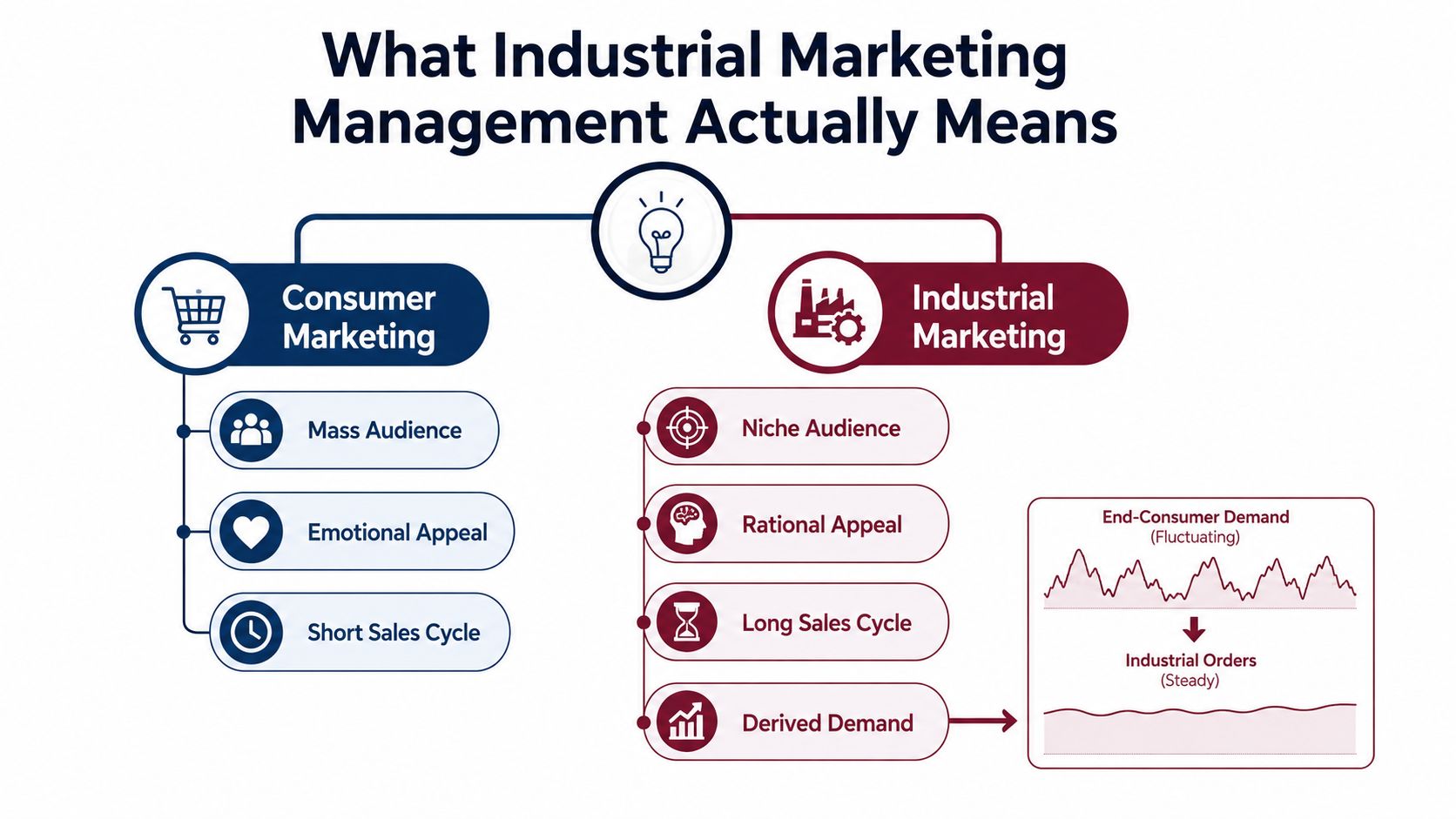
The core mechanic is derived demand. Abertay University's resource explains that industrial demand rises when consumer demand for finished goods rises, and that price changes often have little or no effect on industrial demand Abertay University industrial marketing overview. In plain English, your buyer usually isn't buying because they suddenly feel inspired. They're buying because production needs, customer orders, capacity planning, or system requirements changed upstream.
Think like a procurement engineer, not a brand advertiser
Consumer marketing often relies on emotion, repetition, and impulse. Industrial marketing is closer to a specification review. The buyer asks whether the part fits, whether the process works, whether the support is real, and whether the supplier can reduce risk.
That means your job isn't to make a buyer feel good. It's to help them justify the decision internally. You're giving them language, proof, and confidence they can use with colleagues who were not in the first meeting.
Buyers in technical markets usually don't need more hype. They need fewer unknowns.
Use the right mental model
A useful way to think about industrial marketing management is this:
- Diagnose the buying environment. Identify whether demand is driven by production volume, compliance, replacement cycles, or new capability needs.
- Map the stakeholders. Engineers, procurement, operations, and executives each bring a different risk lens.
- Match content to that risk. One person wants specs, another wants delivery confidence, another wants cost justification.
- Measure the handoff. If sales has to restart the conversation every time, marketing is not doing enough of the upstream work.
MIT Sloan Review notes that industrial programs often combine tangible products, service support, and ongoing information services before and after the sale, and that execution requires participation from multiple marketing groups responsible for product, service, and the sale itself MIT Sloan Review on industrial marketing requirements. That is the core definition of industrial marketing management. It is not a campaign. It is a coordinated operating model.
A coordinated operating model also matters when the same account has multiple plants, multiple buyers, and different service expectations. That is where enterprise multi site solutions come into play, because the marketing system has to stay aligned across locations without turning into a pile of disconnected assets.
Industrial teams that get this right usually build a longer-range plan around technical proof, account coverage, and sales follow-up. A useful way to structure that thinking is the three horizons framework, because it forces you to balance near-term lead creation with the longer work of account expansion and market position. In industrial markets, that balance matters more than a quick burst of traffic.
Building a Strategic Framework for Industrial Growth
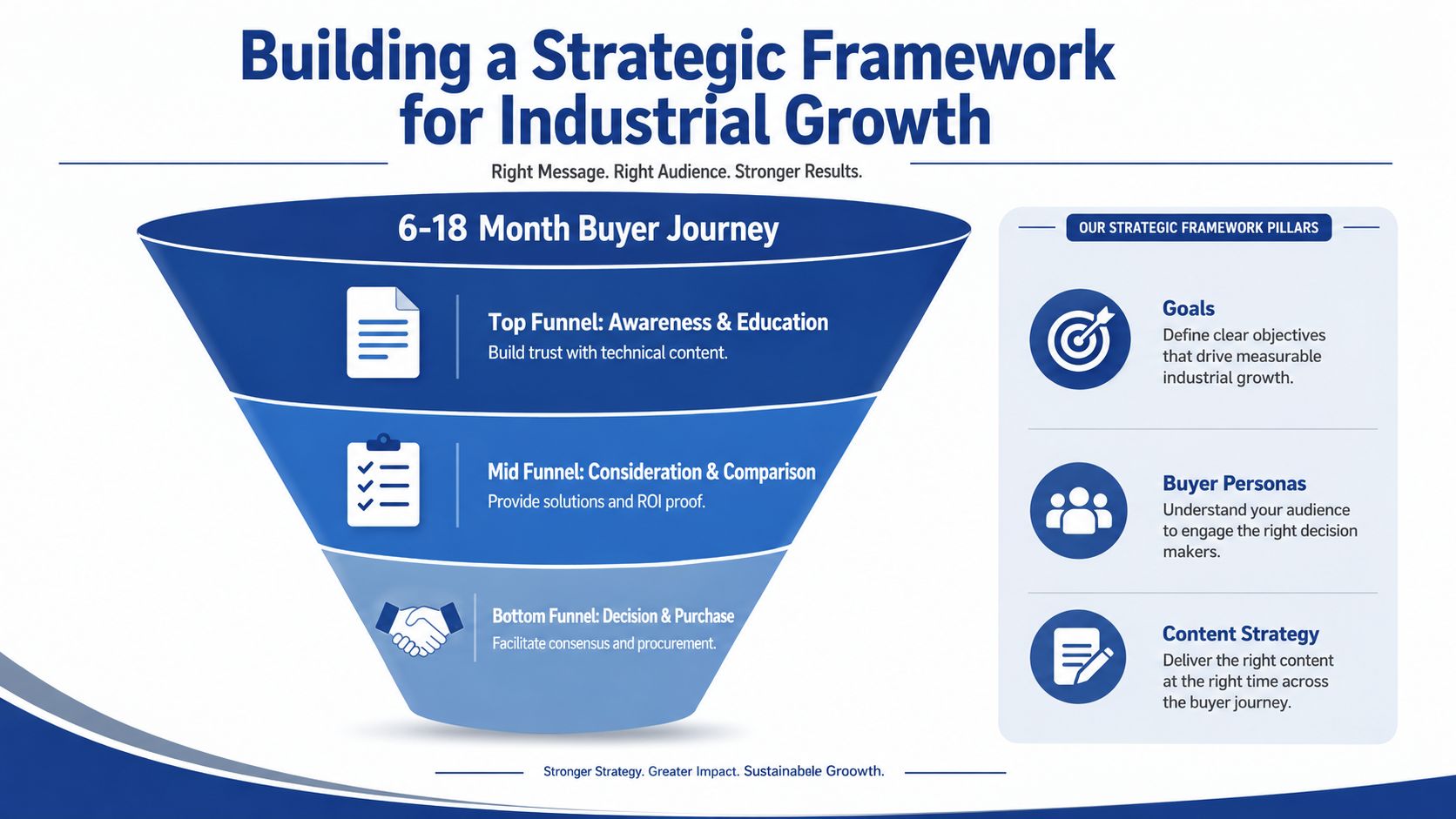
The strongest industrial programs start with the buying committee, not the channel list. A six to eighteen month sales cycle changes everything, because people don't move from awareness to purchase in a straight line. Engineers may want technical validation early, procurement may appear later with commercial questions, and executives may step in only when risk, cost, or capacity gets too large to ignore.
The strategic mistake is trying to force everyone through the same funnel with the same message. The better approach is to map content and follow-up to the stage and the role. That gives each stakeholder the information they need without overwhelming them with the wrong kind of detail.
Match the message to the role
For engineers, the best assets usually reduce technical uncertainty. Think specification pages, application guides, integration notes, and comparison sheets. For procurement, the questions shift toward lead time, supplier stability, total cost, and commercial risk. Operations often want maintainability, implementation friction, and how the product affects uptime.
Executives don't want every detail. They want enough evidence to approve the risk. That's why case studies and concise ROI framing matter, especially when they show measurable outcomes instead of vague promises.
Build the framework around goals, personas, and content
A useful framework keeps three things connected:
- Goals. Decide whether the priority is more qualified inquiries, larger account penetration, better sales enablement, or shorter deal friction.
- Buyer personas. Not generic personas, but role-specific views of what each stakeholder needs to believe.
- Content strategy. Build assets that help buyers move from learning to comparison to decision.
If you manage multiple business units or locations, the operational side gets complicated fast. That's where a resource like enterprise multi site solutions can be useful, because industrial firms often need coordinated content control across several websites, brands, or regional pages without losing consistency.
Tie strategy to a real operating model
The 3 horizons framework is useful when you need to separate immediate demand capture from longer-term market development. Not every industrial company has to do everything at once, and that's the point. You need one horizon for today's pipeline, one for the next wave of opportunities, and one for the ideas that will matter after the current product cycle matures.
A strong framework answers three questions before any campaign goes live:
- Who is this for?
- What does this person need to believe next?
- What asset will move them forward?
If you can't answer those cleanly, the campaign usually becomes busy work.
Channel Strategy and Content That Converts Industrial Buyers
Industrial demand generation has shifted hard toward digital, and the channel mix should reflect that. Industrial buying teams now research vendors online long before they talk to sales, and they keep comparing options after the first meeting. Trade shows still matter, but digital does the heavy lifting before and after the event, especially when engineers, procurement, operations, and executives each need different proof at different points in the cycle.
The practical implication is straightforward. You need channels that match how buyers research, compare, and decide across a long sales cycle. SEO and technical content handle discovery. Email and nurture sequences keep momentum alive while internal stakeholders review specs and risk. Sales enablement assets help the rep answer the commercial questions that surface late in the process.
Pick channels by buying stage
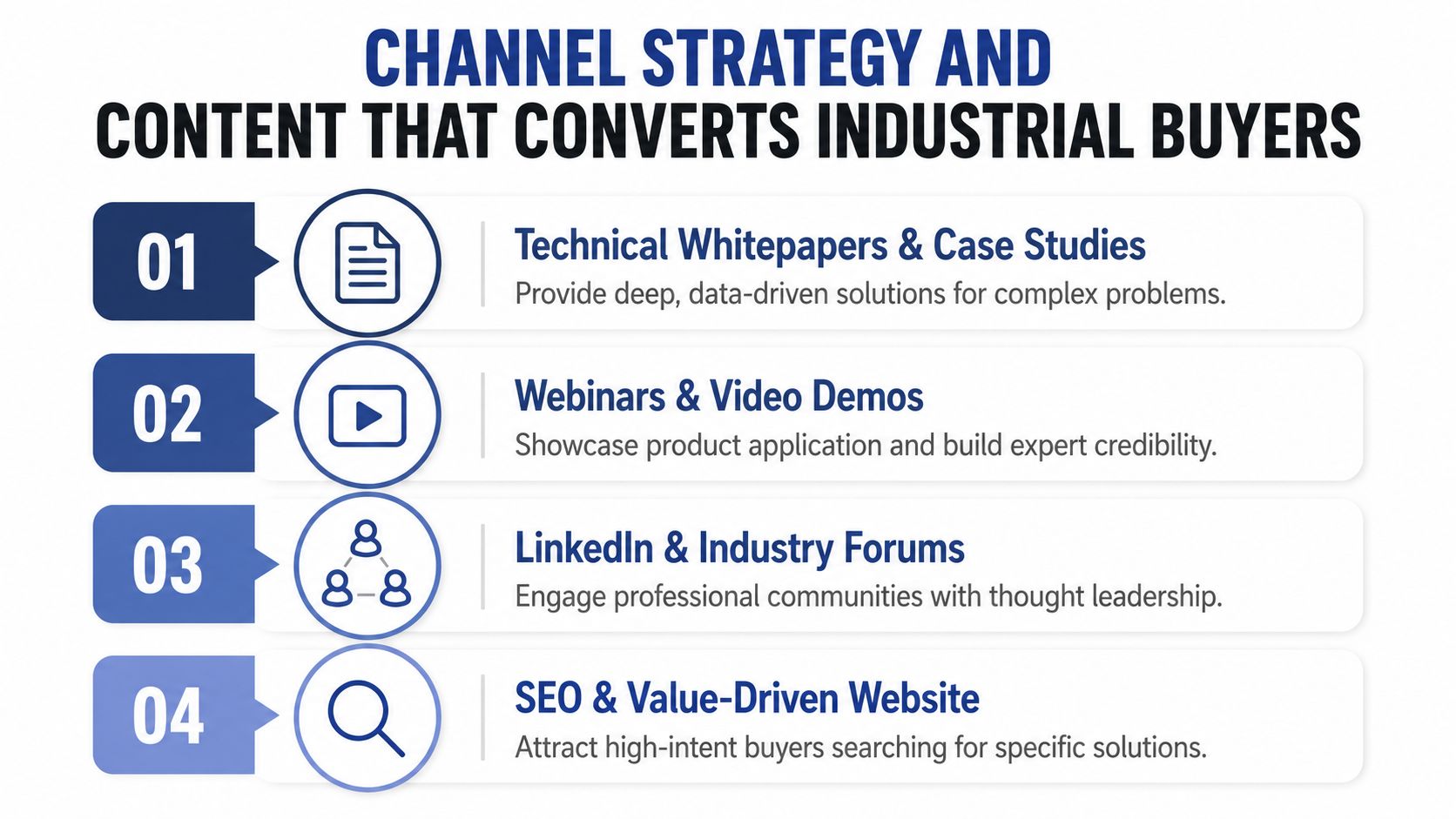
At the top of the funnel, industrial buyers search for symptoms and technical answers. Your website needs structured product pages, application content, and clear internal linking so both search engines and answer engines can understand what you do. Industrial teams also need a CRM tied to campaign activity, which is why connecting CRM and digital marketing for industrial sales matters when account intent builds slowly across multiple touches. Recent industrial marketing guidance has also emphasized featured snippets, AI overviews, and structured data, so plain SEO basics are not enough if you want visibility in AI-mediated discovery Workshop Digital on industrial marketing challenges.
At the middle of the funnel, content should help buyers compare options. Short spec sheets rarely do the job alone. Buyers want application guides, case studies, installation notes, and practical comparisons that reduce internal debate without forcing the sales team to explain every technical difference from scratch.
At the bottom of the funnel, your content has to support action. Quote forms, contact forms, pricing prompts, and sales-assisted follow-up matter here, because the buyer is trying to get alignment inside the account before money moves. If the content does not answer procurement questions, technical objections, and operational concerns in one pass, the deal slows down.
Build content that earns trust
A technical whitepaper is useful only if it answers a real operational question. A webinar works only if it shows how the product is applied, not just how it is positioned. Video demos can work well when they show tolerances, interfaces, or setup steps in a way a busy buyer can evaluate quickly.
One overlooked content type is the comparison resource. Buyers often need help choosing between two acceptable options, not just deciding whether to buy at all. A thoughtful comparison page can shorten internal approval cycles because it gives engineers, purchasing, and operations a common reference point.
Surnex's analysis of digital marketing technologies is useful here, because the channel stack only works when the tools support measurement, segmentation, and timely follow-up.
Watch the conversion design
Industrial websites with quote and contact forms average 3% conversion WebFX industrial marketing facts roundup. That number is a benchmark, not a target. If you fall well below it, the issue may be friction, unclear offers, weak proof, or a form that asks for too much too soon.
The fix usually is not a bigger button. It is better page structure, better proof, and a better reason to act now. The WebFX industrial marketing facts roundup also points to the broader shift toward digital lead generation, which fits what I see in the field, buyers want enough confidence to move from technical interest to a sales conversation without feeling rushed.
Connecting Your Tools Into a Unified Marketing System
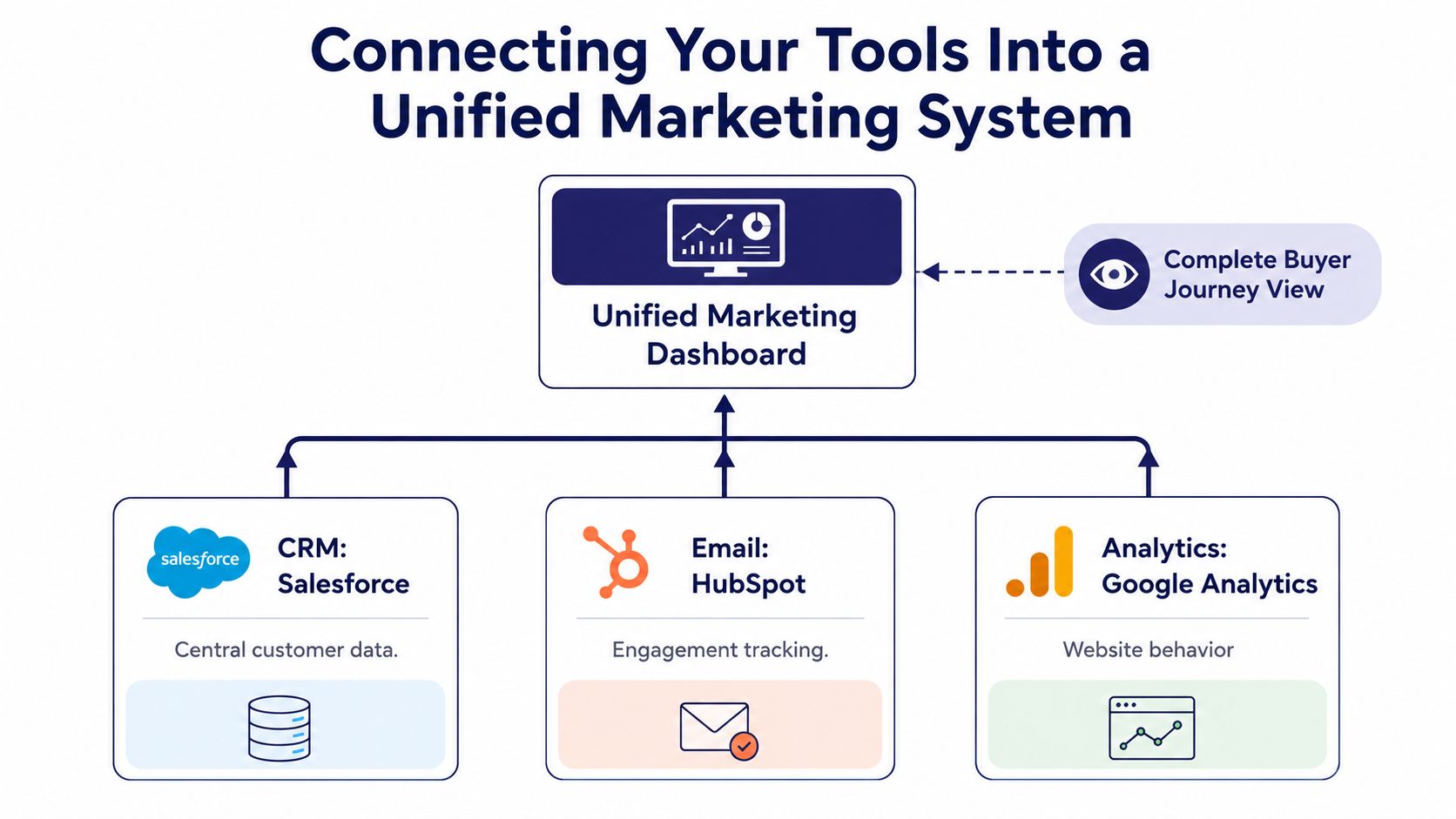
Most industrial companies already have the parts. There's a CRM somewhere, email software in another login, and website analytics in a dashboard nobody checks consistently. The problem is not the tools themselves. The problem is that they don't talk to each other well enough to show how an account is progressing.
That matters because industrial demand is account-based and multi-contact. If three people at the same company are reading your technical content, a lead-only view undercounts intent. A unified system lets you see the account, not just the form fill.
Connect the data before you chase more leads
The cleanest stack usually starts with three systems working together, CRM, marketing automation, and website analytics. Konstruct Digital's industrial marketing strategy guidance points to segmentation by account, lifecycle stage, region, vertical, and product fit, plus lead scoring based on job title, company size, industry, and engagement behavior Konstruct Digital industrial marketing strategy. That structure helps you prioritize the right accounts instead of reacting to every inbound touch the same way.
A solid setup should answer questions like these:
- Who from the account is active?
- What content did they read?
- Which stage of the journey do they seem to be in?
- What should sales do next?
Use score thresholds, not guesswork
Lead scoring works best when it reflects buying reality. A plant manager opening a pricing page deserves a different follow-up than a student downloading a brochure. So do contacts from the same company who are at different stages.
That is where timing matters. Mature programs use engagement thresholds to trigger actions such as post-demo follow-up, pricing prompts, and sales handoffs. If the system waits until someone self-identifies, you've already lost valuable context.
Keep the human side of the stack
If your sales team uses social media to understand buyers better, that can help the handoff too. A recent B2B sales study found that social media use can support small talk, which can build rapport and surface useful customer intelligence in complex sales conversations ScienceDirect study on social media in B2B sales. The point isn't to turn sales reps into influencers. It's to make sure digital systems and human conversations reinforce each other.
CRM and digital marketing should function as one process, not two departments. If marketing creates interest and sales can't see the trail, the system leaks value at the exact point where intent is strongest.
Your 90-Day Implementation Roadmap
The fastest way to improve industrial marketing management is not to rebuild everything. It's to fix the system in order. Trying to launch campaigns, rewrite the website, and buy tools at the same time usually creates noise before it creates traction.
A better 90-day plan breaks the work into three 30-day phases. That keeps the team focused, makes the trade-offs visible, and prevents the common mistake of tool-first thinking.
Days 1 to 30 diagnose and define
Start by diagnosing the current revenue path. What creates opportunities today, and where does the process stall? Ask sales which leads convert, which questions keep repeating, and which accounts go dark after the first conversation.
During this phase, define:
- Primary growth goal. More qualified inquiries, more target accounts, or better sales efficiency.
- Priority buyer roles. Decide whose concerns must be answered first.
- Core content gaps. Identify the assets that are missing from the journey.
- Tracking baseline. Confirm what the CRM and analytics can currently show you.
This is also the right time to decide what not to do. If a tactic won't support the buyer journey or the sales process, leave it off the list.
Days 31 to 60 build the foundation
Next, clean up the website structure, create the core technical content, and make sure the tracking is reliable. That usually includes product pages, application pages, a small set of comparison assets, and a clear form strategy.
Don't aim for volume first. Aim for completeness. A modest number of strong pages is better than a large library that doesn't answer real questions.
Days 61 to 90 activate and align
Now launch campaigns, nurture sequences, and sales handoffs. Keep the messaging focused on the questions buyers ask. Then watch how accounts move, not just how many leads arrive.
What to look for: if marketing activity increases but sales still reports confusion, the handoff is broken. If inquiries increase but no one from the buying committee engages further, the content is probably too shallow.
If you need outside support, choose a partner that understands technical products, not just general brand marketing. Machine Marketing is one option in this space, and its work centers on plans for technical products and services sold in industrial or manufacturing contexts.
Diagnose Your Gaps and Take the Next Step
The fastest diagnosis starts with honest questions. Are you marketing to one person, or to the whole buying committee? Does your content help engineers, procurement, operations, and executives make the next decision? Can you see account-level engagement in one place, or are you guessing from scattered signals?
If the answers are fuzzy, the next move is usually not another campaign. It's a clearer system. Improve the website, tighten the content map, connect the tools, and give sales a cleaner handoff.
Use these questions to self-assess:
- Goals: Do we know what marketing is meant to move this quarter?
- Buyers: Do we know which stakeholder blocks deals most often?
- Content: Do we have assets for evaluation, comparison, and decision?
- Channels: Are we prioritizing the places buyers research?
- System: Can we trace interest from first visit to sales conversation?
If you can answer those questions with evidence, you're in a strong position. If you can't, the best next step is a diagnostic review before spending more on traffic or tools.
Machine Marketing helps manufacturers and industrial companies build the kind of marketing system described here, one that connects strategy, content, CRM, and sales follow-up. If you want a practical assessment of where your current system is leaking value, visit Machine Marketing and start with a diagnosis you can act on.