If your sales forecast changes every week, deals sit in the CRM with no clear next step, and revenue still depends on a few reps “working their magic,” you don't have a sales problem. You have a system problem.
That's common in manufacturing. Many industrial companies have solid products, experienced people, and decent lead flow, but the path from inquiry to closed deal is still a black box. One rep calls it a qualified opportunity. Another calls it a quote. Leadership calls it pipeline. Then the quarter ends and everyone realizes those labels didn't mean much.
A strong industrial sales pipeline fixes that. It turns tribal knowledge into a measurable process, forces clarity at each handoff, and makes stalled deals visible before they wreck the forecast. It also gives marketing, sales, and leadership a shared operating system instead of three disconnected opinions. If lead quality is part of the issue, this guide on lead generation for manufacturers is a useful companion to the pipeline work.
Table of Contents
- Why Your Current Sales Process Feels Unpredictable
- Foundation First Define Your Ideal Customer and Buying Committee
- Architecting Your Pipeline Stages and Handoffs
- Building the Engine with CRM Setup and Automation
- Your Dashboard Key Metrics for Pipeline Health
- Ongoing Optimization Playbooks and Iteration
Why Your Current Sales Process Feels Unpredictable
Most unpredictable pipelines have the same root issue. The company never formally defined how an opportunity moves from first contact to real commitment, so each seller built a personal version of the process.
That creates three expensive problems. First, opportunity quality gets mixed together. A plant manager who asked for specs, a buyer who requested a quote, and a tire-kicker from a web form all end up looking similar in the CRM. Second, deals stall without a visible reason because nobody agreed on what had to happen before the next stage. Third, forecast meetings become opinion contests.
The fix isn't more activity for activity's sake. The fix is an engineered pipeline with clear stage definitions, strict advancement rules, and data that exposes where motion stops.
Practical rule: If two reps can look at the same opportunity and place it in different stages, your pipeline stages are too vague.
Industrial selling adds complexity because the buyer usually isn't one person, the product often needs technical validation, and the timeline can stretch across budgeting, procurement, and operational review. A loose process can survive for a while when demand is strong. It falls apart when leadership asks for an accurate forecast.
Watch for these symptoms:
- A bloated pipeline: Reps keep old quotes open because nobody wants to remove potential revenue.
- Late-stage surprises: Procurement, engineering, or finance shows up late and resets the deal.
- Weak handoffs: Marketing sends “leads,” sales says they aren't qualified, and both teams are technically right.
- No stall diagnosis: Deals age in place because the CRM records stage names, not the missing requirements.
An industrial sales pipeline should work like a production system. You define the inputs, specify the process, inspect at each checkpoint, and remove ambiguity. When that happens, revenue becomes more predictable because the team stops relying on memory, heroics, and gut feel.
Foundation First Define Your Ideal Customer and Buying Committee
A pipeline full of weak-fit accounts isn't a healthy pipeline. It's just organized waste.
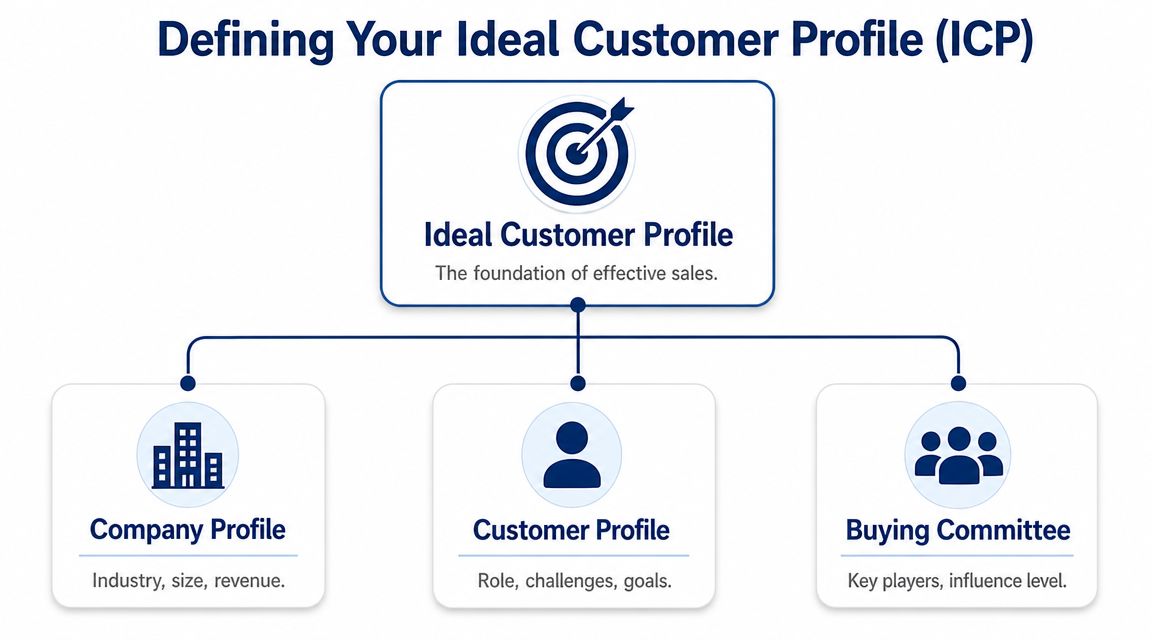
The first job is deciding who belongs in the system at all. In industrial sales, that means defining your ideal customer profile, then expanding your view from one contact to the full buying committee. Industrial pipelines must adapt to buying committees and technical risk, and buying behavior is moving further toward self-directed research before sales contact, which means your stages and content need to serve engineers, operations, finance, and procurement differently rather than treating the lead as a single buyer, as noted in NetSuite's manufacturing sales pipeline guidance.
Start with fit before volume
A workable ICP goes past industry and company size. Those are useful, but they don't explain whether the account is operationally and commercially viable for you.
Build your ICP around three layers:
- Company fit: Sector, application, production environment, installed base, and whether your solution matches the complexity of their operation.
- Problem fit: The operational bottleneck, compliance issue, throughput constraint, quality challenge, or maintenance burden that makes change necessary.
- Commercial fit: Budget logic, buying cadence, internal approval style, and whether the account can support your delivery model.
If your team sells custom equipment, automation, contract manufacturing, or engineered services, pricing context matters too. Teams that review competitor positioning and buyer expectations before a proposal is built usually have fewer surprises later. If you need a practical primer on optimizing pricing with market data, that framework helps tighten the commercial side of ICP work.
Map the committee, not just the contact
Industrial deals often stall because the salesperson built a relationship with one person and assumed that was enough. It rarely is.
Your contact map should usually include roles like these:
- Engineering or technical evaluator: Cares about specifications, compatibility, risk, and implementation details.
- Operations leader: Focuses on uptime, throughput, safety, labor impact, and disruption during rollout.
- Finance or executive sponsor: Wants business justification, timing, and confidence that the purchase supports wider priorities.
- Procurement: Looks at terms, vendor risk, price discipline, and internal process compliance.
A lead is not a buying decision. It's one point of entry into a committee.
Persona work supports pipeline design. If you need a structured way to document these roles, this guide on creating buyer personas for industrial marketing is useful because it helps separate job title from decision criteria.
A simple committee map should answer:
- Who feels the pain?
- Who validates the technical fit?
- Who owns the budget logic?
- Who can delay or block approval?
- Who will defend the project internally when you're not in the room?
When teams skip this step, they confuse contact activity with deal momentum. Those are not the same thing. A busy inbox from one champion can still hide a weak account with no executive support and no procurement path.
Architecting Your Pipeline Stages and Handoffs
A pipeline becomes predictable only when each stage marks a real change in buyer commitment. Industrial teams get into trouble when stage names describe seller activity instead of account progress. “Contacted” and “interested” create motion in the CRM, but they do not tell leadership whether the deal can survive technical review, budget scrutiny, or procurement.
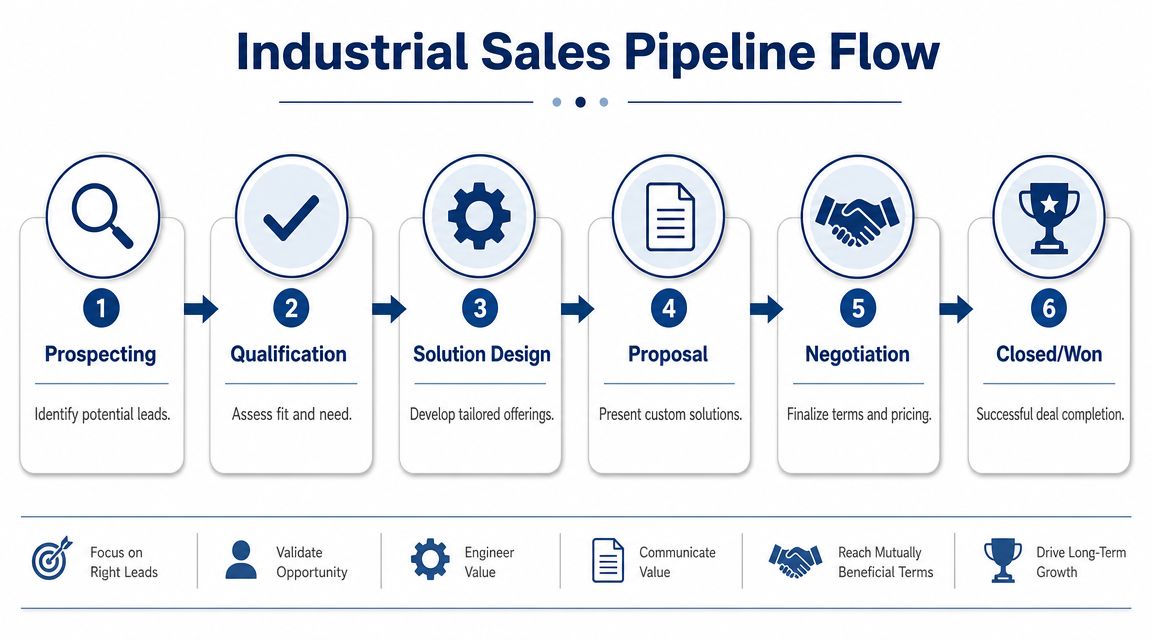
A workable industrial pipeline usually follows a path like prospecting → qualification → discovery → solution fit and proposal → commercial review → close → post-sale transition. The exact labels matter less than the rules behind them. If two reps can move an opportunity forward based on different standards, the forecast will drift.
Use stages that reflect real buying progress
For manufacturers, a stage architecture should answer one question at every step: what changed inside the account that justifies advancement?
A clean version often looks like this:
Prospecting
The account fits the market, and there is a credible reason to pursue it.Qualification
The team confirms the problem is real, the fit is plausible, and the account is worth sales time.Discovery
A meaningful conversation happens with a relevant stakeholder, and the team learns enough to frame the problem correctly.Solution Fit and Proposal
Technical requirements, constraints, scope, and commercial assumptions are documented well enough to build the offer.Commercial Review
The account is working through pricing, terms, approval steps, vendor review, or timing.Close
The deal is won or lost, and the outcome is recorded with a useful reason code.Post-Sale Transition
Ownership moves cleanly into onboarding, account management, service, or reorder planning.
The stage names can vary by product line. The exit criteria cannot stay vague.
Sample industrial pipeline stages and exit criteria
| Stage | Objective | Exit Criteria (Example) |
|---|---|---|
| Prospecting | Focus effort on accounts worth pursuing | Account matches ICP, target site or division is identified, and outreach has a clear use case |
| Qualification | Confirm the opportunity deserves rep time | Business issue is confirmed, fit looks commercially realistic, and a next conversation is scheduled |
| Discovery | Understand the application and buying context | Relevant stakeholder engaged, current process or pain documented, and success criteria discussed |
| Solution Fit and Proposal | Build the technical and commercial case | Requirements captured, scope boundaries defined, internal feasibility checked, and proposal path approved |
| Commercial Review | Advance through approval and negotiation | Pricing or terms under review, buying steps clarified, and the next approval action has an owner and date |
| Close | Record the outcome accurately | Won or lost status confirmed, amount updated, and reason logged |
| Post-Sale Transition | Protect implementation and future revenue | Handoff completed, internal owner assigned, and follow-up plan documented |
Good stage design protects engineering time.
If a rep can request a quote before the application is clear, the team starts solving the wrong problem. If a proposal can go out before the buying path is known, pricing becomes a substitute for discovery. Both failures are common in industrial sales, especially when the buyer asks for a quote early and the rep feels pressure to respond.
Design handoffs like process controls
Handoffs fail when ownership changes but definition does not. Marketing calls something a lead. Sales treats it like an opportunity. Engineering gets pulled in before the account has earned technical attention. Every team feels busy, and nobody can explain why win rates stay soft.
The fix is operational. Define what each team must provide before the next team accepts the record.
For example:
- Marketing to sales: source, company fit, known application, and reason for outreach
- Sales to engineering or technical support: documented requirements, target use case, timeline, and open technical risks
- Sales to leadership for forecast review: verified next step, stakeholder coverage, commercial range, and close window
- Sales to account management or service: won scope, promised deliverables, contacts, and implementation notes
This is the difference between a stage map and a revenue machine. One is a set of labels. The other is a controlled system with inputs, checks, and release conditions.
Where industrial teams usually break the process
The common failure points are predictable:
- Inquiry without application detail: a form fill enters the pipeline with no plant, line, part, or use-case context
- Discovery without qualification: the rep books a meeting before confirming the account is worth the time
- Proposal before technical clarity: pricing is sent while requirements are still inferred
- Stage movement without next step: the opportunity advances with no dated action, no owner, and no buyer commitment
- Post-sale drop-off: the deal is marked won, but service and account teams do not receive the information needed to execute
A rep should never advance a deal based on optimism. Advancement should require evidence.
Teams building this in software should align stage definitions with the CRM from the start. A practical reference for that setup is this guide to CRM strategy for manufacturing companies, especially if sales, service, and operations all touch the same account after the handoff.
The trade-off is straightforward. Tighter stage rules slow early movement and reduce inflated pipeline volume. They also improve forecast quality, cut wasted quoting, and make automation possible later. That is usually the right trade for industrial businesses, where each serious opportunity consumes real sales and technical labor.
Building the Engine with CRM Setup and Automation
A stage map on a whiteboard won't change anything. The process has to live inside the CRM, and the CRM has to enforce behavior when reps get busy.
That's where most industrial teams underbuild. They buy a tool, add a few columns, and call it pipeline management. Then manual follow-up slips, stale opportunities stack up, and nobody trusts the data.
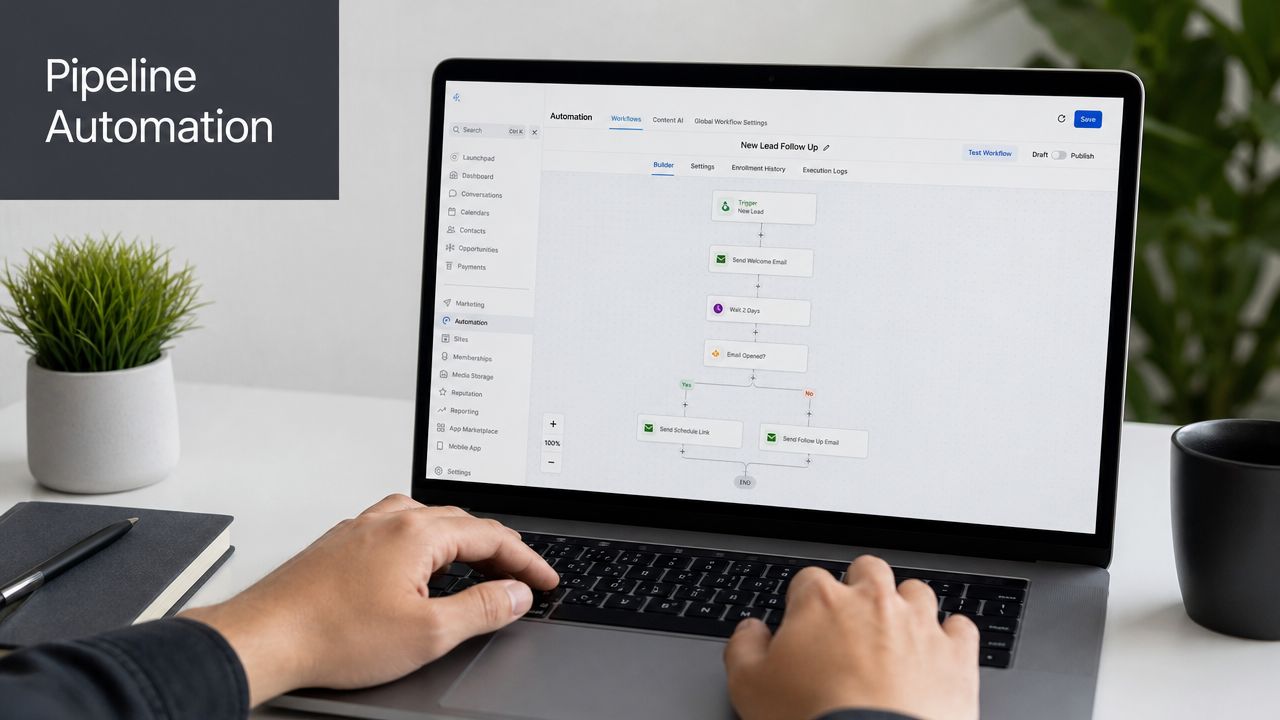
Build the pipeline inside the CRM
In GoHighLevel, start with the Opportunities area and create custom stages that match your real process. Keep the labels clear. If your internal process requires technical discovery before quoting, make that a distinct stage. Don't hide it under a vague label.
Then add required fields that support advancement. Examples include:
- Technical requirements documented
- Primary pain statement
- Next meeting date
- Decision-maker identified
- Budget status
- Proposal due date
- Estimated close window
For manufacturers evaluating systems, this overview of CRM strategy for manufacturing companies is a practical reference because it ties CRM setup back to operational use, not just software features.
Automation that prevents deal drift
Benchmarks from MarketJoy, cited by Landbase, show 20–25% conversion from Lead→MQL, 12–18% from MQL→SQL, 10–12% from SQL→Opportunity, and 6–9% from Opportunity→Closed-Won in B2B pipelines, which is why small improvements in qualification and follow-up have an outsized effect downstream according to Landbase's pipeline benchmark summary.
That's the practical case for automation. In long-cycle industrial selling, manual follow-up gets deprioritized. The rep has live quotes, customer issues, internal meetings, and engineering questions. Without automation, the oldest opportunities rot.
Use automation for the parts of discipline that humans do inconsistently:
- Stale deal alerts: Trigger a reminder when an opportunity sits too long without an activity update.
- Task creation: When a deal changes stage, automatically create the required next-step task.
- Manager visibility: Escalate aging deals when the rep ignores the first prompt.
- Follow-up sequences: Send standardized emails or SMS reminders after meetings, quote delivery, or missed callbacks.
- Recycling rules: Move inactive opportunities into a nurture path instead of leaving them in the active pipeline.
A practical GoHighLevel workflow
A basic workflow that works well for industrial teams looks like this:
- Trigger: Opportunity stays in “Needs Analysis and Proposal” with no update for a defined period.
- Condition check: Confirm there is no future task and no recent outbound contact logged.
- Rep action: Create a task for the owner and send an internal notification.
- Manager action: If no update follows, notify the sales manager.
- Cleanup path: If the buyer doesn't respond after the follow-up sequence, move the deal to a nurture or stale pipeline.
That kind of automation doesn't replace selling. It protects the process from neglect.
Here's a visual walkthrough you can use as a reference point when building workflows in GoHighLevel:
Teams that want outside support for mapping stages, automations, and reporting can use platforms directly or work with a consultancy such as Machine Marketing for CRM and process implementation. What matters is that the automation reflects your actual industrial buying cycle rather than a generic template.
Your Dashboard Key Metrics for Pipeline Health
A plant manager asks for this quarter's forecast. The CRM shows plenty of open revenue, so the answer looks safe. Two weeks later, several deals slip, one quote was never reviewed by engineering, and another "late-stage" opportunity had no confirmed next meeting. The problem was never the total pipeline number. The problem was that nobody was measuring pipeline health.
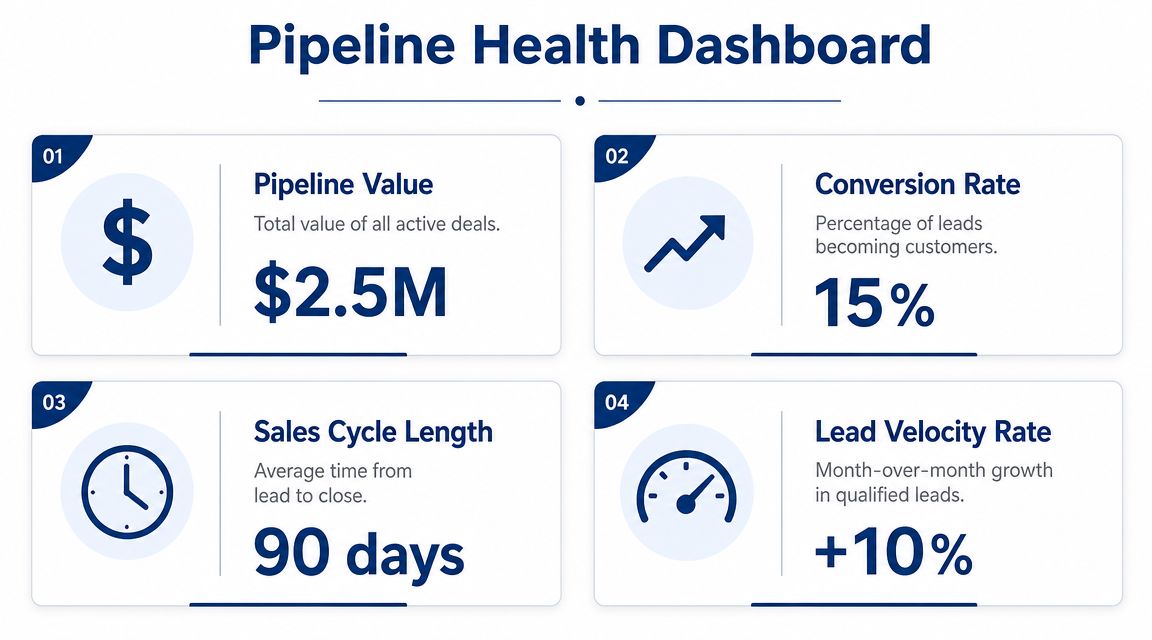
A useful dashboard gives leaders an operating view, not a vanity report. For industrial sales, four metrics usually carry most of the diagnostic value: pipeline coverage, stage conversion rate, sales cycle length, and pipeline velocity. Together, they show whether the revenue engine has enough input, whether deals are advancing with quality, and where friction is building.
The few metrics that actually diagnose problems
Pipeline coverage answers a simple question. Is there enough qualified revenue in motion to support the target, even after normal slippage? Earlier in the article, we noted the common rule of thumb that industrial teams often need several times their target in active pipeline. The exact number depends on deal size, win rate, and cycle length. Custom capital projects need more coverage than repeat-order product lines.
Stage conversion rate shows where the process breaks. If many deals enter discovery but few reach quote review, qualification is loose or discovery is weak. If quotes go out and then stall, the issue often sits elsewhere: pricing strategy, technical fit, stakeholder access, or proposal quality.
Sales cycle length helps separate expected complexity from avoidable delay. Industrial deals take time. Engineering reviews, validation, procurement, and plant scheduling are real constraints. The metric becomes useful when it is segmented by deal type and stage, not averaged into one number that hides what changed.
Pipeline velocity combines movement and value. It is one of the fastest ways to spot false confidence in the CRM because old opportunities with large dollar amounts can make total pipeline look healthy while actual progress slows.
What a bad number usually means
Metrics matter only if they trigger inspection and action.
| Metric | What it tells you | If it looks bad, investigate |
|---|---|---|
| Pipeline coverage | Whether current qualified opportunities can support the target | Weak prospecting volume, poor-fit accounts entering the funnel, or stale deals inflating expected revenue |
| Stage conversion rate | Where deals consistently advance or drop out | Weak discovery, unclear stage entry rules, missing economic buyer access, or proposals that do not match the buying committee's concerns |
| Sales cycle length | How long opportunities take to move from first qualification to close | Delays in technical review, proposal turnaround time, procurement friction, legal review, or rep follow-up gaps |
| Pipeline velocity | How quickly revenue is progressing through the system | Too many parked opportunities, internal approval bottlenecks, low rep urgency, or stage progression that is not tied to buyer commitments |
Numbers do not repair the pipeline. They tell managers where to inspect the system.
In GoHighLevel, this only works if the fields behind the dashboard are controlled. Each opportunity should have an owner, current stage, deal value, last activity date, next step date, and a clear source. Without that, velocity and aging reports become fiction. I have seen manufacturers blame forecasting when the actual problem was simpler: reps were advancing stages without logging commitments, so the dashboard could not distinguish active deals from neglected ones.
A few rules keep the dashboard useful:
- Review by segment: Separate OEM accounts, distributors, repeat buyers, and custom-engineered opportunities. Their buying cycles are different.
- Track aging inside each stage: Long cycles can be normal. Long periods with no logged progress are not.
- Compare activity to advancement: High call volume with weak stage movement usually points to poor qualification or conversations that never secure a buying action.
- Audit stage usage monthly: If one rep converts at an unrealistic rate, check whether the team is applying stage definitions the same way.
Forecasting improves when these metrics are used together. Coverage without conversion is noise. Conversion without cycle length misses timing risk. Velocity without stage discipline can be manipulated by careless updates. A healthy dashboard functions like an instrument panel for the revenue machine. It shows where output is constrained so the team can fix the process, not debate opinions.
Ongoing Optimization Playbooks and Iteration
The first version of your industrial sales pipeline won't be perfect. That's fine. The point is to build a system that can be inspected, improved, and taught.
What breaks most often after implementation isn't the software. It's drift. Reps start skipping fields. Managers make exceptions. Old deals stay open because nobody wants to lose “potential.” Before long, the pipeline exists, but the discipline around it doesn't.
Turn good rep behavior into an SOP
A sales playbook keeps that from happening. It should be a working SOP, not a motivational document.
Your playbook should define:
- Stage definitions: What each stage means in plain language
- Exit criteria: What must be true before a deal advances
- Qualification rules: What disqualifies an opportunity early
- Talk tracks and email templates: Standard language for discovery, follow-up, and quote progression
- Handoff rules: What marketing, sales, engineering, and account management must document
Win/loss review belongs in that same operating rhythm. Not a vague postmortem. A repeatable review. Did you lose on technical fit, stakeholder coverage, pricing position, timing, internal champion weakness, or implementation risk? Those answers should change the playbook.
Forecasting gets better when discipline gets tighter
One of the biggest gaps in pipeline advice is forecasting in complex industrial sales. The hard part isn't drawing stages. It's preventing inflated pipeline from creating false confidence.
Guidance from SalesMotion notes that success depends less on the pipeline diagram itself and more on process discipline, including strict stage exit criteria, regular checks for stale opportunities, and scenario planning for complex deals, as discussed in SalesMotion's view on pipeline stages and forecast discipline.
That means your forecast review should challenge deals, not just total them. Ask:
- Is there a documented next step?
- Are the right buyer roles engaged?
- Is the close timing based on buyer action or seller hope?
- Has the opportunity moved recently, or is it aging in place?
- What would remove this deal from the forecast entirely?
Forecast quality usually reflects CRM hygiene more than sales ambition.
If your pipeline still depends on rep memory, informal updates, and heroic follow-up, it will stay unpredictable. If your stages are clear, your CRM enforces behavior, and your reviews challenge stale assumptions, revenue becomes easier to understand and easier to improve.
If your team has the people and tools but still lacks a reliable pipeline system, Machine Marketing helps manufacturers diagnose the gaps between lead generation, CRM setup, automation, and reporting. If you want a practical review of your current pipeline, start with a system diagnosis and identify where deals are stalling.