If you're running a manufacturing business, you may already know the frustrating version of this story. Your shop produces excellent work. Your team solves hard technical problems. Customers who know you tend to stay. But new buyers don't always see that value quickly, and less-capable competitors sometimes look more credible in the market than you do.
That gap usually isn't caused by engineering. It's caused by branding that was never built as a system.
In manufacturer brand building, the problem isn't usually a bad logo. It's a broken commercial signal. Your website says one thing, your sales deck says another, your trade show booth looks outdated, and your follow-up emails sound like they came from a different company. Consistent branding across all channels can increase revenue by up to 23% for manufacturers, according to Salesgenie's brand awareness statistics roundup. That tells us something important. Brand consistency isn't cosmetic. It affects trust, and trust affects revenue.
Table of Contents
- Why Your Best Machine Is Not Your Best Salesperson
- The Diagnostic Phase Research and Positioning
- Crafting Your Core Message and Value Proposition
- Building Your Digital Foundation With SEO and Automation
- Amplifying Your Brand Through Content PR and Trade Shows
- Aligning Sales and Measuring Brand Impact
- Your First 90 Days A Manufacturer's Brand Building Plan
Why Your Best Machine Is Not Your Best Salesperson
A great machine proves capability after the buyer is already interested. Your brand has to do the work before that moment.
That's where many manufacturers get stuck. They assume product quality will carry the sale, but most buyers don't experience your quality first through a plant tour or a sample part. They experience it through your homepage, your line card, your quote follow-up, your booth graphics, your response time, and the clarity of your message. If those signals feel scattered, buyers fill in the gaps themselves.
That creates a trade-off you can't ignore. You can invest in equipment, process improvement, and hiring, then needlessly lose opportunities because the market can't see the difference between your firm and the average shop down the road. In B2B manufacturing, buyers often choose the supplier that feels lower-risk. Brand is one of the fastest ways they judge that risk.
Practical rule: If your external presence looks less disciplined than your internal operation, your brand is understating your value.
We see this pattern often in machine shops, OEM suppliers, industrial service firms, and technical manufacturers. The team talks in tolerances, capabilities, materials, and lead times. The buyer hears fragmented claims with no unifying promise. Sales ends up relying on one-off conversations to fix what the brand should have made obvious from the start.
Here's what usually works, and what usually doesn't:
| Approach | What happens |
|---|---|
| Specs-only marketing | Engineers may understand it, but non-technical stakeholders struggle to see business value |
| Ad-hoc brand updates | Assets improve in isolation, but the company still feels inconsistent |
| Systematic brand building | Message, visuals, sales process, and digital touchpoints reinforce each other |
The point isn't to make your company sound flashy. It's to make it legible. Buyers should understand, quickly, why you're credible, what you're best at, and why working with you feels safer than working with an unknown alternative.
When manufacturer brand building is done well, your brand stops acting like decoration and starts acting like infrastructure.
The Diagnostic Phase Research and Positioning
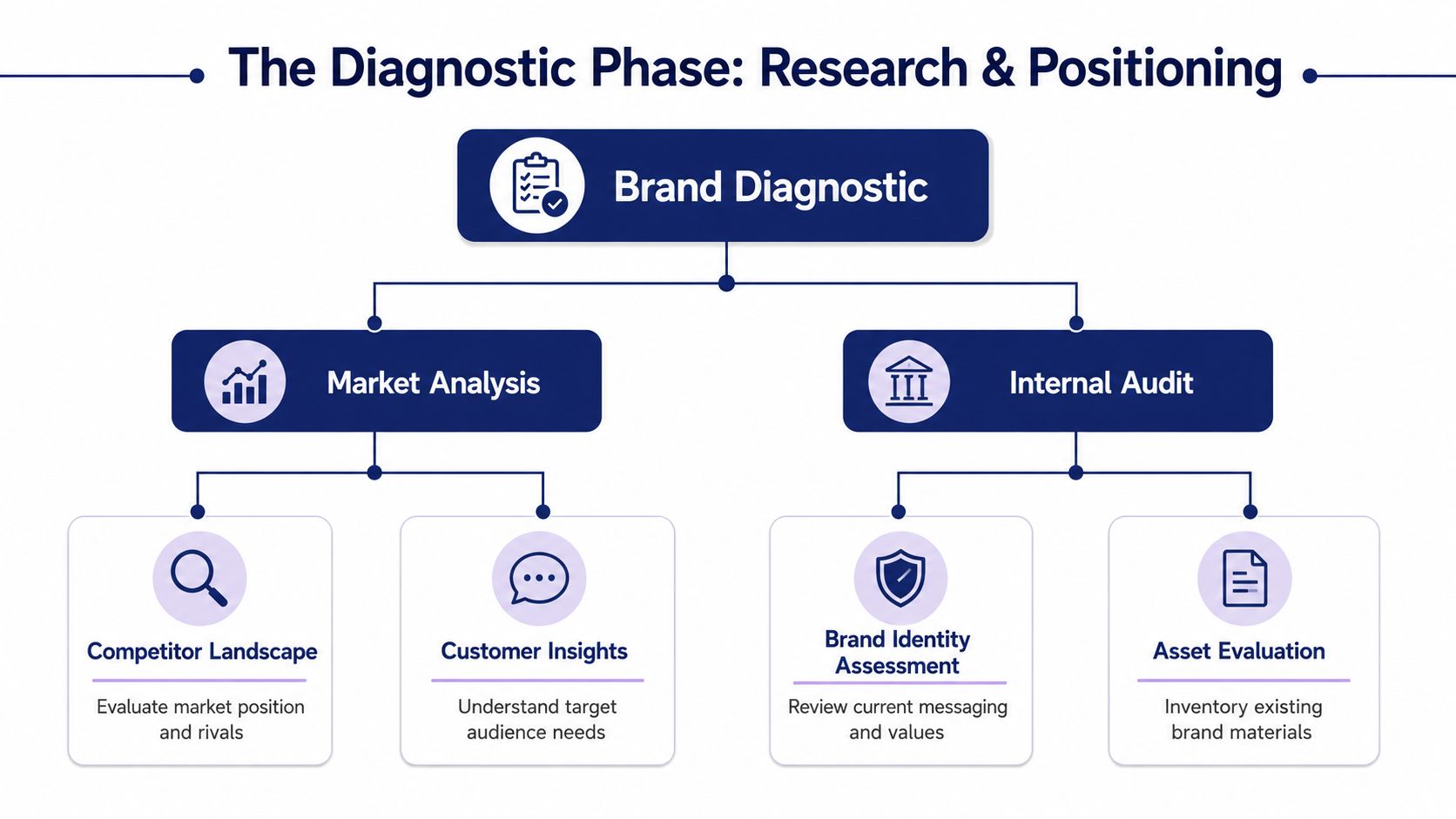
Most brand problems are diagnostic problems first. Companies jump to design, slogans, or content before they've identified where trust is breaking down.
A structured process matters here. A structured 7-step brand-building methodology shows that manufacturers who follow it achieve a 72% increase in brand value growth compared to just 20% for those using ad-hoc, short-term tactics, according to this manufacturing brand strategy breakdown. The first move is diagnosis, not decoration.
Start with the evidence you already have
Run your audit like an engineer would run a process review. Don't ask whether your brand “looks good.” Ask whether it performs consistently across touchpoints.
Review these assets side by side:
- Website pages: Home, services, industries, about, contact, and landing pages.
- Sales materials: Capability statements, quote templates, one-pagers, pitch decks, and proposal documents.
- Trade assets: Booth backdrops, signage, product sheets, leave-behinds, and banners.
- Outbound communication: Sales emails, nurture emails, LinkedIn company posts, and customer onboarding messages.
- Operational touchpoints: Packaging, shipping communication, service updates, and customer support responses.
Look for four recurring failure points:
- Message drift. Different teams describe the company in different ways.
- Visual inconsistency. Logos, colors, photography, and layout styles don't match.
- Weak positioning. The company sounds competent, but not distinct.
- Missing buyer translation. Internal language reflects plant-floor expertise, but not buyer priorities.
If you need a simple way to sharpen audience definition during this phase, these actionable steps for creators are useful because they force clearer thinking about who you're trying to reach and why that matters.
Find the position you can actually own
Competitor review shouldn't stop at “what machines do they run?” Study how competitors present themselves.
Ask practical questions:
- What do they claim repeatedly? Speed, quality, service, innovation, local supply, sustainability?
- Who are they really talking to? Engineers, buyers, operations leaders, procurement, owners?
- What proof do they use? Certifications, process detail, vertical specialization, documentation quality?
- Where do they all sound the same? That's often where opportunity lives.
Buyers rarely reward generic competence. They respond when a company names a specific problem and proves it can solve it reliably.
Your position should be narrow enough to be believable. “High quality solutions” is useless. “Rapid-turn precision machining for urgent production bottlenecks” is sharper. “Zero-defect documentation discipline for regulated manufacturing” is stronger still.
Once you've identified that space, map it formally. A strategic positioning framework like the one outlined in this guide to brand positioning for industrial firms helps turn raw observations into a usable market position instead of a vague internal opinion.
Crafting Your Core Message and Value Proposition
Most manufacturers already have differentiators. The problem is that they describe them from the inside out.
Your team may say, “We hold tight tolerances, run advanced equipment, and maintain strict process control.” That's true, but buyers don't purchase a machine spindle or a tolerance band. They purchase confidence. They purchase lower risk. They purchase fewer production surprises.
Recent studies show that 70% of B2B purchasing decisions are now influenced by branding rather than technical specs alone, and brands failing to articulate a clear “why” beyond functionality lose 45% of engagement with senior decision-makers. That's the warning sign. If your message stays at the feature level, you lose the people who control budget, approve vendors, and carry organizational risk.
Translate features into buyer outcomes
Here's the practical shift.
Instead of listing technical strengths, connect each one to a business consequence:
| Technical input | Buyer-facing meaning |
|---|---|
| Tight tolerances | Fewer quality issues and less downstream failure risk |
| Fast lead times | Less production delay and more planning confidence |
| Material expertise | Better fit for demanding applications |
| Strong documentation | Easier vendor approval and smoother compliance review |
A machine shop that says “we machine to micron-level tolerances” may impress engineers. A machine shop that says “we help aerospace buyers reduce defect risk on critical parts” is speaking to a broader buying group.
That translation work is the core of manufacturer brand building. You're not dumbing down the truth. You're making the truth usable.
Build a message your whole team can repeat
A useful core message has three parts:
- Who you serve
- What problem you solve
- Why buyers should believe you
Try pressure-testing your message against these questions:
- Can a sales rep say it in one breath?
- Can a non-technical buyer understand it immediately?
- Does it sound distinct from your top competitors?
- Can your website, trade booth, and proposal template all support it?
Field note: If your message only works when your owner explains it live, it isn't ready yet.
The strongest value propositions are specific without becoming cluttered. They don't try to say everything. They choose the commercial truth that matters most.
If you want a practical structure for writing and refining that language, this resource on how to write a manufacturing value proposition is a good working model. Use it to create a short brand promise, a longer positioning statement, and three proof points your team can use everywhere.
Building Your Digital Foundation With SEO and Automation
In most manufacturing companies, the website is the highest-impact brand asset because it handles three jobs at once. It introduces the company, proves credibility, and converts interest into action.
If that site acts like a digital brochure, your brand underperforms. If it acts like a working commercial system, it starts supporting sales every day.

Treat the website like a production asset
A strong manufacturing site needs more than polished design. It needs operational clarity.
Your baseline checklist should include:
- Clear navigation: Buyers should reach services, industries, proof, and contact options without hunting.
- Focused service pages: Don't hide key capabilities inside one generic page.
- Industry language: Show buyers you understand their application, not just your process.
- Proof elements: Certifications, process detail, case examples, FAQs, and documentation standards.
- Conversion paths: RFQ forms, contact forms, call scheduling, downloadable resources, and trackable calls to action.
Search also matters, but not as a vanity exercise. Industrial SEO works best when pages align to real buying intent. That means building pages around problems, capabilities, industries, and use cases buyers search for. If you're tightening this foundation, a guide to SEO for manufacturing companies is a practical place to structure that work.
There's also a newer discovery layer to pay attention to. Buyers increasingly encounter vendors through search experiences shaped by AI summaries, entity recognition, and citation patterns. This overview of AI-driven discovery and link building from AY Rank is useful because it shows why authority signals now matter beyond traditional rankings.
Use GoHighLevel to operationalize the brand
Once your site is attracting the right visitors, automation closes the gap between attention and action.
GoHighLevel is useful here because it combines forms, pipelines, email, SMS, workflows, landing pages, and reporting in one environment. For a manufacturer, that means you can connect brand experience directly to follow-up instead of relying on manual handoffs.
Common use cases include:
New inquiry routing
A form submission can trigger internal alerts, assign the lead to a rep, and place the contact into the right pipeline stage.Lead nurturing
If a buyer downloads a capability guide but doesn't request a quote, GoHighLevel can send a short email sequence that reinforces your positioning, industries served, and next step.Reactivation
Old contacts from trade shows, dormant house lists, or lost opportunities can receive targeted campaigns tied to a service line or industry focus.Sales visibility
Marketing can see whether leads were contacted, advanced, stalled, or closed. Sales can see what page or form started the relationship.
A short walkthrough helps if you want to see how these systems are typically implemented in practice:
Your website should not hand leads to sales and disappear. It should continue supporting the conversation after the first conversion.
That's the core value of digital brand infrastructure. It makes your message repeatable, your follow-up faster, and your pipeline more measurable.
Amplifying Your Brand Through Content PR and Trade Shows
Once the brand is clear and the digital base is working, amplification becomes much easier. You don't need more noise. You need more repetition in the right channels.
The cleanest pattern is simple. Publish useful content. Turn the best material into PR opportunities. Carry the same message into trade events where buyers can meet your team face to face.
One story across three channels
Start with content. A manufacturer might publish an article about reducing part failure in a demanding application, a short video from the floor explaining a process, or a downloadable guide that helps buyers evaluate vendors more intelligently. Good content proves expertise without forcing a sales pitch.
That same content can support PR. Trade editors, association publications, and niche industry outlets often need informed commentary, practical articles, and timely insights. If your company already has a clear point of view, earned visibility becomes more realistic.
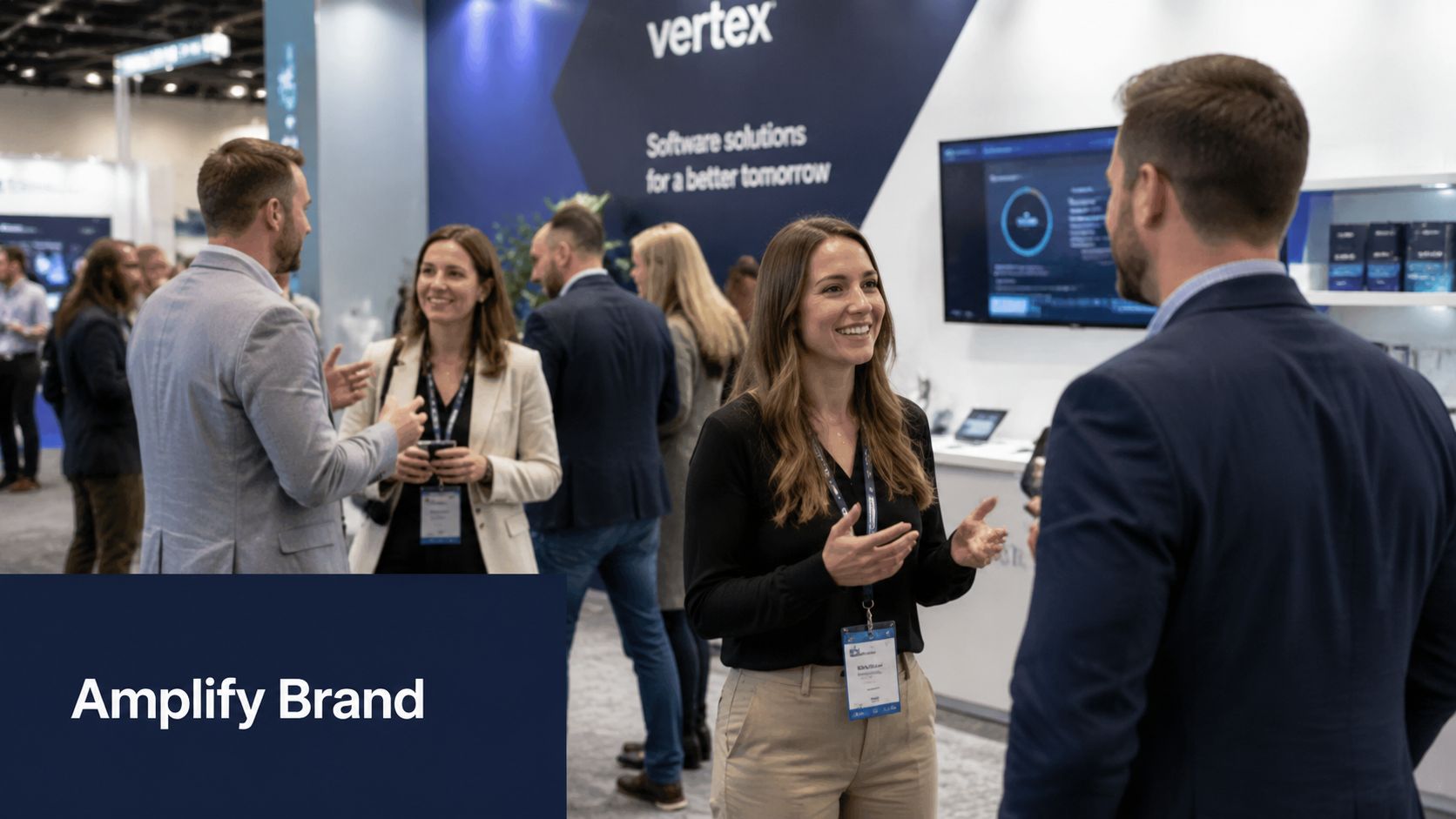
Then trade shows enter the picture. At these events, many firms waste money. They invest heavily in booth space but arrive with weak pre-show outreach, generic booth messaging, and no consistent talk track for the team. The result is activity without a strong memory.
What strong amplification looks like in practice
A better approach is to choose one message and make it visible everywhere. If your brand promise centers on reliable turnaround for urgent industrial needs, then:
- Your article explains how buyers can reduce delays when sourcing precision parts.
- Your outreach offers that insight to a trade publication or association audience.
- Your booth leads with the same promise, not a cluttered list of every capability.
- Your sales team uses the same framing in conversation.
- Your follow-up sends prospects one useful asset tied to that exact issue.
That consistency matters because stories travel better than specs alone. If you tell a compelling brand story, 55% of B2B buyers are more likely to purchase from you in the future, and 44% will share that story with others, according to FUEL's review of branding ROI research.
Don't try to say everything at the trade show. Say one important thing clearly, then support it with proof.
The manufacturers that get the most from amplification don't separate digital from physical marketing. They carry one believable promise from article to inbox to booth to sales follow-up. That's how brand memory gets built.
Aligning Sales and Measuring Brand Impact
A brand fails fast when marketing says one thing and sales says another.
This breakdown usually isn't dramatic. It shows up in smaller moments. The website emphasizes precision and reliability, but the sales rep opens with “we can do a little bit of everything.” Marketing frames the firm around a defined niche, while proposals fall back to generic language. Buyers notice that mismatch immediately.
Fix the handoff between marketing and sales
Sales alignment starts with shared language and shared tools.
Build a simple enablement package:
- One core narrative: A short positioning statement everyone can repeat.
- Proof assets: One-pagers, short case summaries, vertical-specific decks, FAQ sheets, and objection handling notes.
- Talk tracks for key moments: Intro calls, quoting conversations, stalled opportunities, and follow-up after trade shows.
- Operational commitments: Response time standards, handoff rules, and clear ownership inside the CRM.
This is also where process design matters. If you're refining sales follow-up after the lead comes in, this guide to improving your B2B conversion funnel is useful because it focuses attention on the moments where interest gets lost between touchpoints.
Measurement insight: If sales can't see where the lead came from or what message attracted it, they'll default to improvisation.
Measure behavior that ties to revenue
Brand measurement gets fuzzy when teams track reach without tracking downstream effect. A better approach is to watch indicators that reflect buying behavior and commercial movement.
According to Nielsen data, a 1% increase in brand awareness correlates with a 0.4% increase in short-term sales and a 0.6% long-term sales increase, as summarized in this brand-building strategy analysis. That doesn't mean every dashboard should focus on awareness alone. It means brand health has a real sales relationship, so the measurement system should connect visibility to pipeline.
Useful metrics include:
| Metric | Why it matters |
|---|---|
| Branded search activity | Shows whether more buyers are looking for you by name |
| Lead quality by source | Separates traffic from viable opportunities |
| Sales cycle patterns | Helps you see whether brand clarity is reducing friction |
| Pipeline stage conversion | Reveals where messaging or follow-up breaks down |
| Repeat inquiry behavior | Signals trust and brand recall |
A practical dashboard in GoHighLevel or your CRM should show first touch, conversion action, owner assignment, pipeline status, and outcome. When marketing and sales review the same board, brand stops being abstract. It becomes a set of signals you can inspect and improve.
Your First 90 Days A Manufacturer's Brand Building Plan
Most manufacturers don't need a massive rebrand to get traction. They need a disciplined start.
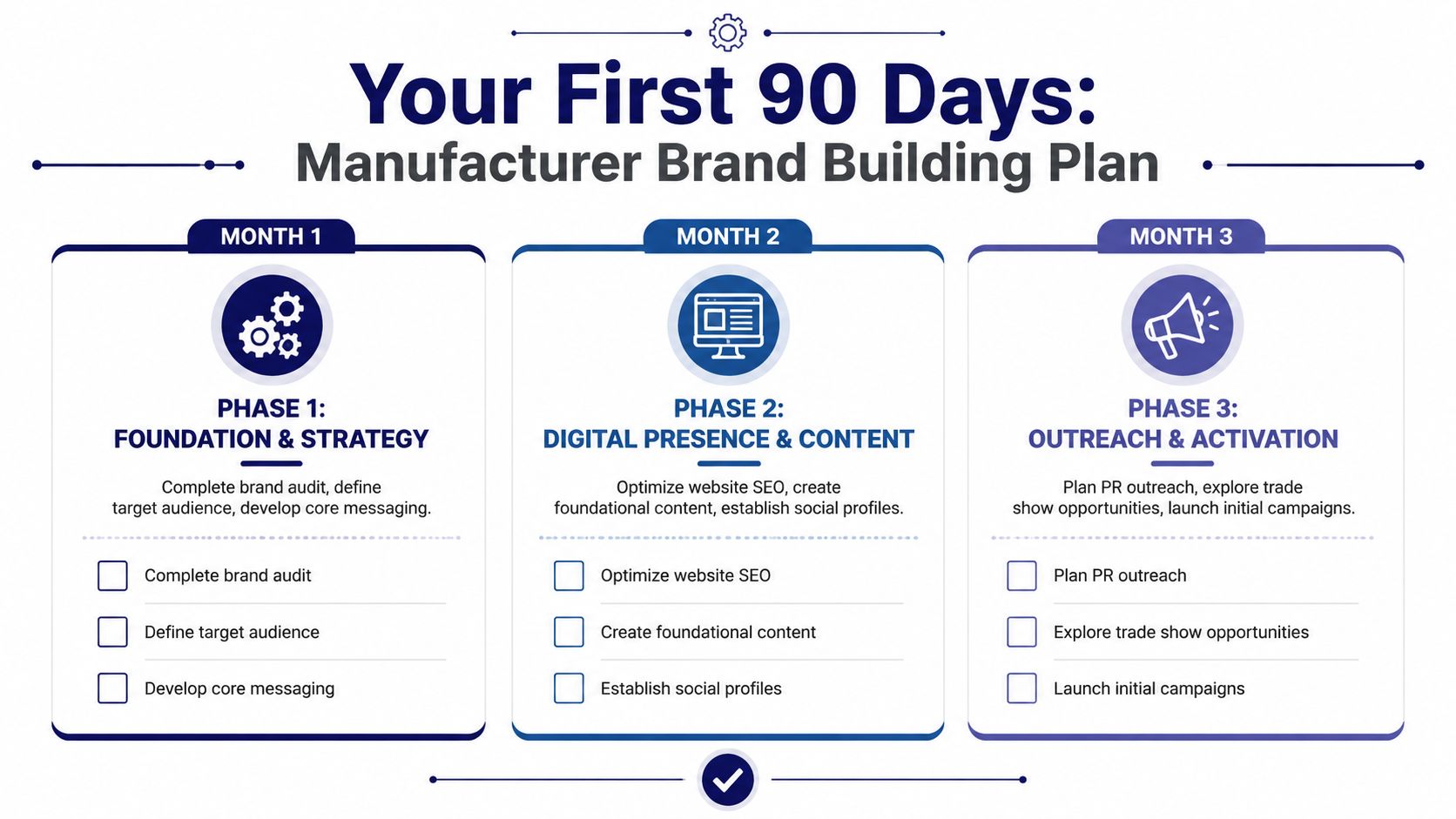
This plan works best when one person owns progress, leadership agrees on the positioning direction, and the team limits scope. Don't try to rebuild every asset at once. Fix the system in the order buyers experience it.
Days 1 through 30
Start with diagnosis.
- Audit the current brand: Review website pages, sales materials, trade assets, email templates, and buyer-facing documents.
- Interview internal stakeholders: Sales, leadership, customer service, and operations often expose message gaps quickly.
- Study competitors: Focus on positioning, not just products.
- Choose a primary audience: Don't write for everyone.
By the end of this phase, you should have a short list of inconsistencies, a clearer audience definition, and a draft position you believe you can own.
Days 31 through 60
Turn insight into usable messaging and infrastructure.
Write your core message, brand promise, and three proof points. Update homepage copy, service pages, proposal templates, and your main sales one-pager so they all tell the same story. If your CRM is underused, clean up pipeline stages and define what should happen when a new lead arrives.
Use this checkpoint to ask:
- Can buyers understand us quickly?
- Do our assets sound like one company?
- Can sales repeat the message without rewriting it?
Days 61 through 90
Activate the brand in the market.
Publish foundational content tied to your position. Tighten your contact forms and follow-up workflows. Prepare a simple outbound sequence for priority accounts or past leads. If you have an upcoming event, align booth messaging, pre-show outreach, and post-show follow-up around one clear promise.
At the end of 90 days, you should have three things in place:
- A diagnosed brand system
- A message the whole team can use
- A digital and sales process that supports consistent execution
Manufacturer brand building works when it becomes operational, not aspirational. That's when your brand starts carrying some of the sales load your team has been handling manually.
If your company has solid capabilities but your marketing, website, CRM, and sales messaging still feel disconnected, Machine Marketing can help you diagnose the gaps and build a system that fits the way manufacturers grow.