If you're running a manufacturing company, there's a good chance growth feels uneven. One quarter starts with a strong RFQ pipeline and a few serious conversations. The next quarter depends on old accounts, referrals, and whatever happens to come through the website.
That pattern usually doesn't mean your team can't sell. It means your manufacturing business development process isn't built like a system.
Most shops and industrial firms already have the raw ingredients. They have technical capability, a decent reputation, some customer history, and a sales process that works when the right buyer shows up. What's missing is the operating layer that turns those assets into repeatable demand. That's where a structured playbook matters, especially for lean manufacturers. Small firms make up 98% of all U.S. manufacturing firms and employ 4.8 million workers, according to the U.S. Small Business Administration Office of Advocacy. Most of these companies don't have the luxury of a large marketing department or a separate revenue operations team.
Table of Contents
- Why Your Manufacturing Business Needs a Development System
- Building Your Growth Blueprint with Market and Customer Data
- Crafting a Message That Resonates with Industrial Buyers
- Activating the Right Lead Generation Channels for Manufacturing
- Building Your Growth Engine in GoHighLevel
- Executing Your Outreach and Measuring What Matters
- Your 30-60-90 Day Manufacturing Growth Implementation Plan
Why Your Manufacturing Business Needs a Development System
Random growth is expensive. It creates quoting spikes, idle capacity, rushed follow-up, and too much dependence on a few relationships. Most manufacturers don't have a lead problem as much as they have a system design problem.
A good development system does three things at once. It identifies the right accounts, gives them a reason to engage, and makes sure no serious opportunity gets lost between inquiry and quote. Without that structure, your team falls back on habit. That usually means relying on referrals, checking in with dormant contacts, showing up at the occasional event, and hoping timing works in your favor.
The opportunity is large enough to justify building this properly. According to the National Association of Manufacturers, every $1.00 spent in manufacturing generates $2.69 in total output across the U.S. economy. That multiplier matters because the contract you're pursuing rarely stops at one PO. It can lead to repeat runs, supplier consolidation, engineering involvement, aftermarket work, or a foothold inside a larger account.
What a real system includes
A working manufacturing business development system usually has these components:
- Clear market focus so your team knows which industries, buyer types, and project profiles deserve attention
- Stakeholder-specific messaging so engineering, operations, procurement, and ownership each hear the value in terms they care about
- Channel discipline so you're not spreading effort across tactics that don't fit industrial buying behavior
- CRM structure and automation so inquiries, follow-ups, quotes, and reminders move without manual chaos
- Reporting that reflects real value so you can judge progress by pipeline quality, speed, fit, and margin
Practical rule: If growth depends on memory, heroics, or one salesperson's inbox, you don't have a system yet.
For manufacturers using outbound as part of that system, signal quality matters more than volume. If you want a practical view of how timing-based outreach works, Reachly's guide for B2B outbound is worth reviewing because it aligns with the way industrial opportunities often open around specific events, capacity changes, or sourcing shifts.
Building Your Growth Blueprint with Market and Customer Data
The first fix isn't “get more leads.” The first fix is to stop pursuing work that doesn't fit your equipment, margins, or team.
A practical growth strategy starts with a formal audit. Genedge's manufacturing guidance recommends that manufacturers map current competencies and capacity, validate market demand, set phased revenue targets, and align technology investments to the bottlenecks. That's a better starting point than brainstorming tactics because it forces you to work from constraints and fit, not wishful thinking.
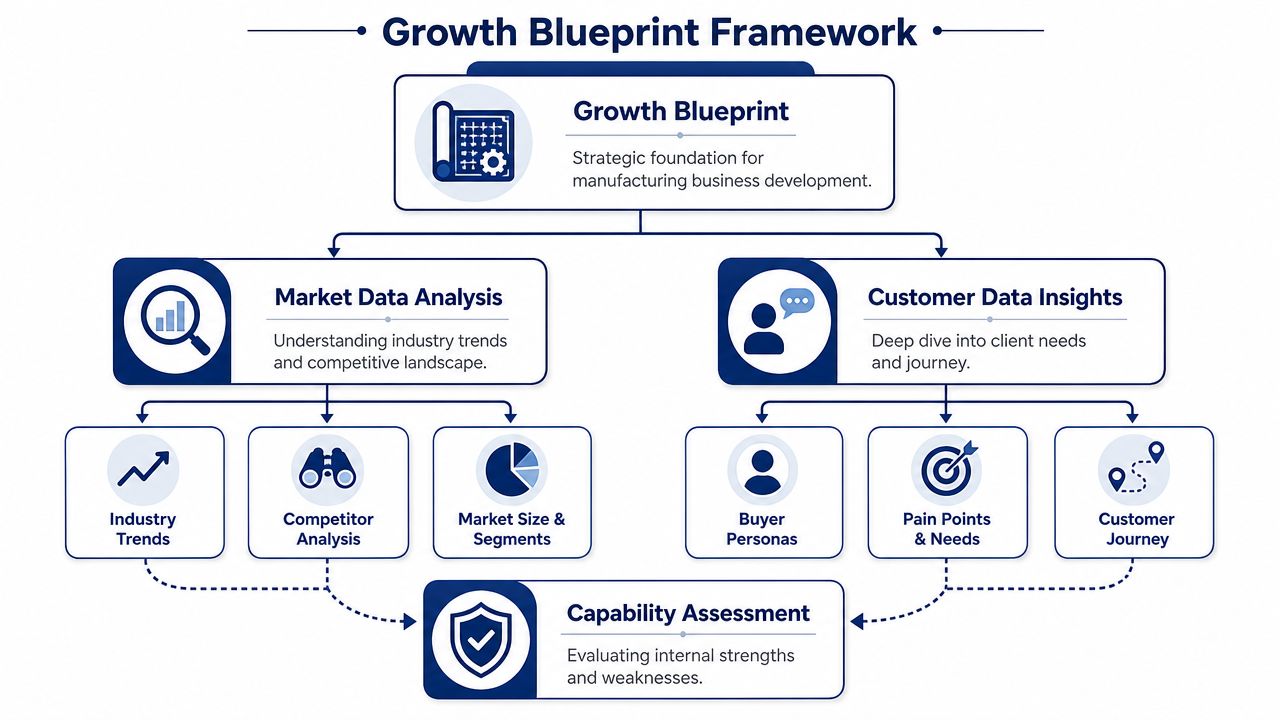
Start with operational reality
Your market position starts on the shop floor, not in a campaign tool.
Ask direct questions:
- Where do we consistently win? Look at jobs with strong margins, smooth production, and low customer friction.
- Where do we struggle? Flag jobs that create rework, quoting confusion, approval delays, or custom engineering drain.
- What constraints keep showing up? Capacity, certification requirements, long setup times, documentation load, material sourcing, or weak follow-up.
- Which projects create downstream value? Some customers bring repeat releases, better planning, or entry into a strategic vertical.
That diagnosis changes your targeting fast. A shop may say it serves “industrial customers,” but the data often shows something narrower and more useful, such as short-run stainless fabrication for regulated environments, prototype-to-production machining for OEMs, or replacement parts for aging equipment.
Define your ICP by fit, not size
A lot of manufacturers build an ideal customer profile around employee count or revenue. That's too shallow for industrial sales.
Build your ICP around:
- Technical need such as tolerance range, material type, part complexity, assemblies, or documentation requirements
- Project pattern such as prototype-heavy work, recurring production, emergency replacement, or supplier consolidation
- Buying behavior including whether they source through engineering, purchasing, operations, or ownership
- Commercial fit including margin potential, quote complexity, and how realistic the account is for your current team
If you need a practical structure for this exercise, use a buyer persona worksheet rather than trying to hold it all in meetings. This guide on how to create buyer personas is useful when you need to turn scattered account knowledge into something your team can use.
The best ICP usually isn't the biggest company you can imagine winning. It's the customer type your operation can serve repeatedly and profitably.
Turn findings into a working blueprint
Once the audit is done, put it into a one-page operating document. Keep it simple enough that sales, marketing, and leadership will use it.
A practical blueprint should include:
| Area | What to document |
|---|---|
| Best-fit segments | Industries, applications, and account types with strong fit |
| Core offers | The services or capabilities you want to lead with |
| Proof points | Specs, turnaround strengths, certifications, process reliability, documentation quality |
| Top bottlenecks | Capacity limits, response delays, weak content, inconsistent quoting, low CRM adoption |
| Near-term targets | The segments and outreach plays to activate first |
This document becomes the filter for every later decision. It tells you which website pages to build, which lists to source, which trade events matter, which case examples to highlight, and which opportunities to decline.
Crafting a Message That Resonates with Industrial Buyers
Manufacturers often describe themselves the way they see the business internally. Buyers don't evaluate you that way.
A prospect rarely cares that you have advanced equipment in the abstract. They care whether your process helps them reduce risk, hit a deadline, protect quality, or avoid another supplier failure. If your message stays at the feature level, the buyer has to translate the value themselves. Many won't.
Translate features into outcomes
Here's the practical shift.
Instead of saying:
- “We offer 5-axis CNC machining.”
- “We do custom metal fabrication.”
- “We have in-house engineering support.”
Say what that capability changes for the buyer:
- “We machine complex parts in one setup when geometry and tolerance stack-up make multi-op work risky.”
- “We fabricate assemblies for industrial environments where late revisions and documentation control matter.”
- “We help move projects from concept to quote faster when your internal engineering team is overloaded.”
The internal feature isn't wrong. It's incomplete.
A useful test is this: can a procurement manager, an engineer, and an operations leader each hear a version of your value that matches their job? If not, the message still needs work.
Build messages for the buying committee
Manufacturing purchases often involve several people with different priorities. Industry Select notes that business development in manufacturing works best when it's stakeholder-specific and evidence-led, especially in complex buying committees, and that targeted channels tend to outperform generic tactics in this environment. That means your message library should be modular, not generic.
Try building your message around stakeholder concerns:
- For engineering: Can you hit the specification, solve manufacturability issues, and reduce back-and-forth?
- For procurement: Are you responsive, organized, and realistic on lead times and documentation?
- For operations: Will your parts arrive reliably enough to protect production flow?
- For leadership: Does this relationship lower supplier risk and support long-term growth goals?
A simple messaging framework keeps this from drifting. This resource on a marketing messaging framework is useful when you need to organize claims, proof, and audience-specific language into something your whole team can repeat consistently.
If your message starts with your machines, you're talking about yourself. If it starts with the buyer's production risk, you're finally speaking their language.
Activating the Right Lead Generation Channels for Manufacturing
Manufacturers lose time when they chase visibility everywhere. Industrial buyers don't reward broad activity. They respond to relevance.
That changes channel choice. The right mix isn't the one with the most impressions. It's the one that lets you present proof to the people closest to the need.
Why broad marketing usually fails here
Manufacturing buying decisions often involve engineering, procurement, and operations. Those buyers don't usually respond to generic brand awareness campaigns. They respond when your company shows up in a context tied to a real project, sourcing need, or technical issue.
Industry Select's guidance is direct on this point. For manufacturers selling into complex committees, stakeholder-specific, evidence-led business development through targeted channels like trade shows, networking, and niche thought leadership outperforms generic tactics.
That doesn't mean digital channels don't work. It means they need to be used precisely.
Choose channels by buying behavior
For most industrial firms, these are the channels worth evaluating first:
- Industrial SEO when buyers search by process, material, capability, or application. This works well when prospects already know the problem and are looking for a supplier.
- LinkedIn outreach when your ideal buyer sits inside a named account and the sales motion requires account-based contact, not broad visibility.
- Trade publications and niche content when you need credibility in a specialized category.
- Trade shows and industry events when buyers need to see samples, talk through applications, or compare vendors in person.
Trade shows still matter, but only if you treat them like a sales system. Booth traffic alone isn't a strategy. Pre-show outreach, meeting scheduling, post-show follow-up, and exhibit quality all matter. If you're investing in events, working with experienced exhibition stand contractors can help you create a setup that supports conversations instead of just taking up floor space.
A simple decision filter helps:
| Channel | Best when | Weak when |
|---|---|---|
| SEO | Buyers are actively searching for a process or supplier | Your offer is too custom or niche to capture meaningful search intent |
| You can name target accounts and roles clearly | Your team won't maintain consistent outreach | |
| Trade shows | Your buyers attend specific industry events | You don't have a follow-up workflow |
| Thought leadership | Buyers need technical trust before talking | Your team can't produce useful, specific insight |
Broad presence feels productive. Focused presence produces conversations.
Pick one primary demand channel and one support channel. That's usually enough to create traction without overwhelming a lean team.
Building Your Growth Engine in GoHighLevel
Strategy doesn't help much if inquiries sit in email, notes live in spreadsheets, and follow-ups depend on whoever remembers first. You need a central operating system. For many lean manufacturers, GoHighLevel can fill that role if it's configured around industrial sales reality rather than generic service-business templates.

Set up a pipeline that matches industrial sales
Most manufacturing opportunities don't move from “lead” straight to “closed won.” They go through technical review, quote development, and often some kind of validation.
A useful GoHighLevel pipeline for manufacturers looks like this:
New inquiry
Web form, email referral, inbound call, list import, or trade show contact.Qualified opportunity
Buyer fit confirmed. Project type, timing, and account relevance look real.Discovery and scope review
Drawings, specs, quantities, material, tolerances, certifications, and commercial constraints reviewed.Quoting
Estimating is active. Internal due date and owner assigned.Prototype or sample stage
Sample work, first article, or validation activity underway if required.Production decision
Buyer is comparing suppliers, reviewing terms, or finalizing internal approval.Won or lost
Closed with documented reason.
That structure matters because it lets you see where work is bunching up. If quoting is overloaded, you'll know. If opportunities stall after sample work, you'll know that too.
For manufacturers comparing systems or implementation options, this overview of GoHighLevel for manufacturers gives a practical picture of how the platform can be adapted for industrial workflows.
Add custom fields your sales team actually needs
Generic CRM fields aren't enough. Your team needs context that affects fit, urgency, and handoff quality.
Create custom fields such as:
- Annual part volume for production potential
- Estimated first order value for prioritization
- Material specification so quoting and production teams see requirements early
- Tolerance range to flag technical fit
- Certification required for compliance screening
- Buyer role so outreach matches engineering, procurement, or operations
- Application or end use to support segmentation
- Target quote due date so speed is managed, not guessed
- Current supplier status to understand whether you're replacing, adding, or quoting greenfield work
If you're already using another CRM, keep the same logic. The tool matters less than the field design.
Automate the first response and the internal handoff
Your first automation should solve one problem. No serious inquiry gets ignored.
Set up a workflow that triggers when a prospect fills out a form or is added to the pipeline:
- Send an immediate confirmation that acknowledges the inquiry and sets expectations
- Deliver a capability deck or relevant line card if the request matches a known service category
- Assign a task to the right owner based on territory, service line, or segment
- Apply tags such as machining, fabrication, OEM, aftermarket, prototype, or regulated
- Create a follow-up reminder if no human response happens within your chosen window
Later, add quote-stage automations, lost-opportunity follow-up, reactivation for dormant accounts, and post-show workflows. Machine Marketing is one option manufacturers use for CRM and automation strategy when they need help connecting these workflows into a single operating system rather than a pile of disconnected tools.
A short walkthrough helps if your team needs to see what a setup like this can look like in practice.
Executing Your Outreach and Measuring What Matters
Once the system is live, execution becomes the difference between a well-built CRM and a real growth engine. Most companies often drift at this point. They build the pipeline, import contacts, maybe send a few emails, then stop because nobody owns the rhythm.
Consistency matters more than intensity. A small, disciplined outreach cadence beats occasional bursts almost every time.
Use a simple outreach rhythm
For outbound and follow-up, keep the approach professional and low-pressure. Industrial buyers respond better to relevance than to polished sales language.
A practical cadence might include:
- Day one with a short email tied to a specific capability, application, or account fit
- Day three or four with a LinkedIn connection request referencing the same context
- Next touch with a useful asset, such as a capability sheet, application note, or short explanation of a common production issue
- Final touch asking whether the topic is relevant now, later, or not at all
A basic first email can be simple:
We work with manufacturers that need reliable support for [process or part type]. Reaching out because your team appears to operate in a category where [specific problem] often creates sourcing friction. If this is relevant, we're happy to share capabilities and discuss fit.
That works better than aggressive claims because it opens a conversation without pretending urgency.
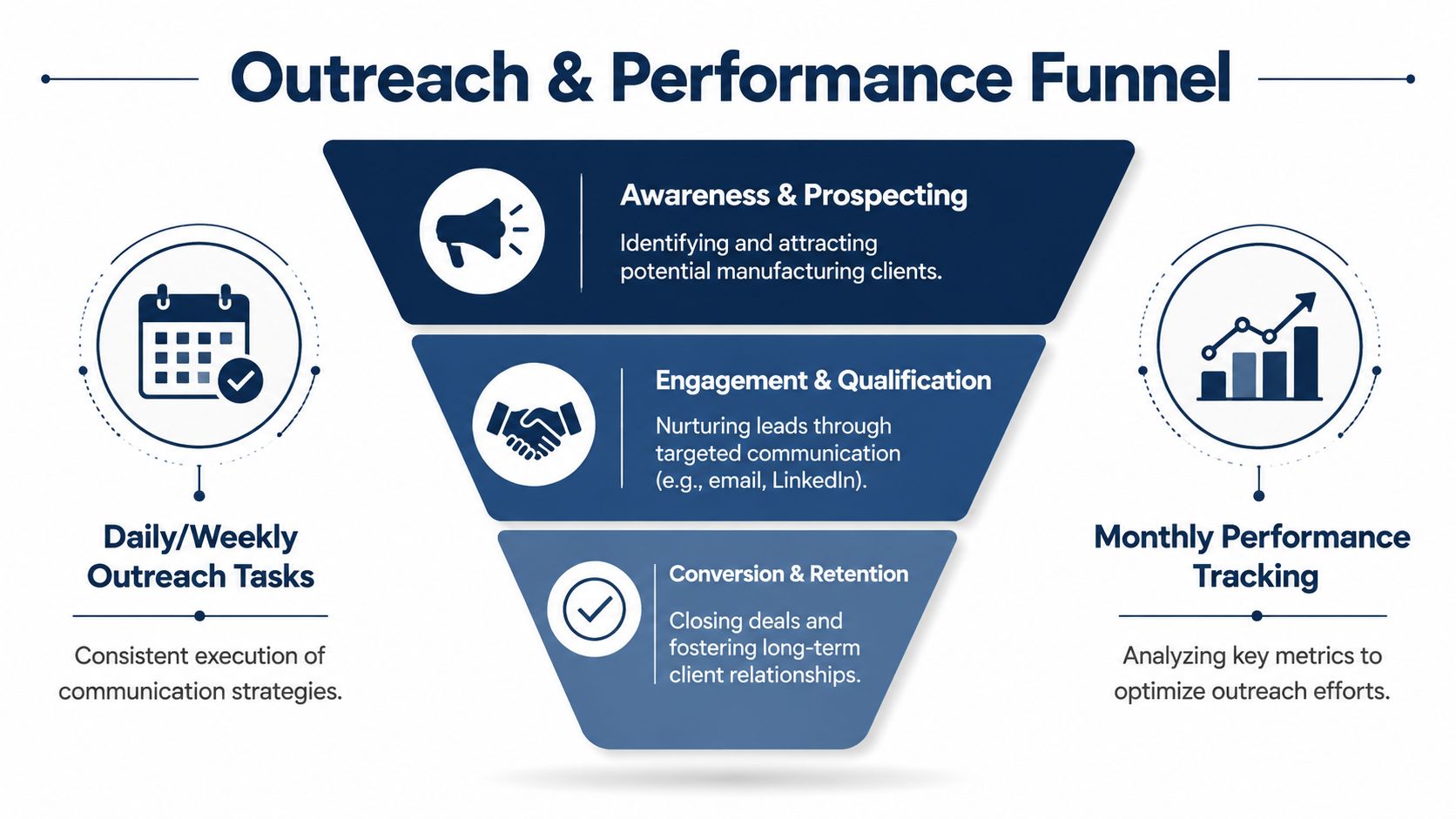
Qualify for fit before you chase volume
Not every inquiry deserves equal attention. Your qualification process should separate strategic opportunities from requests that consume estimating time without a realistic path to business.
Use a short fit screen:
Need clarity
Is there a defined part, process, or sourcing problem?Commercial fit
Does the project match your target margin profile and production model?Operational fit
Can your current equipment, team, and timing support the work?Relationship potential
Is this a one-off price check, or the start of a supplier relationship?
This keeps the team from treating every contact like a must-win deal.
Measure business development ROI the right way
A lot of manufacturers still judge BD effort by lead count, traffic, or form fills. Those metrics aren't useless, but they don't tell you whether the system is producing the right business.
Area Development's manufacturing guidance makes the problem clear. Many manufacturers use superficial metrics, while a better model tracks the percentage of revenue from newly targeted segments, average project margin on new opportunities, and time-to-quote reductions tied to better content and CRM workflows.
That framework is closer to how operators should think.
Track metrics such as:
| Metric | Why it matters |
|---|---|
| Quote-to-win ratio | Shows whether you're targeting and qualifying well |
| Average margin on BD-driven work | Tells you whether new business is actually good business |
| Sales cycle velocity | Exposes delays in response, quoting, and decision movement |
| Revenue from newly targeted segments | Proves whether your ICP expansion is working |
| Time to quote | Measures internal responsiveness and process friction |
If you need a mindset shift, look outside manufacturing for a moment. Service businesses that win consistently often succeed because they measure execution quality, not just inquiries. Reviewing documented success for plumbing and HVAC companies can be useful here, not because the markets are identical, but because the operating discipline around follow-up, conversion, and attribution carries over.
Count leads if you want activity. Track margin, segment quality, and quoting speed if you want decisions.
Your 30-60-90 Day Manufacturing Growth Implementation Plan
A useful plan needs to be specific enough to assign. If it can't be delegated, reviewed, and checked off, it won't survive a busy month.
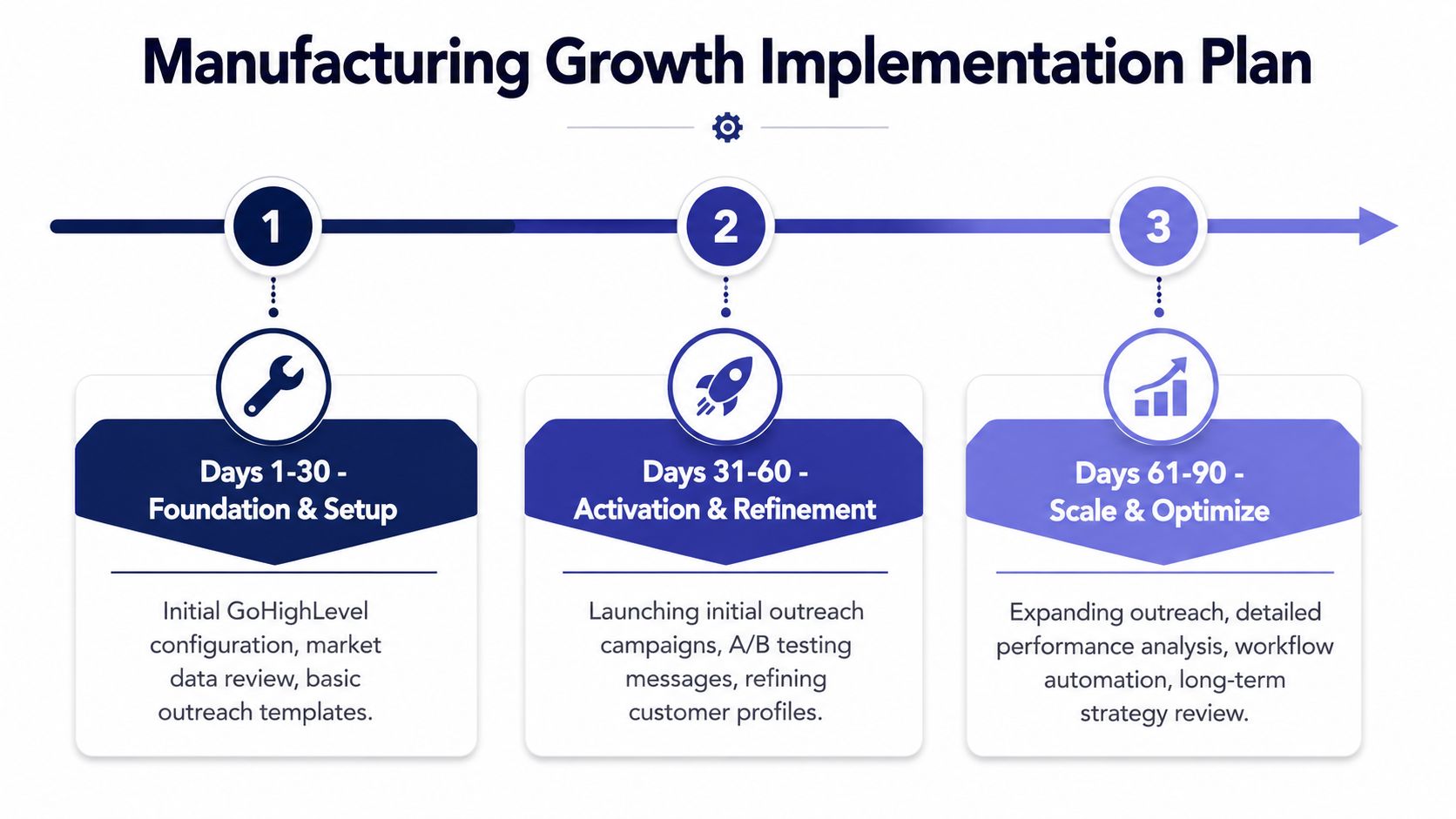
Days 1 to 30 foundation and setup
Use the first month to diagnose and build.
- Audit your current book of business and identify the accounts, job types, and segments that fit best
- Document your ICP by technical need, buying role, and commercial fit
- Write core messaging for engineering, procurement, operations, and leadership
- Set up GoHighLevel with your core pipeline stages, owners, and custom fields
- Create essential assets including capability sheets, form workflows, and basic follow-up templates
At the end of this phase, your team should know who you're targeting, what you're saying, and where opportunities will be managed.
Days 31 to 60 activation and refinement
The second phase is about controlled launch, not maximum volume.
- Choose one main lead channel and one support channel
- Build a target account list based on your blueprint
- Start weekly outreach with short email and LinkedIn sequences
- Route every inbound inquiry through the same qualification standard
- Review pipeline movement each week and fix handoff or quoting delays quickly
This is also when you start learning where the core friction is. Often it isn't messaging. It's quote turnaround, missing account data, or inconsistent follow-up ownership.
Days 61 to 90 scale and optimize
The third phase is where your process starts acting like an operating system.
- Review won and lost opportunities for common fit, objection, and timing patterns
- Clean up weak stages in the CRM where deals stall without clear next steps
- Improve automations for reminders, reactivation, and quote follow-up
- Refine your content and scripts based on actual buyer conversations
- Measure business development performance using segment revenue, margin, and quoting speed rather than vanity metrics
By day ninety, you don't need a perfect system. You need a system that's visible, used, and improving.
Ask yourselves a final set of questions:
- Where are qualified opportunities coming from now?
- Which messages get replies from the right buyers?
- How long does it take us to move from inquiry to quote?
- Which new segments look promising enough to pursue further?
- Where are we still relying on memory instead of process?
Manufacturing business development works when you treat it like production improvement. You diagnose the bottleneck, standardize the workflow, measure the result, and keep tightening the system.
If you're ready to build a repeatable growth system instead of relying on referrals and scattered follow-up, Machine Marketing can help you diagnose the gaps, structure your CRM and automation, and turn your manufacturing business development process into something your team can run every week.