If your dashboards are full of flat lines, you’re not getting the full story. The numbers—your website traffic, lead volume, and conversion rates—tell you what is happening. Market research focus groups are how you diagnose the why. This guide will show you how to use them to find and fix the hidden friction points in your marketing and sales process.
It’s the difference between reading error codes and popping the hood to listen to the engine.
Why Your Metrics Are Stalling and What to Do About It
You’re staring at your analytics every week. You see the website visitors, the conversion rates, and the sales figures. But what happens when those numbers just… stop? Or worse, start to slip? It’s a common issue we see all the time, and the problem is almost always a gap between what your data is telling you and what your customers are actually thinking.
Quantitative data from your CRM or Google Analytics is great at showing you outcomes. It tells you that only 3% of visitors filled out your contact form. But it can't tell you why the other 97% walked away.
Was your value proposition unclear? Did the form have too many fields? Was your pricing a total turn-off? Your data can't answer that. You need a different tool in your toolbox.
Moving Beyond the What to Uncover the Why
To fix the problem, you have to get inside the human motivations driving those numbers. This means shifting gears from quantitative to qualitative. A market research focus group is a moderated, structured conversation designed to pull out those core customer perceptions, frustrations, and unstated needs.
Think of it like this: Your marketing analytics are the dashboard lights in a piece of heavy machinery. They’re great for telling you something’s wrong. But a focus group is like sitting down with the veteran operators—your customers—and having them tell you, in their own words, what feels clunky and what would make their job a hell of a lot easier.
A focus group isn't about collecting random opinions. It’s about digging for the hidden logic behind your customers' choices. You’re moving from seeing a symptom to diagnosing the root cause.
A Practical Tool for B2B Growth
For B2B companies, particularly in technical fields like manufacturing, these conversations are pure gold. You get to hear directly from the engineers, the purchasing managers, and the plant supervisors who make the real decisions.
You’ll learn the exact language they use, the unspoken priorities that drive their choices, and the real-world headaches they're trying to solve.
This guide is an actionable framework. We'll show you how to:
- Diagnose the hidden friction in your messaging and sales process.
- Design discussions that pull out honest, unfiltered, and actionable feedback.
- Transform those raw conversations into a marketing system that connects with customers and drives real growth.
Understanding What Market Research Focus Groups Can Do
Think of your quantitative data—your analytics and surveys—as the dashboard lights in your business. They tell you something is wrong, but not what or why. A focus group is like getting an expert mechanic under the hood to listen for that subtle knock or hiss that tells you the real story.
It’s a guided conversation built to uncover the why behind what your customers do. This isn't about finding statistically perfect answers; it's about digging up the rich, detailed, and often surprising human truths that numbers alone can't give you.
The Core Components of a Focus Group
A real focus group isn’t just a random chat. It's a carefully engineered process with three crucial parts working in sync.
- A Small, Carefully Selected Group: We’re talking 6 to 10 people who perfectly represent a slice of your target market. These aren't just bodies in a room; they’re screened to match your ideal customer, whether that's an engineer using specific equipment or a purchasing manager in the manufacturing space. To nail down this profile, see our guide on how to create buyer personas.
- A Skilled Moderator: This person is part facilitator, part investigator. Their job is to steer the conversation with a clear plan, ask tough follow-up questions, and ensure everyone gets a chance to speak—all without killing the natural flow of ideas.
- A Structured Discussion: The conversation follows a “discussion guide,” which is your standard operating procedure for the session. It’s designed to move from broad, open questions to the specific business problems you absolutely need to solve.
These elements create a unique environment where people feel comfortable enough to give you their honest, unfiltered opinions about your products, your messaging, or your brand. The method was first developed during World War II to figure out how people were really reacting to propaganda, and its power to uncover human motivation remains just as potent today.
When to Use a Focus Group (And When Not To)
Focus groups deliver their biggest wins when you need to explore complex, emotional, or nuanced topics that a simple survey just can’t touch. They are a powerful diagnostic tool, but they aren't a silver bullet. Knowing when to use them—and when to choose another tool—is how you ensure your research budget pays off.
Use a focus group when your goal is to:
- Explore new product or service concepts: Get crucial first reactions before you sink money into development.
- Refine marketing and sales messaging: Does your value proposition actually land? Find out if your message connects with the people you’re trying to sell to.
- Understand deep customer pain points and motivations: Uncover the unspoken needs and frustrations your current offers are missing.
- Investigate a new market or customer segment: Learn the language, priorities, and buying criteria of an audience you don't know yet.
A focus group is the wrong tool if you need to:
- Get statistically valid data: With a small group, you can’t accurately project findings onto your entire audience. You need a quantitative survey for that.
- Measure precise metrics: If you need to know what percentage of customers prefer option A over B, a survey is faster, cheaper, and more accurate.
- Discuss highly sensitive or personal topics: One-on-one interviews are far better for creating a safe space where people will open up about private matters. Transparency requires acknowledging these limitations.
Choosing Your Research Method: Focus Groups vs. Alternatives
Deciding on the right research method can feel overwhelming. This table breaks it down, helping you match your business goal to the tool that will give you the clearest answers.
| Research Goal | Best Method | Why It's the Right Fit |
|---|---|---|
| Exploring "Why?" (motivations, perceptions, feelings) | Focus Group | The group dynamic uncovers shared experiences and sparks new ideas that wouldn't surface in a one-on-one setting. |
| Validating "How Many?" (preferences, frequencies, ratings) | Survey | Perfect for collecting large-scale, statistically significant data you can project onto a wider population. |
| Deep-Diving into "How?" (individual processes, personal stories) | Individual Interview | Allows you to go deep into a single person's journey or decision-making process without any group influence. |
Choosing the right tool ensures the insights you gather are directly tied to solving a real business challenge. For a detailed walkthrough, learn how to conduct a focus group effectively. Getting this right is what separates wasted effort from game-changing intelligence.
How to Design a High-Impact Focus Group
A powerful focus group doesn’t just happen. The difference between getting a room full of vague opinions and uncovering a genuine business-changing insight comes down to design. A poorly planned session is a waste of everyone’s time, but a well-designed one is a diagnostic tool for your biggest business problems.
This is where you draw the blueprint. You need to define a razor-sharp objective, find the exact right people to talk to, and build a conversation guide that flows naturally. Think of it as your SOP for mining gold out of a conversation.
The process is straightforward: you gather the right group, guide the discussion, and distill the insights.
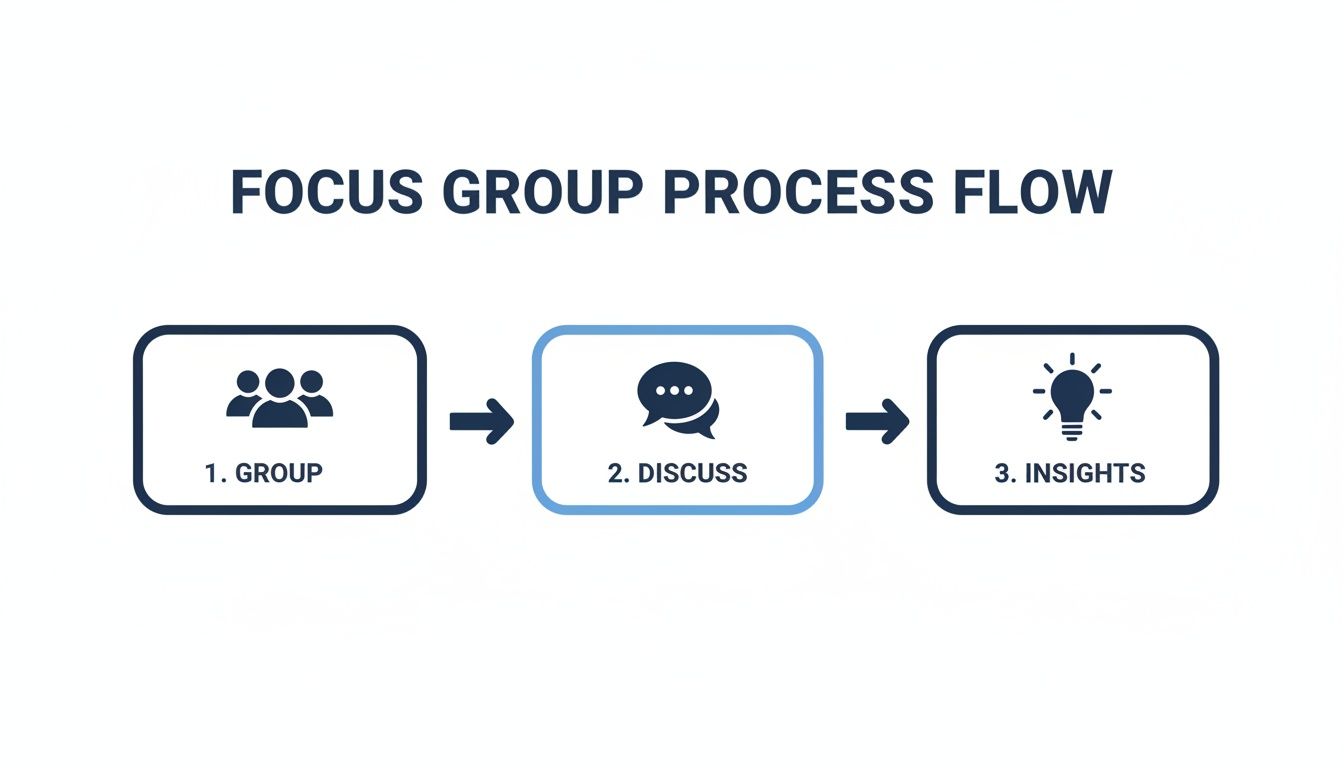
As you can see, the quality of the "Insights" you get is completely dependent on how well you handle the first two steps.
Start With One Business Decision
Before you do anything else, answer this question: “What specific business decision will this research help us make?” If your goal is something fuzzy like “understanding our customers better,” stop right there. That’s a recipe for useless data.
You need a concrete finish line.
Good objectives sound like this:
- “We need to pick one of three value propositions for the new landing page.”
- “We have to figure out why people are dropping out of our sales demo at the 10-minute mark.”
- “We need to know if our new pricing is an absolute deal-breaker for small manufacturers.”
By tying the research to a single decision, you give the entire project a clear purpose. Every question you ask and every person you recruit should get you closer to making that one decision.
Recruit the Right People
The insights you get are only as good as the people in the room. You’re not looking for a random sample; you're assembling a hand-picked group that perfectly represents the customer segment you’re trying to understand. For B2B, that means getting incredibly specific.
This is why market research focus groups require a tough screening process. You need a screener—a short questionnaire built to weed out anyone who isn't a perfect fit.
Your screener must confirm:
- Role and Responsibilities: Are they an actual Plant Manager or Lead Engineer?
- Industry and Company Size: Do they work in your target vertical (like metal fabrication) and at a company with the right revenue or employee count?
- Experience and Behavior: Have they bought a similar product recently? Do they use a competitor’s software?
- Willingness to Participate: Are they articulate and willing to give you their unfiltered, honest feedback?
Finding these niche B2B professionals isn’t easy. It often takes a targeted approach using professional recruiters, direct LinkedIn outreach, or your own customer list. Be prepared to pay for their time—for busy professionals, an incentive between $150 to $250 for a 60- to 90-minute session is standard. It shows you respect their expertise.
Build a Discussion Guide That Flows
Your discussion guide isn't a script to be read word-for-word. It's a roadmap that steers the moderator, guiding the conversation from general to specific. The best guides are structured like a funnel.
- Welcome and Icebreakers (10 minutes): Start with easy, open-ended questions to get them comfortable. Ask about their job or a recent work challenge. The goal is just to get them talking.
- Broad Exploration (20 minutes): Zoom out to the general topic. If you're testing a new software feature, first ask about their current workflow and the tools they’re already using to solve the problem.
- Specific Probes and Stimuli (45 minutes): This is the heart of the session. Now you introduce your concept, prototype, or ad copy. Ask direct questions. "What’s your gut reaction to this?" or "How would this actually fit into your day?"
- Wrap-Up and Final Thoughts (15 minutes): Wind down by asking for final advice. A fantastic closing question is, "If you were in our shoes, what's the one thing you would absolutely change?"
This structured approach has been refined for decades. The 'Mad Men' era of market research in the 1950s cemented the power of focus groups, with analysts watching from behind one-way mirrors to dissect ad slogans. That core principle—using direct feedback to shape strategy—is just as critical today. Discover more insights about the evolution of these methods and their impact on strategy.
Best Practices for Moderating Your Session

If your discussion guide is the roadmap, the moderator is the one behind the wheel. A great moderator does more than just read questions; their real job is to build an environment where people feel safe enough to share honest, valuable insights.
This is where the true potential of your market research focus groups is either unlocked or completely lost. A skilled moderator acts as a neutral guide, steering the conversation with a firm but gentle hand. Think of them as part investigator, part diplomat, and part timekeeper.
The moderator's main goal is to keep the conversation balanced. Without careful management, a group can easily be taken over by one or two dominant personalities, while the quieter members never get a word in.
Creating a Balanced Environment
Your first order of business is to create a space where participants feel comfortable sharing what they really think. This starts with setting clear expectations: there are no right or wrong answers, and every perspective is valuable. It also means you have to actively manage the social dynamics.
Here are a few techniques we use to keep the conversation inclusive and on track:
- Handling the Dominant Speaker: When one person is talking too much, use subtle body language—like turning slightly away from them. Then, jump in with a phrase like, "That’s a great point. I’d love to get some other reactions to that. [Participant Name], what’s your take?"
- Encouraging the Quiet Member: Gently and directly invite quieter people into the discussion. For example, "We haven't heard from you yet, [Participant Name]. Does this idea resonate with your own experience at all?"
- Using Probing Questions: Never settle for the first answer. When someone says they "like" a concept, you have to dig for the why. Follow up with probing questions like, "What specifically do you like about it?" or "Can you walk me through how you might actually use this in your day-to-day?"
The moderator’s most important skill is active listening. You have to pay attention not just to what is said, but how it’s said. A hesitant tone, a quick glance at another person, or a sudden shift in posture can tell you more than their words alone.
Choosing Between In-Person and Online Focus Groups
The environment you’re trying to build also depends heavily on the format you choose. Both in-person and online focus groups have clear advantages, and the right call often comes down to your target audience—especially for B2B companies trying to reach dispersed decision-makers.
A traditional, in-person focus group lets you observe non-verbal cues much more easily. You can feel the energy in the room and see how participants interact with each other in real-time. This format is a must if you're testing physical products that people need to touch and handle.
But the logistics can be a nightmare, particularly when you’re trying to recruit specialized professionals like engineers or C-suite executives. This is where online focus groups have become an incredibly powerful alternative. With simple video conferencing tools, you can bring together participants from anywhere in the country—or even the world.
A Comparison of Focus Group Formats
Deciding on a format means weighing the trade-offs. Here’s a side-by-side comparison to help you figure out the best fit for your business goals.
| Feature | In-Person Focus Groups | Online Focus Groups |
|---|---|---|
| Geographic Reach | Limited to a single metro area. This makes it tough to recruit niche B2B roles. | National or global reach, which makes it far easier to find the exact right participants. |
| Cost & Logistics | Higher costs from facility rentals, catering, and participant travel. Scheduling is complex. | Lower costs with no facility fees. Scheduling is much more flexible and straightforward. |
| Non-Verbal Cues | Excellent. You can observe full-body language and natural group interactions. | Good, but limited to what’s visible on camera. It's harder to gauge group dynamics. |
| Participant Honesty | Groupthink can be a real risk; some people are hesitant to disagree face-to-face. | The sense of distance (or even anonymity) can encourage more candid and honest feedback. |
For many B2B and manufacturing companies, the benefits of online focus groups are undeniable. The ability to recruit highly specific professionals—like plant managers from three different states—without racking up huge travel costs makes them a practical and effective choice for getting the deep, actionable insights you need.
Turning Customer Conversations Into Actionable Insights

The focus group has wrapped up. You’re left with hours of audio and a mountain of notes. This is the raw material, but it’s not the final product. The real work starts now: transforming those scattered conversations into a clear, strategic map that will actually drive your business forward.
Think of it this way: your notes and transcripts are a list of symptoms. Your job is to play diagnostician—to sift through the evidence, connect the dots, and diagnose the core business problem you set out to solve. This is how you turn a one-time research project into a lasting asset for your marketing, sales, and product teams.
A Systematic Approach to Analysis
To truly analyze qualitative data from your sessions, you need a system. Without one, you’ll just be swimming in a sea of quotes and random observations. We use a straightforward, three-step process to pull meaningful findings out of market research focus groups.
Organize and Get Familiar: First, get everything in one place. Have the recordings transcribed—ideally by a service that can label each speaker. Then, just read through it all. Don’t try to find answers yet. The only goal here is to get back into the flow of the conversation and remember its tone and energy.
Code and Find Categories: Now, read through the transcripts a second time, but this time with a highlighter in hand (digital or real). You’re looking for patterns. "Code" the data by tagging recurring ideas, strong emotions, or specific phrases that keep popping up. A simple spreadsheet is perfect for this—create columns for your themes and paste in the quotes that back them up.
Synthesize and Build the Story: With your themes organized, it’s time to connect the dots. Ask yourself: What were the big "aha!" moments? Where did the group disagree? What were the most powerful quotes that perfectly captured a customer’s pain point? Your final report should zero in on these make-or-break findings.
The most powerful insights often come from the friction in the conversation—the moments where participants passionately disagreed or when an unexpected idea changed the group's direction. These are the signals you can't afford to ignore.
From Raw Data to a Strategic Report
Your analysis needs to end with a short, sharp, and actionable report. This isn’t a novel summarizing every single comment. It’s a diagnostic tool that gives clear answers to the business questions that drove the research.
Structure your report around these key elements:
- An Executive Summary: This is your one-page cheat sheet. It should contain the absolute most critical findings and your top three recommendations. Write it as if your CEO will only read this one page.
- Key Themes: Give each major theme its own section. Use bullet points and direct quotes from participants to bring each point to life.
- Powerful Verbatim Quotes: Pull out the 5-10 most impactful quotes that let the customer’s voice shine through. These are pure gold for your copywriters and marketing team.
- Actionable Recommendations: Don’t just state a problem; propose a solution. For every key finding, suggest a specific next step. For example, “Finding: Customers are confused by our pricing. Recommendation: Redesign the pricing page with a simple comparison table.”
This kind of structured analysis is exactly why qualitative methods are so vital. In fact, research like focus groups makes up about 16% of all global market research spending. Far from being outdated, modern digital tools have only made this process better, helping us find deeper meaning in what people say.
Applying Your Insights to Your B2B Marketing Workflow
That detailed analysis report isn’t the finish line. It’s the starting gun. The insights you’ve worked so hard to pull from your market research focus groups are useless if they just die in a PowerPoint deck. It's time to wire them directly into your marketing engine.
This is where the real work begins—connecting the “why” you just uncovered with the “what” you do every day. It means taking a customer’s exact phrasing about a specific frustration and turning it into a headline for a landing page that actually converts. It’s about letting their unvarnished feedback reshape how you talk about your products across your entire workflow.
From Insight to Implementation
The quickest way to see an impact is to start overhauling your core marketing assets. Begin with the materials that form a prospect's first impression. Don't try to boil the ocean; focus your energy where it will count the most.
- Update Your Buyer Personas: Your focus group just handed you a high-definition photograph of your real customer. Go way beyond simple demographics. Inject their direct quotes, their stated frustrations, and the specific goals they shared. This transforms your personas from static documents into living, breathing guides.
- Sharpen Your Ad Copy: Did participants repeatedly use a certain phrase to describe their problem? That phrase now belongs in your Google Ads and social media campaigns. You’re not guessing what resonates anymore—you know because you heard it straight from the source.
- Re-Calibrate Your Website Messaging: Read your homepage, product pages, and pricing page as if you were one of the participants. Does your value proposition directly counter the pain points they brought up? If they were confused by your industry jargon, it's time to simplify it.
This isn't guesswork. You are systematically replacing the messaging that you think works with messaging that you know works, because your target audience told you so themselves.
Build Smarter Marketing Automation
Now for the fun part. Let's hook these insights into your lead-generation machine. Your CRM and marketing automation platform are the perfect places to deploy this new, hyper-relevant messaging at scale. You can finally stop sending generic email blasts and start building workflows that speak to the specific needs you just uncovered.
For instance, your focus group might have revealed that one segment of engineers is obsessed with integration capabilities, while another is fixated on long-term maintenance costs. This is gold. You can now use this to build incredibly powerful, segmented campaigns.
Step-by-Step CRM Application:
- Create New Audience Segments: Jump into your CRM (like GoHighLevel) and start tagging leads based on these new personas. You can create tags like “Prioritizes Technical Support” or “Concerned with Upfront Cost.”
- Develop Tailored Nurture Sequences: Build out separate email nurture sequences for each of those tags. The "Cost" segment gets content that highlights ROI and flexible payment options. The "Support" segment gets case studies about your incredible service team.
- Track and Measure Performance: Watch the engagement for each sequence like a hawk. Are open rates climbing? Are you getting more demo requests from one segment over another? This is how you close the loop, turning a 90-minute conversation into hard, quantitative results.
This is how you turn a simple discussion into a completely revitalized lead-gen system. For a much deeper dive into building these kinds of systems, check out our guide on marketing automation for B2B. By embedding what you learned from your focus group directly into your daily workflows, you create a marketing engine that is, for the first time, truly built around the customer.
Answering Your Toughest Focus Group Questions
Even with a solid plan, you're bound to have some practical questions about running market research focus groups. We get it. We've gathered the most common ones we hear from business owners and laid out the straight-up answers you need to move forward. Think of this as the final briefing before you get started.
How Much Do Focus Groups Typically Cost?
This is always the first question, and for good reason. The honest answer is that a single focus group can run anywhere from $7,000 to over $20,000. The two biggest factors driving that cost are how hard it is to find your ideal participants and what you offer to get them in the room.
- Your Audience: Recruiting from the general public is relatively straightforward and less expensive. But if you need to find niche B2B professionals—like specialized engineers or hospital administrators—the cost climbs fast. Their time is valuable, and they're much harder to track down.
- Your Incentives: For a consumer group, an incentive might be $75–$150. For a busy professional, you need to show you respect their time and expertise. Expect to offer $200–$250 or even more.
- The Format: Going virtual is a great way to manage costs. Online focus groups completely cut out expenses for facility rentals, catering, and participant travel.
How Many People Do I Need In a Group?
The magic number for a focus group is between 6 and 10 participants. This gives you enough people for a lively discussion with different viewpoints, but it's still small enough for a skilled moderator to make sure everyone gets a chance to contribute.
With fewer than six people, the conversation can easily hit a wall. Once you get over ten, it becomes a real challenge to manage, and the quieter, more thoughtful people inevitably get drowned out.
How Many Focus Groups Should I Conduct?
One focus group is just a single data point—it's never enough. We always recommend running a minimum of two to three groups for any research project. This is how you confirm whether the themes and feedback you're hearing are consistent or just a one-off opinion.
When you start hearing the same core insights in the second and third groups, you can feel confident that you've hit on a reliable pattern. That repetition is a good sign you've reached "saturation," meaning more groups probably won't uncover any new, foundational ideas.
How Long Does a Typical Focus Group Last?
You should plan for a 60 to 90-minute session. That’s the sweet spot. It's long enough to build rapport, dig deep into your most important questions, and wrap things up before everyone starts getting tired. If you go much longer, you'll see participant fatigue set in, and the quality of the feedback will drop off.
Ready to stop guessing what your customers want and start getting real answers? The Machine Marketing team uses market research focus groups to diagnose hidden growth blockers and build marketing systems that truly connect. We'll handle everything from recruiting your ideal B2B customers to turning their feedback into an actionable roadmap.
Book a discovery call to start building a marketing engine based on real customer intelligence.