You're likely dealing with the same problem we see inside a lot of manufacturers. The CRM has contacts, the automation platform is sending something, and sales still says the leads aren't ready. The issue usually isn't “more emails.” It's a broken marketing automation funnel that lacks shared definitions, clear triggers, and measurable handoffs.
When that system is built well, it stops being a loose sequence of follow-ups and becomes an operational path from first touch to closed-won. That matters in industrial sales, where buyers move slowly, multiple people touch the decision, and a weak handoff can make a good lead go cold fast. Strong funnels don't just nurture, they instrument the buyer journey, surface intent, and tell marketing and sales exactly where the bottleneck lives.
Table of Contents
- Why Most Marketing Automation Funnels Stall Inside Manufacturers
- The Hidden Reason Funnels Break Before You Build Anything
- Mapping the Industrial Buyer Journey and Funnel Stages
- Building Your First Trigger-Based Workflow in the CRM
- Triggering on Real Intent Signals Instead of Just Form Fills
- What a Working Funnel Looks Like Inside a Machine Shop
- KPIs, Testing, and Your 30/60/90 Funnel Rollout
Why Most Marketing Automation Funnels Stall Inside Manufacturers
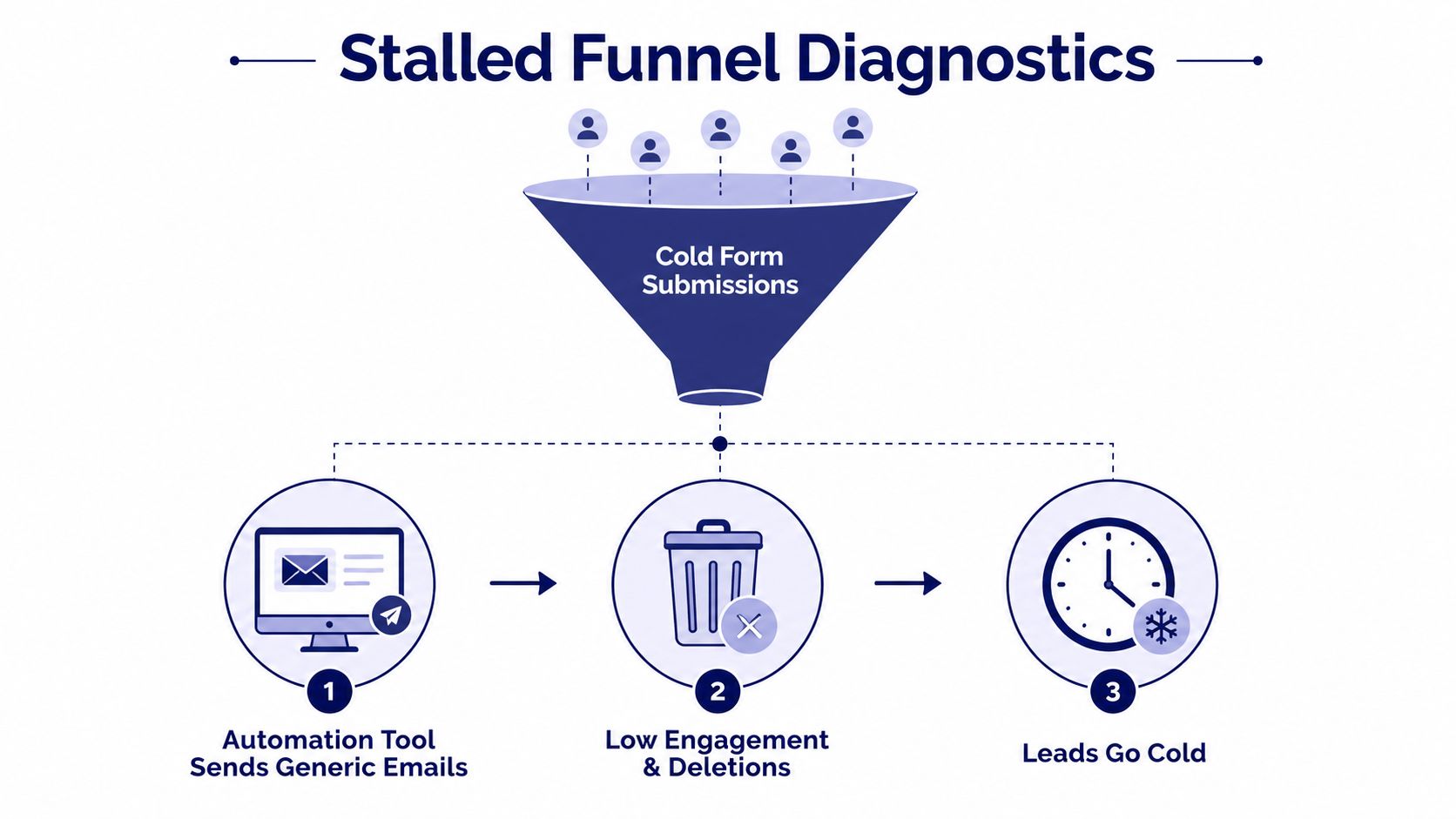
A familiar scene inside a 60-person CNC shop. Sales opens the inbox on Monday and finds a stack of cold form submissions, a handful of RFQs, and a few “just looking for a quote” requests that never turn into anything. Meanwhile, the automation tool keeps sending polished emails that nobody reads, and leadership wonders why lead volume feels weak even though the forms are still working.
That's not an email problem. It's a system problem.
The real failure is usually upstream
A marketing automation funnel should behave like an engineered process. Triggers fire from real behavior, data moves cleanly between systems, and each handoff has a clear owner. Modern industry definitions treat funnel automation as software that manages the buyer journey from awareness through retention with behavior-triggered workflows, not repetitive manual follow-up. HubSpot's framing of the funnel as the complete path from discovery to paying customer, and MarTech's stage model from awareness to purchase, both point to the same idea, the funnel is measurable infrastructure, not a loose content calendar. That historical shift from manual nurture to software-driven orchestration is what changed the game in industrial marketing. Braze's overview of marketing funnel automation captures that transition well.
Here's the practical takeaway. If you're only automating reminders, you're automating noise. If you're building a system that routes the right lead, at the right time, with the right context, you've built something sales can use.
What you should expect from a healthy funnel
The goal isn't more automation for its own sake. You want a measurable revenue path where each stage is visible, each handoff is owned, and each message matches the buyer's stage. That's the difference between a marketing system and a batch of email sequences.
A healthy funnel should help you answer questions like these:
- Where do leads stall? Is it before sales contact, after quote delivery, or during re-engagement?
- Which handoff is broken? Marketing to sales, sales to engineering, or quote to customer follow-up?
- What behavior matters? RFQ submission, pricing-page revisits, demo depth, or stalled quote activity?
Practical rule: If you can't point to the exact step where prospects disappear, the funnel isn't broken in one place, it's undefined.
The Hidden Reason Funnels Break Before You Build Anything
Most manufacturers assume the answer is a new workflow, a better drip sequence, or a different platform. In practice, the most critical failure is usually that marketing and sales do not agree on what a qualified lead is, how quickly follow-up should happen, or which revenue outcome counts as success.
That sounds basic, but it's where funnels often fail.
Run a three-question audit this week
Before you open any automation tool, ask these questions:
- Do marketing and sales define a qualified lead the same way?
- Do both teams agree on follow-up timing for inbound leads and RFQs?
- Are both teams measured on the same revenue outcome, or are they optimizing different scorecards?
If the answers aren't aligned, automation just makes the confusion faster. Research and practitioner guidance on funnel governance emphasize that many funnels fail because teams disagree on ICP, lead definitions, handoff timing, and shared revenue metrics. That problem gets worse in manufacturing because buying committees are larger, internal reviews are slower, and a lead may need engineering or applications support before it's even worth a sales call. A sequence can be technically correct and still underperform if it routes the wrong lead type or nurtures too early. This funnel governance piece on Medium makes that mismatch hard to ignore.
Governance beats another tool
The fix is usually a shared operating model, not a new platform. Sales needs to tell marketing what counts as sales-ready, marketing needs to define when nurture should stop, and leadership needs one revenue metric that both teams can live with. If those rules don't exist, the automation stack just becomes a prettier way to pass broken leads around.
The teams that win don't argue about email frequency first. They agree on lead definition, follow-up timing, and who owns the next move.
Mapping the Industrial Buyer Journey and Funnel Stages
A useful funnel starts with a map, not a workflow. For most industrial firms, the standard five stages, awareness, interest, consideration, conversion, and retention, are still the right skeleton. Sitecore's funnel model uses the same stage logic and recommends mapping customer journeys by segment before tactics are built. Sitecore's marketing automation funnel resource is a good reminder that stage design comes before execution.
In manufacturing, those stages do not look like a generic SaaS funnel. They usually show up as anonymous website traffic, RFQ requests, sample evaluations, on-site audits, and repeat orders. That translation matters because the workflow should follow the buying reality, not a marketing template.
Start with segments, not software
Before you open a CRM or email platform, define segments by:
- Job role, such as buyer, engineer, operations manager, or procurement
- Industry, such as aerospace, medical, food processing, or general industrial
- Deal size, because small reorders behave differently from complex custom programs
- Buying timeline, especially if an RFQ is immediate versus exploratory
Then draw the current journey on a whiteboard. Keep it ugly and simple. Put the first touch on the left, the sale on the right, and every known handoff in between.
Ask your sales team these questions
- Where do leads usually come from?
- Which lead types become quotes fastest?
- Which questions show real buying intent?
- Where do prospects disappear after the quote goes out?
- Which customers came back without being actively chased?
That last question matters more than many realize. If repeat orders happen, there is a path worth automating. If they do not, you may be treating all contacts like first-time buyers when some of them should be in retention or reactivation flows.
The stage map should also define what counts as a qualified lead and when a record should leave marketing nurture and enter sales follow-up. That governance is what keeps the funnel from becoming a pile of email sends with no shared definition of progress. If you want a practical way to connect stage design to CRM execution, this guide on turning your CRM into a growth engine with campaigns shows how the workflow layer should sit on top of the stage map.
| Funnel Stage | Typical B2B Conversion Range | What to Automate |
|---|---|---|
| Top of funnel | 1–3% | Capture, route, and qualify Landbase's sales pipeline statistics |
| Middle of funnel | 10–15% | Nurture, education, and sales support |
| Bottom of funnel | 20–30% | Quote follow-up, objections, and close support Landbase's sales pipeline statistics |
Those ranges are useful because they show why one blanket workflow is rarely enough. Stage-specific automation matters because different parts of the funnel behave differently. The map tells you where to focus first.
Building Your First Trigger-Based Workflow in the CRM
The first workflow should be boring in the right way. Clean the lead-source and lifecycle data, standardize your stage names, and build one focused path before you expand. That is the part many teams skip, then they wonder why automation feels unreliable.
If your CRM is messy, the workflow will be messy too. GoHighLevel-style setups and HubSpot-style setups both depend on the same basics, a clean record, a clear trigger, and one owner for each next step.
Launch one workflow, not five
Start with the highest-friction path in the business, usually the RFQ or contact-request flow. Build this sequence first:
- Instant acknowledgment
- 24-hour follow-up if there's no reply
- 5-day engineering-value email
- 14-day re-engagement message
A machine shop can adapt the copy like this:
- Instant acknowledgment: “We received your RFQ and we're reviewing the specs now. If we need anything from your team, we'll reach out today.”
- 24-hour follow-up: “Quick check. Did you want us to quote the full drawing package or only the critical components?”
- 5-day engineering-value email: “Our team put together a short checklist of the details that usually affect tolerance, lead time, and finish selection. If helpful, we'll send it over.”
- 14-day re-engagement: “We haven't heard back, so we're closing the loop for now. If the project is still active, reply here and we'll reopen it.”
Use email for the main path and SMS only where it's appropriate and expected. A quick SMS can work well for urgent acknowledgement or meeting reminders, but it's a poor substitute for a thoughtful quote process.
Make the CRM do the routing
The most valuable first automation is instant lead assignment and same-day sales follow-up. The Digital Ring notes that teams often discover leads sitting untouched for two to three days after form submission, which makes speed the highest-value fix. That setup guide for automated sales funnels is right about the operational cost of delay.
Use the CRM to:
- Assign ownership immediately based on territory, product line, or account type
- Update lifecycle stage automatically when an RFQ, quote, or meeting request comes in
- Create internal alerts for sales when high-priority forms arrive
- Test with sample contacts before going live
If you want a deeper CRM setup pattern, this guide on turning your CRM into a growth engine with campaigns is worth reviewing after you finish the first workflow.
Triggering on Real Intent Signals Instead of Just Form Fills
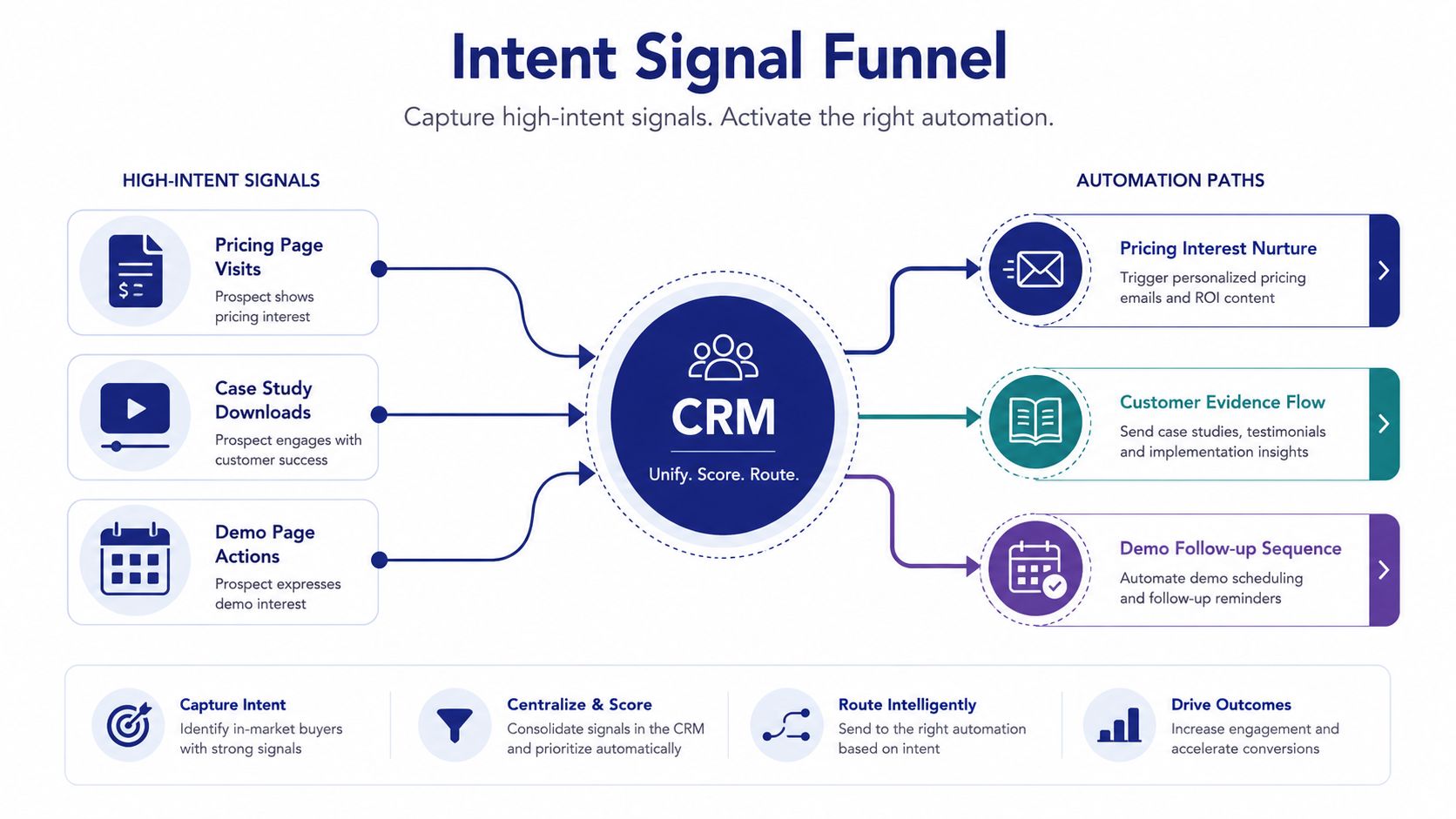
Form fills are easy to trigger on, but they're a weak proxy for buying readiness. In industrial B2B, the better signals are behaviors that show real evaluation. Those include repeat pricing-page visits, product comparisons, demo-page depth, support questions before purchase, stalled quote behavior, and buying-group engagement across multiple stakeholders.
That's where automation starts earning its keep.
Use the signal, then choose the action
A strong automation system doesn't treat every signal the same. It pairs each one with a specific response.
- Repeat pricing-page visits can trigger a sales alert or a customized follow-up email.
- Product or capability comparisons can trigger a deeper technical resource.
- Pre-purchase support questions can route to engineering or applications support.
- Stalled quote behavior can trigger a re-engagement sequence.
- Buying-group engagement can notify sales that multiple people are evaluating the same opportunity.
This is especially important when one RFQ involves a buyer, a process engineer, and a procurement manager. They won't all move at the same speed, and they won't all need the same message. The funnel needs to reflect that reality.
Practical rule: When intent rises, the message should get more specific, not more frequent.
A useful resource here is Divimode's collection of lead nurturing automation ideas, which gives a good starting point for thinking about nurture paths without defaulting to generic sequences. Pair that with the concept of intent data and you get a much more useful model for complex B2B buying.
Why this matters more in industrial sales
A lead who only filled out a form may be early. A lead who keeps comparing capabilities, revisiting pricing, and involving other stakeholders is different. The automation should reflect that distinction, because sending the same nurture track to both groups wastes attention and slows down sales.
What a Working Funnel Looks Like Inside a Machine Shop
A 75-person contract manufacturer selling custom CNC parts into aerospace and medical had a common problem. Leads sat untouched for three days, sales had no clear visibility into which RFQ sources turned into quotes, and dormant customers never got reactivated. The team had activity, but not a system.
The fix wasn't one clever campaign. It was a working funnel with shared definitions, three workflows, and an intent layer on the key pages.
The before and after
Before the rebuild, marketing was judged on volume and sales was judged on quota. After the rebuild, they aligned on lead definitions, added an RFQ nurture path, built a stalled-quote re-engagement flow, and created a customer cross-sell path for existing accounts. They also instrumented pricing and capability pages so sales could see when a prospect was moving from curiosity into evaluation.
That changed the behavior of the whole system. Same-day follow-up became routine instead of exceptional. Quote conversations got shorter because sales knew what the buyer had already viewed. Re-engagement also surfaced dormant accounts that had been sitting invisible in the CRM.
The point isn't the exact numbers. The point is that once the funnel is wired correctly, visibility compounds. You can see which source produced the best opportunities, which stage slows down, and which customer groups are most likely to come back. That's a different operating model from ad hoc follow-up.
If you want a broader framing of that kind of execution in industrial settings, this B2B marketing guide for machine shops fits the same pattern.
What worked, and what didn't
What worked was simple:
- Aligned definitions between marketing and sales
- Three focused workflows instead of a pile of generic ones
- Intent tracking on high-value pages
- Reactivation logic for existing customers
What didn't work was trying to automate around an unclear process. The team didn't need another nurture sequence. It needed a map of what buyers did, when they did it, and who should act next.
KPIs, Testing, and Your 30/60/90 Funnel Rollout
A funnel is only healthy if you can measure it stage by stage. The dashboard should track visitor-to-lead, lead-to-MQL, MQL-to-SQL, SQL-to-opportunity, and opportunity-to-closed-won, plus time spent in each stage, cost per stage progression, drop-off volume and reasons, pipeline velocity, and closed-loop ROI by campaign and channel. Improvado's funnel dashboard guidance also stresses segmentation by campaign, channel, persona, deal size, and time cohort, which is exactly how industrial teams should look at performance. Improvado's marketing funnel dashboard resource lays out that measurement stack clearly.
Don't trust correlation alone
If conversions go up, that doesn't prove the funnel caused it. Put holdout groups in place for major journeys so you can measure incremental lift instead of guessing. Edge's guidance on funnel automation makes that measurement point well, especially around pairing outcome metrics with diagnostics like deliverability, timing, drop-off, and channel overlap. Their step-by-step funnel automation guide is useful because it treats the funnel like a measurement system, not a mailer.
A solid rollout looks like this:
- Days 1 to 30: Align marketing and sales, define the qualified lead, and map the buyer journey.
- Days 31 to 60: Clean lifecycle data, build the first workflow, and test it with sample contacts.
- Days 61 to 90: Add intent-signal triggers, review the dashboard, and compare holdout results.
Questions to ask before launch
- Do we know where leads stall most often?
- Are we measuring the same outcome across teams?
- Can sales see the reason behind each handoff?
- Have we tested one workflow cleanly before building another?
The fastest way to improve a funnel is not adding more steps. It's removing confusion from the steps that already exist.
Start this week with the three-question sales and marketing audit from the earlier section. If the answers are still fuzzy, fix that before you touch the automation tool. Once the definitions are clear, the workflows stop fighting the process and start supporting it.
Machine Marketing helps manufacturers turn scattered tools into a working system, and that includes CRM, automation, and funnel diagnosis. If you're ready to make your lead flow measurable instead of guesswork, visit Machine Marketing and see how a practical industrial strategy can fit your operation.