Are you treating brochures like dusty relics from a bygone era? If so, you're missing out on a powerful, tangible sales tool. When a brochure is engineered the right way, it cuts through digital chaos, delivers a real brand experience, and gives your sales team a physical asset to help close deals.
In this guide, we'll diagnose the common failure points in brochure marketing and give you a step-by-step framework to turn them into measurable lead-generation machines.
Why Brochures Still Matter in a Digital World

If you've written off print marketing, you’re not alone. We see businesses go all-in on digital, only to find themselves shouting for attention in overcrowded inboxes and endless social feeds. The problem isn’t that brochures are outdated; it’s that the strategy most companies use is broken.
Let's be transparent: digital fatigue is a real problem. Your customers—especially B2B decision-makers like engineers and plant managers—spend all day staring at screens. A well-designed, physical brochure offers a welcome break and an entirely different kind of experience.
A physical brochure commands attention in a way a fleeting digital ad cannot. It’s a tangible asset that proves you’ve invested in your message, which builds instant credibility.
Cutting Through the Digital Noise
So, why do so many digital-only campaigns fall flat? The diagnosis is simple: too much noise, not enough signal. Your carefully crafted email is one of hundreds they receive that day. Your social post is a blip in an infinite scroll. In that environment, a physical touchpoint becomes a massive differentiator.
The data backs this up. According to recent studies, print advertisements (including brochures) can achieve an average response rate of 9%. This far surpasses the typical 1% from email, paid search, and social media. People also spend 45% longer with tangible materials than with digital ads, giving your message a real chance to sink in. You can dig deeper into these compelling print marketing statistics and what they mean for your campaigns.
Here's a quick look at how brochures stack up against their digital counterparts. While digital is essential for reach, the engagement from a physical item is hard to ignore.
Brochure Marketing Vs. Digital Channels: A Quick Diagnosis
| Channel | Average Response Rate | Average Engagement Time | Audience Trust Factor |
|---|---|---|---|
| Brochures/Direct Mail | 9% | High (Minutes) | High |
| Email Marketing | 1% | Low (Seconds) | Medium |
| Paid Search (PPC) | 1% | Low (Seconds) | Low |
| Social Media Ads | 1% | Very Low (Seconds) | Low |
The numbers are clear: when you need someone to stop, think, and consider your message, a brochure is an incredibly effective tool.
The Power of a Physical Touchpoint
Think about the last time you were handed a high-quality brochure. It feels substantial. It communicates a permanence and professionalism that a website popup just can't match. For manufacturers, engineering firms, and other B2B businesses, that feeling is gold.
A well-engineered brochure accomplishes several jobs that digital channels struggle with:
- It’s the perfect leave-behind sales tool. After a meeting or trade show chat, leaving a brochure ensures your company stays top-of-mind.
- It supports complex sales cycles. For technical products, a brochure can lay out specs, diagrams, and case studies in a clean format that prospects can review and share.
- It builds trust. In a world of temporary digital content, a physical asset signals stability and commitment. It shows you’re a serious operation.
Forget flimsy, text-heavy pamphlets. Modern marketing with brochures means creating a focused, high-impact piece of your sales system. When you engineer it with a clear goal and a direct path to action, a simple piece of paper can become a valuable lead generation tool.
Building Your Strategic Blueprint Before You Print
A successful brochure campaign starts long before you talk to a printer. This strategic phase is where most brochure marketing efforts fail. Skipping this foundational work is like trying to build a house without a blueprint.
Let's walk through the framework for defining your goals, zeroing in on your audience, and sharpening your message so that every element works toward a measurable result.
Step 1: Define Your Primary Goal
First, what is the one thing you need this brochure to accomplish? A brochure designed to capture leads at a trade show is entirely different from one mailed to re-engage dormant customers. When you try to make a brochure do everything, it ends up doing nothing well.
Here are the primary goals we see in B2B brochure marketing:
- Lead Generation: Capture contact information from prospects at events, through direct mail, or during sales visits.
- Sales Enablement: Arm your sales team with a professional tool to explain complex products in meetings.
- Customer Reactivation: Re-engage past clients with a new offer or a product update.
- Brand Awareness: Introduce your company to a new market or solidify your credibility.
Before you start, get your resources in order. Knowing how to structure an effective small business marketing budget is fundamental. This planning prevents expensive mistakes.
A brochure without a singular, defined goal is just an expensive piece of paper. A brochure with a clear objective is an engineered sales tool.
Step 2: Pinpoint Your Exact Audience
Once your goal is clear, get laser-focused on who you're talking to. "Anyone interested in our products" is not an audience—it's a recipe for wasted money. You need to understand their specific problems, daily pressures, and what motivates them.
This is where building detailed buyer personas is a non-negotiable step. If you haven't done this, our guide on how to create buyer personas that truly work is a great place to start.
Ask yourself these diagnostic questions:
- Who is reading this? An Engineer, a Purchasing Manager, or a C-suite executive?
- What urgent problem are they trying to solve?
- What information is critical for their decision?
- What are their biggest objections to a solution like yours?
An engineer needs to see technical specs and performance data. A purchasing manager is focused on pricing, warranty, and lead times. Your brochure’s content must speak their language directly.
Step 3: Craft a Messaging Matrix
Now, connect your goal and audience with a powerful, direct message. We use a simple but effective tool called a messaging matrix to organize key points and ensure everything from the headline to the call-to-action is aligned.
Here’s a simple matrix for a manufacturer launching a new industrial pump:
| Audience | Problem | Our Solution | Key Message | Proof Point |
|---|---|---|---|---|
| Plant Engineer | Frequent downtime from pump failures. | The new XP-500 pump has a 99.8% uptime rating. | "Reliability You Can Build On" | Case study showing a 40% reduction in maintenance calls. |
| Purchasing Agent | Budget constraints and high TCO. | The XP-500 is 15% more energy-efficient. | "Lower Total Cost of Ownership" | 5-year ROI calculation and flexible financing options. |
This matrix forces discipline. It ensures every word, image, and data point is there for a reason: to solve a specific problem for a specific person. This blueprint is the difference between a brochure that gets trashed and one that drives revenue.
Designing a Brochure That Drives Action
Great brochure design isn't about making something pretty; it's about engineering a specific response. When marketing with brochures, your goal is to guide a prospect from casual interest to decisive action. Every choice, from the paper fold to the headline, must serve that purpose.
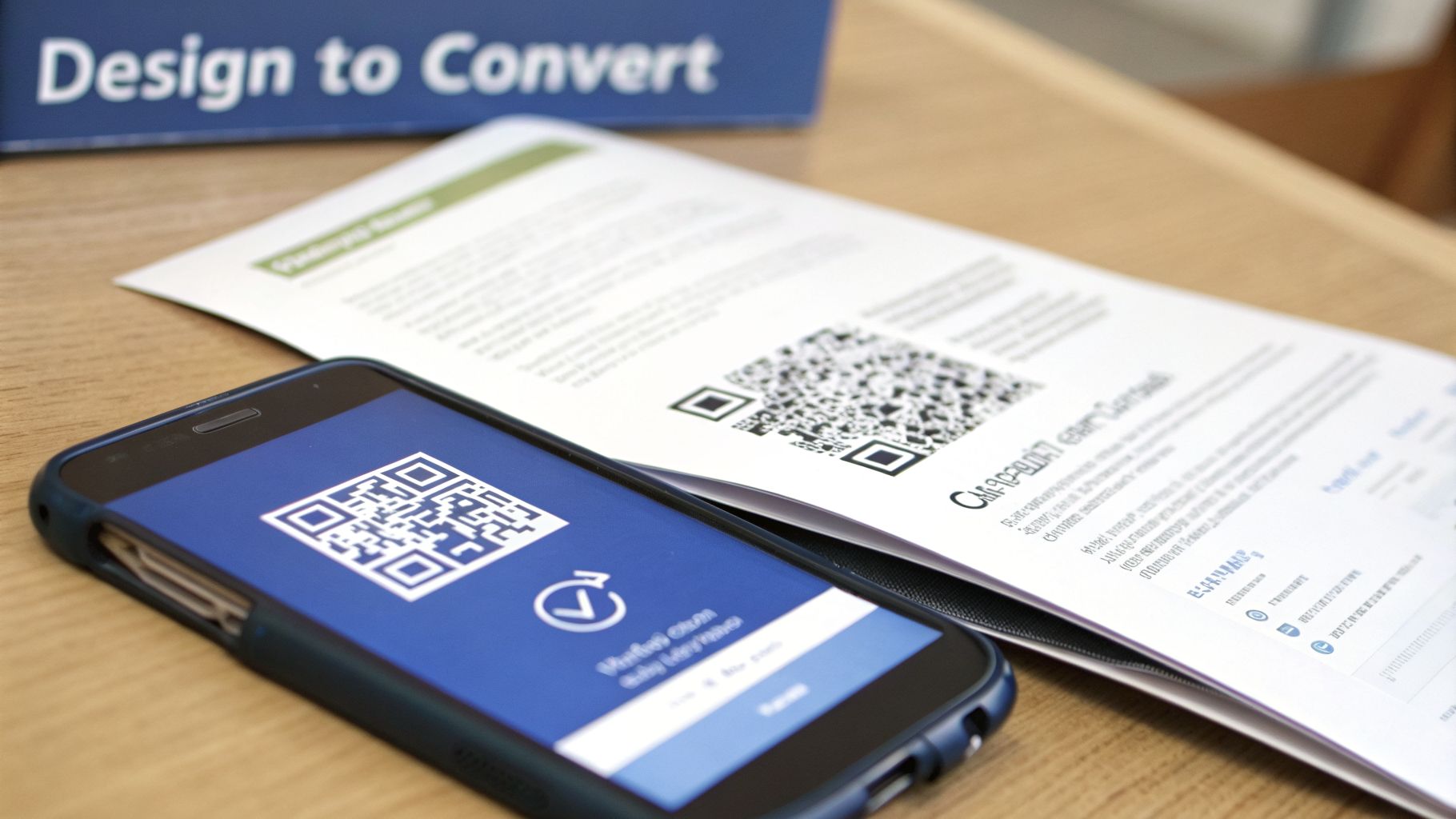
First, choose a format that matches your goal. Don't just default to a standard tri-fold.
- Tri-Fold: A workhorse for organizing information into digestible chunks, like spec sheets or service breakdowns.
- Bi-Fold (Half-Fold): Best for bold, visual statements, brand storytelling, or premium offers.
- Z-Fold: Creates a "reveal" as it unfolds, perfect for walking someone through a timeline or process.
- Gate-Fold: Two inward-folding panels build anticipation before revealing a central message. Use this for a dramatic product launch.
Engineering a Path for the Reader’s Eye
Once your format is chosen, control where the reader’s eye goes. This concept is called visual hierarchy—using design elements like size, color, and placement to guide the eye straight to your call-to-action (CTA).
Your headline is the single most important piece of copy. It must communicate a solution to your audience's problem. A headline like "Reduce Downtime by 40% with the XP-500 Pump" is infinitely more powerful than "Innovative Pumping Solutions."
From there, use subheadings and bullet points to break down details. Your prospect should be able to scan the entire brochure in 15 seconds and instantly get the main point. And use high-quality images that support the text, not just decorate the page.
A well-designed brochure doesn't just present information; it manages the reader's attention. Every element should work together to make your most important message impossible to miss.
Bridging the Physical and Digital Worlds with QR Codes
This is where modern brochure marketing flexes its muscle: connecting your physical asset directly to your digital sales funnel. The humble QR code is the bridge that turns a static piece of paper into an interactive, trackable lead generation tool.
But just slapping a QR code on the back isn’t enough. You must give people a compelling reason to scan it. Tie the code to a specific, high-value offer.
Consider these "phygital" integrations:
- Scan to Watch a Demo: Place a QR code next to a product image. It links to a video of that machine in action.
- Scan for a Free Assessment: Offer a no-obligation consultation, linking the QR code to a simple lead capture form.
- Scan to Download the Full Case Study: Tease a powerful success story in the brochure, with a QR code that unlocks the complete PDF.
- Scan to View Testimonials: Let happy clients do the selling. A QR code can send prospects to a page full of video testimonials.
For B2B operators, a well-crafted brochure balancing machine specs with powerful testimonials can help close deals up to 24% faster. It puts credible, tangible proof directly into a decision-maker's hands. You can find more compelling data in HubSpot's latest marketing statistics.
By creating unique QR codes for different campaigns (e.g., one for a trade show, another for direct mail), you can track which physical assets generate the most engagement and leads in your CRM. This gives you the hard data you need to prove the ROI of your print marketing.
Getting Your Brochure into The Right Hands: Smart Distribution and Integrated Tracking
A beautifully printed brochure is only half the job. Real success comes from smart distribution and integrated tracking. This is how you turn a physical asset into a measurable piece of your digital marketing system.
Your mission is to get that brochure in front of a qualified prospect at the exact moment they’re most open to hearing from you. This isn't about "spray and pray"; it's about targeted, strategic strikes.
The magic happens when you stop seeing distribution as the final step. Instead, think of it as the bridge connecting your physical marketing directly to your digital sales funnel.
Strategic Distribution Channels
Where you place your brochures is as critical as what’s inside them. Each channel serves a unique purpose.
Here are three high-impact distribution methods we build for our B2B clients:
- Targeted Direct Mail: This is about surgical precision. We help clients build lists of ideal prospects and mail them a high-quality brochure with a personalized letter. It's an effective way to land directly on a decision-maker's desk.
- Trade Show and Sales Team Enablement: Arm your sales team with tools that start conversations. We work with teams to use the brochure as a guide, pointing to specific specs or case studies to answer questions in real-time.
- Product Shipment Inserts: A surprisingly powerful way to drive repeat business. Tucking a brochure showcasing a complementary product into every outgoing order engages a customer who already trusts your brand.
Integrating Tracking for Measurable ROI
This is where the game changes. By integrating tracking, you transform your brochure campaign from an expense into a data-driven investment. You can finally prove the value of print with hard numbers.
The key is building a seamless workflow that captures leads and automates follow-up. Imagine a prospect at a trade show scanning a QR code on your brochure. That code sends them to a dedicated landing page.
Once they submit the form, the automation kicks in:
- Instant Lead Capture: The contact is created in your CRM (we use GoHighLevel for this) and tagged with the source, like "TradeShow2024_Brochure."
- Automated Nurture Sequence: They instantly get a personalized email or text delivering the promised asset (case study, demo video, etc.).
- Sales Team Notification: Your sales team gets an immediate alert about the new, warm lead, including the brochure source for a relevant follow-up call.
This closed-loop system shows you exactly which brochures pull in the most qualified leads. It's a core piece of building a comprehensive multi-channel marketing strategy where every component works together.
Brochures have been around since the 1800s, but we're seeing a 'phygital' renaissance. As buyers battle screen fatigue, they're placing more trust in print. You can explore more print marketing statistics and trends that highlight this shift.
Measuring Your ROI and Optimizing the System
If you can't measure it, you can't improve it. This is the moment your brochure marketing becomes a repeatable, scalable system for growth. We have to track what actually matters: the return on your investment.
The goal is to connect a physical action—picking up your brochure—to a digital result you can see and count. The infographic below maps out this modern tracking system.
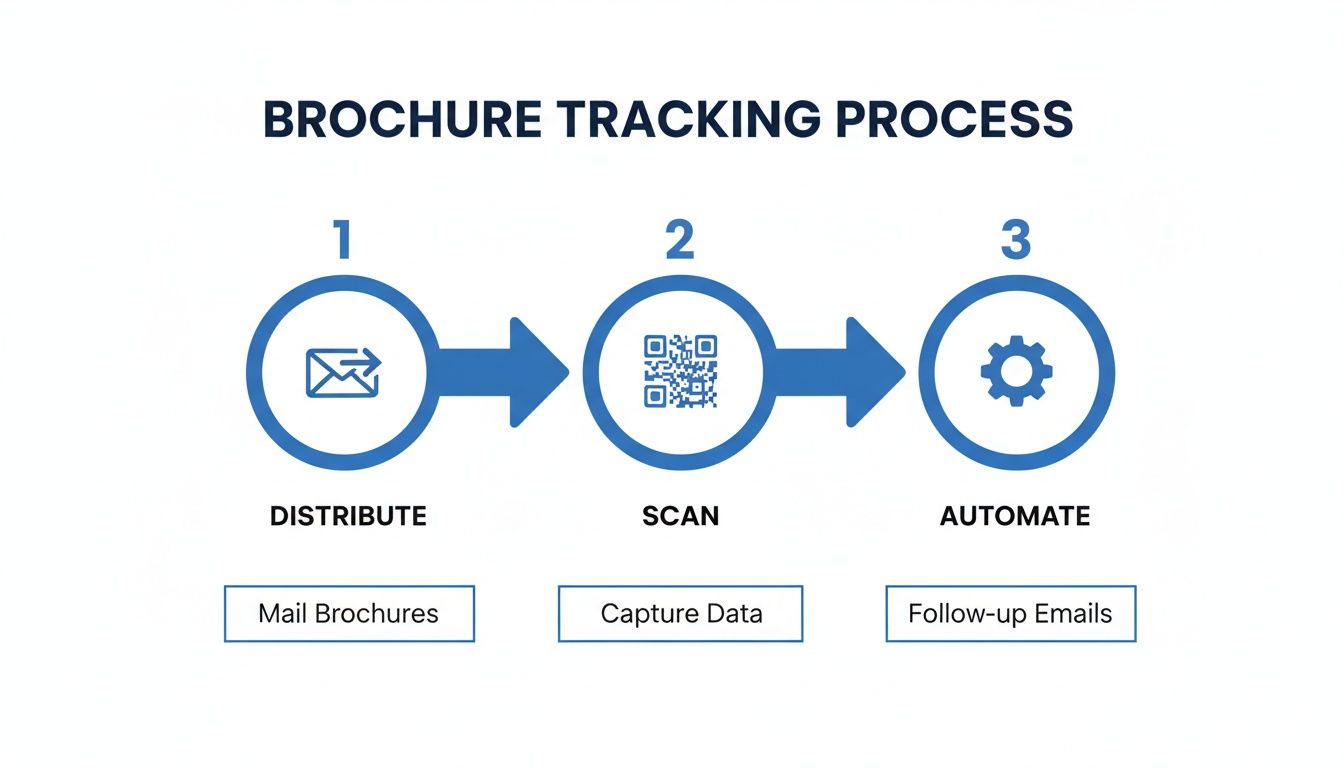
The key takeaway is simple: your brochure is the starting gun for a race your digital systems are built to win. By building this bridge, every dollar you spend on print becomes accountable.
From Cost to Investment: Key Metrics to Track
Stop thinking of brochures as a marketing expense and start treating them as an investment. You need to diagnose your campaign’s health by tracking the right numbers—metrics with a direct line to your bottom line.
Here are the numbers you must track:
- Cost Per Lead (CPL): Your direct measure of efficiency. Divide the total campaign cost (design, printing, distribution) by the number of leads generated from your tracked QR codes. If you spent $2,000 on a campaign that brought in 40 leads, your CPL is a crisp $50.
- Lead-to-Customer Conversion Rate: How many of those leads became paying customers? Tracking this in your CRM reveals the quality of the leads your brochure is generating.
- Customer Lifetime Value (CLV): The ultimate metric. What is the total revenue a customer acquired through a brochure brings to your business? This tells you the real, long-term ROI.
When you have these metrics, you can have data-driven conversations about your marketing budget. For a deeper dive, check out our guide on how to properly measure marketing ROI.
Building a System for Continuous Optimization
A great marketing system is never "done." It’s a machine you constantly tune based on real-world data. Now that tracking is in place, you can A/B test your physical brochures, just like a digital ad.
Your first brochure campaign isn't the finish line; it's your baseline. The real growth comes from testing, measuring, and iterating to build a system that gets smarter over time.
Start with a simple framework. Create two versions of your brochure (Version A and Version B) with one specific element changed. Use a unique QR code for each version to measure performance independently.
Consider testing these elements:
- The Headline: Pit a benefit-driven headline ("Reduce Downtime by 40%") against a problem-focused one ("Tired of Unscheduled Maintenance?").
- The Offer: Does a QR code for a "Free Consultation" get more scans than one for a "Free Case Study"?
- The QR Code Placement: Test the code on the front panel versus inside, next to relevant product specs.
After running your test, analyze the CPL and conversion rates for each version. The winner becomes your new control, and you move on to test another element. This iterative process turns guesswork into a predictable science and is key to understanding effective strategies for customer loyalty programs.
Common Questions About Modern Brochure Marketing
It’s smart to have questions before investing in physical marketing. Every dollar in your budget needs to work for you. We hear the same questions from business owners all the time—here are the straight answers.
Are Brochures Still Relevant in 2024?
Absolutely, but with one critical catch: they must be part of a connected system. Their power comes from their ability to slice through digital noise. Your inbox is a warzone, but your physical desk is prime real estate.
A brochure’s job isn’t to replace your digital marketing; it’s to fuel it. It’s a physical handshake that guides people into your digital world via QR codes. In a world of screen fatigue, a tangible brochure makes a statement and sticks in memory far longer than a fleeting online ad.
Brochures aren’t just relevant; they create a rare, distraction-free moment with your prospect. It's your chance to have their undivided attention—a luxury most digital channels can no longer promise.
Are Brochures Too Expensive for a Small Business?
The real question isn't "How much do they cost?" but "What's my cost per lead?" A cheap, badly designed brochure that gets zero leads is infinitely more expensive than a thoughtful one that costs $5 per piece but brings in qualified customers.
To get the costs right, you need to diagnose what you actually need:
- Start small. You don't need to order 10,000 brochures. Print a test batch of 250-500 to see if your message is hitting the mark.
- Focus on purpose. A simple bi-fold for a sales meeting can be cheaper and more effective than a complex gate-fold for a trade show.
- Measure everything. Once you can prove every dollar spent on brochures brings back $5 in revenue, the cost is no longer an expense. It becomes a smart investment in growth.
How Can I Possibly Track the ROI of a Piece of Paper?
The answer is simpler than you think: unique QR codes and dedicated landing pages. This is the non-negotiable bridge between your physical and digital marketing.
Here’s the system in practice:
- Create a Unique QR Code: For every campaign—like "Spring Trade Show" or "July Direct Mail"—generate a specific QR code that links to one place.
- Build a Dedicated Landing Page: This page has one job: deliver on the promise made in the brochure (e.g., a downloadable case study or demo sign-up).
- Track the Conversions: When someone scans the code and takes action on the landing page, your CRM can trace that lead directly back to the brochure campaign.
This method gives you hard data. You’ll see exactly which brochures are driving action, allowing you to calculate your Cost Per Lead (CPL) and measure the true ROI. The guesswork is gone.
Ready to build a marketing system that turns physical touchpoints into measurable leads? The team at Machine Marketing specializes in creating and integrating these exact kinds of campaigns. We can help you diagnose your current process and build a roadmap for sustainable growth.