Most manufacturers don't have a purpose problem, they have a sentence problem. The website says one thing, the lobby plaque says another, and the sales team is still using a third version that nobody can repeat under pressure. If your purpose vs. mission language is fuzzy, your buyers feel it long before they can explain it.
That confusion is expensive. It muddies positioning, weakens sales conversations, and makes your CRM feel like a filing cabinet instead of a growth system. We're going to separate the two statements the right way, then turn them into something you can use on the shop floor, on the website, and in the nurture sequence that brings dead leads back to life.
| Criterion | Purpose | Mission |
|---|---|---|
| Time horizon | Enduring, stable | Specific, changeable |
| Core question | Why we exist | How we operate now |
| Scope | Broad, identity-level | Narrower, execution-level |
| Best use | Alignment, culture, brand direction | Sales focus, operating priorities, measurable action |
| Rewrite frequency | Rarely, only when the company's reason for being truly changes | More often, when strategy, markets, or offers shift |
Table of Contents
- Why Most Manufacturers Get Purpose and Mission Wrong
- What Purpose and Mission Actually Mean
- A Side-by-Side Comparison Across Five Criteria
- How Different Manufacturers Use Each Statement
- Templates and Tests for Writing Your Own Statements
- Connecting Both Statements to CRM and Lead Generation
- When to Rewrite One, the Other, or Both
Why Most Manufacturers Get Purpose and Mission Wrong
The most common mistake is treating purpose and mission like interchangeable branding words. That's how you end up with a hero line on the website, a different line in the sales deck, and a totally different sentence in the employee handbook. Nobody can use that language consistently because it was never written to do an operating job.
The better way to think about it is simple. Purpose is the deeper why, the enduring reason the company exists beyond making money, while mission is the operational how, the path you use to accomplish that reason today, as the source material describes in organizational design and strategy. That distinction matters because modern management writing treats mission as the company's business, customers, objectives, and approach, while purpose sits above day-to-day execution as the unifying principle behind the work, according to Bain's mission and vision toolkit and Harvard Business Review's definition of purpose as the unifying principle beyond mission.
Why vague language hurts pipeline
Manufacturers often think the problem is polish. It usually isn't. The problem is that vague language fails every practical test, including the only one that matters in a sales cycle, “Could this sentence belong to any competitor?”
Practical rule: If your statement sounds good on a wall but can't guide a quote, a follow-up email, or a hiring decision, it's decoration, not strategy.
That's why this topic matters operationally, not just rhetorically. A purpose statement that stays abstract will never help your sales team qualify leads, and a mission statement that reads like a slogan won't help your plant manager make trade-offs. For industrial firms, clarity is not a branding preference, it's a working asset. If your team needs a starting point for the marketing side of that diagnosis, this breakdown of why manufacturers struggle with marketing is the right companion piece.
The failure mode to watch for
Here's the pattern we see over and over. Leadership wants “one inspiring line,” so they compress everything into something broad enough to avoid disagreement. The result is a sentence that sounds noble but can't steer anything.
That's the trap. Purpose should stay broad enough to hold the company together through strategy changes, while mission should be specific enough to guide what happens this quarter. If your team can't tell which sentence belongs where, the problem isn't semantics. It's that nobody has defined the operating rules.
What Purpose and Mission Actually Mean
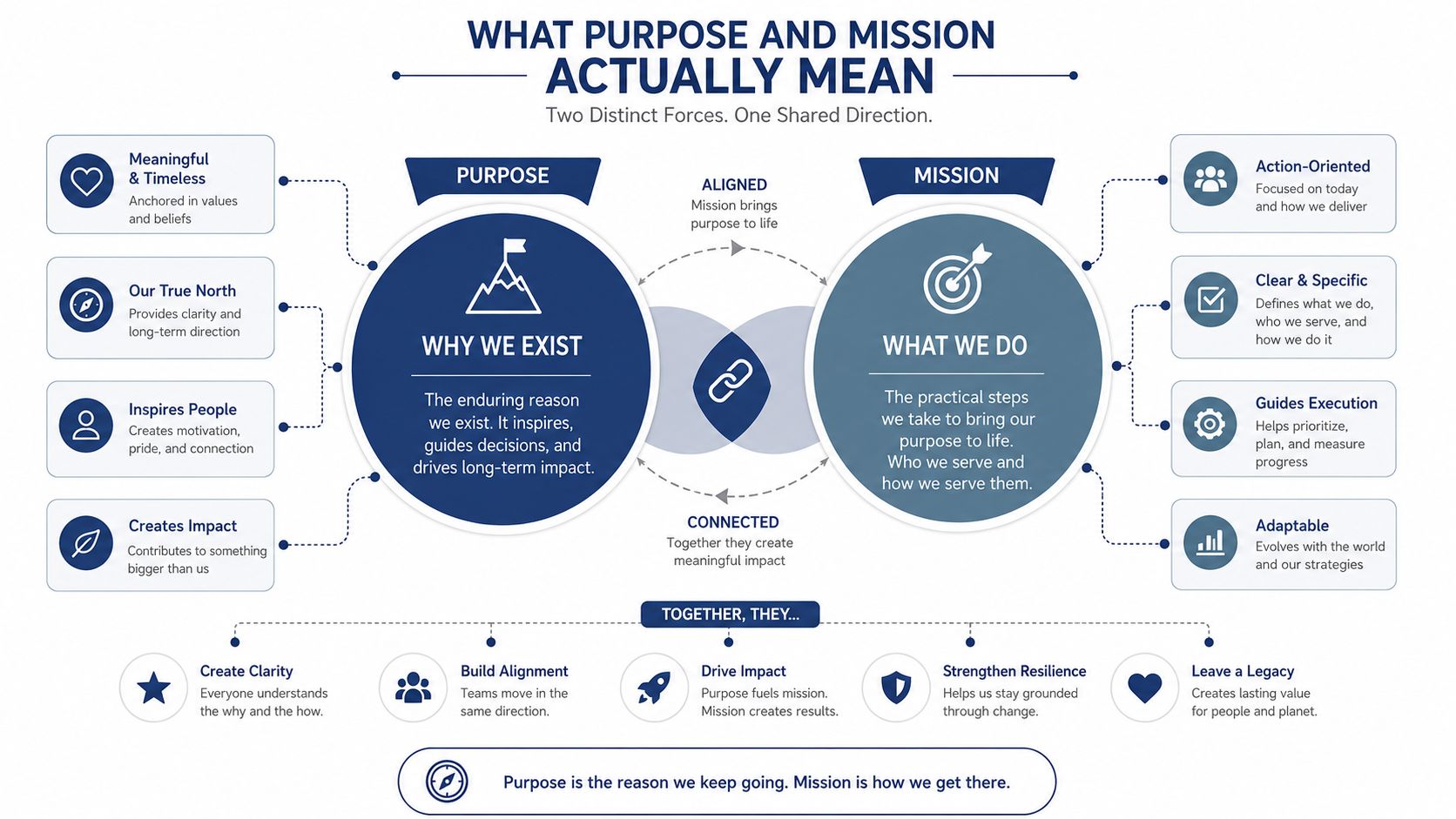
Purpose is the enduring reason the company exists. It answers the question why are we here? That is the deeper commitment that stays relevant even when products, markets, or execution models change. Modern research treats it as a real, behavior-shaping construct rather than a slogan, including a 2025 review in The Journal of Positive Psychology that defines purpose as an active commitment to an aim meaningful to the self and consequential beyond the self.
Mission is the operational path. It answers how do we get there now? In practice, that means the mission should describe the current business, the customers served, the work done, and the objectives being pursued, which matches the way Bain defines mission statements and the way BetterUp frames purpose versus mission.
A simple test you can use
If a sentence describes the company's reason for existing in a broad, stable way, it belongs in purpose. If it describes what the company does now, for whom, and with what operational focus, it belongs in mission.
- Purpose example: We exist to help manufacturers build reliable businesses that outlast a single market cycle.
- Mission example: We design and build precision parts for regional OEMs with fast quoting and tight delivery control.
The first line is about identity and long-term meaning. The second is about current execution. Keep that separation clean. organizational design guidance is blunt on the point, purpose should remain stable across strategy changes, while mission can be rewritten when markets, offers, or execution models change.
What to look for in your own wording
If your “purpose” line includes a product name, a process, or a quarterly target, it is too narrow. If your “mission” line sounds like a values poster, it is too soft to help your team operate. The best statements do different jobs, and they should feel different when you read them out loud.
Purpose is the sentence you want unchanged when the business evolves. Mission is the sentence you should be willing to replace when the work changes.
The reason this distinction matters is practical, not philosophical. Purpose creates continuity. Mission creates focus. Manufacturers need both, but they need them to do different jobs.
A Side-by-Side Comparison Across Five Criteria
Use five criteria, not gut feel, to separate purpose vs. mission. That is how you keep a shop-floor statement from drifting into marketing fluff, and how you keep a website claim from pretending to be a corporate philosophy.
| Criterion | Purpose | Mission |
|---|---|---|
| Time horizon | Long-term, enduring | Current, time-bound |
| Scope | Broad identity and direction | Specific business focus |
| Action level | Guides decisions and alignment | Guides execution and priorities |
| Audience | Internal culture, customers, partners, leadership | Teams, prospects, operators, managers |
| Rewrite frequency | Rare, only after a real shift in why the company exists | More often, when strategy or market conditions change |
Time horizon and scope
Purpose stretches over time. It gives the company a stable anchor when a new product line, a different market, or a revised pricing model comes along. Mission sits closer to the present, which is why it works for a job shop, an OEM supplier, or an industrial vendor with a live pipeline to manage.
A machine shop quoting one-off parts needs a mission that says what it does now, not what it might do someday. A broader purpose can hold the culture together while the mission changes as capabilities, demand, or equipment change. That is not inconsistency, it is good management.
Action level and audience
Purpose is the sentence that helps people make sense of the work. Mission is the sentence that helps them do the work. In a B2B industrial setting, purpose belongs in internal alignment and brand-level positioning, while mission belongs in sales conversations, hiring language, and operational priorities.
Decision rule: If the statement is supposed to steady the company through change, it is purpose. If it is supposed to tell people what to do next, it is mission.
Rewrite frequency and practical use
Manufacturers should not rewrite purpose every time they adjust their offer. That is sloppy. They also should not cling to a mission statement after the business has pivoted into a new market or service model. The point is to preserve meaning where it should stay fixed and preserve agility where it should move.
If you need a more formal writing process for the mission side, this guide to writing a mission statement for business is useful because it keeps the statement tied to action, not aspiration. That is the right instinct for industrial firms, where the words have to support actual decisions.
How Different Manufacturers Use Each Statement
A CNC job shop, an industrial SaaS company, and a contract manufacturer can all share the same broad purpose language and still need very different missions. That's because the business model changes the operational sentence, even when the deeper reason for existing stays consistent.
CNC job shop
A CNC shop's purpose should anchor culture and standards. It should tell people why the shop exists beyond hitting this month's shipment board. That matters when a foreman, estimator, and owner all need the same north star while juggling rush work and capacity constraints.
Its mission, though, should be much sharper. It should define the kind of work the shop wants, the speed of response it commits to, and the tolerance for complexity it can support. If you say yes to everything, your mission is too vague to be useful.
Industrial SaaS vendor
An industrial SaaS company selling into manufacturing needs purpose to differentiate itself in a crowded market. Buyers don't just want features, they want to know what kind of company they're partnering with and why it exists. Purpose helps here because it frames the bigger promise.
Mission, on the other hand, should set product priorities and customer focus. It should help the team decide what to build, what not to build, and which accounts deserve attention right now. If your roadmap has no operating filter, your mission is not doing its job.
Contract manufacturer
A contract manufacturer should use purpose to justify capital investment decisions and long-term capability choices. If you're buying equipment or expanding a plant, you need a reason that goes deeper than a temporary order spike. Purpose provides that continuity.
Mission should drive the plant-level KPIs. It should connect the work on the floor to the current service promise, the customers you serve, and the execution standards you're willing to defend. When people in the plant can recite the mission but can't explain the purpose, the company has reverse-engineered its identity.
The important thing is not to copy language across all three. The important thing is to keep the deeper why stable and make the mission fit the actual business model. That's the difference between a statement and an operating tool.
Templates and Tests for Writing Your Own Statements
Start with two fill-in-the-blank statements. Keep them plain. If the wording sounds like a slogan, you've gone too far.
Purpose template
We exist to [make a specific change or enable a specific outcome] for [the people or organizations you ultimately serve] so that [the broader impact beyond the immediate sale].
Example shape for an industrial firm:
We exist to help manufacturers build dependable operations so they can grow without losing control of quality, delivery, or trust.
That's purpose language because it reaches beyond a product list. It names a durable reason for being and the change the company wants to support.
Mission template
We help [specific customer type] achieve [specific result] by [current method, offer, or capability] within [timeframe or operating window].
Example shape for an industrial firm:
We help regional manufacturers improve throughput by providing precision machining, responsive quoting, and dependable delivery schedules.
That's mission language because it is current, specific, and operational. It tells a prospect what happens now, not what the company wishes to become someday.
Four tests that fail weak statements
- Competitor test: If a rival could use the same sentence without changing a word, it's too generic.
- Shop-floor test: If the production team can't explain how the statement changes daily decisions, it's too abstract.
- Sales test: If a rep can't use it to open or qualify a conversation, it's not useful enough.
- Rewrite test: If the sentence would break the moment your offer changes, it belongs in mission, not purpose.
Practical rule: Don't write for applause. Write for use. The best statement is the one your team can repeat under pressure without sounding scripted.
What good looks like in practice
A purpose statement should sound like a reason. A mission statement should sound like a commitment. If you can swap them and nobody notices, both are failing.
For teams that want a more process-driven approach, strategy and sales discipline meet. The language has to be specific enough to guide positioning, but not so narrow that it becomes obsolete the next time the business evolves.
Connecting Both Statements to CRM and Lead Generation
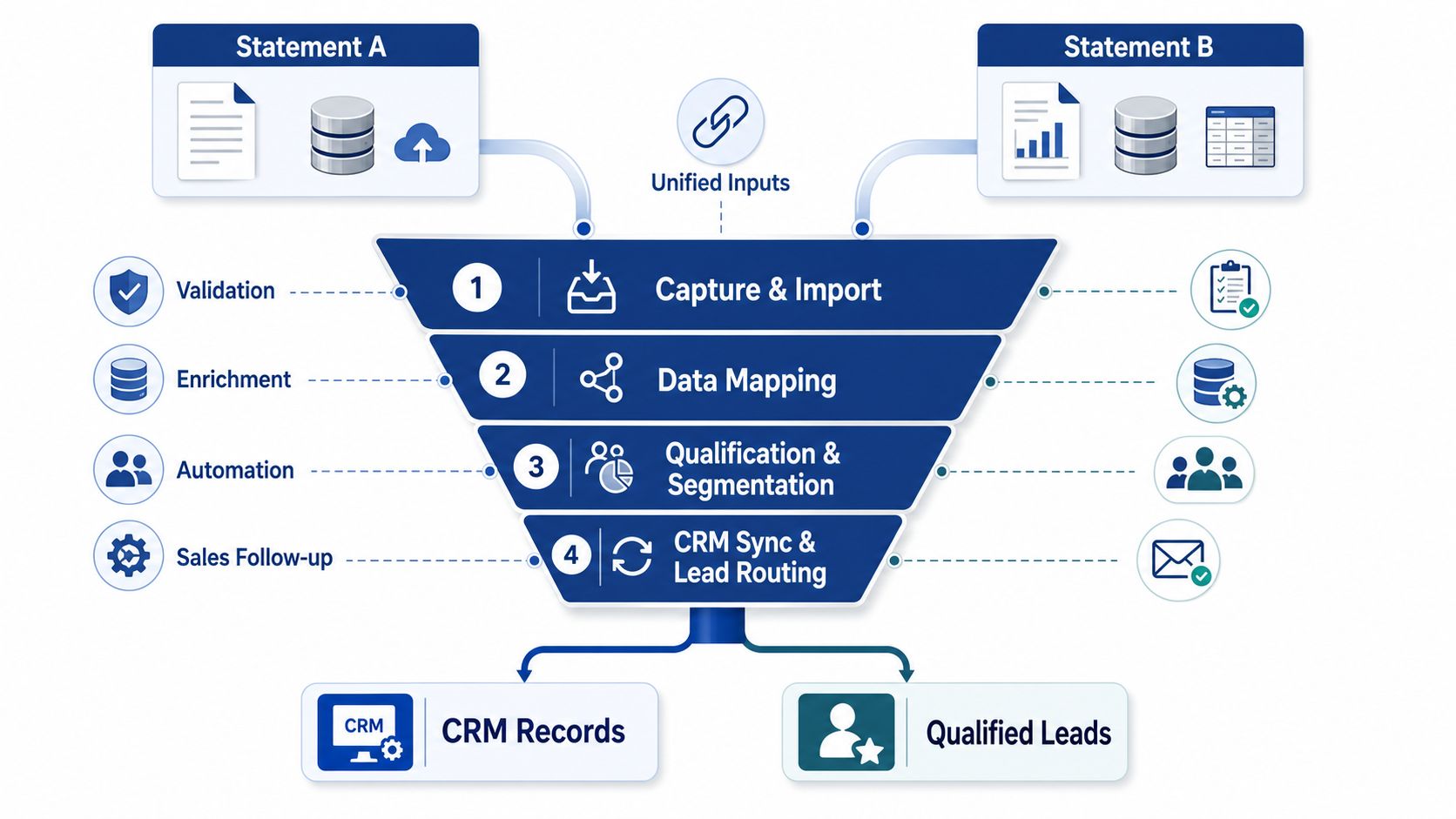
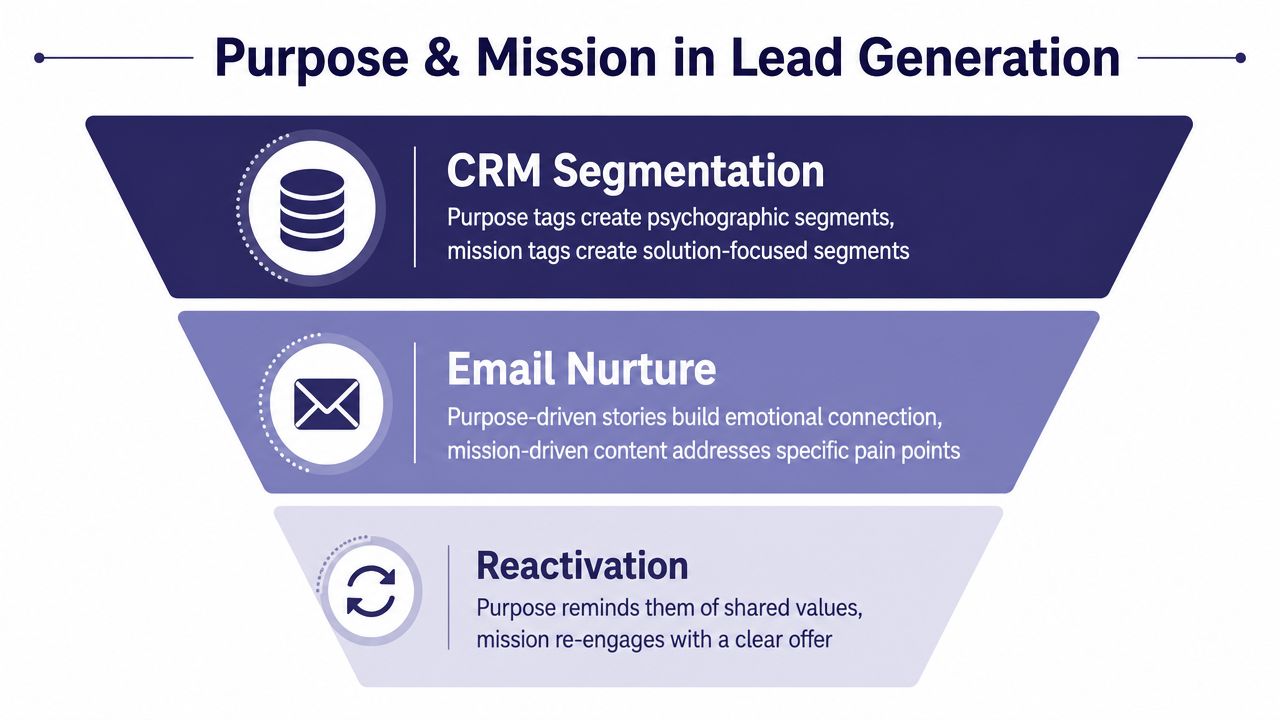
The distinction stops being theoretical here. Purpose should shape your brand-level messaging, top-of-funnel content, and welcome sequences. Mission should shape your offers, case studies, qualification questions, and follow-up logic inside the pipeline. If those two layers say the same thing in different words, your CRM becomes noisy. If they do different jobs, your CRM becomes useful.
A clean workflow in GoHighLevel makes the split obvious. Purpose drives the welcome email, the first-touch story, and the tone of the nurture track. Mission drives the offer, the segmentation logic, and the reactivation message that asks for a concrete next step. That's the right division of labor because the buyer first needs to understand who you are, then needs a reason to respond.
For a broader operating view on the CRM side, this guide to CRM for lead generation is the right companion. It connects the messaging layer to the system layer, which is where manufacturers usually lose momentum.
How to use the split in the CRM
- Purpose tags: Use them to group leads by values, industry identity, or long-term fit.
- Mission tags: Use them to group leads by service need, product interest, or buying stage.
- Purpose emails: Keep them about trust, credibility, and the broader reason to keep reading.
- Mission emails: Keep them about specific pain points, offers, and next actions.
If you want a useful outside reference on sales and marketing alignment, Stamina's alignment strategies are worth reading because the emphasis is on shared definitions and cleaner handoffs. That's exactly the same problem purpose and mission solve inside an industrial CRM.
The payoff is simple. When purpose and mission are separated correctly, your reactivation campaign stops sounding random. One line reminds the lead what kind of company you are. The next line gives them a reason to take action now.
When to Rewrite One, the Other, or Both
Rewrite the mission when strategy changes. Rewrite the purpose only when the company's reason for existing has genuinely shifted, which is far less common. If nothing material has changed but the team can't recite either statement, fix the messaging first. Don't pretend that a wording problem is an identity crisis.
That's the clean rule. It keeps you from over-updating the wrong sentence and under-updating the one that guides execution. If you need a practical cross-check for whether your top-of-funnel and sales language are aligned, Sprints & Sneakers B2B insights is a useful read because it keeps demand and lead generation from getting mixed together.
A one-week action plan
- Audit every public sentence. Pull the homepage hero line, sales deck opener, about page, and CRM welcome email into one document.
- Sort each sentence. Mark it as purpose, mission, or noise.
- Delete duplicates. Keep one clean version of each idea, not three almost-matching lines.
- Rewrite the mission first. Make it specific to your current offers, customers, and operating model.
- Test it with the team. Ask three people to repeat it in their own words and explain how it changes decisions.
That gives you a practical reset without turning the exercise into a branding workshop. If the language still feels muddy after that, the problem is probably strategic alignment, not copywriting.
If you want a team that can pressure-test your purpose vs. mission language against your actual growth system, Machine Marketing works with manufacturers, machine shops, and industrial firms that need clearer positioning, cleaner CRM logic, and better lead generation. Visit Machine Marketing to start a strategy diagnosis and get your statements turned into something your team can use.