You don't need more PDFs. You need a sales enablement content strategy that helps your reps win the next deal when the buying committee is messy, the timeline is long, and procurement has suddenly joined the thread. In manufacturing and industrial sales, the library usually looks full right up until a rep needs one specific asset for one specific objection, and then everyone discovers the system was never built for live deals.
What follows is the practical version. We'll look at why content libraries fail, how to audit what you already have, how to map assets to non-linear buying committees, which formats move pipeline, and how to keep content fresh enough that reps trust it. The standard here is simple, if an asset doesn't help a rep change a deal, it's clutter.
Table of Contents
- Why Most Sales Enablement Content Libraries Quietly Fail
- Running the Content Audit That Surfaces What to Keep, Fix, or Kill
- Mapping Content to Personas, Stakeholders, and Real Deal Moments
- The Content Types That Move Pipeline for Manufacturers
- The Production Workflow That Keeps Content Fresh and Rep-Ready
- Tech Stack and Repository Choices That Put Content in the Rep's Workflow
- Your 30-60-90 Rollout Plan and the KPIs That Prove It Works
Why Most Sales Enablement Content Libraries Quietly Fail
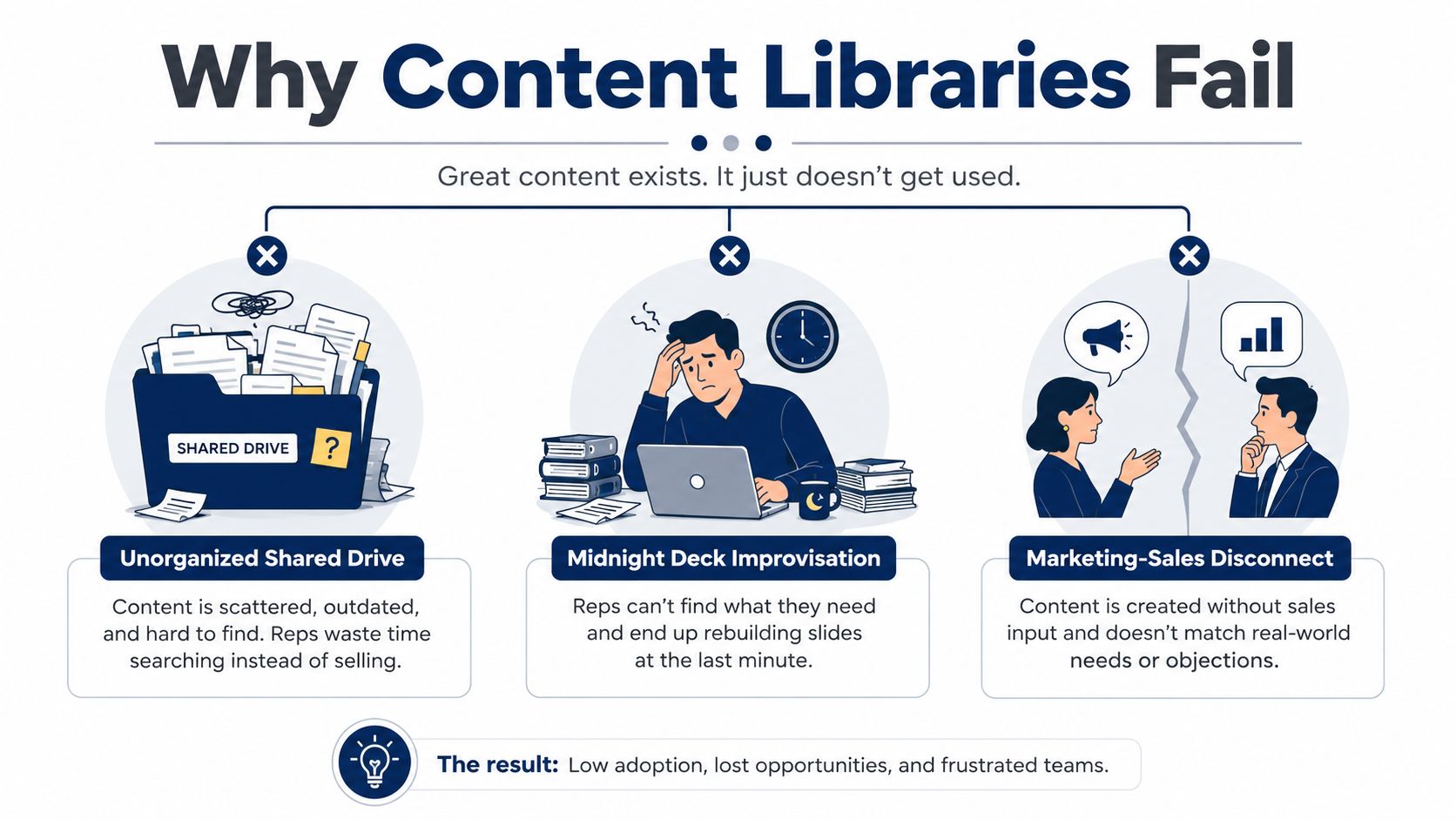
Most manufacturing teams don't have a content shortage. They have a relevance problem, and it shows up the same way every time, a shared drive full of assets, a rep rebuilding a deck at 10 p.m., and marketing insisting the library is “complete.” The buyer doesn't care how much you produced. Buyers typically consume 3–5 pieces of content before engaging a sales rep, 65% say relevant content influences their purchasing decisions, and 60% of successful sales interactions use personalized content aligned to buyer intent (industry compilation). That's the core job.
The three failure modes that keep repeating
First, teams confuse volume with usefulness. A long library feels safe internally, but it doesn't help a rep in a live opportunity if the asset doesn't answer the objection in front of them.
Second, content gets built around the company's favorite topics, not the buyer's actual questions. In technical sales, that's fatal because the committee isn't thinking in campaign themes, it's thinking in risk, integration, downtime, compliance, and budget justification.
Third, there's no feedback loop. Sales sends informal complaints, marketing hears scattered anecdotes, and nobody closes the loop on what was opened, shared, ignored, or used to move a deal.
Practical rule: if your reps keep recreating the same materials, the problem isn't the rep. The system is misaligned.
The shift is blunt. Content isn't a support activity sitting beside the buying process, it's part of the buying process itself. That's why a documented strategy matters so much, because 82% of companies with effective enablement have a documented content strategy (industry compilation). In industrial and B2B manufacturing sales, where buyers need proof points and comparison assets before they trust a vendor, that documentation is a structural advantage.
Running the Content Audit That Surfaces What to Keep, Fix, or Kill
Start with inventory, not ideation. If you don't know what you already own, you'll keep creating duplicates while the gaps stay hidden.
Build the audit in a spreadsheet, not in your head
Pull every asset into one sheet. Include decks, one-pagers, battle cards, case studies, email snippets, calculators, product sheets, technical PDFs, and any “temporary” file that somehow became permanent.
Tag each asset by persona, stage, format, freshness, and last-use date. Those tags matter because they tell you whether an asset is discoverable, current, and being used in deals.
Then score each item on two questions, Is it used? and Does it influence deals? A high-usage asset that doesn't change outcomes may be tolerated, but it shouldn't receive the same attention as a lower-use asset that consistently helps reps get past procurement or technical validation.
A quick scoring rubric keeps the conversation from turning into taste-based debate:
- Keep: Used often, current, and tied to active deal moments.
- Fix: Useful in principle, but outdated, too long, or missing proof.
- Kill: No recent use, no clear owner, and no clear role in sales conversations.
A rep survey helps, but don't stop there. Pair the survey with a CRM pull of attachments or linked assets used in active opportunities, because people always remember what they liked and conveniently forget what never gets sent. That's where the truth lives.
If an asset hasn't been used in a real deal recently, it's probably decoration.
By the end of the audit, you should have a tagged inventory and a short list of content that deserves improvement versus retirement. That's the point. You're not cleaning up a folder, you're building the evidence base for what gets produced next.
Mapping Content to Personas, Stakeholders, and Real Deal Moments
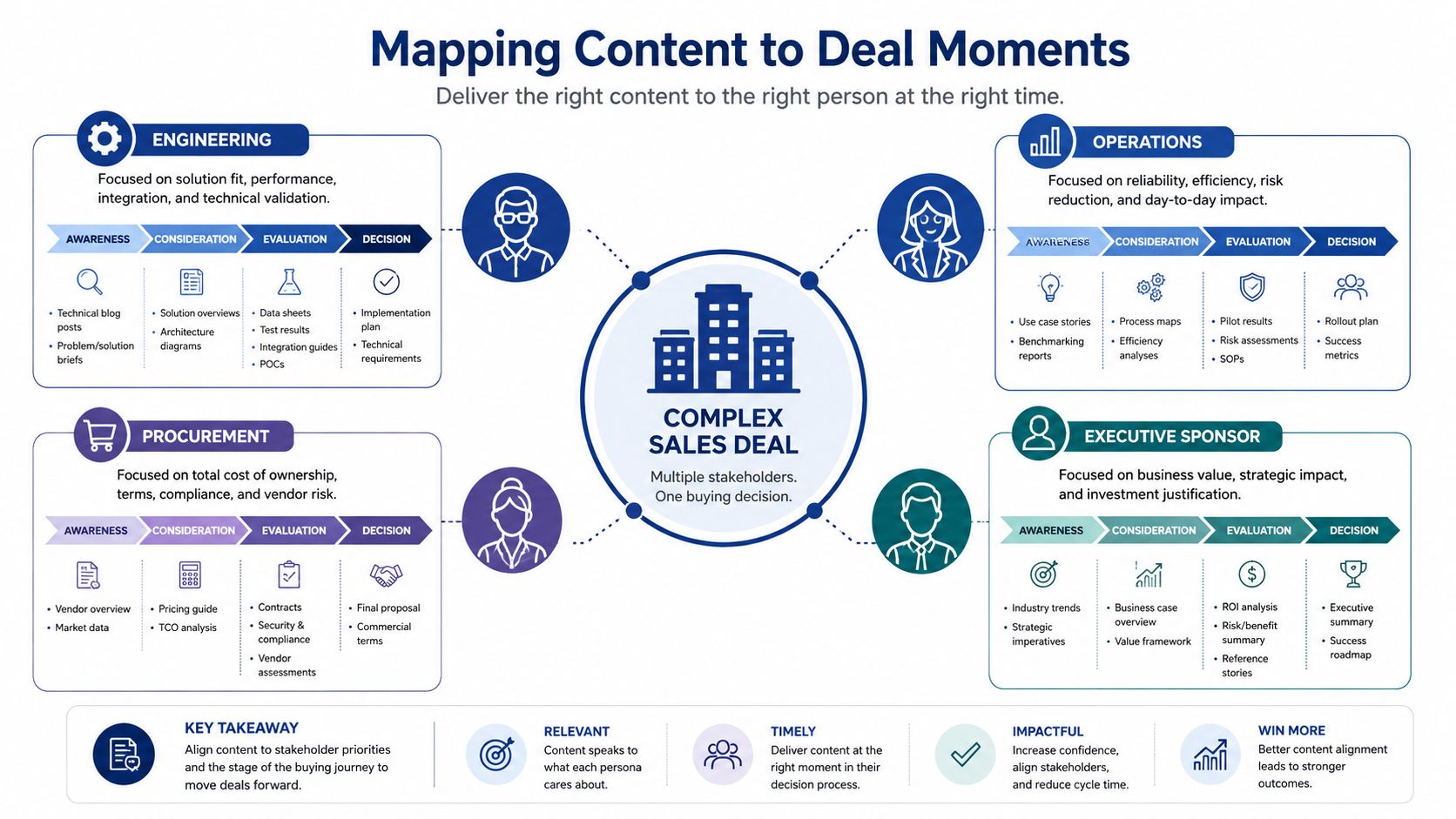
Generic funnel mapping breaks down in manufacturing because real deals don't move in a straight line. Engineering shows up early, procurement shows up late, finance shows up when the risk gets expensive, and operations may step back in after everyone thought the evaluation was done.
Build the matrix around people and moments
Use two axes. One axis is the buying committee, by role and priority. The other axis is the deal moment, such as kickoff, technical evaluation, pilot, procurement, legal, and renewal.
For each cell, write down three things: the question the stakeholder is asking, the proof point that answers it, and the asset that already covers it. If nothing exists, the gap becomes obvious immediately.
That's a better operating model than asking, “Do we have a brochure?” The better question is, “Do we have a procurement-cost-justification asset for the CFO at the pilot-review moment?”
Here's the practical habit that pays off. Review the matrix with sales leaders and technical sellers, not just marketers, because they hear the objections first. If procurement keeps asking for implementation risk language and your library only has generic product overviews, the gap is already costing you.
For a useful way to frame buyer logic before you map content, see this guide to buyer personas. Use it as the starting point, then extend it into stakeholder-specific deal moments instead of stopping at persona labels.
What the matrix should produce
- Engineering: Needs technical specificity, integration details, and proof that the solution won't create downstream surprises.
- Operations: Needs installability, process fit, and clarity on disruption.
- Procurement: Needs comparison language, risk reduction, and defensible cost logic.
- Executive sponsor: Needs business case framing, strategic fit, and confidence that the decision won't backfire.
The matrix becomes your production queue, your distribution logic, and your gap analysis. It replaces vague requests with real ones, and that's where the strategy gets sharper.
The Content Types That Move Pipeline for Manufacturers
Content that looks polished is usually the first thing to get ignored in a manufacturing deal. Reps need assets they can send, attach, or say in the middle of a live objection without cleaning them up first.
Rank assets by how reps use them
The highest-performing formats are the ones a rep can use immediately. In the compiled enablement dataset, email templates and snippets had 89% usage, one-page battle cards 78%, and ROI calculators 71%. That is the priority stack, not the vanity shelf.
That also matches how industrial B2B prospecting works. In a long-cycle market, the first job is to give the rep material that makes the next conversation easier and more credible. If the follow-up asset does not answer the objection, it is already too weak for the deal.
| Asset Type | Typical Usage | Best Deal Moment | Manufacturing-Specific Notes |
|---|---|---|---|
| Email templates and snippets | Very high | First follow-up, objection reply, recap | Keep them short, plain, and specific to a technical or commercial question. |
| One-page battle cards | Very high | Competitive evaluation | Include win themes, traps, and a clean comparison against the rival vendor. |
| ROI calculators | High | Business case and procurement review | Tie the math to downtime, labor, throughput, or waste reduction. |
| Comparison sheets | High | Technical evaluation and shortlist stage | Buyers want a quick way to compare your offer with alternatives. |
| Case studies with quantified outcomes | High | Validation and late-stage proof | Make sure the story feels operational, not marketing-polished. |
| Objection-handling playbooks | High | Discovery, pilot, procurement | Reps need phrasing, not theory. |
| Dimensional cut sheets and certifications | Medium to high | Technical evaluation | Specificity matters more than narrative. |
| Generic thought leadership PDFs | Low | Early awareness only | Useful for positioning, weak in live deal moments. |
What good looks like versus forgettable
Good assets are short, current, and tied to a decision. Forgettable assets are bloated, abstract, and written like nobody had to use them on a call.
For manufacturers, proof-of-capability assets matter as much as messaging assets. A dimensional cut sheet, a material certification, an integration diagram, or an install-base reference often moves the deal more than a long brand narrative ever will.
The best content for industrial sellers does not impress the marketing team. It removes friction from the buyer's next decision.
Use the content calendar to keep those assets tied to live pipeline needs, not random campaign dates. A practical planning resource like content calendar basics for industrial teams helps keep the work attached to deals instead of internal deadlines.
That is the filter. If the asset cannot help a rep move a specific deal moment, it is not core enablement content.
The Production Workflow That Keeps Content Fresh and Rep-Ready
Freshness isn't cosmetic. A stale asset tells the buyer your company is behind, and a rep who shares stale material loses credibility fast.
Use one brief, one owner, and one expiration date
Every asset should start with a short brief that includes audience, stage, key message, proof point, call to action, and expiration date. That brief keeps content grounded in a real use case instead of drifting into internal preference.
Assign one accountable owner per asset. Not a committee, one owner. The owner is responsible for keeping it current, chasing approvals, and retiring it when it's no longer useful.
For reference on building the cadence around a real calendar, this practical planning resource helps anchor the work, content calendar basics for industrial teams. Use it to schedule content against deal needs, not campaign vanity.
Set the review cadence by usage
High-usage assets need a review every 90 days, and everything else gets reviewed every 180 days. That cadence keeps the library from drifting into stale territory while avoiding busywork on low-touch files.
Quarterly, sit down with sales leaders and top reps and ask what's getting in the way. Don't ask them what they want in theory, ask what objections, blockers, and missing proof points keep showing up in live opportunities.
A simple governance rule helps here:
- Approve: One business owner, one subject-matter reviewer, one final approver.
- Resolve disputes: The decision goes to the deal owner or sales leader, not whoever shouts loudest.
- Maintain a kill list: Anything outdated, unused, or redundant gets flagged for removal.
The hard part isn't making content. It's removing content fast enough that the library stays credible. If the team can't trust the freshness, they won't trust the folder.
Tech Stack and Repository Choices That Put Content in the Rep's Workflow
If reps have to hunt for content, the content doesn't exist operationally. A beautiful repository buried in a drive is still a dead repository.
Put assets where sellers already work
Start with the systems your reps already touch, then decide how much extra stack you need. CRM platforms like HubSpot and Salesforce, sales engagement tools like Outreach, Salesloft, and Apollo, and enablement platforms like Highspot, Seismic, and Showpad all serve different purposes.
The decision isn't about feature count. It's about whether the right asset shows up inside the workflow, in sequences, in deal rooms, attached to opportunity stages, or searchable by persona and objection. That's what changes behavior.
If your team already uses a CRM well, it may be enough to organize the library there and layer in strong tagging. If content discovery still fails, a dedicated enablement platform may be worth it because it improves search, governance, and rep adoption. If both are weak, the problem is probably process first, software second.
For broader stack planning, this resource helps frame the surrounding systems, marketing tech stack considerations for industrial teams. The point isn't to collect tools. It's to make sure content lives inside the tools your sellers already trust.
Use AI carefully, not lazily
AI tagging and search can help surface the right asset faster, but it needs guardrails. Use it to classify, recommend, and retrieve. Don't use it to invent proof points or summarize technical claims without human review.
AI should help reps find approved content faster. It should never become a shortcut around accuracy.
A practical integration checklist is simple:
- CRM connection: Content should be linked to opportunity stages and accessible from the record.
- Sequence integration: Reps should be able to insert approved assets into outreach without leaving the tool.
- Deal-room access: Buyers and internal stakeholders should see the right materials in one place.
- Search logic: The library should support persona, objection, and stage filters.
- Governance controls: Owners, expiration dates, and approvals need to be visible.
If your stack can't do those things, your issue isn't the library size. It's workflow friction.
Your 30-60-90 Rollout Plan and the KPIs That Prove It Works
A strategy without a rollout is just a slide deck. The work has to turn into routines, or it disappears into the backlog.
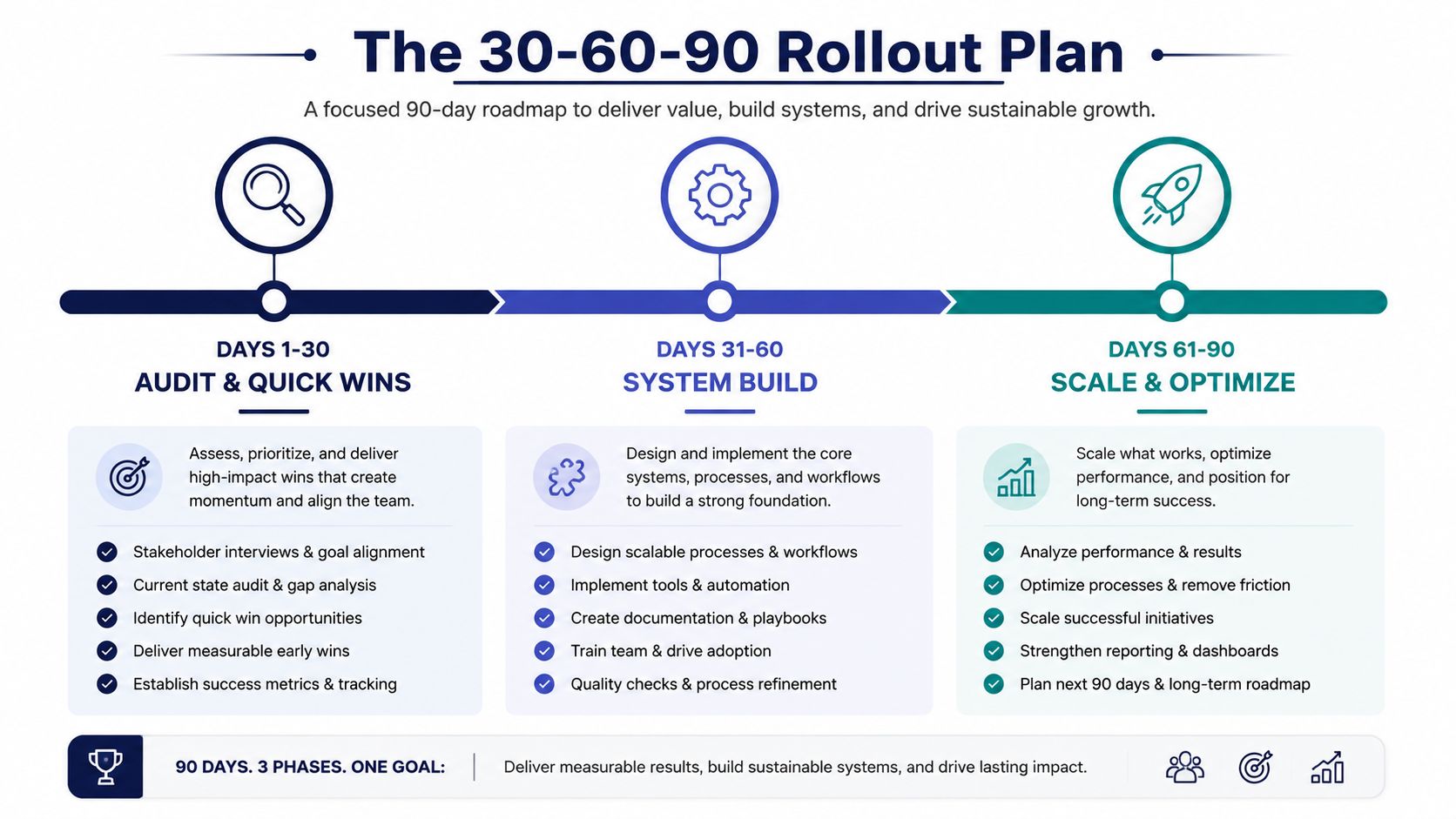
Days 1 to 30, diagnose and fix the obvious gaps
Start with the audit, the rep survey, and the CRM pull of what's being used. Then fix the top five gaps that show up most often in live deals, usually the missing objection reply, the weak comparison asset, and the stale proof point.
Get basic tagging into the CRM or repository right away. You don't need perfection to get started, you need enough structure that reps can find the right thing without asking around.
Days 31 to 60, build the system
Complete the stakeholder-and-deal-moment matrix. Ship the first batch of battle cards, ROI calculators, and other rep-ready assets that came out of the audit.
Put content inside sequences and opportunity workflows, not just in a drive. If the rep still has to copy, paste, rename, and hunt, the system is too clunky to matter.
Days 61 to 90, operationalize and measure
Lock in the governance cadence. Schedule the quarterly interviews. Start the kill list. Then measure the effect on real deals, not just clicks.
Focus on the KPIs that matter:
- Asset usage in active deals tells you whether reps trust the library.
- Content-influenced pipeline velocity shows whether assets help deals move.
- Win rate lift on deals with attached enablement assets tells you whether the content changes outcomes.
- Cycle-time reduction on stages with required assets shows whether the right material removes friction.
In the first quarter, expect a few early wins, a few retirements, and some pushback from people who liked the old chaos. Then expect the turning point, when reps stop building their own materials and start asking for the approved ones instead.
If reps begin requesting content instead of improvising it, the system is starting to work.
Machine Marketing helps manufacturers turn scattered marketing assets into a system that supports real sales conversations, not just a nicer-looking library. If you want a sharper diagnosis of where your sales enablement content strategy is breaking down, visit Machine Marketing and let's talk through the gaps that are costing you deals.