Most manufacturers are still treating search reports like they're intelligence. They're not. A ranking export, a traffic chart, and a keyword list tell you what happened in one slice of the funnel, but they don't tell you whether buyers saw you, whether AI answered for you, or whether search demand is shifting in a way that should change your pipeline plan.
That distinction matters now because search visibility no longer means “blue link clicks” alone. Google still dominates discovery, with 68% of online experiences beginning with a search engine, about 90.39% global search market share, and 3.1+ trillion searches per year according to the BrightEdge-referenced data in the SEO statistics roundup at SearchLab's 2026 SEO statistics overview. The same dataset says organic results get about 86% of clicks on the results page, while 58.5% of Google searches are zero-click in 2026, so your visibility has to be measured across answer surfaces, not just sessions.
For a B2B manufacturer, that's the key shift. If your sales cycle is long and your buyers research across multiple visits, a report can't tell you which topics deserve budget, which pages are being cannibalized by AI summaries, or which queries deserve commercial investment. Search marketing intelligence is the layer that connects demand, visibility, and revenue so you can make better decisions before the quarter is gone.
Table of Contents
- Why Search Reports Are Not Search Marketing Intelligence
- What Search Marketing Intelligence Means
- Core KPIs That Matter in 2026
- Data Sources and How to Connect Them
- Linking Search Intelligence to Industrial Demand Shifts
- Why Organic Search Still Earns B2B Budget
- A Manufacturer Walkthrough From Question to Action
- Implementation Roadmap, Roles, and Next Steps
Why Search Reports Are Not Search Marketing Intelligence
Many teams already have reports. That's the problem. Reports tell you what changed in a channel, but they don't explain whether the change came from paid search, organic discovery, branded demand, an AI Overview, or a shift in buyer intent. If you're only looking at rankings or traffic, you're treating a sensor reading like a control system.
Search marketing intelligence is different because it's a decision layer. It connects demand signals, visibility across answer surfaces, and downstream revenue so you can decide where to spend, what to write, and what to fix first. That matters more for manufacturers than for many other businesses because long sales cycles make raw click metrics a weak proxy for opportunity.
Practical rule: if a report can't change a budget decision, a content priority, or a CRM rule, it isn't intelligence.
The market has also moved under your feet. AI Overviews and zero-click behavior mean a high ranking doesn't always mean a high-opportunity click path. If a prospect gets the answer they need on the results page, your job shifts from “win the click” to “win the presence.”
That's why the old dashboard habit fails. A team can celebrate traffic growth while missing the fact that the growth came from branded searches, low-intent informational queries, or AI-mediated exposure that never entered the lead funnel. If you want the planning version of this distinction, we cover the broader definition in what search marketing means, but the strategic point is simple, reports describe, intelligence decides.
For industrial teams, the useful question isn't “How did my keyword rank?” It's “What demand is forming, where is it showing up, and what business action should we take before competitors notice it?” If your current process can't answer that, you've got reporting. You don't yet have intelligence.
What Search Marketing Intelligence Means
Search marketing intelligence is the system that turns search data into commercial judgment. It works like a control panel on a CNC machine. You do not improve precision by staring at the finished part. You improve it by reading live signals, correcting fast, and keeping output aligned with spec.
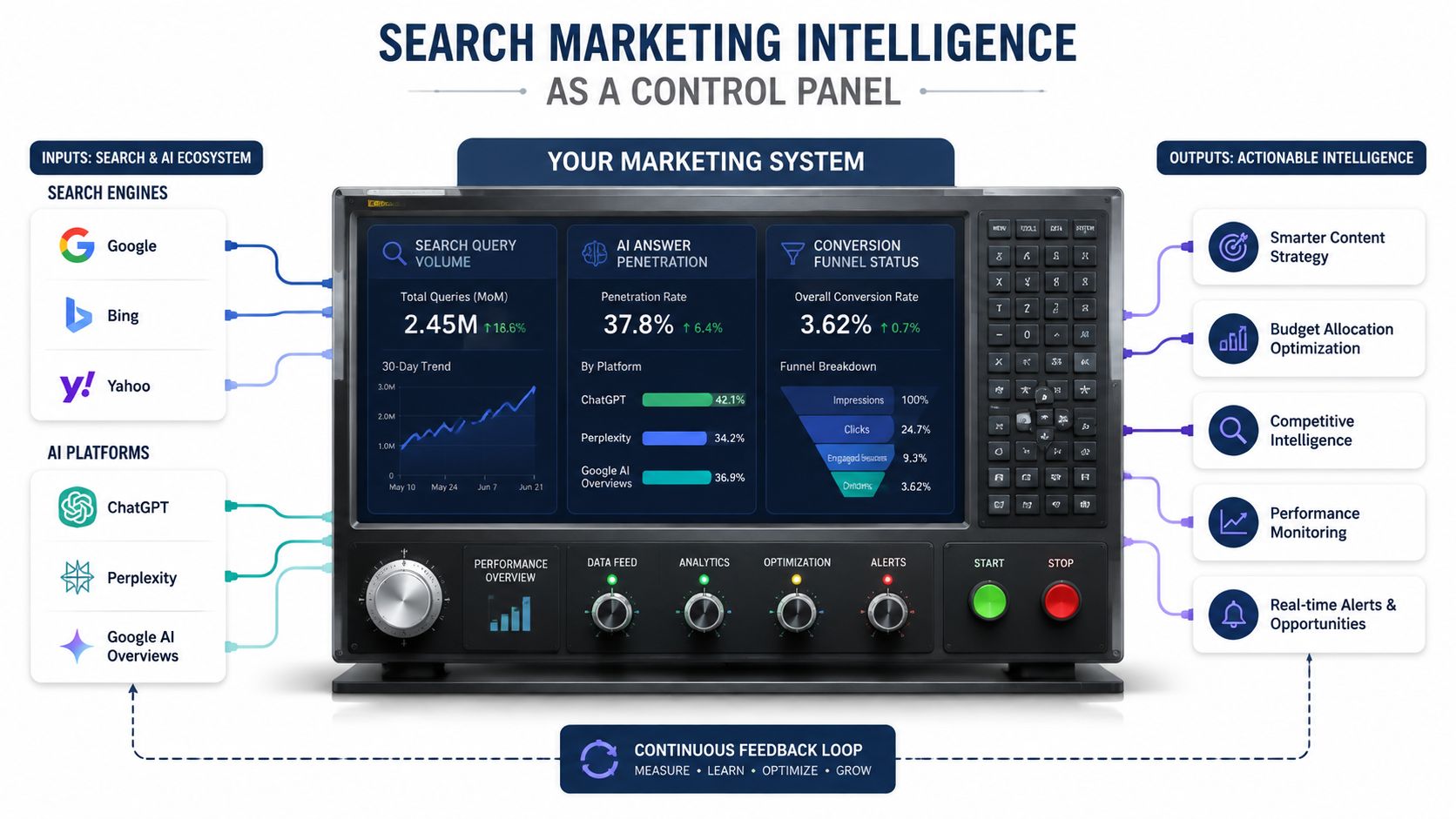
The point is not to admire data. The point is to combine the signals that usually sit in separate tools and separate meetings, then turn them into decisions that affect pipeline. A real system pulls together paid search performance, organic visibility, search and market trends, and first-party engagement data, then groups demand by product, problem, use case, and buying stage before tying it to leads, accounts, and opportunities.
The difference between reporting and intelligence
Reporting answers a narrow question, what happened? Intelligence answers the one that matters, what should we do next? The same keyword report can drive different conclusions depending on who is reading it. A marketing manager sees clicks. A sales leader sees lead quality. A finance lead sees whether the channel is tied to revenue.
A practical definition is easy to use internally:
- Paid search data tells you where intent is strong enough to buy attention.
- Organic visibility tells you where your content earns discovery without media cost.
- Search and market trends tell you whether demand is expanding, shifting, or fragmenting.
- First-party engagement data tells you what buyers did after they arrived.
When those four layers stay separate, decisions get noisy. When they connect, you can see whether a topic deserves more spend, whether a page is acting as a door or a dead end, and whether a query should be handled by SEO, paid, or both.
For teams that want a closer look at AI answer visibility, read how to rank with Google AI Overviews. The lesson is not to game the box. Answer surfaces now matter as much as rankings.
That is also why marketing analytics matters as the operating layer underneath the system. Search marketing intelligence uses the same discipline, but it applies it to demand, visibility, and revenue movement instead of just channel performance. If you cannot trace a search query to an opportunity record without manual guesswork, you are looking at reports, not intelligence.
Core KPIs That Matter in 2026
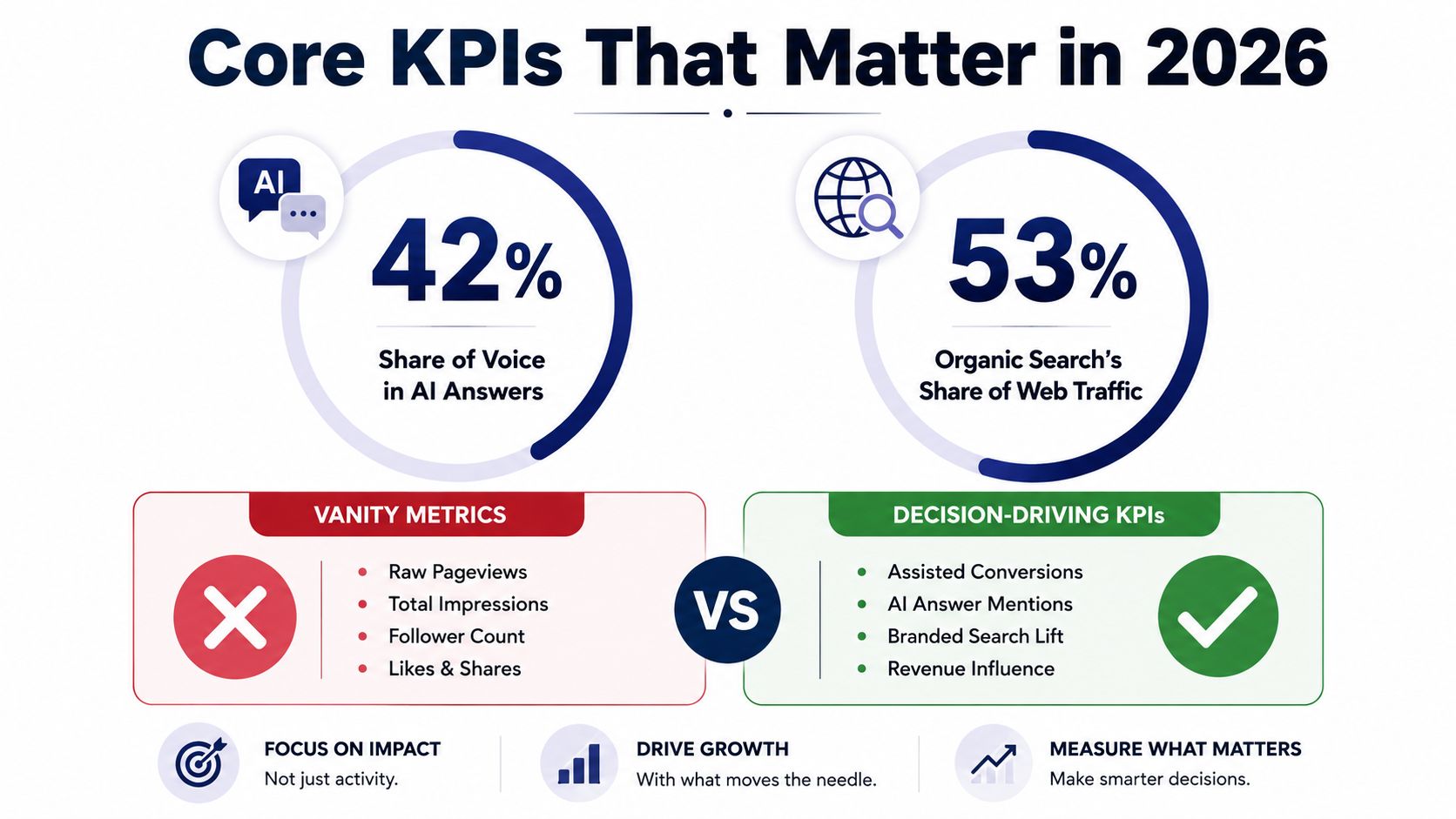
Most KPI stacks still overweight vanity metrics. That skews decisions toward activity instead of commercial impact. In 2026, the measures that deserve attention are the ones that show whether your brand is present in search conversations and whether that presence creates pipeline. The useful split is between AI-era visibility KPIs and traditional SEO and revenue KPIs.
The AI-era metrics you should not ignore
Start with Share of Voice in AI Answers. In the LLMrefs guide, it is treated as the “north star” because it shows how much of the AI answer space your brand owns across systems like ChatGPT, Gemini, and Google's AI Overviews, where a growing share of buying research now starts. The companion metric is Citation Frequency, which shows how often your content is explicitly cited as a source in AI responses as defined in the LLMrefs guide.
That visibility gap is already large. A 2026 press release reported that 89% of brands are already appearing in AI search citations, while only 14% of marketers track AI search citations according to the GlobeNewswire release. If you are not tracking citations, you are likely showing up without knowing which questions, entities, or pages are doing the work.
The traditional metrics that still matter
Organic search still deserves a seat in the stack because it remains a serious discovery and conversion channel. Ahrefs cites BrightEdge data showing that 68% of online experiences begin with a search engine, and also notes organic search converts at about 5.0% in B2B contexts, according to Ruler Analytics in the Ahrefs SEO statistics roundup. For a wider view of how search fits into market measurement, marketing analytics foundations still apply here, because search only matters when it can be tied to a revenue outcome. The point is not to admire traffic, it is to see whether search is producing qualified sessions, useful engagement, and actual opportunities.
Weekly reviews should focus on query visibility, AI citation presence, and conversion quality. Monthly business reviews should focus on whether search is contributing leads, opportunities, and revenue. Raw impressions can stay on the dashboard, but they do not deserve decision rights.
Data Sources and How to Connect Them
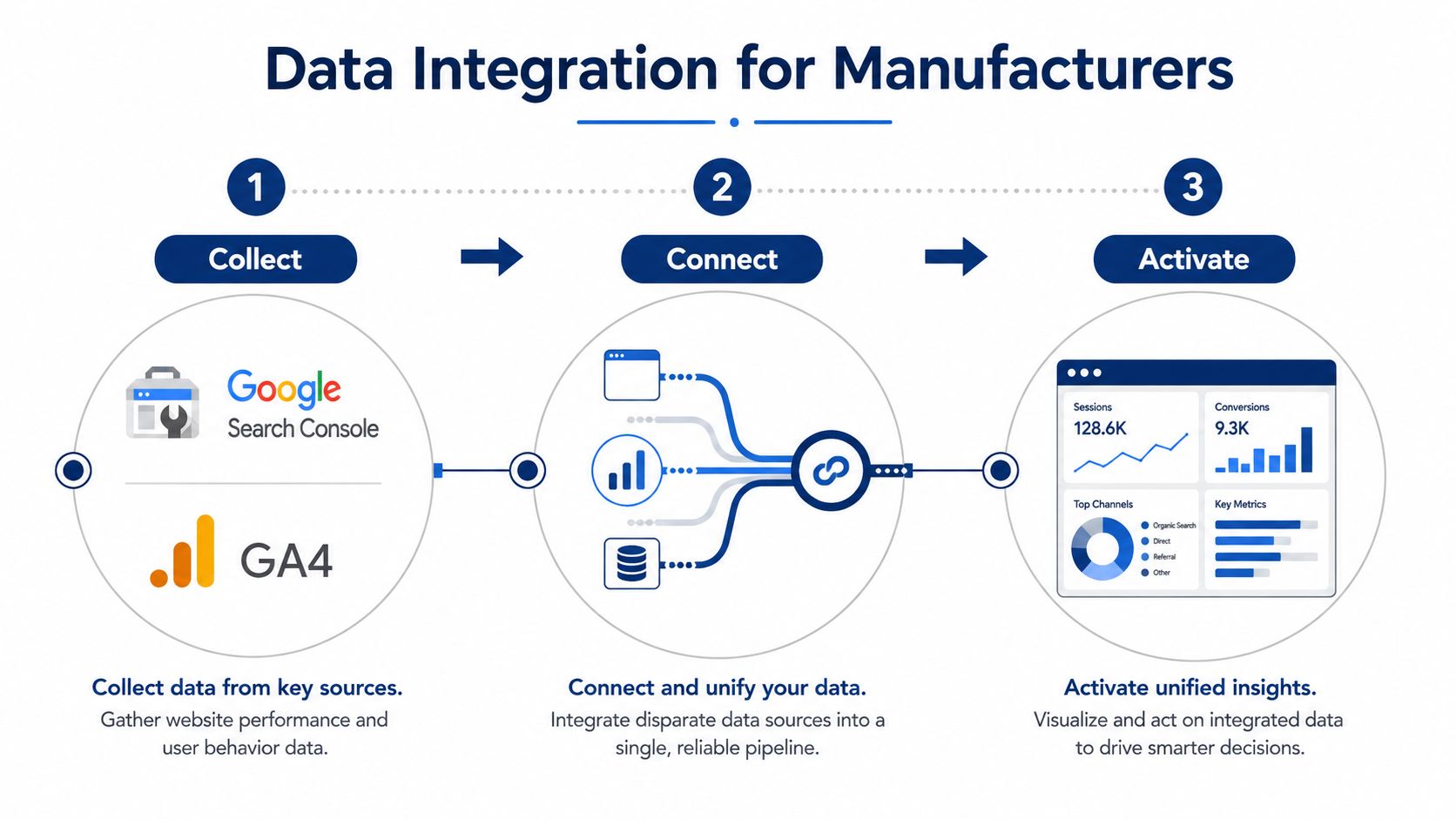
The stack has to be wired, not just installed. If your sources don't talk to each other, you'll keep mistaking channel noise for market movement. For manufacturers, the starting point is simple, connect the systems that show what buyers searched for, what they did next, and whether that activity produced revenue.
Start with the core sources
Google Search Console tells you which queries and pages earn impressions and clicks. That makes it your best source for understanding demand and surface-level visibility. GA4 tells you what happened after the click, which pages held attention, which ones leaked it, and which ones helped the buyer continue the journey.
CRM data is the part many teams underuse. If search activity isn't tied to lead status, account stage, and opportunity outcome, you'll never know whether the traffic matters. Paid search platforms add immediate intent feedback, while tools such as WARC and SERP tracking platforms help you understand competitive pressure and message shifts. If you want the mechanics behind the intent layer, what intent data means is a useful internal reference.
Review cadence and ownership
Keep the cadence practical:
- Weekly: Search Console, paid search, and AI citation visibility.
- Monthly: GA4 engagement patterns and CRM lead movement.
- Quarterly: Revenue review across keyword groups, content clusters, and opportunity stages.
Ownership matters too. Marketing operations should own the plumbing. Demand generation should own prioritization. Sales leadership should validate whether the labeled commercial intent matches buyer behavior.
Watch for this: if your dashboard combines source data but nobody trusts the labels, the problem isn't the chart. The problem is the definitions.
The most common integration mistake is merging everything into one view without standardizing naming, query categories, or stage definitions. That creates a prettier mess, not intelligence. Connect the data, then normalize it, then decide what counts.
Linking Search Intelligence to Industrial Demand Shifts
Most search programs chase keywords. Strong industrial programs chase market signals. That's the more valuable move because search demand often rises in response to changes in sourcing, compliance, geography, or category structure, and those shifts create topics your competitors haven't operationalized yet.
Validate the demand before you create content
Search marketing intelligence becomes a commercial signal system. If a plant manager starts searching for a new material spec, or procurement begins asking more compliance questions, the search pattern is telling you something about market transition. Cross-reference that search activity with import-export trends, geographic concentration, and supply-chain changes, then decide whether the demand is real enough to support content, sales outreach, or product messaging.
The trap is chasing easy keywords that don't convert. A low-competition topic can look attractive in a keyword tool and still be commercially dead. The better test is simple, does the topic match a buying problem, a sourcing shift, or a compliance need that's already affecting your market?
Use the query to ask a business question
A useful internal checklist looks like this:
- Is the topic tied to an active industrial change? If not, be cautious.
- Does the query reflect a problem a buyer can budget for? If not, it may be informational only.
- Can sales validate that the language appears in real conversations? If not, don't overbuild content around it.
- Does the external market data show the demand is rising faster than your coverage? If not, the gap may be smaller than it looks.
Content production is expensive in industrial markets. Writing for a query with no commercial pull burns time that should go to topics linked to reshoring, regulation, category growth, or sourcing disruption.
For manufacturers, the upside is clear. Search intelligence stops being a content calendar exercise and becomes a way to spot where buyers are actively looking while the market itself is changing. That's a much better place to invest than trying to outrun every keyword with more blog posts.
Why Organic Search Still Earns B2B Budget
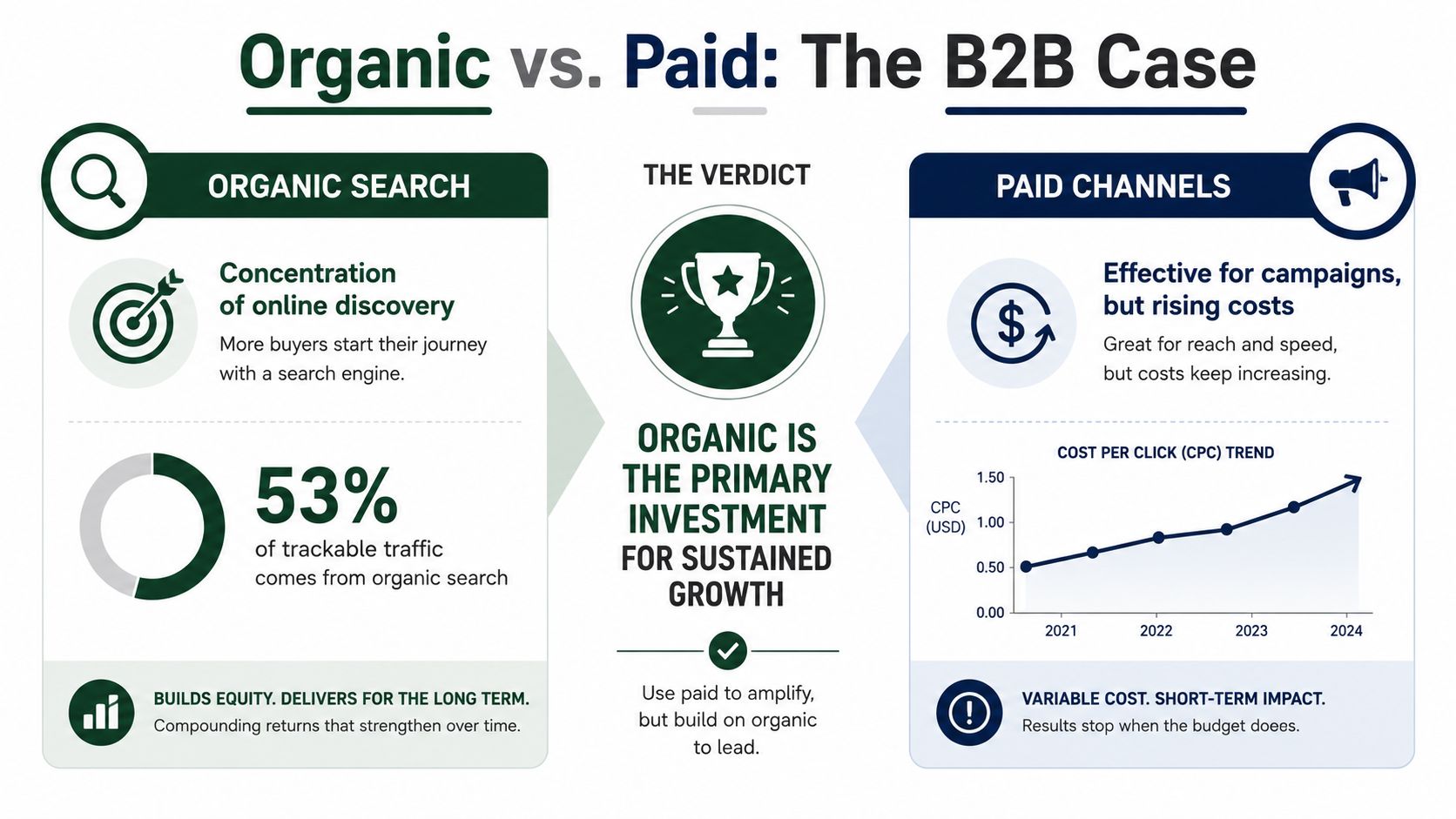
AI hype has pushed some teams to starve organic search. That is a budget mistake. Search still shapes discovery, and organic still captures a large share of B2B attention once buyers move from curiosity to vendor evaluation.
Organic still anchors discovery
The core reason organic keeps winning budget is simple. Buyers use search to compare options, check technical fit, and pressure-test vendors before they ever talk to sales. AI answer surfaces have made that behavior even more visible, because more questions are being answered before a click happens.
Paid search still matters. It is the fastest way to capture high-intent demand and test whether a topic has commercial weight. Organic does the harder job. It builds durable visibility around the questions buyers keep asking, and it keeps doing that work after the media spend stops.
Budget should follow marginal value
Use revenue contribution, not channel loyalty, to decide where the money goes. Organic deserves budget when it shows up in assisted paths, supports commercial queries, and feeds the CRM with opportunities that sales can work. Paid deserves budget when it captures immediate intent or gives you a fast read on whether a search theme is worth deeper SEO investment.
That is also why teams should build a B2B SEO pipeline. SEO works best when it is treated as an operating process tied to pipeline, not as a content habit that produces traffic reports no one can act on.
Video walkthrough:
The blunt answer to “Is SEO still worth it?” is yes, if you measure it against pipeline, not pageviews. If organic does not connect to revenue, the channel looks weaker than it is. If it does connect to revenue, it usually proves it is still carrying more of the buying journey than the dashboard admits.
A Manufacturer Walkthrough From Question to Action
A precision parts manufacturer notices a familiar problem. Traffic is steady, but inbound leads are flat. The team has a decent monthly SEO report, a paid search dashboard, and a CRM that sales mostly trusts, yet nobody can explain why more visits aren't turning into better opportunities.
What the diagnosis reveals
The first pass shows informational queries pulling in most of the organic attention. That wouldn't be a problem if those visits were advancing into commercial pages, but they aren't. AI Overviews are absorbing some of the top-of-funnel answers, which means prospects are getting quick explanations without clicking through. Meanwhile, the content team has been optimizing for rankings that look good in isolation but don't map cleanly to lead stages.
The core issue is classification. The manufacturer has not separated commercial intent from research intent, so the dashboard treats both as “good traffic.” Sales sees the result in the CRM, where opportunity creation doesn't move in step with sessions.
Practical rule: if a search query doesn't map to a stage in your CRM, it's not ready to guide budget.
What changes next
The fixes are surgical, not glamorous. Consolidate thin informational pages that overlap. Build or upgrade pages that deserve citation-worthy, answer-ready content. Rework paid search so bottom-of-funnel terms get enough coverage to keep producing qualified clicks while the SEO side matures. Then tie every major query group back to lead source, opportunity stage, and closed revenue.
The manufacturer shouldn't expect miracles next week. It should expect cleaner attribution, better query classification, and a tighter connection between search effort and sales activity over the next two quarters if the diagnosis is right. That's the win, fewer false positives and more investment in pages that move buying conversations forward.
Implementation Roadmap, Roles, and Next Steps
You don't need a giant transformation program. You need a phased rollout that gets the right data under one roof, assigns ownership, and forces the team to review search through a revenue lens.
A simple 30-60-90 day plan
First 30 days: audit the current stack. Identify every source of search, web, paid, AI, and CRM data. Decide which definitions are inconsistent, especially around query groups, lead stages, and source attribution.
Days 31 to 60: build the single-source-of-truth dashboard. Keep it lean. Include the KPI set that matters, query visibility, AI citation presence, assisted conversions, and opportunity movement. If the dashboard takes too long to open or too long to interpret, people won't use it.
Days 61 to 90: run the first revenue review. Tie the search groups to pipeline outcomes, then cut or expand based on what the data shows. The work stops being marketing theater and starts becoming operating discipline.
Who needs to be in the room
- Marketing operations lead: owns data plumbing, normalization, and dashboard reliability.
- Demand generation manager: owns query prioritization and channel actions.
- Sales leader: validates whether the intent labels match real buyer conversations.
- Executive sponsor: removes roadblocks when the data reveals uncomfortable truths.
The most common failure mode is simple. Teams build a dashboard and assume the work is done. It isn't. If the review cadence isn't tied to pipeline, the dashboard becomes wall art.
Start Monday with three questions: Which search queries influence revenue? Which AI answers mention us? Which pages deserve more budget and which deserve to be cut? If you can answer those cleanly, you've got the beginnings of a real system.
Machine Marketing helps manufacturers turn search data into a usable operating system for growth, not another dashboard nobody trusts. If you want a sharper diagnosis of your search marketing intelligence stack and a plan tied to CRM revenue, visit Machine Marketing and book a working session with us.