If you're a manufacturer with solid capabilities and a website that barely produces quote requests, the issue usually isn't your machining, fabrication, molding, or engineering. The issue is that buyers can't find the right evidence at the right moment.
We see this pattern often. Sales still depends on referrals, repeat business, trade shows, and outbound follow-up, while engineers and procurement teams are already researching suppliers in search. By the time your team hears from them, they've often narrowed the field. If your site doesn't show up for the problems they need solved, you're invisible during the part of the buying process that shapes the shortlist.
The practical case for SEO for manufacturing companies is simple. It should function as a business system that attracts qualified visitors, answers technical questions, and turns that attention into RFQs, quote requests, and sales conversations.
Table of Contents
- The Diagnosis Why Your Website Is Invisible to Buyers
- Blueprint Your Strategy with Industrial Keyword Research
- Build Your Technical SEO Foundation
- Create Content That Closes B2B Deals
- Build Authority with Link Building and Directory Listings
- Your 90-Day Implementation Plan and Measurement System
The Diagnosis Why Your Website Is Invisible to Buyers
A common manufacturing scenario looks like this. The company has good margins on the right jobs, experienced people on the floor, respected customers, and strong technical capabilities. But the website reads like a brochure, the product pages are thin, the service pages are broad, and nobody can say which pages generate qualified inquiries.
That gap matters because buyer behavior changed. One manufacturing SEO guide reports that organic traffic accounts for 45 to 65% of online traffic for manufacturers, and nearly 70% of manufacturing leads come from organic search according to its cited figures in the same piece on manufacturing SEO performance. If that channel is weak, you don't just lose traffic. You lose visibility during supplier discovery.
The cost shows up in familiar ways:
- Sales gets late-stage inquiries only. Buyers contact you after they've already compared alternatives.
- Good-fit work gets missed. Your team may be capable of solving the problem, but the site never made the shortlist.
- Marketing reports activity, not outcomes. You hear about impressions or blog posts, not RFQs.
- The website becomes passive. It exists, but it doesn't support the commercial process.
Buyers don't care that your company has been excellent for years if your website doesn't help them verify fit, capability, and next steps quickly.
For CEOs and owners, this is the right question: is the website helping buyers move from search to confidence to contact?
If you can't answer that, start with a structured review. A proper marketing audit for manufacturers will usually expose the bottlenecks fast. In most cases, the problem isn't one broken page. It's that the company never built an SEO system tied to buyer journeys and quote generation.
Blueprint Your Strategy with Industrial Keyword Research
Keyword research for manufacturers isn't a content brainstorming exercise. It's a translation exercise. You have to map what your company sells to the exact terms engineers, plant managers, sourcing teams, and specifiers use when they're trying to solve a problem.
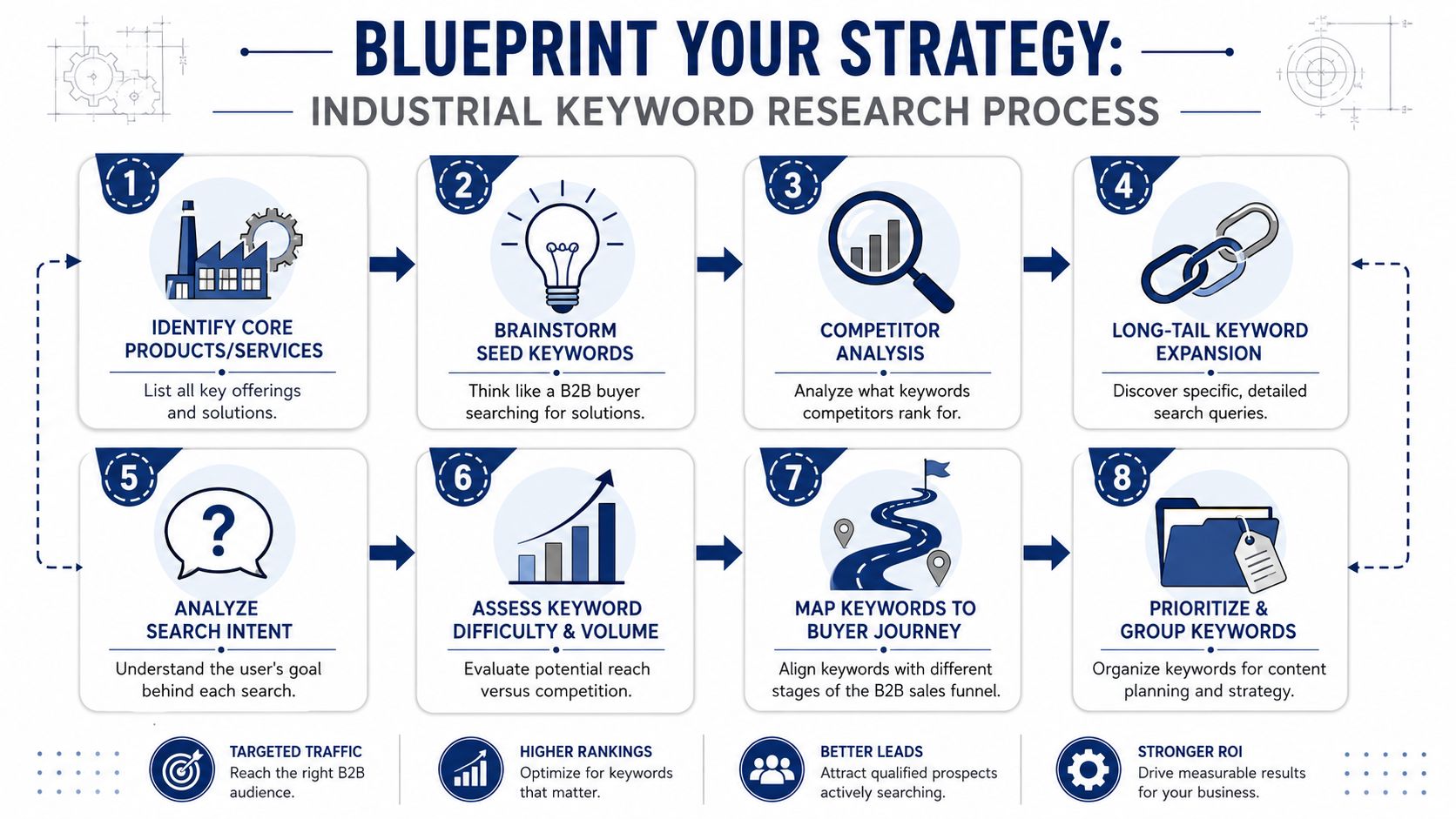
Start with buyer language, not marketing language
Most manufacturing sites start too high-level. They target broad phrases like "precision manufacturing," "industrial solutions," or "quality components." Those phrases may describe the business, but they rarely reflect the way a buyer searches when a real job is on the line.
Start with four buckets:
Core offerings
List actual services, product categories, processes, and industries served. Think CNC machining, sanitary welding, aluminum extrusion, custom control panels, contract packaging, or short-run injection molding.Technical modifiers
Add the details buyers care about. Materials, tolerances, certifications, sizes, finishes, lead-time concerns, operating environments, and compliance requirements belong here.Application language
Buyers don't always search by process. They often search by use case. They may need a part for food equipment, a housing for harsh environments, or a fabricator familiar with OEM production.Commercial intent terms
Include phrases that signal supplier evaluation. Terms like manufacturer, supplier, custom, contract, OEM, quote, capabilities, specification, and near-me variants often belong in this layer.
A simple working method is to pull language from:
- Sales call notes
- RFQ forms
- Customer emails
- Internal product catalogs
- Competitor navigation and page titles
- Search Console query data
- SEO tools such as Ahrefs, Semrush, and Google Search Console
Build a keyword map you can actually execute
A useful keyword map doesn't stop at a spreadsheet. It assigns a page type and a business purpose to each cluster.
Use a structure like this:
| Keyword cluster | Search intent | Best page type | Business goal |
|---|---|---|---|
| Process-specific terms | Commercial investigation | Service page | Generate quote requests |
| Product and model terms | Direct evaluation | Product page | Capture in-market buyers |
| Problem and troubleshooting terms | Informational | Blog or FAQ page | Build early trust |
| Industry and application terms | Fit validation | Industry page or application page | Prove relevance |
Then pressure-test each cluster with three questions:
- Would a buyer use this phrase before contacting sales?
- Can we build a page that answers the query better than a generic competitor page?
- Does this topic connect to a quote request, sample request, or sales conversation?
Practical rule: If a keyword can't be tied to a page, an audience, and a conversion path, it doesn't belong in the first wave of work.
What works is specificity. What doesn't work is chasing broad vanity terms that bring unqualified visitors.
A strong manufacturing keyword set usually includes a mix of:
- Service terms tied to margin-driving work
- Application terms tied to industries you want more of
- Technical support terms that answer engineering questions
- Decision-stage terms that belong on quote-ready pages
This is also where leadership needs to make trade-offs. You probably can't build content for every service, every industry, and every product family at once. Start with the pages tied to capacity, margins, and strategic fit. SEO for manufacturing companies performs better when it's aligned with revenue priorities, not just search opportunity.
Build Your Technical SEO Foundation
A manufacturing website can fail even with strong content if the technical foundation is weak. Search engines need to crawl it efficiently, understand what each page represents, and load it fast enough that users don't abandon the visit before they see the proof they need.
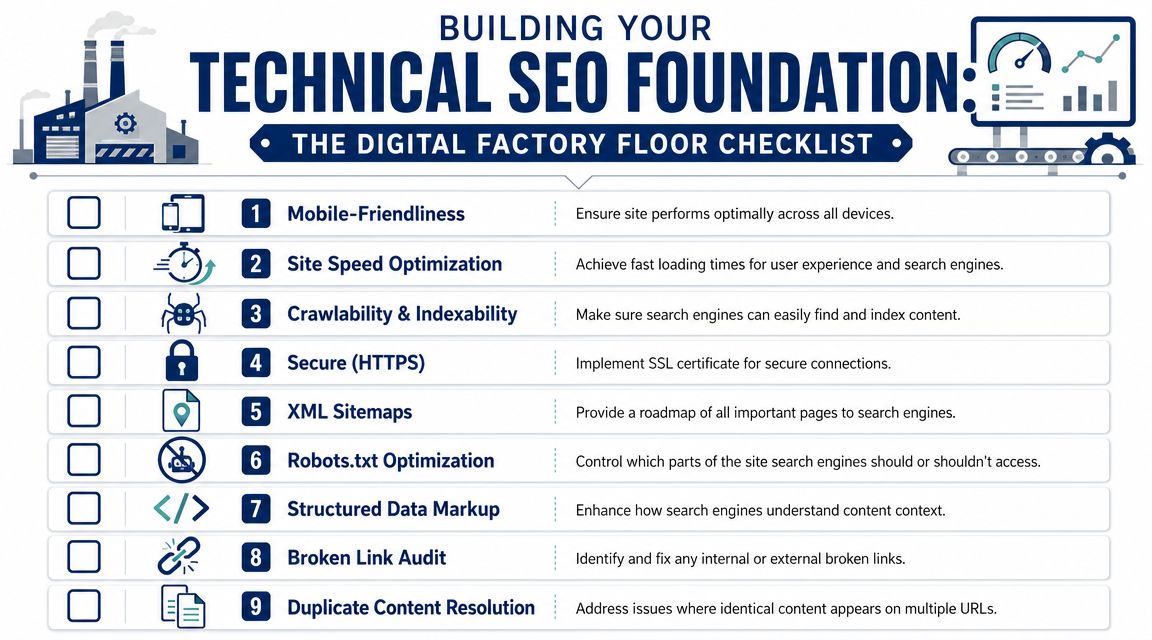
Treat the website like a production system
Industrial websites often carry extra complexity. Product catalogs, PDFs, spec libraries, filters, legacy pages, distributor content, and duplicate variants can create a mess quickly. Search engines reward strong technical signals on these sites, including product schema markup, fast page load speed, and content that directly answers buyer questions, as noted in this manufacturing technical SEO guide.
That means your digital factory floor needs three things:
Efficiency
Pages should load quickly, especially product and service pages.Clear labeling
Titles, headers, URLs, and schema should make the page purpose obvious.Accessible pathways
Search engines need clean crawl paths to important pages without getting stuck in parameter junk, thin duplicates, or dead ends.
For teams that need a deeper operational framework, this conversion-centric guide to technical content SEO is a useful complement because it ties technical health to lead generation rather than rankings alone.
What to audit first on industrial websites
Don't start with edge-case fixes. Start with the failures that block discovery and conversion.
First priority checklist
Indexation problems
Check whether your key service, product, and application pages are indexed in Google Search Console.Site speed issues
Slow templates, oversized imagery, and bloated scripts often hurt important commercial pages first.Schema gaps
Product and FAQ schema help search engines interpret specs, features, and answer blocks more clearly.Navigation bloat
If visitors can't move logically from category to product to quote path, rankings won't rescue conversion.Duplicate or thin pages
Manufacturers often publish similar product pages with little differentiating copy. That weakens page value.
A practical review looks like this:
| Area | What good looks like | Common failure |
|---|---|---|
| URLs | Clean, descriptive, stable | Long parameter-heavy variants |
| Metadata | Specific to the page | Reused titles across templates |
| Product pages | Specs, applications, FAQs, CTA | Thin copy with no buying context |
| PDFs | Supported by indexable HTML pages | Important info trapped in downloads |
Technical SEO isn't separate from sales. If your most important pages are slow, confusing, or hard to index, buyers and search engines hit the same wall.
What works is focused cleanup on high-value pages first. What doesn't work is spending months polishing low-priority blog content while quote-ready pages remain weak.
Create Content That Closes B2B Deals
Manufacturing content shouldn't aim for applause. It should reduce buyer uncertainty.
When engineers and procurement teams evaluate suppliers, they want proof, fit, and clarity. They need to know whether you can make the part, meet the tolerance, handle the material, support the volume, satisfy the spec, and respond without friction. That's why content has to operate as a coordinated system, not as isolated blog posts.
A helpful visual reference is below.
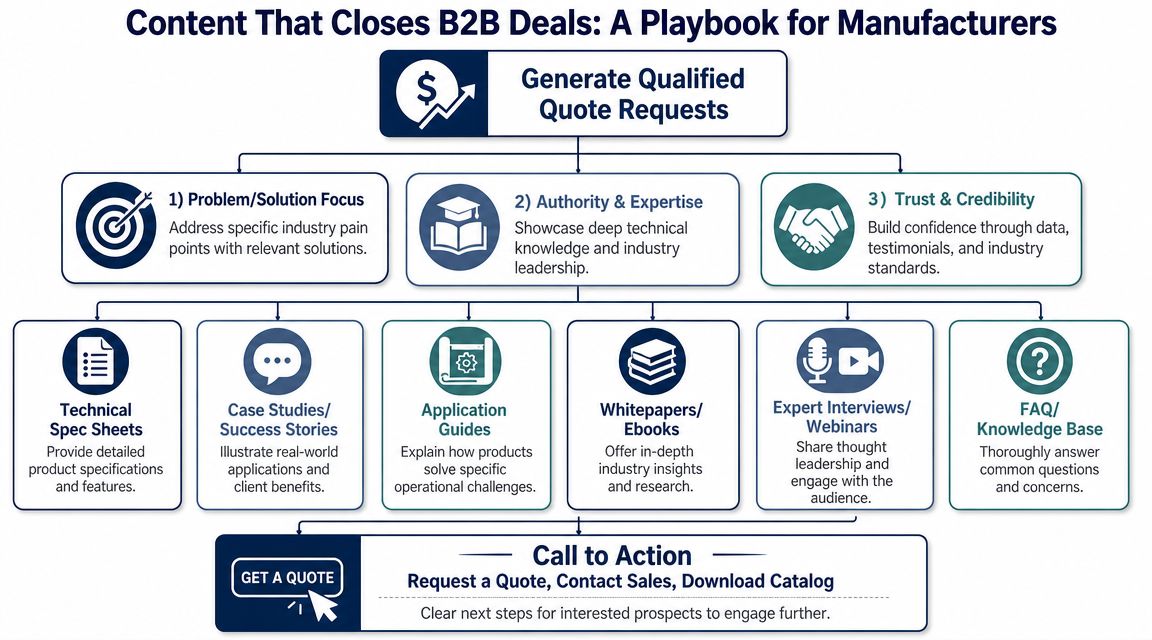
The content types that move buyers forward
The strongest manufacturing content programs usually revolve around a few page types, each doing a different job.
Product and service pages
These are your money pages. They should explain what you make or do, who it's for, the constraints you solve, the technical details buyers care about, and the next action to take. If a page can't support a quote request, it's incomplete.
Technical resource pages
Spec sheets, material guidance, tolerance explainers, CAD-related support pages, and process documentation attract technical visitors who are still verifying fit. These pages don't need hype. They need precision.
Case studies
For manufacturing buyers, a case study isn't fluff if it proves capability. Show the application, the constraint, the process challenge, and the reason your approach was a fit. Keep it concrete.
Pillar content and FAQs
These pages help you win broader topic visibility while feeding deeper commercial pages. They work best when they answer recurring buyer questions your sales team hears every month.
Here's where many companies miss the mark. They create educational content but fail to connect it to action. Every useful page should offer a next step such as a quote request, drawing review, catalog download, or sales contact.
Later in the buyer journey, video can help explain processes that are easier to show than describe.
How to write for AI-assisted search without dumbing things down
Search behavior is changing. For manufacturers, the important implication isn't that blogs need to become shorter. It's that pages need to be easier for search systems to interpret and summarize.
One manufacturing SEO source notes that with the rise of AI-assisted search, manufacturers should use clear schema, concise FAQ blocks, and verifiable data on product pages so they remain visible when search engines summarize results in this guide to manufacturing content for modern search.
That changes page construction in practical ways:
- Put core answers high on the page. Don't bury the useful part under generic introductions.
- Use clear subheads. Buyers and search systems both scan structure.
- Add FAQ blocks. Use real technical questions, not invented marketing ones.
- Present verifiable detail. Materials, dimensions, compatibility, certifications, process notes, and operating constraints help.
- Keep claims disciplined. If you can't prove it, don't write it.
The pages most likely to earn qualified inquiries are usually the ones that answer uncomfortable buyer questions clearly.
What doesn't work
A lot of content underperforms for predictable reasons.
- Generic thought leadership that never connects to a service, product line, or buyer need
- Thin location pages built only for rankings
- Keyword-stuffed product pages that sound written for search engines instead of engineers
- Blog calendars disconnected from sales so traffic goes up but RFQs don't
- Specs hidden in PDFs only with no indexable page support
One useful operating model is to make content planning a shared sales and marketing process. Sales brings questions, objections, and qualification patterns. Marketing turns those into pages and supporting assets. If you want outside support, agencies and consultants can help build that system. Machine Marketing is one option in this space for manufacturers that need SEO, content, CRM, and website strategy tied together, rather than run as separate activities.
Build Authority with Link Building and Directory Listings
Even a strong manufacturing site won't rank as well as it should if no trusted sources point to it. Search engines use external signals to judge credibility, and buyers do the same. If your company appears in the right directories, trade publications, partner pages, and supplier ecosystems, that visibility supports both trust and discovery.
Where manufacturers should earn authority
The right links are usually boring in the best possible way. They come from places your market already respects.
Focus on sources like these:
Industry directories
Prioritize relevant industrial directories and association listings where buyers look for vendors.Trade publications
Contributed articles, expert commentary, and technical pieces can earn links from publications tied to your niche.Supplier and partner websites
If you work with distributors, OEMs, material suppliers, or integration partners, there may be legitimate opportunities for profile links, resource pages, or case-study references.Certifications and memberships
If your business holds certifications or belongs to manufacturing organizations, make sure those profiles are complete and linked properly.Google Business Profile
For regional manufacturers, this is often underused. It won't replace core SEO, but it can help capture location-based searches and support trust.
A manufacturer's backlink strategy should start with reputation assets you already own. Don't lead with cold outreach asking strangers for links. Lead with relationships, proof, and legitimate reasons to be cited.
What to avoid
The wrong link-building approach usually shows up fast in industrial markets because it feels out of place.
Avoid these patterns:
- Low-quality directory blasts
- Paid links on irrelevant blogs
- Guest posts on sites with no connection to manufacturing
- Press releases used as a fake link strategy
- Anchor text manipulation that reads unnaturally
If you're not sure what your site already looks like from an authority standpoint, review your backlink profile and risk areas. That's often the fastest way to separate useful authority signals from noise.
Authority isn't a vanity metric in B2B manufacturing. It's a proxy for trust when buyers are evaluating whether your company belongs on the shortlist.
What works is relevance, consistency, and credibility. What doesn't work is chasing volume.
Your 90-Day Implementation Plan and Measurement System
Most manufacturers don't need a giant SEO initiative to get traction. They need a disciplined sequence and a clear way to judge progress. One manufacturing SEO framework emphasizes a fixed order of operations: research, analysis, content creation, technical setup, and authority building, while warning that content alone isn't enough in this SEO system for manufacturers.
That sequencing matters because it prevents a common failure mode. Companies publish content before fixing crawl issues, before deciding which pages matter most, and before defining what counts as a qualified conversion.
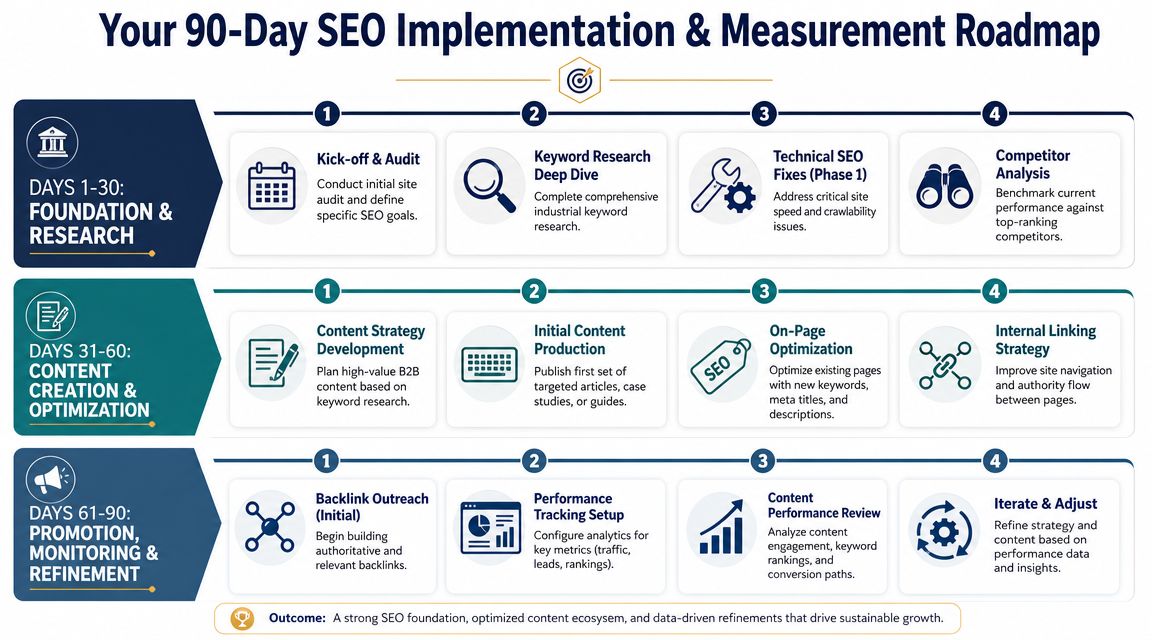
Days 1 through 30
The first month is diagnosis and stabilization.
Week 1
Audit the current site. Review indexation, key templates, conversion paths, existing rankings, top pages, and inquiry forms. Identify the pages most closely tied to revenue.
Week 2
Finish keyword research and competitor analysis. Group terms by service line, buyer intent, and page type. Decide what deserves a net-new page versus a rewrite.
Week 3
Fix the highest-impact technical issues. Prioritize indexing problems, slow commercial pages, bad internal linking, and broken quote paths.
Week 4
Define measurement. Set up form tracking, phone tracking if appropriate, Search Console reporting, and CRM source attribution rules so organic leads don't disappear into a generic bucket.
Days 31 through 60
The second month is where execution becomes visible.
Use this period to publish and improve the pages that matter most:
- Rewrite core service pages so they reflect buyer language and include strong CTAs
- Build or improve product pages with technical detail, FAQs, and schema support
- Create one or more application pages for industries or use cases you want more of
- Publish supporting articles tied directly to recurring sales questions
- Improve internal links so informational pages feed commercial pages logically
A simple way to prioritize is this:
| Priority | Page type | Reason |
|---|---|---|
| High | Service and product pages | Closest to quote intent |
| Medium | Application and industry pages | Helps buyers validate fit |
| Medium | FAQ and technical guides | Supports earlier-stage research |
| Lower | Broad thought-leadership topics | Useful later, not first |
Days 61 through 90
The third month is promotion, authority, and refinement.
Authority work
Submit or improve directory listings, request partner links where appropriate, and pitch trade publication opportunities tied to real expertise.
Performance review
Look at landing pages, conversion paths, search queries, and sales feedback. Which pages attract the right companies? Which pages attract the wrong traffic? Which inquiries turn into real opportunities?
Iteration
Tighten weak pages. Expand topics that lead to qualified discussions. Remove friction from forms, quote CTAs, and technical resource paths.
A page that generates the wrong inquiries isn't a win. In manufacturing, lead quality matters more than raw visit volume.
What to measure if you care about revenue
Many SEO programs break when they report rankings and traffic but never connect activity to pipeline.
For manufacturing businesses with long sales cycles, the better approach is to measure SEO against buyer journey milestones and qualified opportunities. A manufacturing SEO glossary from Siteimprove emphasizes tying SEO to lead generation user journeys and web analytics in this manufacturing SEO measurement overview.
Track metrics in layers:
Visibility metrics
Organic landing pages, query coverage, indexing status, and rankings for target topicsEngagement metrics
Page-level behavior on service, product, and application pagesConversion metrics
RFQs, quote requests, contact forms, sample requests, and sales conversations sourced from organic trafficPipeline metrics
Whether those inquiries become qualified opportunities in the CRM
Ask these questions every month:
- Which organic landing pages generated qualified inquiries?
- Which service lines gained visibility but not conversions?
- Which search terms brought the wrong audience?
- Did organic leads influence pipeline, not just sessions?
If you build SEO for manufacturing companies this way, the program stops being a reporting exercise. It becomes an operating system for demand capture, qualification, and commercial growth.
If you want a practical diagnosis instead of another generic SEO checklist, Machine Marketing can help you audit your current site, identify the pages and keywords tied to qualified opportunities, and build a system that connects search visibility to RFQs, sales conversations, and measurable pipeline impact.