If you're running a manufacturing business, you may already have this pattern in place. The company page posts a machine photo, a trade show update, maybe a link to a blog post. A few people hit like. Sales sees no change. Leadership starts treating social as a distraction.
That diagnosis is common, but it's usually wrong. The problem isn't social media itself. The problem is that most industrial firms run it as a disconnected activity instead of a lead generation and trust validation system tied to pipeline, CRM data, and the actual buying process.
Table of Contents
- Why Social Media Feels Like a Waste of Time and How to Fix It
- Choosing Your Platforms An Industrial Marketer's Guide
- Mapping Content to the Industrial Buyer Journey
- Creating Content That Works Boring vs Human
- How to Integrate Social Media with Your Core Systems
- A Practical Framework for Measuring Social Media ROI
- Your First Step to Building a Social Media Machine
Why Social Media Feels Like a Waste of Time and How to Fix It
Social feels wasteful when you treat it like a publishing chore. Post an update, hope someone sees it, move on. That workflow creates activity, not an outcome.
In industrial markets, the better diagnosis is simple. Social media is often used as a megaphone when it should be used as a system. A megaphone pushes announcements. A system helps buyers discover you, evaluate your credibility, and carry your name into internal buying discussions.
That shift matters because social media is now the primary customer acquisition channel for 83% of B2B marketers, delivering a 33% higher ROI compared to brands that invest less in social efforts, according to Sprinklr's B2B social media statistics roundup. For manufacturers, that doesn't mean every platform deserves your time. It means the channel has already moved upstream in the buying process.
The actual failure mode
When social underperforms, we usually find one of these issues:
- No buyer-path logic: Posts aren't mapped to engineers, operations leaders, procurement, or executives.
- No sales integration: Sales never sees who engaged, what they viewed, or when intent started rising.
- No content conversion point: The feed has posts, but no path to a demo request, technical guide, webinar, or consultation.
- No measurement discipline: The team reports impressions and likes instead of qualified inquiries and influenced opportunities.
Practical rule: If your social reporting can't help sales prioritize accounts, you're not running a marketing system. You're running a visibility exercise.
The fix isn't posting more. It's redesigning the job of social media in B2B marketing. For industrial firms, that job is customer acquisition, trust transfer, and sales validation. Once you frame it that way, the channel stops looking soft and starts looking operational.
Choosing Your Platforms An Industrial Marketer's Guide
Being active everywhere is usually a waste of industrial marketing resources. Your buyers don't reward channel sprawl. They reward relevance, clarity, and repeated useful exposure in the places where they already do professional research.
Start with the hub
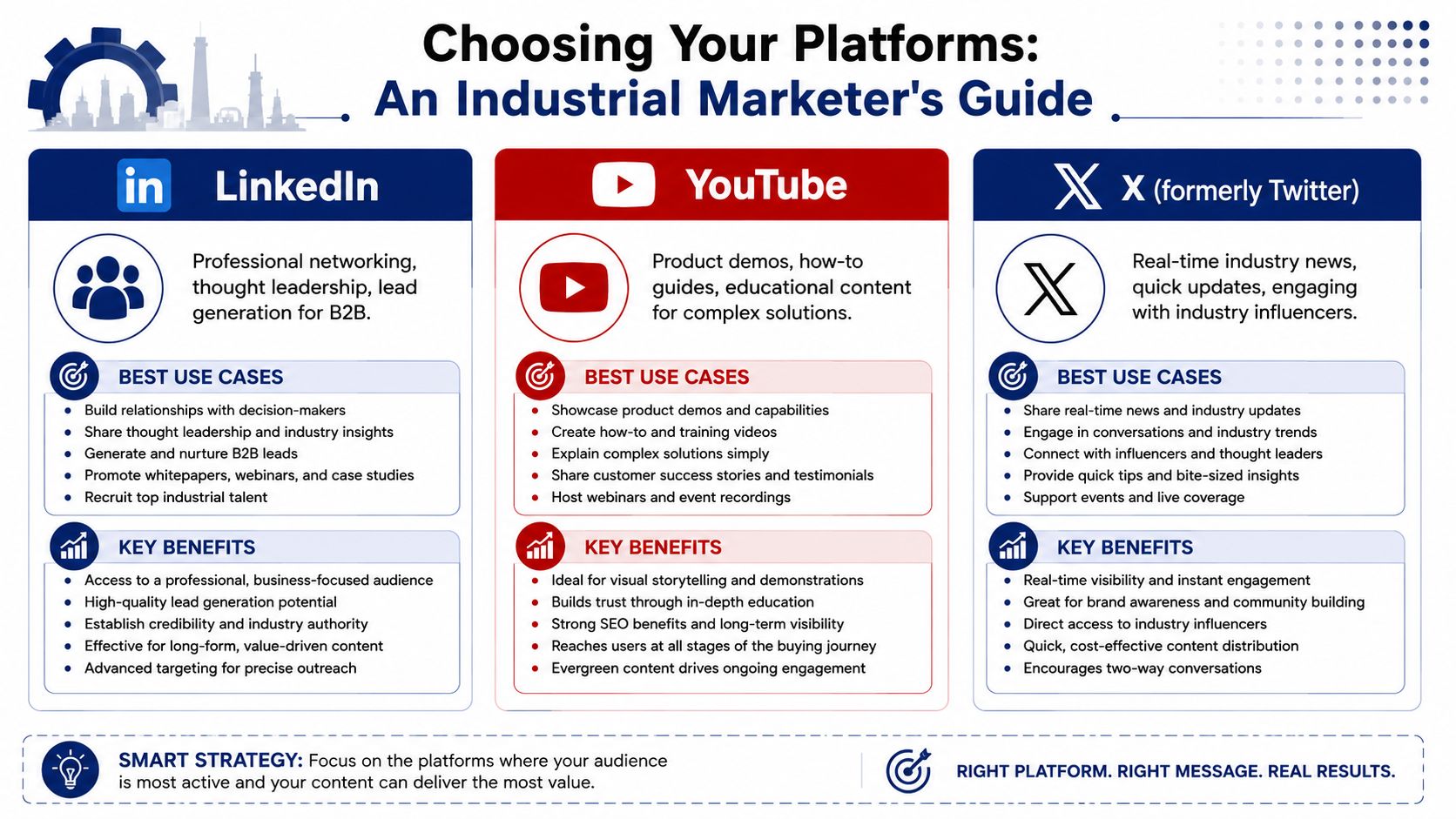
For most manufacturers, LinkedIn is the hub. That's not opinion. LinkedIn generates 80% of all social media leads in B2B, and 94% of B2B marketers distribute content there, according to Coalition Technologies' B2B marketing statistics for 2025. If you're trying to reach plant leaders, engineers, operations teams, distributors, and executive buyers, that's the first platform that should get disciplined attention.
LinkedIn works best when you use it for:
- Thought leadership: Technical observations, project lessons, failure analysis, and buying criteria.
- Sales enablement: Giving reps content they can send before and after conversations.
- Account visibility: Staying in front of named companies during long sales cycles.
- Paid precision: If your internal team needs help building a tighter campaign structure, Outsourced B2B LinkedIn ad management is a useful reference for how specialist support can fit into a focused industrial demand program.
Use supporting platforms with restraint
You don't need a full content engine on every network. Supporting platforms should have a defined job.
| Platform | Primary Use Case | Best For | Key Metric |
|---|---|---|---|
| Professional visibility and lead generation | Manufacturers selling complex B2B solutions | Qualified leads from target accounts | |
| YouTube | Demonstration and education | Machine demos, process walk-throughs, troubleshooting explainers | Sales conversations influenced by video views |
| X | Real-time industry participation | Quick commentary, news reaction, event visibility | Relevant engagement from industry voices |
A practical platform stack often looks like this:
- LinkedIn as the control center: Company posts, employee advocacy, sales outreach support, and paid distribution.
- YouTube as the proof library: Product demos, maintenance walkthroughs, installation overviews, and recorded technical answers.
- X as a listening layer: Useful if your niche still discusses standards, supply chain shifts, or event commentary there.
Treat every platform after LinkedIn as optional until you can name its exact operational role.
Reddit and niche forums can still matter, especially when engineers discuss technical problems in public. But they are rarely good places for direct promotion. Use them for listening, language capture, and problem discovery. If your team can't maintain that distinction, stay out.
Mapping Content to the Industrial Buyer Journey
Industrial content often fails because it isn't sequenced. Teams publish technical information without asking where the buyer is in the decision process. That's like sending a quote before confirming the spec.
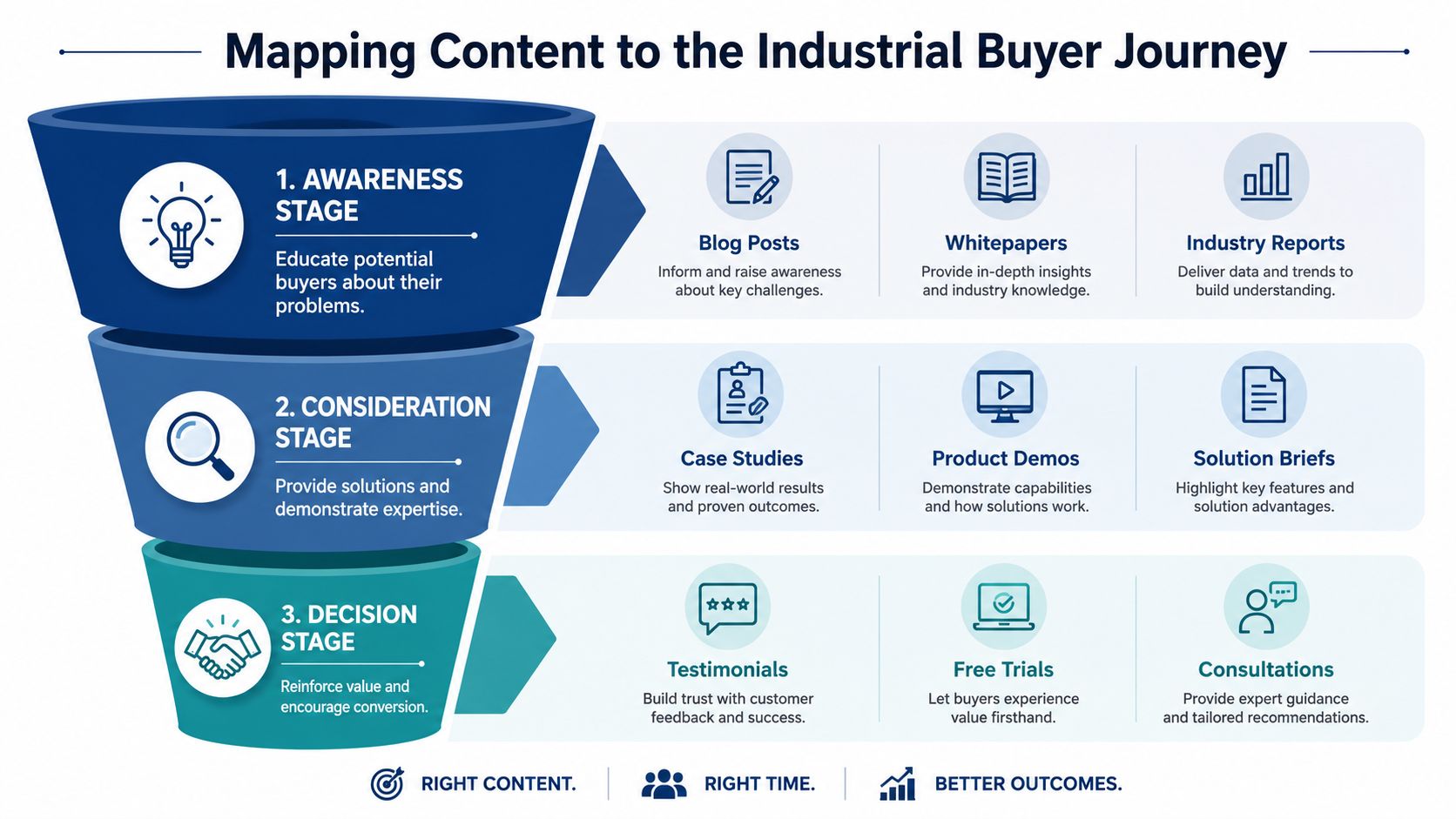
A better system maps content to three stages. Not because the world is perfectly linear, but because your team needs a working architecture. If you haven't documented your audience clearly, start by tightening your industrial buyer persona process. Weak persona work usually leads to generic posts that satisfy nobody.
Awareness content for problem recognition
At the top of the journey, buyers may not be shopping yet. They may be noticing inefficiency, quality drift, bottlenecks, downtime patterns, or vendor risk.
Content here should help them name the problem:
- Educational posts: Explain a recurring production issue in plain language.
- Short technical observations: Share what causes a failure mode, delay, or scrap issue.
- Industry perspective pieces: Comment on process changes, compliance pressure, or operational trade-offs.
- Engineer-friendly visuals: Diagrams, process clips, or annotated photos that make complexity easier to grasp.
Many industrial marketers often become too promotional. If every post mentions your product, the buyer won't learn anything except that you're trying to sell.
Consideration content for technical evaluation
Middle-stage buyers are comparing options. They want proof that your team understands the application, implementation reality, and constraints.
Useful content at this stage includes:
- Product demos
- Solution briefs
- Technical FAQs
- Application-focused videos
- Explainers that compare methods, not just brands
A strong consideration post doesn't just say what your machine does. It shows where it fits, where it doesn't, and what conditions affect performance. That honesty makes the content more credible.
Buyers trust teams that explain trade-offs clearly. They ignore teams that pretend every job has the same answer.
Decision content for risk reduction
The bottom of the journey is less about information volume and more about confidence. 75% of B2B buyers use social media to support and validate their final purchase decisions, according to Noble Studios' analysis of B2B social media marketing. In manufacturing, that often means your social presence becomes a final checkpoint.
Your decision-stage content should reduce perceived risk:
- Customer proof: Testimonials, implementation stories, or practical outcomes framed without hype.
- Team visibility: Posts from engineers, project managers, or leadership that show competence.
- Process clarity: What onboarding, quoting, install support, or service communication looks like.
- Direct next steps: Consultation offers, plant assessment calls, or technical review meetings.
If social media in B2B marketing is doing its job, buyers don't arrive cold. They arrive preconditioned. They already recognize your expertise, understand your fit, and feel safer taking the next conversation.
Creating Content That Works Boring vs Human
Most industrial brands aren't ignored because the subject matter is too technical. They're ignored because the content sounds like it was cleared by six departments and written for none of the people who buy.

Why sterile content underperforms
There's a real tension in industrial marketing. Teams want to appear credible, so they strip out personality. The result is safe, jargon-heavy copy that reads like a brochure excerpt. It looks professional. It also disappears into the feed.
That's the missed opportunity. While 84% of C-level decision-makers are influenced by social content, most industrial brands avoid humanizing content like memes or short videos out of fear, according to Dusted's analysis of B2B social content behavior. For manufacturers, the takeaway isn't "start acting like a consumer brand." It's that there is room to sound like real people.
Here's what usually works better than polished corporate language:
- Behind-the-scenes process content: Show setup, inspection, testing, or workflow moments.
- Short expert commentary: An engineer explains one mistake buyers make when comparing options.
- Light humor with context: A niche joke about tolerances, lead times, or documentation pain can work if the audience faces that problem.
- Face-to-camera updates: Quick insights from sales engineers, founders, or service leads.
A practical workflow for human technical content
You don't need a creative department reinventing the wheel every day. Start with one useful technical asset and repurpose it.
For example, one application note can become:
- A LinkedIn post about the buyer mistake behind the problem.
- A short video showing the issue on the shop floor.
- A carousel explaining the decision criteria.
- A sales follow-up asset a rep can send after a call.
- A YouTube walkthrough for buyers who need more depth.
That approach keeps the content grounded in expertise instead of empty engagement tactics.
A simple content filter helps. Before publishing, ask:
- Would an engineer respect this?
- Would a buyer understand this without a sales call?
- Would a rep be proud to send this to a prospect?
- Does this sound like a human with experience, or a committee?
Here's a useful example of the format in action:
"Human" doesn't mean casual for the sake of it. It means specific, clear, and recognizably written by people who know the work.
Employee advocacy matters here. Some of the best industrial social content comes from engineers, service managers, and technical sales staff. Give them prompts, approval guardrails, and content support. Don't force them to become influencers. Just help them publish what they already explain in meetings every week.
How to Integrate Social Media with Your Core Systems
A common industrial marketing failure looks like this. Marketing publishes a LinkedIn post about reducing unplanned downtime. An engineer from a target account clicks through. A plant manager from the same company watches a short video two days later. Sales never sees either signal, so no one follows up and the account stays cold on paper.
That is not a content problem. It is a systems problem.
Social media only earns budget when it feeds the operating systems that already run demand generation, sales activity, and account visibility. If social sits in a reporting silo, manufacturers get activity without coordination. The result is familiar: scattered engagement, weak follow-up, and no credible way to connect social touchpoints to pipeline.
Connect social to CRM behavior
Start with the CRM. Industrial buying rarely happens through one contact, and social engagement often surfaces earlier than form fills or demo requests. If those signals never enter the record, your team misses both timing and context.
A practical setup looks like this:
- Log meaningful social activity: Record comments, direct messages, repeat visits from known contacts, and clicks tied to campaign links.
- Attach engagement to topics: Mark whether the contact engaged with maintenance, compliance, throughput, safety, sourcing risk, or product comparison content.
- Route signals by threshold: Sales does not need alerts for every reaction. Reps need alerts when engagement suggests account movement.
- Track by account, not just by lead: In manufacturing, one engineer consuming technical content and one operations leader engaging with business-case content can indicate real buying momentum.
For teams working through attribution, contact syncing, and campaign tracking, this guide to CRM and digital marketing integration is a solid operational reference.
The goal is not to flood Salesforce or HubSpot with noise. The goal is to give sales a usable picture of what the account is paying attention to, so outreach reflects actual interest instead of generic follow-up.
Use social signals to improve adjacent channels
Industrial firms often treat social as a standalone channel, then wonder why it underperforms. It works better as an input system for channels with clearer revenue paths.
What buyers engage with on social should shape three things:
- SEO priorities: Repeated technical questions usually point to strong FAQ pages, comparison pages, and problem-solution articles.
- Paid media decisions: Organic response helps identify which roles, pain points, and industry segments deserve paid support.
- Sales messaging: Comments and direct messages expose the language buyers use when describing failures, constraints, and buying criteria.
This matters more in manufacturing than in many other sectors because buying groups are multi-threaded by default. Engineering, operations, procurement, quality, and leadership often enter at different times with different objections. Social can help map that behavior, but only if the signal is captured and shared across systems.
Social listening is an input for sales priorities, content planning, and campaign refinement.
If social activity is not feeding your CRM, and your CRM data is not shaping social targeting and follow-up, the system is incomplete.
A Practical Framework for Measuring Social Media ROI
A manufacturer posts every week, the numbers look healthy, and sales still says social is useless. That usually means the reporting system is measuring activity, not commercial impact.
What to stop measuring
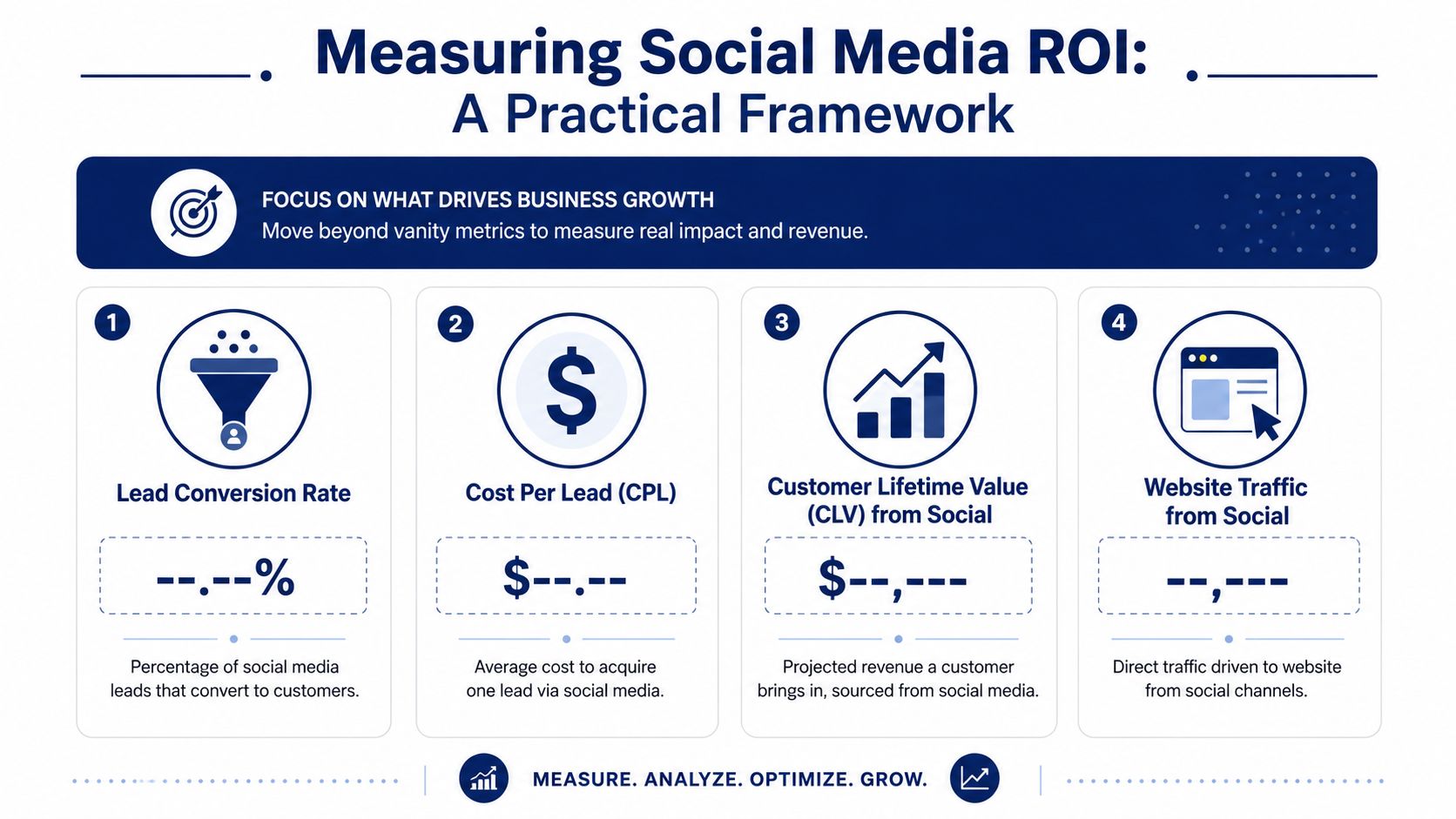
Follower counts, impressions, reactions, and undifferentiated traffic belong in a diagnostic view, not in the headline. They can help explain distribution patterns, but they do not prove that social helped create demand, move an account forward, or support a deal.
For industrial firms, this matters even more. A plant manager liking a post is not the same as an engineer downloading a spec guide, a procurement lead revisiting a product comparison, or a target account engaging across multiple contacts. If the metric cannot help answer a revenue question, it should not lead the report.
Deprioritize metrics that create noise:
- Raw follower growth
- Unqualified reach
- Low-context reactions
- Traffic with no downstream action
Leadership will ask a simple question. What did social contribute to pipeline?
What to report instead
Use a reporting model that starts with buyer movement and ends with pipeline evidence. For a practical baseline, align the dashboard with marketing ROI measurement fundamentals.
A useful dashboard for manufacturers should include:
- Qualified leads from social: Contacts that match target industry, company profile, and buying role. Not every form fill.
- Pipeline influence: Open opportunities where social contributed to first touch, retargeting engagement, content consumption, or account validation during the sales cycle.
- Conversion on technical assets: Performance of spec sheets, design guides, webinar registrations, RFQ requests, plant audit offers, or demo requests tied to social traffic.
- Buying group engagement: Evidence that more than one stakeholder from the same account interacted with content or converted on related assets.
- Sales feedback: A simple CRM field or opportunity note that confirms whether social helped warm the account or gave reps a better entry point.
Industrial teams often miss the mark. They report top-of-funnel visibility, but they do not connect social touches to account progression inside the CRM. Without that connection, social stays in the "awareness" bucket forever, even when it helped create trust with engineering, operations, and leadership before a serious sales conversation.
Keep the reporting cadence simple. Monthly is usually enough. One page is better than a dense slide deck. If the dashboard cannot help a sales leader decide where to focus, it is too abstract.
Your First Step to Building a Social Media Machine
Don't start by creating a giant content calendar. Start by diagnosing the system you already have.
Pull your last 90 days of social activity and sort every post into one of three buckets: awareness, consideration, or decision. Then ask three blunt questions. Which posts were aimed at a real buyer role? Which posts created a measurable next step? Which posts would help sales move an opportunity forward?
That single exercise usually exposes the core issue fast. Most manufacturing teams discover they're overproducing generic awareness content, underproducing decision support content, and not connecting any of it to CRM workflows.
Use that diagnosis to rebuild the machine:
- Keep one platform primary
- Tie every content type to a buyer stage
- Log social intent inside the CRM
- Report pipeline influence, not vanity
Social media in B2B marketing works when you run it like an engineered system. Inputs, process, output, feedback loop. That's the difference between posting and building a channel that supports revenue.
If you want a clear diagnosis of where your current marketing system is breaking down, Machine Marketing helps manufacturers and industrial firms connect social media, CRM, content, and lead generation into one measurable growth system. Reach out for a practical diagnosis and a plan you can run.