Your sales team is chasing quotes. Your engineers are answering technical questions. Your website looks busy enough. But deals still stall, price becomes the deciding factor, and procurement goes quiet after what felt like a strong technical fit.
That usually isn't a sales problem. It's a strategy problem.
Most manufacturers still treat marketing like a brochure function. They publish capabilities, tolerances, materials, and machine lists, then assume the right buyers will connect the dots. They won't. Strategic industrial marketing works when it helps the full buying committee move from interest to internal approval, not when it only impresses the engineer.
Table of Contents
- The Gap Most Manufacturers Try to Ignore
- What Strategic Industrial Marketing Actually Means
- The Four-Part Framework That Ties Strategy to Pipeline
- Why Engineers Are Not the Whole Audience
- Channels That Earn the Industrial Buyer's Attention
- KPIs and Benchmarks That Actually Matter
- A Practical 90-Day Roadmap to Get Started
- Putting It All Together and Your Next Move
The Gap Most Manufacturers Try to Ignore
The blind spot is simple. Most industrial companies write for the person who specs the part and ignore the people who approve the vendor.
That creates predictable friction. Engineering may like your process. Procurement still sees an undifferentiated supplier. Finance still doesn't see risk reduction. Plant leadership still doesn't know whether your team can support uptime, implementation, or service reliability after the first shipment.
The fallout shows up in familiar ways:
- Quotes get compared on price alone: If your value story never reaches procurement, your tolerances and expertise collapse into a line-item comparison.
- Deals stall late: Legal, quality, or operations asks for proof your team should have surfaced earlier.
- Websites answer the wrong questions: Buyers find CAD files and machine photos, but not the evidence non-technical stakeholders need to sign off.
- Lead capture breaks at the worst moment: A high-intent visitor wants to ask about capacity, lead time, or certifications and hits a generic contact page instead of a structured inquiry path. If your forms are weak, this guide to better manufacturer lead capture forms is worth reviewing.
Industrial buying has been digital for a long time. 73% of B2B buyers pay attention to a supplier's website when deciding whether to submit RFIs, 94% conduct online research before purchasing, 70% compare suppliers online, and B2B researchers average about 12 searches before engaging a brand site according to Thomasnet manufacturing marketing benchmarks. If your site only serves engineers, you're losing influence before sales even gets a chance.
Your website isn't a brochure. It's part of the buying process.
We use a simple system to fix this. Four parts. Audience, positioning, channels, and measurement. When those four line up, marketing stops producing activity and starts producing pipeline your sales team can use.
What Strategic Industrial Marketing Actually Means
Strategic industrial marketing is the disciplined process of deciding which industries, applications, and buyer roles you can win profitably, then aligning your message, content, channels, and tracking around those opportunities.
That's different from generic B2B marketing. Industrial buying has longer cycles, heavier technical validation, more internal stakeholders, and more operational risk. A buyer isn't just asking, “Do I like this company?” They're asking, “Can this supplier meet spec, avoid disruption, survive audit review, and justify the decision commercially?”
Strategy starts before content
If you're publishing content before making those choices, you're producing motion, not direction.
A useful way to think about it is a CNC shop:
- Strategy is the print: It defines what you're making and what tolerance matters.
- Content is the tooling: It shapes how you cut, explain, and prove your value.
- Channels are the machine: They determine how that message gets delivered to the market.
- Measurement is the QC gauge: It tells you whether the system is holding tolerance or producing scrap.
Without the print, you're guessing. With it, every asset has a job.
If you need a basic definition before going deeper, this overview of industrial marketing fundamentals gives the broader context. The important part here is that strategic industrial marketing isn't “doing more marketing.” It's choosing where to compete and building a system around that choice.
What makes it strategic
A strategic approach answers hard questions early:
- Which work do we want more of? Not every RFQ deserves equal attention.
- Why should a buyer trust us over alternatives? “Quality and service” isn't a position.
- What proof does each role need? Engineers, buyers, plant leaders, and executives don't approve vendors for the same reasons.
- Which channels reach those people? Visibility without relevance doesn't help.
- How will we know the system is working? Traffic alone won't tell you.
Practical rule: If your message could fit any other machine shop, fabricator, contract manufacturer, or OEM, it isn't positioning.
The companies that grow steadily don't market to everyone. They define a wedge. Maybe it's a material specialty, a tolerance advantage, faster lead times, better documentation, stronger certification support, or lifecycle service. Then they build everything else around that edge.
The Four-Part Framework That Ties Strategy to Pipeline
Strategic industrial marketing works as a connected system. Splitting it into silos and then wondering why results feel random leaves teams stuck.
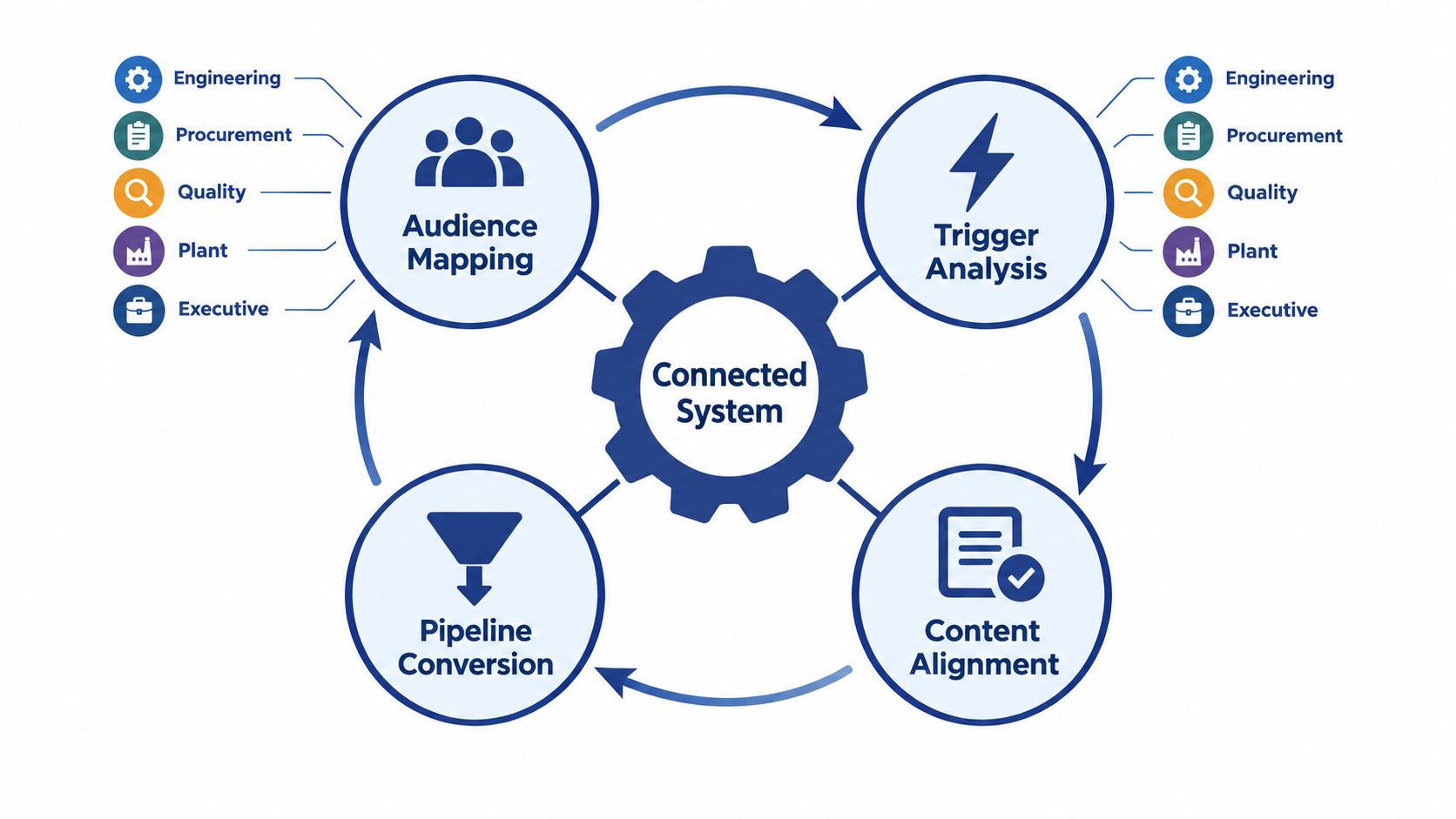
Audience mapping
Start with the full buying committee, not the first technical contact. Recent industrial reporting cites an average buying committee of about 11 people, with roughly 67% of the journey completed digitally before sales is engaged, and typical capital equipment cycles extending beyond 9 months according to Ingenia's industrial marketing analysis. That changes how you plan content.
Map roles, triggers, objections, and proof needs:
- Engineering: Needs spec fit, tolerances, materials, process capability.
- Procurement: Needs supplier reliability, lead time confidence, commercial clarity.
- Quality: Needs certifications, documentation, traceability, audit readiness.
- Plant operations: Needs uptime, responsiveness, implementation confidence.
- Executive leadership: Needs risk reduction, ROI language, strategic fit.
A role map becomes useful when you tie it to buying triggers. Capacity constraint. Supplier failure. New product launch. Certification need. Lead time pressure. Regulatory requirement. Each trigger changes what matters.
Positioning choices
Positioning is your safest-wins reason. Not your slogan.
Strong industrial positioning usually comes from one or more of these wedges:
| Positioning wedge | What buyers hear |
|---|---|
| Material expertise | “They understand the substrate and its failure modes.” |
| Tight tolerance capability | “They can meet spec with less production risk.” |
| Speed and lead time | “They can solve the timing problem.” |
| Certifications and compliance | “They'll survive quality review.” |
| Service and lifecycle support | “They won't disappear after the PO.” |
Change the wedge and your content changes too. A shop winning on speed needs visible turnaround proof, intake efficiency, and quote responsiveness. A shop winning on compliance needs documentation, audit language, and certification evidence up front.
Channel selection
Channels should reflect how each role searches and what each role trusts. That usually means a mix, not a bet on one tactic.
For many industrial firms, the shift toward digital is already obvious. Manufacturing firms increased marketing investment from 6.7% of revenue in 2024 to 9.5% in 2025, a 42% year over year jump. In the same benchmark set, digital channels accounted for more than half of manufacturing marketing spend, and 98% of industrial manufacturers were reported to generate sales-qualified leads through digital marketing, based on WebFX-tonic benchmark reporting summarized here. That doesn't mean trade shows stopped mattering. It means digital now carries the pipeline burden.
Measurement discipline
Measurement closes the loop. If procurement-focused pages attract visits but don't influence RFQs, your proof stack may be weak. If technical content drives inquiries but quote acceptance stays soft, your positioning may be too generic.
The point isn't to report more metrics. It's to learn which audience-role combinations convert, which message themes hold up in sales conversations, and where deals stall.
Why Engineers Are Not the Whole Audience
Many industrial teams still act as if winning the engineer means winning the deal. It doesn't.
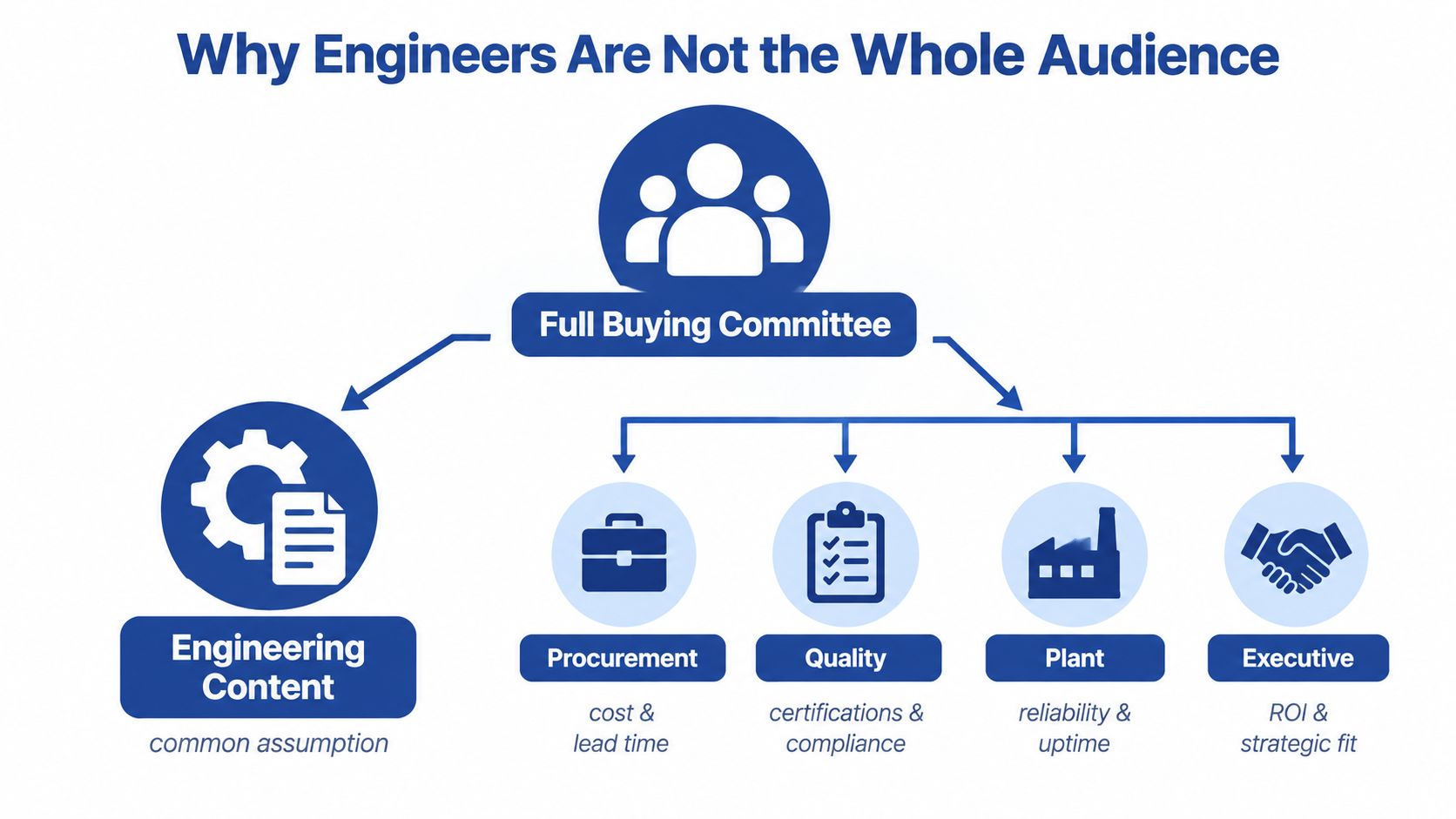
Engineering content matters. It just isn't enough on its own. Manufacturing marketing coverage has called out a consistent gap. Companies create content for engineers but miss procurement and financial decision-makers, even as buying groups continue to widen. The same source notes that industrial purchases are projected to involve about 12 to 13 stakeholders by 2028 and argues that vendors need proof for procurement, finance, and plant leadership, not just technical readers, as outlined in Emulent's manufacturing marketing trends and projections.
What each role needs to approve
The committee doesn't evaluate one thing. It evaluates several different risks.
- Engineering wants feasibility: Can you make the part, hold the tolerance, and support the application?
- Procurement wants vendor confidence: Can they compare you cleanly, trust your response process, and defend the commercial decision internally?
- Quality wants evidence: Are your systems documented and repeatable?
- Plant leadership wants continuity: Will your team support production without creating headaches?
- Executives want business logic: Why is this the right supplier decision for margin, continuity, growth, or risk control?
When companies get audience profiling wrong, they usually flatten all of that into a single persona. If your team needs a good reset, this article on how to fix audience profiling is useful because it forces you to separate assumptions from real buying behavior.
Build a proof stack, not just a content library
Your content should function like a layered proof stack:
- Technical layer: Drawings, tolerances, process capabilities, material expertise, application notes.
- Commercial layer: Lead times, quote process clarity, warranty and service terms, onboarding expectations.
- Risk layer: Certifications, audit readiness, traceability, quality system summaries, service responsiveness.
- Executive layer: ROI framing, implementation confidence, business continuity, reference credibility.
If one proof layer is missing, the deal often stalls even when your technical fit is strong.
A CNC shop can win the print review and still lose the PO because procurement can't verify risk controls. The fix is rarely flashy. Add an ISO certificate summary, a quality management one-pager, and a reference letter from a plant manager. Suddenly the next meeting gets scheduled because the non-engineering objections were handled before they turned into delay.
Channels That Earn the Industrial Buyer's Attention
Most manufacturers don't need more channels. They need a tighter channel system.
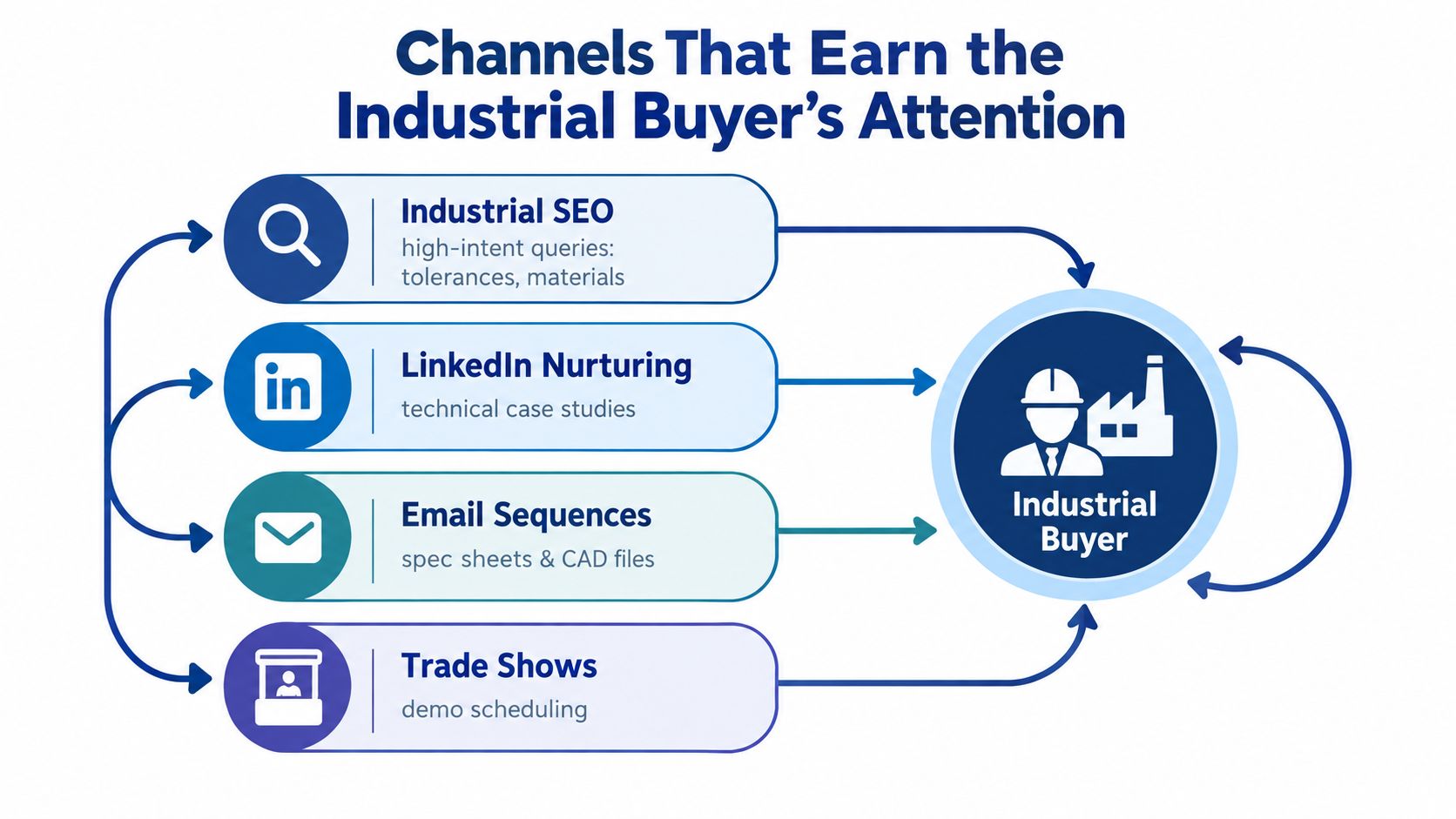
A small industrial team can get real traction with four integrated plays: SEO, email nurture, local search, and CRM automation. Trade shows still matter for many categories, but they work better when your digital system does the pre-show filtering and post-show follow-up.
Industrial SEO that answers buying questions
Industrial SEO should target high-intent searches tied to capabilities and commercial intent. Not broad vanity terms.
Think in page clusters such as:
- Capability pages: CNC turning, sheet metal fabrication, control panel build, field service.
- Material pages: Stainless, aluminum, titanium, engineered plastics.
- Industry pages: Medical, food processing, aerospace, energy.
- Proof pages: Certifications, quality process, equipment list, turnaround policy.
A precision machine shop doesn't need to “rank for manufacturing.” It needs pages that answer specific searches tied to alloys, tolerances, production constraints, and certification requirements. Those pages should route visitors into structured RFQ or inquiry flows, not generic contact forms.
Email that nurtures the committee
Email still works in industrial markets when it respects role and timing. It fails when teams blast promotions.
Manufacturing email benchmarks vary widely by source and segmentation, with cited open-rate ranges from about 11% to 37.36%. One benchmark places the manufacturing and industrial category at 20.2% open rate and 2.0% click rate, according to manufacturing email benchmark reporting. Use that as a category-specific baseline, not a trophy target.
A strong nurture sequence might include:
- A technical application piece for engineering.
- A supplier capability summary for procurement.
- A quality or audit-readiness asset for compliance reviewers.
- A lead time or capacity update for active opportunities.
- An executive brief for larger purchases.
Local search and Google Business Profile
For regional suppliers, local search is practical, not optional. Emergency work, plant visits, and local vendor checks often start there.
Google describes local visibility around relevance, distance, and prominence, as summarized in this breakdown of local ranking factors. Independent industry coverage of a 2026 local ranking survey also reports Google Business Profile signals at roughly 32% of local pack weighting, with review signals around 20% and on-page website factors around 15%, according to Search Scope's ranking-factor summary.
That gives you a clear order of operations:
- Complete the profile: Categories, services, operating areas, phone, photos, updates.
- Show the facility: Upload shop photos, equipment, receiving area, and quality stations.
- Request reviews consistently: Especially after successful delivery or service recovery.
- Connect the website: Make sure capability and location pages reinforce the same services.
This short video gives a useful visual primer on channel coordination in practice.
CRM automation that prevents lead waste
If your team responds manually to every inquiry the same way, you're slowing down the accounts most likely to close.
A practical setup should:
- Score by fit: Role, company type, urgency, and inquiry type.
- Route by workflow: RFQs to estimating, service requests to operations, partnership inquiries elsewhere.
- Trigger follow-up: If a quote stalls, sales should get a reminder and context.
- Track source clearly: You should know whether SEO, email, referral, trade media, or events created the opportunity.
If you're evaluating implementation options, platforms such as HubSpot, GoHighLevel, and purpose-built setups from firms like Machine Marketing can handle this kind of routing and tracking. What matters is the workflow design, not the logo on the software.
Trade shows fit into this system too. If your team exhibits, your booth should support targeted meetings and post-show follow-up, not just foot traffic. For companies reviewing booth formats or layouts, examples of an industrial expo stand can help you think through how the physical experience supports your funnel.
KPIs and Benchmarks That Actually Matter
Industrial dashboards go off the rails when they reward activity instead of buying progress. More traffic isn't the goal. More qualified pipeline is.
The benchmarks worth tracking
Website conversion is one of the few numbers many manufacturers can operationalize quickly. Industrial manufacturing websites have a practical visitor-to-lead benchmark of about 2.2%, while stronger performance is often cited in the 5% to 8% range, based on manufacturing lead generation benchmark data. If your capability pages get traffic but your forms and RFQ paths convert below that practical baseline, the issue usually isn't just visibility.
Another strategic issue sits higher up the funnel. One benchmark analysis reports manufacturers allocating only 29% of effort to brand building versus 71% to activation, while broader B2B benchmarks are closer to a 46/54 split, according to Considered Content's manufacturing marketing effectiveness review. That imbalance matters because teams often squeeze short-term lead tactics while underfunding the trust assets that make future conversion easier.
Use this KPI structure instead of a generic marketing report. If you want a deeper framework, this guide to manufacturing marketing KPIs expands the measurement side.
Industrial Marketing KPIs and Benchmarks
| KPI Category | Metric | Benchmark Range | What It Signals |
|---|---|---|---|
| Pipeline | Qualified RFQ rate | Qualitative trend | Whether inquiries are actually sales-usable |
| Pipeline | Quote-to-cash ratio | Qualitative trend | Whether your positioning survives commercial review |
| Pipeline | Average deal cycle by sector | Longer in complex industrial sales | Whether friction sits in validation or closing |
| Channel | Website visitor-to-lead conversion | About 2.2% practical benchmark, 5% to 8% stronger range | Whether traffic is turning into inquiries |
| Channel | Email engagement by role | About 11% to 37.36% open-rate range, 20.2% open and 2.0% click in one manufacturing benchmark | Whether nurture content matches the contact type |
| Channel | Google Business Profile actions | Qualitative trend | Whether local visibility creates calls and route requests |
| Content | Spec sheet or drawing downloads | Qualitative trend | Whether technical buyers find your resources useful |
| Content | Sales reuse of proof assets | Qualitative trend | Whether marketing supports live deals |
| Trust | Review velocity | Qualitative trend | Whether buyers can find recent external validation |
| Trust | Certification mentions in inbound requests | Qualitative trend | Whether compliance proof is shaping demand |
How to spot vanity metrics
A metric is vanity when it flatters the dashboard but doesn't explain buying progress.
Examples:
- Rising traffic with flat RFQs: You're attracting the wrong searches or the wrong audience.
- Strong email opens with weak replies: Subject lines worked. Message relevance didn't.
- Heavy content production with low sales reuse: Marketing is publishing assets sales doesn't need.
- More leads with no pipeline growth: Form fills increased, but buyer quality didn't.
A useful dashboard helps you diagnose where the system breaks. Awareness, consideration, or close.
A Practical 90-Day Roadmap to Get Started
You don't need a full rebrand to fix this. You need a sequence.
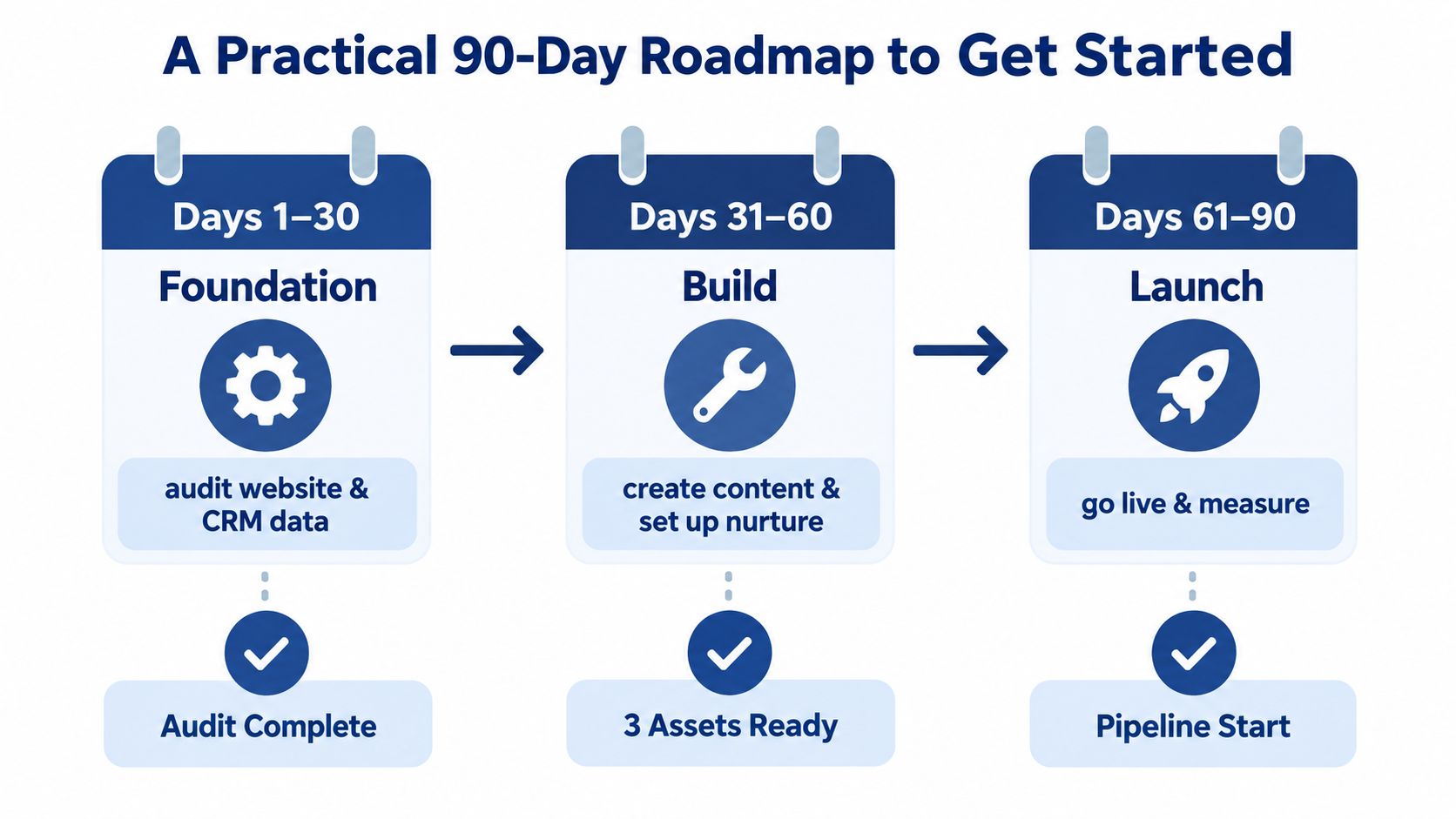
Days 1 to 30
Audit what you already have. Review your website, CRM, forms, quote flow, sales decks, and the content sales sends during live opportunities.
Then document the buying committee map. Run five customer interviews to pressure-test your assumptions. Ask who was involved, what slowed approval, what proof mattered, and why your team was chosen or rejected.
Ship two documents before the month ends:
- An ICP document: Industry, application, fit rules, deal risks, excluded work.
- A positioning statement: Your wedge, proof points, and commercial reason to believe.
If your team needs structure, a practical marketing roadmap template can speed this up.
Days 31 to 60
Build the proof stack.
Publish:
- Two technical assets for engineering.
- One procurement-focused piece on cost, lead time, or supplier evaluation.
- One executive brief that frames ROI, continuity, or risk reduction.
Stand up measurement at the same time. Add source tracking in the CRM, define lead stages cleanly, and score inbound inquiries by role and fit.
Days 61 to 90
Activate the channels that can produce near-term signal.
Launch an SEO cluster around three commercial keywords tied to priority capabilities. Start a monthly nurture sequence segmented by role or account status. Claim and optimize your Google Business Profile and relevant trade-directory listings. Run a targeted LinkedIn campaign aimed at plant managers and procurement contacts if your audience is active there.
Defer what isn't ready yet:
- Paid search: Wait until your messaging and landing paths are clearer.
- ABM tools: Validate the ICP first.
- Broad brand campaigns: Build them after pipeline coverage is healthier.
At day 90, hold a gate review. Did MQLs and SQLs move? Did sales reuse the new proof assets? Are better-fit inquiries entering the pipe? The next quarter's leading indicator is usually simple: whether the right roles are engaging earlier and with fewer unresolved objections.
Putting It All Together and Your Next Move
Strategic industrial marketing works when audience, positioning, channels, and measurement operate as one system. The most common failure is treating it like an engineering content project and ignoring the proof stack procurement and executives need to approve the vendor. Book a working session and map your buying committee against your current proof stack before you spend another quarter publishing assets that can't close.
Machine Marketing helps manufacturers build the strategy, content system, CRM workflows, and measurement needed to turn industrial marketing into usable pipeline. If your team has tools in place but no unifying system, visit Machine Marketing and start with a diagnosis of your buying committee, proof stack, and channel mix.