If your team keeps publishing blogs and brochures that get polite attention but no serious engineering conversations, the problem usually isn't a lack of expertise. It's a mismatch between the content you're creating and the way technical buyers evaluate risk, proof, and fit. A technical white paper is built for that gap, because it gives buyers documented reasoning, not just claims.
This format has real history behind it. Scholarship on white papers traces the term from government policy documents into commercial technology use, with commercial white papers emerging in the 1980s as firms used them to explain products, protocols, and methods to technical and business audiences (SAGE research on white paper history). That matters for manufacturers, because the format inherited an expectation of depth, analysis, and recommendations, which is exactly what engineers want before they trust a vendor.
A white paper is not a brochure with more pages. It's a research-oriented, problem-solving document that educates and persuades before a sale, and modern guidance treats it as a structured asset for lead generation, sales enablement, and engineer-to-engineer communication (Compose.ly's technical white paper guide). If you're also thinking about how search visibility is changing under AI-driven discovery, useful context lives in AI search visibility tactics, because the buyers you want are increasingly using search to find substantiated answers.
For manufacturers, the test is simple. If the issue is complex, the buying committee is technical, and the decision depends on evidence, a technical white paper is usually the right asset. If you need quick awareness only, blog content may do the job better. For a practical content strategy around that split, see our internal guide on B2B content strategy for engineers.
Table of Contents
- Why Technical White Papers Still Win Industrial Deals
- Build Your Issue Plan Before Writing a Single Word
- Structure Your White Paper for Technical Credibility
- Earn Trust with Methodology and Evidence Disclosure
- Turn Your White Paper into a Lead Generation Engine
- Your Launch Checklist and Next Steps
Why Technical White Papers Still Win Industrial Deals
A stalled white paper project usually starts the same way. Someone says, “We need something more substantial than a blog post,” the subject-matter experts are busy, and the draft turns into a generic overview that doesn't help an engineer make a decision. That's not a writing problem. It's a positioning problem.
What a technical white paper actually is
A technical white paper is a text-based, research-oriented document that explains a specific problem, method, or solution in enough depth that a technical reader can evaluate it. Good guidance places it at about 3,000 words or more, often in a six- to 12-page format for readability and depth, while other white-paper formats can be much longer, such as ICO white papers that are often described as 20 to 40 pages (Compose.ly guide). The shorter technical version exists because busy buyers don't want a novel, they want clarity.
The best way to think about it is this. A brochure sells interest. A technical white paper supports a decision. That distinction is why white papers are still useful in industrial marketing, especially when the buying group wants documented reasoning and not hype.
Practical rule: if the document can't help a reader understand the problem, the method, and the evidence, it isn't a white paper yet.
Why it outperforms promotional content
Industrial buyers rarely respond to slogans because slogans don't reduce risk. A technical white paper works better when the issue is complex, the reader faces significant consequences, and the reader needs to compare approaches before talking to sales. That's why the format has stayed relevant across decades, from its policy roots to modern B2B use (SAGE history of white papers).
The format also works because it respects the buyer's process. Engineers want to know what problem you're solving, how you know it's a problem, and what evidence supports your recommendation. That's why modern guidance recommends using statistics, case studies, and cited sources to strengthen credibility (Compose.ly guide).
Use a white paper when you need to do one or more of these things:
- Educate a buying committee on a technical issue before a sales conversation.
- Explain a method or architecture that's harder to communicate in a brochure.
- Support an engineer-to-engineer discussion with evidence instead of opinion.
- Give sales a serious asset they can send after the first meeting.
If your goal is only awareness, a blog post may be enough. If your goal is trust, a technical white paper usually wins.
Build Your Issue Plan Before Writing a Single Word
A technical white paper usually fails before anyone finishes the draft. The problem is rarely weak prose. It is weak scoping. In one review of 300 white papers, 50 were abandoned before publication and another three dozen were published with clear defects, so 29% were not published as intended (Washington white paper production guide). For manufacturers selling to technical buyers, that is the failure to avoid. An engineering-minded workflow starts with the issue plan, then forces agreement on the question, the proof, and the review gates before anyone writes a line.
Lock the scope before drafting
An issue plan defines the paper before drafting starts. It should spell out the goal, target audience, core questions, required visuals, source experts, timetable, and copy flow (Washington white paper production guide). That level of clarity saves time because it closes the arguments that usually surface halfway through production, after a marketer has already written around missing evidence.
Use this fill-in template:
- Business goal: What should the white paper help the reader do?
- Primary audience: Engineer, plant manager, operations leader, or executive?
- Decision question: What issue are they trying to solve?
- Required proof: Benchmarks, field data, diagrams, validation notes, or SME commentary?
- Visuals needed: Charts, architecture diagrams, process flow, or performance tables?
- Owner and reviewers: Who writes, who approves, who can veto?
- Deadline and gates: When do SME review, technical review, and final sign-off happen?
Practical rule: if you cannot state the decision question in one sentence, the paper is not ready to draft.
Put evidence requirements in writing
The production guidance also calls for a methodology section that explains how data were gathered and validated, with benchmarks, architecture diagrams, SME quotes, and peer review checks documented so the claims can be reproduced and traced back to sources (Washington white paper production guide). That matters because technical buyers do not just want a polished conclusion. They want to see how you got there, and they will spot gaps fast if the evidence chain is thin.
A workable internal workflow looks like this:
- Name the question the paper answers.
- List the proof required to answer it.
- Assign each proof point to one subject-matter expert.
- Set review gates before writing begins.
- Freeze the scope unless leadership approves a change.
If you want a cleaner handoff between marketing and engineering, use the white paper topic brief as a working SOP, not a loose brainstorm. For a practical companion reference on documentation discipline, see our internal guide to best practices for technical documentation.
Structure Your White Paper for Technical Credibility
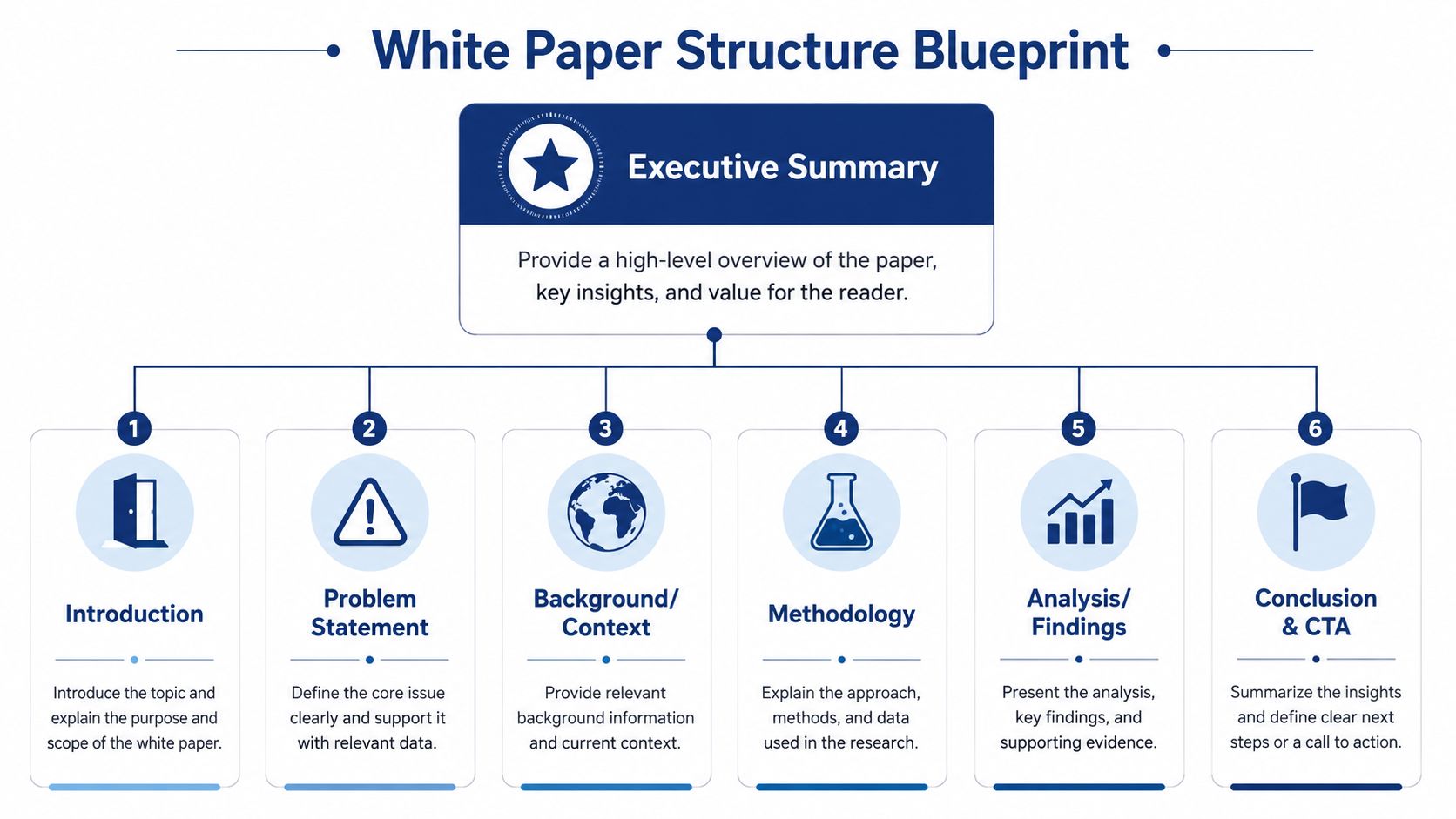
A strong structure does more than make a paper look organized. It tells a technical buyer whether the argument is disciplined enough to trust. In industrial marketing, that usually means each section has to earn its place by moving the reader from the operational problem, to the method used, to the evidence, and then to the decision they should make next.
Use a structure that matches how engineers evaluate risk
A practical technical white paper usually opens with an executive summary, then moves through the introduction, problem statement, methodology, technical solution, findings, and recommendations. The sequence matters because engineering-minded readers scan for context first, then proof, then a clear decision path. If you want a broader editorial framework for keeping those sections aligned, our internal guide on technical documentation strategy is a useful companion.
Another common pattern adds a short overview of terms, a body that explains the issue and solution, and a conclusion with a CTA. Both approaches work, but only if the paper stays focused on one technical question and shows enough evidence for a reader to judge the answer. The structure should feel like a reviewable argument, not a marketing brochure dressed up with headings.
A simple manufacturing outline might look like this:
- Executive summary: State the problem, approach, and conclusion in plain language.
- Introduction: Frame the operational or engineering context.
- Problem statement: Define the bottleneck, failure mode, or inefficiency.
- Methodology: Explain how the data or analysis was gathered.
- Technical solution: Show the approach or system being evaluated.
- Findings: Present the measurable outcome.
- Recommendations: Tell the reader what to do next.
This is not the place for literary flourish. It is the place for clean thinking, clear labels, and a path a technical reviewer can follow without guessing.
Keep the structure tight enough to read, deep enough to trust
A credible white paper gets its strength from what it includes and what it leaves out. Technical buyers notice when a paper wanders, repeats itself, or buries the core claim under extra commentary. The stronger move is to keep the argument narrow, use visuals only where they help a reader test the claim, and make sure every section contributes something specific.
Charts, performance tables, and diagrams should explain the argument, not decorate it. When the paper includes a process, a test result, or a system comparison, the reader should be able to trace how the conclusion follows from the evidence. That is where the technical reviewer decides whether your paper deserves a second read.
A useful standard is simple. If a section does not help the reader understand the problem, the method, the evidence, or the recommendation, it probably does not belong. Technical writing guidance also expects the paper to be detailed enough that others can replicate the method and verify the results, which is why the data presentation and source notes matter so much (Stack Overflow technical white paper guidance).
The cleanest white papers answer a specific question and stop when the answer is complete.
For a practical companion on how engineering teams keep documentation usable and consistent, the best practices for technical documentation guide is a helpful reference.
Earn Trust with Methodology and Evidence Disclosure
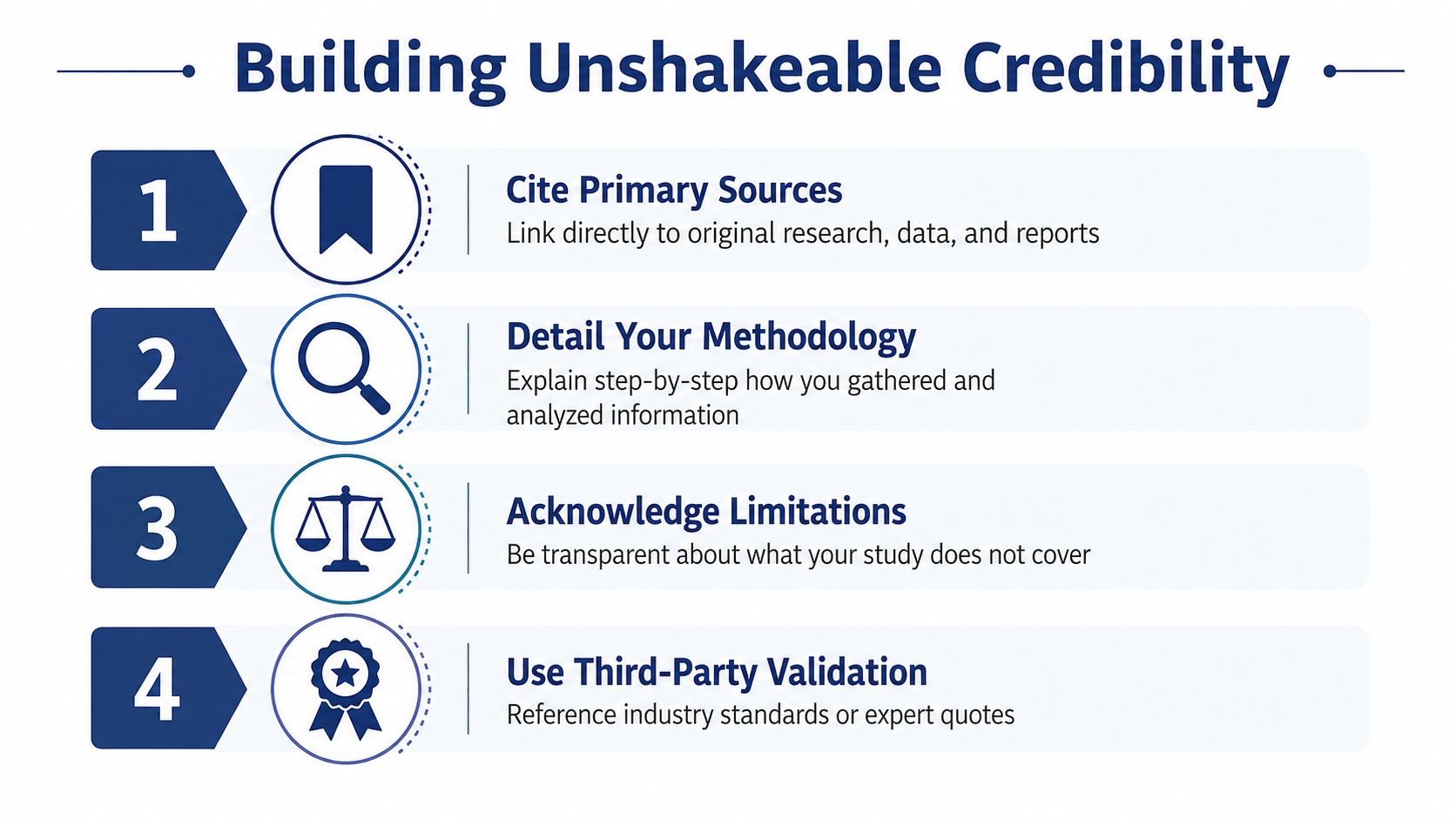
Technical buyers notice when a white paper sounds polished but hides the path behind the claims. The stronger version does the opposite. It shows where the evidence came from, who reviewed it, what the team still cannot prove, and where AI-assisted drafting stopped so human judgment could take over. That level of transparency matters because buyers are already wary of content that reads confidently but falls apart under scrutiny. The Ionos guide also points to the growing risk of hallucinations, weak data quality, and poor oversight in AI-generated technical content.
Show your work, not just your conclusion
A credible methodology section does more than name a process. It makes the paper audit-friendly for a technical reader who wants to know what was observed, what was checked by subject matter experts, and where judgment entered the analysis. In practice, that often means disclosing the test setup, the reviewer role, the assumptions behind the comparison, and any review gates used before publication. The point is not to overwhelm the reader with process detail. The point is to make the argument traceable.
A useful disclosure checklist looks like this:
- Data provenance: Where did the numbers, examples, or observations come from?
- Validation steps: Who checked the claims, and what did they verify?
- Assumptions: What conditions shaped the result, and what was held constant?
- Limitations: What the paper does not cover, and where the evidence is incomplete.
- Reproducibility: What another technical reader would need to inspect the approach.
For manufacturers, the paper earns credibility with engineers, operations leaders, and procurement teams. If you include implementation metrics, make the measurement context clear so the reader can judge whether the result transfers to their environment. That could include latency, throughput, server-load percentages, or the criteria used to accept or reject a test result.
Address AI skepticism directly
AI skepticism does not require a long apology. It requires visible controls. If AI tools helped draft the paper, say so in a restrained way, then show how a human team verified the sources, checked the logic, and removed claims that could not be supported. Technical buyers do not need a manifesto about AI use. They need proof that the final document was reviewed by people who understand the system being discussed.
That concern is even sharper in industrial buying, where the paper may be read by a process engineer, a plant manager, and a technical evaluator who all expect different kinds of proof. A short disclosure note can help here. State what was sourced from field data, what came from vendor testing, and what was confirmed by internal subject matter experts. If a claim cannot be traced to a source, a test, or a documented expert judgment, leave it out.
Practical rule: if a claim cannot be traced to a source, a test, or a documented SME judgment, leave it out.
That kind of discipline is what separates a technical white paper from a glossy sales document. It also protects the buyer's time, because they can see where to trust the paper and where to challenge it. For teams building a content system around lead capture, the white paper itself should still do the credibility work, while the surrounding assets handle promotion, follow-up, and form fills. Our guide on inbound marketing lead generation shows how that handoff can work without turning the paper into a pure conversion asset.
A final caution for engineering-minded teams. Do not bury methodology in a footer or a vague appendix note. Put the disclosure where a technical reviewer will see it, then keep it specific enough to support review and flexible enough to admit limits. The stronger the disclosure, the less the reader has to guess about how the paper was built. That is the point of the paper, and it is also why the insights from MarTech Do on lead generation still apply here.
Turn Your White Paper into a Lead Generation Engine
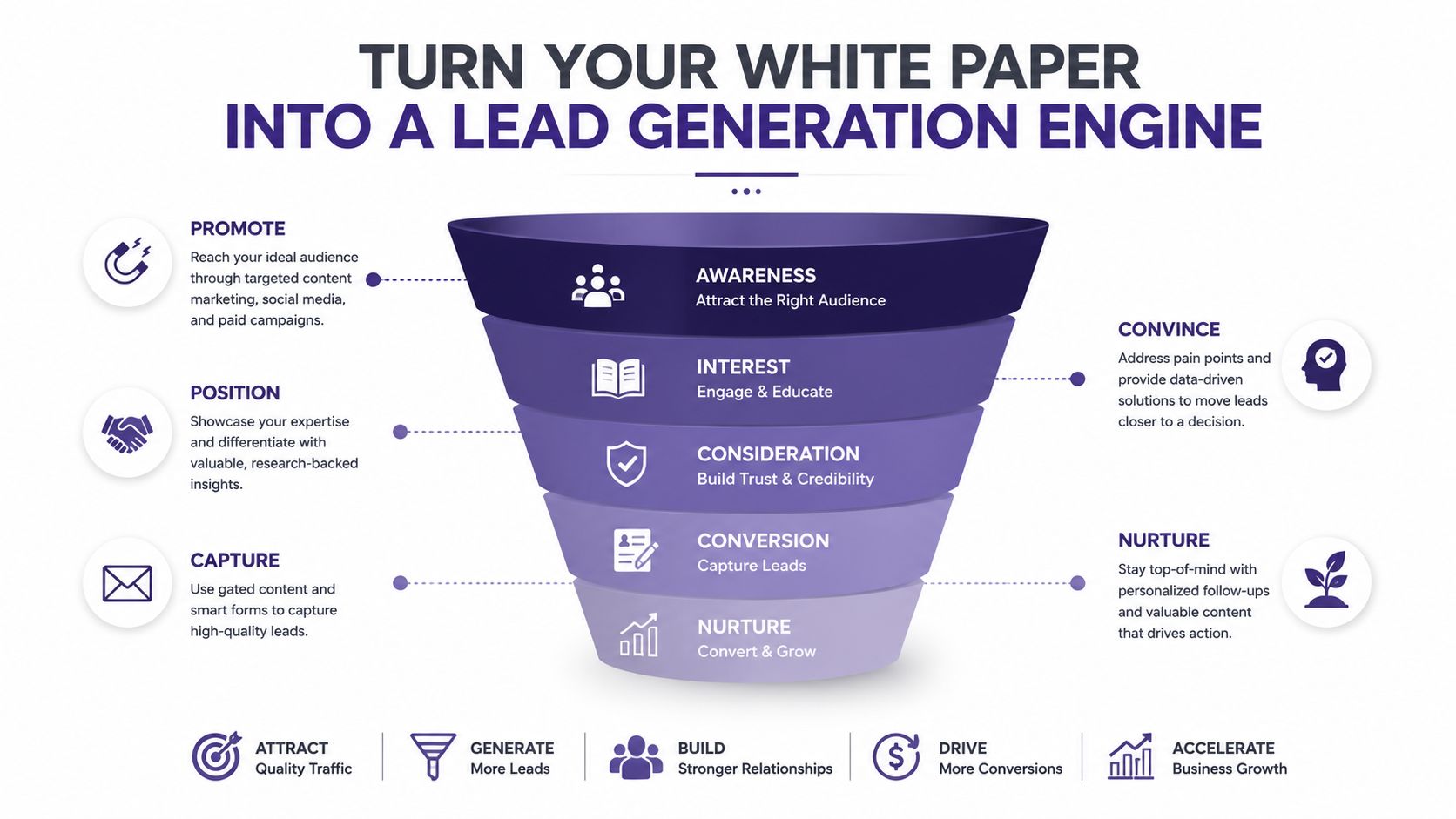
A white paper that nobody finds is a sunk cost. Industrial teams usually make the mistake of treating the paper as a finished PDF instead of the center of a content system. The asset needs search visibility, a conversion path, and a follow-up plan if it is going to support pipeline instead of sitting in a downloads folder.
Decide what to gate and what to leave open
Gating is a trade-off. Research-based industry commentary argues that gated content can improve lead capture, but it also reduces visibility because search engines and AI tools cannot index the full document if it sits behind a form. That matters even more for manufacturers with lower-traffic sites, because every lost impression has more weight. The practical answer is to match the gate to your traffic and your conversion goals, then test the result rather than guess.
A sensible approach is to:
- Keep a preview ungated: Publish the summary, introduction, or key findings on a webpage.
- Gate the full PDF selectively: Ask for contact info when the asset has strong commercial value.
- Use the page as the SEO asset: Let the webpage carry discoverability, not just the form fill.
- Offer both formats: Give visitors a readable page plus a downloadable PDF.
For more on lead-capture mechanics, our internal guide on inbound marketing lead generation is a useful reference.
The issue plan should decide this before copy gets heavy. If the paper is meant to pull in first-time technical buyers, the open page does the discovery work and the PDF becomes the depth layer. If the paper supports late-stage sales, a tighter gate can make sense because the audience already has context and the commercial value is higher. That is the kind of choice that keeps the white paper aligned with the buyer journey instead of forcing every audience through the same path.
Promote it like a campaign, not a file
A white paper rarely succeeds on its own. MarTech Do's discussion of lead generation makes the same point in a different context, a single asset performs better when it sits inside a distribution plan instead of waiting to be found. Manufacturers selling to technical buyers need the same discipline, because email, LinkedIn, partner sites, and sales follow-up each reach a different part of the buying committee. The insights from MarTech Do fit here because the paper is only one part of the system.
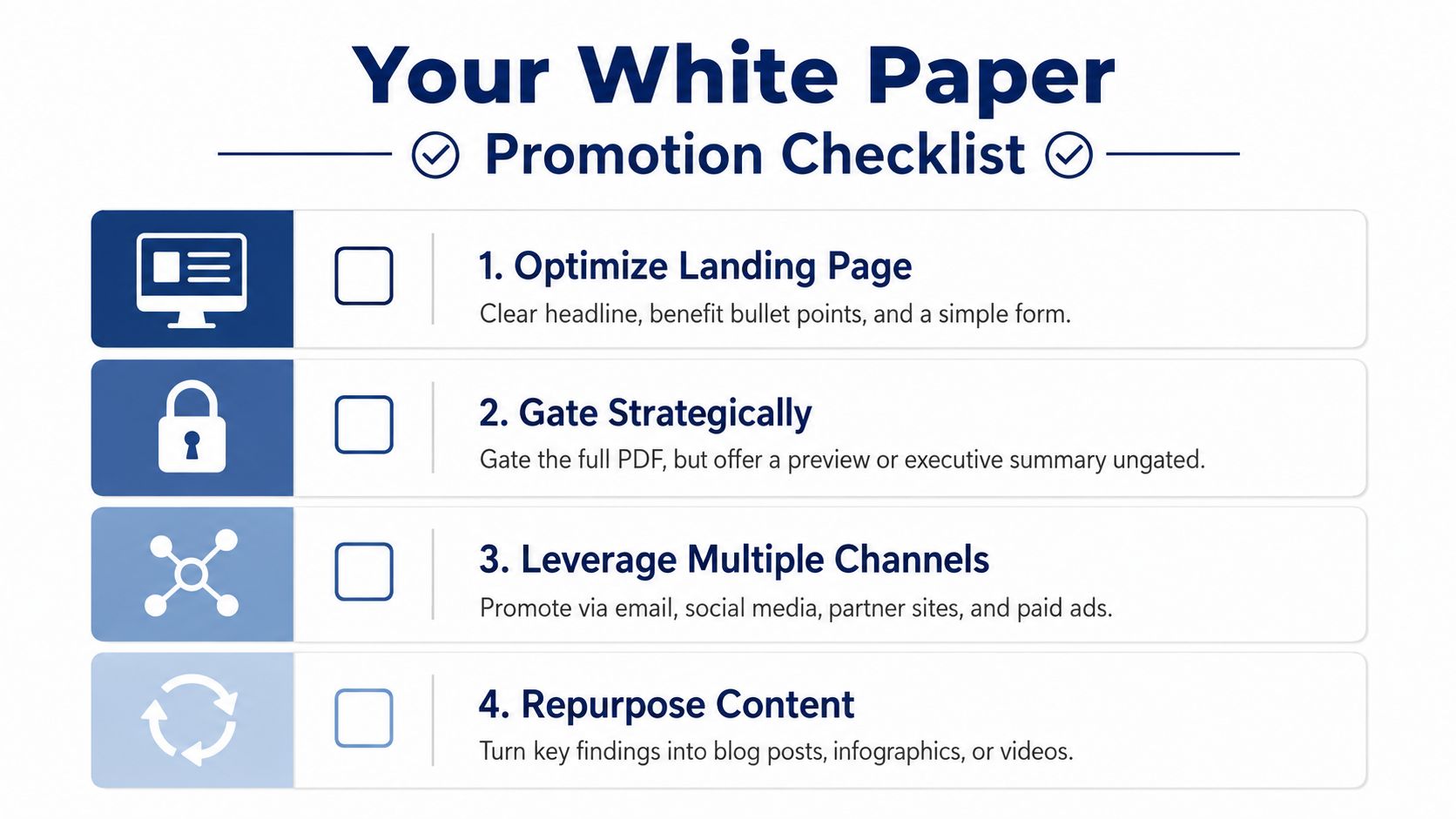
Use the white paper in these channels:
- Email: Send the ungated summary to existing contacts.
- LinkedIn: Share problem framing, not just the download link.
- Sales enablement: Give reps the paper after discovery calls.
- Partner distribution: Use channel partners or industry associations when appropriate.
- Nurture sequences: Follow the download with a short educational email series.
The strongest programs I have seen do not stop at promotion. They break the paper into proof points, charts, objection-handling snippets, and a short landing-page summary that sales can use without reworking the message. That keeps the content usable after launch and gives the team more than one chance to earn attention from the same audience.
Track the metrics that matter
The question is not how many people clicked. It is whether the asset created qualified conversations. Track download rates, lead quality scores, and sales-cycle impact so you can judge whether the white paper contributed to pipeline, not just traffic.
A white paper should help your team do three things better:
- Attract the right technical audience.
- Educate them with evidence.
- Advance the sales conversation with fewer handoffs.
That is the practical test. If the paper is built around a clear issue plan, honest evidence gates, and a distribution path that matches how technical buyers evaluate vendors, it stops being a one-off content project and starts working like part of the revenue system.
Your Launch Checklist and Next Steps
The final quality check should feel boring, because boring here means controlled. Before launch, run the paper through one last technical review, verify every citation, confirm that visuals match the argument, and make sure the CTA is specific. The most common last-minute problems are missing approvals, vague summaries, and claims that got stronger in the rewrite than the evidence allows.
Use this launch checklist:
- Final SME review: Confirm technical accuracy and terminology.
- Citation audit: Make sure every factual claim is traceable.
- Design check: Verify charts, captions, and page flow.
- Landing page review: Test the headline, form, and summary.
- Sales handoff: Brief reps on the paper's promise and limits.
- Post-launch follow-up: Send the asset to the right contacts, then watch how it performs.
A simple timeline keeps the work moving. Brief SMEs first, draft second, design while copy is under review, then launch only after evidence and messaging align. If any one of those steps is skipped, the paper usually shows it.
The best early metrics are the ones tied to action, not vanity. Focus on whether the paper brought in the right buyers, whether sales used it, and whether it supported better technical conversations. If it did, you've got a repeatable asset. If it didn't, the issue is usually scope, proof, or promotion, not the topic itself.
If you want a technical white paper that supports sales, we can help you diagnose the topic, build the issue plan, and turn the evidence into an asset engineers will trust. Visit Machine Marketing to talk through your current content system and find the fastest path to a stronger lead-generation engine.