If you run a manufacturing company, you've probably felt this already. You publish a few articles, update a service page, maybe add a case study, and then wait for qualified leads that never really arrive. The problem usually isn't effort. It's that the content wasn't built as a system.
A strong topical authority manufacturing blog isn't just a publishing schedule. It's an operating model for turning technical knowledge into search visibility, buyer trust, and sales conversations. That matters in industrial markets because buyers rarely convert after one visit. They compare processes, materials, tolerances, lead times, standards, and failure risks long before they contact your team.
Table of Contents
- Why Most Manufacturing Blogs Fail to Generate Leads
- Laying the Foundation for Your Content System
- Designing Your Pillar and Cluster Architecture
- The Production Workflow for Expert Content
- Activating Your Content with Links and Technical SEO
- Measuring and Integrating Your Content System
Why Most Manufacturing Blogs Fail to Generate Leads
A common scenario plays out like this. A manufacturer publishes a few blog posts, traffic trickles in, and nothing changes in the sales pipeline. Six months later, the site has more pages but no stronger position in search, no better lead quality, and no clear evidence that content is helping revenue.
The problem is usually structural. The blog was built as a publishing activity instead of an expertise system.
A company posts trade show observations, an update about company culture, then a broad article on choosing a supplier. Each piece stands alone. None builds technical depth around the services, products, or buying questions that drive RFQs. Search engines get a weak signal. Buyers get no clear path from first question to vendor shortlist.
Random content creates random outcomes
Manufacturing buyers rarely solve a problem with one search. An engineer may start with process fit, then move to tolerance limits, material behavior, inspection requirements, failure risk, and production constraints. A procurement contact may care more about lead time, quality controls, and supplier stability. Content has to reflect that chain of questions.
That is why disconnected posting fails.
If one page does not lead naturally to the next technical or commercial question, it is unlikely to support lead generation. It may attract a visit, but it will not help a buyer progress toward contact, quote request, or supplier evaluation.
This is also why publishing volume alone does not fix the issue. More articles can increase the size of the problem if they are not tied to a defined topic set, a buyer path, and a conversion goal. I have seen manufacturers publish for years and still have no content assets their sales team can use in a live deal.
For a practical example of how manufacturers can structure content around business outcomes, this guide to content marketing for manufacturing companies is useful because it treats content as a sales support system, not a traffic project.
A blog is rarely the whole system
It is common for manufacturers to get stuck because they assume they need a large editorial calendar before content can work. That assumption wastes time. Industrial firms often have better starting points elsewhere on the site.
The pages that carry authority first are often capability pages, product pages, application pages, case studies, and FAQs. Those assets answer the questions buyers already ask sales and engineering. They also map more directly to commercial intent than a general-interest article does. A post can support that structure, but it should not be expected to carry the entire system by itself.
A practical content base often starts with assets you already have and expands from there:
- Capability pages that explain process fit, tolerances, material options, and production limits
- Case studies that document the problem, constraints, and result
- FAQ pages built from repeated sales, quoting, and engineering questions
- Comparison pages that help buyers evaluate options, trade-offs, and risks
This approach matters because manufacturing credibility comes from specificity. Buyers trust pages that show how you think, what constraints you manage, and where your process fits or does not fit. In reliability-focused sectors, even niche resources can reinforce that credibility. For example, these predictive maintenance insights are useful because they address operational problems industrial teams are actively trying to solve.
A manufacturing blog starts producing leads when it documents expertise in a way buyers can follow and sales teams can use. That is the difference between content that fills a calendar and content that supports pipeline.
Laying the Foundation for Your Content System
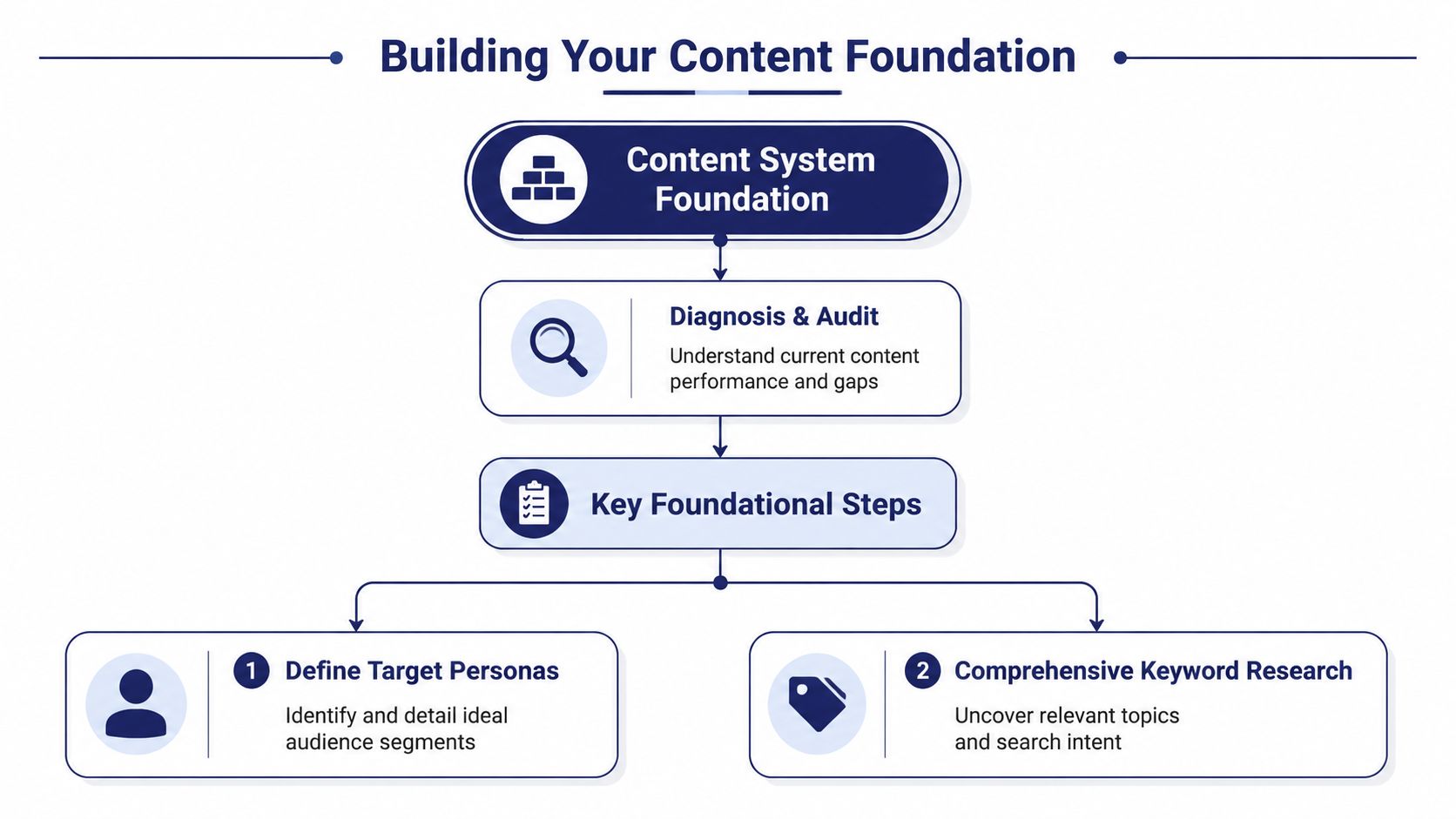
Before you write anything, define the system you're trying to build. The companies that get traction don't start with blog titles. They start with buyer roles, core commercial priorities, and a structured topic map.
Start with buyer roles, not keywords
A design engineer and a purchasing manager may both land on your site, but they don't evaluate vendors the same way. One wants technical confidence. The other wants supplier reliability, risk reduction, and commercial clarity.
That changes the content brief.
Use a simple persona worksheet with four fields:
| Buyer role | Main concern | Questions they ask | Best page types |
|---|---|---|---|
| Design engineer | Manufacturability and specs | Can this tolerance hold? Which alloy is better? | Technical guides, process pages, comparison content |
| Purchasing manager | Cost, lead time, supplier risk | What affects pricing? How stable is delivery? | Capability pages, FAQs, proof pages |
| Operations leader | Throughput and quality | Will this reduce rework? Can they scale? | Case studies, workflow explainers |
| Maintenance or reliability stakeholder | Uptime and compliance | What failure risks exist? What standards matter? | Troubleshooting pages, compliance content |
This doesn't need to be complicated. It needs to be specific enough that your team can tell the difference between content for evaluation and content for purchase readiness.
For a broader planning framework, VIP TECH CONSULTING's strategy guide is a useful reference because it helps organize goals, audiences, and channels before content production starts.
Map the topic universe before you publish
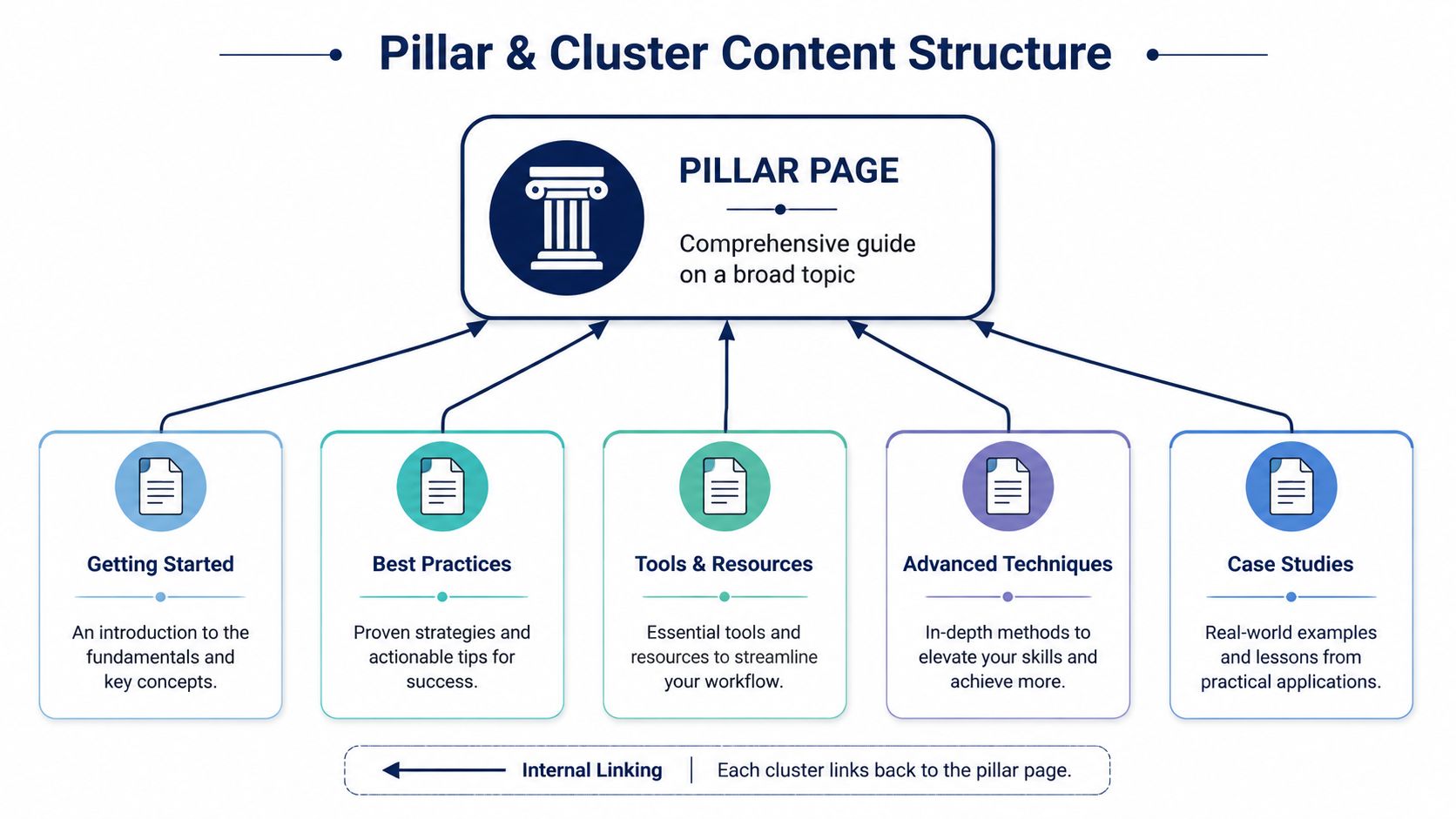
A widely used foundation for topical authority is the topic cluster model. One central pillar page supports multiple related subpages, all internally linked. SpyFu describes this as a way to make your site a one-stop shop for a subject, which is especially important for industrial buyers working through long, technical buying cycles in its guide to growing rankings with topical authority.
For manufacturing, the topic map usually begins with one core offering:
- CNC machining
- Panel building
- Hydraulic repair
- Industrial automation integration
- Precision fabrication
From there, break that offering into subtopics by actual buyer need.
Process questions might include tolerances, materials, finishes, design constraints, certifications, and inspection.
Commercial questions often include lead times, minimum order fit, prototyping versus production, and supplier selection criteria.
Risk questions cover failure modes, compliance, revision control, and maintenance implications.
A good topic map looks less like a keyword list and more like an engineering tree. Parent category, sub-assembly, component detail, use case, failure mode.
That's also where existing assets matter. If you already have strong service pages, expand those first. If you need a practical model for connecting strategy, web structure, and SEO execution, content marketing for manufacturing companies is one example of how this planning can be organized around real business goals instead of publishing volume.
The outcome you want here isn't a spreadsheet full of ideas. It's a blueprint that tells your team what to build first, what supports what, and why each page exists.
Designing Your Pillar and Cluster Architecture
A manufacturer with zero content history does not need more pages. It needs the right page hierarchy.
Poor architecture creates two expensive problems. One oversized pillar page tries to answer every question and never earns depth on the subtopics buyers research. Or the site publishes a stack of disconnected articles that attract scattered visits but give no clear path to qualification, inquiry, or quote request.
Both patterns weaken lead generation because they break the connection between expertise, search intent, and conversion.
A practical example using precision CNC machining
Use precision CNC machining as the core topic.
The pillar page should cover the subject at the level a serious buyer needs before taking action. That usually includes process fit, material range, tolerance expectations, part examples, quality controls, lead time variables, and what information a buyer should prepare before requesting a quote. The pillar is not a glossary page. It is the central decision page for the topic.
Cluster pages handle the questions that deserve their own proof, examples, and search intent. For example:
- Tolerance capability pages for buyers comparing achievable limits by process or material
- Material comparison pages such as aluminum grades based on strength, corrosion resistance, or machinability
- Surface finish explainers tied to function, cosmetic requirements, and downstream assembly
- DFM content for engineers trying to prevent scrap, delays, or unnecessary cost
- Industry-specific application pages for aerospace, medical, energy, or industrial equipment
Page relationships matter as much as page topics. A clear website taxonomy structure for industrial sites keeps pillar pages, cluster pages, and service pages from competing with each other or creating dead ends in navigation.
Use search results to expose missing coverage
A workable architecture starts with decomposition. Break the core service into the decisions a buyer has to make, then check search results to see how Google groups those decisions into distinct intents and page types. Build the pillar around the broad commercial topic. Build clusters around the narrower questions that support evaluation, qualification, and risk reduction.
That structure usually gets indexed and understood faster than a flat blog because each page has a defined job and a defined relationship to the rest of the topic. The benefit is practical. Buyers find the next answer without hunting, and search engines can interpret topical coverage without sorting through overlapping pages.
Audit the architecture before writing anything:
Search the core topic manually
Review service pages, buying guides, videos, forums, and People Also Ask results. Those result types show what search engines already associate with the topic.Separate intent by page type
An educational query like “what tolerance can CNC milling hold” should not live on the same page as “CNC machining supplier for aluminum housings.” One supports research. The other supports vendor selection.Look for coverage gaps with commercial value
A common mistake is to publish definitions and basic overviews while ignoring troubleshooting, qualification criteria, compliance requirements, or supplier comparison pages. Those are often the pages that turn technical traffic into sales conversations. For regulated or safety-sensitive topics, pages like this Practical guide to hydraulic compliance can show how specialized compliance content answers buyer risk questions better than generic service copy.Remove overlap before production starts
If two planned pages solve the same problem, merge them. Cannibalization usually begins in the content plan, not after the pages go live.
Build one clear route through the topic. Each page should answer a distinct question, support a specific stage of the buying process, and push the visitor toward the next logical step.
That is what turns a blog into an operating system for demand generation. The pillar sets the commercial center. The clusters supply proof, detail, and discoverability. Together, they create a structure that can start from zero and still compound into measurable inbound leads.
The Production Workflow for Expert Content
A manufacturing blog starts producing leads when the content reflects how buying decisions are made on the shop floor and in procurement reviews. Buyers can tell the difference between polished copy and working knowledge in a few seconds. Pages built from real operating detail earn trust faster and create a usable path from search visit to sales conversation.
Extract knowledge from the people doing the work
In many manufacturing companies, the expertise already exists. The failure point is usually the handoff between technical staff and marketing.
A workable process starts with the person closest to the issue. That might be an engineer explaining why a tolerance stack-up changes manufacturability, a quality lead walking through inspection risk, or a sales engineer describing the questions that stall deals. The goal is not to collect quotes. The goal is to capture how an expert evaluates a problem, what variables matter, and where buyers make expensive mistakes.
Use a practical sequence:
Interview the subject matter expert
Ask what buyers get wrong, what data they need before requesting a quote, what creates delays, and which specifications separate a good project from a bad fit.Turn the interview into a decision structure
Organize the page around choices, constraints, and consequences. Buyers need help selecting a process, comparing materials, qualifying a supplier, or diagnosing a failure.Pull in operating evidence
Add standards references, internal checklists, inspection criteria, process photos, sample drawings, or material considerations where they improve the answer. Specific evidence carries more weight than polished generalities.Edit for clarity
Remove jargon that blocks understanding, but keep the detail that proves competence. Oversimplified manufacturing content often loses the very information a serious buyer came to find.
Many firms often stall at this juncture. Marketing teams wait for a perfect draft from engineering, and engineering teams do not have time to write one. A better system is to let marketing extract and shape the expertise, then send a near-final draft back for review.
If the topic involves safety, verification, or regulated processes, the bar is even higher. A resource like this Practical guide to hydraulic compliance shows the level of procedural detail buyers expect before they trust a supplier.
Build pages that help buyers make decisions
Longer content is not better by default. Better content answers the full decision. Some topics need 800 words. Others need far more because the buyer has to evaluate standards, materials, production constraints, inspection methods, and supplier fit on one page.
That is why generic awareness posts often fail to produce pipeline. Industrial firms need pages that reduce uncertainty near the point of inquiry. In practice, that usually means product-led and service-led topics, supported by technical educational pages that answer the questions buyers ask before they contact sales.
Strong topics usually sound like this:
- Aluminum 6061 vs 7075 for high-load parts
- CNC milling vs turning for a specific geometry
- How ISO requirements affect supplier qualification
- What surface finish changes in wear, sealing, or bonding
- Why a prototype succeeded but the production run failed
Each one helps a buyer make a decision. That is the standard.
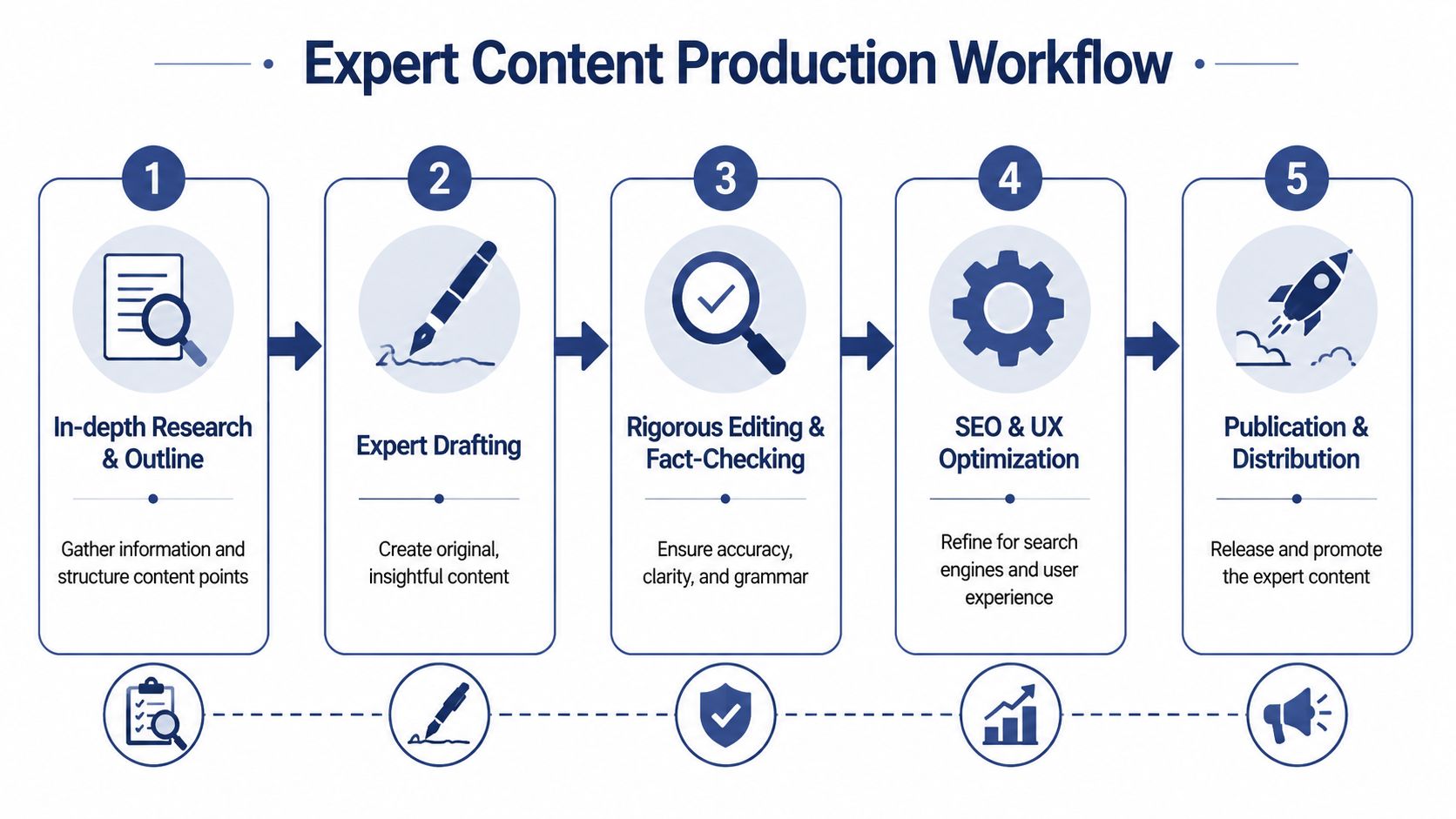
A repeatable production checklist keeps quality from drifting as volume increases:
| Step | What the team does | What to watch for |
|---|---|---|
| Research | Collect buyer questions, technical inputs, and sales objections | Broad claims with no process detail |
| Drafting | Write around the decision the buyer needs to make | Intro paragraphs full of definitions |
| SME review | Confirm technical accuracy and edge cases | Clean copy that misses production reality |
| SEO and UX edit | Improve headings, scanning, search intent fit, and conversion path | Forcing one keyword into every section |
| Publish and route | Connect the page to relevant service pages, CTAs, and sales follow-up | Publishing a page with no commercial next step |
The strongest pages usually come from a mixed team. Engineering supplies the truth. Marketing supplies structure, readability, and conversion design.
That combination turns expertise into an operating asset instead of a collection of disconnected blog posts. For teams building that process from zero, a conversion-centric guide to technical content SEO can help define how research, writing, and lead generation fit together.
If you need operational help executing the workflow, some firms use in-house marketing, some use freelance technical writers, and some use strategy partners that combine SEO, content planning, and CRM alignment. Machine Marketing is one example of that kind of system-focused support for industrial companies.
Activating Your Content with Links and Technical SEO
Publishing the page isn't the finish line. It's the point where activation starts.
A page can be accurate, useful, and well written, then still underperform because the site doesn't help users or search engines understand how that page fits into the larger topic. That's where internal linking and technical SEO do the heavy lifting together.

Internal links should clarify relationships
Internal links shouldn't be added as an afterthought. They should explain topic relationships.
Weak anchor text looks like this:
- click here
- learn more
- read this article
Stronger manufacturing anchor text looks like this:
- precision tolerance specifications
- aluminum machining material comparison
- CNC milling design considerations
- hydraulic system compliance requirements
Those anchors do two jobs. They help users predict what they'll get after the click, and they help search engines understand how your pages connect semantically.
Use a practical linking pattern:
- Link from the pillar page to each core cluster page
- Link from each cluster page back to the pillar page
- Add cross-links between related cluster pages where the relationship is genuine
- Link from service pages to supporting proof content such as FAQs, comparisons, and case studies
If the topic is broad, build small loops inside the cluster. A materials page can link to a finishing page. A tolerance page can link to a DFM page. A compliance page can link to a qualification checklist.
Technical SEO keeps good content usable
Technical SEO doesn't need to become a science project. For most manufacturing sites, the highest-impact basics are straightforward:
- Crawlability so important pages can be found and indexed
- Page speed so buyers don't bounce while waiting for oversized assets
- Mobile usability because many stakeholders still research on phones, even in B2B
- Clean heading structure so content hierarchy is easy to parse
- Schema and metadata discipline where appropriate for clarity and consistency
A good technical page should feel boring in the best way. It loads cleanly, the navigation makes sense, and the next step is obvious.
For teams trying to connect technical content quality with search performance and conversion paths, this conversion-centric guide to technical content SEO is a practical reference point.
The larger point is simple. Internal links define the map. Technical SEO removes friction from using it.
Measuring and Integrating Your Content System
A common pattern in industrial firms goes like this. Marketing publishes articles, sales keeps selling from tribal knowledge, and leadership sees no clear line between content spend and RFQs. In that setup, content gets treated like overhead because nobody built it into the commercial system.
The fix is operational. Measure content the way you would measure production capacity or quoting performance. Track whether each topic area increases qualified traffic, supports buyer evaluation, and contributes to pipeline movement.
Measure topic coverage, buying intent, and sales influence
Pageviews alone do not tell you whether a manufacturing content system is working. A cluster can attract traffic from students, job seekers, or low-fit buyers and still produce no revenue.
Review performance at the topic-cluster level instead:
- Search visibility by service line or process area
- Visits to high-intent pages such as capability pages, comparison pages, and quote-related content
- Form fills and resource requests tied to specific topics
- Assisted conversions where content appears early in the buying journey
- Sales conversations influenced by content, especially repeat questions that map back to specific articles
As noted earlier, topical authority comes from full subject coverage and clear relevance, not keyword repetition. The practical question is whether a topic area becomes easier to find, easier to trust, and easier to buy from over time.
That is the level that matters.
A good measurement model asks whether the cluster reduced friction in the buying process. If a buyer reads your tolerance guide, then your machining capability page, then requests a quote, that sequence has commercial value even if the first page was never meant to convert on its own.
Connect content to your sales process
Content should feed the same system your sales team uses to qualify opportunities. If that connection is missing, marketing reports on traffic while sales reports on pipeline, and neither side can explain what works.
A simple integration model includes:
Tag key conversion points
Quote forms, contact forms, downloadable assets, and high-intent page visits should be tracked in analytics and passed into the CRM where possible.Group pages by topic cluster
Review performance by service line, process, or buyer problem. Single-page reporting hides patterns that matter.Give sales usable context
If prospects repeatedly read one comparison page or FAQ before submitting an inquiry, sales should see that behavior. It tells them what objections, risks, or qualification questions are active.Use stalled deals to find content gaps
If opportunities slow down around pricing, certifications, tolerances, or onboarding requirements, publish content that addresses those points directly.
For manufacturing firms, the outcome is either compounding value or wasted effort. A disconnected blog produces isolated assets. An integrated content system produces better-informed buyers, cleaner sales conversations, and sharper feedback on what the market still needs.
A topical authority manufacturing blog works best as market-facing documentation. It captures expertise, helps buyers judge fit before they talk to sales, and gives both teams a clearer view of which topics are creating pipeline.
If your content feels disconnected, or you're not sure which pages should carry authority first, Machine Marketing can help you diagnose the gaps and build a practical system around your services, site structure, and lead pipeline.