ABM is a B2B strategy that shifts focus from generating high volumes of generic leads to coordinating sales and marketing around a targeted list of high-value accounts. In mature 1:1 programs, benchmark medians include 78% account engagement, 32% MQA-to-opportunity conversion, 38% opportunity-to-win rate, a 70% ACV lift, and a 32% shorter sales cycle compared with non-ABM baselines, according to Tomba's ABM benchmark summary.
A machine shop owner usually doesn't need another spreadsheet full of names. The problem is often simpler and more expensive: sales is chasing every inquiry, marketing is publishing broad messages, and nobody is systematically working the manufacturers, engineering firms, or procurement teams that could become valuable long-term customers.
That gap is where account-based marketing, or ABM, earns its place. Instead of treating every form submission as equally important, you decide which companies deserve focused attention, identify the people involved in their buying process, and coordinate useful outreach around their needs.
Table of Contents
- The Problem With Broad Lead Generation
- Core Components of Account-Based Marketing
- The History and Evolution of ABM
- How Manufacturers Implement ABM Strategies
- Key Metrics and Benefits of ABM
- Why ABM Is an Operating Model, Not a Tactic
- Next Steps for Your Manufacturing Business
The Problem With Broad Lead Generation
A typical industrial sales week can look productive while producing little commercial progress. A salesperson receives inquiries for one-off jobs, low-fit industries, small quantities, and projects outside the shop's capabilities. Marketing reports a healthy flow of leads. Meanwhile, a strategically important manufacturer visits the website several times, downloads a technical document, and never receives a relevant follow-up because nobody has assigned ownership of the account.
That isn't a lead shortage. It's a prioritization failure.

Broad lead generation works best when a company can serve a large market with a relatively repeatable offer. Manufacturers and machine shops often operate differently. Capacity is limited, qualification depends on materials, tolerances, certifications, equipment, geography, and production volume, and a purchase may involve engineering, operations, quality, procurement, and finance.
A large list of unqualified contacts creates work without necessarily creating pipeline. The sales team spends time sorting inquiries, while marketing optimizes clicks and form fills that may have little connection to margin or production fit.
Practical rule: If your best prospects are already identifiable by industry, application, location, equipment, or buying potential, treating them like anonymous leads wastes your advantage.
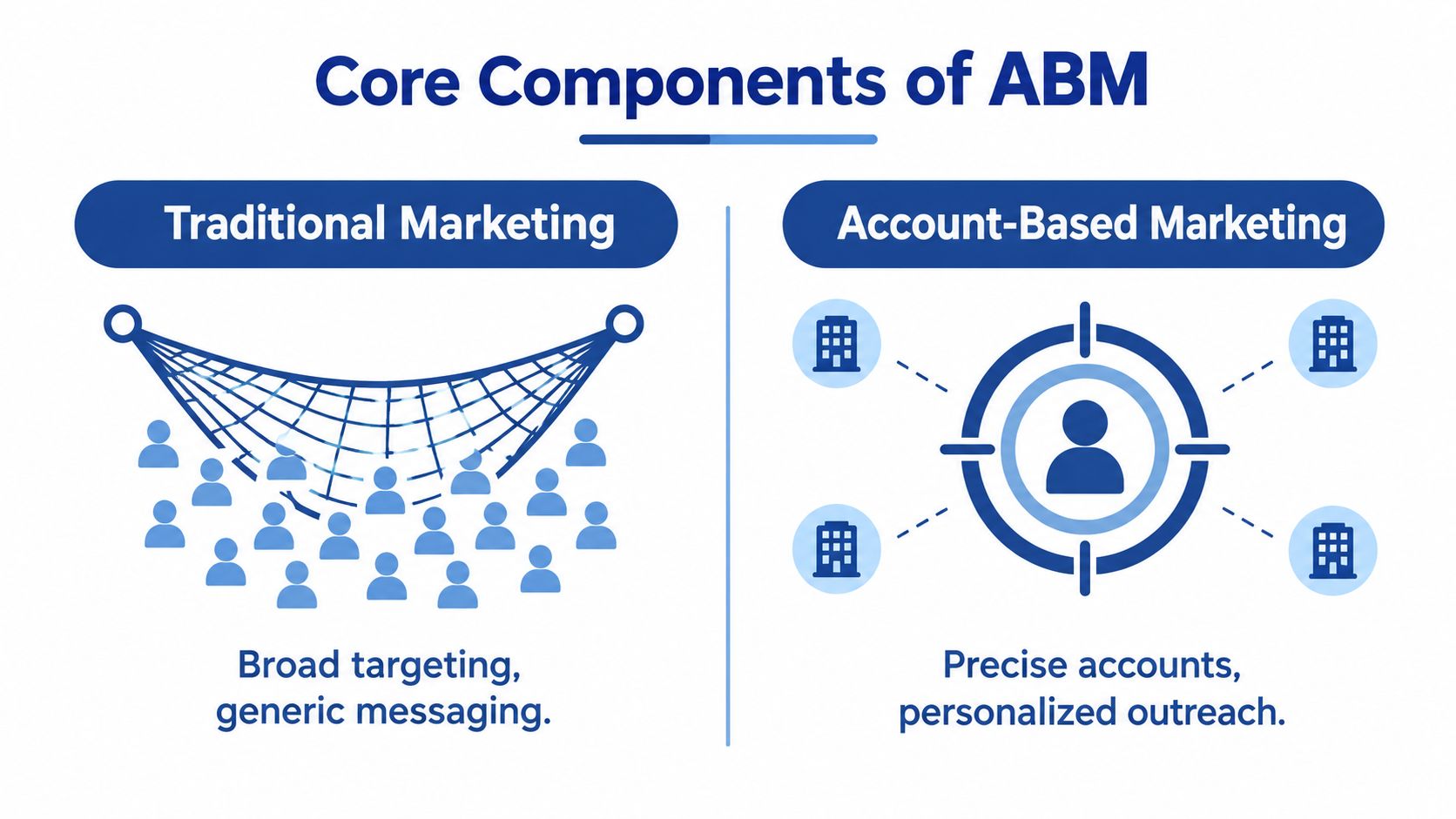
ABM changes the unit of work from the individual lead to the target account. You choose the companies worth winning first, then coordinate messages and sales activity around the people inside those companies. The focus moves from “How many leads did we generate?” to questions such as:
- Which named accounts are engaged?
- Are multiple stakeholders participating?
- Has engagement created a qualified opportunity?
- Is the account progressing through the sales process?
- Does the work support profitable, strategically valuable revenue?
This approach doesn't mean abandoning inbound marketing. Your website, search visibility, referrals, and trade-show activity can still create demand. ABM gives your team a second system for making sure high-value accounts receive deliberate attention instead of waiting to appear as perfect leads.
Core Components of Account-Based Marketing
ABM is a go-to-market model built around a defined group of high-value companies. Teams select those accounts before a contact fills out a form, then coordinate marketing and sales activity around the company and the people who influence its decision, as explained in this overview of account-based marketing.
The model has three practical components:
- Account selection: Choose companies that fit your ideal customer profile and deserve focused resources.
- Buying-group understanding: Identify the roles involved, their concerns, and their influence on the decision.
- Orchestrated engagement: Deliver coordinated content, outreach, and follow-up across the buying process.
1-to-1 ABM
1-to-1 ABM is reserved for the accounts with the greatest strategic value. Your team builds a highly specific plan for one company, using known business priorities, applications, facilities, production challenges, and stakeholder roles.
For a machine shop, that might mean creating a technical capability package for a manufacturer expanding a product line, preparing an engineering-focused conversation about difficult materials, and involving a salesperson who understands the account's procurement expectations. The work is intensive, so it only makes sense when the potential value and fit justify the effort.
1-to-few ABM
1-to-few ABM groups similar accounts into a practical segment. You might group aerospace suppliers, industrial equipment manufacturers, or regional OEMs with comparable technical requirements. The message is more scalable than 1-to-1 ABM, but it still reflects a real industry problem rather than a generic service description.
Intent data can help you understand which accounts are showing research activity or returning to relevant pages. Your team can use this guide to intent data to clarify what signals are useful and how they should influence account prioritization.
The strongest ABM programs combine disciplined targeting with useful relevance. If you need a broader implementation reference, this resource on how to land high-value accounts with ABM offers another perspective on focused account engagement.
The History and Evolution of ABM
ABM became a defined term in 2004, when the Information Technology Services Marketing Association, or ITSMA, introduced the phrase to describe a more structured way for B2B companies to coordinate sales and marketing around important customers. Its roots reach back to the early 2000s, when firms were looking for a more disciplined alternative to broad, volume-based demand generation. The history is documented in this ABM backgrounder.
That origin matters for manufacturers because ABM wasn't created as a software feature or a short-term campaign format. It emerged from a business problem that industrial firms still face: revenue teams need a shared view of which accounts matter, who owns the relationship, and how activity connects to commercial progress.
The model has since moved well beyond a niche concept. One 2024 benchmark reported that 64% of marketers said their teams had an ABM or target-account approach, while a 2025 summary reported 70% adoption in 2024, with both figures covered in the same industry background. The figures vary by survey method and definition, but they point in the same direction. ABM has become a familiar operating approach for many B2B organizations.
Budget and market forecasts reinforce that shift. A 2025 roundup reported that companies allocate an average of 29% of their marketing budget to ABM. The same ABM statistics roundup cites forecasts that place the global ABM market at $1.07 billion in 2023, with projected growth to nearly $2 billion by 2032, while another forecast places the ABM software market at $1.82 billion in 2022 and $4.56 billion by 2030, with a 12.2% CAGR.
The practical lesson is clear. ABM has evolved from a targeting idea into a system involving data, process, technology, and accountability.
How Manufacturers Implement ABM Strategies
Implementation starts with account intelligence, not personalization software. If your target list is wrong, better emails and advertising won't fix the system.
Step 1 Define the ideal customer profile
Build your ICP from profitable, winnable business rather than from industry labels alone. Review the characteristics that make an account valuable:
- Commercial fit: Revenue potential, repeat-order potential, margin, and strategic importance.
- Technical fit: Materials, tolerances, part complexity, equipment requirements, certifications, and quality expectations.
- Operational fit: Order volume, production schedule, logistics, capacity requirements, and geographic practicality.
- Relationship fit: Existing connections, referral paths, supplier dissatisfaction, and openness to a new partner.
Then remove attractive but unrealistic accounts. A global manufacturer may look impressive in a database, but if your shop lacks the required certification or capacity, it doesn't belong in the first test group.
Step 2 Select a finite account list
ABM works better with a deliberate list than with an enormous audience. One 2026 ABM strategy guide identifies 100 to 300 target accounts maximum as a practical testing range, with fewer accounts for 1-to-few and 1-to-1 programs. The ABM strategy guide is useful when you need to set a manageable starting boundary.
Rank each account by fit, potential value, access, timing, and evidence of interest. Use firmographic, technographic, and behavioral signals together. A company that fits your ICP but shows no active need may require education, while a strong-fit account researching a relevant capability deserves prompt sales attention.
Step 3 Map the buying committee
Industrial purchases rarely depend on one contact. A technical buyer may care about capability and risk, an operations leader may care about throughput, procurement may focus on commercial terms, and quality may need evidence that your process meets requirements.
One 2026 ABM playbook recommends identifying 6 to 10 people per account, including economic buyers, technical buyers, end users, champions, blockers, and other influencers, then verifying contact data before outreach. Use the ABM nurturing playbook as a reference for building that map.
Step 4 Create coordinated plays
For each account or segment, define:
- The business problem you believe the account may be facing.
- The evidence that supports that assumption.
- The stakeholder-specific message.
- The content or proof point that helps each role.
- The sales action that follows engagement.
- The condition that moves the account to the next stage.
A technical case example, capability page, plant visit, supplier-transition conversation, or application guide may be more useful than a generic newsletter. For a broader view of the process, review this account based marketing framework, then adapt it to your sales cycle.
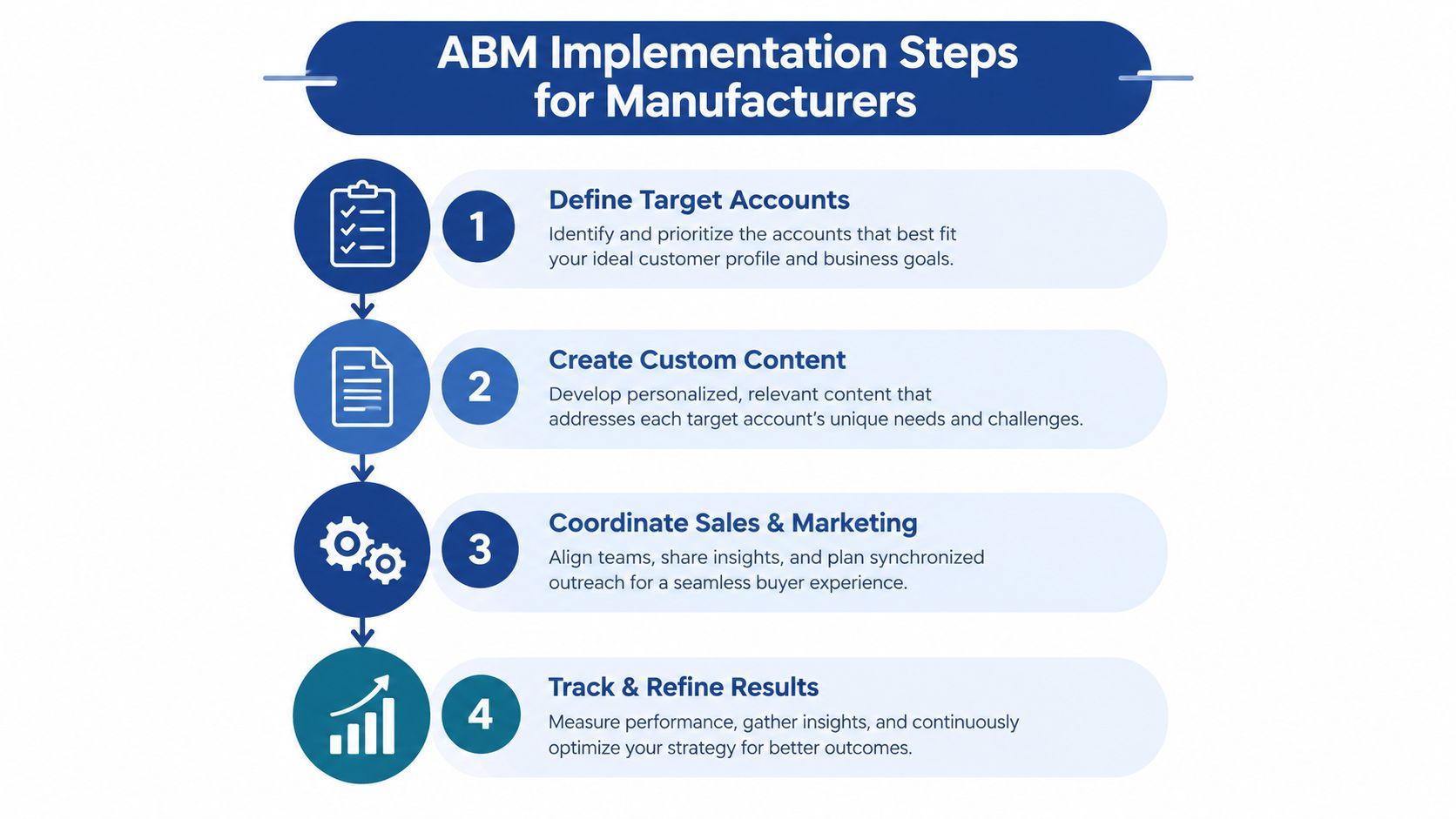
Your CRM should show account status, stakeholder coverage, recent engagement, open opportunities, next actions, and ownership. It shouldn't merely store disconnected contact records.
The following video provides additional context on coordinating ABM activity:
For a manufacturing-specific application, see this guide to account-based marketing for manufacturers.
Key Metrics and Benefits of ABM
ABM changes what your team considers progress. Broad lead generation usually emphasizes reach, traffic, form fills, and marketing-qualified leads. Those measures can be useful diagnostic signals, but they don't tell you whether the right company is moving toward a commercial conversation.
Account-based measurement focuses on engagement density, conversion efficiency, deal value, and sales velocity. The comparison is not “more leads versus fewer leads.” It's a question of whether your team is spending effort on accounts with a credible path to revenue.
| Measurement area | Broad lead generation | Account-based marketing |
|---|---|---|
| Primary unit | Individual lead | Named account |
| Early signal | Form fills and traffic | Engagement from priority accounts |
| Sales alignment | Handoff after qualification | Shared account ownership |
| Buying process | Often single-contact | Buying-committee coverage |
| Commercial outcome | Lead volume | Pipeline, win rate, contract value, and cycle duration |
The benchmark evidence shows why the shift matters. In mature 1:1 ABM programs, median account engagement reached 78%, compared with a non-ABM baseline of 8% to 12%. MQA-to-opportunity conversion reached 32%, while the cited non-ABM comparison was about 6% MQL-to-opportunity conversion. These figures come from Tomba's account-based marketing benchmarks.
The same benchmark summary reports a 38% opportunity-to-win rate, an ACV lift of 70%, and a 32% reduction in sales-cycle duration for mature 1:1 ABM programs. These are benchmark medians, not promises for every manufacturer. Results depend on account selection, data quality, sales execution, offer strength, and whether the organization follows the agreed process.
What to measure first
Start with measures your teams can influence and verify:
- Target-account engagement: Are priority companies returning, consuming content, responding, or entering conversations?
- Stakeholder coverage: Do you have relationships beyond one contact?
- Account-to-opportunity conversion: Which engaged accounts become real opportunities?
- Opportunity-to-win rate: Does account focus improve deal quality and execution?
- Average contract value: Are you attracting work that fits your commercial strategy?
- Sales-cycle duration: Are coordinated conversations reducing delays and confusion?
Don't erase lead metrics. Put them in the right place. A form fill is an event. An engaged target account with several relevant stakeholders and a defined business need is a sales asset.
Why ABM Is an Operating Model, Not a Tactic
Calling ABM a lead-generation tactic creates the wrong expectations. A campaign can target named accounts, use personalized messaging, and still fail if sales doesn't know which accounts matter, marketing doesn't know what sales needs, and RevOps can't report account-level movement.
ABM requires a change in how the company plans and executes growth. Marketing helps create relevance and engagement. Sales develops relationships and advances opportunities. RevOps maintains definitions, ownership, data quality, routing, and reporting. Leadership decides which accounts deserve scarce capacity.
The organizational shift usually shows up in four places:
- Planning: Teams agree on the ICP, target-account criteria, segments, and exclusions.
- Ownership: Each account has a responsible seller and clear marketing support.
- Playbooks: Reusable sequences define what happens when an account shows interest, goes quiet, or adds a new stakeholder.
- Governance: Teams review account status and pipeline quality instead of celebrating disconnected activity.
ABM is also becoming more standardized. Coverage describes 88% of programs using strategic ABM and 70% using AI for content creation, as reported in this ABM operating-model update. Those figures don't mean AI can replace judgment. They show that teams are using repeatable structures and automation to support account-focused work.
Operating principle: Use AI to accelerate research, drafting, and variation. Keep account selection, claims, technical accuracy, and relationship decisions under human control.
A practical content system should give sales useful materials for each buying role, stage, and objection. RedactAI's resource on sales enablement content strategy provides helpful context for structuring that content. Your own process still needs to connect those assets to CRM stages and real conversations.
Alignment can't remain a quarterly meeting. Use a shared account review to ask which accounts are active, what changed, who is missing from the buying group, and what action happens next. This guide to aligning sales and marketing can help teams turn agreement into a repeatable operating rhythm.
Next Steps for Your Manufacturing Business
ABM makes sense when your market is finite, your sales cycle involves multiple stakeholders, and the value of winning the right account justifies focused effort. It may not be the right first move if your offer is low-value, highly transactional, or still lacks a clear ideal customer profile.
Start with a diagnosis rather than a platform purchase. Review recent wins, profitable customers, stalled opportunities, lost accounts, and the inquiries your team rejected. Look for repeated patterns in industry, application, technical need, buying role, geography, and commercial fit.
Then take these steps:
- Write your ICP: Define the customers your operation serves best and the work you don't want.
- Build a short target list: Rank named companies by fit, value, access, and timing.
- Map the buying group: Identify technical, operational, procurement, quality, executive, and user perspectives.
- Create one repeatable play: Pair relevant content with a sales action and a clear follow-up rule.
- Measure account movement: Track engagement, stakeholder coverage, opportunities, wins, contract value, and cycle time.
- Review and refine: Remove poor-fit accounts, improve messages, and document what the team learns.
The transformation isn't a larger database. It's a more disciplined revenue system where marketing and sales agree on who matters, why they matter, and what happens next.
Machine Marketing helps manufacturers and machine shops diagnose disconnected marketing systems and build practical B2B growth strategies across SEO, content, CRM, automation, and sales alignment. Visit Machine Marketing to request a focused assessment of your target-account strategy and identify the next operational improvement.