If you're a manufacturer reading this, there's a good chance your marketing already looks active from the outside. You have a website. Someone posts on LinkedIn when time allows. Your team sends occasional emails. Maybe you've paid for SEO, ads, or a CRM at some point. But sales still says lead flow is inconsistent, and leadership still can't answer a basic question: which parts of marketing are creating pipeline?
That's the gap an industrial marketing agency should solve. Not by adding more disconnected tactics, but by acting as a strategic integrator across your existing team, tools, and sales process. For manufacturers, that matters because the problem usually isn't a total lack of assets. It's that those assets aren't wired together like a system.
This guide is for companies that already have some pieces in place and need a clearer way to diagnose gaps, evaluate partners, and build a marketing engine that supports real revenue outcomes.
Table of Contents
- The Diagnosis Why Your Current Marketing Isn't Generating Leads
- Defining an Industrial Marketing Agency
- Core Services of a High-Performing Agency
- The Transformation Measurable Benefits for Your Business
- How to Evaluate and Choose the Right Agency
- Onboarding and Launching a Pilot with Machine Marketing
The Diagnosis Why Your Current Marketing Isn't Generating Leads
The usual failure pattern is simple. Marketing activity exists, but it isn't connected to a buying process. A blog gets published without a distribution plan. A trade show follow-up list sits outside the CRM. Sales has conversations that never flow back into content priorities. Your website attracts some traffic, but no one can explain which visits came from target accounts or which pages helped move a deal forward.
That isn't a tactics problem first. It's a systems problem.
In manufacturing, isolated activity creates false confidence. You can look busy and still have no reliable lead engine. That helps explain why 98% of industrial manufacturers generate sales-qualified leads through digital marketing, yet only 26% believe their efforts are ahead of the competition, according to manufacturing marketing statistics compiled from the 2022 IndustrialSage survey.
Practical rule: If sales can't trace a qualified opportunity back to a campaign, page, message, or audience segment, your marketing system isn't instrumented well enough.
A lot of manufacturers try to solve this by buying another tool. They add HubSpot, GoHighLevel, a chat widget, or an email platform and expect the gap to close. It usually doesn't. Tools don't create strategy any more than a new PLC program fixes a broken process map.
Use this quick diagnosis:
- Lead flow is irregular: Some months feel promising, then momentum disappears because campaigns weren't tied to a repeatable process.
- Sales rejects marketing leads: The handoff criteria are vague, so inquiry volume and lead quality get confused.
- Reporting stays shallow: You see traffic, clicks, and form fills, but not account engagement, opportunity creation, or influenced pipeline.
- Content production stalls: Engineers, sales reps, and leadership all have useful knowledge, but no one has turned it into a documented content system.
If that sounds familiar, start with a proper marketing audit for manufacturers and service businesses. The point isn't to grade your team. It's to identify where the signal breaks between attention, intent, sales follow-up, and revenue.
An industrial marketing agency earns its keep when it can diagnose those breaks without defaulting to generic advice. You don't need more random output. You need a better schematic.
Defining an Industrial Marketing Agency
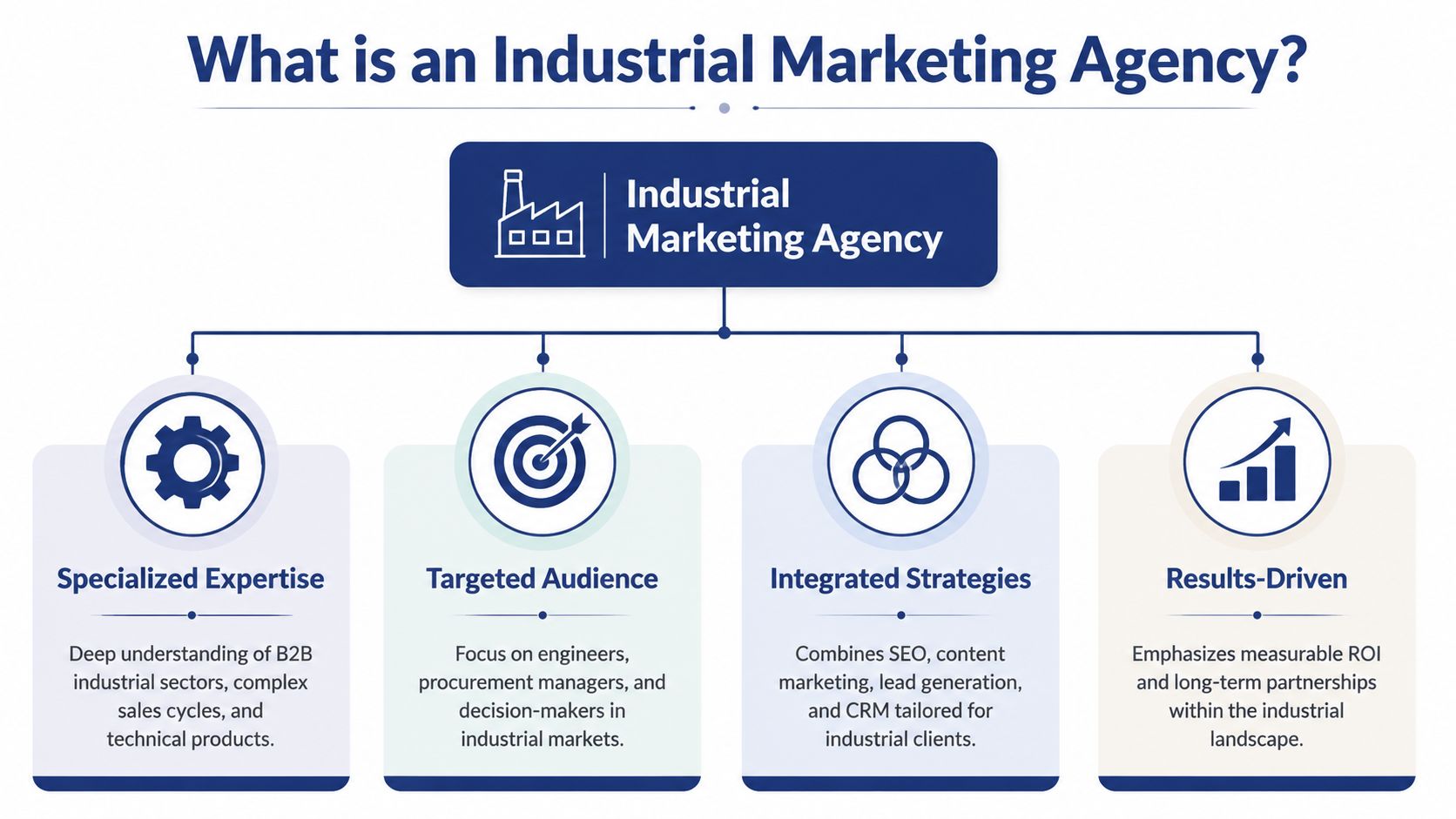
A generalist agency knows marketing channels. An industrial marketing agency knows how those channels behave inside a technical B2B sale.
That difference matters more than most companies expect. Selling fabricated components, automation systems, engineered assemblies, or contract manufacturing services isn't like selling apparel or software subscriptions. The buyer group is wider, the information needs are heavier, and the sales cycle depends on trust, proof, and technical fit.
You can hire a competent general mechanic to keep a pickup truck running. But if your production line depends on a specialized CNC platform, you don't call someone who says, "Machines are machines." You call the technician who understands that exact operating environment, failure mode, and tolerance stack-up.
What specialization actually means
An industrial marketing agency should understand several realities that generalist firms often flatten:
- Technical buying behavior: Engineers need detailed specs, application fit, and implementation confidence.
- Commercial friction: Procurement cares about pricing structure, risk, and vendor reliability.
- Executive review: Leadership wants strategic fit, business case clarity, and confidence that a supplier can deliver.
A specialist agency doesn't just write cleaner copy. It translates complex capability into messages that different stakeholders can act on.
The agency market itself has become more specialized. The number of U.S. marketing agencies grew 12.0% annually between 2017 and 2022, and top-performing agencies reported an average ROI of 220% for clients, according to marketing agency industry statistics. More options sounds good, but it also means manufacturers have to distinguish between niche expertise and a generic sales pitch dressed up with industrial language.
What an industrial agency should do beyond campaigns
The right partner behaves less like a vendor and more like a systems integrator. It should be able to step into your current environment and answer questions like:
- Where does lead qualification happen?
- Which products deserve dedicated search and content support?
- How should website structure mirror your applications, industries served, and RFQ paths?
- Which data belongs in the CRM, and which belongs in automation workflows?
- How should marketing and sales define a handoff so no inquiry gets stranded?
For companies comparing options, a sales and marketing agency for B2B growth systems should be evaluated on its ability to connect those moving parts, not just produce deliverables.
A real industrial partner doesn't ask you to ignore operational complexity. It builds around it.
That's the definition worth using. An industrial marketing agency is not a company that happens to accept manufacturing clients. It's a partner that can work inside technical sales environments and build a cohesive demand system around them.
Core Services of a High-Performing Agency
The strongest industrial marketing programs don't run on a menu of unrelated services. They run on connected components. Search, website structure, CRM design, automation, and sales feedback all need to pass data and intent between each other, like stations on a production line.
When one station fails, downstream performance suffers. Good-looking creative won't compensate for weak lead routing. Paid traffic won't save a site that doesn't answer buyer questions. Content won't close the loop if the CRM can't tie activity back to opportunities.

A useful way to think about services is this: each one should either improve discoverability, improve qualification, or improve conversion across a long buying cycle.
Search visibility for technical buyers
Industrial SEO isn't mainly about broad awareness. It's about showing up when a prospect has a specific problem and starts searching in technical language.
That can include:
- part names
- product categories
- material or compliance requirements
- use-case queries
- comparison searches
- application-specific problems
A high-performing agency should structure pages around how buyers investigate solutions. That usually means dedicated product pages, application pages, industry pages, FAQ content, and technical resource content that sales can also use in conversations.
If your team needs a planning model, this roadmap for content marketing is a useful reference for turning scattered ideas into a documented publishing system. The key for manufacturers is adapting that roadmap to technical buying stages, not copying a generic editorial calendar.
CRM and automation as the control layer
At this stage, many industrial programs break.
Your CRM should function as the control layer between marketing activity and sales action. It needs to show who engaged, what they engaged with, which company they belong to, and what should happen next. That includes account context, lifecycle stage, territory assignment, source tracking, and follow-up workflows.
According to Konstruct Digital's explanation of industrial marketing strategy and attribution, effective industrial marketing requires a unified data architecture that connects the CRM, marketing automation platform, and website data so teams can attribute revenue to specific campaigns across sales cycles that can last over 12 months.
That has practical implications:
- Forms must map cleanly: Inquiry data should route into the CRM with product, source, and intent detail.
- Automation should support sales: Post-download, post-demo, and post-quote workflows need to match buyer context.
- Reporting must stay account-aware: One contact filling out a form rarely tells the whole story in B2B manufacturing.
For manufacturers using HubSpot, GoHighLevel, or similar platforms, setup quality matters more than feature count. A cluttered CRM is like a control cabinet with unlabeled wiring. Everything is technically connected, but no one wants to touch it.
One option in this space is manufacturing digital marketing services, which can include CRM setup, automation mapping, SEO, and content support for industrial firms that need better coordination across channels.
Before you commit to any agency, ask to see how it handles lifecycle stages, lead source hygiene, and sales notifications. Those details tell you whether the firm understands operational marketing.
To see what that operating model can look like in practice, this walkthrough is useful:
Website and content built for real buying committees
Industrial websites often fail for a simple reason. They were built to describe the company, not to help a buying group make a decision.
A capable agency treats the site as a working sales asset. Product and service pages should reduce friction. Navigation should reflect how buyers sort options. Calls to action should match the stage of intent. Early-stage visitors may want technical documentation or application guidance. Mid-stage buyers may want proof, comparison content, or process detail. Late-stage buyers may want an RFQ path, a consultation, or direct access to a rep.
Content should answer the next question a buyer will ask, not the one marketing wants to publish.
Good agencies also connect email and SMS carefully where it fits. Not every manufacturer needs SMS. In some sales environments it adds noise. But email nurture, remarketing audiences, and triggered follow-up can keep opportunities warm during long periods between inquiry and quote.
The point isn't channel volume. It's system coherence. Every service should feed the same objective: move the right accounts through the pipeline with enough visibility that leadership can see what's working.
The Transformation Measurable Benefits for Your Business
When the system is wired correctly, the biggest change isn't cosmetic. It shows up in operational clarity.
Sales stops asking where leads came from. Marketing stops defending itself with traffic charts. Leadership gets a cleaner line of sight between market activity and pipeline movement. That's when marketing starts behaving less like a cost center and more like production support for revenue.
What changes operationally
A strategic industrial marketing agency improves three things first.
The first is signal quality. Your team sees which companies are engaging, which topics attract serious interest, and which handoffs convert into meaningful conversations.
The second is alignment. Sales and marketing stop operating from different definitions of a qualified lead. The handoff gets documented. Follow-up timing improves. Content priorities become easier to set because they come from actual objections and recurring deal friction.
The third is predictability. You may not control when every account buys, but you can build a process that consistently captures demand, nurtures interest, and surfaces buying signals earlier.
What improves commercially
The strongest commercial benefit is usually better sales velocity. Not because marketing "speeds things up" in a vague sense, but because the buyer receives the right information at the right level of detail.
According to Twenty One Twelve's analysis of industrial marketing for complex purchases, agencies that engineer content for technical, financial, and executive stakeholders have helped companies reduce typical industrial deals from 12 months to 8 months.
That result makes sense in practice. Engineers need specs and application confidence. Procurement needs cost and risk framing. Executives need a business case. If your content only speaks to one group, the deal slows down while the rest of the committee catches up.
A better system produces benefits that sales teams notice quickly:
- Fewer low-fit inquiries
- Better prepared prospects
- Cleaner follow-up paths
- More useful reporting for leadership
- Less dependence on one channel or one salesperson's network
Buyers don't experience your marketing in channels. They experience it as one company.
That's the transformation worth chasing. Not more noise. More control, more visibility, and a buying process that feels easier on the customer side and more measurable on yours.
How to Evaluate and Choose the Right Agency
Most manufacturers don't need help finding an agency. They need help filtering one.
Almost every firm says it understands B2B, generates leads, and values transparency. Those claims don't tell you whether the agency can work inside your actual operating environment. The useful question is narrower: can this team audit what you already have, connect the parts, and improve performance without forcing unnecessary disruption?
That matters because many manufacturers already have a CRM, a website, sales reps, product literature, trade show history, and some form of content library. As noted in this guidance on choosing an industrial marketing agency, many firms struggle not because they have nothing, but because they can't connect existing tools and teams into one coherent strategy.
Questions worth asking in the first meeting
The first meeting should feel diagnostic, not theatrical. If the agency jumps straight to tactics before learning your sales process, that's a warning sign.
Ask questions like these:
- How do you audit existing assets? Look for a real process covering CRM setup, website structure, content inventory, lead routing, and sales handoff.
- How do you work with internal staff? You want a partner that can coordinate with sales, technical experts, and leadership without creating duplicate ownership.
- How do you define success? Good answers tie activity to qualified opportunities, pipeline influence, or revenue attribution, not just top-of-funnel metrics.
- How do you handle technical subject matter? The agency should have a method for extracting knowledge from engineers and turning it into usable content.
- What happens if our stack stays in place? The best answer is usually integration, not forced replacement.
If an agency's first recommendation is to rebuild everything, ask whether the system is actually broken or whether the agency just prefers a clean slate.
Agency Evaluation Generalist vs Industrial Specialist
| Evaluation Criterion | Generalist Agency | Industrial Marketing Agency |
|---|---|---|
| Audience understanding | Broad B2B language, often high-level | Knows engineers, procurement, operations, and executive stakeholders |
| Discovery process | Focuses on channels and goals | Examines sales cycle, product complexity, CRM flow, and buyer roles |
| Content examples | Brand copy, generic lead magnets | Technical pages, application content, RFQ support, sales enablement materials |
| Reporting style | Traffic, clicks, form fills | Account engagement, qualified opportunities, pipeline visibility |
| Tech stack approach | May push platform replacement | Works with existing CRM and automation where practical |
| Sales alignment | Often treated as separate | Built into lead definitions, routing, and follow-up workflows |
| Messaging depth | Value propositions stay broad | Connects specs, use cases, and business outcomes |
This table won't choose the agency for you, but it helps remove vague positioning from the conversation.
Red flags that show up early
Some problems are easy to spot if you know where to look.
- Instant-results language: Industrial demand generation takes consistent execution. Serious agencies talk about sequencing, prioritization, and proof points.
- Heavy jargon, light explanation: If the team can't explain its method in plain English, implementation will likely be messy.
- No interest in your internal process: Agencies that ignore sales workflow usually create reporting and handoff problems later.
- One-size-fits-all packages: Manufacturing firms vary widely by deal complexity, market position, and internal capacity.
- Vanity metric obsession: Traffic matters, but only as part of a larger system.
A short proposal can still be strong. A polished proposal can still be weak. Look for operational thinking.
Metrics that define success
You don't need a giant dashboard on day one. You need a small set of metrics that sales and leadership both trust.
Start with measures like:
- Lead quality by source: Which channels produce inquiries that sales wants?
- Lead-to-opportunity movement: Are qualified conversations increasing?
- Sales response and follow-up compliance: Does the team act on inbound demand consistently?
- Content-assisted progression: Which pages, resources, or emails appear repeatedly before meetings and quotes?
- Pipeline attribution: Can you connect marketing influence to real opportunities?
Those metrics create accountability on both sides. Marketing can't hide behind activity, and sales can't dismiss leads without a reason.
Choosing an industrial marketing agency should feel closer to selecting an integration partner for a critical machine than choosing a vendor for a brochure refresh. The fit shows up in process discipline, technical curiosity, and reporting logic.
Onboarding and Launching a Pilot with Machine Marketing
A strong agency relationship starts the way a good plant improvement project starts. First inspect the line, confirm where the constraint sits, and define what success should look like before anyone starts changing parts.
During onboarding, the agency should learn how your marketing and sales system runs. That means reviewing the website, CRM, automation platform, reporting setup, content library, sales process, and lead handoff rules. The goal is not to inventory assets for a slide deck. The goal is to find where demand generation breaks, where information drops between teams, and which existing tools can be connected into a working system.

What the first phase should look like
For many manufacturers, a pilot is the right place to begin. It limits risk, gives both sides a real operating test, and shows whether the agency can integrate with the team you already have.
A useful pilot usually includes:
System diagnosis
Review the current stack, lead flow, sales handoff, tracking setup, and reporting blind spots.Priority mapping
Choose one constrained area to fix first. That might be a product line with weak inquiry volume, a segment with poor conversion, or a quote path that loses buyers before sales gets involved.Core fixes
Repair the basics that affect measurement and follow-through. Common examples include form tracking, CRM field structure, lead routing, page messaging, and simple automation that supports sales instead of creating noise.Measured launch
Run the pilot long enough to see behavior patterns, handoff issues, and early pipeline signals. A pilot should produce learning, not just activity.
This stage shows whether the agency works like a strategic integrator or just a task vendor. Can it connect marketing activity to sales reality? Can it use your current people and platforms instead of replacing everything? Can it create a tighter operating rhythm across teams?
That matters more than a fast kickoff.
Machine Marketing is one example of an agency model that can be evaluated this way. The right conversation in onboarding is practical. What is already in place, where does the process break, who owns each handoff, and what pilot would prove value without disrupting the business.