Does your pipeline feel busy but still hard to predict? That usually isn't a lead volume problem. In manufacturing, it's a system problem.
A manufacturing sales funnel works when it reflects how industrial buyers evaluate risk, compare vendors, involve multiple stakeholders, and move through procurement. If your process still depends on a contact form, a rep's memory, and a few follow-up emails, you don't have a funnel. You have activity without control.
The fix is to design the funnel like an operating system. We map stages to real buying behavior, connect them to CRM fields and automations, define handoffs, and review the data every month so the process improves instead of drifting.
Table of Contents
- Why Your Manufacturing Leads Are Unpredictable
- Map Your Funnel Stages and Buyer Personas
- Fuel Your Funnel with Targeted Content
- Automate Your Funnel with a CRM System
- Define Your KPIs and Sales Handoff Process
- Your 90-Day Plan to Launch Your Funnel
Why Your Manufacturing Leads Are Unpredictable
If leads come in from trade shows, referrals, organic search, outbound, and distributor relationships, it's easy to assume unpredictability is normal. It isn't. What's normal is a long, technical, multi-step buying process that needs structure.
In 2026 B2B field sales benchmarks, the average sales cycle is reported at 3–12 months, with 63% of deals taking 3+ months and 20% taking more than a year. That matters in manufacturing because buyers don't move from first inquiry to purchase in a straight line. They move through awareness, interest, evaluation, decision, purchase, and often retention over time.
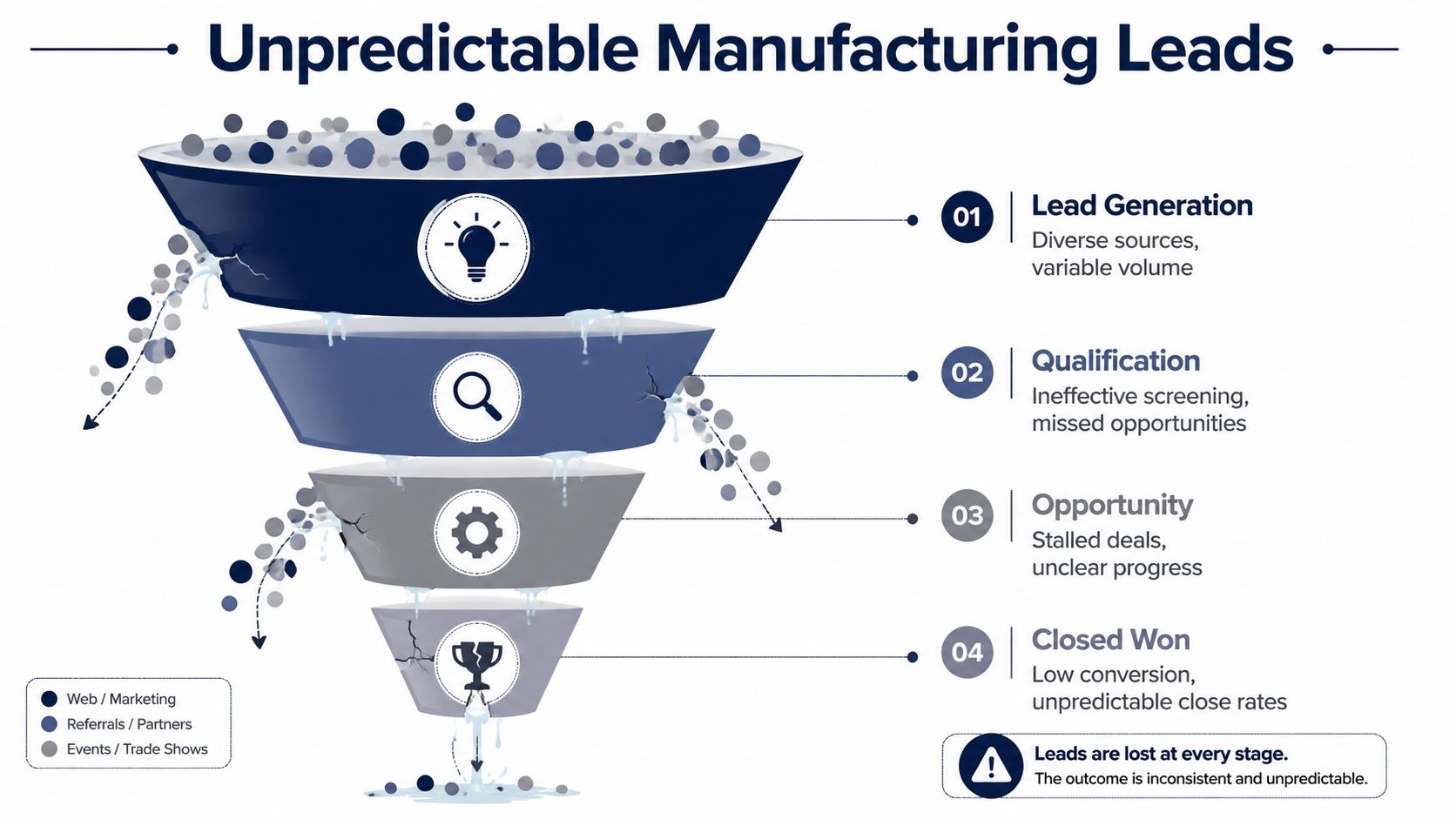
The real problem is cycle length and complexity
Most manufacturers don't suffer from a complete lack of demand. They suffer from poor continuity between first touch and sales conversation.
A prospect downloads a spec sheet. No tag is applied.
A rep gets a trade show list. Half the contacts never make it into the CRM.
Someone requests a quote too early. Sales spends time on an account that still hasn't aligned internally.
That's why “get more leads” is often the wrong instruction. If your process leaks after the first touch, adding volume just gives you a larger mess to sort through.
Practical rule: If you can't see where a lead is sitting, why it stalled, and who owns the next step, your manufacturing sales funnel isn't built yet.
Why more leads usually doesn't solve it
A healthy funnel turns scattered inquiries into managed opportunities. An unhealthy funnel creates false optimism at the top and empty forecasts at the bottom.
Look at the common failure points:
- Lead capture is disconnected: Website forms, rep notes, and event scans live in separate places.
- Qualification is inconsistent: One salesperson treats an inquiry as active pipeline, another treats it as research.
- Follow-up depends on memory: No automated reminders, no stage exit criteria, no nurture track.
- Sales context is thin: Reps get a name and company, but not the pages viewed, content consumed, or problem signaled.
- Leadership measures the wrong thing: Total leads go up, but nobody can explain pipeline quality.
If that sounds familiar, start by tightening the system behind your manufacturing lead generation efforts. Demand generation matters, but without stage control, it won't produce stable revenue.
A manufacturing sales funnel should do three things at once:
| Funnel job | What it looks like in practice | Business outcome |
|---|---|---|
| Organize demand | Every inquiry enters one tracked workflow | Fewer missed opportunities |
| Guide evaluation | Prospects receive the right proof at the right time | Better movement through technical review |
| Improve forecasting | Stage definitions reflect real buying progress | More credible pipeline visibility |
When we treat the funnel as an engineering problem, the path gets clearer. We identify failure points, define stage gates, assign ownership, and measure conversion by stage instead of hoping the pipeline fixes itself.
Map Your Funnel Stages and Buyer Personas
Generic funnel labels sound neat in a slide deck. They don't help your sales team decide whether an account is ready for a technical review, an RFQ, or procurement.
The stronger model is to define stages around how your buyers buy. A five-stage B2B funnel model built around prospecting, discovery call, buying committee nurturing, RFP, and legal produced 50% revenue growth, a 20-day shorter sales cycle, and a 30% increase in average contract value for one company. The lesson isn't that you must copy those labels exactly. The lesson is that formal stage definitions create alignment.
Use stages your sales team can actually defend
For most manufacturers, a practical funnel looks more like this:
Problem identified
The buyer knows something needs to change. Capacity, quality, cost, uptime, sourcing risk, lead time, or compliance is driving attention.Technical fit under review
Engineering, operations, or quality teams are comparing specifications, tolerances, materials, integrations, or production capabilities.Vendor evaluation
Your company is one of a smaller set being reviewed. Conversations get more specific. Questions shift from “Can you do this?” to “How would you deliver this?”Commercial validation
Pricing, scope, terms, timing, and implementation concerns become active. At this stage, many teams confuse interest with intent.Procurement and approval
Purchasing, legal, finance, and internal approvers step in. If your funnel doesn't separate this from earlier evaluation, reps tend to over-forecast.
Stage names matter less than stage criteria. Every stage needs an entry rule, an owner, and a required next action.
A good test is simple. If two sales reps review the same opportunity, they should place it in the same stage for the same reason.
Build personas around buying jobs, not demographics
Many persona exercises fail because they produce posters instead of tools. In manufacturing, personas should answer one question. What does this person need to say yes, or at least not block the deal?
A simple working set often includes:
- The engineer: Wants technical proof, compatibility, tolerances, drawings, process detail, and confidence that your team understands the application.
- The plant manager or operations leader: Cares about throughput, reliability, implementation disruption, training burden, and whether this will create headaches on the floor.
- The purchasing agent: Needs vendor documentation, pricing clarity, lead times, commercial terms, and a process that won't create administrative friction.
- The executive sponsor: Wants business justification. Risk reduction, cost logic, production impact, and strategic fit.
That's why a persona framework should live inside your CRM and content plan, not in a forgotten PDF. If you need a starting point, use a practical buyer persona framework for industrial teams.
Here's the simplest way to map personas to stages:
| Persona | Early stage need | Mid stage need | Late stage need |
|---|---|---|---|
| Engineer | Problem framing | Technical validation | Final spec confidence |
| Operations | Use case relevance | Workflow impact | Rollout clarity |
| Purchasing | Vendor fit | Commercial comparison | Documentation and terms |
| Leadership | Strategic rationale | ROI narrative | Approval confidence |
When teams skip this mapping, content becomes generic and sales conversations stay reactive. When teams do it well, the funnel stops speaking to “the lead” and starts supporting the actual committee behind the purchase.
Fuel Your Funnel with Targeted Content
Most manufacturing content doesn't fail because it's badly written. It fails because it arrives at the wrong time, speaks to the wrong role, or asks for a sales conversation before the buyer has enough confidence to take one.
A common gap in B2B funnel design is what happens after the first conversion. Buying groups commonly involve 6-10 stakeholders, and deals often stall when content only speaks to one role instead of the full committee. Effective funnel content has to support technical proof, ROI discussion, and procurement requirements across that group.
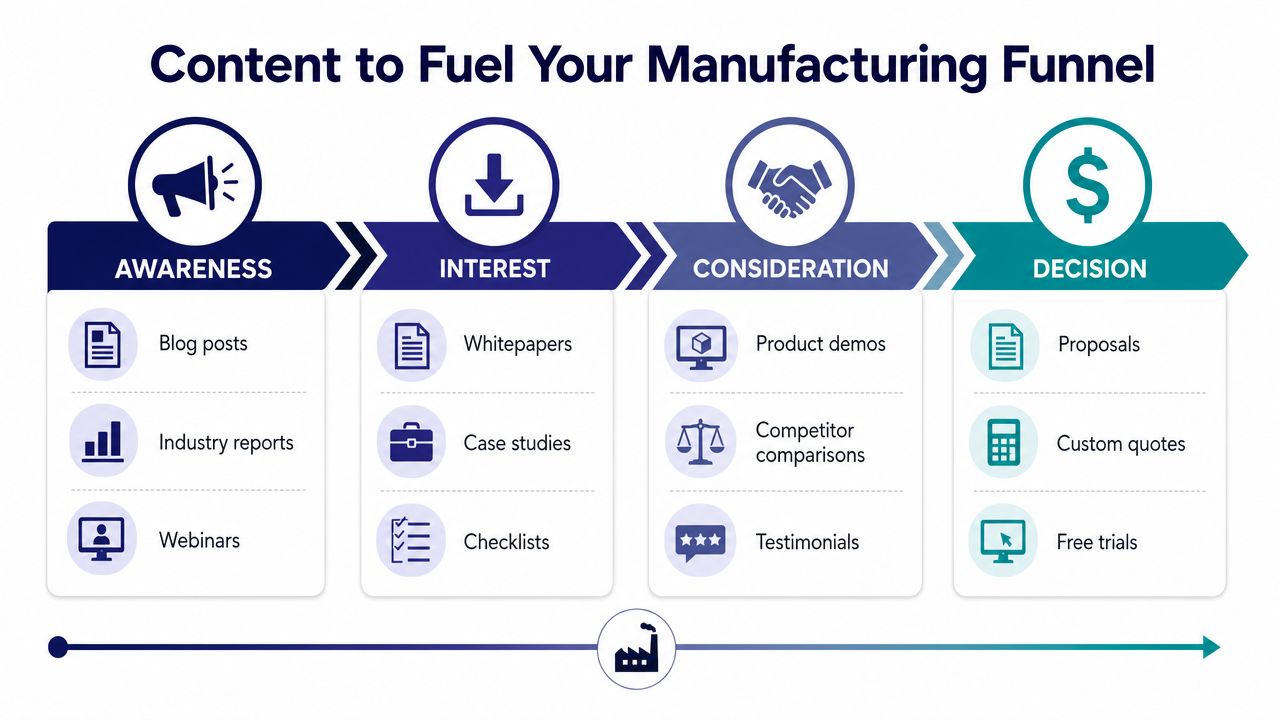
Content should remove buying friction
The best content in a manufacturing sales funnel answers the next operational question. It doesn't just attract clicks.
For industrial teams, useful assets often include:
- Application guides: Help engineers compare materials, methods, or component options.
- Capability pages: Show process range, tolerances, equipment, certifications, and ideal project fit.
- CAD files and technical documentation: Reduce friction for engineering review.
- ROI and cost framing tools: Help internal champions justify a change to finance or leadership.
- Procurement support documents: Make vendor approval easier instead of slower.
If your content mix is still built around generic ebooks, it's probably too broad. Technical buyers usually want proof, not inspiration. A stronger content marketing system for manufacturing companies builds around buying obstacles you can remove.
Create assets your internal champion can reuse
Your first contact rarely closes the deal alone. They carry your case into internal meetings where you aren't present.
That changes the content brief. You're not only educating a lead. You're equipping a champion.
Your contact needs material they can forward, screenshot, print, or summarize in a meeting where your sales rep isn't in the room.
That means each late-stage opportunity usually needs a small content bundle, not a single brochure:
- For engineering: Drawings, specs, process explanation, quality notes
- For operations: Implementation notes, production impact, support expectations
- For finance or leadership: Business case summary, risk framing, expected operational value
- For purchasing: Vendor information, terms, documentation checklist
A practical nurture sequence for manufacturers
Instead of “send three emails,” use a sequence with a job.
Touch one should acknowledge the trigger. If someone downloaded a guide on material selection, follow up with related technical proof, not a demo request.
Touch two should deepen the conversation. Send a comparison page, process explainer, or use-case example that helps them evaluate fit.
Touch three should widen the audience. Offer a resource designed for another stakeholder, such as a one-page business case or procurement checklist.
Touch four should invite a low-friction next step. A design review, application consult, quote readiness call, or feasibility discussion usually works better than a broad “book a meeting” ask.
Use multiple channels where appropriate. Email handles continuity. Sales outreach adds context. Retargeting reinforces visibility. CRM notes keep the whole team informed.
A manufacturing sales funnel gains momentum when content is tied to movement. Every asset should either qualify interest, answer a decision question, or help the buyer bring another stakeholder into the process.
Automate Your Funnel with a CRM System
A funnel on a whiteboard is theory. A funnel inside a CRM is a working system.
That's where most manufacturing teams either gain control or lose it. If stages, contact records, notes, tasks, and follow-up logic live in different places, nobody has a complete picture of the account.
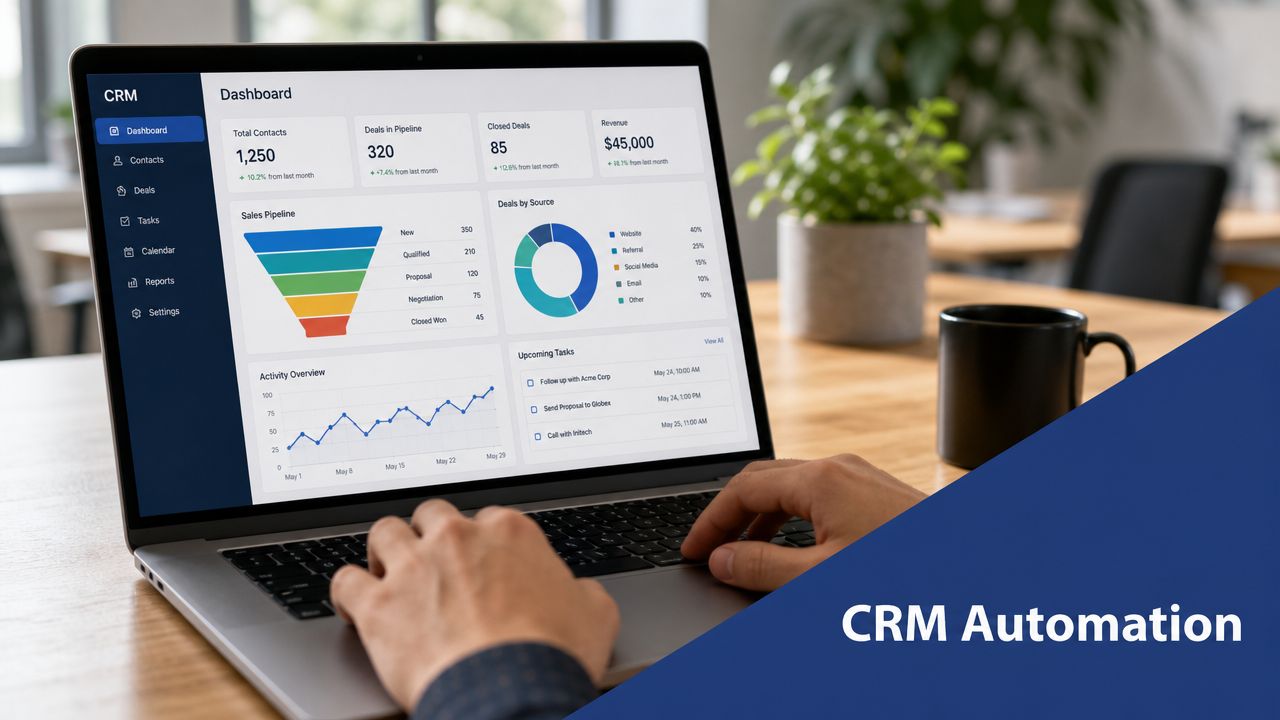
Build the pipeline inside the CRM
Start by matching your CRM pipeline to the stage map you defined earlier. Don't add vague columns like “hot lead” or “interested.” Use stages that reflect buying progress.
Each opportunity record should include fields such as:
- Lead source
- Primary application or product interest
- Target industry or account type
- Buyer role
- Estimated project timing
- Known stakeholders
- Next step
- Stage exit reason
GoHighLevel can handle this structure well for small and midsize manufacturers because it combines pipeline management, forms, automation, email, SMS, task creation, and reporting in one place. HubSpot, Salesforce, and Pipedrive can also work. The right choice depends on your internal complexity and how disciplined your team is about data entry.
Use GoHighLevel for routing, tagging, and follow-up
Here's the setup pattern that works:
Capture the lead with context
Website forms should ask enough to route intelligently without creating friction. Product interest, project type, and timeline are often enough to start.Apply tags automatically
If a contact downloads a spec sheet, visits a product page, or submits a quote form, tag those actions. Tags become shorthand for sales context.Create the right task at the right moment
A new quote request may trigger an immediate rep task. An early-stage content download may trigger a nurture workflow instead.Build stage-based automations
When a deal moves into technical review, notify the right owner. When it sits too long without activity, create a follow-up task. When it closes lost, trigger a recycle sequence.Track handoff details in the record
Reps shouldn't have to guess why a lead was passed to them. Include source, recent engagement, content viewed, and recommended first conversation angle.
A useful implementation often combines your CRM with web forms, analytics, ad platforms, and email workflows. If you need help connecting those pieces, Machine Marketing provides CRM and automation strategy for B2B manufacturers as one option alongside internal admin support, freelance RevOps help, or platform-specific consultants.
Automation should support reps, not replace them
Automation works best when it removes clerical effort and improves timing. It fails when teams use it to avoid thinking.
Don't automate around assumptions like “downloaded a file equals sales ready.” Automate around behavior plus context. A contact from an existing target account who requests a quote should move differently than a student who downloads a guide.
The video below gives useful context on funnel and CRM setup workflows.
Use this standard when reviewing your build:
If an automation fires, someone on your team should be able to explain why it fired, what it changed, and what outcome it's supposed to create.
That's what turns a CRM from a contact database into a manufacturing sales funnel your team can trust.
Define Your KPIs and Sales Handoff Process
If leadership only asks, “How many leads did we get?” the funnel will drift toward vanity. Traffic grows. form fills rise. Sales still says the pipeline feels weak.
That happens because a single top-line conversion number hides the underlying issue. The main operational pitfall in funnel management is relying on one summary metric. It masks leakage between stages. A better process is a monthly review of stage conversion trends and the content most correlated with closed deals, with attention on metrics like win rate, average deal size, and sales-cycle length.
Stop managing the funnel with one headline number
A manufacturing sales funnel should be measured by stage behavior, not by lead totals alone.
That means your dashboard should separate three types of metrics:
| Metric group | What to monitor | Why it matters |
|---|---|---|
| Awareness signals | Website traffic, trade show contacts, key page visits | Shows whether you're generating relevant attention |
| Consideration signals | Content downloads, technical page views, repeat engagement | Shows whether buyers are evaluating fit |
| Revenue signals | Win rate, average deal size, sales-cycle length | Shows whether the funnel is producing business results |
This approach changes the conversation. Instead of saying “marketing generated leads,” you can ask better questions:
- Are technical buyers engaging with the right assets?
- Which stage shows the biggest slowdown?
- Are quote requests moving into real opportunities?
- Which content appears in won deals most often?
- Where does sales lose confidence in lead quality?
A dashboard should help you choose the next fix. If it only reports activity, it isn't doing its job.
What marketing must hand off to sales
The handoff fails when sales receives names instead of context.
A usable handoff package should include:
- Lead source and first conversion point
- Pages viewed or assets downloaded
- Known role or department
- Stated problem, timeline, or application
- Recommended next action
- Owner and follow-up deadline
Then set the rules. What makes a lead sales qualified in your business? Is it a quote request, a defined application, a target account match, or a specific level of engagement plus fit? Your answer should be written down, reviewed jointly, and enforced in the CRM.
Without that agreement, marketing thinks sales ignores leads and sales thinks marketing sends bad leads. Both teams can sound justified because nobody defined the system.
A simple monthly review rhythm
You don't need a giant RevOps department to run this well. You need a consistent operating cadence.
Use a monthly review with sales and marketing to answer:
- Where are deals slowing down by stage?
- Which lead sources are producing movement, not just inquiries?
- Which content appears in opportunities that advance?
- What objections are repeating?
- What workflow, field, or automation needs adjustment?
That meeting should end with a short action list. Tighten one handoff rule. Add one field. Rewrite one email. Build one missing asset. Good funnel management is usually iterative, not dramatic.
Your 90-Day Plan to Launch Your Funnel
A manufacturing sales funnel becomes manageable when you build it in sprints. Don't try to redesign stages, write every asset, migrate your CRM, and retrain sales in one push. That's how teams create half-finished systems nobody adopts.
If you want an outside reference on how to build effective sales funnels, that guide is a useful companion for broad funnel planning. For manufacturers, the key is narrowing that guidance into a process your sales team can run every day.
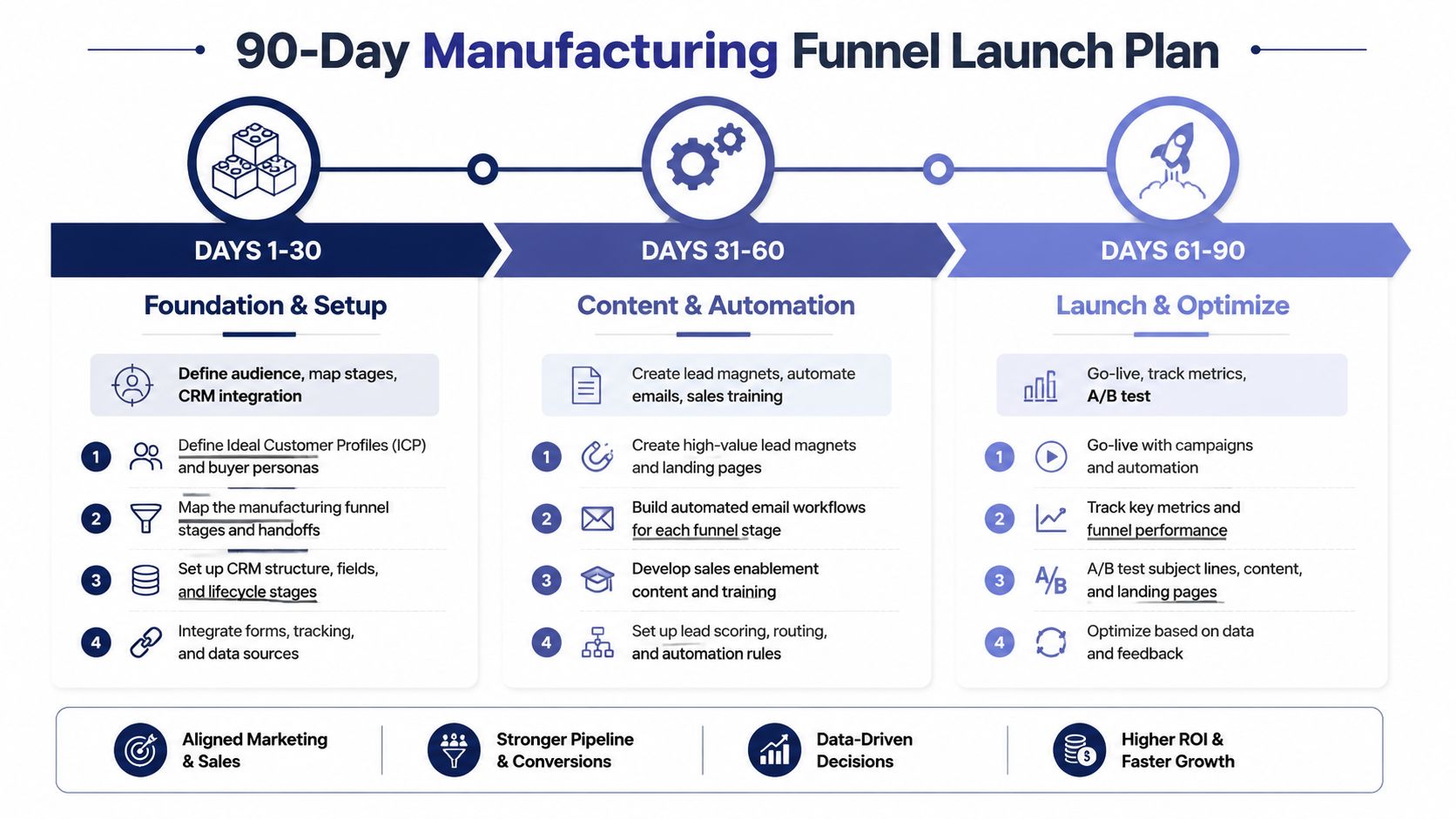
Days 1 through 30 foundation and setup
Use the first month to define the operating model.
- Audit your current path: List every lead source, every handoff point, and every place leads currently get stuck.
- Define your stages: Keep them tied to buyer progress, not gut feel.
- Name your personas: Focus on engineer, operations, purchasing, and executive concerns if those roles matter in your deals.
- Set field requirements: Decide what information must exist before a lead can move stages.
- Choose one CRM owner: Someone has to own structure, cleanup, and process discipline.
By the end of this sprint, your team should be able to answer two questions without debate. What stage is this opportunity in, and what has to happen next?
Days 31 through 60 content and automation
Now build the tools that make the process move.
Create your core content set first. That usually means one early-stage educational asset, one technical proof asset, one business-case asset, and one procurement support asset. You don't need a giant library. You need the smallest useful set that supports real conversations.
Then configure automation:
| Build item | What to implement |
|---|---|
| Forms and intake | Route inbound leads into the CRM with clear source data |
| Tags and segmentation | Identify interest by product, role, and behavior |
| Task automation | Trigger rep follow-up and stalled-opportunity reminders |
| Nurture workflows | Send role-relevant content tied to stage and behavior |
| Pipeline visibility | Make stage ownership and next steps obvious |
Don't automate exceptions first. Automate the common path that your team handles every week.
Train sales at this stage, not after launch. Reps need to know what fields matter, what stages mean, and how automation supports them.
Days 61 through 90 launch and optimization
The last month is where discipline matters most. Launch the funnel, but keep the first version tight enough to observe.
Use this sprint to:
- Turn on campaigns deliberately: Start with the channels you already control well.
- Monitor stage movement daily: Not forever, just long enough to catch setup errors.
- Review handoff quality: Ask sales whether they're getting context or just contact records.
- Refine content gaps: If deals stall in technical review or procurement, create the missing support asset.
- Hold the first monthly funnel review: Use real stage data, not opinions.
What works in this phase is restraint. Don't chase every idea. Fix the visible bottlenecks first.
A solid first-quarter outcome isn't perfection. It's a working manufacturing sales funnel with defined stages, active CRM automation, accountable handoffs, and a review rhythm your team can sustain.
If your team has the tools but not the system, Machine Marketing can help you diagnose the gaps, map the funnel, and connect your CRM, content, and sales process into one operating model.