If you run a machine shop or manufacturing company, this probably feels familiar. Your website still gets some traffic, your team still answers RFQs, and you're still publishing capability pages or blog posts. But the right leads don't seem to grow the way they used to, and more buyers are showing up better informed before they ever contact you.
That shift isn't just about Google rankings anymore. Buyers now use AI tools to compare vendors, ask process questions, shortlist suppliers, and summarize technical options before they fill out a form. If your expertise isn't easy for those systems to parse, trust, and cite, your company can become invisible during the research phase that shapes the final vendor list.
If you want to learn how to optimize for AI search, the job is no longer “publish more content.” The job is to build a system that makes your expertise extractable, verifiable, and measurable.
Table of Contents
- The New Hidden Hurdle to B2B Lead Generation
- Diagnosing Your AI Search Readiness
- Create Content That AI Search Engines Trust
- Fortify Your Website's Technical Foundation
- Measure AI Visibility and Prove Your ROI
- Your AI Search Optimization Implementation Checklist
The New Hidden Hurdle to B2B Lead Generation
A lot of industrial companies are still using a search strategy built for an older buying process. Publish a few service pages. Add some keyword-targeted blog posts. Wait for traffic. Hope the right buyer lands on the right page at the right time.
That system doesn't break all at once. It just starts producing weaker signals. You may still get visits, but fewer of those visits turn into qualified conversations. Buyers are doing more research before they ever reach your team, and AI tools now sit in the middle of that research process.
For manufacturers, that creates a hidden hurdle. You may have real expertise in tolerances, materials, lead times, production methods, quality standards, and application fit. But if that expertise is buried in vague copy, PDF-only documentation, messy page structure, or generic marketing language, AI systems won't surface it well.
Practical rule: If an estimator, engineer, or sourcing manager can't skim your page and get a direct answer fast, an AI system probably won't cite it either.
AI-driven search behaves differently from traditional search. It doesn't just rank pages. It extracts answers, compares sources, and favors content that looks trustworthy, structured, and specific.
For a machine shop, that changes the target. You're not only trying to rank for “CNC machining services” or “contract manufacturing.” You're trying to become the source an AI system pulls when someone asks:
- Capability questions: “Who can machine tight-tolerance aluminum housings?”
- Comparison questions: “When should I use 5-axis instead of 3-axis machining?”
- Qualification questions: “What should I ask a precision machining supplier before requesting a quote?”
- Process questions: “What materials create the biggest issues for repeatability?”
That's why the old playbook feels less reliable. It wasn't built for answer extraction.
The good news is that industrial businesses already have the raw material needed to win. Your expertise is real. Your process knowledge is hard-earned. Your applications, spec knowledge, and production constraints are valuable. The issue usually isn't credibility. It's packaging that credibility in a format AI can understand and reuse.
Diagnosing Your AI Search Readiness
Before you change your content, diagnose the system. Most websites don't have a traffic problem first. They have a clarity problem.
Evaluate your website's current AI search compatibility.
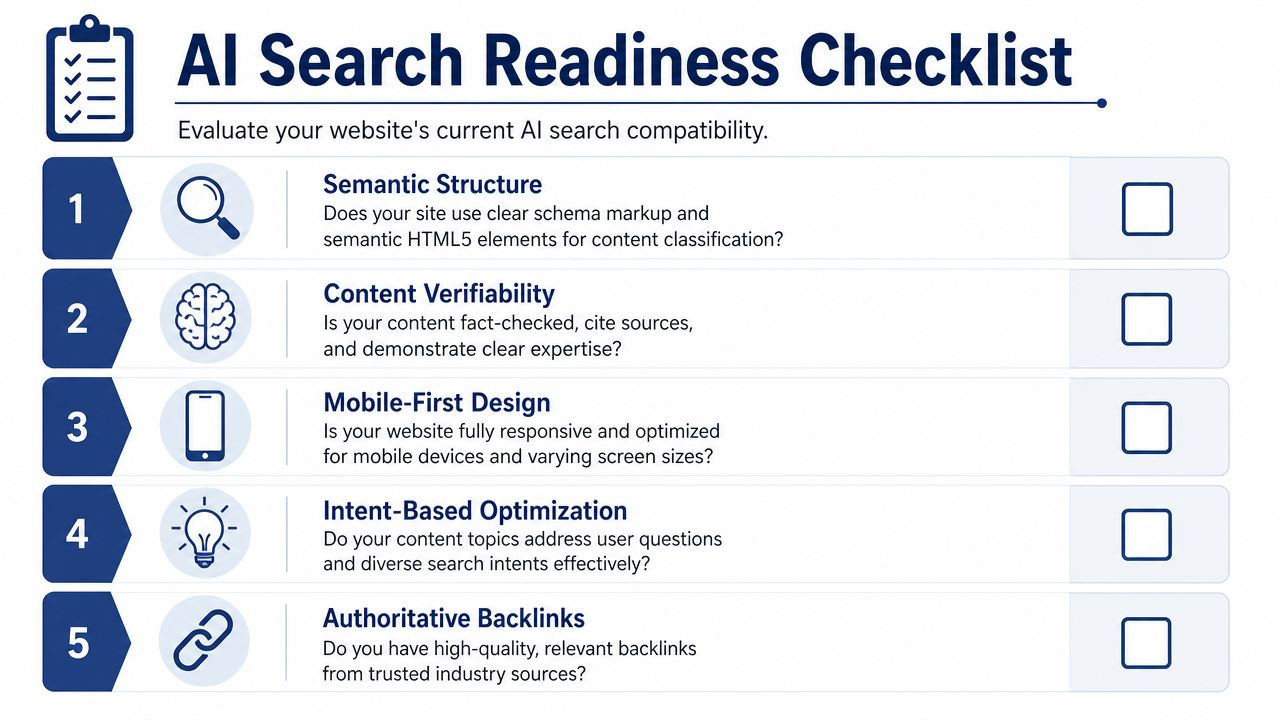
What AI systems look for first
AI search tools favor pages that are easy to extract, easy to validate, and easy to attribute. That means your homepage polish matters less than your page structure, answer quality, and proof.
One structural requirement is especially important. Pages should include a 40- to 60-word direct answer summary placed above the fold immediately under the H1 heading so the main question is answered right away, as explained in Elementor's guide on answer-first formatting for AI search.
If your service pages open with brand slogans, broad claims, or a stock hero image before saying what you do, you're making AI work harder than it needs to.
Use this quick diagnostic list:
- Answer-first content: Does each key page answer a real buyer question in the first few lines, or does it start with general marketing copy?
- Logical structure: Do your headings follow a clear hierarchy, or do pages jump around without a usable outline?
- Crawlable information: Is critical information in HTML on the page, or buried in downloadable files, tabs, sliders, or images?
- Clear expertise signals: Does the page show who knows this topic inside your company?
- Verifiable claims: Are technical claims supported with specifics, not just adjectives like “high quality” or “industry leading”?
Questions to ask before you change anything
A strong diagnosis starts with uncomfortable questions. Most companies skip this and go straight to publishing. That's usually where wasted effort begins.
Ask your team:
- Would a first-time buyer understand this page in under a minute?
- Can a sourcing manager tell what industries, materials, tolerances, or production types we're best suited for?
- Do our pages solve narrow technical questions, or only describe broad services?
- Have we shown real expertise, or just said we have it?
- Is our website architecture clean enough that a crawler can understand how pages relate?
If you're not sure where the gaps are, start with a formal review. A structured marketing audit process helps you identify whether the problem is messaging, structure, technical SEO, or measurement instead of guessing and rewriting random pages.
Most AI visibility problems look like content problems from the outside. Inside the system, they're often organization problems.
Here's a simple way to score readiness internally:
| Area | What good looks like | Common failure |
|---|---|---|
| Page opening | Direct answer appears immediately | Long introduction with no answer |
| Content proof | Specific, checkable details | Generic claims with no support |
| Structure | Clean H1, H2, H3 order | Visual formatting without logical hierarchy |
| Expertise | Named experts or author context | Anonymous copy |
| Accessibility | Core info in crawlable HTML | Important details hidden in assets |
That gives you a practical starting point. Don't treat AI search like a mystery. Treat it like a site diagnosis.
Create Content That AI Search Engines Trust
Generic content is easy to produce now. That's exactly why it's becoming less useful.
Build content that AI prioritizes by focusing on expertise and originality.
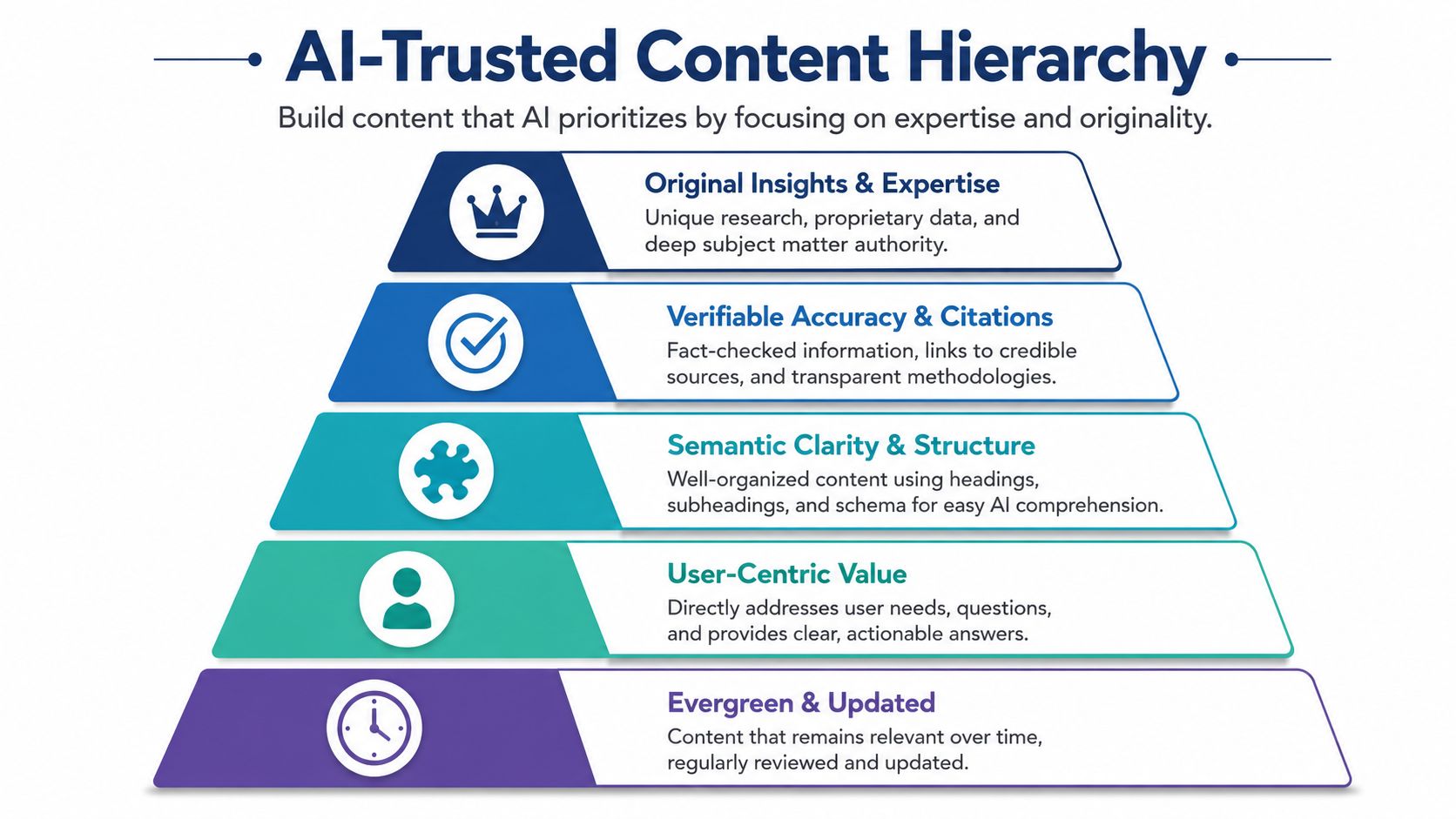
Industrial companies have an advantage here because your business runs on details competitors can't fake easily. Material behavior, fixturing decisions, tolerance trade-offs, quality checkpoints, and quoting constraints all come from real experience. That's the kind of input AI systems tend to value when it's documented well.
Aleyda Solis recommends creating 30 to 50 commercially relevant prompts grouped by product, service, or persona, then building content hubs around them. In relevant niches, that structured approach can increase AI citation rates by up to 40% when paired with strong answer-first formatting, according to her AI search optimization checklist.
Later, when you're planning your internal process, keep that prompt range in mind. It forces specificity.
What trusted industrial content looks like
The strongest pages don't read like blog filler. They read like useful technical guidance.
Instead of a broad article on “CNC machining services,” build pages around narrower questions such as:
- Material-specific guidance: “What affects tolerances when machining Inconel parts?”
- Process comparison: “When is 5-axis worth the added setup complexity?”
- Buyer education: “What information speeds up quoting for repeat production parts?”
- Risk reduction: “What design choices increase scrap risk in thin-wall components?”
This is also where original evidence matters. Investing in original data and expert quotes can increase AI visibility by 30% to 40% because AI models prioritize “fact-density” and trust signals tied to verifiable claims and credentialed experts, according to the Digital Marketing Institute.
A page with engineering commentary, inspection notes, material guidance, and real constraints usually beats a polished but generic page every time.
A practical content hub model for manufacturers
Use your content like an application library, not a publishing calendar.
Here's a practical hub structure for a machine shop focused on precision machining:
Pillar page
One main capability page for precision CNC machining. It explains fit, materials, part profiles, production scenarios, and quality expectations in plain language.Decision pages
Supporting pages that answer buyer comparison questions. For example, 3-axis versus 5-axis, prototype versus production, or aluminum versus stainless for a specific application.Problem pages
Content built around failure points. Thin walls, burr control, tolerance stack-up, heat distortion, finish requirements, or inspection issues.Industry pages Pages designed for medical, aerospace, industrial equipment, or energy buyers, each written around that industry's documentation and quality concerns.
FAQ blocks and short-form answers
These are the extractable units AI systems like. Keep them concise and self-contained.
If your team uses tools to organize knowledge and connect related ideas, it's worth looking at how people structure internal knowledge systems. This write-up on semantic search for Obsidian is useful because it shows how topic relationships matter when you're trying to retrieve the right answer from a large body of information. The same principle applies to your website content.
For a more detailed industrial publishing approach, a technical content marketing system helps teams turn engineering knowledge into pages that sales, SEO, and AI search can all use.
How to capture expertise from your team
Most industrial companies don't have a content shortage. They have an extraction problem. The engineers know the answers. The sales team hears the recurring questions. The operators know where parts fail. None of that helps if it stays in Slack, meetings, or tribal knowledge.
A simple capture process works better than waiting for someone to “write a blog.”
- Interview one subject matter expert at a time: Ask about the questions buyers repeat most often.
- Pull out decision criteria: What changes the answer? Material, tolerance, quantity, finish, geometry?
- Add credentials where relevant: State who the expert is and why their input matters.
- Turn answers into modular sections: Short paragraphs, bullet lists, comparison tables, and FAQs.
- Review for accuracy before publishing: AI trust starts with human accuracy.
This section pairs well with a practical example. Watch this short walkthrough for another angle on how teams are thinking about visibility in AI search.
Buyers don't need more content. They need faster confidence.
Fortify Your Website's Technical Foundation
Even strong content gets ignored when the website underneath it is hard to parse.
A step-by-step guide to optimize your site's technical structure for AI crawlers.
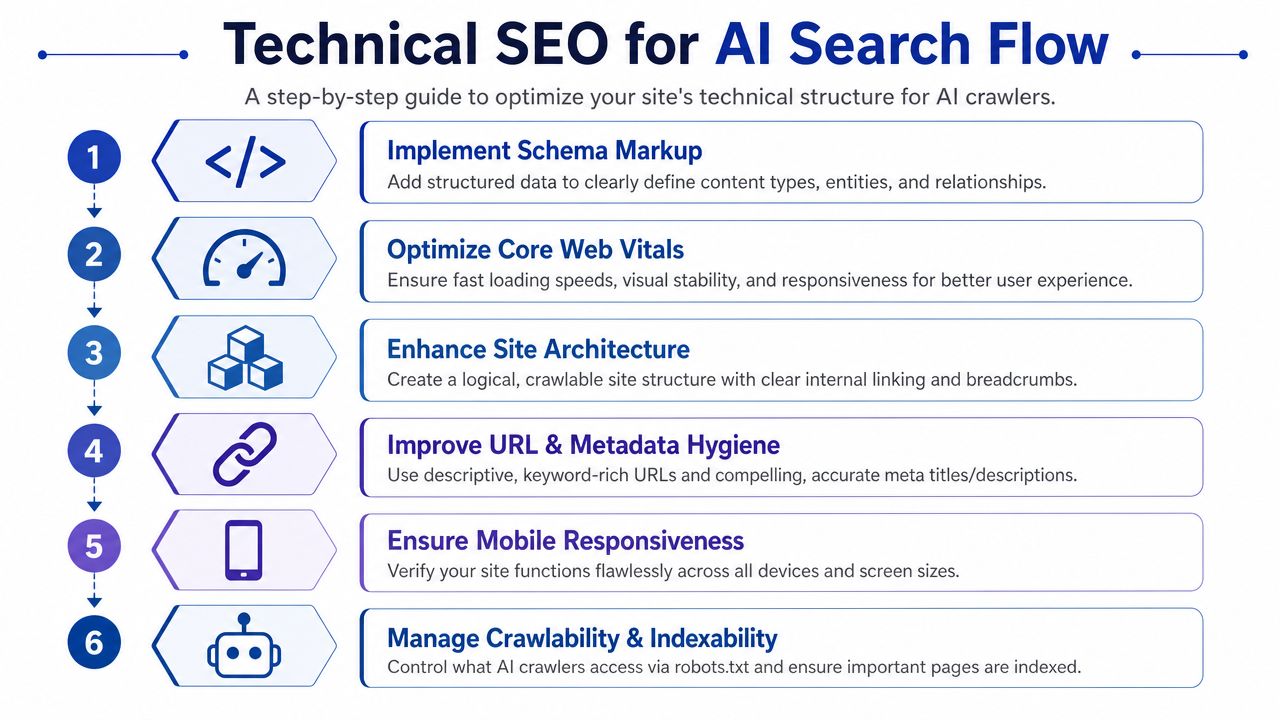
The technical side of AI search doesn't require a full rebuild in every case. But it does require discipline. AI systems need a clean blueprint that tells them what each page is, how sections relate, who authored the content, and which information is current.
Google's guidance for generative AI visibility puts foundational SEO first. A clear technical structure with logical heading hierarchies and JSON-LD schema is the base requirement, as noted in this summary of Google's guidance on technical structure for generative AI.
Your site needs a clean blueprint
Think of your website like a shop floor. If raw material, setups, inspection, and shipping were all mixed together without labels, people would waste time and make mistakes. Search systems have the same problem with messy websites.
The first priority is structure:
- One clear H1 per page: State the main topic plainly.
- Logical H2 and H3 hierarchy: Group ideas in a way that reflects how buyers think through the topic.
- Semantic HTML5 elements: Use meaningful structure like article, section, and nav where appropriate.
- Schema markup: Add organization, article, author, business, and event details where relevant.
- HTTPS everywhere: Security and page experience are baseline requirements.
If your site taxonomy is confusing, AI will struggle to understand the relationship between pages. This guide to website taxonomy is useful if your services, industries, and resource pages have grown without a clear organizing logic.
The technical fixes that matter most
Not every technical task has equal value. Start with the work that improves comprehension and accessibility.
A practical sequence looks like this:
| Priority | What to fix | Why it matters |
|---|---|---|
| First | Heading hierarchy | Helps AI parse page structure |
| Next | JSON-LD schema | Labels entities and page meaning |
| Next | Crawlable HTML content | Prevents key information from being hidden |
| Next | Performance improvements | Makes pages easier to access and use |
| Next | Metadata and freshness signals | Clarifies page purpose and recency |
MonsterInsights recommends load times under 3 seconds, along with image compression in WebP or AVIF, browser caching, and minimized CSS and JavaScript for fast crawler access in its guide to technical AI search optimization.
There's also a hard lesson here. Teams that rely only on traditional SEO and ignore page structure, conciseness, and extractability can see AI citation rates drop by 50% to 60%, based on the same MonsterInsights guide. That doesn't mean you abandon SEO. It means you stop assuming old SEO alone is enough.
A few technical trade-offs are worth calling out:
- Fancy design vs clarity: Motion-heavy layouts and hidden content may look modern but often reduce extractability.
- PDF dependence vs HTML pages: Spec sheets in PDF form can support buyers, but the core information still needs to live on the page.
- Template convenience vs page intent: Reusing the same generic page format across every service usually weakens specificity.
Clean technical structure doesn't make weak content strong. It makes strong content visible.
Measure AI Visibility and Prove Your ROI
The biggest reporting mistake in AI search is using old metrics to judge a new system.

If your monthly review still focuses only on keyword rankings, sessions, and form fills, you're missing the stage where more buyers now form their shortlist. Olive & Company highlights the gap clearly: 78% of B2B marketers lack a framework to measure AI visibility, while 65% of B2B decision-makers now use AI for initial research, which makes traditional rank tracking insufficient for proving ROI, according to their article on measuring AI search optimization.
Traditional SEO reporting misses the real question
A page can rank reasonably well and still fail in AI search. That's because ranking and citation are not the same thing.
An operations-minded business owner should ask a different question: Are AI systems using our content when buyers ask the questions that lead to revenue?
That means your reporting needs to shift from position tracking alone to visibility tracking at the answer level.
Here's the practical distinction:
- Traditional SEO asks: Did we rank?
- AI visibility asks: Did we get cited, summarized, or used as the basis for an answer?
Those are related, but they aren't interchangeable.
What to track instead
You don't need a perfect enterprise dashboard to start. You need a repeatable measurement framework your team can maintain.
Track these categories:
- Citation presence: Does your company appear in AI-generated answers for your core commercial questions?
- Citation frequency: How often do your pages show up over time for those same prompts?
- Page source patterns: Which pages get cited most often? Capability pages, FAQ pages, comparison pages, or resource content?
- Message accuracy: When AI references your business, does it describe your capabilities correctly?
- Commercial prompt coverage: Are you visible for buying-stage questions, not just top-of-funnel educational topics?
A simple internal workflow works well:
- Build a prompt library based on your core services, materials, industries, and buyer concerns.
- Test those prompts on the AI platforms your customers are likely to use.
- Log whether your brand appears, which page is used, and how accurate the summary is.
- Repeat the same prompt set on a schedule so you can compare patterns.
- Tie that visibility trend back to page updates and content launches.
If you can't tell which pages AI cites, you can't prove whether your content system is improving.
This is especially important in industrial sales cycles. A buyer may not click through from an AI answer immediately. But if your company keeps appearing as a credible source during early research, you shape the shortlist before sales ever sees the opportunity.
That's why AI visibility should sit next to pipeline reporting, not outside it. It's an upstream authority metric.
Your AI Search Optimization Implementation Checklist
A machine shop can spend months publishing articles, updating title tags, and polishing case studies, then still fail to appear when a buyer asks an AI tool, "Who can handle tight-tolerance aerospace machining in the Midwest?" The usual problem is not effort. It is sequence.
Industrial teams get better results when they fix the pages tied to quoting, make technical details easier to parse, and build a review routine they can keep up with between production deadlines. That matters because AI search does not reward volume alone. It rewards clear, trustworthy, well-structured information that matches real buying questions.
Priority one fixes
Start with pages that support revenue now. For manufacturers and machine shops, that usually means capability pages, process pages, service pages, and industry pages that buyers check before they request a quote.
Use this checklist:
- Add a plain-language answer near the top: Put a short summary under the H1 that explains what you do, for whom, and where your strengths are.
- Cut generic intros: Buyers and AI systems both need the answer early. Move core details above company history and marketing copy.
- Tighten heading structure: Use headings that reflect the actual questions a purchasing manager or engineer would ask.
- Pull important details out of PDFs: If tolerances, materials, certifications, or lead-time information only live in downloadable files, move the key points into the page itself.
- Use schema where it supports the page: Organization, Article, FAQ, and author-related markup can help clarify what the page is about.
- Show real expertise: Name the contributor, reviewer, or technical source when the topic depends on engineering or production knowledge.
- Build content around buying prompts: Group pages by services, materials, industries served, and common evaluation questions.
If you want another implementation-focused perspective, learn AI search with Shoptank.
Operational habits that keep the system working
Execution breaks down when AI search becomes "marketing's side project." In industrial companies, the best source material often sits with sales engineers, quality managers, estimators, and production leaders. A workable system respects that reality and keeps the lift reasonable.
Set a recurring routine your team can maintain:
- Run a monthly prompt check: Review the commercial questions that matter to quoting and shortlist creation.
- Refresh weak pages each quarter: Update pages that are vague, outdated, or missing technical proof.
- Interview subject-matter experts on a schedule: Short, focused interviews usually produce better material than asking busy technical staff to draft content from scratch.
- Review page relationships: Make sure supporting pages reinforce your main capability and industry pages instead of competing with them.
- Compare visibility with sales feedback: Look for overlap between the topics where you appear in AI results and the questions prospects bring into early calls.
A good checkpoint is simple. Can a sourcing manager understand your capabilities, constraints, and fit without having to infer the details from design, brochures, or sales follow-up?
Use these questions during review:
- Does this page answer a buying-stage question clearly?
- Are our claims specific enough to be credible?
- Do we explain materials, tolerances, processes, and certifications in plain language?
- Can a crawler read the key information in HTML?
- Do we know which pages are helping us show up in AI-generated answers?
Good implementation is usually less glamorous than teams expect. It means fewer filler pages, better technical detail, cleaner structure, and a measurement routine you can defend to leadership.
That is how a B2B manufacturer improves AI search visibility in a way that supports lead quality, shortlist inclusion, and revenue.
If you want a clear diagnosis of where your website stands, Machine Marketing helps manufacturers and industrial businesses identify the content, structure, and measurement gaps that keep them invisible in AI-driven search. If your team already has tools in place but needs a stronger system, that's the right place to start.