If you're a manufacturer posting shop photos, trade show updates, and company milestones but getting little back, the problem usually isn't effort. It's that your social activity was built like a bulletin board instead of a system.
We see this pattern constantly in industrial firms. The team knows the business cold. The engineers can solve real problems. Sales has strong customer knowledge. But social media gets handed off as a side task, and the result is predictable: inconsistent posting, low engagement, no clear attribution, and a growing suspicion that none of it matters.
A better approach to B to B social media marketing looks a lot more like operations than promotion. You define the objective, choose the right channel, build a repeatable content engine, and measure outcomes that connect to pipeline. For manufacturers, that usually means fewer platforms, more subject-matter expertise, and a lot less noise.
Table of Contents
- Diagnosing the Problem with Industrial Social Media
- Building Your Strategic Foundation Before You Post
- Choosing Your Core Platforms with 80/20 Focus
- The Content Repurposing System for Maximum Efficiency
- A Sample Content Calendar and Post Templates
- Measuring What Matters KPIs and Reporting for B2B
- Your Next Action From Playbook to Practice
Diagnosing the Problem with Industrial Social Media
A typical industrial company starts social media with good intentions. Someone on the team posts finished parts, a booth photo from an expo, a holiday message, maybe a new machine install. Months later, the company has a feed, but not much else. Sales doesn't mention it. Leadership doesn't trust it. Marketing feels stuck.
That outcome isn't surprising. Most industrial social programs fail because they publish updates that matter internally, not content that helps buyers think through a problem. The feed becomes a record of company activity instead of a reason for a prospect to pay attention.
A lot of manufacturers are dealing with a broader version of the same issue. The tools exist, the expertise exists, but the pieces aren't connected into a useful system. That's the same root cause described in this breakdown of why manufacturers struggle with marketing.
The symptoms are easy to spot
You probably have a systems issue if social media looks like this:
- The company page acts like a press release feed. New hires, anniversaries, machine photos, and internal news dominate the schedule.
- The posts don't answer buyer questions. Procurement, engineering, operations, and ownership all care about different risks. The content addresses none of them directly.
- No one owns the process. Marketing posts when there's time. Sales doesn't contribute. Engineers aren't involved.
- The team judges success by activity. If something got posted, it feels complete, even if no qualified conversation started.
Social media feels random when it isn't attached to a business objective, a buyer problem, and a distribution process.
What industrial buyers actually respond to
In manufacturing, buyers don't need more generic visibility. They need signs that your team understands tolerances, lead time pressure, quality concerns, supply chain risk, documentation needs, production constraints, and implementation reality.
That means effective B to B social media marketing for industrial firms usually has these traits:
- Problem-first content. Posts start with a production, sourcing, engineering, or quality problem.
- Visible expertise. The people who know the work help shape the message.
- Commercial intent. Content points toward a next step, even if softly, such as reading a case study, watching a walkthrough, or contacting sales.
- Consistency. The audience sees the same useful themes often enough to remember you.
The fix isn't posting more. The fix is replacing random content with an operating system.
Building Your Strategic Foundation Before You Post
Before content calendars, design templates, or scheduling tools, we need three answers. Without them, social media becomes motion without direction.
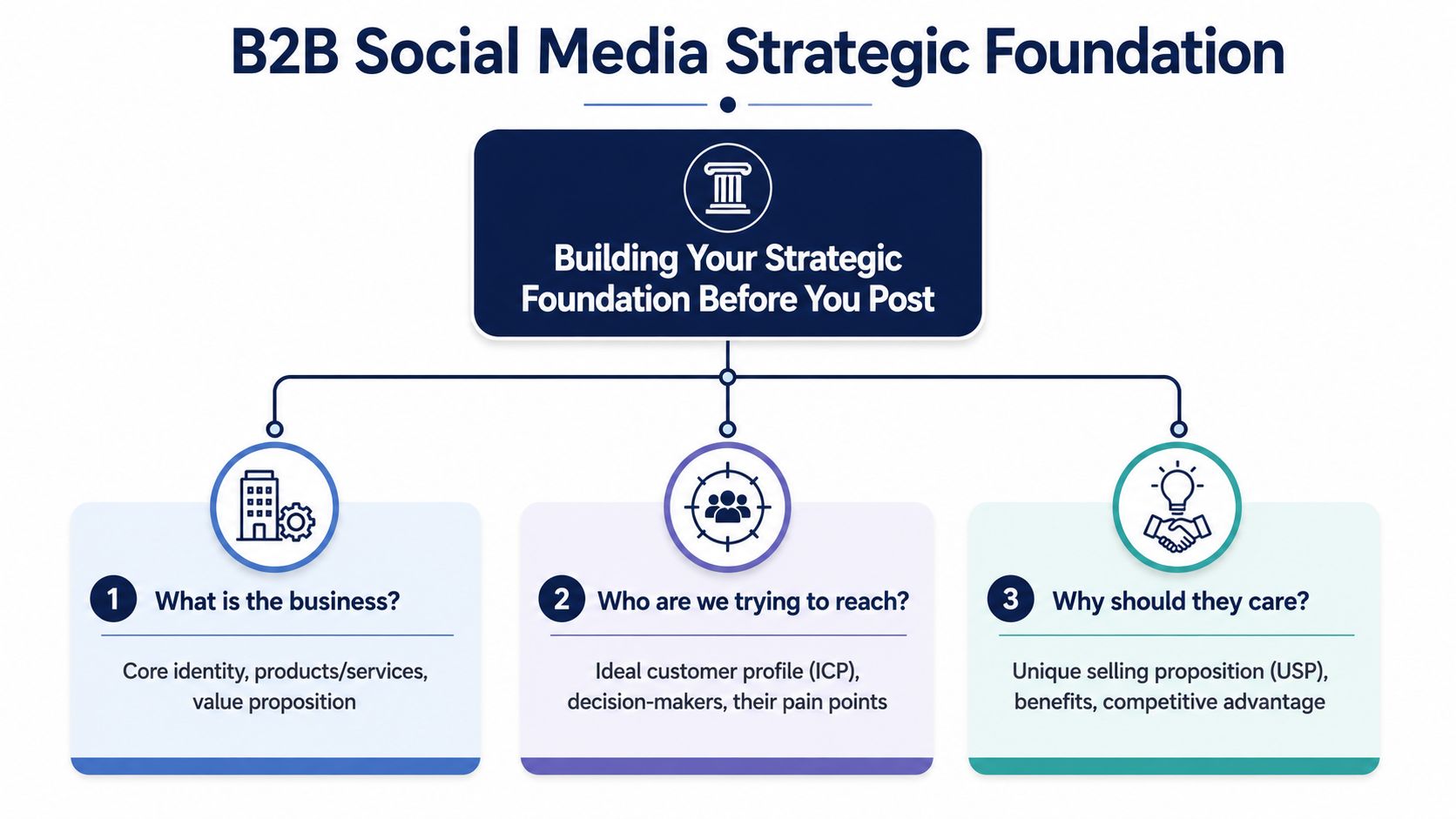
Start with the business objective
Most firms start with a vague goal like "be more active" or "build awareness." That sounds harmless, but it creates weak content because nobody knows what success is supposed to look like.
A better starting point is a business question:
- Do you need more quote requests from a specific industry?
- Do you need better visibility with engineering decision-makers?
- Do you need to shorten trust-building before the first sales call?
- Do you need more sales conversations from named target accounts?
Write down one primary objective and one secondary objective. Keep it simple. If social media is supposed to help sales, say that directly.
Define the audience with buying reality
"Engineers" isn't a usable audience definition. Neither is "manufacturers." You need a practical view of who buys, who influences, and who blocks.
For most industrial firms, we build around:
- The economic buyer. Owner, president, or operations leader who cares about risk, capacity, margin, and vendor reliability.
- The technical evaluator. Engineer, quality lead, plant manager, or maintenance lead who wants proof that your team can execute.
- The commercial gatekeeper. Procurement or sourcing contact who cares about responsiveness, documentation, and supplier fit.
If you need a structured way to document that, this guide to creating buyer personas for industrial marketing is a useful starting point.
Practical rule: If a post wouldn't matter to a real buyer in a real buying conversation, it probably doesn't belong in your core content system.
Translate expertise into a message people care about
Your business already has a message. It just usually exists in fragments across sales calls, engineer conversations, proposal language, and customer emails.
We'd turn that into three to five content pillars. For a manufacturing client, those often look like:
How we solve production problems
Missed tolerances, redesign issues, bottlenecks, or vendor handoff failures.How buyers reduce risk
Quality processes, documentation, communication standards, lead time management, and implementation clarity.What good decision-making looks like
Material choices, process selection, manufacturability trade-offs, and vendor selection criteria.
Many teams find it helpful to formalize this in a documented content strategy framework for social media so content decisions stop depending on whoever happens to be available that week.
Use a simple message filter before publishing anything:
| Question | If the answer is no |
|---|---|
| Does this help a buyer solve, avoid, or understand a problem? | Don't post it yet |
| Does this support the business objective? | Rework it |
| Can one of our real experts stand behind it? | Get input first |
That foundation does more than improve content quality. It makes execution faster because the team stops debating what social media is for.
Choosing Your Core Platforms with 80/20 Focus
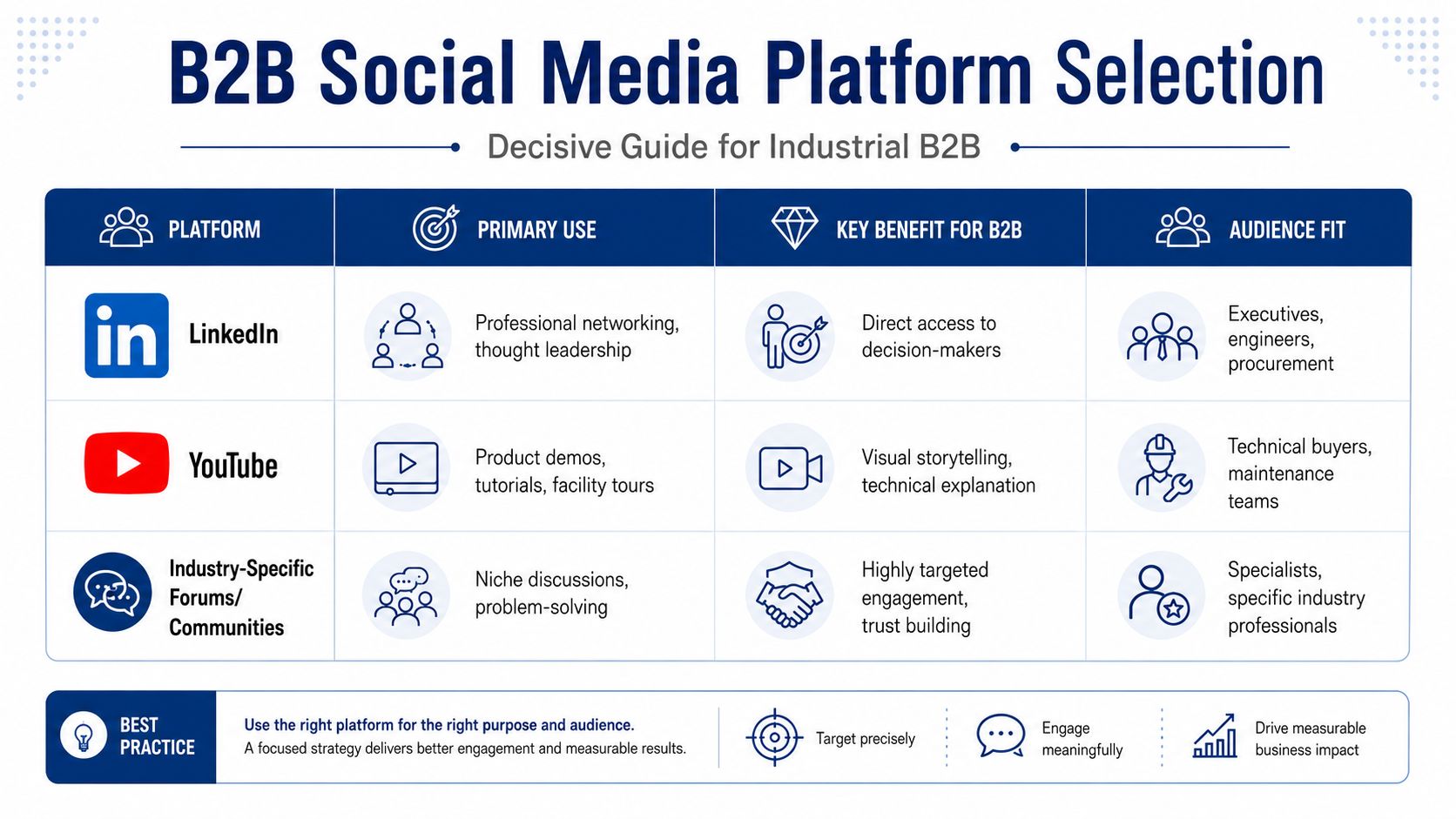
Most manufacturers don't need a social presence everywhere. They need one platform that reliably reaches decision-makers, one supporting video channel, and a disciplined refusal to chase distractions.
LinkedIn is the primary platform
For industrial B to B social media marketing, platform selection is mostly settled. LinkedIn generates 80% to 84% of all B2B social leads, and 84% of B2B marketers identified it as their most valuable social media platform according to these B2B social media marketing statistics.
That matters because manufacturers usually sell through long, high-trust buying cycles. You need a platform where buyers are already in a professional mindset and where expertise can travel through personal networks, company pages, comments, and direct outreach.
LinkedIn works well for industrial firms because it supports:
- Subject-matter authority. Engineers, founders, sales leaders, and technical managers can publish useful insight in plain language.
- Account visibility. You can stay in front of specific companies without waiting for them to search for you.
- Sales alignment. Marketing content and sales prospecting can reinforce each other instead of operating separately.
If you're building around LinkedIn first, a focused guide to LinkedIn marketing for manufacturers will help you avoid generic tactics.
Secondary channels have specific jobs
YouTube is usually the next best supporting platform for manufacturers. Not because you need a full media studio, but because some industrial ideas are easier to prove visually than in text.
Use YouTube for:
- Product walkthroughs
- Facility tours
- Technical explainers
- Webinar replays
- Recorded customer education sessions
X can have value in narrow cases. It can help if your buyers, partners, or industry media actively discuss events, regulation, or technical developments there. But for most industrial firms, it shouldn't be the core pipeline channel.
Industry-specific forums and communities can also matter. They won't replace LinkedIn, but they can support credibility if your team participates helpfully and avoids promotion.
What to ignore until the core system works
A lot of companies spread themselves thin by trying to keep Facebook, Instagram, X, YouTube, and LinkedIn all active at once. That usually produces weak output everywhere.
For most manufacturers:
- Facebook is often more useful for employer brand or local visibility than complex B2B demand generation.
- Instagram can help with recruiting or visual culture, but it rarely deserves priority over LinkedIn.
- Trend-led platforms can consume time fast and return little if your buying process is technical and considered.
One strong platform with a real operating system beats five neglected channels every time.
The 80/20 move is simple. Build for LinkedIn first. Add YouTube when you have enough useful material to support it. Treat everything else as optional until the core system produces consistent conversations.
The Content Repurposing System for Maximum Efficiency
Manufacturers usually don't have a content problem. They have an extraction problem. The knowledge is sitting inside sales calls, engineering reviews, project recaps, setup conversations, webinars, and customer questions. The job is turning that knowledge into assets without creating extra work for the people doing their core work.
A repurposing system fixes that.
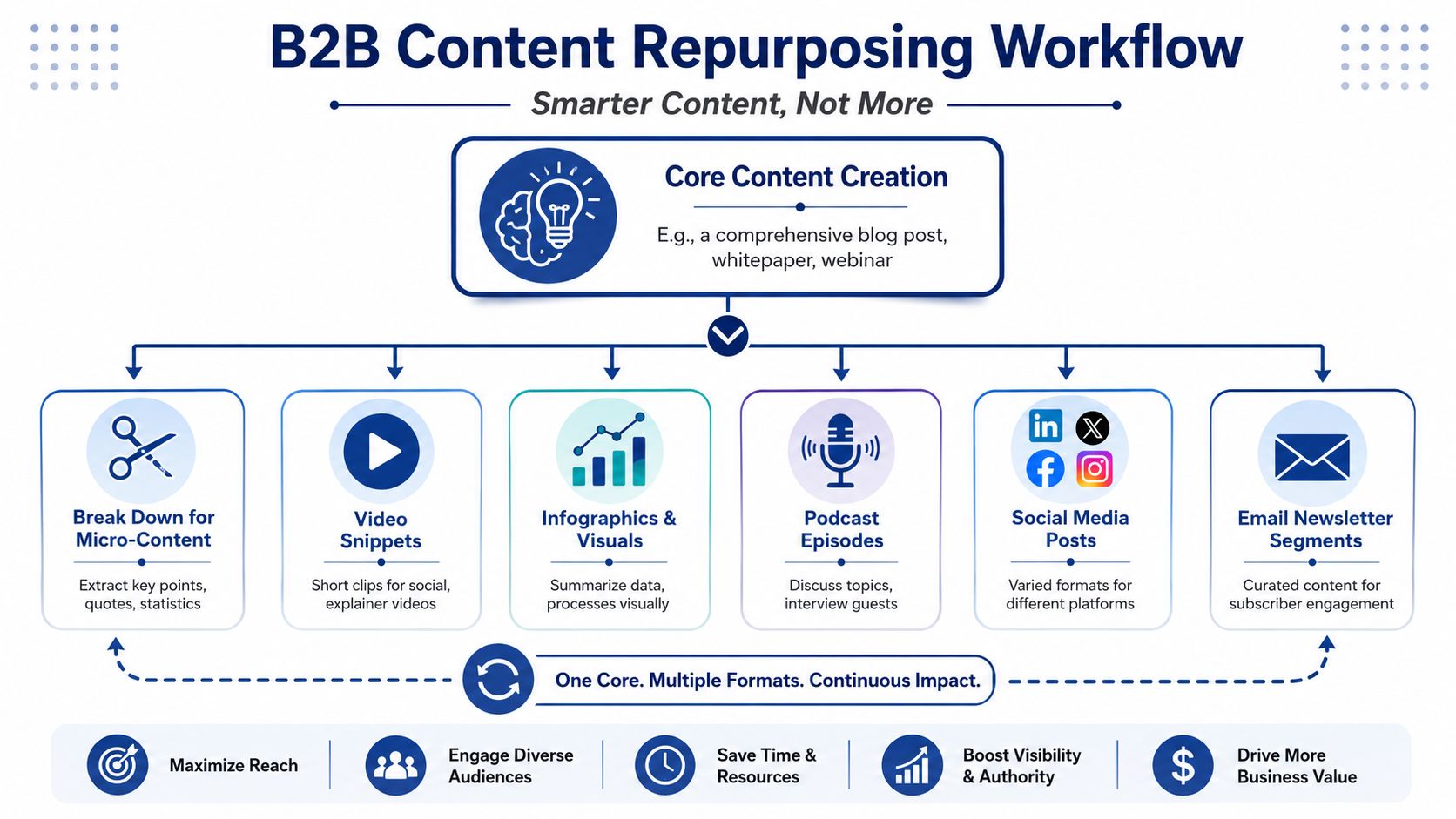
One deep asset becomes the month's content
Start with one substantial piece of source material. For an industrial client, good starting assets include:
- A recorded webinar
- A customer Q&A session
- A technical blog post
- A process walkthrough
- A project debrief with sales and engineering
From there, break it into smaller outputs. Short-form video is especially useful here because video clips under 90 seconds deliver the highest ROI among video formats at 41% according to Sprout Social's social media statistics roundup.
A single webinar can become:
| Source asset | Repurposed output |
|---|---|
| Webinar recording | Short LinkedIn video clips |
| Transcript | Founder or engineer text posts |
| Slide deck | Carousel post |
| Q&A section | FAQ post for buyers |
| Key lesson | Sales enablement snippet |
| Process explanation | Blog article or email segment |
Later in the same workflow, video can support your social mix directly:
Build around people, not just the company page
Many industrial companies leave value on the table, as 73% of B2B buyers are more influenced by content from personal profiles of company leaders than from brand channels, yet only 12% of industrial firms systematically enable and train their SMEs to post consistently on LinkedIn as noted in Neil Patel's analysis of B2B social media.
That means your subject-matter experts shouldn't be optional extras. They should be part of the system.
A practical setup looks like this:
- Marketing captures the raw insight. Record the webinar, interview the engineer, summarize the customer issue.
- An editor shapes the content. Turn jargon into clear buyer-facing language without flattening the expertise.
- The SME approves for accuracy. Fast review, not a long rewrite loop.
- Leaders and salespeople publish adapted versions. Same core insight, different voice and angle.
Buyers trust people who sound like they've solved the problem before.
A practical weekly workflow
For a busy manufacturing team, we'd keep the workflow tight:
Record one knowledge session
A webinar, internal discussion, or customer-facing presentation.Pull three to five usable insights
Focus on mistakes to avoid, trade-offs, buyer questions, or process lessons.Create the asset set
One video clip, two text posts, one image or carousel, one email excerpt.Assign distribution roles
Company page posts one version. Sales leader posts another. Engineer posts a more technical angle.Log performance and questions
Save comments, DMs, and sales feedback. Those become the next content inputs.
This is the heart of scalable B to B social media marketing. Create once. Adapt intentionally. Publish through both brand and people.
A Sample Content Calendar and Post Templates
A system becomes usable when it lands on a calendar. Many teams don't struggle because they lack ideas. They struggle because they don't know what to publish this week, who owns it, and how to keep quality high without starting from scratch every time.
For a manufacturer, we like a simple weekly rhythm that balances authority, proof, and buyer education. That gives sales something useful to share and keeps the feed centered on real customer concerns instead of internal updates.
Sample 4-Week B2B Social Media Calendar
| Week | Monday (Expert Tip) | Wednesday (Behind the Scenes) | Friday (Problem/Solution) |
|---|---|---|---|
| Week 1 | Engineer explains a common design-for-manufacturing mistake | Shop floor look at setup process for a complex part | Why quote delays happen and how to reduce them |
| Week 2 | Quality lead shares a practical inspection lesson | Short video from a team meeting on process planning | How to choose between two production approaches |
| Week 3 | Sales engineer answers a recurring buyer question | Photo series showing fixture prep or workflow planning | What buyers should provide before requesting a quote |
| Week 4 | Operations leader explains how lead times are managed | Clip from a customer education webinar | How to avoid vendor handoff issues in production |
That calendar works because each day has a job.
- Monday builds expertise. The audience learns something useful.
- Wednesday proves reality. Buyers see the people, process, and environment behind the promise.
- Friday ties content to commercial value. The post addresses a real business problem buyers want solved.
Three LinkedIn post templates you can use today
These aren't meant to sound polished. They're meant to sound credible.
Template 1: Expert insight
We keep seeing the same issue in [process, part type, or buyer situation].
The problem isn't usually [common assumption]. It's usually [real cause].
What helps is:
- [practical step]
- [practical step]
- [practical step]
If you're dealing with [specific challenge], this is worth fixing early.
Template 2: Behind the scenes
A lot of buyers only see the finished part.
What they don't always see is the planning behind [setup, inspection, fixturing, documentation, workflow].
In this job, our team focused on [specific operational detail]. That mattered because [buyer impact].
Small decisions early in the process usually prevent bigger problems later.
Template 3: Problem and solution
One issue we hear from customers is [pain point].
It creates problems because [consequence].
Our approach is to start with [step], then [step], then confirm [requirement or checkpoint].
If you're evaluating suppliers for [type of work], ask how they handle this before the job starts.
Use these as controlled starting points, not rigid scripts. The best posts usually come from a real conversation your sales or engineering team had this week.
Measuring What Matters KPIs and Reporting for B2B
If your report starts and ends with impressions, likes, and follower count, leadership will stop taking social media seriously. That's reasonable. Those numbers can be interesting, but they don't tell a manufacturer whether social activity is helping create pipeline.
The dashboard we would build first
The right dashboard for B to B social media marketing is small. It should fit on one page and answer one question: did social media help create qualified commercial movement?
Start with these measures:
Website clicks from social
Track traffic into core pages, quote pages, technical resources, and contact pages in Google Analytics.Conversion actions from social traffic
Contact form submissions, guide downloads, webinar registrations, or demo requests.Lead source capture
Add "How did you hear about us?" or a similar source field on forms and in CRM workflows.Sales feedback
Ask the sales team whether prospects mention posts, videos, or specific team members.Content-assisted conversations
Log DMs, email replies, meeting requests, and re-engagement from existing opportunities.
A helpful companion resource if you're refining your reporting process is this guide on how to measure social media ROI.
How to read the numbers without fooling yourself
Discipline is paramount. The technical metric that dictates ROI is not engagement volume but pipeline velocity. While organic social engagement rates average only 2% on LinkedIn, paid sponsored content achieves a 2.30 ROAS and a 192% ROI, significantly outperforming Facebook's 1.80 ROAS and 87% ROI according to these B2B digital marketing benchmarks.
That doesn't mean every manufacturer should rush into paid social. It means you need to judge the channel by business outcomes, not applause.
A practical interpretation framework looks like this:
| Signal | What it usually means |
|---|---|
| High engagement, low clicks | Content is interesting but not commercially useful |
| Good clicks, weak conversion | Offer, landing page, or targeting needs work |
| Few public interactions, strong sales feedback | Content may be influencing trust privately |
| Paid results look expensive | The audience, message, or offer may be too broad |
Don't ask whether social media was popular. Ask whether it helped the right buyer take the next step.
For paid LinkedIn campaigns, cost quality matters more than cheap traffic. If the traffic doesn't turn into real conversations, the campaign isn't efficient, even if the platform metrics look decent. If sales keeps hearing, "I've been seeing your posts," that's a stronger signal than a vanity spike.
Your Next Action From Playbook to Practice
The strongest B to B social media marketing systems for manufacturers aren't built from trends. They're built from operating discipline. You define the objective, choose the platform that matters, capture expertise from the team, repurpose it efficiently, and measure outcomes that leadership can respect.
That changes the role social media plays in the business. It stops being a side task and starts acting like a trust-building layer around sales, engineering, and business development. This transformation isn't just better posting. It's a repeatable system that turns internal expertise into market visibility.
If you're feeling behind, don't try to implement everything this week.
Start with one meeting.
Get sales, leadership, and one technical expert in a room for an hour. Answer three questions:
- What business result do we want social media to support first?
- Which buyer roles do we need to influence?
- What recurring problems can we speak to with authority?
Write those answers down. Build your first month of content from them. Keep the platform focus narrow. Review what the sales team hears back.
That's how industrial social media starts working. Not with more activity, but with a system your team can run.
If you want help diagnosing your current marketing system and building a practical social program that fits the way manufacturers sell, talk with Machine Marketing. We help industrial companies turn scattered marketing activity into a clear system for visibility, trust, and lead generation.