You're probably looking at a homepage, a brochure, and a few LinkedIn posts that all say roughly the same thing, but none of it is sticking. That's the usual mess: one sentence is trying to act like a motto, a tagline, and a slogan at the same time, and it's doing none of those jobs well. If you run a machine shop or an industrial brand, the fix isn't to invent one magic phrase. It's to put the right phrase in the right place and make each one earn its keep.
Table of Contents
- Why Industrial Brands Need Both a Motto and a Slogan
- Defining Motto vs Slogan in Plain English
- Where Taglines Fit in the Mix
- Choosing the Right Phrase for Each Channel
- The Honest Truth About AI Slogan Generators
- A Step-by-Step Process for Writing Phrases That Actually Stick
- Manufacturer and Machine Shop Examples in Practice
- Testing, Rollout, and SEO Placement Essentials
Why Industrial Brands Need Both a Motto and a Slogan
If you own a shop, you already know the trap. The team wants one phrase for the website, the sales deck, the recruiting ad, the trade show banner, and the company values page. That's how you end up with a line that sounds fine everywhere and strong nowhere.

A motto is about identity. A slogan is about action. In branding practice, that split matters because a motto supports internal alignment and long-term consistency, while a slogan is built for immediate persuasion and short-term recall, especially in campaigns and promotions (Chevron Editing). If you only use one phrase for both jobs, you force your brand to choose between depth and speed. Most businesses need both.
The real problem is not wording, it's job confusion
Industrial companies often treat messaging like a design task. It isn't. It's a system task. If the phrase is supposed to guide employee behavior, it should act like a motto. If it's supposed to get a buyer to click, call, or remember you at a trade show, it should act like a slogan.
Practical rule: if the line needs to survive across years, it belongs closer to a motto. If it needs to win attention this quarter, it belongs closer to a slogan.
That's why a useful branded phrase stack usually has layers. The internal layer supports culture and hiring. The external layer supports campaigns and lead generation. The middle layer, often a tagline, carries the brand promise on the homepage and in core sales collateral. That's a better operating model than squeezing everything into one sentence.
If you're also building out your social presence, an AI-powered LinkedIn growth tool can help you distribute the message once the wording is set. The tool isn't the strategy, though. The strategy is knowing which phrase belongs where before you start posting.
Defining Motto vs Slogan in Plain English
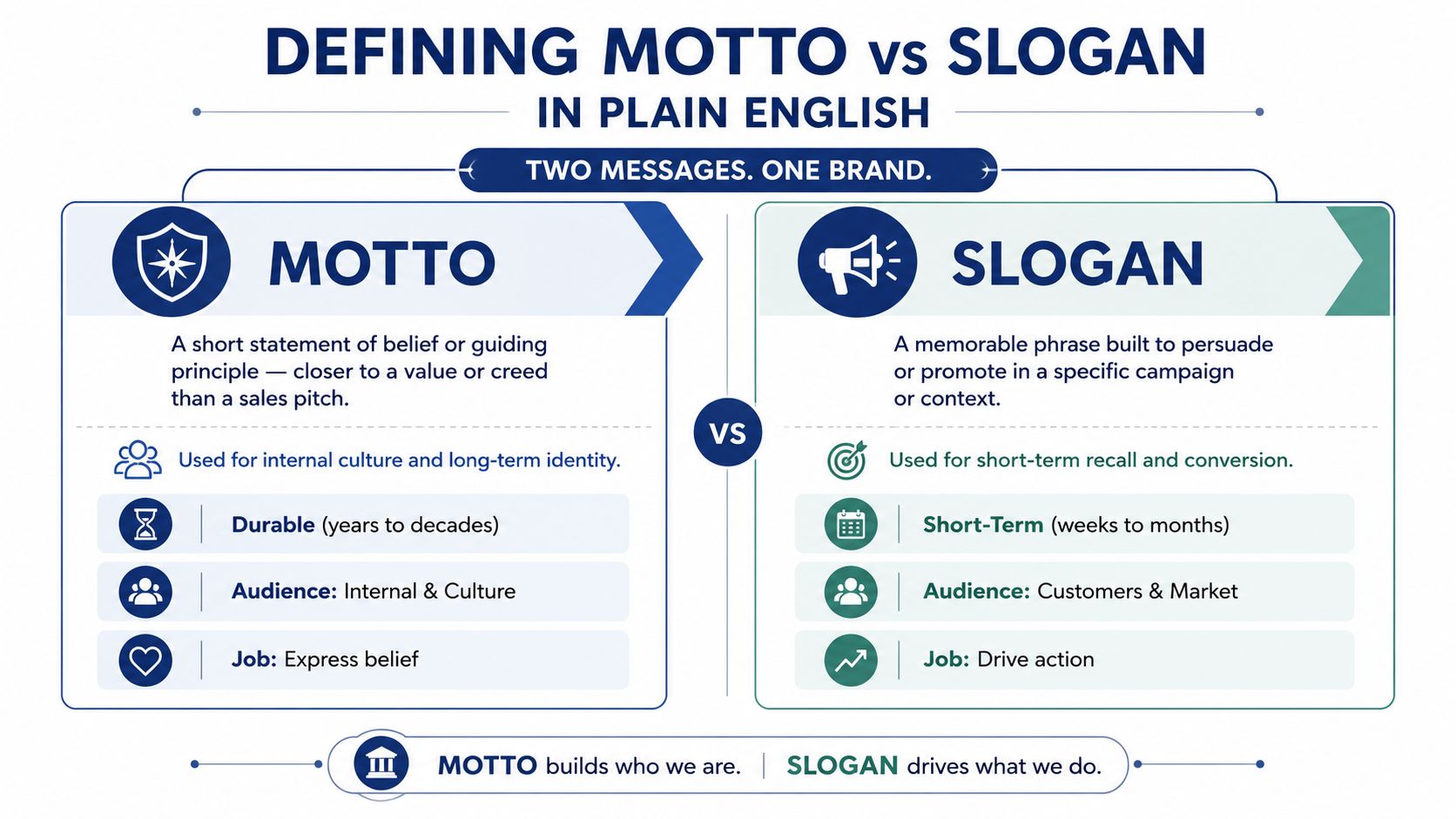
A motto is a short statement of belief, purpose, or guiding principle. A slogan is a memorable phrase used to persuade or promote, and that distinction holds consistently across branding, politics, and institutions (Wikipedia). That's the cleanest way to think about it without getting lost in terminology.
A motto sounds like something a company believes. A slogan sounds like something a company wants you to do. That difference shows up in tone, lifespan, and audience. A motto tends to be broader and steadier. A slogan tends to be sharper, shorter, and attached to a specific message push.
What each one is doing for you
A good motto helps answer, “Who are we when nobody's watching?” A good slogan answers, “Why should someone care right now?” That's why industrial firms often use mottos inside onboarding materials, safety culture guides, or leadership communication, while slogans show up in promotions, event campaigns, and hiring pushes.
For a practical brand-building reference, the AI CMO brand strategy guide is useful because it reinforces the need for consistency before you start creating language. If your shop already has a mission statement, you can also compare it against your messaging by reviewing your mission statement framework. That keeps you from writing a slogan that accidentally sounds like a policy manual.
The easiest test is this:
- Motto: Does it sound like a guiding principle you'd want employees to repeat?
- Slogan: Does it sound like something designed to catch attention and drive a response?
- Neither: Does it sound vague, interchangeable, or like corporate wallpaper?
A strong slogan usually has pressure in it. A good motto usually has backbone in it.
If you're deciding between the two, stop thinking about style first. Think about function. The phrase isn't supposed to be “nice.” It's supposed to do a job.
Where Taglines Fit in the Mix
A machine shop can have a motto that shapes the culture, a slogan that drives a campaign, and a tagline that carries the brand across the ordinary stuff, homepage headers, sales decks, email footers, and repeat introductions. Taglines sit closest to the brand promise. They are more durable than a launch line, but they still need to work in public.
The clean way to separate the three is straightforward. A motto is about values and internal identity. A slogan is built for a push, a promotion, or a response. A tagline sits in between, because it has to sound stable without pretending to do campaign work. That is the part many branding teams get wrong.
A practical three-part filter
Use this filter before you approve any phrase:
- Motto: internal, values-based, culture-driven
- Tagline: external, durable, brand promise-oriented
- Slogan: short-term, campaign-specific, action-driven
That filter is useful because it forces a decision about purpose instead of style. If you want a tighter editorial frame for how language shifts between persuasion and explanation, the key differences between copy and content article helps explain why one line should not be asked to do every job.
For manufacturers, the channel decides the phrase. A homepage can support a tagline that lasts. A trade show banner needs a slogan that lands fast. An onboarding guide needs a motto that tells people how the company thinks. Put a campaign line on the About page and it feels thin. Put a values statement on a banner and it feels too soft for the setting.
A tagline is not a prettier slogan. It is the stable public line that holds the brand together across repeated touchpoints. If you want a source that keeps the distinction between motto, tagline, and slogan clear, Chevron Editing gives a useful reference point without pretending the three terms mean the same thing.
The better test is simple. Ask whether the phrase belongs in a channel that needs memory, trust, or momentum. Then write for that job. That is how industrial brands avoid generic wording and stop mixing internal identity with external promotion.
Choosing the Right Phrase for Each Channel
A machine shop that uses the wrong line in the wrong place wastes good copy. The fix is simple. Match the phrase to the channel, then write to that job. A motto belongs where people need to understand your values or how the company thinks. A tagline belongs where the market needs a clear promise. A slogan belongs where you want a fast reaction.

The decision is not whether a phrase sounds good on paper. It is where the phrase will live. A homepage, a recruiting ad, and a culture guide all ask for different language because each one carries a different burden. Put a campaign line on an About page and it feels thin. Put a values statement on a trade show banner and it slows the message down.
A homepage should carry a tagline first, because visitors need a stable promise fast. An About page can use a motto or a tagline, depending on whether the page is about beliefs or market position. Sales decks work best with a tagline, then a campaign slogan can add force inside a specific slide or offer. Recruitment ads call for a motto if you are selling culture, or a slogan if you are pushing one hiring message hard.
For trade show banners, use a slogan. The aisle is noisy, attention is short, and you need a line that sticks immediately. Email signatures usually fit a tagline if you want consistency across touchpoints. If the audience is internal, a motto makes more sense because it signals how the company operates, not what it is selling. Culture docs and onboarding materials should use a motto, because new hires need a durable principle, not a promotional line.
One simple test cuts through the noise. Ask whether the phrase would still work if a competitor borrowed it. If the answer is yes, the line is probably too generic for external differentiation. If the line only makes sense inside your shop, it is doing motto work. That is the kind of filter that keeps industrial brands from spraying the same phrase across every asset just because it sounds polished.
The Machine Marketing brand building guide is a useful reference if you want to connect phrase choice to broader positioning. Brand language should support the commercial system, not sit on top of it as decoration.
The Honest Truth About AI Slogan Generators
A machine shop owner who asks an AI tool for a slogan usually gets the same kind of result: quick, polished, and forgettable. That is fine if you need raw ideas before lunch. It is a bad place to stop if you care about differentiation.
AI slogan tools help with one job, fast ideation. They break the blank page problem and give you material to react to. They do not make a brand distinct on their own. That gap matters for manufacturers, because a smooth phrase that could sit on any competitor's truck, header, or website does nothing to sharpen positioning.
The standard has to be higher. Effective taglines need to be specific, distinctive, memorable, and not transferable to another organization, and AI generators often miss that bar by producing competent but generic phrasing (Canva). If the line sounds nice but could belong to five different shops, it weakens the message instead of tightening it.
Use AI for volume, then strip the list down with discipline. Generate a wide set of options first, then cut anything generic, vague, or overworked. If a line could apply to a different machine shop without changing a word, delete it. If it hints at your process, your customer, or the way you deliver value, keep it in play.
Human judgment serves as the filter. Say the line out loud. If it feels inflated, broad, or too tidy, it probably is. Your team has to stand behind the phrase in sales calls, on the website, and at the trade show booth, so approval cannot come from the tool alone.
Use AI as a draft assistant, not a brand arbiter
A better workflow starts with speed and ends with restraint:
- Generate options quickly. Use the tool to create raw material.
- Remove the generic ones. If the line could fit several competitors, it is out.
- Press for specificity. The phrase should point to your process, your buyer, or your value.
- Read it out loud. If it sounds padded or vague, cut it.
- Decide with people, not software. Sales, leadership, and operations should all sign off.
A phrase can also be too clever for its own good. AI is good at producing lines that sound like marketing. That is the problem. Manufacturers do not need copy that sounds like marketing, they need wording that makes the business easier to remember and harder to confuse with the next shop on the road.
The best use of AI is early-stage drafting, then a hard pass through a differentiation filter. If you want a practical way to shape that filter into a usable message, the marketing messaging framework gives you a cleaner way to move from rough ideas to a line that fits the business.
A Step-by-Step Process for Writing Phrases That Actually Stick
A machine shop that skips this step usually ends up with a line that sounds polished and means nothing. Start with the job. Decide whether the phrase needs to shape culture, support the brand promise, or drive action in a campaign. If you do not define that first, every draft will drift.
Slogans work because they compress meaning. Research from Université Toulouse Jean Jaurès points to concise phrasing, ellipsis, imperative mood, and reduced syntax as the parts that help recall and impact. That does not give you permission to write something cute. It tells you to strip the sentence until only the useful words remain.
Start with the use case. That simple decision keeps the rest of the process honest.
Use the job to decide the shape
If the phrase is for culture, it can be steadier and more internal. If it is for positioning, it should hold up across the website, sales deck, and trade show booth. If it is for promotion, it needs a sharper edge and a faster read. The worst mistake is trying to make one line do all three jobs.
A better workflow is simple. Write a rough set of options, including a few fast drafts from AI if you want speed. Then cut hard. Delete anything that could belong to another shop, anything that sounds padded, and anything that needs explanation to land. Read the survivors out loud. If the line feels inflated or too neat, drop it.
Use a pressure test, not a preference test
At this stage, the question is not whether the line sounds nice. The question is whether it survives contact with the business. Sales has to use it without sounding fake. Operations has to recognize the promise behind it. Leadership has to stand behind it in front of customers, candidates, and the crew.
One simple filter works better than a long checklist. Ask whether the phrase is specific to your process, your buyer, or your value. If another machine shop could use it unchanged, it is too generic. If it only works because someone explains it, it is too weak.
A drafting template can help, but only as a starting point. We help [audience] [outcome] by [method]. That structure gives you a shape. It does not give you the final line, and it should not be treated like one. Use it to get past the blank page, then rewrite until the sentence sounds like your shop instead of a form fill.
For a cleaner way to move from rough language to a message your team can repeat, the messaging framework guide is a useful companion. The goal is not poetic copy. The goal is clean positioning that stays consistent without turning stale.
If a phrase sounds clever but cannot pass the transfer test, cut it. If it is clear but forgettable, compress it further. If it sounds true to the shop and still rolls off the tongue, you have something worth using.
Manufacturer and Machine Shop Examples in Practice
A precision machine shop should use a motto to steady internal behavior. “Built on consistency” works in onboarding, in shift handoffs, and on the shop floor because it tells the crew what matters without pretending to sell anything. It is a culture line, not a sales pitch.

A campaign for a new CNC service line needs a different kind of wording. Put the tighter slogan on the landing page or trade show banner, where the line has one job, get the prospect to act. It should sound active and direct, because the point is inquiry, not identity.
The same logic holds for hiring. A manufacturer looking for skilled operators can keep the motto in the culture guide, where it supports the internal story and gives new hires a clear standard. The recruitment slogan belongs in the campaign, where it has to grab attention and push a response.
What good looks like in the field
The cleanest way to sort the three jobs is simple.
- Internal durability: a motto keeps the language steady.
- External clarity: a tagline keeps the brand promise recognizable.
- Campaign urgency: a slogan gives you a push when you need action.
Manufacturers make trouble for themselves when every phrase tries to do the same job. Culture language starts to sound like ad copy, and campaign language loses force because it is carrying too much baggage. Split the roles, and the wording improves fast.
If you want a broader view of how industrial brands connect identity to lead generation, the manufacturer brand building guide gives useful context. The right phrase still has to fit inside the larger brand system, not sit there as a clever one-off.
Testing, Rollout, and SEO Placement Essentials
A phrase can look sharp on paper and still fail in the shop. Roll it out inside the company first. Get sales, operations, and leadership to react to the wording before it goes public. If the people who answer the phone or handle quoting do not like it, it will not survive contact with the market.
Use it in real conversations before you print it everywhere. Put it in an email, bring it up at a trade show, or use it in a sales follow-up. Pay attention to whether people repeat it back without prompting. If they do not, the line is not sticking.
Keep the channel assignment clean for SEO and site placement. Put the tagline where the homepage can carry the brand promise. Put the slogan on campaign-specific landing pages. Keep the motto in culture-facing areas where employees and recruits will see it.
The U.S. Census Bureau used “Shape Your Future. START HERE.” to build awareness and drive participation, which is the right model for a slogan that needs to push action. Short slogans are easier to remember and repeat in crowded media, so keep the line tight and practical.
Track the basics after rollout. Watch whether branded searches increase, whether the About page holds attention, and whether emails using the new line get better replies. Keep the test simple. If the phrase is not helping people remember you or respond to you, it is not doing its job.
Pick one phrase this week, assign it to the right channel, and ship it. If you want help tightening your motto, tagline, or slogan into something a machine shop buyer will remember, contact Machine Marketing and let's diagnose the message before you print another banner.