Organic search is often where industrial buyers start, and that changes how you should think about SEO strategy for B2B. When benchmark sets show organic search generating 53% to 76% of trackable B2B website traffic, contributing 44.6% of total B2B revenue, and delivering an average 748% ROI over a standard multi-year window, SEO stops looking like a content experiment and starts looking like a revenue system. The same benchmark set also reports 14.6% conversion for B2B SEO leads versus 1.7% for outbound leads, which is why manufacturers that sell complex products usually get more value from search than from broad paid awareness campaigns. For industrial firms, the question is not whether SEO works. It's whether the system behind it is built to capture the right demand, convert it cleanly, and prove impact internally.
Table of Contents
- Why SEO Is a Revenue Channel for B2B Manufacturers
- Keyword Research That Maps to the B2B Buyer Journey
- Site Architecture and Information Hierarchy for Industrial Catalogs
- Content Strategy for Engineers and Industrial Buyers
- Technical SEO Checklist for Manufacturing Websites
- Building Authority in Niche Industrial Markets
- Measurement Framework and Implementation Roadmap
Why SEO Is a Revenue Channel for B2B Manufacturers
Organic search is one of the few channels that can influence both discovery and purchase intent in the same journey. Benchmark compilations for 2026 show organic search generating 53% to 76% of trackable B2B website traffic, contributing 44.6% of total B2B revenue, and producing an average 748% ROI over a standard multi-year window. That combination matters because it means search is not just feeding the top of the funnel, it's participating in revenue generation. The same source set also reports 14.6% conversion for B2B SEO leads versus 1.7% for outbound leads, which explains why a good organic program usually feels quieter than paid media but produces cleaner opportunities.

A lot of manufacturers still treat SEO like a side project because it doesn't create the instant feedback loop of ads. That's a mistake. When buyers search for specs, tolerances, application fit, or vendor comparisons, they're self-selecting into a commercial research process, and you either show up or you don't.
Practical rule: if your sales team hears the same technical questions every week, search is already telling you what content needs to exist.
The engineering mindset helps here. Think of keywords as inputs, site health and content as process control, and leads and revenue as outputs. Once that system is mapped, SEO becomes easier to diagnose because you can ask a simple question at every stage: where is the signal breaking?
For teams comparing agencies or looking at adjacent strategies, a useful outside reference is compare GEO agencies for SaaS. Even though that resource is SaaS-focused, it can still help you think more critically about evaluation criteria, especially if you're trying to avoid vague promises and pick a partner who can build a system.
Keyword Research That Maps to the B2B Buyer Journey
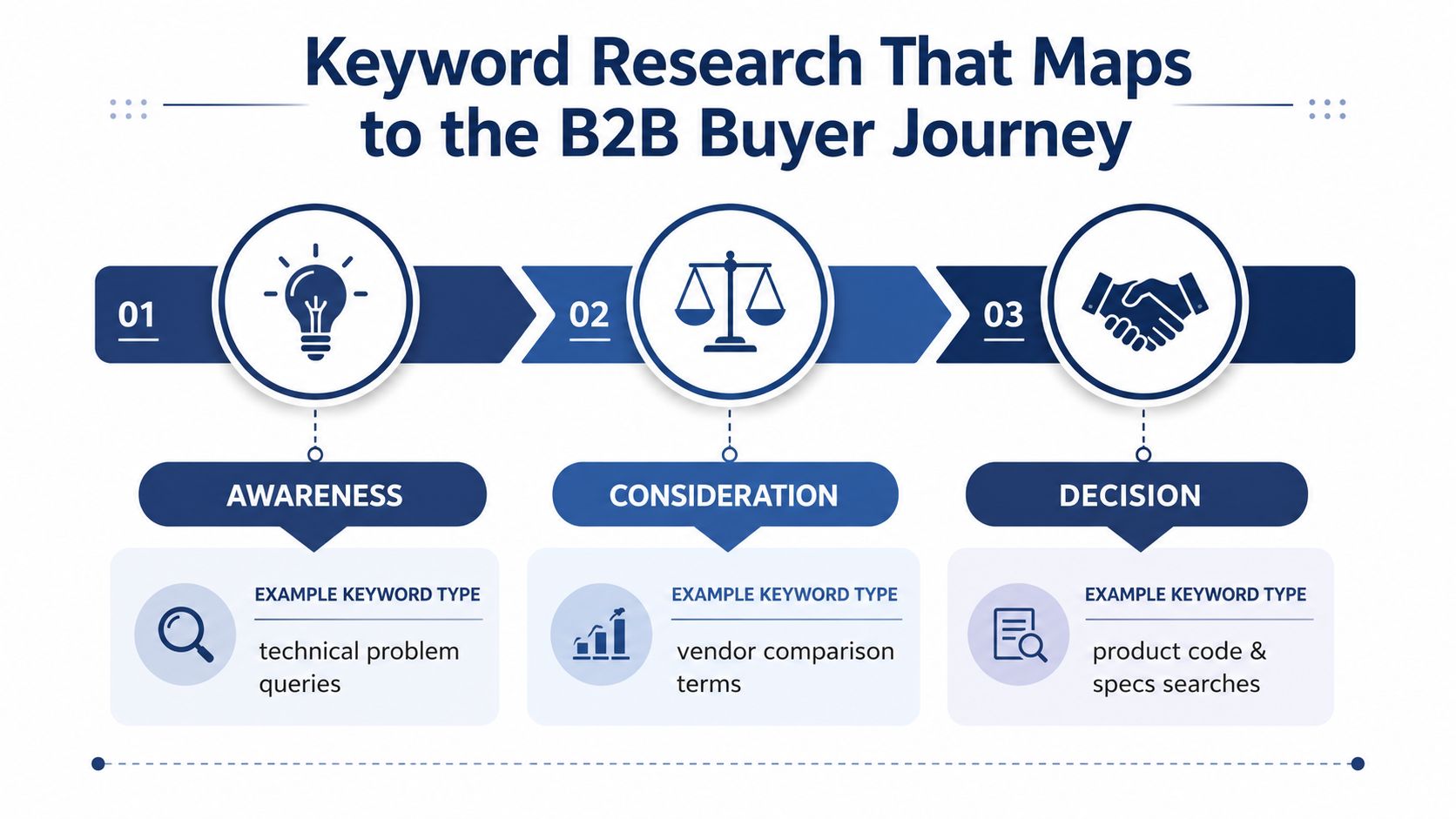
Generic keyword tools can show volume, but they can't tell you whether a query came from an engineer checking compatibility or procurement comparing vendors. That distinction matters more in industrial SEO than in most other B2B categories. The best keyword research starts with the words your buyers already use, not the terms a tool suggests in isolation.
Start with the language your team already hears
Sales calls, support tickets, and win-loss notes are the cleanest source of buyer language you already own. Read them with a pattern-finding mindset. Pay attention to the phrases that repeat when buyers ask about performance, lead times, tolerances, compliance, installation, maintenance, or integration.
Then sort that language by buyer role. Engineers usually ask in the language of fit and function. Procurement asks in the language of risk and comparison. Operations asks in the language of reliability and uptime.
A practical workflow looks like this:
- Collect real phrases: Pull objections, spec questions, and comparison language from call notes and tickets.
- Group by stage: Separate awareness questions from comparison queries and product-code searches.
- Assign an owner page: Give each priority query a specific page type, not a vague content bucket.
- Match intent to persona: Write for the person most likely to search that term first, then support the secondary reader with links and proof.
The point isn't to create more content for its own sake. It's to avoid publishing pages that sound relevant but never match the way buyers search. That's where many industrial sites waste months.
Separate branded and non-branded demand
B2B search is usually split between 20-30% branded and 70-80% non-branded queries, so non-branded content should carry most of the early-funnel load. Branded terms are still valuable, but they usually belong to decision-stage capture, not discovery.
Buyers don't begin with your company name. They begin with a problem, a spec, or a category.
For competitive feasibility, one guide cites average DR 78 for top 10 B2B keywords versus 62 for B2C. That benchmark is useful because it reminds you not every keyword deserves a direct attack. Sometimes the smarter move is to build around long-tail intent clusters where the page can win on relevance and depth instead of trying to out-muscle a heavily contested head term.
If you want a deeper framework for structuring these inputs, use our internal guide on keyword strategy for manufacturers. It pairs well with this buyer-journey approach because it forces the keyword list to connect to actual pages, not just a spreadsheet.
Site Architecture and Information Hierarchy for Industrial Catalogs
Most manufacturing sites don't have a content problem first. They have an information hierarchy problem. The catalog grows, the PDFs pile up, the product lines multiply, and nobody steps back to ask whether a buyer can move through the site without friction.
Build the site like a product system
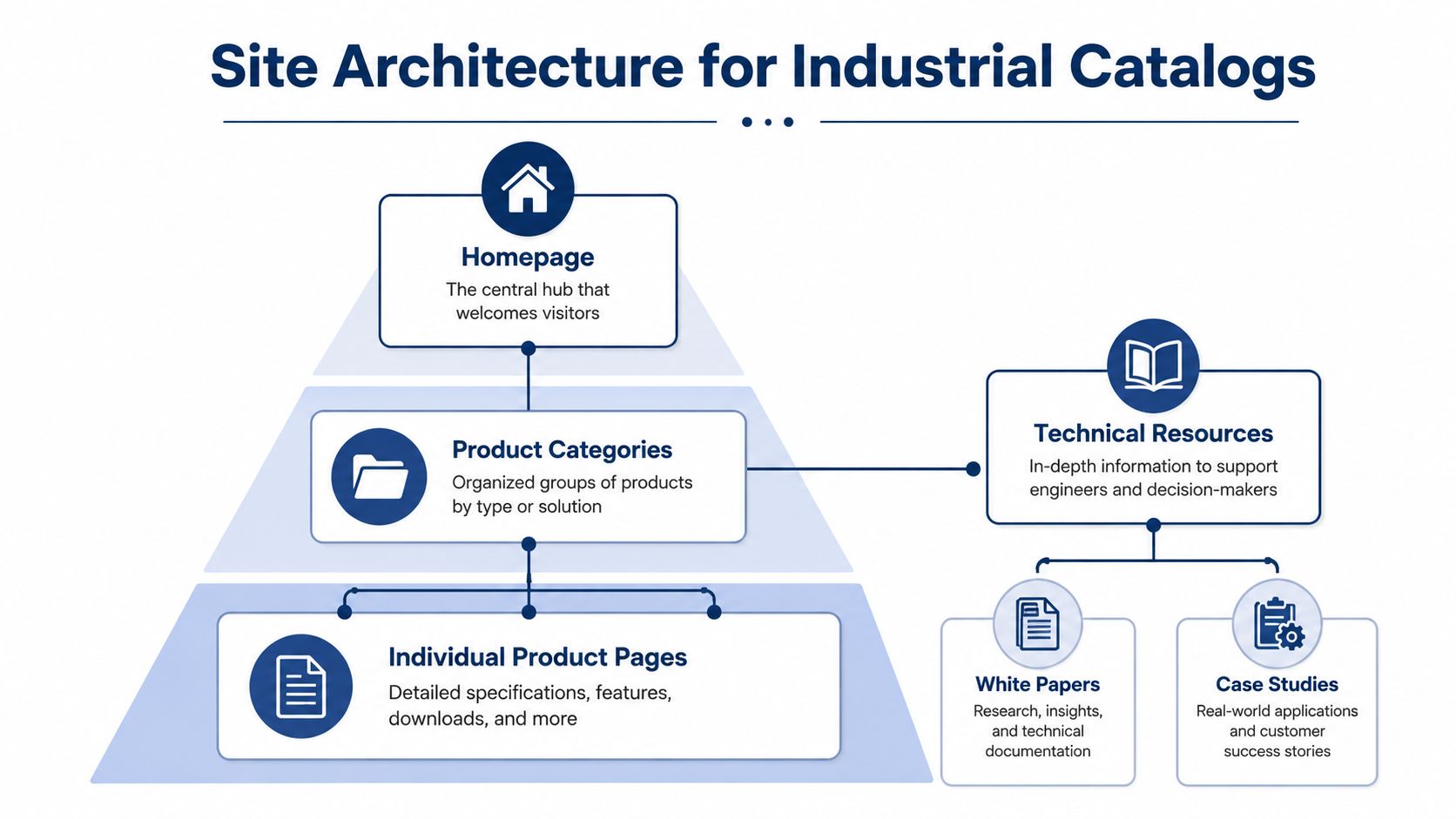
The simplest model is a hub-and-spoke structure. Category pages should act as hubs. Product pages, spec sheets, case studies, and technical resources should hang off those hubs in a predictable way. If a buyer lands on a category page, they should be able to move into product detail, then into proof, then into contact or quote flow without hunting.
That structure helps search engines, but it also helps the buyer who has ten minutes between meetings. Clean hierarchy reduces hesitation.
For a useful conceptual overview of this discipline, Exclusive Addons on information architecture is a practical place to start. The important point is that architecture is not just design, it's retrieval logic. If people can't find what they need quickly, the site is broken even if it looks polished.
Treat technical clutter as a routing problem
Industrial sites often struggle with faceted navigation, duplicate product variants, and parameter URLs. Those aren't cosmetic issues. They create routing confusion for both crawlers and users.
Use this sequence when you review structure:
- Identify your highest-value hubs. These are usually product families, not every individual SKU.
- Consolidate thin or redundant pages. If two pages compete for the same intent, one of them is probably clutter.
- Route authority downward. Link from strong category and resource pages into conversion pages with descriptive anchors.
- Create a resource layer. White papers and case studies should support the catalog, not sit off to the side as a separate universe.
If your best pages don't link to your best conversion pages, you're leaving authority stranded.
Use taxonomy in website as a working model when your catalog spans multiple product families, applications, and industries. A good taxonomy makes scale manageable. A bad one turns every new page into an orphan.
Content Strategy for Engineers and Industrial Buyers
Engineers and procurement teams don't want content that flatters the brand. They want content that helps them decide. That means specs, compatibility, application fit, failure modes, and proof that a solution performs in the conditions they care about.
Build pillars around product reality
Start with pillar pages for your core product categories. A pillar page should define the category, explain the applications, identify key buying criteria, and link into supporting assets. That page becomes the anchor for the cluster.
Then create supporting pieces that answer specific questions. Think application notes, comparison guides, maintenance articles, compatibility checks, troubleshooting pages, and case studies. These should not read like marketing filler. They should answer the exact questions buyers type when they're trying to eliminate risk.
A strong cluster usually includes:
- Specs-led pages: Product pages, datasheets, compatibility notes, and tolerance references.
- Comparison content: Vendor comparison guides, material comparisons, or application selection pages.
- Proof content: Case studies, installation examples, and process results.
- Decision support: Quote pages, calculators, or request forms that help buyers take the next step.
Optimize for clarity before cleverness
Backlinko's B2B on-page guidance is still useful in practice. Put the target keyword in the H1 title, title tag, and URL, use synonyms naturally, write a unique meta description, and include the keyword high on the page, within roughly the first 50 words. That doesn't mean stuffing. It means signaling relevance fast enough that both the buyer and the crawler know they're in the right place. Backlinko's B2B on-page guidance is worth reviewing if your pages tend to meander.
The trade-off is simple. If you optimize too aggressively for keywords, the page sounds robotic. If you optimize too loosely, search engines and buyers both miss the point. The best pages read like technical sales support written by someone who understands the product.
What to look for: if a page answers a question only a marketer would ask, it probably isn't close enough to buyer intent.
Technical SEO Checklist for Manufacturing Websites
Industrial sites often carry years of technical debt. Legacy CMS builds, PDF-heavy libraries, duplicate product variants, and slow templates can suppress organic performance even when the content itself is strong. The fix is not a giant audit document that nobody will finish. The fix is triage.
Triage the biggest blockers first
Start with crawlability. Orphaned pages, broken internal links, and redirect chains keep authority from moving where it should. Screaming Frog is usually enough to expose the problem fast, especially on large sites where manual checking is unrealistic.
Then look at indexation. Duplicate product variants and PDF spec sheets often create multiple URLs for the same intent. If search engines can't tell which version matters, ranking signals get diluted. Consolidation, canonicals, and cleaner linking usually solve more than teams expect.
Fix the pages buyers actually see
Core Web Vitals matter because buyers feel them. Slow pages make technical content harder to use, especially on mobile or on sites packed with product data. Mobile usability is not optional, either. Buyers do research in field offices, on plant floors, and between meetings, not just at clean desktop setups.
Structured data is another clean win. Product schema helps search engines understand what's on the page and can make product pages stand out more clearly in search results. It won't rescue weak content, but it does sharpen visibility when the page already deserves to rank.
Keep the checklist tight:
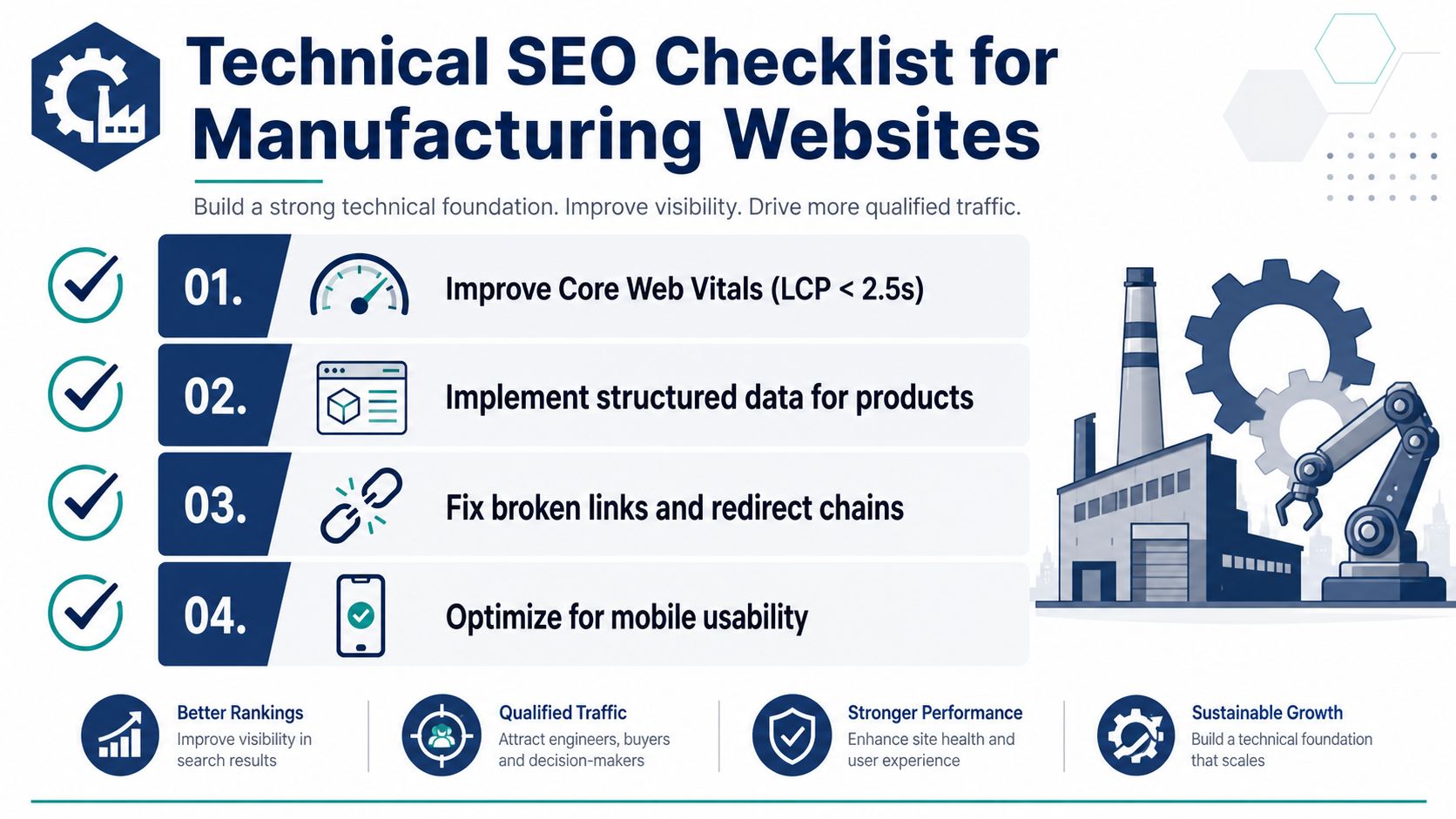
- Improve Core Web Vitals. Fix the worst loading and interaction problems first.
- Add product structured data. Make product pages easier to interpret.
- Repair broken links and redirect chains. Remove dead ends.
- Improve mobile usability. Make the content readable and usable everywhere.
A focused technical pass creates momentum because it clears friction that content alone can't overcome. The key is to treat technical SEO like plant maintenance, not a one-time rebuild.
A short video can help teams align on priorities, especially when non-technical stakeholders need to see how issues surface in real audits.
Building Authority in Niche Industrial Markets
Authority in industrial SEO is rarely built through generic guest posting. Nobody buying fabrication equipment or specialty components cares that your article appeared on a broad marketing site. What matters is whether the signal is relevant to the industry and trustworthy enough for other professionals to cite.
Earn links where your buyers already trust information
Start with trade associations, supplier directories, and industry-specific resource lists. These are often overlooked because they're not glamorous, but they're highly relevant. If your business belongs in a category listing or association page, that link can carry more practical value than a random high-DR mention from an unrelated blog.
Then turn internal expertise into linkable assets. Original technical white papers, application studies, and field-tested explanations tend to earn references because they're useful. If your engineers or product leaders can explain a process clearly, that insight can become the kind of asset editors want to cite.
Use partnerships and editorial channels
Supplier and distributor relationships are often underused. A co-authored technical note, a featured partner page, or a product integration mention can produce natural backlinks without forcing the issue. Trade publications and industry events also create editorial opportunities when your team has something concrete to say.
The best industrial links usually come from real participation, not link chasing.
What does not work well is the common agency playbook of scattered outreach, irrelevant guest posts, and links that have no relationship to your market. That approach wastes time and usually produces authority signals that don't help buying decisions anyway. In niche markets, relevance beats scale.
If your team can only do a few things here, choose these:
- Join the right directories: Prioritize industry resources where buyers already look.
- Publish one strong technical asset: Make it worth citing.
- Collaborate with partners: Let distributors and suppliers amplify the work.
- Show up in trade channels: Use publication and event opportunities to earn editorial mentions.
Authority compounds slowly, but only if the links and mentions fit the market you serve.
Measurement Framework and Implementation Roadmap
The fastest way to waste an SEO program is to measure the wrong thing too early. Rankings matter, but they're not the finish line. Organic traffic matters, but traffic without conversion is just noise.
Match KPIs to program stage
Early-stage reporting should focus on whether the system is functioning. Later-stage reporting should focus on whether it's producing pipeline and revenue influence. If you try to judge a new program only by closed-won revenue in the first months, you'll usually under-read the signal.
| Program Stage | Primary KPIs | Timeframe | Success Indicator |
|---|---|---|---|
| Launch | Crawl errors resolved, indexed pages, keyword coverage | First 30 days | The site is technically readable and priority pages are discoverable |
| Build | Ranking movement, organic sessions, page engagement | 30 to 90 days | Priority topics gain visibility and buyers stay on the page |
| Convert | Leads, form submissions, assisted opportunities | 90 to 180 days | Organic visits turn into qualified inquiries |
| Prove | Pipeline contribution, revenue attribution | Ongoing | Leadership can trace SEO impact to business outcomes |
Use How to measure marketing ROI as your internal reference point when you connect SEO reporting to the rest of the marketing stack. SEO can't live in isolation if you want leadership to trust the numbers.
Assign ownership before you launch
A 90-day rollout works best when ownership is explicit. Marketing owns topic planning and publishing. Sales owns the language capture from calls and objections. Web or agency support handles technical fixes and page updates. Leadership reviews the dashboard and removes blockers.
A clean cadence helps:
- Week 1 to 2: Audit the current state, identify priorities, and map the buyer language.
- Week 3 to 6: Fix technical blockers and publish the first priority pages.
- Week 7 to 12: Connect reporting, review initial engagement, and expand the winning clusters.
The question to keep asking is simple: does this page help a buyer make a better decision, and can we prove that it helped? If the answer is no, the page probably needs a rewrite, a better internal link, or removal.
If you want a B2B SEO system that treats your website like a measurable demand engine, Machine Marketing can help you diagnose the gaps and rebuild the structure around your buyers. Visit Machine Marketing to see how we approach industrial SEO, content, and lead generation with a practical, engineering-minded process.